Indonesia Herbal/Traditional Products Market Report: Trends, Growth and Forecast (2026-2032)
By Category (Topical Analgesics, Sleep Aids, Cough, Cold & Allergy Remedies, Digestive Remedies, Dermatologicals, Paediatric Dietary Supplements, Dietary Supplements, Tonics), By Form (Capsules/Tablets, Powder, Syrups, Oils & Ointments, Others), By Health Benefit (General Wellness, Cardiovascular Health, Cognitive & Mental Health, Digestive & Gut Health, Immunity Support, Respiratory Health, Bone & Joint Health, Others), By Source (Leaves, Roots, Barks, Flowers, Seeds, Others), By Ingredient Type (Single-Herb Products, Multi-Herb Products), By Function (Preventive Care, Curative/Relief Care), By End User (Adults, Geriatric Population, Children), By Prescription Type (Over-the-Counter (OTC), Prescription Herbal Medicines), By Sales Channel (Retail Offline, Retail Online) ... Read more
|
Major Players
|
Indonesia Herbal/Traditional Products Market Statistics and Insights, 2026
- Market Size Statistics
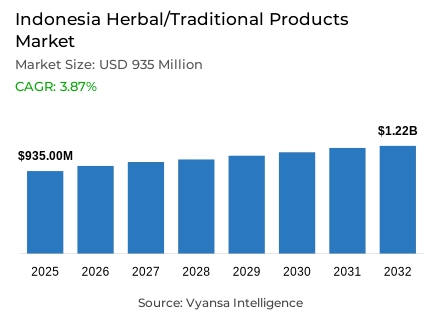
- Herbal/traditional products in Indonesia is estimated at USD 935 million in 2025.
- The market size is expected to grow to USD 1.22 billion by 2032.
- Market to register a cagr of around 3.87% during 2026-32.
- Category Shares
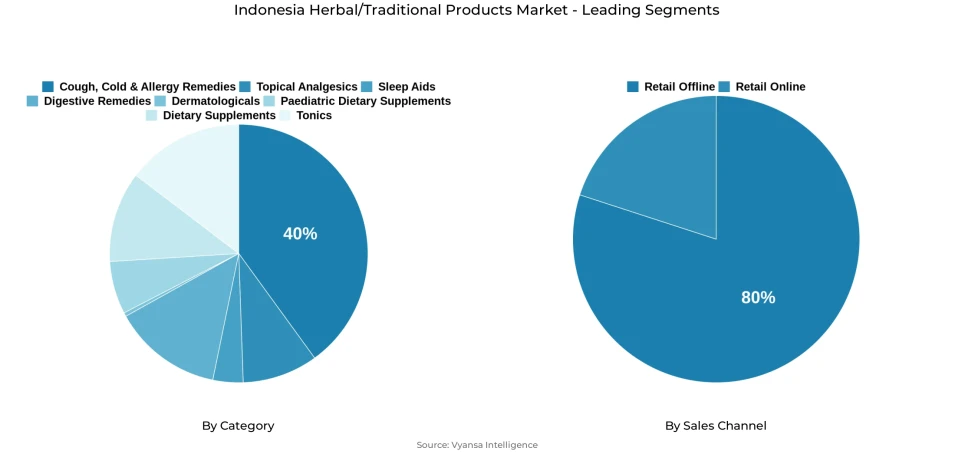
- Cough, cold & allergy remedies grabbed market share of 40%.
- Competition
- More than 20 companies are actively engaged in producing herbal/traditional products in Indonesia.
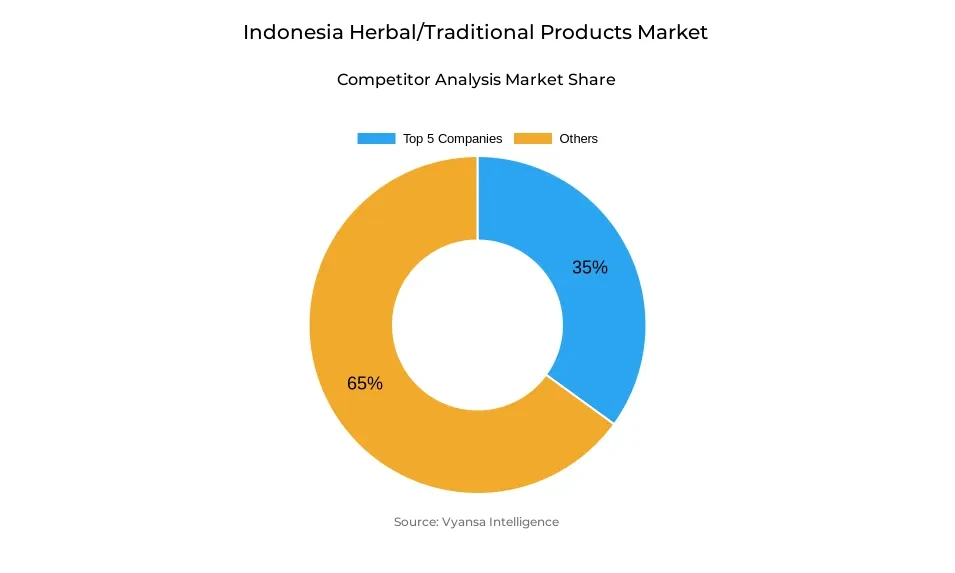
- Top 5 companies acquired around 35% of the market share.
- Eagle Indo Pharmaceutical PT; Mecosin Indonesia PT; Lofthouse of Fleetwood Ltd; Sido Muncul PT; Deltomed Laboratories PT etc., are few of the top companies.
- Sales Channel
- Retail offline grabbed 80% of the market.
Indonesia Herbal/Traditional Products Market Outlook
The Indonesia Herbal/Traditional Products Market was valued around USD 935 million in 2025 and is expected to reach USD 1.22 billion by 2032, expanding at a CAGR of 3.87%. Consumption is deeply ingrained in the culture of indonesians, who use such remedies for daily wellness and pain relief. Cough, Cold & Allergy Remedies remains the most widely used category, accounting for 40% of the market, supported by strong familiarity and trust. Meanwhile, innovative uses of traditional products—like Koyo Cabe patches for headache or toothache and eucalyptus oil for relief from tension—are helping maintain relevance among a younger end user base.
Domestic companies like Sido Muncul, Soho Industri Pharmasi, and Deltomed Laboratories remain market leaders due to their well-trusted herbal formulations. For example, products like Tolak Angin receive clever marketing, extending even to tourism-linked campaigns that link heritage, culture, and wellness. More recent innovations, such as ready-to-drink herbal beverages and nanotechnology-based turmeric supplements, illustrate the increasing trend toward convenient and contemporary herbal formats. Pharmacies, traditional shops, and jamu stores continue to be core channels, with retail offline at 80% of total sales.
In the future, herbal medicines are anticipated to find an increasingly wider application in Indonesia's healthcare system. Government initiatives-enabling herbal treatments in community health centers, partnering with large hospitals-will enable the expansion of official acceptance. This also strengthens the role of herbal products in preventive care, especially as immunity and natural healing solutions remain a priority among end users after the pandemic period.
Growth will also be bolstered by increasing interest in premium herbal ingredients, such as Habbatussauda, which is being used in new nutrition applications like adult milk powders. In a broader sense, the government of Indonesia is interested in decreasing its reliance on imported raw materials and positioning the country as a global exporter of jamu, helped by its rich biodiversity with more than 32,000 traditional medicinal herbs. Enhancement of supply chains and industrial-scale production will be essential for opening export avenues and long-term growth in the herbal/traditional products market.
Indonesia Herbal/Traditional Products Market Growth DriverDeep-Rooted Cultural Reliance on Herbal Remedies
Herbal/traditional products maintain a central position in indonesia daily healthcare practices, driven by deep cultural acceptance and the long use of natural remedies like jamu. According to the Indonesian Ministry of Health, indonesia has 32,013 documented traditional medicinal formulas and 2,848 plant species used in traditional medicine, further establishing the strong familiarity and trust of end users in using plant-based treatments. Such cultural embeddedness feeds into regular demand from analgesics, digestive care, and cough and cold relief, among other categories, for herbal formulations over synthetic alternatives.
Ongoing acceptance of jamu and herbal remedies indicates that people prefer gentle, preventive healthcare solutions rather than treatment approaches. During recent years and continuing into the present, traditional remedies have gained additional recognition as immunity-supporting options, further reinforcing habitual consumption patterns. The consistent use of culturally known remedies keeps demand steady through age cohorts and makes herbal and traditional products part of everyday choices for health, not one-off alternatives, hence intrinsically part of Indonesia's healthcare.
Indonesia Herbal/Traditional Products Market ChallengeDependence on Imported Raw Materials
Indonesia herbal and traditional products market continues to face challenges linked to its dependence on raw material supply, notwithstanding the country’s exceptionally high level of biodiversity. According to the Indonesian Food and Drug Authority (BPOM), about 25% of the raw materials used in natural remedy extraction sources can still be imported, posing risks to local value chains and affecting pricing, thereby posing challenges to fully localized offerings.
Moreover, the lack of upstream facilities for the growing and processing of medicinal plants hampers the scalability of local herbal production. Although the intensity of demand for these products is strong, the sector faces challenges in terms of quality and quantity control, especially for export quality. The above challenges and constraints on the supply-side are critical to overcome in the long run to ensure sustainable growth and to further shield the country herbal market against global volatility.
Unlock Market Intelligence
Explore the market potential with our data-driven report
Indonesia Herbal/Traditional Products Market TrendInnovative Use and Modernization of Traditional Remedies
A defining trend reshaping indonesia herbal and traditional products market is the innovative repurposing of traditional remedies for contemporary health needs. Herbal patches, eucalyptus oil, and herbal drinks are now increasingly used for various everyday conditions, going beyond their conventional uses. This is a reflection of the need for multifunctional herbal products that can fit into modern lifestyle needs.
State assistance does much to fuel this process. In July 2023, the operational incorporation of the herbal research facility B2 P2 TOOT into the vertical hospital RSUP Dr. Sardjito was institutionalized, thus indicating increasing acceptance at the institutional level of herbal medicine. It must be stated that acceptance at the institutional level does much to boost the confidence of end users in herbal medicine, and in the process, manufacturers are encouraged to improve their product format while retaining their traditional ones.
Indonesia Herbal/Traditional Products Market OpportunityHealthcare Integration and Export Expansion of Jamu
The herbal market in Indonesia offers great opportunities with formal integration into the healthcare sector and strategic developments in export. The government supports herbal medicine and phytopharmaceuticals to achieve pharmaceutical independence and reduce reliance on imported medicines. Partnerships with public hospitals and research organizations show increased incorporation of herbal medicine into medical practices, which proof their efficacy in a formal medical setting. At the same time, Indonesia has plans for the country to become a world center for the export of herbal medicine.
Indonesia can leverage the biodiversity factor in this move. There is increasing interest in jamu from Asia, the Middle East, Europe, and North America. With enhancements in growth, processing, and quality accreditation systems for jamu, companies can expand their operations for export and satisfy international quality requirements. Such a move can unlock huge growth potential for Indonesia as a leading international seller of authentic herbal medicine.
Unlock Market Intelligence
Explore the market potential with our data-driven report
Indonesia Herbal/Traditional Products Market Segmentation Analysis
By Category
- Topical Analgesics
- Sleep Aids
- Cough, Cold & Allergy Remedies
- Digestive Remedies
- Dermatologicals
- Paediatric Dietary Supplements
- Dietary Supplements
- Tonics
The segment with highest market share under categoryis Cough, Cold & Allergy Remedies, which held a share of approximately 40%.. This is indicative of the common incidence of common sicknesses like masuk angin, cough, and flu, where herbal remedies such as Tolak Angin are firmly integrated into the lives of end users. In many cases, it was trusted for the purpose of both prevention and symptom alleviation, hence encouraging frequent consumption.
This leadership further draws support from other factors such as cultural familiarity, ease of consumption, and strong brand recognition. Herbal cough and cold remedies are consumed not only in times of illness but also proactively, thus giving way to a steady demand. Their association with traditional beliefs and health maintenance represents their continuous prominence in Indonesia's herbal/traditional product area.
By Sales Channel
- Retail Offline
- Retail Online
The segment with the highest share under sales channel segmentation is retail offline, which holds approximately 80% of the market share. Physical outlets like pharmacies and old traditional shops, minimarkets, and herbal stores remain the major purchasing points for herbal products due to end user preference for immediate availability and trusted seller recommendations. Also, retail offline support impulse and habitual purchases of herbal drinks, patches, and oils that are commonly used against everyday ailments.
Moreover, cultural habits of buying health products favor in person interactions, reinforcing the dominance of retail offline. While digital awareness might be growing, it is physical retail that continues to anchor end user trust and accessibility in Indonesia's herbal/traditional products market.
List of Companies Covered in Indonesia Herbal/Traditional Products Market
The companies listed below are highly influential in the Indonesia herbal/traditional products market, with a significant market share and a strong impact on industry developments.
- Eagle Indo Pharmaceutical PT
- Mecosin Indonesia PT
- Lofthouse of Fleetwood Ltd
- Sido Muncul PT
- Deltomed Laboratories PT
- Soho Industri Pharmasi PT
- Herbalife Indonesia PT
- Artois Pharmaceutical Ind Co Ltd PT
- K-Link Indonesia PT
- Matolindo Primantara PT
Competitive Landscape
The competitive landscape of herbal and traditional products in Indonesia is strongly dominated by local players, reflecting deep-rooted cultural trust in indigenous remedies. Companies such as Industri Jamu Dan Farmasi Sido Muncul, Soho Industri Pharmasi, and Deltomed Laboratories continue to lead the market by leveraging well-established brands, extensive distribution networks, and formulations based on familiar herbal ingredients. Sido Muncul’s Tolak Angin remains the flagship brand in cough, cold, and allergy remedies, benefiting from both strong efficacy perceptions and innovative marketing. Competition is increasingly shaped by modernisation, with ready-to-drink formats, improved absorption technologies, and creative branding helping traditional products remain relevant to younger, urban end users while reinforcing leadership among domestic manufacturers.
Frequently Asked Questions
Related Report
1. Market Segmentation
1.1. Research Scope
1.2. Research Methodology
1.3. Definitions and Assumptions
2. Executive Summary
3. Indonesia Herbal/Traditional Products Market Policies, Regulations, and Standards
4. Indonesia Herbal/Traditional Products Market Dynamics
4.1. Growth Factors
4.2. Challenges
4.3. Trends
4.4. Opportunities
5. Indonesia Herbal/Traditional Products Market Statistics, 2022-2032F
5.1. Market Size & Growth Outlook
5.1.1.By Revenues in USD Million
5.2. Market Segmentation & Growth Outlook
5.2.1.By Category
5.2.1.1. Topical Analgesics- Market Insights and Forecast 2022-2032, USD Million
5.2.1.2. Sleep Aids- Market Insights and Forecast 2022-2032, USD Million
5.2.1.3. Cough, Cold & Allergy Remedies- Market Insights and Forecast 2022-2032, USD Million
5.2.1.4. Digestive Remedies- Market Insights and Forecast 2022-2032, USD Million
5.2.1.5. Dermatologicals- Market Insights and Forecast 2022-2032, USD Million
5.2.1.6. Paediatric Dietary Supplements- Market Insights and Forecast 2022-2032, USD Million
5.2.1.7. Dietary Supplements- Market Insights and Forecast 2022-2032, USD Million
5.2.1.8. Tonics- Market Insights and Forecast 2022-2032, USD Million
5.2.2.By Form
5.2.2.1. Capsules/Tablets- Market Insights and Forecast 2022-2032, USD Million
5.2.2.2. Powder- Market Insights and Forecast 2022-2032, USD Million
5.2.2.3. Syrups- Market Insights and Forecast 2022-2032, USD Million
5.2.2.4. Oils & Ointments- Market Insights and Forecast 2022-2032, USD Million
5.2.2.5. Others- Market Insights and Forecast 2022-2032, USD Million
5.2.3.By Health Benefit
5.2.3.1. General Wellness- Market Insights and Forecast 2022-2032, USD Million
5.2.3.2. Cardiovascular Health- Market Insights and Forecast 2022-2032, USD Million
5.2.3.3. Cognitive & Mental Health- Market Insights and Forecast 2022-2032, USD Million
5.2.3.4. Digestive & Gut Health- Market Insights and Forecast 2022-2032, USD Million
5.2.3.5. Immunity Support- Market Insights and Forecast 2022-2032, USD Million
5.2.3.6. Respiratory Health- Market Insights and Forecast 2022-2032, USD Million
5.2.3.7. Bone & Joint Health- Market Insights and Forecast 2022-2032, USD Million
5.2.3.8. Others- Market Insights and Forecast 2022-2032, USD Million
5.2.4.By Source
5.2.4.1. Leaves- Market Insights and Forecast 2022-2032, USD Million
5.2.4.2. Roots- Market Insights and Forecast 2022-2032, USD Million
5.2.4.3. Barks- Market Insights and Forecast 2022-2032, USD Million
5.2.4.4. Flowers- Market Insights and Forecast 2022-2032, USD Million
5.2.4.5. Seeds- Market Insights and Forecast 2022-2032, USD Million
5.2.4.6. Others- Market Insights and Forecast 2022-2032, USD Million
5.2.5.By Ingredient Type
5.2.5.1. Single-Herb Products- Market Insights and Forecast 2022-2032, USD Million
5.2.5.2. Multi-Herb Products- Market Insights and Forecast 2022-2032, USD Million
5.2.6.By Function
5.2.6.1. Preventive Care- Market Insights and Forecast 2022-2032, USD Million
5.2.6.2. Curative/Relief Care- Market Insights and Forecast 2022-2032, USD Million
5.2.7.By End User
5.2.7.1. Adults- Market Insights and Forecast 2022-2032, USD Million
5.2.7.2. Geriatric Population- Market Insights and Forecast 2022-2032, USD Million
5.2.7.3. Children- Market Insights and Forecast 2022-2032, USD Million
5.2.8.By Prescription Type
5.2.8.1. Over-the-Counter (OTC)- Market Insights and Forecast 2022-2032, USD Million
5.2.8.2. Prescription Herbal Medicines- Market Insights and Forecast 2022-2032, USD Million
5.2.9.By Sales Channel
5.2.9.1. Retail Offline- Market Insights and Forecast 2022-2032, USD Million
5.2.9.2. Retail Online- Market Insights and Forecast 2022-2032, USD Million
5.2.10. By Competitors
5.2.10.1. Competition Characteristics
5.2.10.2. Market Share & Analysis
6. Indonesia Topical Analgesics Herbal/Traditional Products Market Statistics, 2022-2032
6.1. Market Size & Growth Outlook
6.1.1.By Revenues in USD Million
6.2. Market Segmentation & Growth Outlook
6.2.1.By Form- Market Insights and Forecast 2022-2032, USD Million
6.2.2.By Health Benefit - Market Insights and Forecast 2022-2032, USD Million
6.2.3.By Source- Market Insights and Forecast 2022-2032, USD Million
6.2.4.By Ingredient Type- Market Insights and Forecast 2022-2032, USD Million
6.2.5.By Function- Market Insights and Forecast 2022-2032, USD Million
6.2.6.By End User- Market Insights and Forecast 2022-2032, USD Million
6.2.7.By Prescription Type- Market Insights and Forecast 2022-2032, USD Million
6.2.8.By Sales Channel- Market Insights and Forecast 2022-2032, USD Million
7. Indonesia Sleep Aids Herbal/Traditional Products Market Statistics, 2022-2032
7.1. Market Size & Growth Outlook
7.1.1.By Revenues in USD Million
7.2. Market Segmentation & Growth Outlook
7.2.1.By Form- Market Insights and Forecast 2022-2032, USD Million
7.2.2.By Health Benefit - Market Insights and Forecast 2022-2032, USD Million
7.2.3.By Source- Market Insights and Forecast 2022-2032, USD Million
7.2.4.By Ingredient Type- Market Insights and Forecast 2022-2032, USD Million
7.2.5.By Function- Market Insights and Forecast 2022-2032, USD Million
7.2.6.By End User- Market Insights and Forecast 2022-2032, USD Million
7.2.7.By Prescription Type- Market Insights and Forecast 2022-2032, USD Million
7.2.8.By Sales Channel- Market Insights and Forecast 2022-2032, USD Million
8. Indonesia Cough, Cold & Allergy Remedies Herbal/Traditional Products Market Statistics, 2022-2032
8.1. Market Size & Growth Outlook
8.1.1.By Revenues in USD Million
8.2. Market Segmentation & Growth Outlook
8.2.1.By Form- Market Insights and Forecast 2022-2032, USD Million
8.2.2.By Health Benefit - Market Insights and Forecast 2022-2032, USD Million
8.2.3.By Source- Market Insights and Forecast 2022-2032, USD Million
8.2.4.By Ingredient Type- Market Insights and Forecast 2022-2032, USD Million
8.2.5.By Function- Market Insights and Forecast 2022-2032, USD Million
8.2.6.By End User- Market Insights and Forecast 2022-2032, USD Million
8.2.7.By Prescription Type- Market Insights and Forecast 2022-2032, USD Million
8.2.8.By Sales Channel- Market Insights and Forecast 2022-2032, USD Million
9. Indonesia Digestive Remedies Herbal/Traditional Products Market Statistics, 2022-2032
9.1. Market Size & Growth Outlook
9.1.1.By Revenues in USD Million
9.2. Market Segmentation & Growth Outlook
9.2.1.By Form- Market Insights and Forecast 2022-2032, USD Million
9.2.2.By Health Benefit - Market Insights and Forecast 2022-2032, USD Million
9.2.3.By Source- Market Insights and Forecast 2022-2032, USD Million
9.2.4.By Ingredient Type- Market Insights and Forecast 2022-2032, USD Million
9.2.5.By Function- Market Insights and Forecast 2022-2032, USD Million
9.2.6.By End User- Market Insights and Forecast 2022-2032, USD Million
9.2.7.By Prescription Type- Market Insights and Forecast 2022-2032, USD Million
9.2.8.By Sales Channel- Market Insights and Forecast 2022-2032, USD Million
10. Indonesia Dermatologicals Herbal/Traditional Products Market Statistics, 2022-2032
10.1. Market Size & Growth Outlook
10.1.1. By Revenues in USD Million
10.2. Market Segmentation & Growth Outlook
10.2.1. By Form- Market Insights and Forecast 2022-2032, USD Million
10.2.2. By Health Benefit - Market Insights and Forecast 2022-2032, USD Million
10.2.3. By Source- Market Insights and Forecast 2022-2032, USD Million
10.2.4. By Ingredient Type- Market Insights and Forecast 2022-2032, USD Million
10.2.5. By Function- Market Insights and Forecast 2022-2032, USD Million
10.2.6. By End User- Market Insights and Forecast 2022-2032, USD Million
10.2.7. By Prescription Type- Market Insights and Forecast 2022-2032, USD Million
10.2.8. By Sales Channel- Market Insights and Forecast 2022-2032, USD Million
11. Indonesia Paediatric Dietary Supplements Herbal/Traditional Products Market Statistics, 2022-2032
11.1. Market Size & Growth Outlook
11.1.1. By Revenues in USD Million
11.2. Market Segmentation & Growth Outlook
11.2.1. By Form- Market Insights and Forecast 2022-2032, USD Million
11.2.2. By Health Benefit - Market Insights and Forecast 2022-2032, USD Million
11.2.3. By Source- Market Insights and Forecast 2022-2032, USD Million
11.2.4. By Ingredient Type- Market Insights and Forecast 2022-2032, USD Million
11.2.5. By Function- Market Insights and Forecast 2022-2032, USD Million
11.2.6. By End User- Market Insights and Forecast 2022-2032, USD Million
11.2.7. By Prescription Type- Market Insights and Forecast 2022-2032, USD Million
11.2.8. By Sales Channel- Market Insights and Forecast 2022-2032, USD Million
12. Indonesia Dietary Supplements Herbal/Traditional Products Market Statistics, 2022-2032
12.1. Market Size & Growth Outlook
12.1.1. By Revenues in USD Million
12.2. Market Segmentation & Growth Outlook
12.2.1. By Form- Market Insights and Forecast 2022-2032, USD Million
12.2.2. By Health Benefit - Market Insights and Forecast 2022-2032, USD Million
12.2.3. By Source- Market Insights and Forecast 2022-2032, USD Million
12.2.4. By Ingredient Type- Market Insights and Forecast 2022-2032, USD Million
12.2.5. By Function- Market Insights and Forecast 2022-2032, USD Million
12.2.6. By End User- Market Insights and Forecast 2022-2032, USD Million
12.2.7. By Prescription Type- Market Insights and Forecast 2022-2032, USD Million
12.2.8. By Sales Channel- Market Insights and Forecast 2022-2032, USD Million
13. Indonesia Tonics Herbal/Traditional Products Market Statistics, 2022-2032
13.1. Market Size & Growth Outlook
13.1.1. By Revenues in USD Million
13.2. Market Segmentation & Growth Outlook
13.2.1. By Form- Market Insights and Forecast 2022-2032, USD Million
13.2.2. By Health Benefit - Market Insights and Forecast 2022-2032, USD Million
13.2.3. By Source- Market Insights and Forecast 2022-2032, USD Million
13.2.4. By Ingredient Type- Market Insights and Forecast 2022-2032, USD Million
13.2.5. By Function- Market Insights and Forecast 2022-2032, USD Million
13.2.6. By End User- Market Insights and Forecast 2022-2032, USD Million
13.2.7. By Prescription Type- Market Insights and Forecast 2022-2032, USD Million
13.2.8. By Sales Channel- Market Insights and Forecast 2022-2032, USD Million
14. Competitive Outlook
14.1. Company Profiles
14.1.1. Sido Muncul PT
14.1.1.1. Business Description
14.1.1.2. Product Portfolio
14.1.1.3. Collaborations & Alliances
14.1.1.4. Recent Developments
14.1.1.5. Financial Details
14.1.1.6. Others
14.1.2. Deltomed Laboratories PT
14.1.2.1. Business Description
14.1.2.2. Product Portfolio
14.1.2.3. Collaborations & Alliances
14.1.2.4. Recent Developments
14.1.2.5. Financial Details
14.1.2.6. Others
14.1.3. Soho Industri Pharmasi PT
14.1.3.1. Business Description
14.1.3.2. Product Portfolio
14.1.3.3. Collaborations & Alliances
14.1.3.4. Recent Developments
14.1.3.5. Financial Details
14.1.3.6. Others
14.1.4. Herbalife Indonesia PT
14.1.4.1. Business Description
14.1.4.2. Product Portfolio
14.1.4.3. Collaborations & Alliances
14.1.4.4. Recent Developments
14.1.4.5. Financial Details
14.1.4.6. Others
14.1.5. Artois Pharmaceutical Industries Co Ltd PT
14.1.5.1. Business Description
14.1.5.2. Product Portfolio
14.1.5.3. Collaborations & Alliances
14.1.5.4. Recent Developments
14.1.5.5. Financial Details
14.1.5.6. Others
14.1.6. Eagle Indo Pharmaceutical PT
14.1.6.1. Business Description
14.1.6.2. Product Portfolio
14.1.6.3. Collaborations & Alliances
14.1.6.4. Recent Developments
14.1.6.5. Financial Details
14.1.6.6. Others
14.1.7. Mecosin Indonesia PT
14.1.7.1. Business Description
14.1.7.2. Product Portfolio
14.1.7.3. Collaborations & Alliances
14.1.7.4. Recent Developments
14.1.7.5. Financial Details
14.1.7.6. Others
14.1.8. Lofthouse of Fleetwood Ltd
14.1.8.1. Business Description
14.1.8.2. Product Portfolio
14.1.8.3. Collaborations & Alliances
14.1.8.4. Recent Developments
14.1.8.5. Financial Details
14.1.8.6. Others
14.1.9. K-Link Indonesia PT
14.1.9.1. Business Description
14.1.9.2. Product Portfolio
14.1.9.3. Collaborations & Alliances
14.1.9.4. Recent Developments
14.1.9.5. Financial Details
14.1.9.6. Others
14.1.10. Matolindo Primantara PT
14.1.10.1.Business Description
14.1.10.2.Product Portfolio
14.1.10.3.Collaborations & Alliances
14.1.10.4.Recent Developments
14.1.10.5.Financial Details
14.1.10.6.Others
15. Disclaimer
| Segment | Sub-Segment |
|---|---|
| By Category |
|
| By Form |
|
| By Health Benefit |
|
| By Source |
|
| By Ingredient Type |
|
| By Function |
|
| By End User |
|
| By Prescription Type |
|
| By Sales Channel |
|
Research Methodology
This study followed a structured approach comprising four key phases to assess the size and scope of the electro-oxidation market. The process began with thorough secondary research to collect data on the target market, related markets, and broader industry context. These findings, along with preliminary assumptions and estimates, were then validated through extensive primary research involving industry experts from across the value chain. To calculate the overall market size, both top-down and bottom-up methodologies were employed. Finally, market segmentation and data triangulation techniques were applied to refine and validate segment-level estimations.
Secondary Research
The secondary research phase involved gathering data from a wide range of credible and published sources. This step helped in identifying industry trends, defining market segmentation, and understanding the market landscape and value chain.
Sources consulted during this phase included:
- Company annual reports, investor presentations, and press releases
- Industry white papers and certified publications
- Trade directories and market-recognized databases
- Articles from authoritative authors and reputable journals
- Gold and silver standard websites
Secondary research was critical in mapping out the industry's value chain and monetary flow, identifying key market segments, understanding regional variations, and tracking significant industry developments.
Other key sources:
- Financial disclosures
- Industry associations and trade bodies
- News outlets and business magazines
- Academic journals and research studies
- Paid industry databases
Primary Research
To validate secondary data and gain deeper market insights, primary research was conducted with key stakeholders across both the supply and demand sides of the market.
On the demand side, participants included decision-makers and influencers from end-user industries—such as CIOs, CTOs, and CSOs—who provided first-hand perspectives on market needs, product usage, and future expectations.
On the supply side, interviews were conducted with manufacturers, industry associations, and institutional participants to gather insights into current offerings, product pipelines, and market challenges.
Primary interviews provided critical inputs such as:
- Market size and revenue data
- Product and service breakdowns
- Market forecasts
- Regional and application-specific trends
Stakeholders consulted included:
- Leading OEM and solution providers
- Channel and distribution partners
- End users across various applications
- Independent consultants and industry specialists
Market Size Estimation and Data Triangulation
- Identifying Key Market Participants (Secondary Research)
- Goal: To identify the major players or companies in the target market. This typically involves using publicly available data sources such as industry reports, market research publications, and financial statements of companies.
- Tools: Reports from firms like Gartner, Forrester, Euromonitor, Statista, IBISWorld, and others. Public financial statements, news articles, and press releases from top market players.
- Extracting Earnings of Key Market Participants
- Goal: To estimate the earnings generated from the product or service being analyzed. This step helps in understanding the revenue potential of each market player in a specific geography.
- Methods: Earnings data can be gathered from:
- Publicly available financial reports (for listed companies).
- Interviews and primary data sources from professionals, such as Directors, VPs, SVPs, etc. This is especially useful for understanding more nuanced, internal data that isn't publicly disclosed.
- Annual reports and investor presentations of key players.
- Data Collation and Development of a Relevant Data Model
- Goal: To collate inputs from both primary and secondary sources into a structured, data-driven model for market estimation. This model will incorporate key market KPIs and any independent variables relevant to the market.
- Key KPIs: These could include:
- Market size, growth rate, and demand drivers.
- Industry-specific metrics like market share, average revenue per customer (ARPC), or average deal size.
- External variables, such as economic growth rates, inflation rates, or commodity prices, that could affect the market.
- Data Modeling: Based on this data, the market forecasts are developed for the next 5 years. A combination of trend analysis, scenario modeling, and statistical regression might be used to generate projections.
- Scenario Analysis
- Goal: To test different assumptions and validate how sensitive the market is to changes in key variables (e.g., market demand, regulatory changes, technological disruptions).
- Types of Scenarios:
- Base Case: Based on current assumptions and historical data.
- Best-Case Scenario: Assuming favorable market conditions, regulatory environments, and technological advancements.
- Worst-Case Scenario: Accounting for adverse factors, such as economic downturns, stricter regulations, or unexpected disruptions.












