India Window Film Market Report: Trends, Growth and Forecast (2026-2032)
By Film Type (Solar Control Films, Decorative Films, Privacy Films, Safety & Security Films, Low-E/Insulating Films, Smart/Switchable Films, Surface Protection Films, Other Window Films), By Material (Polyester/PET Films, Polyurethane Films, PVC/Vinyl Films, Composite/Hybrid Films, Other Materials), By Technology (Dyed Films, Metallized Films, Ceramic Films, Carbon Films, Multi-Layer Laminated Films, PDLC/Electro-Active Films, Other Technologies), By Film Thickness (Up to 2 Mil, Above 2 Mil to 4 Mil, Above 4 Mil to 8 Mil, Above 8 Mil), By End User (Automotive, Residential, Commercial, Marine, Aerospace, Industrial, Others), By Sales Channel (Distributor/Dealer Network, Professional Installer/Tint Shop Channel, Direct Project Sales, Offline Retail, Online Retail, OEM/Fleet Channel), By Price Category (Economy, Mid-Range, Premium, Specialty), By Region (North, East, West, South) ... Read more
|
Major Players
|
India Window Film Market Statistics and Insights, 2026
- Market Size Statistics
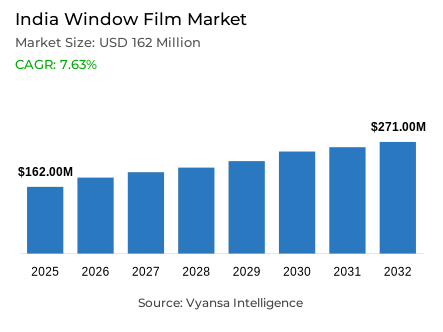
- Window film market size in India was valued at USD 162 million in 2025 and is estimated at USD 173 million in 2026.
- The market size is expected to grow to USD 271 million by 2032.
- Market to register a CAGR of around 7.63% during 2026-32.
- Film Type Shares
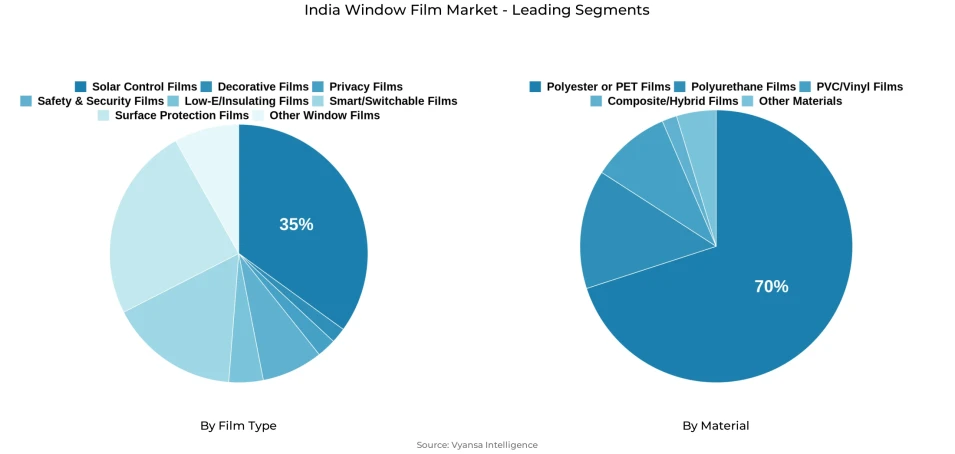
- Solar control films grabbed market share of 35%.
- Competition
- More than 10 companies are actively engaged in producing window film in India.
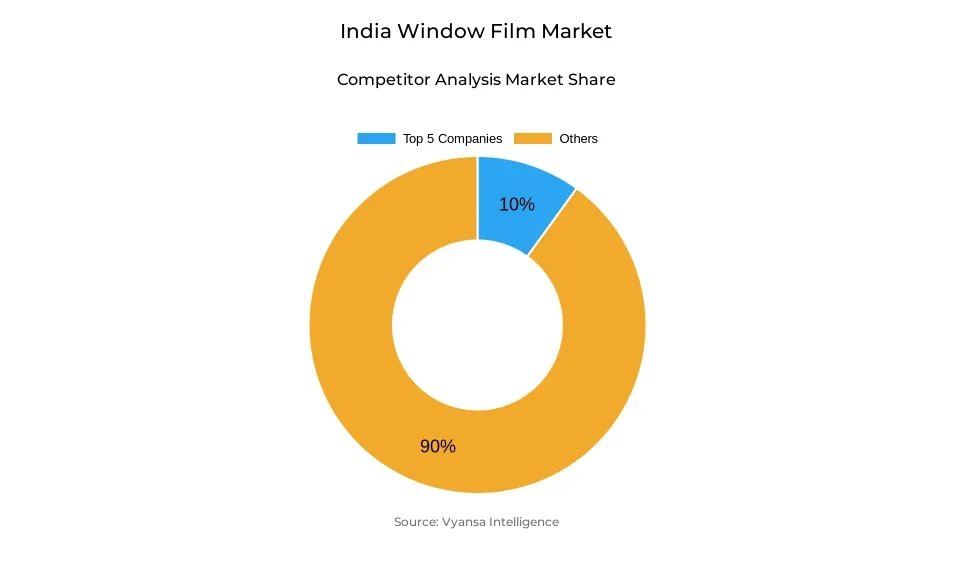
- Top 5 companies acquired around 10% of the market share in 2026.
- Eastman Chemical Company (V-KOOL India), Avery Dennison India Pvt Ltd., XPEL Inc., Garware Hi-Tech Films Limited, 3M India Limited etc., are few of the top companies.
- Material
- Polyester/pet films grabbed 70% of the market.
India Window Film Market Outlook
India window film market is expanding as homes, offices, stores, hospitals, hotels, vehicles, and shops use retrofit films for heat reduction, glare control, privacy enhancement, UV protection, and interior comfort. The market size was valued at USD 162 million in 2025 and is projected to grow from USD 173 million in 2026 to USD 271 million by 2032, registering a CAGR of 7.63% during the forecast period. Growth is supported by rising cooling loads, glass-heavy buildings, vehicle ownership, residential renovations, commercial retrofits, and demand for practical window upgrades across Indian cities.
Cooling pressure gives the window film market in India its strongest use case. IEA reports that India’s electricity demand grew 5.8% in 2024, while first-half consumption rose 8.5% because of intense and long heatwaves. This matters because heat rejection window film targets solar heat before it becomes indoor cooling load. IEA also states that each 1°C rise in India’s outdoor temperature in 2024 added 7 GW to peak electricity demand. For property owners, this converts film into an operating-cost product through lower heat gain, better comfort, reduced glare, and less air-conditioning stress.
Solar Control Films hold the leading 35% share because heat rejection is the clearest buying reason in India’s hot urban climate. 3M India states that its Prestige Series rejects up to 97% of infrared light, up to 60% of heat, and up to 99.9% of damaging UV rays. These figures explain why sun control film is chosen for offices, apartments, malls, schools, hospitals, and vehicles where sunlight creates discomfort, fading, and cooling pressure. Polyester/PET Films hold 70% share because PET is flexible, durable, optically clear, adhesive-friendly, and suitable for laminated solar, safety, decorative, and automotive products.
Demand through 2032 remains linked to India’s building-efficiency and vehicle-upgrade cycle. BEE’s Energy Conservation and Sustainable Building Code 2024 defines window solar heat gain coefficient and visible light transmission requirements, confirming that glazing performance is part of formal energy design. SIAM reports passenger vehicle sales reached 46.43 lakh units in FY2025-26, up 7.9%, creating a large automotive glass base for legal heat-control and UV protection film products. NREL describes solar-control films as passive retrofits applied to existing windows without complete replacement, making adoption practical for asset owners, renters, fleet users, and trained installers.
India Window Film Market Growth Driver
Cooling Load Reduction Drives Adoption
Cooling-load pressure is the primary demand driver because Indian buildings and vehicles face rising heat exposure and peak electricity stress. IEA reports that India’s electricity demand grew 5.8% in 2024, while consumption rose 8.5% in the first half because of intense and long heatwaves. This matters because cooling demand converts directly into operating cost for homes, offices, malls, hospitals, and hotels. Architectural window films in India reduce solar heat gain at the glass surface, improving indoor temperature control without replacing glazing or immediately upsizing air-conditioning systems.
The driver becomes sharper during temperature spikes. IEA states that each 1°C rise in India’s outdoor temperature in 2024 added 7 GW to peak electricity demand, and this could rise to 12 GW per degree in 2030 without further efficiency action. This shows why passive cooling products matter commercially. Heat rejection window film cannot replace efficient air conditioners, but it reduces solar heat gain, glare, and UV exposure before cooling equipment works harder. For Indian developers, fleet owners, retailers, and homeowners, film becomes a quick retrofit tool for energy savings and air-conditioning efficiency.
India Window Film Market Challenge
Specification Complexity Slows Adoption
Specification complexity is the main challenge because window films must match glass type, building orientation, climate zone, visible light needs, and safety expectations. BEE’s Energy Conservation and Sustainable Building Code 2024 uses window solar heat gain coefficient, visible light transmission, U-factor, shading multipliers, and fenestration orientation in envelope calculations. This matters because the wrong product can reduce daylight, weaken appearance, or fail to deliver expected thermal performance. In India’s mixed building stock, installers must handle old single glazing, modern façades, shopfronts, residential windows, automotive glass, and different heat exposure conditions.
The challenge also comes from fragmented retrofit decision-making. NREL notes that solar-control film applicability depends on baseline window type and climate zone, which means window film is not one universal product. Buyers need audits, correct film selection, skilled installation, warranty clarity, and performance education. Without this, low-cost film quality, installation issues, counterfeit window films, and weak product awareness can damage trust. This is especially important in premium offices, malls, apartments, hotels, and automotive window films in India, where appearance, compliance, product durability, and long-term performance shape repeat purchasing.
Unlock Market Intelligence
Explore the market potential with our data-driven report
India Window Film Market Trend
Passive Solar Retrofits Gain Momentum
The strongest trend is passive solar-control retrofitting, where owners improve existing glazing instead of replacing windows. NREL describes solar-control films as passive retrofit solutions applied to existing window surfaces without complete window replacement. This matters in India because retrofits reduce disruption for occupied offices, apartments, hospitals, schools, stores, and hotels. Installation can happen room by room or façade by façade, making it faster than glass replacement. For buyers facing hot interiors and rising cooling bills, sun control film offers a visible performance upgrade with lower disruption, less waste, and easier procurement.
Product innovation strengthens this trend by combining heat rejection with clearer aesthetics. 3M India states that its Prestige Series allows 40% to 70% of natural light into spaces while rejecting up to 97% of infrared light and up to 99.9% of damaging UV rays. These figures matter because Indian buyers often resist dark tinting in homes, offices, and retail spaces. Spectrally selective products, nano-ceramic film, ceramic window film, and smart window film improve comfort while preserving daylight and appearance. This shifts demand from basic dark films toward higher-performance solar film for premium buildings and vehicles.
India Window Film Market Opportunity
Existing Buildings Open Retrofit Scope
The strongest opportunity lies in commercial and public-building energy retrofits. 3M India states that window films can reduce summer heat gain by up to 79%, save as much as 19 kWh per square foot of glass, and deliver payback in as little as three years. These figures translate directly into commercial value because glass-heavy commercial buildings, hospitals, hotels, malls, schools, airports, and government buildings pay recurring cooling bills. When films cut heat entry, owners can improve comfort, reduce hot spots, protect interiors, and support sustainability goals without replacing existing glazing.
India’s formal building-efficiency framework also supports opportunity. BEE’s Energy Conservation and Sustainable Building Code 2024 treats fenestration through solar heat gain coefficient, visible light transmission, and envelope performance calculations. This matters because suppliers can position solar-control products as practical glazing-performance upgrades during audits, retrofits, green-building projects, and facility management reviews. NREL confirms that these films modify glazing thermal and solar optical properties by reflecting or absorbing incident solar radiation. Together, policy language and technical validation create a stronger selling case for installation service providers, window film dealers, building material retailers, and online platforms.
Unlock Market Intelligence
Explore the market potential with our data-driven report
India Window Film Market Segmentation Analysis
By Film Type
- Solar Control Films
- Decorative Films
- Privacy Films
- Safety & Security Films
- Low-E/Insulating Films
- Smart/Switchable Films
- Surface Protection Films
- Other Window Films
The segment with the highest share under Film Type is Solar Control Films, holding around 35% of the market. This leadership is commercially logical because India’s core pain point is heat, not decoration alone. IEA reports that India’s cooling equipment contributed about 60 GW to peak load in 2024, while air-conditioner sales reached a record 14 million units. These figures show why customers seek products that reduce solar heat before cooling equipment works harder. Sun control film helps homes, offices, malls, hospitals, hotels, and vehicles manage heat, glare control, UV exposure, and interior fading.
Supplier evidence supports the 35% leadership. 3M India says its Prestige Series rejects up to 60% of heat, up to 97% of infrared light, and up to 99.9% of damaging UV rays while allowing 40% to 70% natural light transmission. This performance balance matters because Indian buyers want cooler spaces without dark, unattractive glass. UV protection film and heat rejection window film therefore serve both building and automotive users by improving comfort, protecting interiors, and reducing cooling pressure. The segment’s strength comes from visible heat relief, better daylight, and faster installation than glass replacement.
By Material
- Polyester/PET Films
- Polyurethane Films
- PVC/Vinyl Films
- Composite/Hybrid Films
- Other Materials
The segment with the highest share under Material is Polyester/PET Films, holding around 70% of the market. PET leads because it is the practical base material for most retrofit film structures. NREL describes solar-control films as transparent, tinted, or metallized laminated polyester layers that alter glazing performance by reflecting or absorbing solar radiation. This confirms the technical role of PET window film because it carries coatings, dyes, metals, ceramics, UV blockers, adhesives, and scratch-resistant layers while remaining thin, flexible, and optically useful for retrofit installation.
The 70% share is also supported by cost, scalability, and product variety. Polyester window film can be manufactured in large rolls, transported through dealer networks, and converted into solar-control, safety, privacy, decorative, and automotive products. This matters in India because the market serves varied end users, including apartments, offices, retail stores, hospitals, schools, cars, buses, and commercial fleets. PET’s durability and dimensional stability help films perform across heat, dust, handling, and installation conditions. The material anchors market economics by allowing suppliers to offer many price points and performance levels from one flexible platform.
List of Companies Covered in India Window Film Market
The companies listed below are highly influential in the India window film market, with a significant market share and a strong impact on industry developments.
- Eastman Chemical Company (V-KOOL India)
- Avery Dennison India Pvt Ltd.
- XPEL Inc.
- Garware Hi-Tech Films Limited
- 3M India Limited
- Saint-Gobain Performance Plastics Corporation (Solar Gard)
- Gras Impex Pvt. Ltd. (LLumar)
- Cosmo First Limited (Cosmo Sunshield)
- Johnson Window Films Inc.
- Madico Inc.
Market News & Updates
- Garware Hi-Tech Films Limited, 2025:
Garware Hi-Tech Films highlighted the Garware Application Studio model for premium automotive film installation. Each outlet is positioned to deliver PPF and window film application aligned with global installation standards. The update supports organized retail and installer-led access to Garware’s window film and automotive protection film portfolio in India.
- 3M India Limited, 2026:
3M India listed automotive window film options including Ceramic IM Series, Ceramic XP Series, Crystalline Series, and building window film products. The Ceramic IM Series provides up to 65% heat rejection, 99% UV protection, and advanced nano-ceramic technology. The update supports premium automotive and building window film availability in India
Frequently Asked Questions
Related Report
- Market Segmentation
- Research Scope
- Research Methodology
- Definitions and Assumptions
- Executive Summary
- India Window Film Market Policies, Regulations, and Standards
- India Window Film Market Dynamics
- Growth Factors
- Challenges
- Trends
- Opportunities
- India Window Film Market Statistics, 2022-2032F
- Market Size & Growth Outlook
- By Revenues in USD Million
- By Quantity Sold in Million Meter Square
- Market Segmentation & Growth Outlook
- By Film Type
- Solar Control Films- Market Insights and Forecast 2022-2032, USD Million
- Decorative Films- Market Insights and Forecast 2022-2032, USD Million
- Privacy Films- Market Insights and Forecast 2022-2032, USD Million
- Safety & Security Films- Market Insights and Forecast 2022-2032, USD Million
- Low-E/Insulating Films- Market Insights and Forecast 2022-2032, USD Million
- Smart/Switchable Films- Market Insights and Forecast 2022-2032, USD Million
- Surface Protection Films- Market Insights and Forecast 2022-2032, USD Million
- Other Window Films- Market Insights and Forecast 2022-2032, USD Million
- By Material
- Polyester/PET Films- Market Insights and Forecast 2022-2032, USD Million
- Polyurethane Films- Market Insights and Forecast 2022-2032, USD Million
- PVC/Vinyl Films- Market Insights and Forecast 2022-2032, USD Million
- Composite/Hybrid Films- Market Insights and Forecast 2022-2032, USD Million
- Other Materials - Market Insights and Forecast 2022-2032, USD Million
- By Technology
- Dyed Films- Market Insights and Forecast 2022-2032, USD Million
- Metallized Films- Market Insights and Forecast 2022-2032, USD Million
- Ceramic Films- Market Insights and Forecast 2022-2032, USD Million
- Carbon Films- Market Insights and Forecast 2022-2032, USD Million
- Multi-Layer Laminated Films- Market Insights and Forecast 2022-2032, USD Million
- PDLC/Electro-Active Films- Market Insights and Forecast 2022-2032, USD Million
- Other Technologies- Market Insights and Forecast 2022-2032, USD Million
- By Film Thickness
- Up to 2 Mil- Market Insights and Forecast 2022-2032, USD Million
- Above 2 Mil to 4 Mil- Market Insights and Forecast 2022-2032, USD Million
- Above 4 Mil to 8 Mil- Market Insights and Forecast 2022-2032, USD Million
- Above 8 Mil- Market Insights and Forecast 2022-2032, USD Million
- By End User
- Automotive- Market Insights and Forecast 2022-2032, USD Million
- Residential- Market Insights and Forecast 2022-2032, USD Million
- Commercial- Market Insights and Forecast 2022-2032, USD Million
- Marine- Market Insights and Forecast 2022-2032, USD Million
- Aerospace- Market Insights and Forecast 2022-2032, USD Million
- Industrial- Market Insights and Forecast 2022-2032, USD Million
- Others- Market Insights and Forecast 2022-2032, USD Million
- By Sales Channel
- Distributor/Dealer Network- Market Insights and Forecast 2022-2032, USD Million
- Professional Installer/Tint Shop Channel- Market Insights and Forecast 2022-2032, USD Million
- Direct Project Sales- Market Insights and Forecast 2022-2032, USD Million
- Offline Retail- Market Insights and Forecast 2022-2032, USD Million
- Online Retail- Market Insights and Forecast 2022-2032, USD Million
- OEM/Fleet Channel- Market Insights and Forecast 2022-2032, USD Million
- By Price Category
- Economy- Market Insights and Forecast 2022-2032, USD Million
- Mid-Range- Market Insights and Forecast 2022-2032, USD Million
- Premium- Market Insights and Forecast 2022-2032, USD Million
- Specialty- Market Insights and Forecast 2022-2032, USD Million
- By Region
- North- Market Insights and Forecast 2022-2032, USD Million
- East- Market Insights and Forecast 2022-2032, USD Million
- West- Market Insights and Forecast 2022-2032, USD Million
- South- Market Insights and Forecast 2022-2032, USD Million
- By Competitors
- Competition Characteristics
- Market Share & Analysis
- By Film Type
- Market Size & Growth Outlook
- India Solar Control Films Market Statistics, 2022-2032
- Market Size & Growth Outlook
- By Revenues in USD Million
- By Quantity Sold in Million Meter Square
- Market Segmentation & Growth Outlook
- By Material- Market Insights and Forecast 2022-2032, USD Million
- By Technology- Market Insights and Forecast 2022-2032, USD Million
- By Film Thickness- Market Insights and Forecast 2022-2032, USD Million
- By End User- Market Insights and Forecast 2022-2032, USD Million
- By Sales Channel- Market Insights and Forecast 2022-2032, USD Million
- By Price Category- Market Insights and Forecast 2022-2032, USD Million
- By Region- Market Insights and Forecast 2022-2032, USD Million
- Market Size & Growth Outlook
- India Decorative Films Market Statistics, 2022-2032
- Market Size & Growth Outlook
- By Revenues in USD Million
- By Quantity Sold in Million Meter Square
- Market Segmentation & Growth Outlook
- By Material- Market Insights and Forecast 2022-2032, USD Million
- By Technology- Market Insights and Forecast 2022-2032, USD Million
- By Film Thickness- Market Insights and Forecast 2022-2032, USD Million
- By End User- Market Insights and Forecast 2022-2032, USD Million
- By Sales Channel- Market Insights and Forecast 2022-2032, USD Million
- By Price Category- Market Insights and Forecast 2022-2032, USD Million
- By Region- Market Insights and Forecast 2022-2032, USD Million
- Market Size & Growth Outlook
- India Privacy Films Market Statistics, 2022-2032
- Market Size & Growth Outlook
- By Revenues in USD Million
- By Quantity Sold in Million Meter Square
- Market Segmentation & Growth Outlook
- By Material- Market Insights and Forecast 2022-2032, USD Million
- By Technology- Market Insights and Forecast 2022-2032, USD Million
- By Film Thickness- Market Insights and Forecast 2022-2032, USD Million
- By End User- Market Insights and Forecast 2022-2032, USD Million
- By Sales Channel- Market Insights and Forecast 2022-2032, USD Million
- By Price Category- Market Insights and Forecast 2022-2032, USD Million
- By Region- Market Insights and Forecast 2022-2032, USD Million
- Market Size & Growth Outlook
- India Safety & Security Films Market Statistics, 2022-2032
- Market Size & Growth Outlook
- By Revenues in USD Million
- By Quantity Sold in Million Meter Square
- Market Segmentation & Growth Outlook
- By Material- Market Insights and Forecast 2022-2032, USD Million
- By Technology- Market Insights and Forecast 2022-2032, USD Million
- By Film Thickness- Market Insights and Forecast 2022-2032, USD Million
- By End User- Market Insights and Forecast 2022-2032, USD Million
- By Sales Channel- Market Insights and Forecast 2022-2032, USD Million
- By Price Category- Market Insights and Forecast 2022-2032, USD Million
- By Region- Market Insights and Forecast 2022-2032, USD Million
- Market Size & Growth Outlook
- India Low-E/Insulating Films Market Statistics, 2022-2032
- Market Size & Growth Outlook
- By Revenues in USD Million
- By Quantity Sold in Million Meter Square
- Market Segmentation & Growth Outlook
- By Material- Market Insights and Forecast 2022-2032, USD Million
- By Technology- Market Insights and Forecast 2022-2032, USD Million
- By Film Thickness- Market Insights and Forecast 2022-2032, USD Million
- By End User- Market Insights and Forecast 2022-2032, USD Million
- By Sales Channel- Market Insights and Forecast 2022-2032, USD Million
- By Price Category- Market Insights and Forecast 2022-2032, USD Million
- By Region- Market Insights and Forecast 2022-2032, USD Million
- Market Size & Growth Outlook
- India Smart/Switchable Films Market Statistics, 2022-2032
- Market Size & Growth Outlook
- By Revenues in USD Million
- By Quantity Sold in Million Meter Square
- Market Segmentation & Growth Outlook
- By Material- Market Insights and Forecast 2022-2032, USD Million
- By Technology- Market Insights and Forecast 2022-2032, USD Million
- By Film Thickness- Market Insights and Forecast 2022-2032, USD Million
- By End User- Market Insights and Forecast 2022-2032, USD Million
- By Sales Channel- Market Insights and Forecast 2022-2032, USD Million
- By Price Category- Market Insights and Forecast 2022-2032, USD Million
- By Region- Market Insights and Forecast 2022-2032, USD Million
- Market Size & Growth Outlook
- India Surface Protection Films Market Statistics, 2022-2032
- Market Size & Growth Outlook
- By Revenues in USD Million
- By Quantity Sold in Million Meter Square
- Market Segmentation & Growth Outlook
- By Material- Market Insights and Forecast 2022-2032, USD Million
- By Technology- Market Insights and Forecast 2022-2032, USD Million
- By Film Thickness- Market Insights and Forecast 2022-2032, USD Million
- By End User- Market Insights and Forecast 2022-2032, USD Million
- By Sales Channel- Market Insights and Forecast 2022-2032, USD Million
- By Price Category- Market Insights and Forecast 2022-2032, USD Million
- By Region- Market Insights and Forecast 2022-2032, USD Million
- Market Size & Growth Outlook
- India Other Window Films Market Statistics, 2022-2032
- Market Size & Growth Outlook
- By Revenues in USD Million
- By Quantity Sold in Million Meter Square
- Market Segmentation & Growth Outlook
- By Material- Market Insights and Forecast 2022-2032, USD Million
- By Technology- Market Insights and Forecast 2022-2032, USD Million
- By Film Thickness- Market Insights and Forecast 2022-2032, USD Million
- By End User- Market Insights and Forecast 2022-2032, USD Million
- By Sales Channel- Market Insights and Forecast 2022-2032, USD Million
- By Price Category- Market Insights and Forecast 2022-2032, USD Million
- By Region- Market Insights and Forecast 2022-2032, USD Million
- Market Size & Growth Outlook
- Competitive Outlook
- Company Profiles
- Garware Hi-Tech Films Limited
- Business Description
- Product Portfolio
- Collaborations & Alliances
- Recent Developments
- Financial Details
- Others
- 3M India Limited
- Business Description
- Product Portfolio
- Collaborations & Alliances
- Recent Developments
- Financial Details
- Others
- Saint-Gobain Performance Plastics Corporation (Solar Gard)
- Business Description
- Product Portfolio
- Collaborations & Alliances
- Recent Developments
- Financial Details
- Others
- Gras Impex Pvt. Ltd. (LLumar)
- Business Description
- Product Portfolio
- Collaborations & Alliances
- Recent Developments
- Financial Details
- Others
- Cosmo First Limited (Cosmo Sunshield)
- Business Description
- Product Portfolio
- Collaborations & Alliances
- Recent Developments
- Financial Details
- Others
- Eastman Chemical Company (V-KOOL India)
- Business Description
- Product Portfolio
- Collaborations & Alliances
- Recent Developments
- Financial Details
- Others
- Avery Dennison India Pvt Ltd.
- Business Description
- Product Portfolio
- Collaborations & Alliances
- Recent Developments
- Financial Details
- Others
- XPEL Inc.
- Business Description
- Product Portfolio
- Collaborations & Alliances
- Recent Developments
- Financial Details
- Others
- Johnson Window Films, Inc.
- Business Description
- Product Portfolio
- Collaborations & Alliances
- Recent Developments
- Financial Details
- Others
- Madico Inc.
- Business Description
- Product Portfolio
- Collaborations & Alliances
- Recent Developments
- Financial Details
- Others
- Garware Hi-Tech Films Limited
- Company Profiles
- Disclaimer
| Segment | Sub-Segment |
|---|---|
| By Film Type |
|
| By Material |
|
| By Technology |
|
| By Film Thickness |
|
| By End User |
|
| By Sales Channel |
|
| By Price Category |
|
| By Region |
|
Research Methodology
This study followed a structured approach comprising four key phases to assess the size and scope of the electro-oxidation market. The process began with thorough secondary research to collect data on the target market, related markets, and broader industry context. These findings, along with preliminary assumptions and estimates, were then validated through extensive primary research involving industry experts from across the value chain. To calculate the overall market size, both top-down and bottom-up methodologies were employed. Finally, market segmentation and data triangulation techniques were applied to refine and validate segment-level estimations.
Secondary Research
The secondary research phase involved gathering data from a wide range of credible and published sources. This step helped in identifying industry trends, defining market segmentation, and understanding the market landscape and value chain.
Sources consulted during this phase included:
- Company annual reports, investor presentations, and press releases
- Industry white papers and certified publications
- Trade directories and market-recognized databases
- Articles from authoritative authors and reputable journals
- Gold and silver standard websites
Secondary research was critical in mapping out the industry's value chain and monetary flow, identifying key market segments, understanding regional variations, and tracking significant industry developments.
Other key sources:
- Financial disclosures
- Industry associations and trade bodies
- News outlets and business magazines
- Academic journals and research studies
- Paid industry databases
Primary Research
To validate secondary data and gain deeper market insights, primary research was conducted with key stakeholders across both the supply and demand sides of the market.
On the demand side, participants included decision-makers and influencers from end-user industries—such as CIOs, CTOs, and CSOs—who provided first-hand perspectives on market needs, product usage, and future expectations.
On the supply side, interviews were conducted with manufacturers, industry associations, and institutional participants to gather insights into current offerings, product pipelines, and market challenges.
Primary interviews provided critical inputs such as:
- Market size and revenue data
- Product and service breakdowns
- Market forecasts
- Regional and application-specific trends
Stakeholders consulted included:
- Leading OEM and solution providers
- Channel and distribution partners
- End users across various applications
- Independent consultants and industry specialists
Market Size Estimation and Data Triangulation
- Identifying Key Market Participants (Secondary Research)
- Goal: To identify the major players or companies in the target market. This typically involves using publicly available data sources such as industry reports, market research publications, and financial statements of companies.
- Tools: Reports from firms like Gartner, Forrester, Euromonitor, Statista, IBISWorld, and others. Public financial statements, news articles, and press releases from top market players.
- Extracting Earnings of Key Market Participants
- Goal: To estimate the earnings generated from the product or service being analyzed. This step helps in understanding the revenue potential of each market player in a specific geography.
- Methods: Earnings data can be gathered from:
- Publicly available financial reports (for listed companies).
- Interviews and primary data sources from professionals, such as Directors, VPs, SVPs, etc. This is especially useful for understanding more nuanced, internal data that isn't publicly disclosed.
- Annual reports and investor presentations of key players.
- Data Collation and Development of a Relevant Data Model
- Goal: To collate inputs from both primary and secondary sources into a structured, data-driven model for market estimation. This model will incorporate key market KPIs and any independent variables relevant to the market.
- Key KPIs: These could include:
- Market size, growth rate, and demand drivers.
- Industry-specific metrics like market share, average revenue per customer (ARPC), or average deal size.
- External variables, such as economic growth rates, inflation rates, or commodity prices, that could affect the market.
- Data Modeling: Based on this data, the market forecasts are developed for the next 5 years. A combination of trend analysis, scenario modeling, and statistical regression might be used to generate projections.
- Scenario Analysis
- Goal: To test different assumptions and validate how sensitive the market is to changes in key variables (e.g., market demand, regulatory changes, technological disruptions).
- Types of Scenarios:
- Base Case: Based on current assumptions and historical data.
- Best-Case Scenario: Assuming favorable market conditions, regulatory environments, and technological advancements.
- Worst-Case Scenario: Accounting for adverse factors, such as economic downturns, stricter regulations, or unexpected disruptions.












