India Membrane Water and Wastewater Treatment Market Report: Trends, Growth and Forecast (2026-2032)
By Product (Microfiltration, Ultrafiltration, Nanofiltration, Reverse Osmosis, Others), By Material (Polymeric, Ceramic, Others), By Application (Water Treatment, Wastewater Treatment, Desalination, Water Reuse/Reclamation, Industrial Process Water), By End User (Municipal, Industrial, Food & Beverage, Pharmaceuticals, Chemicals, Power, Oil & Gas, Others), By Sales Channel (Retail Offline (Direct Sales, Distributors/Dealers, OEM/System Integrator Sales, EPC/Project-Based Sales), Retail Online (Company-Owned Websites, Distributor Online Portals, B2B E-Marketplaces, E-Procurement/Tender Platforms)), By Region (North, East, West, South) ... Read more
|
Major Players
|
India Membrane Water and Wastewater Treatment Market Statistics and Insights, 2026
- Market Size Statistics
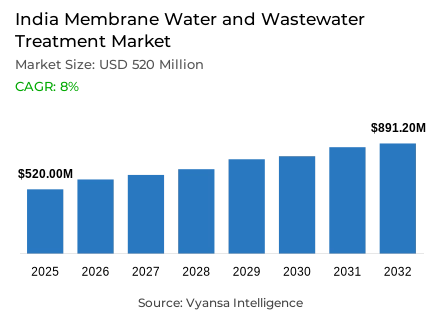
- Membrane water and wastewater treatment market size in India was valued at USD 520 million in 2025 and is estimated at USD 561.6 million in 2026.
- The market size is expected to grow to USD 891.2 million by 2032.
- Market to register a CAGR of around 8% during 2026-32.
- Product Shares
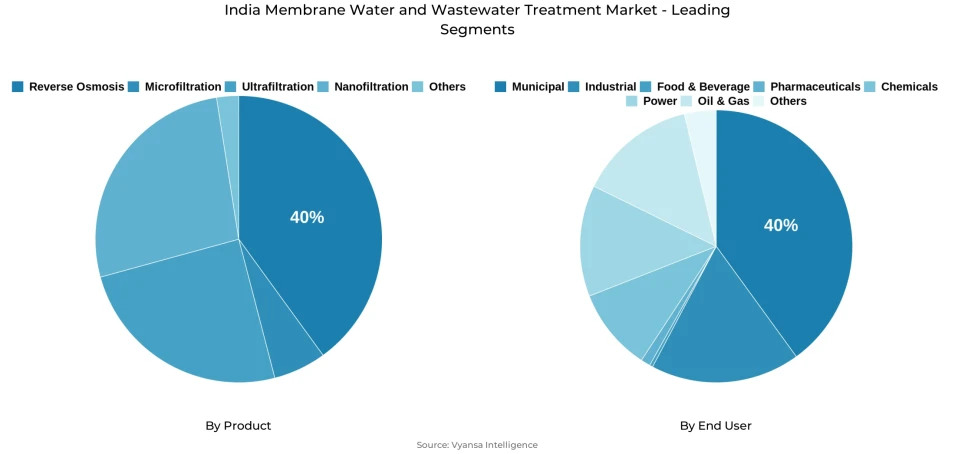
- Reverse osmosis grabbed market share of 40%.
- Competition
- More than 10 companies are actively engaged in producing membrane water and wastewater treatment in India.
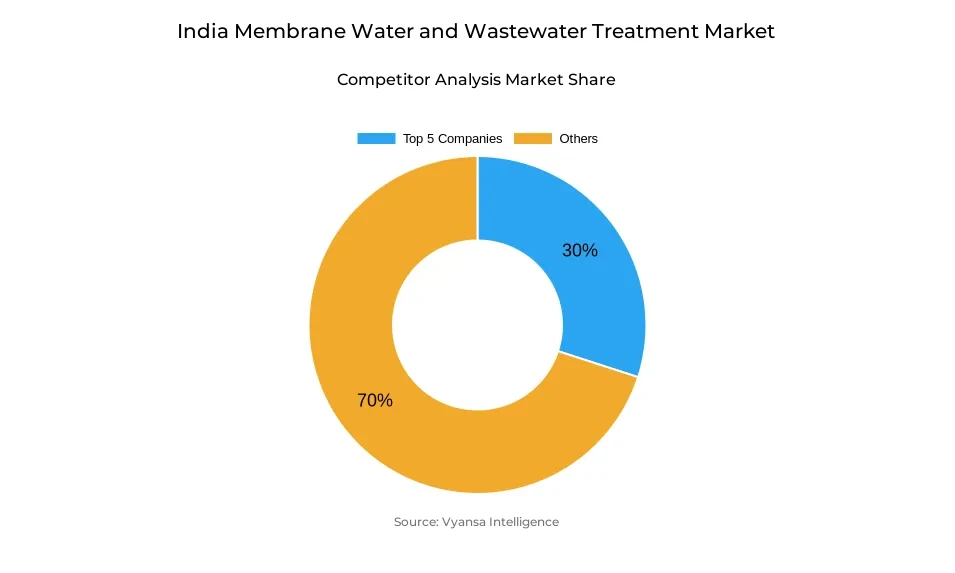
- Top 5 companies acquired around 30% of the market share.
- Pentair/Pentair X-Flow, Ion Exchange India, Thermax, Veolia India/Veolia Water Technologies & Solutions, Xylem India etc., are few of the top companies.
- End User
- Municipal grabbed 40% of the market.
India Membrane Water and Wastewater Treatment Market Outlook
The India membrane water and wastewater treatment market was valued at USD 520 million in 2025, establishing a commercially purposeful and infrastructure-driven foundation within one of Asia's most actively expanding water management ecosystems. Projected to advance from USD 561.6 million in 2026 to USD 891.2 million by 2032, the sector registers a compound annual growth rate of 8.0% across the forecast horizon. This steady and structurally supported expansion trajectory reflects the sustained and growing institutional need for reliable water purification and wastewater treatment across India's urban, rural, and industrial environments. Growth is anchored in genuine infrastructure necessity rather than technology cycle enthusiasm, giving this market a commercial durability that sustains consistent procurement activity across diverse user segments and economic conditions.
The product architecture defining this market's commercial structure is anchored in reverse osmosis technology. Reverse Osmosis commands approximately 40% of total product segment market share, reflecting the consistent and deeply embedded institutional preference for membrane treatment systems whose separation performance, output quality reliability, and broad application compatibility make them the reference product type across municipal water supply, wastewater handling, and industrial process water treatment environments. This product concentration confirms that Indian infrastructure buyers continue to prioritize proven treatment technologies whose operational credentials are validated across large-scale public and private deployment contexts, sustaining disproportionate procurement share across both new installation and system upgrade demand cycles.
The end-user architecture reinforces the structural centrality of municipal buyers as the category's dominant demand source. The Municipal segment accounts for approximately 40% of total end-user market share, reflecting the foundational role of city-level and public utility water infrastructure in shaping overall treatment system procurement activity across India. The Ministry of Housing and Urban Affairs' documentation that AMRUT 2.0 had approved 10,647 MLD of water treatment plant capacity and 6,739 MLD of sewage treatment plant capacity by June 2025 confirms the institutional investment scale that sustains municipal membrane treatment procurement at a commercially significant and consistently expanding level. This public-sector demand concentration creates a procurement environment where treatment performance reliability, system scalability, and long-term operational support capability carry disproportionate commercial weight.
The future outlook is defined by four converging structural forces whose combined commercial impact creates a membrane water and wastewater treatment market of sustained and well-grounded expansion momentum. The Press Information Bureau's documentation that over 15.57 crore rural households, representing 80.38% of all rural households, had tap water supply under Jal Jeevan Mission as of March 2025 confirms the national water access infrastructure commitment that sustains consistent membrane treatment procurement. AMRUT 2.0's approval of 1,487 water supply projects with SCADA technology and 235 sewerage projects with SCADA technology confirms that smart monitoring integration is advancing at an institutionally supported pace. NITI Aayog's November 2025 national workshop highlighting treated wastewater reuse as a national water security priority is opening new membrane technology application demand across circular water management contexts. The Technology Sub-Mission's mapping of 120 shortlisted start-ups to 82 AMRUT cities confirms that innovation-led treatment system development is advancing in ways that will progressively reshape competitive dynamics over the forecast period.
India Membrane Water and Wastewater Treatment Market Growth Driver
Public Water Infrastructure Investment Sustains Core Treatment Procurement Demand
The sustained and institutionally documented expansion of India's public water supply and wastewater treatment infrastructure represents the primary structural driver of membrane water and wastewater treatment demand, functioning as a persistent procurement imperative that sustains consistent treatment system installation, capacity addition, and technology upgrade investment across municipal, urban local body, and rural water authority buyer segments nationwide. This infrastructure-driven demand dynamic transcends cyclical government budget fluctuations, reflecting a durable national development priority whose procurement volume generation is structurally anchored in India's multi-decade commitment to universal water access, urban sewage management, and public health infrastructure modernization across every administrative tier.
The quantitative evidence validating this infrastructure-driven demand dynamic is documented with precision by the Press Information Bureau and the Ministry of Housing and Urban Affairs. Over 15.57 crore rural households, representing 80.38% of all rural households, had tap water supply connectivity under Jal Jeevan Mission as of 31 March 2025, confirming the national water access infrastructure commitment that sustains consistent membrane treatment technology procurement at population scale. AMRUT 2.0 had approved 3,568 water supply projects alongside 10,647 MLD of water treatment plant capacity and 6,739 MLD of sewage treatment plant capacity by June 2025, confirming the active urban infrastructure pipeline that generates consistent and commercially significant membrane treatment system procurement activity. These public infrastructure metrics validate a government-led demand base of sufficient institutional scale and execution momentum to sustain structural membrane treatment market growth over the forecast period.
India Membrane Water and Wastewater Treatment Market Challenge
Long Project Gestation Periods Constrain Procurement Cycle Velocity
The structural length and complexity of large public water infrastructure project approval, contracting, and implementation cycles represent the most consequential operational challenge confronting membrane water and wastewater treatment suppliers in India, creating systematic procurement timeline, revenue realization, and capacity scaling delays that moderate commercial growth velocity even when project approval activity is expanding at institutionally significant scale. In a market where the largest and most commercially valuable treatment procurement opportunities are concentrated within public infrastructure programs whose execution timelines are governed by administrative approvals, detailed project report preparation, contractor selection, and construction sequencing, the interval between project approval and active membrane system procurement can extend across multiple years in ways that constrain supplier revenue planning and installed capacity growth.
The structural depth and project-scale specificity of this execution challenge are documented with precision by the Ministry of Housing and Urban Affairs. AMRUT 2.0 had approved 8,998 projects worth INR 1,89,458.55 crore by 28 November 2024, yet 1,198 approved projects remained at the detailed project report stage as of the same period, confirming that a meaningful proportion of approved project value had not yet converted into active procurement activity. Contracts had been awarded for 4,916 AMRUT 2.0 projects as of 15 November 2024, with the ministry explicitly noting that these are large infrastructure projects with long gestation periods, confirming that execution timeline constraints are an institutionally recognized structural feature of the market environment rather than an anomalous delivery challenge. For membrane treatment suppliers, navigating this challenge demands sustained investment in project pipeline monitoring, procurement relationship management, and financial planning capability calibrated to long-cycle public infrastructure revenue realization patterns over the forecast period.
Unlock Market Intelligence
Explore the market potential with our data-driven report
India Membrane Water and Wastewater Treatment Market Trend
Smart Monitoring Integration Reshapes Treatment System Design Standards
The accelerating adoption of SCADA technology, digital process monitoring, and data-led operational management across India's public water and wastewater treatment infrastructure represents the defining structural trend reshaping membrane treatment system design priorities, operational performance expectations, and competitive differentiation parameters across the India market. This smart monitoring trend is progressively transforming the functional role of membrane treatment systems from standalone water processing units into integrated, data-connected infrastructure components whose performance characteristics must support real-time process visibility, remote operational management, and continuous system optimization alongside traditional treatment capacity and output quality requirements. The commercial implications of this functional shift are significant, as membrane system providers unable to demonstrate smart monitoring integration readiness are progressively disadvantaged in AMRUT 2.0 procurement evaluations among India's most technically advancing municipal utility buyer segments.
The institutional momentum and project-scale specificity of this smart monitoring trend are documented with authority by the Ministry of Housing and Urban Affairs. AMRUT 2.0 had approved 1,487 water supply projects with SCADA technology and 235 sewerage projects with SCADA technology by June 2025, confirming that digitally monitored treatment infrastructure has advanced from a pilot-stage preference into a mainstream municipal procurement specification across India's most active urban water infrastructure development programs. The Technology Sub-Mission's engagement of 120 shortlisted start-ups mapped to 82 AMRUT cities for pilot projects further confirms that innovation-led treatment system development is advancing at an institutionally supported pace that will progressively introduce smarter operational architectures across the membrane treatment product landscape. As SCADA-integrated treatment infrastructure becomes a standard municipal procurement expectation, smart monitoring capability will transition from a competitive differentiator to a baseline system requirement over the forecast period.
India Membrane Water and Wastewater Treatment Market Opportunity
Treated Wastewater Reuse Creates a Structurally New Application Demand Base
The growing national policy focus on treated wastewater reuse as a strategic water security tool creates a structurally significant and commercially compelling opportunity for membrane water and wastewater treatment providers whose systems combine the treatment quality performance, operational reliability, and reuse standard compliance required across India's most institutionally committed circular water management programs. This wastewater reuse opportunity is distinguished from conventional municipal replacement demand by its policy-backed investment certainty, its expanding end-use acceptance across agricultural, industrial, and urban reuse applications, and the advanced treatment quality requirements it places on membrane system performance, creating procurement conditions where treatment technology depth and reuse quality credentials carry disproportionate commercial weight relative to price competition alone.
The policy specificity and institutional commitment of this wastewater reuse opportunity are documented with precision by NITI Aayog and the Ministry of Housing and Urban Affairs. A national workshop convened by NITI Aayog in November 2025 explicitly highlighted that scaling up treated wastewater reuse can improve water security, reduce freshwater dependency, strengthen climate resilience, and advance resource circularity, confirming that wastewater reuse has reached the highest levels of national policy prioritization as a structural water management solution. The "Jal Hi AMRIT" initiative under AMRUT 2.0 actively encourages states and union territories to manage sewage plants efficiently so that water can be treated and reused safely, creating a direct and institutionally supported procurement pathway for membrane-based treatment systems whose output quality meets municipal reuse standards. Suppliers combining advanced membrane treatment performance, reuse-grade output quality credentials, and public sector procurement alignment will capture disproportionate value from this structurally significant and policy-supported market opportunity over the forecast period.
Unlock Market Intelligence
Explore the market potential with our data-driven report
India Membrane Water and Wastewater Treatment Market Segmentation Analysis
By Product
- Microfiltration
- Ultrafiltration
- Nanofiltration
- Reverse Osmosis
- Others
The segment with highest market share under the Product category is Reverse Osmosis, accounting for approximately 40% of the total market. This leading position reflects the deep structural alignment between reverse osmosis technology characteristics and the specific treatment performance requirements of India's most institutionally significant water infrastructure buyer segments, where effective separation performance, dependable output quality, and broad application compatibility across both potable water production and wastewater reclamation make RO the reference membrane technology across municipal, industrial, and public utility procurement decisions. With two-fifths of total market value concentrated within a single product type, Reverse Osmosis defines the commercial priorities, system integration frameworks, and procurement evaluation criteria of the India membrane water and wastewater treatment market.
The structural leadership of Reverse Osmosis is further sustained by its practical relevance and operational familiarity across India's most volume-significant infrastructure deployment contexts. Unlike less established membrane configurations whose performance validation evidence bases are still developing across Indian operating conditions, reverse osmosis technology benefits from decades of large-scale deployment across municipal water treatment, industrial process water management, and wastewater reclamation environments whose documented performance outcomes create consistent buyer confidence across procurement decision cycles. As the "Jal Hi AMRIT" initiative under AMRUT 2.0 encourages states and union territories to manage sewage plants for treated water reuse, reverse osmosis technology's strong reuse quality credentials position it favorably within the expanding circular water management procurement pipeline. The segment's structural market leadership is expected to remain comprehensively intact over the forecast period.
By End User
- Municipal
- Industrial
- Food & Beverage
- Pharmaceuticals
- Chemicals
- Power
- Oil & Gas
- Others
The segment with highest market share under the End User category is Municipal, accounting for approximately 40% of the total market. This dominant position reflects the foundational role of city-level and public utility water infrastructure in generating consistent and high-volume membrane treatment system procurement across India's most commercially significant project pipelines, where urban water supply expansion, sewage treatment capacity development, and public infrastructure modernization programs collectively sustain disproportionate treatment technology investment relative to private sector buyer segments of comparable organizational scale. With two-fifths of total market value anchored in municipal demand, this end-user segment defines the compliance requirements, performance specifications, and long-term operational support standards that shape membrane treatment procurement strategy across the India market.
The structural leadership of the Municipal segment is being actively sustained by the accelerating institutional investment in public water infrastructure across India's urban and peri-urban environments. The Ministry of Housing and Urban Affairs' documentation that AMRUT 2.0 had approved 3,568 water supply projects alongside 10,647 MLD of water treatment plant capacity and 6,739 MLD of sewage treatment plant capacity by June 2025 confirms the scale of the active public infrastructure pipeline whose treatment system procurement requirements generate consistent and compounding membrane technology demand. The further integration of SCADA-monitored water and sewerage projects across the AMRUT 2.0 portfolio confirms that municipal treatment infrastructure is broadening in both coverage and operational sophistication. The Municipal segment's position as the market's dominant commercial demand anchor is expected to deepen over the forecast period.
List of Companies Covered in India Membrane Water and Wastewater Treatment Market
The companies listed below are highly influential in the India membrane water and wastewater treatment market, with a significant market share and a strong impact on industry developments.
- Pentair/Pentair X-Flow
- Ion Exchange India
- Thermax
- Veolia India/Veolia Water Technologies & Solutions
- Xylem India
- DuPont Water Solutions India
- Toray India
- Nitto Hydranautics India
- VA Tech Wabag
- Permionics
Market News & Updates
- Veolia India / Veolia Water Technologies & Solutions, 2026:
Veolia marked a major milestone in India with the inauguration of a new Customer Experience Center at its Hoskote plant in Bangalore, which the company described as a world-class hub for membrane manufacturing, specialty chemicals, and advanced water technologies. For the India water and wastewater treatment membrane market, this is one of the strongest verified developments because it strengthens local and regional manufacturing relevance, improves customer-facing demonstration and application support, and signals continued confidence in India as a strategic production and innovation base for membrane-linked water treatment solutions
- VA Tech WABAG, 2025:
WABAG announced that its 40 MLD Ghaziabad Tertiary Treatment Reverse Osmosis plant in Uttar Pradesh had won the Distinction Award in the “Water Reuse Project of the Year” category at the Global Water Awards 2025; the company said the facility treats 40,000 cubic metres per day of municipal wastewater and uses disc filtration, ultrafiltration, and reverse osmosis to supply industrial-grade water to the Sahibabad Industrial Estate. For the India membrane market, this is highly significant because it validates advanced membrane-based reuse at municipal-industrial interface scale, strengthening the case for UF-RO based recycling projects as states push harder on water reuse and groundwater substitution
Frequently Asked Questions
Related Report
- Market Segmentation
- Research Scope
- Research Methodology
- Definitions and Assumptions
- Executive Summary
- India Membrane Water and Wastewater Treatment Market Policies, Regulations, and Standards
- India Membrane Water and Wastewater Treatment Market Dynamics
- Growth Factors
- Challenges
- Trends
- Opportunities
- India Membrane Water and Wastewater Treatment Market Statistics, 2022-2032F
- Market Size & Growth Outlook
- By Revenues in USD Million
- Market Segmentation & Growth Outlook
- By Product
- Microfiltration- Market Insights and Forecast 2022-2032, USD Million
- Ultrafiltration- Market Insights and Forecast 2022-2032, USD Million
- Nanofiltration- Market Insights and Forecast 2022-2032, USD Million
- Reverse Osmosis- Market Insights and Forecast 2022-2032, USD Million
- Others- Market Insights and Forecast 2022-2032, USD Million
- By Material
- Polymeric- Market Insights and Forecast 2022-2032, USD Million
- Ceramic- Market Insights and Forecast 2022-2032, USD Million
- Others- Market Insights and Forecast 2022-2032, USD Million
- By Application
- Water Treatment- Market Insights and Forecast 2022-2032, USD Million
- Wastewater Treatment- Market Insights and Forecast 2022-2032, USD Million
- Desalination- Market Insights and Forecast 2022-2032, USD Million
- Water Reuse/Reclamation- Market Insights and Forecast 2022-2032, USD Million
- Industrial Process Water- Market Insights and Forecast 2022-2032, USD Million
- By End User
- Municipal- Market Insights and Forecast 2022-2032, USD Million
- Industrial- Market Insights and Forecast 2022-2032, USD Million
- Food & Beverage- Market Insights and Forecast 2022-2032, USD Million
- Pharmaceuticals- Market Insights and Forecast 2022-2032, USD Million
- Chemicals- Market Insights and Forecast 2022-2032, USD Million
- Power- Market Insights and Forecast 2022-2032, USD Million
- Oil & Gas- Market Insights and Forecast 2022-2032, USD Million
- Others- Market Insights and Forecast 2022-2032, USD Million
- By Sales Channel
- Retail Offline- Market Insights and Forecast 2022-2032, USD Million
- Direct Sales- Market Insights and Forecast 2022-2032, USD Million
- Distributors/Dealers- Market Insights and Forecast 2022-2032, USD Million
- OEM/System Integrator Sales- Market Insights and Forecast 2022-2032, USD Million
- EPC/Project-Based Sales- Market Insights and Forecast 2022-2032, USD Million
- Retail Online- Market Insights and Forecast 2022-2032, USD Million
- Company-Owned Websites- Market Insights and Forecast 2022-2032, USD Million
- Distributor Online Portals- Market Insights and Forecast 2022-2032, USD Million
- B2B E-Marketplaces- Market Insights and Forecast 2022-2032, USD Million
- E-Procurement/Tender Platforms- Market Insights and Forecast 2022-2032, USD Million
- Retail Offline- Market Insights and Forecast 2022-2032, USD Million
- By Region
- North
- East
- West
- South
- By Competitors
- Competition Characteristics
- Market Share & Analysis
- By Product
- Market Size & Growth Outlook
- India Microfiltration Market Statistics, 2022-2032
- Market Size & Growth Outlook
- By Revenues in USD Million
- Market Segmentation & Growth Outlook
- By Material- Market Insights and Forecast 2022-2032, USD Million
- By Application- Market Insights and Forecast 2022-2032, USD Million
- By End User- Market Insights and Forecast 2022-2032, USD Million
- By Sales Channel- Market Insights and Forecast 2022-2032, USD Million
- By Region- Market Insights and Forecast 2022-2032, USD Million
- Market Size & Growth Outlook
- India Ultrafiltration Market Statistics, 2022-2032
- Market Size & Growth Outlook
- By Revenues in USD Million
- Market Segmentation & Growth Outlook
- By Material- Market Insights and Forecast 2022-2032, USD Million
- By Application- Market Insights and Forecast 2022-2032, USD Million
- By End User- Market Insights and Forecast 2022-2032, USD Million
- By Sales Channel- Market Insights and Forecast 2022-2032, USD Million
- By Region- Market Insights and Forecast 2022-2032, USD Million
- Market Size & Growth Outlook
- India Nanofiltration Market Statistics, 2022-2032
- Market Size & Growth Outlook
- By Revenues in USD Million
- Market Segmentation & Growth Outlook
- By Material- Market Insights and Forecast 2022-2032, USD Million
- By Application- Market Insights and Forecast 2022-2032, USD Million
- By End User- Market Insights and Forecast 2022-2032, USD Million
- By Sales Channel- Market Insights and Forecast 2022-2032, USD Million
- By Region- Market Insights and Forecast 2022-2032, USD Million
- Market Size & Growth Outlook
- India Reverse Osmosis Market Statistics, 2022-2032
- Market Size & Growth Outlook
- By Revenues in USD Million
- Market Segmentation & Growth Outlook
- By Material- Market Insights and Forecast 2022-2032, USD Million
- By Application- Market Insights and Forecast 2022-2032, USD Million
- By End User- Market Insights and Forecast 2022-2032, USD Million
- By Sales Channel- Market Insights and Forecast 2022-2032, USD Million
- By Region- Market Insights and Forecast 2022-2032, USD Million
- Market Size & Growth Outlook
- Competitive Outlook
- Company Profiles
- Veolia India/Veolia Water Technologies & Solutions
- Business Description
- Product Portfolio
- Collaborations & Alliances
- Recent Developments
- Financial Details
- Others
- Xylem India
- Business Description
- Product Portfolio
- Collaborations & Alliances
- Recent Developments
- Financial Details
- Others
- DuPont Water Solutions India
- Business Description
- Product Portfolio
- Collaborations & Alliances
- Recent Developments
- Financial Details
- Others
- Toray India
- Business Description
- Product Portfolio
- Collaborations & Alliances
- Recent Developments
- Financial Details
- Others
- Nitto Hydranautics India
- Business Description
- Product Portfolio
- Collaborations & Alliances
- Recent Developments
- Financial Details
- Others
- Pentair/Pentair X-Flow
- Business Description
- Product Portfolio
- Collaborations & Alliances
- Recent Developments
- Financial Details
- Others
- Ion Exchange India
- Business Description
- Product Portfolio
- Collaborations & Alliances
- Recent Developments
- Financial Details
- Others
- Thermax
- Business Description
- Product Portfolio
- Collaborations & Alliances
- Recent Developments
- Financial Details
- Others
- VA Tech Wabag
- Business Description
- Product Portfolio
- Collaborations & Alliances
- Recent Developments
- Financial Details
- Others
- Permionics
- Business Description
- Product Portfolio
- Collaborations & Alliances
- Recent Developments
- Financial Details
- Others
- Veolia India/Veolia Water Technologies & Solutions
- Company Profiles
- Disclaimer
| Segment | Sub-Segment |
|---|---|
| By Product |
|
| By Material |
|
| By Application |
|
| By End User |
|
| By Sales Channel |
|
| By Region |
|
Research Methodology
This study followed a structured approach comprising four key phases to assess the size and scope of the electro-oxidation market. The process began with thorough secondary research to collect data on the target market, related markets, and broader industry context. These findings, along with preliminary assumptions and estimates, were then validated through extensive primary research involving industry experts from across the value chain. To calculate the overall market size, both top-down and bottom-up methodologies were employed. Finally, market segmentation and data triangulation techniques were applied to refine and validate segment-level estimations.
Secondary Research
The secondary research phase involved gathering data from a wide range of credible and published sources. This step helped in identifying industry trends, defining market segmentation, and understanding the market landscape and value chain.
Sources consulted during this phase included:
- Company annual reports, investor presentations, and press releases
- Industry white papers and certified publications
- Trade directories and market-recognized databases
- Articles from authoritative authors and reputable journals
- Gold and silver standard websites
Secondary research was critical in mapping out the industry's value chain and monetary flow, identifying key market segments, understanding regional variations, and tracking significant industry developments.
Other key sources:
- Financial disclosures
- Industry associations and trade bodies
- News outlets and business magazines
- Academic journals and research studies
- Paid industry databases
Primary Research
To validate secondary data and gain deeper market insights, primary research was conducted with key stakeholders across both the supply and demand sides of the market.
On the demand side, participants included decision-makers and influencers from end-user industries—such as CIOs, CTOs, and CSOs—who provided first-hand perspectives on market needs, product usage, and future expectations.
On the supply side, interviews were conducted with manufacturers, industry associations, and institutional participants to gather insights into current offerings, product pipelines, and market challenges.
Primary interviews provided critical inputs such as:
- Market size and revenue data
- Product and service breakdowns
- Market forecasts
- Regional and application-specific trends
Stakeholders consulted included:
- Leading OEM and solution providers
- Channel and distribution partners
- End users across various applications
- Independent consultants and industry specialists
Market Size Estimation and Data Triangulation
- Identifying Key Market Participants (Secondary Research)
- Goal: To identify the major players or companies in the target market. This typically involves using publicly available data sources such as industry reports, market research publications, and financial statements of companies.
- Tools: Reports from firms like Gartner, Forrester, Euromonitor, Statista, IBISWorld, and others. Public financial statements, news articles, and press releases from top market players.
- Extracting Earnings of Key Market Participants
- Goal: To estimate the earnings generated from the product or service being analyzed. This step helps in understanding the revenue potential of each market player in a specific geography.
- Methods: Earnings data can be gathered from:
- Publicly available financial reports (for listed companies).
- Interviews and primary data sources from professionals, such as Directors, VPs, SVPs, etc. This is especially useful for understanding more nuanced, internal data that isn't publicly disclosed.
- Annual reports and investor presentations of key players.
- Data Collation and Development of a Relevant Data Model
- Goal: To collate inputs from both primary and secondary sources into a structured, data-driven model for market estimation. This model will incorporate key market KPIs and any independent variables relevant to the market.
- Key KPIs: These could include:
- Market size, growth rate, and demand drivers.
- Industry-specific metrics like market share, average revenue per customer (ARPC), or average deal size.
- External variables, such as economic growth rates, inflation rates, or commodity prices, that could affect the market.
- Data Modeling: Based on this data, the market forecasts are developed for the next 5 years. A combination of trend analysis, scenario modeling, and statistical regression might be used to generate projections.
- Scenario Analysis
- Goal: To test different assumptions and validate how sensitive the market is to changes in key variables (e.g., market demand, regulatory changes, technological disruptions).
- Types of Scenarios:
- Base Case: Based on current assumptions and historical data.
- Best-Case Scenario: Assuming favorable market conditions, regulatory environments, and technological advancements.
- Worst-Case Scenario: Accounting for adverse factors, such as economic downturns, stricter regulations, or unexpected disruptions.












