India Industrial Gases Market Report: Trends, Growth and Forecast (2026-2032)
By Gas Type (Nitrogen Gas, Oxygen Gas, Carbon Dioxide Gas, Argon Gas, Helium Gas, Hydrogen Gas, Other), By Supply Mode (Cylinders, Bulk, On-Site Production, Captive, Other), By Application (Combustion and Process Oxygen, Welding and Metal Fabrication, Inerting Blanketing and Heat Treating, Cryogenics and liquefaction, Chemical Synthesis and Hydrogenation, Purging and Purifications, Analytical and Calibration), By End User Industry (General Manufacturing, Food, Metallurgy, Chemicals, Healthcare, Electronics, Refining & Energy, Glass, Pulp & Paper, Others) ... Read more
|
Major Players
|
India Industrial Gases Market Statistics and Insights, 2026
- Market Size Statistics
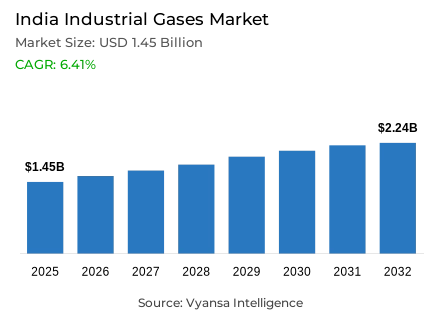
- Industrial gases market size in India was estimated at USD 1.45 billion in 2025.
- The market size is expected to grow to USD 2.24 billion by 2032.
- Market to register a CAGR of around 6.41% during 2026-32.
- Gas Type Shares
- Nitrogen gas grabbed market share of 40%.
- Competition
- More than 10 companies are actively engaged in producing industrial gases in India.
- Top 5 companies acquired around 50% of the market share.
- SOL Group, Bhuruka Gases Limited, Ellenbarrie Industrial Gases Ltd, Linde plc, INOX Air Products Private Limited etc., are few of the top companies.
- Supply Mode
- Cylinders grabbed 40% of the market.
India Industrial Gases Market Outlook
The India industrial gases market is growing steadily, which is supported by the growth of the manufacturing and infrastructure industries. Since manufacturing contributes about 17% of the national GDP, the gas requirements of oxygen, nitrogen, and argon are on the increase in steelmaking, electronics, and chemical-processing sectors. The market is estimated to be USD 1.45 billion in 2025 and USD 2.24 billion in 2032 with a CAGR of about 6.41% in 2026-2032.
The market outlook is further reinforced by the increasing use of specialty gases in pharmaceuticals and food processing to sterilise, preserve and package food. However, the infrastructure limitations, especially the inefficiency of power supply and the lack of pipeline connectivity, are the obstacles to the stable gas supply. The Ministry of Power reports that AT&C losses amounted to 15.37% in FY 2023, which negatively affects energy-intensive production units. Supply delays are also caused by high logistics costs and lack of automated distribution, particularly in remote industrial areas. Enhancement of power and logistics infrastructure is also critical in maintaining continuous supply in the regions.
At the same time, the market is being transformed by India with its emphasis on sustainability via the National Green Hydrogen Mission, which aims to produce 5 million tonnes by 2030. Renewable electrolysis and green hydrogen technologies are gaining popularity among industrial gas companies, as they are in line with global clean-energy transitions. This transformation opens up long-term prospects in sustainable industrial uses and energy solutions.
Nitrogen has the highest percentage of 40% because it is widely used in electronics, metallurgy, and packaging due to its inertness. Cylinders also occupy 40% of the market in terms of supply mode, which is valued due to its flexibility and reliability, especially in regions that do not have pipeline infrastructure. All these segments point to the changing but stable base of the emerging industrial gases market in India.

India Industrial Gases Market Growth DriverExpanding Manufacturing Output Stimulating Industrial Gas Utilization
The manufacturing industry in India is witnessing a massive growth, which is supported by government programs like Production Linked Incentive (PLI) Scheme. As manufacturing accounts to about 17% of the national GDP, the demand of industrial gases used in steel making, electronics and chemical processing is experiencing a strong trend. The overall market outlook of industrial gases is strengthened by the fact that industries are dependent on oxygen, nitrogen, and argon to improve the efficiency and quality of production.
At the same time, the pharmaceutical and food-processing industries are increasing their reliance on specialty gases in sterilisation, preservation and packaging. Within the framework of Vision 2047, it is expected that long-term growth in manufacturing will be supported by sustained investment in industrial modernisation and infrastructure. All these developments guarantee a consistent demand by the end users, thus strengthening the importance of industrial gases in the economic development of India.
India Industrial Gases Market ChallengeInfrastructure Constraints Hindering Efficient Supply and Distribution
Infrastructure constraints pose a significant impediment to the sustained growth and operational efficiency of the industrial gases market in India. The Ministry of Power and the Central Electricity Authority reported that the AT&C losses in the country were 15.37% in FY 2023, which is a manifestation of inefficiencies that directly impact the energy-intensive gas-production units. Lack of power reliability and poor connectivity of pipelines in different regions results in inconsistent supply and operational delays, especially to end users in manufacturing clusters.
Furthermore, inadequate logistics and slow implementation of automated storage and distribution systems make the issue of stable gas flow more difficult. Such limitations tend to create higher transportation expenses and sometimes scarcity particularly in remote industrial regions. To reduce the impact of these bottlenecks, it is necessary to invest in power infrastructure and modern logistics systems to guarantee the continuous and affordable supply of gas throughout the country.
Unlock Market Intelligence
Explore the market potential with our data-driven report
India Industrial Gases Market TrendGrowing Shift Toward Green Hydrogen Integration
A notable trend shaping the India industrial gases industry is the strategic transition of companies toward green hydrogen production, reflecting the sector’s alignment with decarbonization objectives and clean energy integration. In 2023, the National Green Hydrogen Mission was initiated with a target of 5 million tonnes of production by 2030, which will attract large-scale investment in renewable electrolysis technology.
This shift is transforming the working policies of gas producers and enhancing the cooperation between the state and the business. The adoption of green hydrogen will not only strengthen the efforts of India in reducing emissions but also diversify the portfolio of industrial gases.This development allows providers to seize new prospects in sustainable production and clean-energy solutions. Industrial gas suppliers are leading the way in the transformation of the country towards an environmentally friendly industrial development by aligning themselves with the global decarbonisation objectives.
India Industrial Gases Market OpportunityExpanding Healthcare Infrastructure Driving Market Potential
The changing healthcare ecosystem in India is a significant growth prospect of industrial gas suppliers. As healthcare expenditure is 2.1% of GDP in FY 2023, according to the National Health Accounts, hospitals and diagnostic centres are becoming increasingly dependent on oxygen, nitrous oxide, and other medical gases. The building of new medical facilities and the renovation of the old ones also increase the demand of gases that are used in the therapy, sterilisation, and life-support systems.
The growth of population, urbanisation and the availability of better healthcare are gradually raising the use of gas in both clinical and pharmaceutical uses. To address these varied needs, suppliers are diversifying their products to guarantee high purity and high safety standards. This continued wave of the healthcare industry guarantees a stable and growing customer base to the industrial gas manufacturers across India.
Unlock Market Intelligence
Explore the market potential with our data-driven report
India Industrial Gases Market Segmentation Analysis
By Gas Type
- Nitrogen Gas & Quantity in Tons
- Oxygen Gas & Quantity in Tons
- Carbon Dioxide Gas & Quantity in Tons
- Argon Gas & Quantity in Tons
- Helium Gas & Quantity in Tons
- Hydrogen Gas & Quantity in Tons
- Other & Quantity in Tons
The segment with highest market share under gas type is nitrogen gas accounts for approximately 40% of the India Industrial Gases Market, making it the leading segment by gas type. Its widespread use across industries such as electronics, metallurgy, and packaging stems from its inert characteristics, which prevent oxidation and contamination during production. These properties make nitrogen indispensable for preserving product integrity and ensuring consistent quality in sensitive manufacturing environments.
The growing food processing and pharmaceutical industries are further intensifying nitrogen consumption, utilizing it for storage, freezing, and transportation applications. As safety and purity standards tighten, demand for nitrogen continues to expand, reinforcing its dominance within the market. With its unmatched versatility and reliability, nitrogen is expected to maintain its stronghold in the industrial gases landscape through the forecast period.

By Supply Mode
- Cylinders & Quantity in Tons
- Bulk & Quantity in Tons
- On-Site Production & Quantity in Tons
- Captive & Quantity in Tons
- Other & Quantity in Tons
The segment with highest market share under Supply Mode is Cylinders, holding a 40% market share. Their flexibility, ease of transport, and suitability for regions without developed pipeline infrastructure make them a preferred choice among end users. Industries such as metal fabrication, healthcare, and small-scale manufacturing extensively rely on cylinder-based delivery for convenient, on-demand gas access.
Additionally, advancements in safety standards and material technologies are enhancing the efficiency and portability of gas cylinders. Their adaptability for diverse operational environments, including remote and urban locations, ensures continued market strength. As infrastructure development progresses gradually across the country, cylinders will remain the dominant and most practical supply mode for industrial gases in India.
List of Companies Covered in India Industrial Gases Market
The companies listed below are highly influential in the India industrial gases market, with a significant market share and a strong impact on industry developments.
- SOL Group
- Bhuruka Gases Limited
- Ellenbarrie Industrial Gases Ltd
- Linde plc
- INOX Air Products Private Limited
- Air Liquide
- Nippon Sanso Holdings Corporation (Taiyo Nippon Sanso India Pvt Ltd)
- Air Products
- Goyal MG Gases Pvt Ltd
- Bombay Oxygen Investments Ltd
Market News & Updates
- Linde plc, 2025:
Began production at new Unnao facility for industrial and medical gases and expanding on-site capacity at Kalinganagar via Tata Steel ASU acquisitions.
- INOX Air Products, 2025:
Commissioned fifth ASU at AM/NS Hazira adding 700 TPD oxygen and 300 TPD nitrogen, strengthening India’s largest gas complex.
Frequently Asked Questions
Related Report
- Market Segmentation
- Research Scope
- Research Methodology
- Definitions and Assumptions
- Executive Summary
- India Industrial Gases Market Policies, Regulations, and Standards
- India Industrial Gases Market Dynamics
- Growth Factors
- Challenges
- Trends
- Opportunities
- India Industrial Gases Market Statistics, 2022-2032F
- Market Size & Growth Outlook
- By Revenues in USD Million
- By Quantity Sold in Tons
- Market Segmentation & Growth Outlook
- By Gas Type
- Nitrogen Gas- Market Insights and Forecast 2022-2032, USD Million & Quantity in Tons
- Oxygen Gas- Market Insights and Forecast 2022-2032, USD Million & Quantity in Tons
- Carbon Dioxide Gas- Market Insights and Forecast 2022-2032, USD Million & Quantity in Tons
- Argon Gas- Market Insights and Forecast 2022-2032, USD Million & Quantity in Tons
- Helium Gas- Market Insights and Forecast 2022-2032, USD Million & Quantity in Tons
- Hydrogen Gas- Market Insights and Forecast 2022-2032, USD Million & Quantity in Tons
- Other- Market Insights and Forecast 2022-2032, USD Million & Quantity in Tons
- By Supply Mode
- Cylinders- Market Insights and Forecast 2022-2032, USD Million & Quantity in Tons
- Bulk- Market Insights and Forecast 2022-2032, USD Million & Quantity in Tons
- On-Site Production- Market Insights and Forecast 2022-2032, USD Million & Quantity in Tons
- Captive- Market Insights and Forecast 2022-2032, USD Million & Quantity in Tons
- Other- Market Insights and Forecast 2022-2032, USD Million & Quantity in Tons
- By Application
- Combustion and Process Oxygen- Market Insights and Forecast 2022-2032, USD Million & Quantity in Tons
- Welding and Metal Fabrication- Market Insights and Forecast 2022-2032, USD Million & Quantity in Tons
- Inerting Blanketing and Heat Treating- Market Insights and Forecast 2022-2032, USD Million & Quantity in Tons
- Cryogenics and liquefaction- Market Insights and Forecast 2022-2032, USD Million & Quantity in Tons
- Chemical Synthesis and Hydrogenation- Market Insights and Forecast 2022-2032, USD Million & Quantity in Tons
- Purging and Purifications- Market Insights and Forecast 2022-2032, USD Million & Quantity in Tons
- Analytical and Calibration- Market Insights and Forecast 2022-2032, USD Million & Quantity in Tons
- By End User Industry
- General Manufacturing- Market Insights and Forecast 2022-2032, USD Million & Quantity in Tons
- Food- Market Insights and Forecast 2022-2032, USD Million & Quantity in Tons
- Metallurgy- Market Insights and Forecast 2022-2032, USD Million & Quantity in Tons
- Chemicals- Market Insights and Forecast 2022-2032, USD Million & Quantity in Tons
- Healthcare- Market Insights and Forecast 2022-2032, USD Million & Quantity in Tons
- Electronics- Market Insights and Forecast 2022-2032, USD Million & Quantity in Tons
- Refining & Energy- Market Insights and Forecast 2022-2032, USD Million & Quantity in Tons
- Glass- Market Insights and Forecast 2022-2032, USD Million & Quantity in Tons
- Pulp & Paper- Market Insights and Forecast 2022-2032, USD Million & Quantity in Tons
- Others- Market Insights and Forecast 2022-2032, USD Million & Quantity in Tons
- By Competitors
- Competition Characteristics
- Market Share & Analysis
- By Gas Type
- Market Size & Growth Outlook
- India Nitrogen Gas Market Statistics, 2022-2032
- Market Size & Growth Outlook
- By Revenues in USD Million
- By Quantity Sold in Tons
- Market Segmentation & Growth Outlook
- By Supply Mode- Market Insights and Forecast 2022-2032, USD Million & Quantity in Tons
- By Application- Market Insights and Forecast 2022-2032, USD Million & Quantity in Tons
- By End User Industry- Market Insights and Forecast 2022-2032, USD Million & Quantity in Tons
- Market Size & Growth Outlook
- India Oxygen Gas Market Statistics, 2022-2032
- Market Size & Growth Outlook
- By Revenues in USD Million
- By Quantity Sold in Tons
- Market Segmentation & Growth Outlook
- By Supply Mode- Market Insights and Forecast 2022-2032, USD Million & Quantity in Tons
- By Application- Market Insights and Forecast 2022-2032, USD Million & Quantity in Tons
- By End User Industry- Market Insights and Forecast 2022-2032, USD Million & Quantity in Tons
- Market Size & Growth Outlook
- India Carbon Dioxide Gas Market Statistics, 2022-2032
- Market Size & Growth Outlook
- By Revenues in USD Million
- By Quantity Sold in Tons
- Market Segmentation & Growth Outlook
- By Supply Mode- Market Insights and Forecast 2022-2032, USD Million & Quantity in Tons
- By Application- Market Insights and Forecast 2022-2032, USD Million & Quantity in Tons
- By End User Industry- Market Insights and Forecast 2022-2032, USD Million & Quantity in Tons
- Market Size & Growth Outlook
- India Argon Gas Market Statistics, 2022-2032
- Market Size & Growth Outlook
- By Revenues in USD Million
- By Quantity Sold in Tons
- Market Segmentation & Growth Outlook
- By Supply Mode- Market Insights and Forecast 2022-2032, USD Million & Quantity in Tons
- By Application- Market Insights and Forecast 2022-2032, USD Million & Quantity in Tons
- By End User Industry- Market Insights and Forecast 2022-2032, USD Million & Quantity in Tons
- Market Size & Growth Outlook
- India Helium Gas Market Statistics, 2022-2032
- Market Size & Growth Outlook
- By Revenues in USD Million
- By Quantity Sold in Tons
- Market Segmentation & Growth Outlook
- By Supply Mode- Market Insights and Forecast 2022-2032, USD Million & Quantity in Tons
- By Application- Market Insights and Forecast 2022-2032, USD Million & Quantity in Tons
- By End User Industry- Market Insights and Forecast 2022-2032, USD Million & Quantity in Tons
- Market Size & Growth Outlook
- India Hydrogen Gas Market Statistics, 2022-2032
- Market Size & Growth Outlook
- By Revenues in USD Million
- By Quantity Sold in Tons
- Market Segmentation & Growth Outlook
- By Supply Mode- Market Insights and Forecast 2022-2032, USD Million & Quantity in Tons
- By Application- Market Insights and Forecast 2022-2032, USD Million & Quantity in Tons
- By End User Industry- Market Insights and Forecast 2022-2032, USD Million & Quantity in Tons
- Market Size & Growth Outlook
- Competitive Outlook
- Company Profiles
- Linde plc
- Business Description
- Product Portfolio
- Collaborations & Alliances
- Recent Developments
- Financial Details
- Others
- INOX Air Products Private Limited
- Business Description
- Product Portfolio
- Collaborations & Alliances
- Recent Developments
- Financial Details
- Others
- Air Liquide
- Business Description
- Product Portfolio
- Collaborations & Alliances
- Recent Developments
- Financial Details
- Others
- Nippon Sanso Holdings Corporation (Taiyo Nippon Sanso India Pvt Ltd)
- Business Description
- Product Portfolio
- Collaborations & Alliances
- Recent Developments
- Financial Details
- Others
- Air Products
- Business Description
- Product Portfolio
- Collaborations & Alliances
- Recent Developments
- Financial Details
- Others
- SOL Group
- Business Description
- Product Portfolio
- Collaborations & Alliances
- Recent Developments
- Financial Details
- Others
- Bhuruka Gases Limited
- Business Description
- Product Portfolio
- Collaborations & Alliances
- Recent Developments
- Financial Details
- Others
- Ellenbarrie Industrial Gases Ltd
- Business Description
- Product Portfolio
- Collaborations & Alliances
- Recent Developments
- Financial Details
- Others
- Goyal MG Gases Pvt Ltd
- Business Description
- Product Portfolio
- Collaborations & Alliances
- Recent Developments
- Financial Details
- Others
- Bombay Oxygen Investments Ltd
- Business Description
- Product Portfolio
- Collaborations & Alliances
- Recent Developments
- Financial Details
- Others
- Linde plc
- Company Profiles
- Disclaimer
| Segment | Sub-Segment |
|---|---|
| By Gas Type |
|
| By Supply Mode |
|
| By Application |
|
| By End User Industry |
|
Research Methodology
This study followed a structured approach comprising four key phases to assess the size and scope of the electro-oxidation market. The process began with thorough secondary research to collect data on the target market, related markets, and broader industry context. These findings, along with preliminary assumptions and estimates, were then validated through extensive primary research involving industry experts from across the value chain. To calculate the overall market size, both top-down and bottom-up methodologies were employed. Finally, market segmentation and data triangulation techniques were applied to refine and validate segment-level estimations.
Secondary Research
The secondary research phase involved gathering data from a wide range of credible and published sources. This step helped in identifying industry trends, defining market segmentation, and understanding the market landscape and value chain.
Sources consulted during this phase included:
- Company annual reports, investor presentations, and press releases
- Industry white papers and certified publications
- Trade directories and market-recognized databases
- Articles from authoritative authors and reputable journals
- Gold and silver standard websites
Secondary research was critical in mapping out the industry's value chain and monetary flow, identifying key market segments, understanding regional variations, and tracking significant industry developments.
Other key sources:
- Financial disclosures
- Industry associations and trade bodies
- News outlets and business magazines
- Academic journals and research studies
- Paid industry databases
Primary Research
To validate secondary data and gain deeper market insights, primary research was conducted with key stakeholders across both the supply and demand sides of the market.
On the demand side, participants included decision-makers and influencers from end-user industries—such as CIOs, CTOs, and CSOs—who provided first-hand perspectives on market needs, product usage, and future expectations.
On the supply side, interviews were conducted with manufacturers, industry associations, and institutional participants to gather insights into current offerings, product pipelines, and market challenges.
Primary interviews provided critical inputs such as:
- Market size and revenue data
- Product and service breakdowns
- Market forecasts
- Regional and application-specific trends
Stakeholders consulted included:
- Leading OEM and solution providers
- Channel and distribution partners
- End users across various applications
- Independent consultants and industry specialists
Market Size Estimation and Data Triangulation
- Identifying Key Market Participants (Secondary Research)
- Goal: To identify the major players or companies in the target market. This typically involves using publicly available data sources such as industry reports, market research publications, and financial statements of companies.
- Tools: Reports from firms like Gartner, Forrester, Euromonitor, Statista, IBISWorld, and others. Public financial statements, news articles, and press releases from top market players.
- Extracting Earnings of Key Market Participants
- Goal: To estimate the earnings generated from the product or service being analyzed. This step helps in understanding the revenue potential of each market player in a specific geography.
- Methods: Earnings data can be gathered from:
- Publicly available financial reports (for listed companies).
- Interviews and primary data sources from professionals, such as Directors, VPs, SVPs, etc. This is especially useful for understanding more nuanced, internal data that isn't publicly disclosed.
- Annual reports and investor presentations of key players.
- Data Collation and Development of a Relevant Data Model
- Goal: To collate inputs from both primary and secondary sources into a structured, data-driven model for market estimation. This model will incorporate key market KPIs and any independent variables relevant to the market.
- Key KPIs: These could include:
- Market size, growth rate, and demand drivers.
- Industry-specific metrics like market share, average revenue per customer (ARPC), or average deal size.
- External variables, such as economic growth rates, inflation rates, or commodity prices, that could affect the market.
- Data Modeling: Based on this data, the market forecasts are developed for the next 5 years. A combination of trend analysis, scenario modeling, and statistical regression might be used to generate projections.
- Scenario Analysis
- Goal: To test different assumptions and validate how sensitive the market is to changes in key variables (e.g., market demand, regulatory changes, technological disruptions).
- Types of Scenarios:
- Base Case: Based on current assumptions and historical data.
- Best-Case Scenario: Assuming favorable market conditions, regulatory environments, and technological advancements.
- Worst-Case Scenario: Accounting for adverse factors, such as economic downturns, stricter regulations, or unexpected disruptions.












