India Forestry Machinery Market Report: Trends, Growth and Forecast (2026-2032)
By Equipment Type (Felling Equipment (Chainsaw, Harvester, Feller Buncher), Extracting Equipment (Forwarder, Skidder), On-Site Processing Equipment (Chipper, Delimber), Other Forestry Equipment (Loader, Mulcher)), By Power Source (Diesel, Hybrid, Battery-Electric), By Automation Level (Manual, Semi-Autonomous, Fully Autonomous), By Sales Type (Used, New), By End User (Contract Logging Firms, Forest Ownership Groups, Pulp and Paper Companies), By Region (North, East, West, South) ... Read more
|
Major Players
|
India Forestry Machinery Market Statistics and Insights, 2026
- Market Size Statistics
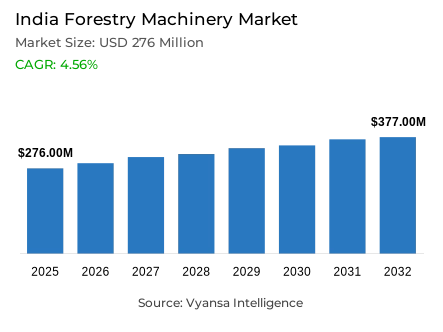
- Forestry machinery market size in India was valued at USD 276 million in 2025 and is estimated at USD 292 million in 2026.
- The market size is expected to grow to USD 377 million by 2032.
- Market to register a CAGR of around 4.56% during 2026-32.
- Equipment Type Shares
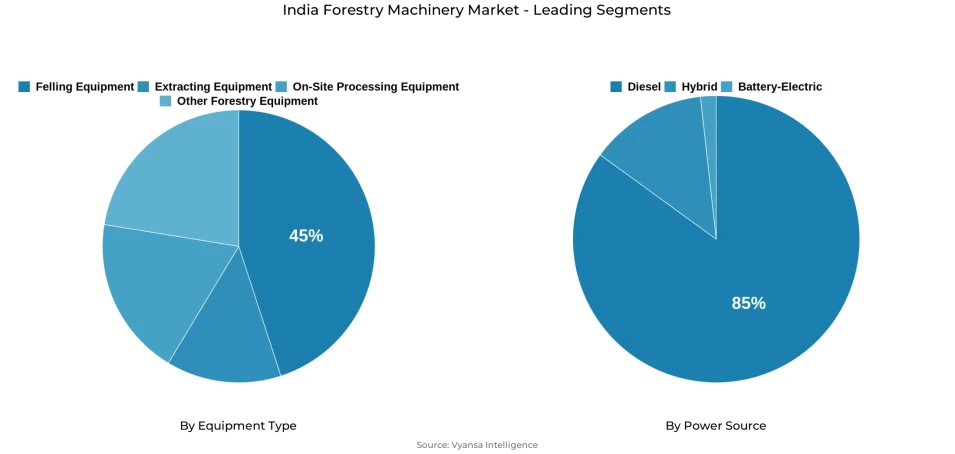
- Felling equipment grabbed market share of 45%.
- Competition
- More than 10 companies are actively engaged in producing forestry machinery in India.
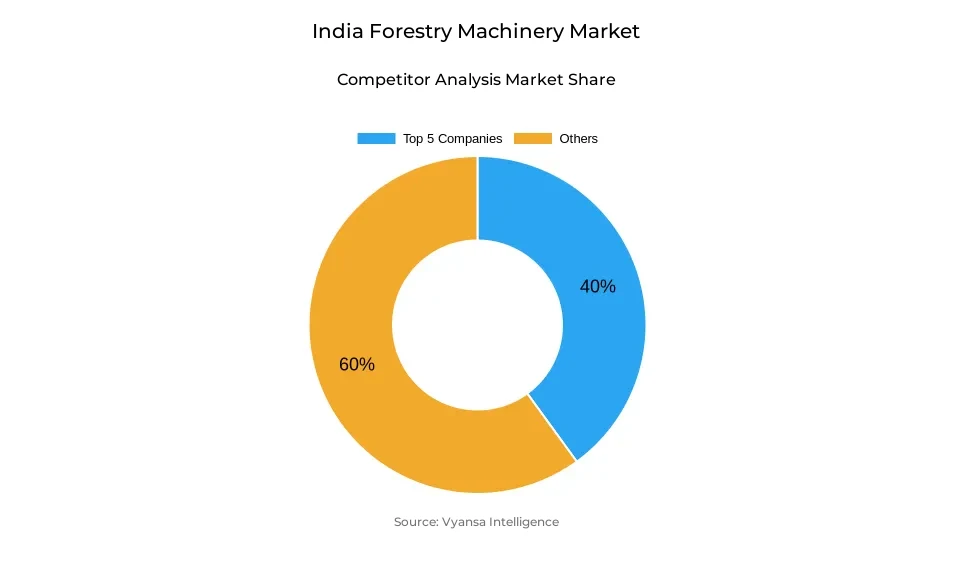
- Top 5 companies acquired around 40% of the market share.
- BEML, Fieldking, Sonalika Tractors, STIHL India, Husqvarna India etc., are few of the top companies.
- Power Source
- Diesel grabbed 85% of the market.
India Forestry Machinery Market Outlook
The India forestry machinery market was valued at USD 276 million in 2025 and is projected to advance from USD 292 million in 2026 to USD 377 million by 2032, registering a CAGR of 4.56% during the forecast period. This growth trajectory is structurally grounded in India's expanding commitment to forest cover improvement, afforestation, plantation drives, and organised forest management, where the scale and operational complexity of field activities across cutting, pruning, site clearing, log movement, and vegetation control are progressively converting mechanized equipment from a productivity preference into an operational requirement for forest departments, contractors, and land-management agencies operating across diverse and often remote terrain conditions.
Felling Equipment commands approximately 45% share within the equipment type category, reflecting the central and irreplaceable role that chainsaws, harvesters, brush cutters, and related cutting tools occupy across tree-cutting, thinning, clearing, and controlled removal activities that form the core operational requirement of India's forestry management sector. The dominance of this segment is sustained by the speed, safety, and precision demands of forestry work in difficult terrain, where mechanized felling tools reduce manual effort and improve productivity across field operations that manual labor alone cannot execute at the required scale or consistency.
Diesel-powered configurations hold approximately 85% share within the power source category, a position anchored in the practical necessity of operating heavy-duty forestry machinery across remote forests, plantations, hilly terrain, and off-grid locations where electric charging infrastructure remains structurally absent. Diesel equipment delivers the high torque output, long operating hours, and refuelling flexibility that felling tools, tractors, skidders, loaders, and heavy clearing equipment require across India's geographically diverse and infrastructure-constrained forestry environments.
India's expanding green cover base provides the structural demand foundation underpinning the India forestry machinery market across all forecast years. As per data published by the Press Information Bureau, India's forest and tree cover reached 8,27,357 square kilometres in the India State of Forest Report 2023, covering 25.17% of the country's geographical area and registering an increase of 1,445 square kilometres over the 2021 assessment, a coverage expansion that generates continuous field-level machinery demand for maintenance, thinning, fire-line management, and plantation support operations through 2032.
India Forestry Machinery Market Growth Driver
Green Cover Expansion Programmes Generating Sustained Field-Level Machinery Requirements
The primary commercial driver within the India forestry machinery market is the country's large-scale commitment to expanding and maintaining forest and tree cover, which generates recurring and operationally specific demand for felling tools, brush cutters, site-preparation equipment, pruning machinery, loaders, and plantation-support systems across forest departments, contractors, and government land-management agencies. According to statistics released by the Press Information Bureau, India's forest and tree cover reached 8,27,357 square kilometres in the India State of Forest Report 2023, representing 25.17% of the country's geographical area and an increase of 1,445 square kilometres over the previous assessment period, a coverage expansion that translates directly into field-level machinery requirements across the site preparation, maintenance, thinning, and fire-line management operations that sustain and protect newly added forest area over time.
The commercial significance of this driver lies in its operational continuity rather than its announcement value, as expanding and maintaining green cover requires repeated mechanized field activity well beyond initial plantation establishment. Forestry machinery is needed for clearing invasive growth, preparing plantation sites, managing thinning cycles, cutting damaged trees, maintaining fire lines, and supporting timber movement across geographically dispersed and often rugged forest landscapes. Forest plantation mechanization trends across India are therefore driven by the practical productivity gap between what manual labor can deliver and what large-scale forest management programmes operationally require, creating a structurally durable demand base for mechanized forestry operations that is reinforced by every incremental expansion of India's national forest cover target.
India Forestry Machinery Market Challenge
Diesel Dependency and Remote Operational Conditions Elevating Cost and Logistics Pressure
The most structurally persistent challenge facing the India forestry machinery market is the heavy operational dependence on diesel-powered equipment across a forestry sector where remote field locations, rugged terrain, and off-grid working conditions simultaneously make diesel the only viable power source and create significant fuel logistics, operating cost, and emissions compliance burdens for machinery users. Diesel configurations hold approximately 85% share within the power source category, a concentration that ties the operational economics of forest departments, contractors, and plantation managers directly to fuel availability and price movements across a procurement environment where field refuelling in remote forests carries both logistical complexity and elevated cost. Evidence drawn from public data released by the Petroleum Planning and Analysis Cell confirms that India's domestic petroleum product consumption registered 3.2% year-on-year growth in March 2026, reflecting a demand trajectory that sustains upward pressure on fuel costs across transport, industry, and field operations including forestry machinery deployment.
For contractors and forest departments operating chainsaws, skidders, tractors, loaders, and heavy felling equipment across India's remote and hilly forestry zones, fuel availability and cost directly influence operating budgets in ways that larger industrial operators can absorb more readily but that create genuine financial strain for smaller field contractors with limited cost recovery flexibility. Maintenance reliability compounds this challenge, as diesel machinery operating in rugged terrain conditions generates higher wear rates and more frequent servicing requirements, while spare parts availability and qualified maintenance support remain structurally limited across many of India's forest-rich states. These combined operational pressures represent a sustained constraint on the cost efficiency and mechanization penetration of the India forestry machinery market through the forecast period.
Unlock Market Intelligence
Explore the market potential with our data-driven report
India Forestry Machinery Market Trend
Satellite-Based Forest Monitoring Creating Direct Linkages Between Data Systems and Machinery Deployment
A structurally significant operational trend is emerging across India's forestry management sector, where the adoption of technology-backed forest monitoring systems is progressively creating direct and measurable linkages between digital risk identification and the field deployment of mechanized forestry equipment for timely ground response. Based on data from the Press Information Bureau, India operates a satellite-based Forest Fire Monitoring and Alert System through the Forest Survey of India, which delivers forest fire alerts via SMS and email to registered users across forest department networks, enabling faster identification of fire-affected zones, damaged forest areas, and high-risk vegetation corridors that require immediate mechanized intervention. This digital monitoring infrastructure is fundamentally changing the operational logic of forestry machinery deployment, shifting it from scheduled maintenance activity toward responsive, data-triggered field action.
The practical machinery demand generated by this trend is both specific and operationally urgent, as alert-identified risk zones require rapid deployment of brush cutters, felling equipment, fire-line clearing tools, vegetation-management machines, and transport equipment capable of reaching and addressing forest disturbances before damage propagates across larger areas. Precision forestry technology adoption is therefore advancing in India not primarily through commercial plantation efficiency pressures but through the government's forest protection mandate, where monitoring systems define the risk and mechanized tools provide the timely operational response. As India's forest monitoring infrastructure expands and alert system coverage extends across more forest-rich states, the operational demand for fast-response forestry machinery linked to digital forest management systems is expected to strengthen progressively through the forecast period.
India Forestry Machinery Market Opportunity
Large-Scale Plantation Programmes Creating Recurring Equipment Demand Beyond Initial Planting
Large plantation drives across India represent the most commercially accessible and policy-supported opportunity within the India forestry machinery market, providing a recurring and operationally layered demand base for machinery used in site preparation, pit digging, clearing, pruning, maintenance, and early-stage plantation management across government agencies, forest contractors, nurseries, and land-management stakeholders. As indicated by authoritative sources at the Press Information Bureau, India planted 80 crore saplings under the Ek Ped Maa Ke Naam campaign by September 2024, achieving its target five days ahead of schedule, a mobilisation scale that generates substantial follow-on machinery requirements for weed removal, sapling transport, vegetation control, damaged-tree removal, and ongoing plantation maintenance across the planted areas in subsequent seasons.
The commercial opportunity for forestry machinery suppliers lies precisely in this post-planting operational cycle, where the sustained productivity of plantation investments depends on repeated mechanized field interventions that manual labor cannot consistently deliver at the required speed, quality, or geographic coverage. Compact, durable, and field-adaptable machinery configurations are particularly well positioned within this opportunity segment, as forest departments and smaller contractors operating across India's diverse terrain conditions require equipment that combines operational reliability in off-grid environments with manageable acquisition and maintenance costs. Afforestation equipment demand and mechanized afforestation systems are expected to expand progressively as India's plantation programmes continue scaling, reinforcing a long-cycle equipment demand opportunity that is structurally supported by government green-cover commitments through 2032.
Unlock Market Intelligence
Explore the market potential with our data-driven report
India Forestry Machinery Market Segmentation Analysis
By Equipment Type
- Felling Equipment
- Chainsaw
- Harvester
- Feller Buncher
- Extracting Equipment
- Forwarder
- Skidder
- On-Site Processing Equipment
- Chipper
- Delimber
- Other Forestry Equipment
- Loader
- Mulcher
Felling Equipment accounts for approximately 45% share within the equipment type category across the India forestry machinery market, a dominance that reflects the operational centrality of tree-cutting, thinning, pruning, clearing, and controlled removal activities across the full spectrum of India's forest management, plantation maintenance, and timber handling operations. Chainsaws, cutters, harvesters, brush cutters, and related felling tools are deployed across forest departments, private contractors, and plantation management agencies because they address the most labor-intensive, safety-critical, and productivity-determining stage of forestry field operations, where mechanized cutting tools reduce manual risk and improve throughput across difficult terrain conditions that characterise the majority of India's active forestry zones. Statistics show that cutting and clearing functions represent the core operational machinery requirement across both commercial timber operations and government-managed forest maintenance programmes throughout the country.
The commercial strength of felling equipment within the India forestry machinery market is further reinforced by the breadth of application contexts across which this equipment category is deployed, encompassing fire-line maintenance, invasive species clearance, plantation thinning, site preparation for afforestation, and controlled harvesting in organised timber plantations across South India, Central India, and the Northeast. As India's forest cover expansion programmes continue generating new plantation areas requiring repeated mechanized maintenance interventions, and as digital forest monitoring systems increasingly trigger rapid field response requirements, demand for versatile and terrain-capable felling equipment is expected to strengthen progressively through the forecast period, supporting the segment's structural leadership position within the equipment type category through 2032.
By Power Source
- Diesel
- Hybrid
- Battery-Electric
Diesel-powered configurations account for approximately 85% share within the power source category across the India forestry machinery market, a position that reflects the fundamental operational realities of forestry activity across a country where active forest management zones span remote hilly terrain, off-grid plantation areas, and geographically dispersed forest landscapes where electric charging infrastructure is structurally absent across the vast majority of field operational sites. Chainsaws, tractors, skidders, loaders, and heavy felling equipment deployed across India's forest departments and contractor networks rely on diesel engines for their high torque output, long operating hour capability, and refuelling flexibility that no currently available electric alternative can replicate across the demanding and infrastructure-constrained conditions of Indian forestry field operations. Official records confirm that India's petroleum product consumption continues growing year-on-year, reflecting the sustained operational dependence on fuel-based machinery across field-intensive sectors including forestry.
The structural dominance of diesel within the India forestry machinery market is reinforced by the service familiarity and maintenance support networks that have developed around combustion-based equipment across India's forestry contractor community, where diesel machinery knowledge, spare-part availability, and field repair capability are more widely distributed than for any alternative power source. While electric forestry equipment may gradually gain traction for lighter tools and urban plantation maintenance applications, the heavy-duty forestry machinery segment is projected to remain overwhelmingly diesel-dependent through 2032, with incremental improvements in fuel efficiency and emissions performance representing the primary technological evolution pathway for India's forestry equipment power source configuration across the forecast period.
List of Companies Covered in India Forestry Machinery Market
The companies listed below are highly influential in the India forestry machinery market, with a significant market share and a strong impact on industry developments.
- BEML
- Fieldking
- Sonalika Tractors
- STIHL India
- Husqvarna India
- Caterpillar India
- Volvo Construction Equipment India
- John Deere India
- Mahindra Tractors
- TAFE
Market News & Updates
- STIHL India, 2025:
STIHL India expanded its professional forestry equipment portfolio in 2025 with the launch of the MS 172, MS 182, and MS 212 petrol chainsaws for forestry, plantation, and agricultural applications. The new range includes upgraded anti-vibration systems, STIHL 2-MIX engine technology, improved fuel efficiency, and simplified chain tensioning aimed at reducing maintenance and operator fatigue in field operations. The launch strengthens the company’s forestry cutting equipment offering for commercial users in India.
- Husqvarna India, 2025:
Husqvarna India expanded its heavy-duty forestry equipment portfolio in India with the availability of the Husqvarna 585 professional chainsaw designed for forestry and tree-care operations. The 86cc chainsaw features an upgraded filtration system, magnesium crankcase construction, enhanced chip ejection design, and X-TORQ engine technology for demanding logging conditions. The product addition supports mechanized forestry and commercial wood-cutting operations requiring higher durability and operational efficiency.
Frequently Asked Questions
Related Report
- Market Segmentation
- Research Scope
- Research Methodology
- Definitions and Assumptions
- Executive Summary
- India Forestry Machinery Market Policies, Regulations, and Standards
- India Forestry Machinery Production (Thousand Ton) Trend 2022-2032
- India Forestry Machinery Production (Thousand Ton) Trend By Equipment Type
- Felling Equipment
- Extracting Equipment
- On-Site Processing Equipment
- Other Forestry Equipment
- Company Wise Production Plants and Statistics
- Installed Production Capacity
- Actual Production
- Planned Production Target
- India Forestry Machinery Production (Thousand Ton) Trend By Equipment Type
- India Forestry Machinery Market Dynamics
- Growth Factors
- Challenges
- Trends
- Opportunities
- India Forestry Machinery Market Statistics, 2022-2032F
- Market Size & Growth Outlook
- By Revenues in USD Million
- By Units Sold (Thousand Units)
- Market Segmentation & Growth Outlook
- By Equipment Type
- Felling Equipment- Market Insights and Forecast 2022-2032, USD Million
- Chainsaw- Market Insights and Forecast 2022-2032, USD Million
- Harvester- Market Insights and Forecast 2022-2032, USD Million
- Feller Buncher- Market Insights and Forecast 2022-2032, USD Million
- Extracting Equipment- Market Insights and Forecast 2022-2032, USD Million
- Forwarder- Market Insights and Forecast 2022-2032, USD Million
- Skidder- Market Insights and Forecast 2022-2032, USD Million
- On-Site Processing Equipment- Market Insights and Forecast 2022-2032, USD Million
- Chipper- Market Insights and Forecast 2022-2032, USD Million
- Delimber- Market Insights and Forecast 2022-2032, USD Million
- Other Forestry Equipment- Market Insights and Forecast 2022-2032, USD Million
- Loader- Market Insights and Forecast 2022-2032, USD Million
- Mulcher- Market Insights and Forecast 2022-2032, USD Million
- Felling Equipment- Market Insights and Forecast 2022-2032, USD Million
- By Power Source
- Diesel- Market Insights and Forecast 2022-2032, USD Million
- Hybrid- Market Insights and Forecast 2022-2032, USD Million
- Battery-Electric- Market Insights and Forecast 2022-2032, USD Million
- By Automation Level
- Manual- Market Insights and Forecast 2022-2032, USD Million
- Semi-Autonomous- Market Insights and Forecast 2022-2032, USD Million
- Fully Autonomous- Market Insights and Forecast 2022-2032, USD Million
- By Sales Type
- Used- Market Insights and Forecast 2022-2032, USD Million
- New- Market Insights and Forecast 2022-2032, USD Million
- By End User
- Contract Logging Firms- Market Insights and Forecast 2022-2032, USD Million
- Forest Ownership Groups- Market Insights and Forecast 2022-2032, USD Million
- Pulp and Paper Companies- Market Insights and Forecast 2022-2032, USD Million
- By Region
- North- Market Insights and Forecast 2022-2032, USD Million
- East- Market Insights and Forecast 2022-2032, USD Million
- West- Market Insights and Forecast 2022-2032, USD Million
- South- Market Insights and Forecast 2022-2032, USD Million
- By Competitors
- Competition Characteristics
- Market Share & Analysis
- By Equipment Type
- Market Size & Growth Outlook
- India Felling Equipment Market Statistics, 2022-2032
- Market Size & Growth Outlook
- By Revenues in USD Million
- By Units Sold (Thousand Units)
- Market Segmentation & Growth Outlook
- By Power Source- Market Insights and Forecast 2022-2032, USD Million
- By Automation Level- Market Insights and Forecast 2022-2032, USD Million
- By Sales Type- Market Insights and Forecast 2022-2032, USD Million
- By End User- Market Insights and Forecast 2022-2032, USD Million
- By Region- Market Insights and Forecast 2022-2032, USD Million
- Market Size & Growth Outlook
- India Extracting Equipment Market Statistics, 2022-2032
- Market Size & Growth Outlook
- By Revenues in USD Million
- By Units Sold (Thousand Units)
- Market Segmentation & Growth Outlook
- By Power Source- Market Insights and Forecast 2022-2032, USD Million
- By Automation Level- Market Insights and Forecast 2022-2032, USD Million
- By Sales Type- Market Insights and Forecast 2022-2032, USD Million
- By End User- Market Insights and Forecast 2022-2032, USD Million
- By Region- Market Insights and Forecast 2022-2032, USD Million
- Market Size & Growth Outlook
- India On-Site Processing Equipment Market Statistics, 2022-2032
- Market Size & Growth Outlook
- By Revenues in USD Million
- By Units Sold (Thousand Units)
- Market Segmentation & Growth Outlook
- By Power Source- Market Insights and Forecast 2022-2032, USD Million
- By Automation Level- Market Insights and Forecast 2022-2032, USD Million
- By Sales Type- Market Insights and Forecast 2022-2032, USD Million
- By End User- Market Insights and Forecast 2022-2032, USD Million
- By Region- Market Insights and Forecast 2022-2032, USD Million
- Market Size & Growth Outlook
- India Other Forestry Equipment Market Statistics, 2022-2032
- Market Size & Growth Outlook
- By Revenues in USD Million
- By Units Sold (Thousand Units)
- Market Segmentation & Growth Outlook
- By Power Source- Market Insights and Forecast 2022-2032, USD Million
- By Automation Level- Market Insights and Forecast 2022-2032, USD Million
- By Sales Type- Market Insights and Forecast 2022-2032, USD Million
- By End User- Market Insights and Forecast 2022-2032, USD Million
- By Region- Market Insights and Forecast 2022-2032, USD Million
- Market Size & Growth Outlook
- Competitive Outlook
- Company Profiles
- STIHL India
- Business Description
- Product Portfolio
- Collaborations & Alliances
- Recent Developments
- Financial Details
- Others
- Husqvarna India
- Business Description
- Product Portfolio
- Collaborations & Alliances
- Recent Developments
- Financial Details
- Others
- Caterpillar India
- Business Description
- Product Portfolio
- Collaborations & Alliances
- Recent Developments
- Financial Details
- Others
- Volvo Construction Equipment India
- Business Description
- Product Portfolio
- Collaborations & Alliances
- Recent Developments
- Financial Details
- Others
- John Deere India
- Business Description
- Product Portfolio
- Collaborations & Alliances
- Recent Developments
- Financial Details
- Others
- BEML
- Business Description
- Product Portfolio
- Collaborations & Alliances
- Recent Developments
- Financial Details
- Others
- Fieldking
- Business Description
- Product Portfolio
- Collaborations & Alliances
- Recent Developments
- Financial Details
- Others
- Sonalika Tractors
- Business Description
- Product Portfolio
- Collaborations & Alliances
- Recent Developments
- Financial Details
- Others
- Mahindra Tractors
- Business Description
- Product Portfolio
- Collaborations & Alliances
- Recent Developments
- Financial Details
- Others
- TAFE
- Business Description
- Product Portfolio
- Collaborations & Alliances
- Recent Developments
- Financial Details
- Others
- STIHL India
- Company Profiles
- Disclaimer
| Segment | Sub-Segment |
|---|---|
| By Equipment Type |
|
| By Power Source |
|
| By Automation Level |
|
| By Sales Type |
|
| By End User |
|
| By Region |
|
Research Methodology
This study followed a structured approach comprising four key phases to assess the size and scope of the electro-oxidation market. The process began with thorough secondary research to collect data on the target market, related markets, and broader industry context. These findings, along with preliminary assumptions and estimates, were then validated through extensive primary research involving industry experts from across the value chain. To calculate the overall market size, both top-down and bottom-up methodologies were employed. Finally, market segmentation and data triangulation techniques were applied to refine and validate segment-level estimations.
Secondary Research
The secondary research phase involved gathering data from a wide range of credible and published sources. This step helped in identifying industry trends, defining market segmentation, and understanding the market landscape and value chain.
Sources consulted during this phase included:
- Company annual reports, investor presentations, and press releases
- Industry white papers and certified publications
- Trade directories and market-recognized databases
- Articles from authoritative authors and reputable journals
- Gold and silver standard websites
Secondary research was critical in mapping out the industry's value chain and monetary flow, identifying key market segments, understanding regional variations, and tracking significant industry developments.
Other key sources:
- Financial disclosures
- Industry associations and trade bodies
- News outlets and business magazines
- Academic journals and research studies
- Paid industry databases
Primary Research
To validate secondary data and gain deeper market insights, primary research was conducted with key stakeholders across both the supply and demand sides of the market.
On the demand side, participants included decision-makers and influencers from end-user industries—such as CIOs, CTOs, and CSOs—who provided first-hand perspectives on market needs, product usage, and future expectations.
On the supply side, interviews were conducted with manufacturers, industry associations, and institutional participants to gather insights into current offerings, product pipelines, and market challenges.
Primary interviews provided critical inputs such as:
- Market size and revenue data
- Product and service breakdowns
- Market forecasts
- Regional and application-specific trends
Stakeholders consulted included:
- Leading OEM and solution providers
- Channel and distribution partners
- End users across various applications
- Independent consultants and industry specialists
Market Size Estimation and Data Triangulation
- Identifying Key Market Participants (Secondary Research)
- Goal: To identify the major players or companies in the target market. This typically involves using publicly available data sources such as industry reports, market research publications, and financial statements of companies.
- Tools: Reports from firms like Gartner, Forrester, Euromonitor, Statista, IBISWorld, and others. Public financial statements, news articles, and press releases from top market players.
- Extracting Earnings of Key Market Participants
- Goal: To estimate the earnings generated from the product or service being analyzed. This step helps in understanding the revenue potential of each market player in a specific geography.
- Methods: Earnings data can be gathered from:
- Publicly available financial reports (for listed companies).
- Interviews and primary data sources from professionals, such as Directors, VPs, SVPs, etc. This is especially useful for understanding more nuanced, internal data that isn't publicly disclosed.
- Annual reports and investor presentations of key players.
- Data Collation and Development of a Relevant Data Model
- Goal: To collate inputs from both primary and secondary sources into a structured, data-driven model for market estimation. This model will incorporate key market KPIs and any independent variables relevant to the market.
- Key KPIs: These could include:
- Market size, growth rate, and demand drivers.
- Industry-specific metrics like market share, average revenue per customer (ARPC), or average deal size.
- External variables, such as economic growth rates, inflation rates, or commodity prices, that could affect the market.
- Data Modeling: Based on this data, the market forecasts are developed for the next 5 years. A combination of trend analysis, scenario modeling, and statistical regression might be used to generate projections.
- Scenario Analysis
- Goal: To test different assumptions and validate how sensitive the market is to changes in key variables (e.g., market demand, regulatory changes, technological disruptions).
- Types of Scenarios:
- Base Case: Based on current assumptions and historical data.
- Best-Case Scenario: Assuming favorable market conditions, regulatory environments, and technological advancements.
- Worst-Case Scenario: Accounting for adverse factors, such as economic downturns, stricter regulations, or unexpected disruptions.












