Hong Kong Bags and Luggage Market Report: Trends, Growth and Forecast (2026-2032)
By Category (Bags (Cross Body Bags, Bags and Backpacks, Business Bags, Duffle Bags, Clutches, Others), Luggage (Soft Luggage, Hard Luggage, Wheeled Luggage, Non-Wheeled Luggage)), By Sales Channel (Retail Offline, Retail Online), By Material Type (Soft Case (Nylon, Polyester, Ballistic Nylon), Hard Case (Polycarbonate, ABS (Acrylonitrile Butadiene Styrene), Polypropylene)), By Price Category (Luxury, Mass/Economy, Premium), By Application (Travel, Business) ... Read more
|
Major Players
|
Hong Kong Bags and Luggage Market Statistics and Insights, 2026
- Market Size Statistics
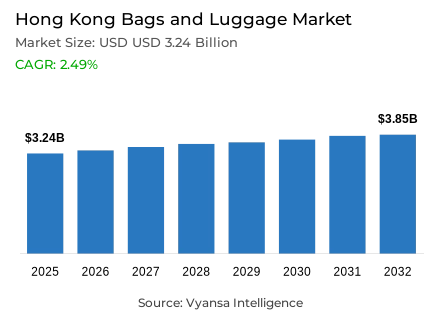
- Bags and luggage in Hong Kong is estimated at USD 3.24 billion in 2025.
- The market size is expected to grow to USD 3.85 billion by 2032.
- Market to register a cagr of around 2.49% during 2026-32.
- Category Shares
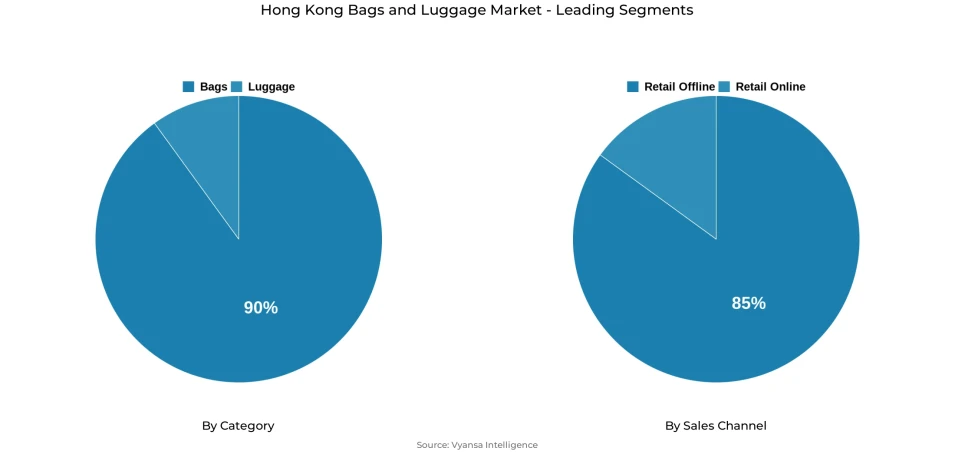
- Bags grabbed market share of 90%.
- Competition
- More than 20 companies are actively engaged in producing bags and luggage in Hong Kong.
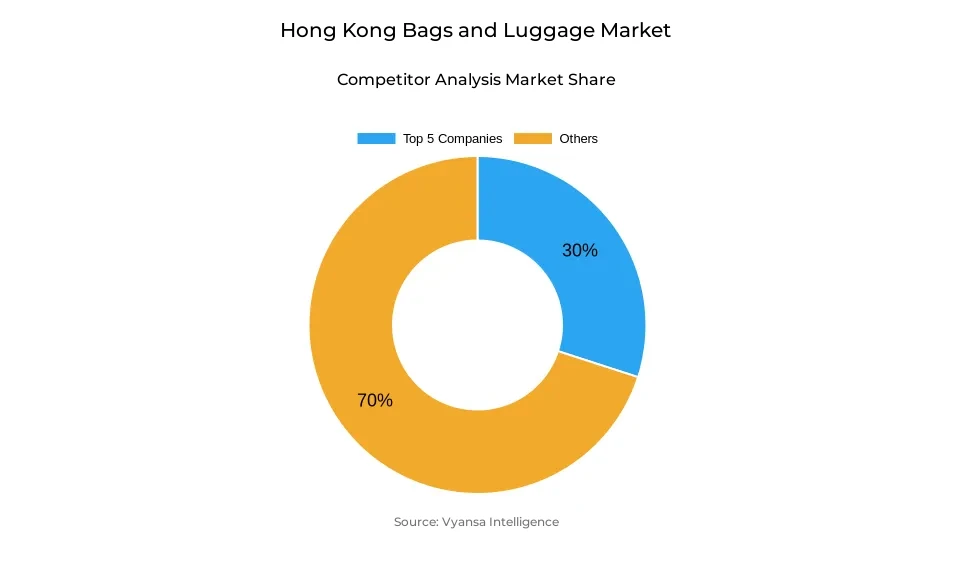
- Top 5 companies acquired around 30% of the market share.
- Prada Asia Pacific Ltd; Coach Hong Kong Ltd; Samsonite Asia Ltd; Louis Vuitton Hong Kong Ltd; LVMH Asia Pacific Ltd etc., are few of the top companies.
- Sales Channel
- Retail offline grabbed 85% of the market.
Hong Kong Bags and Luggage Market Outlook
Hong Kong, the bags and luggage market is projected to recover to a stable growth in 2026–32 following a poor performance in 2024, which was affected by the negative tourist spending and changing local consumption habits. In Hong Kong, bags and luggage are likely to amount to US$ 3.24 billion in 2025 with a further increase of US$ 3.85 billion by 2032 with a CAGR of about 2.49 billion. The recovery will be slow, with the assistance of stabilising travelling activity and partial recovery of visitor flows, yet spending behaviour is anticipated to be risk aversive.
Bags will still be the standard in the market with a share of around 90% of the total value. Although luxury handbags were under pressure owing to poor exchange rates and shopping abroad by tourists and other residents, the daily styles of handbags, including crossbody bags, will help in sustaining demand. The younger generation prefers smaller, practical, and stylish designs that could fit in the city and travel within a short distance, which makes versatility more significant than status-oriented buying.
The demand of luggage will be influenced by short-haul travel and weekend trips which will be the frequent reasons to use the low-cost carriers and growing connectivity with the surrounding cities. Small, light, and compressible types of luggage will probably have their day, as Hong Kong has a compact lifestyle, and airline baggage policies evolve. These operational factors will influence product development and buying choices over the forecasting period.
Distribution wise, retail offline will maintain an approximate market share of 85%. Physical stores are also relevant in the inspection of a product and brand trust, especially when the product is of higher value. Nevertheless, online will keep on supplementing offline sales, particularly of niche, foldable and second-hand products, and help the market grow overall by 2032.
Hong Kong Bags and Luggage Market Growth Driver
Increasing outbound travel spending by residents
Resident travel activity in Hong Kong continues to support demand for bags and luggage, as travel-related spending recovers in line with broader economic normalization. The Census and Statistics Department of Hong Kong reports that household spending on the outbound travel services was growing annually in 2024, which indicates the rediscovery of end users spending on travel-related services by end users after years of restrictions. This helps in sustaining minimum demand of travel goods needed to be used periodically in personal needs.
Also, the Hong Kong Monetary Authority reports that outbound payment transactions by credit cards continue to grow steadily, signaling more spending overseas by the residents. The more often outbound trips appear, the more end users are more focused on long-lasting and multipurpose bags and luggage that could be used during multiple trips instead of single-use travel.
Hong Kong Bags and Luggage Market Challenge
Price-sensitive consumption behaviour pressure
he end users demand of discretion goods is limited by the cautious spending behavior. According to the Census and Statistics Department of Hong Kong, the current volume of retail sales registered by the department remained volatile throughout the year 2024, indicating a dampened retail consumption amidst high living standards and economic insecurity. This is an environment where there is a lack of readiness to change or upgrade non-essential traveling accessories.
Simultaneously, the Hong Kong Monetary Authority emphasizes that the high interest rates continued to be the most prominent in the majority of 2024, which affected the financial choices of households. An increase in the cost of borrowing will stimulate savings rather than discretionary purchases, and demand bags and luggage is challenged, especially for higher-priced products that can be deferred.
Unlock Market Intelligence
Explore the market potential with our data-driven report
Hong Kong Bags and Luggage Market Trend
Shift to multifunctional everyday-use designs
The end users are shifting towards bags that can be used during travel and everyday use in the city. The Transport Department of Hong Kong suggests that as long as people are dependent on the transport system, compact and functional carrying options will be needed to facilitate commuting and short journeys. This justifies the need to have versatile designs which are not limited to the traditional travel only applications.
Meanwhile, the Census and Statistics Department provides that average living space is still limited, which supports the necessity to demand the items that will reduce the storage load. Bags that are multifunctional and adaptable to these constraints are compatible with them as they enable the end users to rationalise the purchase and still remain practical.
Hong Kong Bags and Luggage Market Opportunity
Reuse and repair culture based on sustainability
The policy of the government to encourage waste minimization opens a chance to alternative consumption models in bags and luggage. According to the Environmental Protection Department of Hong Kong, product reuse and lifespan extension presented in the Waste Blueprint of Hong Kong 2035 are considered fundamental pillars, with textiles and personal goods placed in the priorities category. This policy trend favors demand of durable and reusable products.
Moreover, according to the reports of the Council of Sustainable Development, the number of people who are becoming engaged in sustainable consumption practices is growing in surveys. This transformation favours the resale, recondition, and long life product positioning opportunities that allow market actors to match their offerings with the changing environmental demands.
Unlock Market Intelligence
Explore the market potential with our data-driven report
Hong Kong Bags and Luggage Market Segmentation Analysis
By Category
- Bags
- Cross Body Bags
- Bags and Backpacks
- Business Bags
- Duffle Bags
- Clutches
- Others
- Luggage
- Soft Luggage
- Hard Luggage
- Wheeled Luggage
- Non-Wheeled Luggage
The segment with the highest share in the Hong Kong bags and luggage market is bags, holding around 90% of the total market value. This dominance reflects the everyday relevance of bags across work, leisure, and travel, compared to luggage, which is purchased less frequently. Crossbody bags, shoulder bags, and compact everyday styles are particularly popular due to their practicality and alignment with urban lifestyles.
Over the forecast period, the bags segment is expected to maintain its leadership, supported by demand from younger end users seeking functional yet stylish designs. While new luxury handbag purchases may remain under pressure, interest in vintage and second-hand luxury bags will continue to support category value. Sustainability, uniqueness, and affordability are shaping preferences, reinforcing bags as the core revenue driver in Hong Kong’s bags and luggage market.
By Sales Channel
- Retail Offline
- Retail Online
The segment with the highest share under the sales channel category is retail offline, accounting for around 85% of the Hong Kong bags and luggage market. Physical retail remains central, particularly for luxury and premium products, as end users value the ability to assess quality, size, and craftsmanship in person.
During 2026–32, retail offline is expected to remain dominant, supported by tourist shopping districts and established retail hubs. At the same time, online channels will continue to grow alongside offline stores, especially for second-hand, niche, and trend-led products. This balanced omnichannel approach will allow brands and retailers to capture both convenience-driven and experience-focused shoppers, ensuring offline retail retains its leading position in Hong Kong.
List of Companies Covered in Hong Kong Bags and Luggage Market
The companies listed below are highly influential in the Hong Kong bags and luggage market, with a significant market share and a strong impact on industry developments.
- Prada Asia Pacific Ltd
- Coach Hong Kong Ltd
- Samsonite Asia Ltd
- Louis Vuitton Hong Kong Ltd
- LVMH Asia Pacific Ltd
- Hermès Asia Pacific Ltd
- Chanel HK Ltd
- Gucci Group (Hong Kong) Ltd
- Loewe Hong Kong Ltd
- Celine (Hong Kong) Ltd
Competitive Landscape
The bags and luggage market in Hong Kong in 2024 reflects a challenging competitive environment shaped by weaker tourist spending and changing consumer priorities. Luxury brands continue to face pressure as reduced mainland Chinese tourist demand and unfavourable exchange rates have softened sales, while local consumers increasingly divert spending towards overseas travel and experiences. In luggage, players such as MUJI and emerging brands like Jollying Pebble are gaining relevance by focusing on lightweight, foldable, and space-saving designs suited to frequent short-haul travel and compact urban living. In bags, mass and premium minimalist brands such as Uniqlo and COS remain influential among younger consumers through functional crossbody designs. Meanwhile, the growing presence of second-hand specialists, including Brand Off, is intensifying competition and reshaping demand dynamics within the luxury segment.
Frequently Asked Questions
Related Report
1. Market Segmentation
1.1. Research Scope
1.2. Research Methodology
1.3. Definitions and Assumptions
2. Executive Summary
3. Hong Kong Bags and Luggage Market Policies, Regulations, and Standards
4. Hong Kong Bags and Luggage Market Dynamics
4.1. Growth Factors
4.2. Challenges
4.3. Trends
4.4. Opportunities
5. Hong Kong Bags and Luggage Market Statistics, 2022-2032F
5.1. Market Size & Growth Outlook
5.1.1.By Revenues in USD Million
5.1.2.By Units Sold in Thousand Units
5.2. Market Segmentation & Growth Outlook
5.2.1.By Category
5.2.1.1. Bags- Market Insights and Forecast 2022-2032, USD Million
5.2.1.1.1. Cross Body Bags- Market Insights and Forecast 2022-2032, USD Million
5.2.1.1.2. Bags and Backpacks- Market Insights and Forecast 2022-2032, USD Million
5.2.1.1.3. Business Bags- Market Insights and Forecast 2022-2032, USD Million
5.2.1.1.4. Duffle Bags- Market Insights and Forecast 2022-2032, USD Million
5.2.1.1.5. Clutches- Market Insights and Forecast 2022-2032, USD Million
5.2.1.1.6. Others- Market Insights and Forecast 2022-2032, USD Million
5.2.1.2. Luggage- Market Insights and Forecast 2022-2032, USD Million
5.2.1.2.1. Soft Luggage- Market Insights and Forecast 2022-2032, USD Million
5.2.1.2.2. Hard Luggage- Market Insights and Forecast 2022-2032, USD Million
5.2.1.2.3. Wheeled Luggage- Market Insights and Forecast 2022-2032, USD Million
5.2.1.2.4. Non-Wheeled Luggage- Market Insights and Forecast 2022-2032, USD Million
5.2.2.By Sales Channel
5.2.2.1. Retail Offline- Market Insights and Forecast 2022-2032, USD Million
5.2.2.2. Retail Online- Market Insights and Forecast 2022-2032, USD Million
5.2.3.By Material Type
5.2.3.1. Soft Case- Market Insights and Forecast 2022-2032, USD Million
5.2.3.1.1. Nylon- Market Insights and Forecast 2022-2032, USD Million
5.2.3.1.2. Polyester- Market Insights and Forecast 2022-2032, USD Million
5.2.3.1.3. Ballistic Nylon- Market Insights and Forecast 2022-2032, USD Million
5.2.3.2. Hard Case- Market Insights and Forecast 2022-2032, USD Million
5.2.3.2.1. Polycarbonate- Market Insights and Forecast 2022-2032, USD Million
5.2.3.2.2. ABS (Acrylonitrile Butadiene Styrene)- Market Insights and Forecast 2022-2032, USD Million
5.2.3.2.3. Polypropylene- Market Insights and Forecast 2022-2032, USD Million
5.2.4.By Price Category
5.2.4.1. Luxury- Market Insights and Forecast 2022-2032, USD Million
5.2.4.2. Mass/Economy- Market Insights and Forecast 2022-2032, USD Million
5.2.4.3. Premium- Market Insights and Forecast 2022-2032, USD Million
5.2.5.By Application
5.2.5.1. Travel- Market Insights and Forecast 2022-2032, USD Million
5.2.5.2. Business- Market Insights and Forecast 2022-2032, USD Million
5.2.6.By Competitors
5.2.6.1. Competition Characteristics
5.2.6.2. Market Share & Analysis
6. Hong Kong Bags Market Statistics, 2022-2032
6.1. Market Size & Growth Outlook
6.1.1.By Revenues in USD Million
6.1.2.By Units Sold in Thousand Units
6.2. Market Segmentation & Growth Outlook
6.2.1.By Category- Market Insights and Forecast 2022-2032, USD Million
6.2.2.By Sales Channel- Market Insights and Forecast 2022-2032, USD Million
6.2.3.By Material Type- Market Insights and Forecast 2022-2032, USD Million
6.2.4.By Price Category- Market Insights and Forecast 2022-2032, USD Million
6.2.5.By Application- Market Insights and Forecast 2022-2032, USD Million
7. Hong Kong Luggage Market Statistics, 2022-2032
7.1. Market Size & Growth Outlook
7.1.1.By Revenues in USD Million
7.1.2.By Units Sold in Thousand Units
7.2. Market Segmentation & Growth Outlook
7.2.1.By Category- Market Insights and Forecast 2022-2032, USD Million
7.2.2.By Sales Channel- Market Insights and Forecast 2022-2032, USD Million
7.2.3.By Material Type- Market Insights and Forecast 2022-2032, USD Million
7.2.4.By Price Category- Market Insights and Forecast 2022-2032, USD Million
7.2.5.By Application- Market Insights and Forecast 2022-2032, USD Million
8. Competitive Outlook
8.1. Company Profiles
8.1.1.Louis Vuitton Hong Kong Ltd
8.1.1.1. Business Description
8.1.1.2. Product Portfolio
8.1.1.3. Collaborations & Alliances
8.1.1.4. Recent Developments
8.1.1.5. Financial Details
8.1.1.6. Others
8.1.2.LVMH Asia Pacific Ltd
8.1.2.1. Business Description
8.1.2.2. Product Portfolio
8.1.2.3. Collaborations & Alliances
8.1.2.4. Recent Developments
8.1.2.5. Financial Details
8.1.2.6. Others
8.1.3.Hermès Asia Pacific Ltd
8.1.3.1. Business Description
8.1.3.2. Product Portfolio
8.1.3.3. Collaborations & Alliances
8.1.3.4. Recent Developments
8.1.3.5. Financial Details
8.1.3.6. Others
8.1.4.Chanel HK Ltd
8.1.4.1. Business Description
8.1.4.2. Product Portfolio
8.1.4.3. Collaborations & Alliances
8.1.4.4. Recent Developments
8.1.4.5. Financial Details
8.1.4.6. Others
8.1.5.Gucci Group (Hong Kong) Ltd
8.1.5.1. Business Description
8.1.5.2. Product Portfolio
8.1.5.3. Collaborations & Alliances
8.1.5.4. Recent Developments
8.1.5.5. Financial Details
8.1.5.6. Others
8.1.6.Prada Asia Pacific Ltd
8.1.6.1. Business Description
8.1.6.2. Product Portfolio
8.1.6.3. Collaborations & Alliances
8.1.6.4. Recent Developments
8.1.6.5. Financial Details
8.1.6.6. Others
8.1.7.Coach Hong Kong Ltd
8.1.7.1. Business Description
8.1.7.2. Product Portfolio
8.1.7.3. Collaborations & Alliances
8.1.7.4. Recent Developments
8.1.7.5. Financial Details
8.1.7.6. Others
8.1.8.Samsonite Asia Ltd
8.1.8.1. Business Description
8.1.8.2. Product Portfolio
8.1.8.3. Collaborations & Alliances
8.1.8.4. Recent Developments
8.1.8.5. Financial Details
8.1.8.6. Others
8.1.9.Loewe Hong Kong Ltd
8.1.9.1. Business Description
8.1.9.2. Product Portfolio
8.1.9.3. Collaborations & Alliances
8.1.9.4. Recent Developments
8.1.9.5. Financial Details
8.1.9.6. Others
8.1.10. Celine (Hong Kong) Ltd
8.1.10.1. Business Description
8.1.10.2. Product Portfolio
8.1.10.3. Collaborations & Alliances
8.1.10.4. Recent Developments
8.1.10.5. Financial Details
8.1.10.6. Others
9. Disclaimer
| Segment | Sub-Segment |
|---|---|
| By Category |
|
| By Sales Channel |
|
| By Material Type |
|
| By Price Category |
|
| By Application |
|
Research Methodology
This study followed a structured approach comprising four key phases to assess the size and scope of the electro-oxidation market. The process began with thorough secondary research to collect data on the target market, related markets, and broader industry context. These findings, along with preliminary assumptions and estimates, were then validated through extensive primary research involving industry experts from across the value chain. To calculate the overall market size, both top-down and bottom-up methodologies were employed. Finally, market segmentation and data triangulation techniques were applied to refine and validate segment-level estimations.
Secondary Research
The secondary research phase involved gathering data from a wide range of credible and published sources. This step helped in identifying industry trends, defining market segmentation, and understanding the market landscape and value chain.
Sources consulted during this phase included:
- Company annual reports, investor presentations, and press releases
- Industry white papers and certified publications
- Trade directories and market-recognized databases
- Articles from authoritative authors and reputable journals
- Gold and silver standard websites
Secondary research was critical in mapping out the industry's value chain and monetary flow, identifying key market segments, understanding regional variations, and tracking significant industry developments.
Other key sources:
- Financial disclosures
- Industry associations and trade bodies
- News outlets and business magazines
- Academic journals and research studies
- Paid industry databases
Primary Research
To validate secondary data and gain deeper market insights, primary research was conducted with key stakeholders across both the supply and demand sides of the market.
On the demand side, participants included decision-makers and influencers from end-user industries—such as CIOs, CTOs, and CSOs—who provided first-hand perspectives on market needs, product usage, and future expectations.
On the supply side, interviews were conducted with manufacturers, industry associations, and institutional participants to gather insights into current offerings, product pipelines, and market challenges.
Primary interviews provided critical inputs such as:
- Market size and revenue data
- Product and service breakdowns
- Market forecasts
- Regional and application-specific trends
Stakeholders consulted included:
- Leading OEM and solution providers
- Channel and distribution partners
- End users across various applications
- Independent consultants and industry specialists
Market Size Estimation and Data Triangulation
- Identifying Key Market Participants (Secondary Research)
- Goal: To identify the major players or companies in the target market. This typically involves using publicly available data sources such as industry reports, market research publications, and financial statements of companies.
- Tools: Reports from firms like Gartner, Forrester, Euromonitor, Statista, IBISWorld, and others. Public financial statements, news articles, and press releases from top market players.
- Extracting Earnings of Key Market Participants
- Goal: To estimate the earnings generated from the product or service being analyzed. This step helps in understanding the revenue potential of each market player in a specific geography.
- Methods: Earnings data can be gathered from:
- Publicly available financial reports (for listed companies).
- Interviews and primary data sources from professionals, such as Directors, VPs, SVPs, etc. This is especially useful for understanding more nuanced, internal data that isn't publicly disclosed.
- Annual reports and investor presentations of key players.
- Data Collation and Development of a Relevant Data Model
- Goal: To collate inputs from both primary and secondary sources into a structured, data-driven model for market estimation. This model will incorporate key market KPIs and any independent variables relevant to the market.
- Key KPIs: These could include:
- Market size, growth rate, and demand drivers.
- Industry-specific metrics like market share, average revenue per customer (ARPC), or average deal size.
- External variables, such as economic growth rates, inflation rates, or commodity prices, that could affect the market.
- Data Modeling: Based on this data, the market forecasts are developed for the next 5 years. A combination of trend analysis, scenario modeling, and statistical regression might be used to generate projections.
- Scenario Analysis
- Goal: To test different assumptions and validate how sensitive the market is to changes in key variables (e.g., market demand, regulatory changes, technological disruptions).
- Types of Scenarios:
- Base Case: Based on current assumptions and historical data.
- Best-Case Scenario: Assuming favorable market conditions, regulatory environments, and technological advancements.
- Worst-Case Scenario: Accounting for adverse factors, such as economic downturns, stricter regulations, or unexpected disruptions.












