Germany Juice Market Report: Trends, Growth and Forecast (2026-2032)
By Category (100% Juice (Not from Concentrate, Reconstituted), Juice Drinks (up to 24% Juice), Nectars (High Concentration (40% to 50% fruit content), Medium Concentration (30% to 39% fruit content), Low Concentration (25% to 29% fruit content)), Vegetable Juice, Fruit and Vegetable Blends), By Nature (Conventional, Organic), By Packaging Material (Plastic, Glass, Metal, Others), By Packaging Type (PET Bottles, Aseptic Packages (Cartons), Glass Bottles, Metal Cans, Disposable Cups & Pouches), By Sales Channel (Off-Trade (Hypermarkets/ Supermarkets, Retail Outlets, Convenience Stores, Online Platforms), On-Trade) ... Read more

|
Major Players
|
Germany Juice Market Statistics and Insights, 2026
- Market Size Statistics
- Juice market size in Germany was estimated at USD 6.3 billion in 2025.
- The market size is expected to grow to USD 6.93 billion by 2032.
- Market to register a CAGR of around 1.37% during 2026-32.
- Category Shares
- 100% juice grabbed market share of 55%.
- Competition
- More than 15 companies are actively engaged in producing juice in Germany.
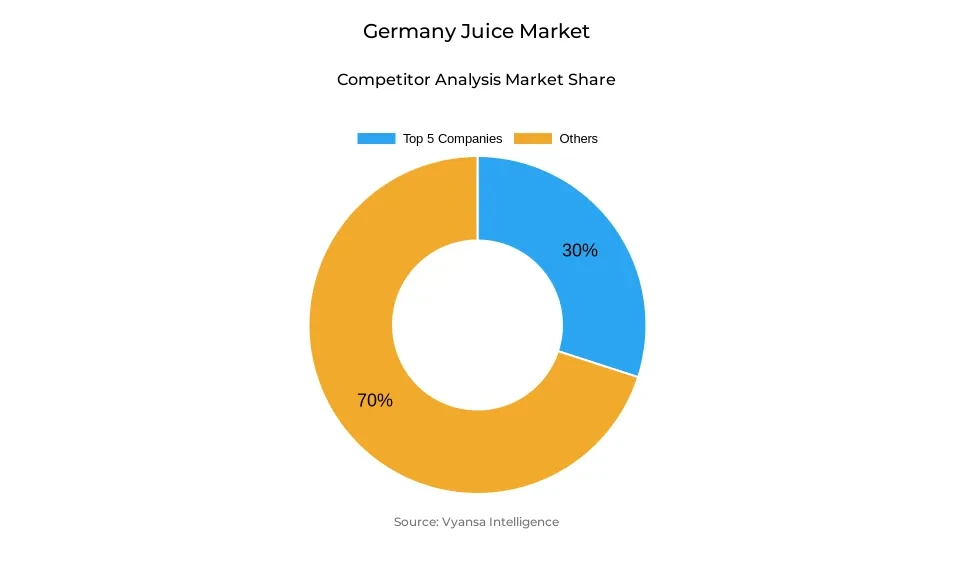
- Top 5 companies acquired around 30% of the market share.
- Rewe Markt GmbH, innocent Alps GmbH, Hermann Pfanner Getränke GmbH, Eckes-Granini Deutschland GmbH, Aldi Einkauf GmbH & Co oHG etc., are few of the top companies.
- Sales Channel
- Off-trade grabbed 75% of the market.
Germany Juice Market Outlook
The Germany juice market is still one of the most salient in Western Europe, with a long-standing tradition of high per capita consumption. The value of the market is strong, although the volume has been fluctuating due to health-conscious trends and sugar content concerns. The market is estimated to grow to 6.3 billion in 2025 and to 6.93 billion in 2032, with a CAGR of about 1.37% between 2026 and 2032. Premiumisation is driving this growth, and end user are perceiving juice as a natural immunity enhancer that is full of essential vitamins.
There is a major change with high prices of staples like orange juice pushing end user to less expensive options like juice drinks (up to 24% juice) which have the added advantage of a price advantage and a strong nostalgia trend. Such brands as Capri-Sun are able to appeal to adults who want to relive childhood and make juice a more acceptable, less glamorous luxury than a breakfast staple.
The main instrument that is being used to get the market out of stagnation is innovation. The majority of new products focus on the so-called juice shots, especially ginger-based immunity boosters, and functional blends, which include flavoured water to lower the total sugar and calorie content. Also, with climate change affecting the global supply chains, sustainable sourcing and transparent packaging are increasingly being given attention. Those brands that are able to integrate health benefits with aspirational, functional stories will be able to outperform the category average by 2032.
The retail environment is marked by the prevalence of value-based shopping, with the off-trade channels taking up 75% of the market. Aldi and Lidl discounters control more than half of the volume sales, but supermarkets are catching up with bigger assortments and price cuts. Although e-commerce is still a niche channel, new strategic alliances between delivery services and large supermarket chains will drive the digital expansion, which will keep juice very accessible to German households in a more omnichannel context.
Germany Juice Market Growth Driver
Wellness-Oriented Consumption Habits Sustaining Juice Relevance Through Natural and Functional Positioning
Juice continues to be a part of daily life since a significant number of German end user continue to relate it to natural products and easy vitamin consumption especially in 100% juice and juice-shot products. This is in line with the present-day standards of food preferences. According to the IN FORM summary of the 2025 BMLEH Nutrition Report, 90% of the participants find it important that food is healthy, and 98% of the participants find taste important.
This health-consciousness and a pleasant taste underpin the demand of juices that seem natural and functional, despite the increased shopper awareness of sugar and portions. It also discusses the reason why brands that emphasize vitamins, immunity signals, and cleaner ingredient stories remain popular in everyday events like breakfast.
Germany Juice Market Challenge
Juice-Specific Price Inflation Accelerating Trade-Down and Consumption Rationalisation
The main obstacle is still higher prices, which reflects the behaviour where shoppers switch to own-label, cut back consumption, and doubt brands when packaging or recipes change. According to official consumer price statistics provided by Destatis, fruit and vegetable juices increased by 8.8% in 2025 relative to 2024.
At the same time, customers are highly price-sensitive. The IN FORM summary of the 2025 BMLEH Nutrition Report shows that 59% of the respondents are concerned with getting food at a good price. Combined, these circumstances simplify the treatment of juice as a discretionary product and hasten the transition to less expensive juice beverages and nectars, thus continuing to put branded value and trust under pressure.
Unlock Market Intelligence
Explore the market potential with our data-driven report
Germany Juice Market Trend
Heightened Climate and Environmental Awareness Elevating Sustainability as a Purchase Filter
Sustainability is a more powerful purchase filter, which helps you to shift your content to innovation that emphasizes responsible sourcing and more resilient juice supply chains. The reason why this trend is now observable is depicted by public attitudes. In its press release dated 12 May 2025, the German Environment Agency, UBA, states that 54% of the respondents value environmental and climate protection as very important.
end user also experience the effects of climate directly. According to the same UBA release, two thirds of the respondents believe that their health is impaired during heatwaves, and 85% of them believe that there is an evident necessity to enhance protection against extreme heat. These signals increase the expectations of juice brands to communicate sustainability more explicitly and to support claims with plausible actions in packaging, ingredients, and sourcing.
Germany Juice Market Opportunity
High Online Shopping Penetration Expanding Digital Pathways for Convenient and Value-Focused Juice Consumption
The online shopping behavior opens a distinct avenue to expand juice via delivery and click-to-order collaboration, the Lieferando and Rewe tie-up and the convenience of single-serve packaging. According to the ICT survey of households, 86% of individuals aged 16 to 74 years in Germany bought online in 2025, according to Federal Statistical Office, Destatis.
This high number of online purchasers facilitates focused bundling and recurring buying cues of juices that compete based on convenience and worth, like multipacks to families or functional shots to adults. It also provides brands with a controlled digital shelf to regain trust by providing more transparent product information on pack sizes, juice content and ingredient changes after recent price-related confusion.
Unlock Market Intelligence
Explore the market potential with our data-driven report
Germany Juice Market Segmentation Analysis
By Category
- 100% Juice
- Not from Concentrate
- Reconstituted
- Juice Drinks (up to 24% Juice)
- Nectars
- High Concentration (40% to 50% fruit content)
- Medium Concentration (30% to 39% fruit content)
- Low Concentration (25% to 29% fruit content)
- Vegetable Juice
- Fruit and Vegetable Blends
The segment has the highest share around the category for the German juice market, where 100% Juice grabbed a market share of 55%. This segment retains its leading position because German end user highly value natural ingredients and the perceived health benefits of pure fruit juice, particularly as a source of vitamin C. Despite being under scrutiny for its natural sugar content, 100% juice is still viewed as a premium, healthy staple for family breakfasts, with trusted brands like Hohes C maintaining a strong presence in the minds of parents.
However, this segment is facing significant headwinds due to rising global orange prices, which have led some end user to trade down. To maintain relevance, manufacturers are innovating within the 100% format by introducing "juice shots" and functional immunity boosters. While categories like juice drinks and nectars are growing faster in volume terms due to their lower price points, the 100% juice segment is expected to remain the largest revenue pillar by catering to the enduring demand for authenticity and naturalness.

By Sales Channel
- Off-Trade
- Hypermarkets/ Supermarkets
- Retail Outlets
- Convenience Stores
- Online Platforms
- On-Trade
The segment has the highest share around the Sales Channel is Off-Trade, which grabbed 75% of the market. This dominance highlights that juice consumption in Germany is primarily home-based, with end user purchasing products as part of their regular grocery routines. Discounters serve as the backbone of this channel, accounting for over half of all retail volume sales. Shoppers frequently visit stores like Aldi and Lidl specifically for their affordable private label staples, which have consolidated their dominance amidst the recent wave of price increases.
While discounters lead on price, supermarkets and hypermarkets are the most dynamic sub-channels, gaining share through diverse product assortments and aggressive price promotions. These modern retailers are essential for the growth of niche and functional juice brands that require more shelf space to communicate their health benefits. Additionally, new digital partnerships are beginning to bridge the gap between physical retail and home delivery, ensuring the off-trade segment remains the powerhouse of the German juice merket through 2032.
List of Companies Covered in Germany Juice Market
The companies listed below are highly influential in the Germany juice market, with a significant market share and a strong impact on industry developments.
- Rewe Markt GmbH
- innocent Alps GmbH
- Hermann Pfanner Getränke GmbH
- Eckes-Granini Deutschland GmbH
- Aldi Einkauf GmbH & Co oHG
- Lidl Stiftung & Co KG
- Capri Sun GmbH
- Edeka Zentrale AG & Co KG
- Valensina GmbH
- Rauch Fruchtsäfte GmbH & Co OG
Competitive Landscape
Germany juice market is shaped by strong price competition and changing consumer trust, with private label retailers led by Aldi, Lidl, and Rewe strengthening their dominance through low prices and improving quality perceptions. Among branded players, Eckes Granini remains the leading manufacturer, supported by well known brands such as Hohes C and Granini, but continues to lose share due to declining 100 percent juice consumption, high orange prices, and consumer dissatisfaction with shrinkflation and recipe changes. Capri Sun has emerged as a dynamic challenger, benefiting from nostalgia driven demand and a clear price advantage in juice drinks with lower juice content. Indirect competition includes other beverages and reduced overall juice consumption. Key differentiation opportunities exist in transparent communication, reduced sugar innovation, functional juice shots, and sustainability led propositions.
Frequently Asked Questions
Related Report
1. Market Segmentation
1.1. Research Scope
1.2. Research Methodology
1.3. Definitions and Assumptions
2. Executive Summary
3. Germany Juice Market Policies, Regulations, and Standards
4. Germany Juice Market Dynamics
4.1. Growth Factors
4.2. Challenges
4.3. Trends
4.4. Opportunities
5. Germany Juice Market Statistics, 2022-2032F
5.1. Market Size & Growth Outlook
5.1.1.By Revenues in USD Million
5.1.2.By Quantity Sold in Million Litres
5.2. Market Segmentation & Growth Outlook
5.2.1.By Category
5.2.1.1. 100% Juice- Market Insights and Forecast 2022-2032, USD Million
5.2.1.1.1. Not from Concentrate- Market Insights and Forecast 2022-2032, USD Million
5.2.1.1.2. Reconstituted- Market Insights and Forecast 2022-2032, USD Million
5.2.1.2. Juice Drinks (up to 24% Juice)- Market Insights and Forecast 2022-2032, USD Million
5.2.1.3. Nectars- Market Insights and Forecast 2022-2032, USD Million
5.2.1.3.1. High Concentration (40% to 50% fruit content)- Market Insights and Forecast 2022-2032, USD Million
5.2.1.3.2. Medium Concentration (30% to 39% fruit content)- Market Insights and Forecast 2022-2032, USD Million
5.2.1.3.3. Low Concentration (25% to 29% fruit content)- Market Insights and Forecast 2022-2032, USD Million
5.2.1.4. Vegetable Juice- Market Insights and Forecast 2022-2032, USD Million
5.2.1.5. Fruit and Vegetable Blends- Market Insights and Forecast 2022-2032, USD Million
5.2.2.By Nature
5.2.2.1. Conventional- Market Insights and Forecast 2022-2032, USD Million
5.2.2.2. Organic- Market Insights and Forecast 2022-2032, USD Million
5.2.3.By Packaging Material
5.2.3.1. Plastic- Market Insights and Forecast 2022-2032, USD Million
5.2.3.2. Glass- Market Insights and Forecast 2022-2032, USD Million
5.2.3.3. Metal- Market Insights and Forecast 2022-2032, USD Million
5.2.3.4. Others- Market Insights and Forecast 2022-2032, USD Million
5.2.4.By Packaging Type
5.2.4.1. PET Bottles- Market Insights and Forecast 2022-2032, USD Million
5.2.4.2. Aseptic Packages (Cartons)- Market Insights and Forecast 2022-2032, USD Million
5.2.4.3. Glass Bottles- Market Insights and Forecast 2022-2032, USD Million
5.2.4.4. Metal Cans- Market Insights and Forecast 2022-2032, USD Million
5.2.4.5. Disposable Cups & Pouches- Market Insights and Forecast 2022-2032, USD Million
5.2.5.By Sales Channel
5.2.5.1. Off-Trade- Market Insights and Forecast 2022-2032, USD Million
5.2.5.1.1. Hypermarkets/ Supermarkets - Market Insights and Forecast 2022-2032, USD Million
5.2.5.1.2. Retail Outlets - Market Insights and Forecast 2022-2032, USD Million
5.2.5.1.3. Convenience Stores- Market Insights and Forecast 2022-2032, USD Million
5.2.5.1.4. Online Platforms- Market Insights and Forecast 2022-2032, USD Million
5.2.5.2. On-Trade- Market Insights and Forecast 2022-2032, USD Million
5.2.6.By Competitors
5.2.6.1. Competition Characteristics
5.2.6.2. Market Share & Analysis
6. Germany 100% Juice Market Statistics, 2022-2032
6.1. Market Size & Growth Outlook
6.1.1.By Revenues in USD Million
6.1.2.By Quantity Sold in Million Litres
6.2. Market Segmentation & Growth Outlook
6.2.1.By Nature- Market Insights and Forecast 2022-2032, USD Million
6.2.2.By Packaging Material- Market Insights and Forecast 2022-2032, USD Million
6.2.3.By Packaging Type- Market Insights and Forecast 2022-2032, USD Million
6.2.4.By Sales Channel- Market Insights and Forecast 2022-2032, USD Million
7. Germany Juice Drinks (up to 24% Juice) Market Statistics, 2022-2032
7.1. Market Size & Growth Outlook
7.1.1.By Revenues in USD Million
7.1.2.By Quantity Sold in Million Litres
7.2. Market Segmentation & Growth Outlook
7.2.1.By Nature- Market Insights and Forecast 2022-2032, USD Million
7.2.2.By Packaging Material- Market Insights and Forecast 2022-2032, USD Million
7.2.3.By Packaging Type- Market Insights and Forecast 2022-2032, USD Million
7.2.4.By Sales Channel- Market Insights and Forecast 2022-2032, USD Million
8. Germany Nectars Market Statistics, 2022-2032
8.1. Market Size & Growth Outlook
8.1.1.By Revenues in USD Million
8.1.2.By Quantity Sold in Million Litres
8.2. Market Segmentation & Growth Outlook
8.2.1.By Nature- Market Insights and Forecast 2022-2032, USD Million
8.2.2.By Packaging Material- Market Insights and Forecast 2022-2032, USD Million
8.2.3.By Packaging Type- Market Insights and Forecast 2022-2032, USD Million
8.2.4.By Sales Channel- Market Insights and Forecast 2022-2032, USD Million
9. Germany Vegetable Juice Market Statistics, 2022-2032
9.1. Market Size & Growth Outlook
9.1.1.By Revenues in USD Million
9.1.2.By Quantity Sold in Million Litres
9.2. Market Segmentation & Growth Outlook
9.2.1.By Nature- Market Insights and Forecast 2022-2032, USD Million
9.2.2.By Packaging Material- Market Insights and Forecast 2022-2032, USD Million
9.2.3.By Packaging Type- Market Insights and Forecast 2022-2032, USD Million
9.2.4.By Sales Channel- Market Insights and Forecast 2022-2032, USD Million
10. Germany Fruit and Vegetable Blends Market Statistics, 2022-2032
10.1. Market Size & Growth Outlook
10.1.1. By Revenues in USD Million
10.1.2. By Quantity Sold in Million Litres
10.2. Market Segmentation & Growth Outlook
10.2.1. By Nature- Market Insights and Forecast 2022-2032, USD Million
10.2.2. By Packaging Material- Market Insights and Forecast 2022-2032, USD Million
10.2.3. By Packaging Type- Market Insights and Forecast 2022-2032, USD Million
10.2.4. By Sales Channel- Market Insights and Forecast 2022-2032, USD Million
11. Competitive Outlook
11.1. Company Profiles
11.1.1. Eckes-Granini Deutschland GmbH
11.1.1.1. Business Description
11.1.1.2. Product Portfolio
11.1.1.3. Collaborations & Alliances
11.1.1.4. Recent Developments
11.1.1.5. Financial Details
11.1.1.6. Others
11.1.2. Aldi Einkauf GmbH & Co oHG
11.1.2.1. Business Description
11.1.2.2. Product Portfolio
11.1.2.3. Collaborations & Alliances
11.1.2.4. Recent Developments
11.1.2.5. Financial Details
11.1.2.6. Others
11.1.3. Lidl Stiftung & Co KG
11.1.3.1. Business Description
11.1.3.2. Product Portfolio
11.1.3.3. Collaborations & Alliances
11.1.3.4. Recent Developments
11.1.3.5. Financial Details
11.1.3.6. Others
11.1.4. Capri Sun GmbH
11.1.4.1. Business Description
11.1.4.2. Product Portfolio
11.1.4.3. Collaborations & Alliances
11.1.4.4. Recent Developments
11.1.4.5. Financial Details
11.1.4.6. Others
11.1.5. Edeka Zentrale AG & Co KG
11.1.5.1. Business Description
11.1.5.2. Product Portfolio
11.1.5.3. Collaborations & Alliances
11.1.5.4. Recent Developments
11.1.5.5. Financial Details
11.1.5.6. Others
11.1.6. Rewe Markt GmbH
11.1.6.1. Business Description
11.1.6.2. Product Portfolio
11.1.6.3. Collaborations & Alliances
11.1.6.4. Recent Developments
11.1.6.5. Financial Details
11.1.6.6. Others
11.1.7. innocent Alps GmbH
11.1.7.1. Business Description
11.1.7.2. Product Portfolio
11.1.7.3. Collaborations & Alliances
11.1.7.4. Recent Developments
11.1.7.5. Financial Details
11.1.7.6. Others
11.1.8. Pfanner Getränke GmbH
11.1.8.1. Business Description
11.1.8.2. Product Portfolio
11.1.8.3. Collaborations & Alliances
11.1.8.4. Recent Developments
11.1.8.5. Financial Details
11.1.8.6. Others
11.1.9. Valensina GmbH
11.1.9.1. Business Description
11.1.9.2. Product Portfolio
11.1.9.3. Collaborations & Alliances
11.1.9.4. Recent Developments
11.1.9.5. Financial Details
11.1.9.6. Others
11.1.10. Rauch Fruchtsäfte GmbH & Co OG
11.1.10.1.Business Description
11.1.10.2.Product Portfolio
11.1.10.3.Collaborations & Alliances
11.1.10.4.Recent Developments
11.1.10.5.Financial Details
11.1.10.6.Others
12. Disclaimer
| Segment | Sub-Segment |
|---|---|
| By Category |
|
| By Nature |
|
| By Packaging Material |
|
| By Packaging Type |
|
| By Sales Channel |
|
Research Methodology
This study followed a structured approach comprising four key phases to assess the size and scope of the electro-oxidation market. The process began with thorough secondary research to collect data on the target market, related markets, and broader industry context. These findings, along with preliminary assumptions and estimates, were then validated through extensive primary research involving industry experts from across the value chain. To calculate the overall market size, both top-down and bottom-up methodologies were employed. Finally, market segmentation and data triangulation techniques were applied to refine and validate segment-level estimations.
Secondary Research
The secondary research phase involved gathering data from a wide range of credible and published sources. This step helped in identifying industry trends, defining market segmentation, and understanding the market landscape and value chain.
Sources consulted during this phase included:
- Company annual reports, investor presentations, and press releases
- Industry white papers and certified publications
- Trade directories and market-recognized databases
- Articles from authoritative authors and reputable journals
- Gold and silver standard websites
Secondary research was critical in mapping out the industry's value chain and monetary flow, identifying key market segments, understanding regional variations, and tracking significant industry developments.
Other key sources:
- Financial disclosures
- Industry associations and trade bodies
- News outlets and business magazines
- Academic journals and research studies
- Paid industry databases
Primary Research
To validate secondary data and gain deeper market insights, primary research was conducted with key stakeholders across both the supply and demand sides of the market.
On the demand side, participants included decision-makers and influencers from end-user industries—such as CIOs, CTOs, and CSOs—who provided first-hand perspectives on market needs, product usage, and future expectations.
On the supply side, interviews were conducted with manufacturers, industry associations, and institutional participants to gather insights into current offerings, product pipelines, and market challenges.
Primary interviews provided critical inputs such as:
- Market size and revenue data
- Product and service breakdowns
- Market forecasts
- Regional and application-specific trends
Stakeholders consulted included:
- Leading OEM and solution providers
- Channel and distribution partners
- End users across various applications
- Independent consultants and industry specialists
Market Size Estimation and Data Triangulation
- Identifying Key Market Participants (Secondary Research)
- Goal: To identify the major players or companies in the target market. This typically involves using publicly available data sources such as industry reports, market research publications, and financial statements of companies.
- Tools: Reports from firms like Gartner, Forrester, Euromonitor, Statista, IBISWorld, and others. Public financial statements, news articles, and press releases from top market players.
- Extracting Earnings of Key Market Participants
- Goal: To estimate the earnings generated from the product or service being analyzed. This step helps in understanding the revenue potential of each market player in a specific geography.
- Methods: Earnings data can be gathered from:
- Publicly available financial reports (for listed companies).
- Interviews and primary data sources from professionals, such as Directors, VPs, SVPs, etc. This is especially useful for understanding more nuanced, internal data that isn't publicly disclosed.
- Annual reports and investor presentations of key players.
- Data Collation and Development of a Relevant Data Model
- Goal: To collate inputs from both primary and secondary sources into a structured, data-driven model for market estimation. This model will incorporate key market KPIs and any independent variables relevant to the market.
- Key KPIs: These could include:
- Market size, growth rate, and demand drivers.
- Industry-specific metrics like market share, average revenue per customer (ARPC), or average deal size.
- External variables, such as economic growth rates, inflation rates, or commodity prices, that could affect the market.
- Data Modeling: Based on this data, the market forecasts are developed for the next 5 years. A combination of trend analysis, scenario modeling, and statistical regression might be used to generate projections.
- Scenario Analysis
- Goal: To test different assumptions and validate how sensitive the market is to changes in key variables (e.g., market demand, regulatory changes, technological disruptions).
- Types of Scenarios:
- Base Case: Based on current assumptions and historical data.
- Best-Case Scenario: Assuming favorable market conditions, regulatory environments, and technological advancements.
- Worst-Case Scenario: Accounting for adverse factors, such as economic downturns, stricter regulations, or unexpected disruptions.












