GCC Bottled Water Market Report: Trends, Growth and Forecast (2026-2032)
By Type of Water (Carbonated Bottled Water, Flavoured Bottled Water, Functional Bottled Water, Still Bottled Water), By Sub Types (Purified (Desalinated, Atmospheric Generated, Others), Mineral, Other (Spring, Alkaline, Other)), By Packaging Material (Flexible Packaging (Aluminium, Pouches), Glass, Rigid Plastic (PET Bottles, Thin Wall Plastic Containers, Others)), By Price Category (Budget, Economy, Premium), By Pack Size (100 ml, 125 ml, 200 ml, 250 ml, 330 ml, 370 ml, 450 ml, 500 ml, 591 ml, 750 ml, 1,000 ml, 1,500 ml, 4,000 ml, 5,000 ml, Others), By Sales Channel (On Trade (Restaurants, Hotels, Cafes, Others), Off Trade (Grocery Retailers (Convenience Retail, Supermarkets, Hypermarkets, Small Local Grocer), Non-Grocery Retailers (General Merchandise Stores, Vending), Vending, E-commerce)), By Country (Saudi Arabia, United Arab Emirates, Qatar, Oman, Kuwait, Bahrain) ... Read more
|
Major Players
|
GCC Bottled Water Market Statistics and Insights, 2026
- Market Size Statistics
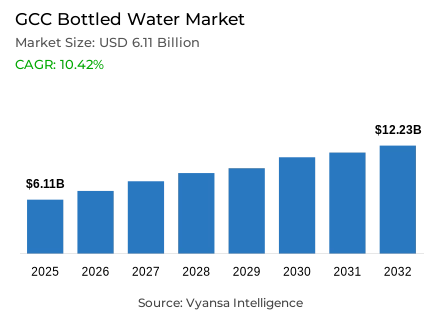
- Bottled water market size in GCC was valued at USD 6.11 billion in 2025 and is estimated at USD 6.83 Billion in 2026.
- The market size is expected to grow to USD 12.23 billion by 2032.
- Market to register a CAGR of around 10.42% during 2026-32.
- Type of Water Shares
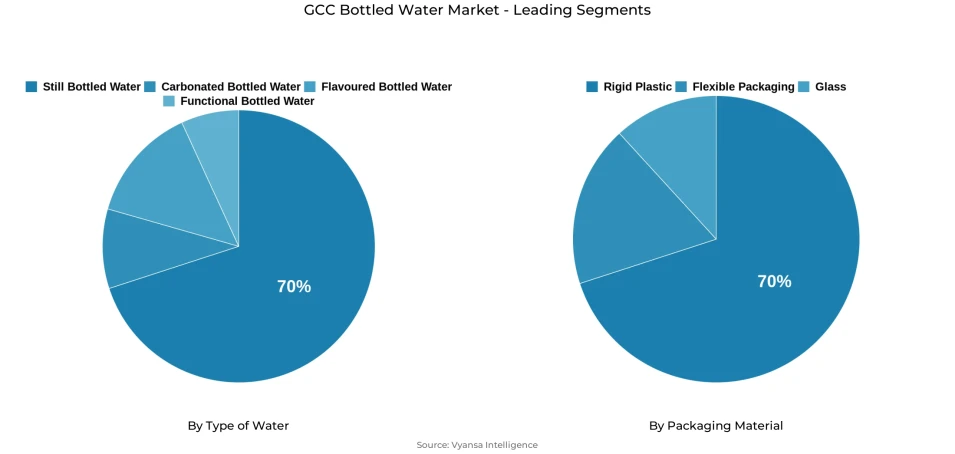
- Still bottled water grabbed market share of 70%.
- Competition
- More than 10 companies are actively engaged in producing bottled water in GCC.
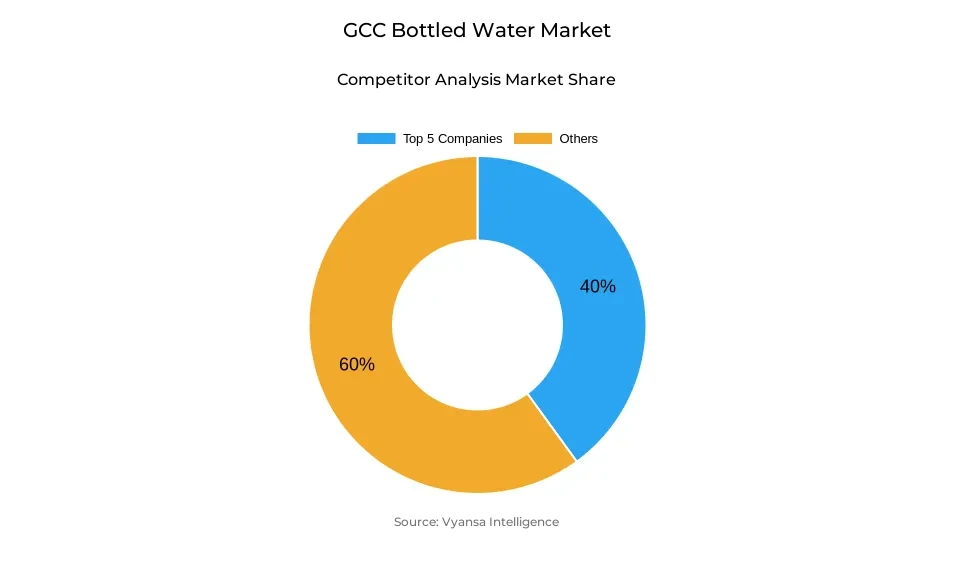
- Top 5 companies acquired around 40% of the market share.
- Berain Water, Nova Water, Almarai Company, Agitha Group PJSC, Masafi LLC etc., are few of the top companies.
- Packaging Material
- Rigid Plastic grabbed 70% of the market.
- Country
- Saudi Arabia leads with a 40% share of the GCC market.
GCC Bottled Water Market Outlook
The GCC Bottled Water Market was valued at USD 6.11 billion in 2025 and is projected to grow from USD 6.83 billion in 2026 to USD 12.23 billion by 2032, reflecting a compound annual growth rate of 10.42% during the forecast period. Structural water scarcity, the rising population base, and the rising need to have convenient hydration solutions in homes and business settings are some of the factors that support market expansion. GCC-Stat states that the population of the region was 61.5 million in 2024, and the volume of desalinated water was 7.2 billion cubic metres in 2023, which indicates the high dependence on artificial water supply systems across GCC nations.
The water usage habits are directly related to the daily hydration requirements in an area with arid climatic conditions. The World Bank notes that water availability across the broader Middle East and North Africa region averages only 480 cubic metres per person annually, which is less than 10% of the global average. This water pressure in the structure reinforces the significance of bottled water as a reliable source of drinking water to the residents, travellers and commercial outlets.
Within the product landscape, still bottled water accounts for 70% of the market. Its leadership is an indication of the high demand of plain drinking water by end users that promotes daily hydration at home, work, shopping centers, and hospitality settings. Since still water meets the daily consumption requirements without any extra flavours or carbonation, it is the most consumed type across the GCC countries.
The preferences of packaging are also highly concentrated. Rigid plastic bottles hold approximately 70% of the market, highlighting their importance in distribution and product availability. This packaging format facilitates effective transportation and shelf life in supermarkets, convenience stores and institutional supply channels. As the growth and sustainability efforts in the tourism industry continue to gain traction, the GCC bottled water market is projected to keep growing until 2032.
GCC Bottled Water Market Growth DriverWater Security and Everyday Hydration Needs
Structural water scarcity across the GCC remains a major driver supporting bottled water demand. The region relies heavily on desalination and engineered water infrastructure to meet consumption needs, making packaged drinking water an important complement to municipal water supply systems.
According to GCC-Stat, desalinated water production reaches 7.2 billion cubic meters in 2023, while per-capita desalinated water output equals 333.9 liters per day. The region also has a growing end user base, with GCC population reaching 61.5 million in 2024. In parallel, the World Bank reports that water availability in the wider MENA region averages 480 cubic meters per person per year, far below global averages. In this context, bottled water remains closely linked to reliable drinking supply, convenience, and perceived water quality across households, workplaces, and hospitality venues.
GCC Bottled Water Market ChallengePlastic Waste Management Pressure
The problem of plastic packaging waste is emerging as a major concern to the bottled water industry in the GCC. With the increase in the consumption of bottled water, the use of single-use plastic packaging is becoming increasingly scrutinized by regulations and the environment. The World Bank estimates that the MENA region produces over 155 million tonnes of waste each year, with the average waste production of 0.9 kg per capita per day, which is higher than the global average of 0.79 kg.
However, less than 10% of waste is recycled, reused, or composted. The same assessment indicates that 67% of waste is mismanaged, resulting in USD 7.2 billion in annual environmental damage across the region. Due to the close relationship between bottled water products and plastic packaging, manufacturers are increasingly under pressure to enhance material efficiency, recycling, and packaging sustainability.
Unlock Market Intelligence
Explore the market potential with our data-driven report
GCC Bottled Water Market TrendCircular Packaging Moves into Focus
The use of circular packaging systems is gaining momentum in the GCC bottled water industry. Regulatory bodies and governments are starting to implement technical requirements and policy frameworks that promote more sustainable packaging practices. On 14 October 2024, the GCC Standardisation Organisation (GSO) approves GSO 2767:2024, which sets standards on plastic caps in drinking water bottles. This action is indicative of a wider trend of standardisation of packaging in the region.
There is also policy support on circular economy initiatives. In September 2025, the UAE Ministry of Climate Change and Environment opens Tahweel, the first national recyclable materials digital marketplace in the country. The program is outlined as one of the transformational projects of the UAE government in 20242025, with the increased interest of the region in recycling and packaging recovery systems.
GCC Bottled Water Market OpportunityTravel and Hospitality Create New Consumption Occasions
The development of tourism in the GCC presents a major market in the consumption of bottled water. Hotels, airports, restaurants, and tourism sites create a steady demand of on-the-go hydration products, which increases the number of consumption occasions beyond the traditional household use. The GCC-Stat Tourism Platform shows that in 2024, the GCC registered 72.2 million inbound tourists, 103.4 million domestic tourists, and 29.8 million intra-GCC travellers.
Employment is also supported by this large tourism ecosystem, where 1.7 million individuals were employed in the tourism sector in 2024. The travel flows provide avenues through which the bottled water brands can grow premium products, convenience packs, and hospitality relationships with hotels, airlines, transport terminals, and event centers across the GCC region.
GCC Bottled Water Market Country Analysis
By Country
- Saudi Arabia
- United Arab Emirates
- Qatar
- Oman
- Kuwait
- Bahrain
Saudi Arabia holds the largest share of the GCC Bottled Water Market, accounting for approximately 40% of regional demand. This leadership is indicative of the high population base, good retail infrastructure and the large hospitality industry in the country. Saudi Arabia is the biggest economy and the most populous nation in the region, which makes it a key player in determining the general trend of bottled water consumption in the GCC.
Bottled water demand is also supported by tourism activity in the country. GCC-Stat shows that Saudi Arabia had the highest number of tourist arrivals in 2023 with 27.4 million arrivals, compared to other GCC countries in the yearbook dataset. These tourist movements create bottled water sales in hotels, restaurants, airports, and pilgrimage paths. Consequently, Saudi Arabia has been the major contributor to GCC bottled water demand due to its size, hospitality business, and high end user population.
Unlock Market Intelligence
Explore the market potential with our data-driven report
GCC Bottled Water Market Segmentation Analysis
By Type of Water
- Carbonated Bottled Water
- Flavoured Bottled Water
- Functional Bottled Water
- Still Bottled Water
The segment with the highest share under Type of Water is still bottled water, accounting for 70% of the market. This leadership is based on the high end user preference of plain drinking water that meets the daily hydration requirements in the GCC countries. Still bottled water is consumed extensively due to its simplicity as a hydration solution and its universal appeal without any added flavours or carbonation. Its wide use in various consumption environments, such as households, workplaces, retail stores, and hospitality establishments, enhances its position in the market.
The category also promotes bulk consumption habits, where households and business buyers buy bottled water in large quantities to use on a regular basis. Since still water is the central hydration product in the entire region, it still determines the product availability, retail presence, and general consumption trends in the GCC bottled water market.
By Packaging Material
- Flexible Packaging
- Aluminium
- Pouches
- Glass
- Rigid Plastic
- PET Bottles
- Thin Wall Plastic Containers
- Others
Under Packaging Material, Rigid Plastic bottles account for approximately 70% of the market. This format remains dominant because it supports large-scale distribution and everyday product accessibility across the GCC.
Rigid plastic bottles are lightweight, durable, and easy to transport, making them well suited for high-volume retail distribution and institutional supply chains. The packaging format also accommodates a wide variety of bottle sizes, ranging from small on-the-go bottles to large multi-liter containers used in homes and offices. Because rigid plastic packaging supports efficient logistics and widespread retail availability, it continues to shape packaging strategy across the GCC bottled water industry.
Various Market Players in GCC Bottled Water Market
The companies mentioned below are highly active in the GCC bottled water market, occupying a considerable portion of the market and shaping industry progress.
- Berain Water
- Nova Water
- Almarai Company
- Agitha Group PJSC
- Masafi LLC
- The Coca-Cola Company
- Mai Dubai LLC
- Hana Food Industries Co.
- Crystal Mineral Water and Refreshments LLC
- Al Furat Drinking Water LLC
- Al-Rawdatain Water Bottling Co.
- Rayyan Mineral Water Company (Qatar)
Market News & Updates
- The Coca-Cola Company, 2025:
Coca-Cola Middle East’s introduction of 100% rPET products in the UAE and Qatar stands out as one of the clearest 2025 packaging innovations among the listed GCC players. Its market impact is important because the move supports circular-packaging adoption in two GCC bottled-water markets and raises the competitive bar for sustainability-led bottled water and hydration portfolios across the region.
- The Naqi Water Co., 2025:
Naqi’s decision to invest in a new Riyadh bottled-water production line with roughly 50% more capacity than its main plant is also a notable GCC development because Saudi Arabia is the region’s largest consumer base. The expansion supports greater scale in mainstream packaged water and can strengthen off-trade and direct-delivery supply in the wider GCC bottled water landscape.
Frequently Asked Questions
Related Report
- Market Segmentation
- Research Scope
- Research Methodology
- Definitions and Assumptions
- Executive Summary
- GCC Bottled Water Market Policies, Regulations, and Standards
- GCC Bottled Water Market Dynamics
- Growth Factors
- Challenges
- Trends
- Opportunities
- GCC Bottled Water Market Statistics, 2022-2032F
- Market Size & Growth Outlook
- By Revenues in USD Million
- By Volume (Million Litres)
- Market Segmentation & Growth Outlook
- By Type of Water
- Carbonated Bottled Water- Market Insights and Forecast 2022-2032, USD Million
- Flavoured Bottled Water- Market Insights and Forecast 2022-2032, USD Million
- Functional Bottled Water- Market Insights and Forecast 2022-2032, USD Million
- Still Bottled Water- Market Insights and Forecast 2022-2032, USD Million
- By Sub Types
- Purified- Market Insights and Forecast 2022-2032, USD Million
- Desalinated- Market Insights and Forecast 2022-2032, USD Million
- Atmospheric Generated- Market Insights and Forecast 2022-2032, USD Million
- Others- Market Insights and Forecast 2022-2032, USD Million
- Mineral- Market Insights and Forecast 2022-2032, USD Million
- Other (Spring, Alkaline, Other)- Market Insights and Forecast 2022-2032, USD Million
- Purified- Market Insights and Forecast 2022-2032, USD Million
- By Packaging Material
- Flexible Packaging- Market Insights and Forecast 2022-2032, USD Million
- Aluminium- Market Insights and Forecast 2022-2032, USD Million
- Pouches- Market Insights and Forecast 2022-2032, USD Million
- Glass- Market Insights and Forecast 2022-2032, USD Million
- Rigid Plastic- Market Insights and Forecast 2022-2032, USD Million
- PET Bottles- Market Insights and Forecast 2022-2032, USD Million
- Thin Wall Plastic Containers- Market Insights and Forecast 2022-2032, USD Million
- Others- Market Insights and Forecast 2022-2032, USD Million
- Flexible Packaging- Market Insights and Forecast 2022-2032, USD Million
- By Price Category
- Budget- Market Insights and Forecast 2022-2032, USD Million
- Economy- Market Insights and Forecast 2022-2032, USD Million
- Premium- Market Insights and Forecast 2022-2032, USD Million
- By Pack Size
- 100 ml- Market Insights and Forecast 2022-2032, USD Million
- 125 ml- Market Insights and Forecast 2022-2032, USD Million
- 200 ml- Market Insights and Forecast 2022-2032, USD Million
- 250 ml- Market Insights and Forecast 2022-2032, USD Million
- 330 ml- Market Insights and Forecast 2022-2032, USD Million
- 370 ml- Market Insights and Forecast 2022-2032, USD Million
- 450 ml- Market Insights and Forecast 2022-2032, USD Million
- 500 ml- Market Insights and Forecast 2022-2032, USD Million
- 591 ml- Market Insights and Forecast 2022-2032, USD Million
- 750 ml- Market Insights and Forecast 2022-2032, USD Million
- 1,000 ml- Market Insights and Forecast 2022-2032, USD Million
- 1,500 ml- Market Insights and Forecast 2022-2032, USD Million
- 4,000 ml- Market Insights and Forecast 2022-2032, USD Million
- 5,000 ml- Market Insights and Forecast 2022-2032, USD Million
- Others- Market Insights and Forecast 2022-2032, USD Million
- By Sales Channel
- On Trade- Market Insights and Forecast 2022-2032, USD Million
- Restaurants- Market Insights and Forecast 2022-2032, USD Million
- Hotels- Market Insights and Forecast 2022-2032, USD Million
- Cafes- Market Insights and Forecast 2022-2032, USD Million
- Others- Market Insights and Forecast 2022-2032, USD Million
- Off Trade- Market Insights and Forecast 2022-2032, USD Million
- Grocery Retailers- Market Insights and Forecast 2022-2032, USD Million
- Convenience Retail- Market Insights and Forecast 2022-2032, USD Million
- Supermarkets- Market Insights and Forecast 2022-2032, USD Million
- Hypermarkets- Market Insights and Forecast 2022-2032, USD Million
- Small Local Grocer- Market Insights and Forecast 2022-2032, USD Million
- Non-Grocery Retailers- Market Insights and Forecast 2022-2032, USD Million
- General Merchandise Stores- Market Insights and Forecast 2022-2032, USD Million
- Vending- Market Insights and Forecast 2022-2032, USD Million
- Vending- Market Insights and Forecast 2022-2032, USD Million
- E-commerce- Market Insights and Forecast 2022-2032, USD Million
- Grocery Retailers- Market Insights and Forecast 2022-2032, USD Million
- On Trade- Market Insights and Forecast 2022-2032, USD Million
- By Country
- Saudi Arabia
- United Arab Emirates
- Qatar
- Oman
- Kuwait
- Bahrain
- By Competitors
- Competition Characteristics
- Market Share & Analysis
- By Type of Water
- Market Size & Growth Outlook
- Saudi Arabia Bottled Water Market Statistics, 2022-2032F
- Market Size & Growth Outlook
- By Revenues in USD Million
- By Volume (Million Litres)
- Market Segmentation & Growth Outlook
- By Type of Water- Market Insights and Forecast 2022-2032, USD Million
- By Sub Types- Market Insights and Forecast 2022-2032, USD Million
- By Packaging Material- Market Insights and Forecast 2022-2032, USD Million
- By Price Category- Market Insights and Forecast 2022-2032, USD Million
- By Pack Size- Market Insights and Forecast 2022-2032, USD Million
- By Sales Channel- Market Insights and Forecast 2022-2032, USD Million
- Market Size & Growth Outlook
- United Arab Emirates Bottled Water Market Statistics, 2022-2032F
- Market Size & Growth Outlook
- By Revenues in USD Million
- By Volume (Million Litres)
- Market Segmentation & Growth Outlook
- By Type of Water- Market Insights and Forecast 2022-2032, USD Million
- By Sub Types- Market Insights and Forecast 2022-2032, USD Million
- By Packaging Material- Market Insights and Forecast 2022-2032, USD Million
- By Price Category- Market Insights and Forecast 2022-2032, USD Million
- By Pack Size- Market Insights and Forecast 2022-2032, USD Million
- By Sales Channel- Market Insights and Forecast 2022-2032, USD Million
- Market Size & Growth Outlook
- Qatar Bottled Water Market Statistics, 2022-2032F
- Market Size & Growth Outlook
- By Revenues in USD Million
- By Volume (Million Litres)
- Market Segmentation & Growth Outlook
- By Type of Water- Market Insights and Forecast 2022-2032, USD Million
- By Sub Types- Market Insights and Forecast 2022-2032, USD Million
- By Packaging Material- Market Insights and Forecast 2022-2032, USD Million
- By Price Category- Market Insights and Forecast 2022-2032, USD Million
- By Pack Size- Market Insights and Forecast 2022-2032, USD Million
- By Sales Channel- Market Insights and Forecast 2022-2032, USD Million
- Market Size & Growth Outlook
- Oman Bottled Water Market Statistics, 2022-2032F
- Market Size & Growth Outlook
- By Revenues in USD Million
- By Volume (Million Litres)
- Market Segmentation & Growth Outlook
- By Type of Water- Market Insights and Forecast 2022-2032, USD Million
- By Sub Types- Market Insights and Forecast 2022-2032, USD Million
- By Packaging Material- Market Insights and Forecast 2022-2032, USD Million
- By Price Category- Market Insights and Forecast 2022-2032, USD Million
- By Pack Size- Market Insights and Forecast 2022-2032, USD Million
- By Sales Channel- Market Insights and Forecast 2022-2032, USD Million
- Market Size & Growth Outlook
- Kuwait Bottled Water Market Statistics, 2022-2032F
- Market Size & Growth Outlook
- By Revenues in USD Million
- By Volume (Million Litres)
- Market Segmentation & Growth Outlook
- By Type of Water- Market Insights and Forecast 2022-2032, USD Million
- By Sub Types- Market Insights and Forecast 2022-2032, USD Million
- By Packaging Material- Market Insights and Forecast 2022-2032, USD Million
- By Price Category- Market Insights and Forecast 2022-2032, USD Million
- By Pack Size- Market Insights and Forecast 2022-2032, USD Million
- By Sales Channel- Market Insights and Forecast 2022-2032, USD Million
- Market Size & Growth Outlook
- Bahrain Bottled Water Market Statistics, 2022-2032F
- Market Size & Growth Outlook
- By Revenues in USD Million
- By Volume (Million Litres)
- Market Segmentation & Growth Outlook
- By Type of Water- Market Insights and Forecast 2022-2032, USD Million
- By Sub Types- Market Insights and Forecast 2022-2032, USD Million
- By Packaging Material- Market Insights and Forecast 2022-2032, USD Million
- By Price Category- Market Insights and Forecast 2022-2032, USD Million
- By Pack Size- Market Insights and Forecast 2022-2032, USD Million
- By Sales Channel- Market Insights and Forecast 2022-2032, USD Million
- Market Size & Growth Outlook
- Competitive Outlook
- Company Profiles
- Agitha Group PJSC
- Business Description
- Product Portfolio
- Collaborations & Alliances
- Recent Developments
- Financial Details
- Others
- Masafi LLC
- Business Description
- Product Portfolio
- Collaborations & Alliances
- Recent Developments
- Financial Details
- Others
- The Coca-Cola Company
- Business Description
- Product Portfolio
- Collaborations & Alliances
- Recent Developments
- Financial Details
- Others
- Mai Dubai LLC
- Business Description
- Product Portfolio
- Collaborations & Alliances
- Recent Developments
- Financial Details
- Others
- Hana Food Industries Co.
- Business Description
- Product Portfolio
- Collaborations & Alliances
- Recent Developments
- Financial Details
- Others
- Berain Water
- Business Description
- Product Portfolio
- Collaborations & Alliances
- Recent Developments
- Financial Details
- Others
- Nova Water
- Business Description
- Product Portfolio
- Collaborations & Alliances
- Recent Developments
- Financial Details
- Others
- Almarai Company
- Business Description
- Product Portfolio
- Collaborations & Alliances
- Recent Developments
- Financial Details
- Others
- Crystal Mineral Water and Refreshments LLC
- Business Description
- Product Portfolio
- Collaborations & Alliances
- Recent Developments
- Financial Details
- Others
- Al Furat Drinking Water LLC
- Business Description
- Product Portfolio
- Collaborations & Alliances
- Recent Developments
- Financial Details
- Others
- Al-Rawdatain Water Bottling Co.
- Business Description
- Product Portfolio
- Collaborations & Alliances
- Recent Developments
- Financial Details
- Others
- Rayyan Mineral Water Company (Qatar)
- Business Description
- Product Portfolio
- Collaborations & Alliances
- Recent Developments
- Financial Details
- Others
- Agitha Group PJSC
- Company Profiles
- Disclaimer
| Segment | Sub-Segment |
|---|---|
| By Type of Water |
|
| By Sub Types |
|
| By Packaging Material |
|
| By Price Category |
|
| By Pack Size |
|
| By Sales Channel |
|
| By Country |
|
Research Methodology
This study followed a structured approach comprising four key phases to assess the size and scope of the electro-oxidation market. The process began with thorough secondary research to collect data on the target market, related markets, and broader industry context. These findings, along with preliminary assumptions and estimates, were then validated through extensive primary research involving industry experts from across the value chain. To calculate the overall market size, both top-down and bottom-up methodologies were employed. Finally, market segmentation and data triangulation techniques were applied to refine and validate segment-level estimations.
Secondary Research
The secondary research phase involved gathering data from a wide range of credible and published sources. This step helped in identifying industry trends, defining market segmentation, and understanding the market landscape and value chain.
Sources consulted during this phase included:
- Company annual reports, investor presentations, and press releases
- Industry white papers and certified publications
- Trade directories and market-recognized databases
- Articles from authoritative authors and reputable journals
- Gold and silver standard websites
Secondary research was critical in mapping out the industry's value chain and monetary flow, identifying key market segments, understanding regional variations, and tracking significant industry developments.
Other key sources:
- Financial disclosures
- Industry associations and trade bodies
- News outlets and business magazines
- Academic journals and research studies
- Paid industry databases
Primary Research
To validate secondary data and gain deeper market insights, primary research was conducted with key stakeholders across both the supply and demand sides of the market.
On the demand side, participants included decision-makers and influencers from end-user industries—such as CIOs, CTOs, and CSOs—who provided first-hand perspectives on market needs, product usage, and future expectations.
On the supply side, interviews were conducted with manufacturers, industry associations, and institutional participants to gather insights into current offerings, product pipelines, and market challenges.
Primary interviews provided critical inputs such as:
- Market size and revenue data
- Product and service breakdowns
- Market forecasts
- Regional and application-specific trends
Stakeholders consulted included:
- Leading OEM and solution providers
- Channel and distribution partners
- End users across various applications
- Independent consultants and industry specialists
Market Size Estimation and Data Triangulation
- Identifying Key Market Participants (Secondary Research)
- Goal: To identify the major players or companies in the target market. This typically involves using publicly available data sources such as industry reports, market research publications, and financial statements of companies.
- Tools: Reports from firms like Gartner, Forrester, Euromonitor, Statista, IBISWorld, and others. Public financial statements, news articles, and press releases from top market players.
- Extracting Earnings of Key Market Participants
- Goal: To estimate the earnings generated from the product or service being analyzed. This step helps in understanding the revenue potential of each market player in a specific geography.
- Methods: Earnings data can be gathered from:
- Publicly available financial reports (for listed companies).
- Interviews and primary data sources from professionals, such as Directors, VPs, SVPs, etc. This is especially useful for understanding more nuanced, internal data that isn't publicly disclosed.
- Annual reports and investor presentations of key players.
- Data Collation and Development of a Relevant Data Model
- Goal: To collate inputs from both primary and secondary sources into a structured, data-driven model for market estimation. This model will incorporate key market KPIs and any independent variables relevant to the market.
- Key KPIs: These could include:
- Market size, growth rate, and demand drivers.
- Industry-specific metrics like market share, average revenue per customer (ARPC), or average deal size.
- External variables, such as economic growth rates, inflation rates, or commodity prices, that could affect the market.
- Data Modeling: Based on this data, the market forecasts are developed for the next 5 years. A combination of trend analysis, scenario modeling, and statistical regression might be used to generate projections.
- Scenario Analysis
- Goal: To test different assumptions and validate how sensitive the market is to changes in key variables (e.g., market demand, regulatory changes, technological disruptions).
- Types of Scenarios:
- Base Case: Based on current assumptions and historical data.
- Best-Case Scenario: Assuming favorable market conditions, regulatory environments, and technological advancements.
- Worst-Case Scenario: Accounting for adverse factors, such as economic downturns, stricter regulations, or unexpected disruptions.












