Egypt Sleep Aids Market Report: Trends, Growth and Forecast (2026-2032)
By Product (Single Ingredient (Doxylamine Succinate, Diphenhydramine, Melatonin), Combination Ingredient (Diphenhydramine + Acetaminophen, Other Antihistamine-Based Combinations), Herbal & Traditional Sleep Aids (Valerian root, Passionflower, Chamomile, Kava, Multi-Herbal Sleep Blends)), By Sleep Disorder (Insomnia, Sleep Apnea, Restless Legs Syndrome, Narcolepsy, Sleep Walking, Others), By Age Group (Young to Mid Adults (25-44 Years), Middle-Aged Adults (45-64 Years), Geriatric Population (65+ Years)), By Sales Channel (Retail Online, Retail Offline), By End User (Homecare/Individual Consumers, Hospitals, Sleep Centers & Clinics), By Formulation (Tablets, Gummies, Capsules, Liquid, Sublingual), By Region (Cairo, Alexandria, Others) ... Read more
|
Major Players
|
Egypt Sleep Aids Market Statistics and Insights, 2026
- Market Size Statistics
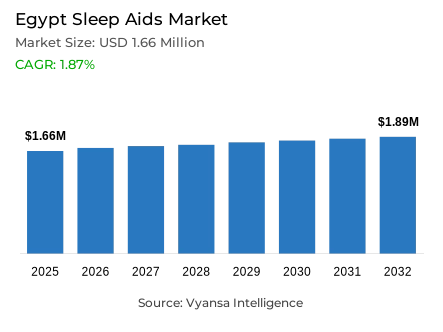
- Sleep aids market size in Egypt was estimated at USD 1.66 million in 2025
- The market size is expected to grow to USD 1.89 million by 2032.
- Market to register a CAGR of around 1.87% during 2026-32.
- Product Shares
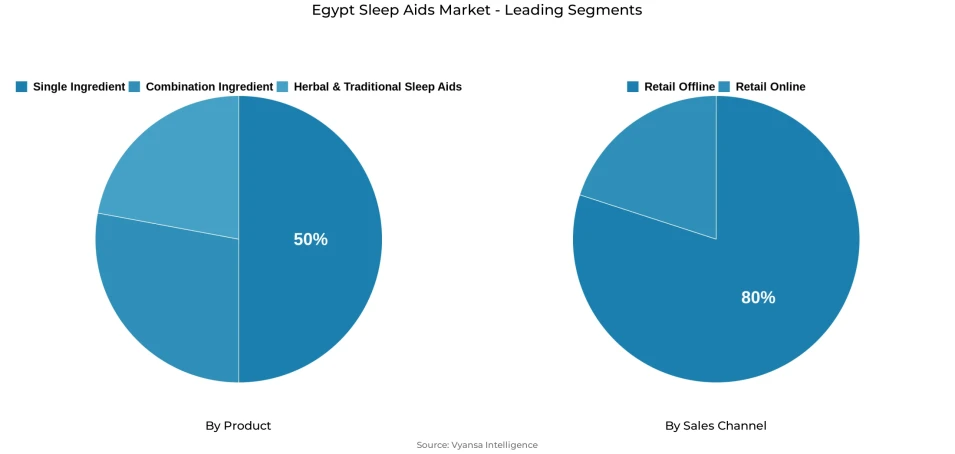
- Single ingredient grabbed market share of 50%.
- Competition
- More than 5 companies are actively engaged in producing sleep aids in Egypt.
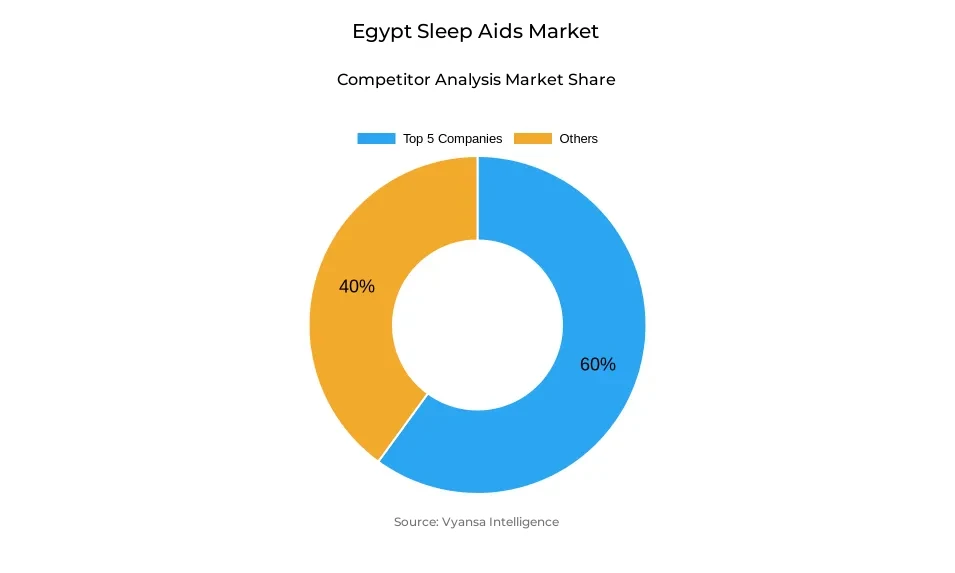
- Top 5 companies acquired around 60% of the market share.
- MEPACO (Arab Co For Pharmaceuticals & Medicinal Plants), UPSA Laboratoires, Natrol LLC, Medizen, Sigma Pharmaceutical Industries etc., are few of the top companies.
- Sales channel
- Retail offline grabbed 80% of the market.
Egypt Sleep Aids Market Outlook
The Egypt sleep aids market is estimated at USD 1.66 million in 2025 and is projected to reach USD 1.89 million by 2032, reflecting a CAGR of approximately 1.87% over the forecast period. Growth remains steady but moderate, supported by underlying demand from end users experiencing stress and anxiety, often linked to broader macroeconomic pressures. While conventional pharmaceutical sleep aids continue to hold relevance, end user behavior is gradually shifting toward natural remedies perceived as safer and more sustainable alternatives.
Market expansion remains structurally constrained by regulatory and economic factors. Lengthy product approval procedures and high import costs limit the diversity of available brands, resulting in a market concentrated among a few established players. Inflationary pressures and currency fluctuations further influence pricing strategies, pushing companies to prioritize costefficient formulations to remain accessible to pricesensitive end users.
Looking ahead, demand is expected to tilt increasingly toward natural formulations containing ingredients such as lavender, melatonin, and chamomile. Rising awareness of the side effects associated with prolonged sedative use including daytime drowsiness and psychological dependency is accelerating interest in milder, wellnessoriented solutions. Over time, traditional sleep medications are likely to face stronger competition from dietary supplements and functional beverages positioned around holistic sleep support.
Ultimately, affordability will remain a decisive success factor, as sleep aids are not universally considered essential products. Brands that successfully balance regulatory compliance, competitive pricing, and credible communication of natural health benefits will be best positioned to capture gradual growth as awareness of sleep hygiene continues to expand in Egypt.
Egypt Sleep Aids Market Growth DriverFinancial Stress Sustains Quick-Fix Sleep Solutions
Sleep aids maintain a stable demand base in Egypt as economic pressure and daily stress continue to disrupt sleep patterns across households. Financial strain contributes to anxiety and insomnia, encouraging end users to seek quick, athome solutions that fit easily into nightly routines. Repeat purchasing is reinforced as products are used not only for sleep latency but also for shortterm mood calming and stress relief.
Macroeconomic conditions reinforce this behavior. According to CAPMAS, headline inflation reached 10.3% in December 2025, reflecting persistent costofliving pressure entering 2026. As household budgets tighten, end users prioritize immediate symptom relief over longterm preventive approaches. This sustains baseline demand for established sleepaid products even when major category innovation remains limited.
Egypt Sleep Aids Market ChallengeRegulatory and Import Barriers Limit Portfolio Depth
Product diversity remains constrained by strict regulatory processes and lengthy approval timelines, which slow new product launches and keep retail shelves concentrated around a limited number of established brands. Import costs, combined with currency and inflation pressures, further raise landed prices, encouraging suppliers to rationalize portfolios toward fewer, lowerrisk SKUs.
The regulatory structure illustrates this complexity. The Egyptian Drug Authority confirms that the Egyptian Pharmacopoeia contains more than 3,000 drug monographs and general chapters. While this extensive framework strengthens quality assurance, it also raises compliance thresholds and prolongs registration timelines. As a result, end users encounter fewer innovative formats and limited assortment expansion in formal channels.
Unlock Market Intelligence
Explore the market potential with our data-driven report
Egypt Sleep Aids Market TrendHolistic, Natural Remedies Gain Preference Over Tablets
End users are increasingly shifting toward natural and plantbased sleep remedies, perceiving them as safer and milder alternatives to conventional tablets. Ingredients such as lavender, melatonin, and chamomile are gaining visibility, while nonpill formats like herbal teas and customized supplements align with flexible, lifestylebased consumption patterns.
This shift mirrors broader global behavior. According to a briefing by the United Nations Office at Geneva, between 40% and 90% of populations in most WHO member states use traditional medicine. As natural options become normalized, sleep support competes more directly with dietary supplements and fortified beverages. Clear positioning, ingredient transparency, and quality assurance therefore become critical to maintaining category relevance.
Egypt Sleep Aids Market OpportunityEntry-Level Pricing Ladders Protect Category Retention
Affordability remains central in sustaining category participation, as sleep aids are often viewed as discretionary purchases. Rising prices encourage some end users to rely on lifestyle adjustments rather than productbased solutions, making value perception a decisive purchase factor.
Income policy highlights the importance of structured price architecture. The State Information Service reports that the privatesector minimum wage was set at EGP 7,000 per month from 1 March 2025. Despite wage adjustments, discretionary healthcare spending remains cautious. Brands that introduce entrylevel pack sizes, maintain stable supply, and balance price tiers can preserve demand without pushing costsensitive end users out of the category.
Unlock Market Intelligence
Explore the market potential with our data-driven report
Egypt Sleep Aids Market Segmentation Analysis
By Product
- Single Ingredient
- Combination Ingredient
- Herbal & Traditional Sleep Aids
The singleingredient segment holds the largest share in the Egypt sleepaids market at approximately 50%. Its dominance reflects continued reliance on wellestablished, foundational solutions commonly used to manage sleep disturbances.
end users favor singleingredient products due to perceived effectiveness and clarity in understanding their function. Although interest in natural components such as lavender, melatonin, and chamomile is increasing sometimes incorporated into multiingredient or holistic blends established singleingredient offerings continue to anchor the category. As awareness of holistic health rises, this segment is expected to maintain its central role, balancing traditional reliability with evolving demand for gentler, nonpharmaceutical options aligned with dietary and wellness preferences.
By Sales Channel
- Retail Online
- Retail Offline
Retail offline accounts for approximately 80% of total market share, making it the dominant sales channel. Local pharmacies remain the primary access point for end users seeking sleeprelated solutions.
Given the regulatory framework and the advisory nature of sleepaid purchases, physical retail continues to provide trusted access and professional guidance. Although digital channels and Retail online may gradually expand particularly in underserved regions the established pharmacy infrastructure and pharmacistled consultation model reinforce offline retail leadership. Consequently, retail offline is expected to remain the principal and most reliable channel for both conventional and natural sleepaid products in Egypt.
List of Companies Covered in Egypt Sleep Aids Market
The companies listed below are highly influential in the Egypt sleep aids market, with a significant market share and a strong impact on industry developments.
- MEPACO (Arab Co For Pharmaceuticals & Medicinal Plants)
- UPSA Laboratoires
- Natrol LLC
- Medizen
- Sigma Pharmaceutical Industries
- October Pharma SAE
- Amoun Pharmaceutical Industry Co
Competitive Landscape
Egypt sleep aids market is highly concentrated and regulation-bound, with Night Calm (Medizen) holding close to one-third of brand share, followed by Siesta (Sigma Pharmaceutical Industries) and Sleep Aid (October Pharma). Growth is underpinned by persistent stress-driven insomnia, yet limited product variety and strict approval processes constrain competitive dynamism. Traditional sedative-based pills dominate, but face rising indirect competition from natural remedies, dietary supplements, herbal teas, and fortified beverages containing melatonin, chamomile, and lavender. Price sensitivity remains critical amid inflation, reinforcing reliance on established, affordable brands. Key differentiation opportunities lie in clinically validated natural formulations, non-habit-forming positioning, diversified delivery formats, and educational campaigns addressing dependency risks to align with broader health and wellness trends.
Frequently Asked Questions
Related Report
- Market Segmentation
- Research Scope
- Research Methodology
- Definitions and Assumptions
- Executive Summary
- Egypt Sleep Aids Market Policies, Regulations, and Standards
- Egypt Sleep Aids Market Dynamics
- Growth Factors
- Challenges
- Trends
- Opportunities
- Egypt Sleep Aids Market Statistics, 2022-2032F
- Market Size & Growth Outlook
- By Revenues in USD Million
- Market Segmentation & Growth Outlook
- By Product
- Single Ingredient- Market Insights and Forecast 2022-2032, USD Million
- Doxylamine Succinate- Market Insights and Forecast 2022-2032, USD Million
- Diphenhydramine- Market Insights and Forecast 2022-2032, USD Million
- Melatonin- Market Insights and Forecast 2022-2032, USD Million
- Combination Ingredient- Market Insights and Forecast 2022-2032, USD Million
- Diphenhydramine + Acetaminophen- Market Insights and Forecast 2022-2032, USD Million
- Other Antihistamine-Based Combinations- Market Insights and Forecast 2022-2032, USD Million
- Herbal & Traditional Sleep Aids- Market Insights and Forecast 2022-2032, USD Million
- Valerian root- Market Insights and Forecast 2022-2032, USD Million
- Passionflower- Market Insights and Forecast 2022-2032, USD Million
- Chamomile- Market Insights and Forecast 2022-2032, USD Million
- Kava- Market Insights and Forecast 2022-2032, USD Million
- Multi-Herbal Sleep Blends- Market Insights and Forecast 2022-2032, USD Million
- Single Ingredient- Market Insights and Forecast 2022-2032, USD Million
- By Sleep Disorder
- Insomnia- Market Insights and Forecast 2022-2032, USD Million
- Sleep Apnea- Market Insights and Forecast 2022-2032, USD Million
- Restless Legs Syndrome- Market Insights and Forecast 2022-2032, USD Million
- Narcolepsy- Market Insights and Forecast 2022-2032, USD Million
- Sleep Walking- Market Insights and Forecast 2022-2032, USD Million
- Others- Market Insights and Forecast 2022-2032, USD Million
- By Age Group
- Young to Mid Adults (25-44 Years)- Market Insights and Forecast 2022-2032, USD Million
- Middle-Aged Adults (45-64 Years)- Market Insights and Forecast 2022-2032, USD Million
- Geriatric Population (65+ Years)- Market Insights and Forecast 2022-2032, USD Million
- By Sales Channel
- Retail Online- Market Insights and Forecast 2022-2032, USD Million
- Retail Offline- Market Insights and Forecast 2022-2032, USD Million
- By End User
- Homecare/Individual Consumers- Market Insights and Forecast 2022-2032, USD Million
- Hospitals- Market Insights and Forecast 2022-2032, USD Million
- Sleep Centers & Clinics- Market Insights and Forecast 2022-2032, USD Million
- By Formulation
- Tablets- Market Insights and Forecast 2022-2032, USD Million
- Gummies- Market Insights and Forecast 2022-2032, USD Million
- Capsules- Market Insights and Forecast 2022-2032, USD Million
- Liquid- Market Insights and Forecast 2022-2032, USD Million
- Sublingual- Market Insights and Forecast 2022-2032, USD Million
- By Region
- Cairo
- Alexandria
- Others
- By Competitors
- Competition Characteristics
- Market Share & Analysis
- By Product
- Market Size & Growth Outlook
- Egypt Single Ingredient Sleep Aids Market Statistics, 2022-2032
- Market Size & Growth Outlook
- By Revenues in USD Million
- Market Segmentation & Growth Outlook
- By Sleep Disorder- Market Insights and Forecast 2022-2032, USD Million
- By Age Group- Market Insights and Forecast 2022-2032, USD Million
- By Sales Channel- Market Insights and Forecast 2022-2032, USD Million
- By End User- Market Insights and Forecast 2022-2032, USD Million
- By Formulation- Market Insights and Forecast 2022-2032, USD Million
- By Region- Market Insights and Forecast 2022-2032, USD Million
- Market Size & Growth Outlook
- Egypt Combination Ingredient Sleep Aids Market Statistics, 2022-2032
- Market Size & Growth Outlook
- By Revenues in USD Million
- Market Segmentation & Growth Outlook
- By Sleep Disorder- Market Insights and Forecast 2022-2032, USD Million
- By Age Group- Market Insights and Forecast 2022-2032, USD Million
- By Sales Channel- Market Insights and Forecast 2022-2032, USD Million
- By End User- Market Insights and Forecast 2022-2032, USD Million
- By Formulation- Market Insights and Forecast 2022-2032, USD Million
- By Region- Market Insights and Forecast 2022-2032, USD Million
- Market Size & Growth Outlook
- Egypt Herbal & Traditional Sleep Aids Market Statistics, 2022-2032
- Market Size & Growth Outlook
- By Revenues in USD Million
- Market Segmentation & Growth Outlook
- By Sleep Disorder- Market Insights and Forecast 2022-2032, USD Million
- By Age Group- Market Insights and Forecast 2022-2032, USD Million
- By Sales Channel- Market Insights and Forecast 2022-2032, USD Million
- By End User- Market Insights and Forecast 2022-2032, USD Million
- By Formulation- Market Insights and Forecast 2022-2032, USD Million
- By Region- Market Insights and Forecast 2022-2032, USD Million
- Market Size & Growth Outlook
- Competitive Outlook
- Company Profiles
- Medizen
- Business Description
- Product Portfolio
- Collaborations & Alliances
- Recent Developments
- Financial Details
- Others
- Sigma Pharmaceutical Industries
- Business Description
- Product Portfolio
- Collaborations & Alliances
- Recent Developments
- Financial Details
- Others
- October Pharma SAE
- Business Description
- Product Portfolio
- Collaborations & Alliances
- Recent Developments
- Financial Details
- Others
- Amoun Pharmaceutical Industry Co
- Business Description
- Product Portfolio
- Collaborations & Alliances
- Recent Developments
- Financial Details
- Others
- MEPACO (Arab Co For Pharmaceuticals & Medicinal Plants)
- Business Description
- Product Portfolio
- Collaborations & Alliances
- Recent Developments
- Financial Details
- Others
- UPSA Laboratoires
- Business Description
- Product Portfolio
- Collaborations & Alliances
- Recent Developments
- Financial Details
- Others
- Natrol LLC
- Business Description
- Product Portfolio
- Collaborations & Alliances
- Recent Developments
- Financial Details
- Others
- Bristol-Myers Squibb Egypt
- Business Description
- Product Portfolio
- Collaborations & Alliances
- Recent Developments
- Financial Details
- Others
- Medizen
- Company Profiles
- Disclaimer
| Segment | Sub-Segment |
|---|---|
| By Product |
|
| By Sleep Disorder |
|
| By Age Group |
|
| By Sales Channel |
|
| By End User |
|
| By Formulation |
|
| By Region |
|
Research Methodology
This study followed a structured approach comprising four key phases to assess the size and scope of the electro-oxidation market. The process began with thorough secondary research to collect data on the target market, related markets, and broader industry context. These findings, along with preliminary assumptions and estimates, were then validated through extensive primary research involving industry experts from across the value chain. To calculate the overall market size, both top-down and bottom-up methodologies were employed. Finally, market segmentation and data triangulation techniques were applied to refine and validate segment-level estimations.
Secondary Research
The secondary research phase involved gathering data from a wide range of credible and published sources. This step helped in identifying industry trends, defining market segmentation, and understanding the market landscape and value chain.
Sources consulted during this phase included:
- Company annual reports, investor presentations, and press releases
- Industry white papers and certified publications
- Trade directories and market-recognized databases
- Articles from authoritative authors and reputable journals
- Gold and silver standard websites
Secondary research was critical in mapping out the industry's value chain and monetary flow, identifying key market segments, understanding regional variations, and tracking significant industry developments.
Other key sources:
- Financial disclosures
- Industry associations and trade bodies
- News outlets and business magazines
- Academic journals and research studies
- Paid industry databases
Primary Research
To validate secondary data and gain deeper market insights, primary research was conducted with key stakeholders across both the supply and demand sides of the market.
On the demand side, participants included decision-makers and influencers from end-user industries—such as CIOs, CTOs, and CSOs—who provided first-hand perspectives on market needs, product usage, and future expectations.
On the supply side, interviews were conducted with manufacturers, industry associations, and institutional participants to gather insights into current offerings, product pipelines, and market challenges.
Primary interviews provided critical inputs such as:
- Market size and revenue data
- Product and service breakdowns
- Market forecasts
- Regional and application-specific trends
Stakeholders consulted included:
- Leading OEM and solution providers
- Channel and distribution partners
- End users across various applications
- Independent consultants and industry specialists
Market Size Estimation and Data Triangulation
- Identifying Key Market Participants (Secondary Research)
- Goal: To identify the major players or companies in the target market. This typically involves using publicly available data sources such as industry reports, market research publications, and financial statements of companies.
- Tools: Reports from firms like Gartner, Forrester, Euromonitor, Statista, IBISWorld, and others. Public financial statements, news articles, and press releases from top market players.
- Extracting Earnings of Key Market Participants
- Goal: To estimate the earnings generated from the product or service being analyzed. This step helps in understanding the revenue potential of each market player in a specific geography.
- Methods: Earnings data can be gathered from:
- Publicly available financial reports (for listed companies).
- Interviews and primary data sources from professionals, such as Directors, VPs, SVPs, etc. This is especially useful for understanding more nuanced, internal data that isn't publicly disclosed.
- Annual reports and investor presentations of key players.
- Data Collation and Development of a Relevant Data Model
- Goal: To collate inputs from both primary and secondary sources into a structured, data-driven model for market estimation. This model will incorporate key market KPIs and any independent variables relevant to the market.
- Key KPIs: These could include:
- Market size, growth rate, and demand drivers.
- Industry-specific metrics like market share, average revenue per customer (ARPC), or average deal size.
- External variables, such as economic growth rates, inflation rates, or commodity prices, that could affect the market.
- Data Modeling: Based on this data, the market forecasts are developed for the next 5 years. A combination of trend analysis, scenario modeling, and statistical regression might be used to generate projections.
- Scenario Analysis
- Goal: To test different assumptions and validate how sensitive the market is to changes in key variables (e.g., market demand, regulatory changes, technological disruptions).
- Types of Scenarios:
- Base Case: Based on current assumptions and historical data.
- Best-Case Scenario: Assuming favorable market conditions, regulatory environments, and technological advancements.
- Worst-Case Scenario: Accounting for adverse factors, such as economic downturns, stricter regulations, or unexpected disruptions.












