Ecuador Juice Market Report: Trends, Growth and Forecast (2026-2032)
By Category (100% Juice (Not from Concentrate, Reconstituted), Juice Drinks (up to 24% Juice), Nectars (High Concentration (40% to 50% fruit content), Medium Concentration (30% to 39% fruit content), Low Concentration (25% to 29% fruit content)), Vegetable Juice, Fruit and Vegetable Blends), By Nature (Conventional, Organic), By Packaging Material (Plastic, Glass, Metal, Others), By Packaging Type (PET Bottles, Aseptic Packages (Cartons), Glass Bottles, Metal Cans, Disposable Cups & Pouches), By Sales Channel (Off-Trade (Hypermarkets/ Supermarkets, Retail Outlets, Convenience Stores, Online Platforms), On-Trade) ... Read more
|
Major Players
|
Ecuador Juice Market Statistics and Insights, 2026
- Market Size Statistics
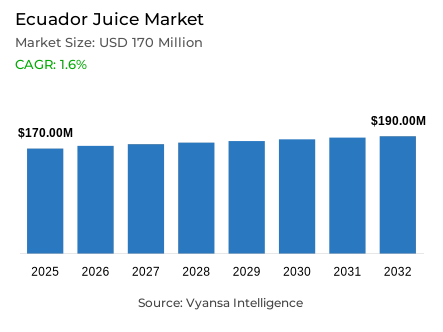
- Juice market size in Ecuador was estimated at USD 170 million in 2025.
- The market size is expected to grow to USD 190 million by 2032.
- Market to register a CAGR of around 1.6% during 2026-32.
- Category Shares
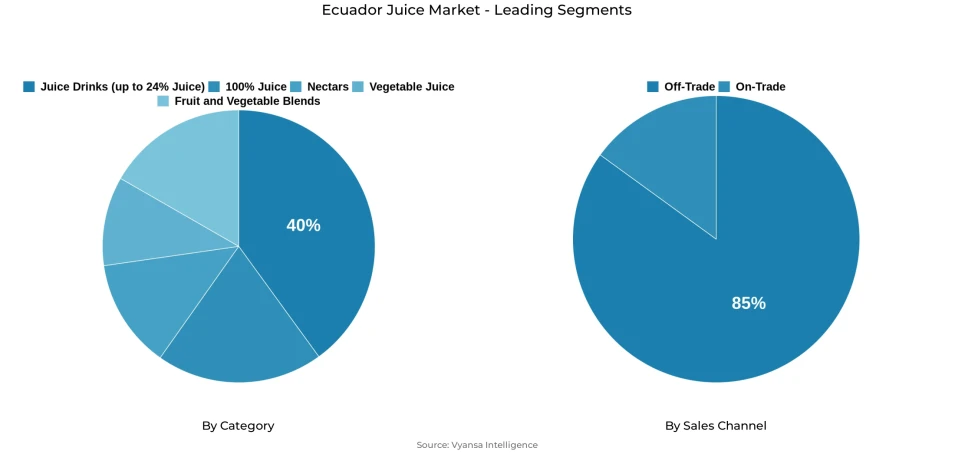
- Juice drinks (up to 24% juice) grabbed market share of 40%.
- Competition
- More than 5 companies are actively engaged in producing juice in Ecuador.
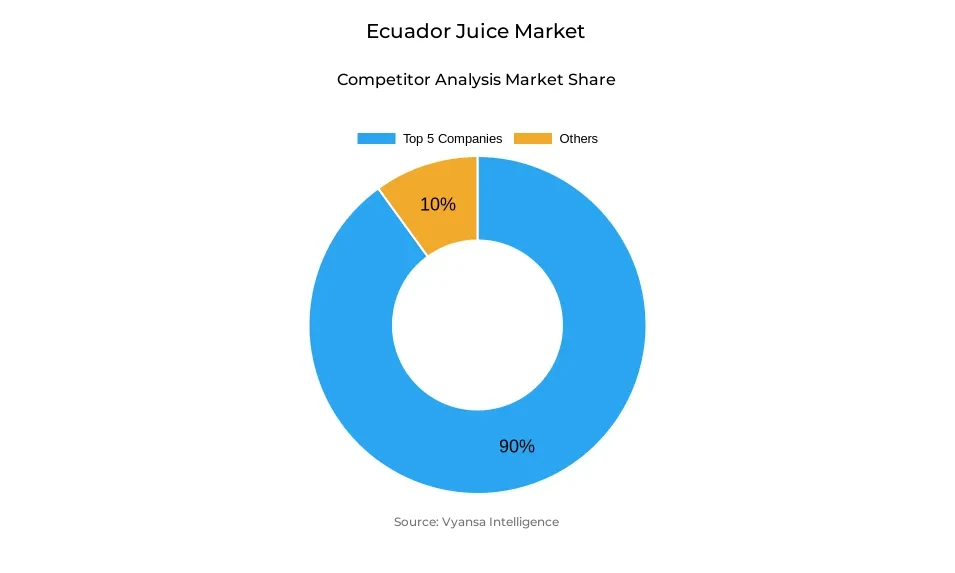
- Top 5 companies acquired around 90% of the market share.
- Gloria Foods SA, Quicornac SA, Tesalia Spring Co, The, Ajecuador SA, Coca-Cola de Ecuador SA etc., are few of the top companies.
- Sales Channel
- Off-trade grabbed 85% of the market.
Ecuador Juice Market Outlook
The Ecuador juice market is going through a complicated transition with the high sugar content and increasing prices putting pressure on the traditional categories. The market is estimated to be USD 170 million in 2025 and is projected to be USD 190 million in 2032 with a compound annual growth rate of about 1.6% between 2026 and 2032. Although economic uncertainty and health trends have reduced the growth of sugary nectars in terms of volume, the overall market is set to recover moderately as people look to strike a balance between affordability and wellness.
The main force behind this resilience is the introduction of democratized premium products. Previously viewed as luxury products, 100 % juice and coconut water are now made more accessible to a broader audience by the means of the private label brands like Prunus, which is provided by hard discount stores like Tiendas Tuti. This change allows price-sensitive households to abandon high-sugar nectars, which tend to have red-flag nutritional labels, in favor of products that are viewed as naturally functional and of high quality.
Innovation is focusing more on storytelling and practical advantages in order to win the contemporary Ecuadorian shopper. Coconut water has already become a star player by positioning itself as a lifestyle-oriented, natural source of hydration, often with claims of high potassium and beach-vibe refreshing effects. 100% juice brands are likely to follow suit by positioning themselves as a high-potassium, beach-vibe refreshing, lifestyle-oriented natural source of hydration.
The retail format is well established within the community, where the Off-Trade channels take 85% of the market. Small local grocers still remain the key to volume sales of low-priced juice drinks and nectars. Nevertheless, with the continued entry of modern retail and discount retailers into the market with a variety of SKUs and competitive prices, the merket is set to transform into a functional wellness and value-based premiumisation by 2032.
Ecuador Juice Market Growth Driver
Budget-Constrained Purchasing Sustaining Demand for Affordable and Single-Serve Juice Formats
The affordability factor remains highly valued by Ecuadorian end user, and the consumption of the lower-priced juice beverages remains stable despite the volumetric pressure faced by the entire merket due to the high prices. The everyday shopping decisions are determined by income constraints the full employment rate according to INEC was 37.1 in December 2025 and the poverty rate was 21.4.
This practical fact makes smaller packs and low-cost formats still pertinent in local grocers and new discount retailers, where single-serving purchases are consistent with weekly cash-flow cycles. The price pressure can also be observed in household budgeting, with INEC recording the basic family basket cost USD 821.80 in January 2026, compared to a monthly household income of USD 899.73.
Ecuador Juice Market Challenge
Heightened Sugar Risk Awareness Constraining Nectar and Traditional Juice Appeal
The presence of high sugar levels is one of the main obstacles to nectar and traditional juice products because end user are becoming more aware of sugary beverages as health hazards and are shifting towards products that are seen as less dense and more natural. This pattern is supported by the mortality rates in Ecuador, where INEC reported 4,680 deaths due to diabetes mellitus in 2024, according to the official death registry released in 2025.
Even in cases of brand reformulation, the issue of sweeteners and the conspicuousness of high-sugar cues hinder the process of nectar losing its unhealthy image. At the same time, not all households switch to 100 % juice completely due to its higher cost and concentration in the contemporary retail, which leaves nectars between health concerns and financial limitations.
Unlock Market Intelligence
Explore the market potential with our data-driven report
Ecuador Juice Market Trend
Digitally Amplified Functional Hydration Narratives Accelerating Plant-Based Beverage Uptake
The concept of functional positioning has gained more prominence in the juice merket of Ecuador, especially in the case of coconut and plant-based waters, with brands actively associating hydration and natural advantages with daily wellness. The rise of coconut water on a small foundation, with brands emphasizing electrolytes, naturalness, and low-calorie properties.
This trend is enhanced by digital reach, where discovery and persuasion are increasingly happening online and not just on shelves. According to July 2025 TIC indicators, INEC reports that 80.1% of people aged five and older use the Internet and 59.3% own a smartphone. Having a developed scale of social-media storytelling, functional claims and lifestyle narratives spread faster, helping premium adjacent drinks to gain mainstream recognition.
Ecuador Juice Market Opportunity
Expanding Online Grocery Penetration Enabling Premiumisation and Multipack Scale
The retail online offers an evident value creation opportunity through the planned purchases of high-quality and health-conscious juices that are not as dependent on impulse buying. The online sales are still niche but have potential in urban centers, particularly in multipacks and products that are mostly found in supermarkets and hypermarkets.
The channel addressable base is already large. According to INEC, in July 2025, 71.3% of households were connected to the Internet, and digital illiteracy rates among individuals aged 15 to 49 were 2.1%, which means that most working-age end user can use ordering and delivery processes. This helps to grow bundles, subscriptions, and bulk packages of 100% juice and coconut water via online platforms.
Unlock Market Intelligence
Explore the market potential with our data-driven report
Ecuador Juice Market Segmentation Analysis
By Category
- 100% Juice
- Not from Concentrate
- Reconstituted
- Juice Drinks (up to 24% Juice)
- Nectars
- High Concentration (40% to 50% fruit content)
- Medium Concentration (30% to 39% fruit content)
- Low Concentration (25% to 29% fruit content)
- Vegetable Juice
- Fruit and Vegetable Blends
The segment has the highest share around the category for the Ecuadorian market, where Juice Drinks (up to 24% Juice) grabbed a market share of 40%. This segment has remained resilient despite the broader category's challenges due to its superior affordability. In a price-sensitive landscape where a significant portion of the population faces income constraints, the lower price points and variety of small pack sizes offered by brands like Cifrut and Pulp ensure that juice drinks remain a staple in both traditional grocers and emerging discounters.
While nectars are struggling under the weight of health-conscious trends and sugar-tax perceptions, juice drinks continue to see low but positive volume growth. Their established presence in family settings and national distribution networks allows them to maintain relevance even as end user become more wary of high-sugar options. By offering a familiar fruit experience at the most accessible price point, the juice drinks segment is projected to lead the market volume through the forecast period.
By Sales Channel
- Off-Trade
- Hypermarkets/ Supermarkets
- Retail Outlets
- Convenience Stores
- Online Platforms
- On-Trade
The segment has the highest share around the Sales Channel is Off-Trade, which grabbed 85% of the market. This dominance highlights the critical role of home consumption and traditional retail in Ecuador. Small independent grocers are the primary touchpoint for the majority of end user, particularly for single-serve formats and daily household needs. These "mom-and-pop" stores provide the necessary geographic reach to consolidate the leadership of mass-market brands, especially in regions with limited modern retail infrastructure.
While the off-trade channel is led by traditional trade, the fastest-growing sub-segment is the discounters channel. Retailers such as Tiendas Tuti are disrupting the market by offering private-label 100% juices and coconut waters at prices that challenge established mid-tier brands. This shift toward value-oriented modern retail, combined with the convenience of delivery apps in urban centers like Quito and Guayaquil, ensures that the off-trade channel will remain the powerhouse of the Ecuadorian juice market through 2032.
List of Companies Covered in Ecuador Juice Market
The companies listed below are highly influential in the Ecuador juice market, with a significant market share and a strong impact on industry developments.
- Gloria Foods SA
- Quicornac SA
- Tesalia Spring Co, The
- Ajecuador SA
- Coca-Cola de Ecuador SA
Competitive Landscape
Ecuador juice market is led by Ajecuador SA, which dominates volume sales through its affordable mass market brands Cifrut and Pulp, supported by extensive national distribution across traditional and modern retail. These brands are positioned for everyday consumption, appealing to price sensitive households and younger consumers amid economic uncertainty. Private label players grouped under “others” represent the fastest growing competitive force, driven by discounters and supermarkets offering lower priced alternatives that improve accessibility to 100% juice and coconut water. Indirect competition comes from plant based waters and other functional beverages that align more closely with health and wellness trends. Key differentiation opportunities lie in functional positioning, improved sugar communication, affordable premiumisation via private label, and digital storytelling to elevate 100% juice beyond a niche modern retail audience.
Frequently Asked Questions
Related Report
1. Market Segmentation
1.1. Research Scope
1.2. Research Methodology
1.3. Definitions and Assumptions
2. Executive Summary
3. Ecuador Juice Market Policies, Regulations, and Standards
4. Ecuador Juice Market Dynamics
4.1. Growth Factors
4.2. Challenges
4.3. Trends
4.4. Opportunities
5. Ecuador Juice Market Statistics, 2022-2032F
5.1. Market Size & Growth Outlook
5.1.1.By Revenues in USD Million
5.1.2.By Quantity Sold in Million Litres
5.2. Market Segmentation & Growth Outlook
5.2.1.By Category
5.2.1.1. 100% Juice- Market Insights and Forecast 2022-2032, USD Million
5.2.1.1.1. Not from Concentrate- Market Insights and Forecast 2022-2032, USD Million
5.2.1.1.2. Reconstituted- Market Insights and Forecast 2022-2032, USD Million
5.2.1.2. Juice Drinks (up to 24% Juice)- Market Insights and Forecast 2022-2032, USD Million
5.2.1.3. Nectars- Market Insights and Forecast 2022-2032, USD Million
5.2.1.3.1. High Concentration (40% to 50% fruit content)- Market Insights and Forecast 2022-2032, USD Million
5.2.1.3.2. Medium Concentration (30% to 39% fruit content)- Market Insights and Forecast 2022-2032, USD Million
5.2.1.3.3. Low Concentration (25% to 29% fruit content)- Market Insights and Forecast 2022-2032, USD Million
5.2.1.4. Vegetable Juice- Market Insights and Forecast 2022-2032, USD Million
5.2.1.5. Fruit and Vegetable Blends- Market Insights and Forecast 2022-2032, USD Million
5.2.2.By Nature
5.2.2.1. Conventional- Market Insights and Forecast 2022-2032, USD Million
5.2.2.2. Organic- Market Insights and Forecast 2022-2032, USD Million
5.2.3.By Packaging Material
5.2.3.1. Plastic- Market Insights and Forecast 2022-2032, USD Million
5.2.3.2. Glass- Market Insights and Forecast 2022-2032, USD Million
5.2.3.3. Metal- Market Insights and Forecast 2022-2032, USD Million
5.2.3.4. Others- Market Insights and Forecast 2022-2032, USD Million
5.2.4.By Packaging Type
5.2.4.1. PET Bottles- Market Insights and Forecast 2022-2032, USD Million
5.2.4.2. Aseptic Packages (Cartons)- Market Insights and Forecast 2022-2032, USD Million
5.2.4.3. Glass Bottles- Market Insights and Forecast 2022-2032, USD Million
5.2.4.4. Metal Cans- Market Insights and Forecast 2022-2032, USD Million
5.2.4.5. Disposable Cups & Pouches- Market Insights and Forecast 2022-2032, USD Million
5.2.5.By Sales Channel
5.2.5.1. Off-Trade- Market Insights and Forecast 2022-2032, USD Million
5.2.5.1.1. Hypermarkets/ Supermarkets - Market Insights and Forecast 2022-2032, USD Million
5.2.5.1.2. Retail Outlets - Market Insights and Forecast 2022-2032, USD Million
5.2.5.1.3. Convenience Stores- Market Insights and Forecast 2022-2032, USD Million
5.2.5.1.4. Online Platforms- Market Insights and Forecast 2022-2032, USD Million
5.2.5.2. On-Trade- Market Insights and Forecast 2022-2032, USD Million
5.2.6.By Competitors
5.2.6.1. Competition Characteristics
5.2.6.2. Market Share & Analysis
6. Ecuador 100% Juice Market Statistics, 2022-2032
6.1. Market Size & Growth Outlook
6.1.1.By Revenues in USD Million
6.1.2.By Quantity Sold in Million Litres
6.2. Market Segmentation & Growth Outlook
6.2.1.By Nature- Market Insights and Forecast 2022-2032, USD Million
6.2.2.By Packaging Material- Market Insights and Forecast 2022-2032, USD Million
6.2.3.By Packaging Type- Market Insights and Forecast 2022-2032, USD Million
6.2.4.By Sales Channel- Market Insights and Forecast 2022-2032, USD Million
7. Ecuador Juice Drinks (up to 24% Juice) Market Statistics, 2022-2032
7.1. Market Size & Growth Outlook
7.1.1.By Revenues in USD Million
7.1.2.By Quantity Sold in Million Litres
7.2. Market Segmentation & Growth Outlook
7.2.1.By Nature- Market Insights and Forecast 2022-2032, USD Million
7.2.2.By Packaging Material- Market Insights and Forecast 2022-2032, USD Million
7.2.3.By Packaging Type- Market Insights and Forecast 2022-2032, USD Million
7.2.4.By Sales Channel- Market Insights and Forecast 2022-2032, USD Million
8. Ecuador Nectars Market Statistics, 2022-2032
8.1. Market Size & Growth Outlook
8.1.1.By Revenues in USD Million
8.1.2.By Quantity Sold in Million Litres
8.2. Market Segmentation & Growth Outlook
8.2.1.By Nature- Market Insights and Forecast 2022-2032, USD Million
8.2.2.By Packaging Material- Market Insights and Forecast 2022-2032, USD Million
8.2.3.By Packaging Type- Market Insights and Forecast 2022-2032, USD Million
8.2.4.By Sales Channel- Market Insights and Forecast 2022-2032, USD Million
9. Ecuador Vegetable Juice Market Statistics, 2022-2032
9.1. Market Size & Growth Outlook
9.1.1.By Revenues in USD Million
9.1.2.By Quantity Sold in Million Litres
9.2. Market Segmentation & Growth Outlook
9.2.1.By Nature- Market Insights and Forecast 2022-2032, USD Million
9.2.2.By Packaging Material- Market Insights and Forecast 2022-2032, USD Million
9.2.3.By Packaging Type- Market Insights and Forecast 2022-2032, USD Million
9.2.4.By Sales Channel- Market Insights and Forecast 2022-2032, USD Million
10. Ecuador Fruit and Vegetable Blends Market Statistics, 2022-2032
10.1. Market Size & Growth Outlook
10.1.1. By Revenues in USD Million
10.1.2. By Quantity Sold in Million Litres
10.2. Market Segmentation & Growth Outlook
10.2.1. By Nature- Market Insights and Forecast 2022-2032, USD Million
10.2.2. By Packaging Material- Market Insights and Forecast 2022-2032, USD Million
10.2.3. By Packaging Type- Market Insights and Forecast 2022-2032, USD Million
10.2.4. By Sales Channel- Market Insights and Forecast 2022-2032, USD Million
11. Competitive Outlook
11.1. Company Profiles
11.1.1. Ajecuador SA
11.1.1.1. Business Description
11.1.1.2. Product Portfolio
11.1.1.3. Collaborations & Alliances
11.1.1.4. Recent Developments
11.1.1.5. Financial Details
11.1.1.6. Others
11.1.2. Coca-Cola de Ecuador SA
11.1.2.1. Business Description
11.1.2.2. Product Portfolio
11.1.2.3. Collaborations & Alliances
11.1.2.4. Recent Developments
11.1.2.5. Financial Details
11.1.2.6. Others
11.1.3. Gloria Foods SA
11.1.3.1. Business Description
11.1.3.2. Product Portfolio
11.1.3.3. Collaborations & Alliances
11.1.3.4. Recent Developments
11.1.3.5. Financial Details
11.1.3.6. Others
11.1.4. Quicornac SA
11.1.4.1. Business Description
11.1.4.2. Product Portfolio
11.1.4.3. Collaborations & Alliances
11.1.4.4. Recent Developments
11.1.4.5. Financial Details
11.1.4.6. Others
11.1.5. Tesalia Spring Co
11.1.5.1. Business Description
11.1.5.2. Product Portfolio
11.1.5.3. Collaborations & Alliances
11.1.5.4. Recent Developments
11.1.5.5. Financial Details
11.1.5.6. Others
11.1.6. Nestlé Ecuador SA
11.1.6.1. Business Description
11.1.6.2. Product Portfolio
11.1.6.3. Collaborations & Alliances
11.1.6.4. Recent Developments
11.1.6.5. Financial Details
11.1.6.6. Others
12. Disclaimer
| Segment | Sub-Segment |
|---|---|
| By Category |
|
| By Nature |
|
| By Packaging Material |
|
| By Packaging Type |
|
| By Sales Channel |
|
Research Methodology
This study followed a structured approach comprising four key phases to assess the size and scope of the electro-oxidation market. The process began with thorough secondary research to collect data on the target market, related markets, and broader industry context. These findings, along with preliminary assumptions and estimates, were then validated through extensive primary research involving industry experts from across the value chain. To calculate the overall market size, both top-down and bottom-up methodologies were employed. Finally, market segmentation and data triangulation techniques were applied to refine and validate segment-level estimations.
Secondary Research
The secondary research phase involved gathering data from a wide range of credible and published sources. This step helped in identifying industry trends, defining market segmentation, and understanding the market landscape and value chain.
Sources consulted during this phase included:
- Company annual reports, investor presentations, and press releases
- Industry white papers and certified publications
- Trade directories and market-recognized databases
- Articles from authoritative authors and reputable journals
- Gold and silver standard websites
Secondary research was critical in mapping out the industry's value chain and monetary flow, identifying key market segments, understanding regional variations, and tracking significant industry developments.
Other key sources:
- Financial disclosures
- Industry associations and trade bodies
- News outlets and business magazines
- Academic journals and research studies
- Paid industry databases
Primary Research
To validate secondary data and gain deeper market insights, primary research was conducted with key stakeholders across both the supply and demand sides of the market.
On the demand side, participants included decision-makers and influencers from end-user industries—such as CIOs, CTOs, and CSOs—who provided first-hand perspectives on market needs, product usage, and future expectations.
On the supply side, interviews were conducted with manufacturers, industry associations, and institutional participants to gather insights into current offerings, product pipelines, and market challenges.
Primary interviews provided critical inputs such as:
- Market size and revenue data
- Product and service breakdowns
- Market forecasts
- Regional and application-specific trends
Stakeholders consulted included:
- Leading OEM and solution providers
- Channel and distribution partners
- End users across various applications
- Independent consultants and industry specialists
Market Size Estimation and Data Triangulation
- Identifying Key Market Participants (Secondary Research)
- Goal: To identify the major players or companies in the target market. This typically involves using publicly available data sources such as industry reports, market research publications, and financial statements of companies.
- Tools: Reports from firms like Gartner, Forrester, Euromonitor, Statista, IBISWorld, and others. Public financial statements, news articles, and press releases from top market players.
- Extracting Earnings of Key Market Participants
- Goal: To estimate the earnings generated from the product or service being analyzed. This step helps in understanding the revenue potential of each market player in a specific geography.
- Methods: Earnings data can be gathered from:
- Publicly available financial reports (for listed companies).
- Interviews and primary data sources from professionals, such as Directors, VPs, SVPs, etc. This is especially useful for understanding more nuanced, internal data that isn't publicly disclosed.
- Annual reports and investor presentations of key players.
- Data Collation and Development of a Relevant Data Model
- Goal: To collate inputs from both primary and secondary sources into a structured, data-driven model for market estimation. This model will incorporate key market KPIs and any independent variables relevant to the market.
- Key KPIs: These could include:
- Market size, growth rate, and demand drivers.
- Industry-specific metrics like market share, average revenue per customer (ARPC), or average deal size.
- External variables, such as economic growth rates, inflation rates, or commodity prices, that could affect the market.
- Data Modeling: Based on this data, the market forecasts are developed for the next 5 years. A combination of trend analysis, scenario modeling, and statistical regression might be used to generate projections.
- Scenario Analysis
- Goal: To test different assumptions and validate how sensitive the market is to changes in key variables (e.g., market demand, regulatory changes, technological disruptions).
- Types of Scenarios:
- Base Case: Based on current assumptions and historical data.
- Best-Case Scenario: Assuming favorable market conditions, regulatory environments, and technological advancements.
- Worst-Case Scenario: Accounting for adverse factors, such as economic downturns, stricter regulations, or unexpected disruptions.












