China Recycled Polyester Market Report: Trends, Growth and Forecast (2026-2032)
By Product (Cotton Spinning Material, Filling Material, Non-woven, Other Products), By Application (Apparel, Home Textiles, Automotive Interior, Construction Material, Healthcare & Hygiene, Other Applications), By Region (North, East, Southwest, Northwest, North East, South) ... Read more
|
Major Players
|
China Recycled Polyester Market Statistics and Insights, 2026
- Market Size Statistics
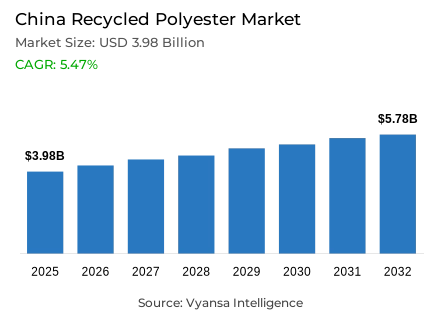
- Recycled polyester market size in China was valued at USD 3.98 billion in 2025 and is estimated at USD 4.18 billion in 2026.
- The market size is expected to grow to USD 5.78 billion by 2032.
- Market to register a CAGR of around 5.47% during 2026-32.
- Product Shares
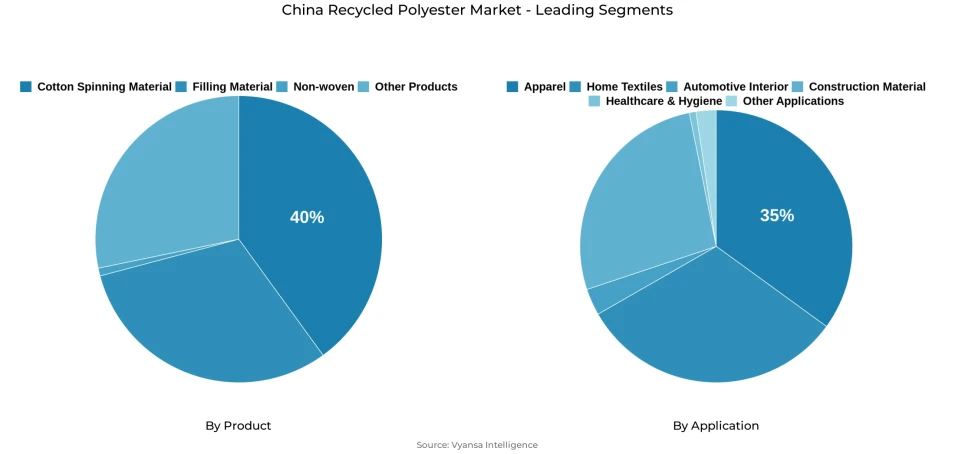
- Cotton spinning material grabbed market share of 40%.
- Competition
- More than 10 companies are actively engaged in producing recycled polyester in China.
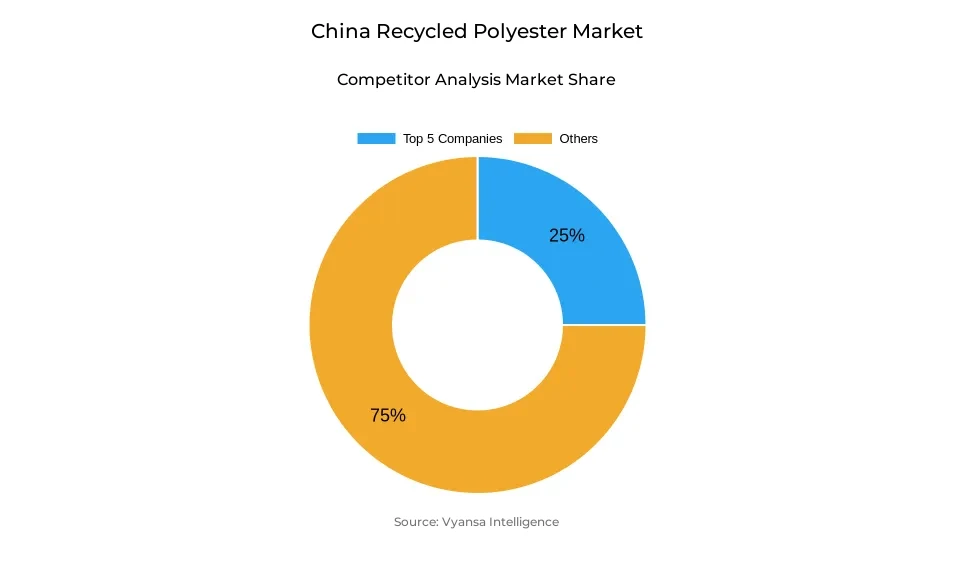
- Top 5 companies acquired around 25% of the market share in 2026.
- Longfu Recycling Energy Scientech Co. Ltd., Shandong Powerloom New Material Co. Ltd., Wankai New Materials Co. Ltd., China Resources Chemical Innovative Materials Group Limited, Far Eastern New Century Corporation etc., are few of the top companies.
- Application
- Apparel grabbed 35% of the market.
China Recycled Polyester Market Outlook
The China recycled polyester market size was valued at USD 3.98 billion in 2025 and is projected to grow from USD 4.18 billion in 2026 to USD 5.78 billion by 2032, exhibiting a CAGR of 5.47% during the forecast period. The market is witnessing substantial expansion as China accelerates its circular economy initiatives, strengthens textile recycling infrastructure, and promotes sustainable textile materials across manufacturing industries. Increasing environmental awareness, growing demand for recycled polyester fiber, and expanding adoption of sustainable apparel materials are supporting the development of the China recycled polyester market.
According to the National Development and Reform Commission (NDRC) and the Ministry of Industry and Information Technology (MIIT), China generates approximately 22 million to 26 million metric tons of textile waste annually. To improve resource efficiency, the government has established targets to increase textile recycling rates and expand recycled fiber production. These initiatives are supporting investments in textile recycling, bottle-to-fiber recycling systems, and advanced recycled PET fiber production facilities across the country.
Within the product segment, Cotton Spinning Material accounts for 40% of the China recycled polyester market. The segment benefits from growing integration of recycled polyester fiber and recycled textile materials into spinning and textile manufacturing operations. Increasing adoption of circular textile manufacturing practices is encouraging producers to incorporate recycled content into yarn and fabric production.
By application, Apparel holds 35% of the China recycled polyester market. Apparel manufacturers are increasingly utilizing recycled polyester, recycled synthetic fiber, and sustainable fibers to meet sustainability commitments and consumer demand for environmentally responsible products. The expansion of sustainable fashion materials and circular textile systems continues to strengthen demand across the apparel industry.
China Recycled Polyester Market Growth Driver
Rising Textile Waste Generation
The growing volume of textile waste remains a major driver for the China recycled polyester market. According to the National Development and Reform Commission (NDRC) and the Ministry of Industry and Information Technology (MIIT), China generates approximately 22 million to 26 million metric tons of textile waste annually. The increasing quantity of discarded textile materials is encouraging greater investment in polyester recycling, textile waste recovery, and circular economy textiles.
The China recycled polyester market benefits from these developments because recycled polyester fiber helps reduce dependence on virgin polyester while supporting sustainable textile manufacturing objectives. Expanding PET bottle recycling programs, post-consumer PET recycling initiatives, and bottle-to-fiber recycling technologies are further strengthening feedstock availability for recycled fiber production throughout the country.
China Recycled Polyester Market Challenge
Low Material Utilization Rates
A key challenge facing the China recycled polyester market is the relatively low utilization rate of textile waste. Official government documents indicate that only around 20% of textile waste is currently recycled or reused, limiting the availability of quality feedstock for recycled polyester production and recycled PET fiber manufacturing.
The China recycled polyester market also faces operational challenges associated with textile waste contamination, feedstock variability, and the complexity of processing blended fabrics. Improving collection systems, advanced sorting technologies, and material traceability will be critical to supporting large-scale textile recycling and strengthening the circular polyester value chain across China.
Unlock Market Intelligence
Explore the market potential with our data-driven report
China Recycled Polyester Market Trend
AI-Powered Textile Sorting
The adoption of advanced sorting technologies is becoming a major trend across the China recycled polyester market. The Ministry of Industry and Information Technology (MIIT) is encouraging the deployment of digital recycling technologies, including Near-Infrared (NIR) identification systems, hyperspectral imaging, and AI-powered textile sorting platforms that improve material classification accuracy.
The China recycled polyester market is benefiting from these innovations because automated sorting systems enhance feedstock quality, improve recycling efficiency, and support textile-to-textile recycling and fiber-to-fiber recycling initiatives. These technologies are helping recyclers process more complex waste streams while increasing the production of high-quality recycled polyester fiber and recycled polymer fibers.
China Recycled Polyester Market Opportunity
Government Recycling Targets
Government-backed recycling objectives are creating substantial opportunities for the China recycled polyester market. Under the framework established by the National Development and Reform Commission (NDRC) and the Ministry of Industry and Information Technology (MIIT), China is advancing toward its 2030 goal of achieving a 30% textile recycling rate and producing approximately 3 million tonnes of recycled fiber annually.
The China recycled polyester market is well positioned to benefit from these initiatives because achieving national recycling targets will require additional investments in collection infrastructure, mechanical recycling facilities, chemical recycling technologies, and closed-loop recycling systems. Growing demand for sustainable textile materials, circular fashion materials, and recycled polyester yarn is expected to create long-term opportunities throughout the recycled polyester value chain.
Unlock Market Intelligence
Explore the market potential with our data-driven report
China Recycled Polyester Market Segmentation Analysis
By Product
- Cotton Spinning Material
- Filling Material
- Non-woven
- Other Products
Cotton spinning material accounts for 40% of the China recycled polyester market, making it the leading product segment. The segment continues to benefit from increasing adoption of recycled polyester fiber, recycled PET fiber, and sustainable textile materials within textile manufacturing operations. Manufacturers are increasingly incorporating recycled inputs to improve sustainability performance and align with circular economy objectives.
The China recycled polyester market continues to witness strong demand for cotton spinning material as textile producers seek to expand recycled content utilization while supporting sustainable apparel production. The segment remains a key contributor to the growth of circular textile manufacturing and recycled fiber consumption across China.
By Application
- Apparel
- Home Textiles
- Automotive Interior
- Construction Material
- Healthcare & Hygiene
- Other Applications
Apparel represents 35% of the China recycled polyester market and remains the largest application segment. Rising consumer preference for eco-friendly products, growing adoption of sustainable fashion materials, and increasing commitments by global apparel brands to use recycled fibers are supporting demand for recycled polyester across clothing applications.
The China recycled polyester market continues to benefit from expanding use of recycled polyester fiber, recycled synthetic fiber, and sustainable textile materials in apparel manufacturing. The growing emphasis on circular textiles, low-carbon textile materials, and sustainable fashion supply chains is expected to support continued growth of recycled polyester applications across the apparel sector.
List of Companies Covered in China Recycled Polyester Market
The companies listed below are highly influential in the China recycled polyester market, with a significant market share and a strong impact on industry developments.
- Longfu Recycling Energy Scientech Co. Ltd.
- Shandong Powerloom New Material Co. Ltd.
- Wankai New Materials Co. Ltd.
- China Resources Chemical Innovative Materials Group Limited
- Far Eastern New Century Corporation
- Zhejiang Jiaren New Materials Co. Ltd.
- Xinda Corp. (including brands)
- Zhejiang Haili Environmental Technology Co. Ltd.
- Tongkun Group Co. Ltd.
- Zhejiang Hengyi Group Co. Ltd.
Market News & Updates
- China Resources Chemical Innovative Materials Group Limited, 2025:
China Resources Chemical Innovative Materials showcased its food-grade recycled polyester (rPET) bottle-chip products at CHINAPLAS 2025 and announced that its recycled polyester product containing 50% recycled content successfully completed food-contact challenge testing. The development supports the commercialization of high-recycled-content PET packaging materials and expands the company's sustainable polyester portfolio for packaging applications, reinforcing China's circular plastics and recycled polyester ecosystem.
- Zhejiang Jiaren New Materials Co. Ltd., 2025:
Zhejiang Jiaren New Materials strengthened its textile-to-textile recycling capabilities through a strategic partnership with Indorama Ventures to expand chemical recycling of polyester textiles. The collaboration supports the production of recycled polyester from post-consumer and post-industrial textile waste and aims to scale textile recycling capacity for global apparel and textile supply chains. The development enhances circular polyester manufacturing and supports the growth of China's recycled polyester industry.
Frequently Asked Questions
Related Report
- Market Segmentation
- Research Scope
- Research Methodology
- Definitions and Assumptions
- Executive Summary
- China Recycled Polyester Market Policies, Regulations, and Standards
- China Recycled Polyester Production (Kiloton) Trend 2022-2032
- China Recycled Polyester Production (Kiloton) Trend By Product
- Cotton Spinning Material
- Filling Material
- Non-woven
- Company Wise Production Plants and Statistics
- Installed Production Capacity
- Actual Production
- Planned Production Target
- China Recycled Polyester Production (Kiloton) Trend By Product
- China Recycled Polyester Pricing Analysis 2022-2032
- China Recycled Polyester Pricing Trend (USD/Kiloton) 2022-2032
- China Recycled Polyester Pricing Trend (USD/Kiloton) By Product 2022-2032
- Cotton Spinning Material
- Filling Material
- Non-woven
- China Recycled Polyester Market Dynamics
- Growth Factors
- Challenges
- Trends
- Opportunities
- China Recycled Polyester Market Statistics, 2022-2032F
- Market Size & Growth Outlook
- By Revenues in USD Million
- By Quantity Sold in Kiloton
- Market Segmentation & Growth Outlook
- By Product
- Cotton Spinning Material- Market Insights and Forecast 2022-2032, USD Million
- Filling Material- Market Insights and Forecast 2022-2032, USD Million
- Non-woven- Market Insights and Forecast 2022-2032, USD Million
- Other Products- Market Insights and Forecast 2022-2032, USD Million
- By Application
- Apparel- Market Insights and Forecast 2022-2032, USD Million
- Home Textiles- Market Insights and Forecast 2022-2032, USD Million
- Automotive Interior- Market Insights and Forecast 2022-2032, USD Million
- Construction Material- Market Insights and Forecast 2022-2032, USD Million
- Healthcare & Hygiene- Market Insights and Forecast 2022-2032, USD Million
- Other Applications- Market Insights and Forecast 2022-2032, USD Million
- By Region
- North- Market Insights and Forecast 2022-2032, USD Million
- East- Market Insights and Forecast 2022-2032, USD Million
- Southwest- Market Insights and Forecast 2022-2032, USD Million
- Northwest- Market Insights and Forecast 2022-2032, USD Million
- North East- Market Insights and Forecast 2022-2032, USD Million
- South- Market Insights and Forecast 2022-2032, USD Million
- By Competitors
- Competition Characteristics
- Market Share & Analysis
- By Product
- Market Size & Growth Outlook
- China Cotton Spinning Material Market Statistics, 2022-2032
- Market Size & Growth Outlook
- By Revenues in USD Million
- By Quantity Sold in Kiloton
- Market Segmentation & Growth Outlook
- By Application- Market Insights and Forecast 2022-2032, USD Million
- By Region- Market Insights and Forecast 2022-2032, USD Million
- Market Size & Growth Outlook
- China Filling Material Market Statistics, 2022-2032
- Market Size & Growth Outlook
- By Revenues in USD Million
- By Quantity Sold in Kiloton
- Market Segmentation & Growth Outlook
- By Application- Market Insights and Forecast 2022-2032, USD Million
- By Region- Market Insights and Forecast 2022-2032, USD Million
- Market Size & Growth Outlook
- China Non-woven Market Statistics, 2022-2032
- Market Size & Growth Outlook
- By Revenues in USD Million
- By Quantity Sold in Kiloton
- Market Segmentation & Growth Outlook
- By Application- Market Insights and Forecast 2022-2032, USD Million
- By Region- Market Insights and Forecast 2022-2032, USD Million
- Market Size & Growth Outlook
- China Other Products Market Statistics, 2022-2032
- Market Size & Growth Outlook
- By Revenues in USD Million
- By Quantity Sold in Kiloton
- Market Segmentation & Growth Outlook
- By Application- Market Insights and Forecast 2022-2032, USD Million
- By Region- Market Insights and Forecast 2022-2032, USD Million
- Market Size & Growth Outlook
- Competitive Outlook
- Company Profiles
- China Resources Chemical Innovative Materials Group Limited
- Business Description
- Product Portfolio
- Collaborations & Alliances
- Recent Developments
- Financial Details
- Others
- Far Eastern New Century Corporation
- Business Description
- Product Portfolio
- Collaborations & Alliances
- Recent Developments
- Financial Details
- Others
- Zhejiang Jiaren New Materials Co. Ltd.
- Business Description
- Product Portfolio
- Collaborations & Alliances
- Recent Developments
- Financial Details
- Others
- Xinda Corp. (including brands)
- Business Description
- Product Portfolio
- Collaborations & Alliances
- Recent Developments
- Financial Details
- Others
- Zhejiang Haili Environmental Technology Co. Ltd.
- Business Description
- Product Portfolio
- Collaborations & Alliances
- Recent Developments
- Financial Details
- Others
- Longfu Recycling Energy Scientech Co. Ltd.
- Business Description
- Product Portfolio
- Collaborations & Alliances
- Recent Developments
- Financial Details
- Others
- Shandong Powerloom New Material Co. Ltd.
- Business Description
- Product Portfolio
- Collaborations & Alliances
- Recent Developments
- Financial Details
- Others
- Wankai New Materials Co. Ltd.
- Business Description
- Product Portfolio
- Collaborations & Alliances
- Recent Developments
- Financial Details
- Others
- Tongkun Group Co. Ltd.
- Business Description
- Product Portfolio
- Collaborations & Alliances
- Recent Developments
- Financial Details
- Others
- Zhejiang Hengyi Group Co. Ltd.
- Business Description
- Product Portfolio
- Collaborations & Alliances
- Recent Developments
- Financial Details
- Others
- China Resources Chemical Innovative Materials Group Limited
- Company Profiles
- Disclaimer
| Segment | Sub-Segment |
|---|---|
| By Product |
|
| By Application |
|
| By Region |
|
Research Methodology
This study followed a structured approach comprising four key phases to assess the size and scope of the electro-oxidation market. The process began with thorough secondary research to collect data on the target market, related markets, and broader industry context. These findings, along with preliminary assumptions and estimates, were then validated through extensive primary research involving industry experts from across the value chain. To calculate the overall market size, both top-down and bottom-up methodologies were employed. Finally, market segmentation and data triangulation techniques were applied to refine and validate segment-level estimations.
Secondary Research
The secondary research phase involved gathering data from a wide range of credible and published sources. This step helped in identifying industry trends, defining market segmentation, and understanding the market landscape and value chain.
Sources consulted during this phase included:
- Company annual reports, investor presentations, and press releases
- Industry white papers and certified publications
- Trade directories and market-recognized databases
- Articles from authoritative authors and reputable journals
- Gold and silver standard websites
Secondary research was critical in mapping out the industry's value chain and monetary flow, identifying key market segments, understanding regional variations, and tracking significant industry developments.
Other key sources:
- Financial disclosures
- Industry associations and trade bodies
- News outlets and business magazines
- Academic journals and research studies
- Paid industry databases
Primary Research
To validate secondary data and gain deeper market insights, primary research was conducted with key stakeholders across both the supply and demand sides of the market.
On the demand side, participants included decision-makers and influencers from end-user industries—such as CIOs, CTOs, and CSOs—who provided first-hand perspectives on market needs, product usage, and future expectations.
On the supply side, interviews were conducted with manufacturers, industry associations, and institutional participants to gather insights into current offerings, product pipelines, and market challenges.
Primary interviews provided critical inputs such as:
- Market size and revenue data
- Product and service breakdowns
- Market forecasts
- Regional and application-specific trends
Stakeholders consulted included:
- Leading OEM and solution providers
- Channel and distribution partners
- End users across various applications
- Independent consultants and industry specialists
Market Size Estimation and Data Triangulation
- Identifying Key Market Participants (Secondary Research)
- Goal: To identify the major players or companies in the target market. This typically involves using publicly available data sources such as industry reports, market research publications, and financial statements of companies.
- Tools: Reports from firms like Gartner, Forrester, Euromonitor, Statista, IBISWorld, and others. Public financial statements, news articles, and press releases from top market players.
- Extracting Earnings of Key Market Participants
- Goal: To estimate the earnings generated from the product or service being analyzed. This step helps in understanding the revenue potential of each market player in a specific geography.
- Methods: Earnings data can be gathered from:
- Publicly available financial reports (for listed companies).
- Interviews and primary data sources from professionals, such as Directors, VPs, SVPs, etc. This is especially useful for understanding more nuanced, internal data that isn't publicly disclosed.
- Annual reports and investor presentations of key players.
- Data Collation and Development of a Relevant Data Model
- Goal: To collate inputs from both primary and secondary sources into a structured, data-driven model for market estimation. This model will incorporate key market KPIs and any independent variables relevant to the market.
- Key KPIs: These could include:
- Market size, growth rate, and demand drivers.
- Industry-specific metrics like market share, average revenue per customer (ARPC), or average deal size.
- External variables, such as economic growth rates, inflation rates, or commodity prices, that could affect the market.
- Data Modeling: Based on this data, the market forecasts are developed for the next 5 years. A combination of trend analysis, scenario modeling, and statistical regression might be used to generate projections.
- Scenario Analysis
- Goal: To test different assumptions and validate how sensitive the market is to changes in key variables (e.g., market demand, regulatory changes, technological disruptions).
- Types of Scenarios:
- Base Case: Based on current assumptions and historical data.
- Best-Case Scenario: Assuming favorable market conditions, regulatory environments, and technological advancements.
- Worst-Case Scenario: Accounting for adverse factors, such as economic downturns, stricter regulations, or unexpected disruptions.












