China Clinical Laboratory Services Market Report: Trends, Growth and Forecast (2026-2032)
By Test Type (Clinical Chemistry (Routine Chemistry Testing, Therapeutic Drug Monitoring Testing, Endocrinology Chemistry Testing, Specialized Chemistry Testing, Other Clinical Chemistry Testing), Hematology Testing, Medical Microbiology (Infectious Disease Testing, Transplant Diagnostic Testing, Other Microbiology Testing), Immunology & Serology Testing, Molecular Diagnostics, Genetic Testing, Pathology (Cytopathology, Histopathology), Blood Banking & Transfusion Services, Toxicology & Drug Abuse Testing, Other Specialty/Esoteric Tests), By Service Provider (Hospital-based Laboratories, Independent/Standalone Clinical Laboratories, Clinic/Physician Office Laboratories, Public Health Laboratories, Specialty Laboratories), By Application (Routine Diagnostic Testing, Chronic Disease Testing, Infectious Disease Testing, Oncology Testing, Preventive/Screening Testing, Specialized/Genetic Testing), By Region (North, East, Southwest, Northwest, North East, South) ... Read more
|
Major Players
|
China Clinical Laboratory Services Market Statistics and Insights, 2026
- Market Size Statistics
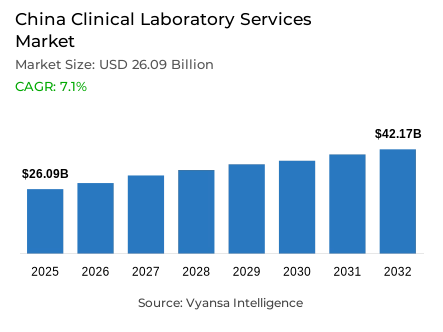
- Clinical laboratory services market size in China was valued at USD 26.09 billion in 2025 and is estimated at USD 27.94 billion in 2026.
- The market size is expected to grow to USD 42.17 billion by 2032.
- Market to register a CAGR of around 7.1% during 2026-32.
- Test Type Shares
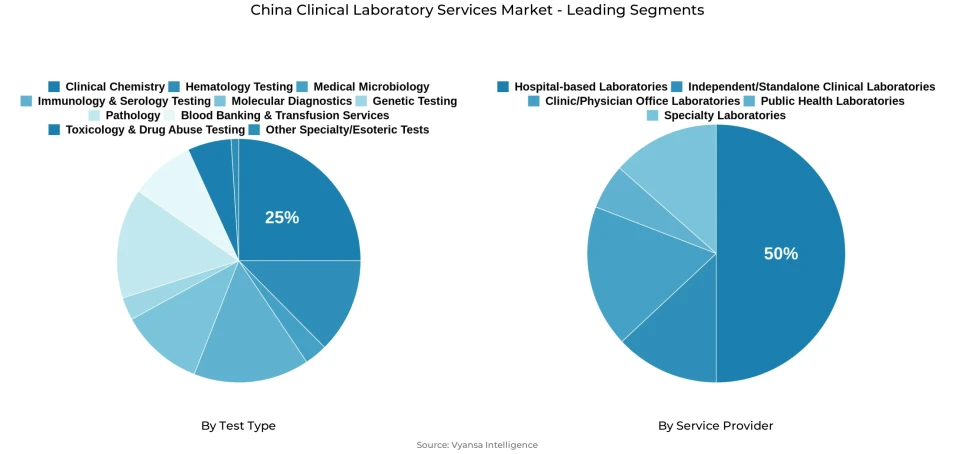
- Clinical chemistry grabbed market share of 25%.
- Competition
- More than 10 companies are actively engaged in producing clinical laboratory services in China.
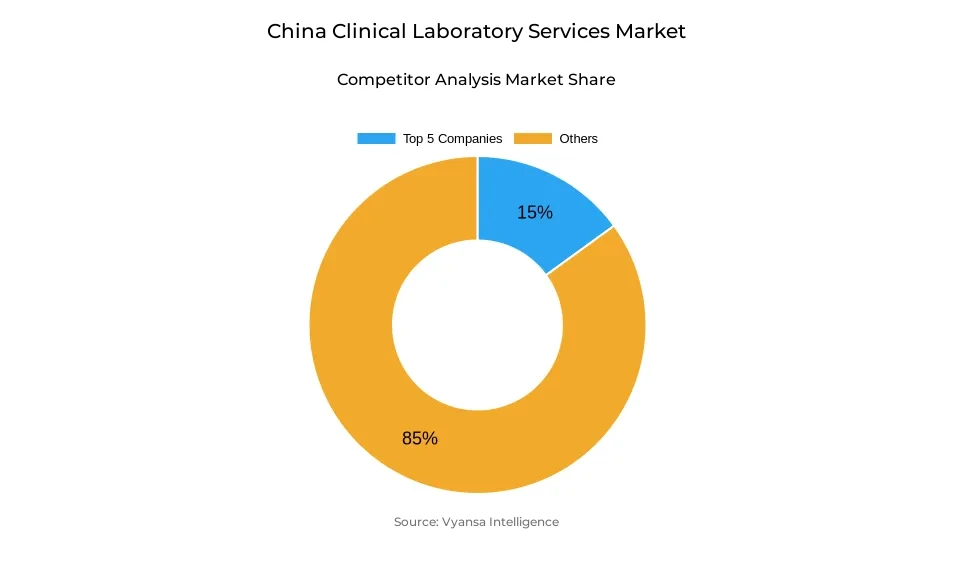
- Top 5 companies acquired around 15% of the market share.
- KingMylab, Burning Rock Dx, Genetron Health, KingMed Diagnostics, ADICON etc., are few of the top companies.
- Service Provider
- Hospital-based laboratories grabbed 50% of the market.
China Clinical Laboratory Services Market Outlook
The China Clinical Laboratory Services Market was valued at USD 26.09 billion in 2025, establishing a commercially substantial and institutionally well-anchored foundation within the world's most populous national healthcare diagnostics ecosystem. Projected to advance from USD 27.94 billion in 2026 to USD 42.17 billion by 2032, the sector registers a compound annual growth rate of 7.1% across the forecast horizon. This steady and structurally supported expansion trajectory reflects the convergence of a rapidly aging national population, accelerating healthcare utilization across primary and hospital-based care settings, and progressive national commitments to AI-enabled diagnostic workflow modernization whose combined institutional force sustains consistent and compounding laboratory service demand across China's vast and continuously expanding healthcare delivery network.
The test type architecture defining this market's commercial structure is anchored in clinical chemistry testing. Clinical Chemistry commands approximately 25% of total test type market share, reflecting the consistent and broad clinical preference for routine biochemical testing whose high-volume applicability, repeat evaluation frequency, and broad relevance across metabolic monitoring, organ function assessment, and chronic disease management make it the reference test category across China's most commercially significant laboratory service environments. The Ministry of Civil Affairs and National Office on Ageing's documentation of 1.41 billion health services delivered to people aged 65 and above at primary healthcare institutions in 2024 confirms the elderly population healthcare utilization scale that sustains consistent clinical chemistry testing demand across hospital-based and primary care laboratory settings nationwide.
The service provider architecture reinforces the structural centrality of hospital-based laboratories as the category's dominant service delivery platform. Hospital-Based Laboratories command approximately 50% of total service provider market share, reflecting the foundational operational advantages of institutional care integration in coordinating diagnostic workflows, physician-laboratory communication, and continuous testing access across China's most clinically active inpatient, outpatient, and specialist treatment environments. The National Healthcare Security Administration's documentation of resident medical insurance beneficiaries recording 30.35 billion treatment episodes in 2024 confirms the healthcare utilization scale that sustains hospital-based laboratory service utilization as the country's dominant diagnostic testing channel across both acute and routine care settings.
The future outlook is defined by four converging structural forces whose combined commercial impact creates a clinical laboratory services market of sustained and well-grounded expansion momentum. The Ministry of Civil Affairs and National Office on Ageing's documentation of the population aged 60 and above reaching 310.31 million at the end of 2024, equivalent to 22.0% of the total national population, confirms the demographic aging pressure that sustains consistent high-frequency diagnostic testing demand across chronic disease monitoring, geriatric care, and preventive health screening programs. The National Healthcare Security Administration's achievement of full disease-based payment coverage across eligible pooling areas and qualified medical institutions by end of 2024 creates a structured reimbursement environment whose standardization is reshaping laboratory service economics and operational efficiency imperatives. The National Health Commission's 2025 implementation framework setting out 8 application directions and 24 key applications for AI-enabled healthcare confirms the intelligent workflow integration trajectory that is progressively elevating digital diagnostic capability expectations across hospital and primary care laboratory environments. The State Council Information Office's documentation of primary-level healthcare institutions handling 5.56 billion patient visits in 2025, representing 52.6% of all medical facility visits, confirms the grassroots care utilization momentum that creates compelling laboratory service expansion opportunities beyond major urban hospital clusters over the forecast period.
China Clinical Laboratory Services Market Growth Driver
Aging Population and Rising Healthcare Utilization Sustain Testing Volume Growth
The rapid and institutionally documented aging of China's national population, combined with the accelerating healthcare service utilization that accompanies demographic aging across the country's public and private care delivery networks, represents the primary structural driver of clinical laboratory services demand. This aging-driven demand dynamic functions as a persistent testing volume generation mechanism that sustains consistent biochemical monitoring, chronic disease assessment, and preventive screening activity across hospital-based and primary care laboratory service environments nationwide. Growth is anchored in demographic inevitability rather than discretionary healthcare spending, giving this demand driver a commercial durability that sustains laboratory service market expansion across economic cycles and healthcare policy environments.
The quantitative evidence validating this aging-driven demand dynamic is documented with precision by the Ministry of Civil Affairs and the National Office on Ageing. The population aged 60 and above reached 310.31 million at the end of 2024, equivalent to 22.0% of the total national population, confirming the demographic aging scale that creates consistent and compounding diagnostic testing demand across China's healthcare system. A total of 1.41 billion health services were delivered to people aged 65 and above at primary healthcare institutions in 2024, confirming the elderly care utilization intensity that generates disproportionate clinical chemistry, chronic disease monitoring, and routine health screening demand relative to younger population segments. The National Healthcare Security Administration's documentation of resident medical insurance beneficiaries recording 30.35 billion treatment episodes in 2024 further validates the healthcare system utilization scale that sustains consistent and high-volume laboratory service demand across the full spectrum of clinical testing categories over the forecast period.
China Clinical Laboratory Services Market Challenge
Payment Standardization and Intelligent Supervision Tighten Operating Economics
The progressive standardization of healthcare reimbursement through disease-based payment coverage and the simultaneous expansion of intelligent supervision mechanisms across China's medical insurance system represent the most consequential operational challenge confronting clinical laboratory service providers, creating systematic pricing flexibility constraints, compliance management obligations, and audit exposure risks that elevate operating complexity and compress the revenue management options available to laboratory service providers across both hospital-integrated and independent service delivery channels. In a laboratory operating environment where reimbursement rates are increasingly determined by standardized disease-based payment frameworks rather than negotiated service pricing, the ability to sustain commercial viability demands operational efficiency, volume management discipline, and robust compliance infrastructure that many smaller and mid-tier providers find difficult to maintain simultaneously.
The structural depth and financial scale of this payment standardization and compliance challenge are documented with precision by the National Healthcare Security Administration. China achieved full coverage of disease-based payment across eligible pooling areas and qualified medical institutions by end of 2024, with disease-based payment already covering more than 90% of discharge cases and approximately 80% of eligible inpatient medical insurance fund spending, confirming that standardized reimbursement has become the dominant payment framework governing the vast majority of hospital-based laboratory service revenue across the national market. The medical insurance system recovered CNY 27.5 billion in 2024, including CNY 3.1 billion recovered through intelligent supervision mechanisms, confirming that data-driven compliance monitoring is identifying reimbursement irregularities at a scale whose financial and operational implications create meaningful audit risk for laboratory service providers whose compliance management infrastructure is insufficient for the current supervision environment. Navigating this challenge demands sustained investment in disease-based payment compliance systems, quality documentation infrastructure, and intelligent supervision-ready operational processes over the forecast period.
Unlock Market Intelligence
Explore the market potential with our data-driven report
China Clinical Laboratory Services Market Trend
AI-Enabled Intelligent Diagnostics Reshape Workflow Standards Across Care Settings
The structured national deployment of AI-enabled healthcare applications across China's hospital and primary care laboratory environments represents the defining structural trend reshaping diagnostic workflow standards, competitive capability requirements, and technology investment priorities within the national clinical laboratory services market. This intelligent workflow integration trend is progressively transforming laboratory service delivery from a volume-focused, manual-process testing model into a data-enabled, AI-augmented service ecosystem where intelligent imaging diagnosis, clinical decision support, automated report generation, and AI-assisted triage collectively create faster, more accurate, and more operationally efficient diagnostic service experiences across the diverse patient and provider populations served by China's national healthcare system.
The policy framework and implementation timeline of this AI-enabled diagnostics trend are documented with authority by the National Health Commission and the State Council. The National Health Commission's 2025 implementation opinions on AI-plus-healthcare establish 8 application directions and 24 key applications, confirming that intelligent diagnostic integration has advanced from isolated hospital pilot programs into a structured national framework whose adoption expectations apply across healthcare facilities at every tier of the national system. The State Council's 2025 policy framework anticipates that by 2030, intelligent diagnosis and treatment assistance will become universal in basic terms across primary-level medical institutions, while second-grade-and-above hospitals are expected to widely adopt intelligent imaging diagnosis and clinical decision support tools. As these AI capability expectations advance toward operational requirements across China's most commercially significant laboratory service environments, providers with established intelligent workflow infrastructure will capture disproportionate institutional referral share and operational efficiency advantages over the forecast period.
China Clinical Laboratory Services Market Opportunity
Primary Healthcare Expansion Creates Distributed Laboratory Service Demand
The large-scale and policy-reinforced expansion of primary healthcare capacity and patient utilization across China's grassroots health institution network creates the clinical laboratory services market's most commercially significant and geographically distributed growth opportunity, providing a vast and rapidly growing first-contact care utilization base whose diagnostic testing requirements are being progressively activated by expanding medical insurance resource allocation toward primary-level institutions and the continuing buildout of community health centers, township health stations, and village clinic infrastructure across urban and rural healthcare markets nationwide. This primary care expansion opportunity is distinguished from major hospital-based market growth by its geographic breadth across previously underserved secondary cities and rural communities, its policy-backed funding trajectory that progressively improves primary care laboratory service reimbursement economics, and the scale of patient flow it represents relative to the current laboratory service penetration depth at grassroots care settings.
The quantitative scale and policy momentum of this primary care expansion opportunity are documented with precision by the State Council Information Office and the National Health Commission. Primary-level healthcare institutions handled 5.56 billion patient visits in 2025, accounting for 52.6% of all visits to China's medical facilities, confirming that grassroots healthcare has become the dominant patient contact channel within the national care delivery system whose laboratory service penetration depth represents the market's most significant untapped demand expansion opportunity. The State Council Information Office confirms that China will direct more medical insurance resources toward primary-level healthcare institutions under 2026 policy guidelines, confirming that reimbursement support for primary care laboratory services will improve in ways that enhance the commercial viability of laboratory service expansion at the grassroots level. The National Health Commission's documentation of more than 1.09 million health institutions across China by end of 2024 confirms the institutional infrastructure breadth that provides a distributed platform for laboratory service partnership, sample logistics network development, and primary care-linked diagnostic testing expansion. Laboratory service providers that invest in primary care collection infrastructure, primary institution partnership models, and reimbursement-aligned service pricing will capture disproportionate value from China's most structurally significant laboratory service growth opportunity over the forecast period.
Unlock Market Intelligence
Explore the market potential with our data-driven report
China Clinical Laboratory Services Market Segmentation Analysis
By Test Type
- Clinical Chemistry
- Routine Chemistry Testing
- Therapeutic Drug Monitoring Testing
- Endocrinology Chemistry Testing
- Specialized Chemistry Testing
- Other Clinical Chemistry Testing
- Hematology Testing
- Medical Microbiology
- Infectious Disease Testing
- Transplant Diagnostic Testing
- Other Microbiology Testing
- Immunology & Serology Testing
- Molecular Diagnostics
- Genetic Testing
- Pathology
- Cytopathology
- Histopathology
- Blood Banking & Transfusion Services
- Toxicology & Drug Abuse Testing
- Other Specialty/Esoteric Tests
The segment with highest market share under the Test Type is Clinical Chemistry, accounting for approximately 25% of the total market. This leading position reflects the deep structural alignment between clinical chemistry testing capabilities and the specific diagnostic workflow requirements of China's most institutionally significant laboratory service environments, where high-volume applicability, repeat testing frequency, and broad clinical relevance across metabolic assessment, organ function monitoring, chronic disease management, and routine health screening make clinical chemistry the reference test category across hospital-based, primary care, and independent laboratory settings nationwide. With one-quarter of total market value concentrated within a single test type category, Clinical Chemistry defines the equipment investment priorities, reagent procurement frameworks, and operational capacity planning benchmarks of the China clinical laboratory services market.
The structural leadership of Clinical Chemistry is being actively sustained by the aging population's chronic disease management requirements and the healthcare system's expanding coverage of elderly patient monitoring programs. The Ministry of Civil Affairs and National Office on Ageing's documentation of 1.41 billion health services delivered to people aged 65 and above at primary healthcare institutions in 2024 confirms the elderly care utilization scale that generates consistent biochemical monitoring, metabolic assessment, and organ function testing demand across China's laboratory service network. As disease-based payment standardization advances and primary healthcare institutions expand their diagnostic service scope under national policy direction, clinical chemistry testing's combination of high volume, broad applicability, and consistent physician utilization will sustain its structural market leadership over the forecast period.
By Service Provider
- Hospital-based Laboratories
- Independent/Standalone Clinical Laboratories
- Clinic/Physician Office Laboratories
- Public Health Laboratories
- Specialty Laboratories
The segment with highest market share under the Service Provider is Hospital-Based Laboratories, accounting for approximately 50% of the total market. This dominant position reflects the foundational operational reality of Chinese clinical diagnostics, where the integration of laboratory testing within hospital care workflows, the physician-directed testing referral patterns of institutional care settings, and the round-the-clock diagnostic access requirements of inpatient, outpatient, and emergency care environments collectively generate the highest concentration and most clinically urgent laboratory service demand across the national market. With half of total market value anchored in hospital-based laboratory service delivery, this provider segment defines the testing volume benchmarks, quality standard expectations, and equipment investment priorities of the China clinical laboratory services market.
The structural leadership of Hospital-Based Laboratories is being actively sustained by the progressive expansion of hospital care capacity across China's urban and secondary city healthcare systems, where government and private sector hospital investment is generating consistent growth in the institutional care settings whose laboratory service requirements create the most commercially significant diagnostic testing demand concentrations in the national market. The National Healthcare Security Administration's documentation of disease-based payment covering more than 90% of discharge cases and approximately 80% of eligible inpatient medical insurance fund spending by end of 2024 confirms the institutional care volume scale that sustains hospital-based laboratory service utilization across the full spectrum of inpatient diagnostic testing categories. As intelligent workflow integration advances across second-grade-and-above hospitals under the National Health Commission's AI-enabled healthcare framework, hospital-based laboratories with established digital diagnostic infrastructure will deepen their competitive advantage. The segment's structural commercial dominance is expected to remain intact over the forecast period.
List of Companies Covered in China Clinical Laboratory Services Market
The companies listed below are highly influential in the China clinical laboratory services market, with a significant market share and a strong impact on industry developments.
- KingMylab
- Burning Rock Dx
- Genetron Health
- KingMed Diagnostics
- ADICON
- DIAN Diagnostics
- BGI Genomics/BGI Group
- Kindstar Globalgene
- Berry Genomics
- Novogene
Market News & Updates
- KingMed Diagnostics, 2026:
KingMed helped launch Guangdong’s first county-level AI-assisted diagnosis platform in Fengkai, built on its digitized county medical-community model and designed to support smart report interpretation, test selection, disease assistance, and medication support across county hospitals and township health centers. For the China clinical laboratory services market, this is a major innovation because it extends digitally assisted diagnostic capability beyond major urban centers and strengthens the role of lab-linked decision support in regional care delivery
- Genetron Health, 2026:
Genetron Health announced official approval of the Beijing Key Laboratory for Liquid Biopsy Innovation and Translation, established with the Cancer Hospital of the Chinese Academy of Medical Sciences, with a focus on multi-omics biomarker discovery, early screening, MRD monitoring, and companion-diagnostic platform development. This is a highly relevant innovation update for China because it reinforces the move toward higher-complexity oncology laboratory services built on liquid biopsy and translational molecular diagnostics.
Frequently Asked Questions
Related Report
- Market Segmentation
- Research Scope
- Research Methodology
- Definitions and Assumptions
- Executive Summary
- China Clinical Laboratory Services Market Policies, Regulations, and Standards
- China Clinical Laboratory Services Market Dynamics
- Growth Factors
- Challenges
- Trends
- Opportunities
- China Clinical Laboratory Services Market Statistics, 2022-2032F
- Market Size & Growth Outlook
- By Revenues in USD Million
- Market Segmentation & Growth Outlook
- By Test Type
- Clinical Chemistry- Market Insights and Forecast 2022-2032, USD Million
- Routine Chemistry Testing- Market Insights and Forecast 2022-2032, USD Million
- Therapeutic Drug Monitoring Testing- Market Insights and Forecast 2022-2032, USD Million
- Endocrinology Chemistry Testing- Market Insights and Forecast 2022-2032, USD Million
- Specialized Chemistry Testing- Market Insights and Forecast 2022-2032, USD Million
- Other Clinical Chemistry Testing- Market Insights and Forecast 2022-2032, USD Million
- Hematology Testing- Market Insights and Forecast 2022-2032, USD Million
- Medical Microbiology- Market Insights and Forecast 2022-2032, USD Million
- Infectious Disease Testing- Market Insights and Forecast 2022-2032, USD Million
- Transplant Diagnostic Testing- Market Insights and Forecast 2022-2032, USD Million
- Other Microbiology Testing- Market Insights and Forecast 2022-2032, USD Million
- Immunology & Serology Testing- Market Insights and Forecast 2022-2032, USD Million
- Molecular Diagnostics- Market Insights and Forecast 2022-2032, USD Million
- Genetic Testing- Market Insights and Forecast 2022-2032, USD Million
- Pathology- Market Insights and Forecast 2022-2032, USD Million
- Cytopathology- Market Insights and Forecast 2022-2032, USD Million
- Histopathology- Market Insights and Forecast 2022-2032, USD Million
- Blood Banking & Transfusion Services- Market Insights and Forecast 2022-2032, USD Million
- Toxicology & Drug Abuse Testing- Market Insights and Forecast 2022-2032, USD Million
- Other Specialty/Esoteric Tests- Market Insights and Forecast 2022-2032, USD Million
- Clinical Chemistry- Market Insights and Forecast 2022-2032, USD Million
- By Service Provider
- Hospital-based Laboratories- Market Insights and Forecast 2022-2032, USD Million
- Independent/Standalone Clinical Laboratories- Market Insights and Forecast 2022-2032, USD Million
- Clinic/Physician Office Laboratories- Market Insights and Forecast 2022-2032, USD Million
- Public Health Laboratories- Market Insights and Forecast 2022-2032, USD Million
- Specialty Laboratories- Market Insights and Forecast 2022-2032, USD Million
- By Application
- Routine Diagnostic Testing- Market Insights and Forecast 2022-2032, USD Million
- Chronic Disease Testing- Market Insights and Forecast 2022-2032, USD Million
- Infectious Disease Testing- Market Insights and Forecast 2022-2032, USD Million
- Oncology Testing- Market Insights and Forecast 2022-2032, USD Million
- Preventive/Screening Testing- Market Insights and Forecast 2022-2032, USD Million
- Specialized/Genetic Testing- Market Insights and Forecast 2022-2032, USD Million
- By Region
- North
- East
- Southwest
- Northwest
- North East
- South
- By Competitors
- Competition Characteristics
- Market Share & Analysis
- By Test Type
- Market Size & Growth Outlook
- China Clinical Chemistry Market Statistics, 2022-2032
- Market Size & Growth Outlook
- By Revenues in USD Million
- Market Segmentation & Growth Outlook
- By Service Provider- Market Insights and Forecast 2022-2032, USD Million
- By Application- Market Insights and Forecast 2022-2032, USD Million
- By Region- Market Insights and Forecast 2022-2032, USD Million
- Market Size & Growth Outlook
- China Hematology Testing Market Statistics, 2022-2032
- Market Size & Growth Outlook
- By Revenues in USD Million
- Market Segmentation & Growth Outlook
- By Service Provider- Market Insights and Forecast 2022-2032, USD Million
- By Application- Market Insights and Forecast 2022-2032, USD Million
- By Region- Market Insights and Forecast 2022-2032, USD Million
- Market Size & Growth Outlook
- China Medical Microbiology Market Statistics, 2022-2032
- Market Size & Growth Outlook
- By Revenues in USD Million
- Market Segmentation & Growth Outlook
- By Service Provider- Market Insights and Forecast 2022-2032, USD Million
- By Application- Market Insights and Forecast 2022-2032, USD Million
- By Region- Market Insights and Forecast 2022-2032, USD Million
- Market Size & Growth Outlook
- China Immunology & Serology Testing Market Statistics, 2022-2032
- Market Size & Growth Outlook
- By Revenues in USD Million
- Market Segmentation & Growth Outlook
- By Service Provider- Market Insights and Forecast 2022-2032, USD Million
- By Application- Market Insights and Forecast 2022-2032, USD Million
- By Region- Market Insights and Forecast 2022-2032, USD Million
- Market Size & Growth Outlook
- China Molecular Diagnostics Market Statistics, 2022-2032
- Market Size & Growth Outlook
- By Revenues in USD Million
- Market Segmentation & Growth Outlook
- By Service Provider- Market Insights and Forecast 2022-2032, USD Million
- By Application- Market Insights and Forecast 2022-2032, USD Million
- By Region- Market Insights and Forecast 2022-2032, USD Million
- Market Size & Growth Outlook
- China Genetic Testing Market Statistics, 2022-2032
- Market Size & Growth Outlook
- By Revenues in USD Million
- Market Segmentation & Growth Outlook
- By Service Provider- Market Insights and Forecast 2022-2032, USD Million
- By Application- Market Insights and Forecast 2022-2032, USD Million
- By Region- Market Insights and Forecast 2022-2032, USD Million
- Market Size & Growth Outlook
- China Pathology Market Statistics, 2022-2032
- Market Size & Growth Outlook
- By Revenues in USD Million
- Market Segmentation & Growth Outlook
- By Service Provider- Market Insights and Forecast 2022-2032, USD Million
- By Application- Market Insights and Forecast 2022-2032, USD Million
- By Region- Market Insights and Forecast 2022-2032, USD Million
- Market Size & Growth Outlook
- China Blood Banking & Transfusion Services Market Statistics, 2022-2032
- Market Size & Growth Outlook
- By Revenues in USD Million
- Market Segmentation & Growth Outlook
- By Service Provider- Market Insights and Forecast 2022-2032, USD Million
- By Application- Market Insights and Forecast 2022-2032, USD Million
- By Region- Market Insights and Forecast 2022-2032, USD Million
- Market Size & Growth Outlook
- China Toxicology & Drug Abuse Testing Market Statistics, 2022-2032
- Market Size & Growth Outlook
- By Revenues in USD Million
- Market Segmentation & Growth Outlook
- By Service Provider- Market Insights and Forecast 2022-2032, USD Million
- By Application- Market Insights and Forecast 2022-2032, USD Million
- By Region- Market Insights and Forecast 2022-2032, USD Million
- Market Size & Growth Outlook
- China Other Specialty/Esoteric Tests Market Statistics, 2022-2032
- Market Size & Growth Outlook
- By Revenues in USD Million
- Market Segmentation & Growth Outlook
- By Service Provider- Market Insights and Forecast 2022-2032, USD Million
- By Application- Market Insights and Forecast 2022-2032, USD Million
- By Region- Market Insights and Forecast 2022-2032, USD Million
- Market Size & Growth Outlook
- Competitive Outlook
- Company Profiles
- KingMed Diagnostics
- Business Description
- Product Portfolio
- Collaborations & Alliances
- Recent Developments
- Financial Details
- Others
- ADICON
- Business Description
- Product Portfolio
- Collaborations & Alliances
- Recent Developments
- Financial Details
- Others
- DIAN Diagnostics
- Business Description
- Product Portfolio
- Collaborations & Alliances
- Recent Developments
- Financial Details
- Others
- BGI Genomics/BGI Group
- Business Description
- Product Portfolio
- Collaborations & Alliances
- Recent Developments
- Financial Details
- Others
- Kindstar Globalgene
- Business Description
- Product Portfolio
- Collaborations & Alliances
- Recent Developments
- Financial Details
- Others
- KingMylab
- Business Description
- Product Portfolio
- Collaborations & Alliances
- Recent Developments
- Financial Details
- Others
- Burning Rock Dx
- Business Description
- Product Portfolio
- Collaborations & Alliances
- Recent Developments
- Financial Details
- Others
- Genetron Health
- Business Description
- Product Portfolio
- Collaborations & Alliances
- Recent Developments
- Financial Details
- Others
- Berry Genomics
- Business Description
- Product Portfolio
- Collaborations & Alliances
- Recent Developments
- Financial Details
- Others
- Novogene
- Business Description
- Product Portfolio
- Collaborations & Alliances
- Recent Developments
- Financial Details
- Others
- KingMed Diagnostics
- Company Profiles
- Disclaimer
| Segment | Sub-Segment |
|---|---|
| By Test Type |
|
| By Service Provider |
|
| By Application |
|
| By Region |
|
Research Methodology
This study followed a structured approach comprising four key phases to assess the size and scope of the electro-oxidation market. The process began with thorough secondary research to collect data on the target market, related markets, and broader industry context. These findings, along with preliminary assumptions and estimates, were then validated through extensive primary research involving industry experts from across the value chain. To calculate the overall market size, both top-down and bottom-up methodologies were employed. Finally, market segmentation and data triangulation techniques were applied to refine and validate segment-level estimations.
Secondary Research
The secondary research phase involved gathering data from a wide range of credible and published sources. This step helped in identifying industry trends, defining market segmentation, and understanding the market landscape and value chain.
Sources consulted during this phase included:
- Company annual reports, investor presentations, and press releases
- Industry white papers and certified publications
- Trade directories and market-recognized databases
- Articles from authoritative authors and reputable journals
- Gold and silver standard websites
Secondary research was critical in mapping out the industry's value chain and monetary flow, identifying key market segments, understanding regional variations, and tracking significant industry developments.
Other key sources:
- Financial disclosures
- Industry associations and trade bodies
- News outlets and business magazines
- Academic journals and research studies
- Paid industry databases
Primary Research
To validate secondary data and gain deeper market insights, primary research was conducted with key stakeholders across both the supply and demand sides of the market.
On the demand side, participants included decision-makers and influencers from end-user industries—such as CIOs, CTOs, and CSOs—who provided first-hand perspectives on market needs, product usage, and future expectations.
On the supply side, interviews were conducted with manufacturers, industry associations, and institutional participants to gather insights into current offerings, product pipelines, and market challenges.
Primary interviews provided critical inputs such as:
- Market size and revenue data
- Product and service breakdowns
- Market forecasts
- Regional and application-specific trends
Stakeholders consulted included:
- Leading OEM and solution providers
- Channel and distribution partners
- End users across various applications
- Independent consultants and industry specialists
Market Size Estimation and Data Triangulation
- Identifying Key Market Participants (Secondary Research)
- Goal: To identify the major players or companies in the target market. This typically involves using publicly available data sources such as industry reports, market research publications, and financial statements of companies.
- Tools: Reports from firms like Gartner, Forrester, Euromonitor, Statista, IBISWorld, and others. Public financial statements, news articles, and press releases from top market players.
- Extracting Earnings of Key Market Participants
- Goal: To estimate the earnings generated from the product or service being analyzed. This step helps in understanding the revenue potential of each market player in a specific geography.
- Methods: Earnings data can be gathered from:
- Publicly available financial reports (for listed companies).
- Interviews and primary data sources from professionals, such as Directors, VPs, SVPs, etc. This is especially useful for understanding more nuanced, internal data that isn't publicly disclosed.
- Annual reports and investor presentations of key players.
- Data Collation and Development of a Relevant Data Model
- Goal: To collate inputs from both primary and secondary sources into a structured, data-driven model for market estimation. This model will incorporate key market KPIs and any independent variables relevant to the market.
- Key KPIs: These could include:
- Market size, growth rate, and demand drivers.
- Industry-specific metrics like market share, average revenue per customer (ARPC), or average deal size.
- External variables, such as economic growth rates, inflation rates, or commodity prices, that could affect the market.
- Data Modeling: Based on this data, the market forecasts are developed for the next 5 years. A combination of trend analysis, scenario modeling, and statistical regression might be used to generate projections.
- Scenario Analysis
- Goal: To test different assumptions and validate how sensitive the market is to changes in key variables (e.g., market demand, regulatory changes, technological disruptions).
- Types of Scenarios:
- Base Case: Based on current assumptions and historical data.
- Best-Case Scenario: Assuming favorable market conditions, regulatory environments, and technological advancements.
- Worst-Case Scenario: Accounting for adverse factors, such as economic downturns, stricter regulations, or unexpected disruptions.












