Cameroon Paediatric Consumer Health Market Report: Trends, Growth and Forecast (2026-2032)
By Product Type (Paediatric Analgesics (Paediatric Acetaminophen, Paediatric Aspirin, Paediatric Combination Products Analgesics, Paediatric Dipyrone, Paediatric Ibuprofen, Paediatric Naproxen), Paediatric Cough, Cold and Allergy Remedies (Paediatric Allergy Remedies, Paediatric Cough/Cold Remedies), Paediatric Digestive Remedies (Paediatric Diarrhoeal Remedies, Paediatric Indigestion and Heartburn Remedies, Paediatric Laxatives, Paediatric Motion Sickness Remedies), Paediatric Dermatologicals, Nappy (Diaper) Rash Treatments, Paediatric Vitamins and Dietary Supplements), By Dosage Form (Liquid Syrups, Chewable Tablets, Drops, Powders/Sachets, Gummies, Topical Creams & Ointments), By Age Group (Infants & Toddlers (0-3 Years), Children (4-12 Years), Adolescents (13-18 Years)), By Treatment Type (Acute Treatment, Chronic Condition Management, Genetic & Rare Disease Management), By Sales Channel (Retail Online (Online Pharmacies, E-commerce Platforms, Brand Websites), Retail Offline (Hospital Pharmacies, Retail Pharmacies / Drugstores, Supermarkets & Hypermarkets, Specialty Baby Stores)) ... Read more
|
Major Players
|
Cameroon Paediatric Consumer Health Market Statistics and Insights, 2026
- Market Size Statistics
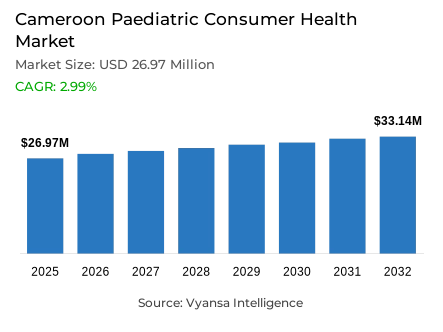
- Paediatric consumer health market size in Cameroon was valued at USD 26.97 million in 2025 and is estimated at USD 29.25 Million in 2026.
- The market size is expected to grow to USD 33.14 million by 2032.
- Market to register a CAGR of around 2.99% during 2026-32.
- Product Type Shares
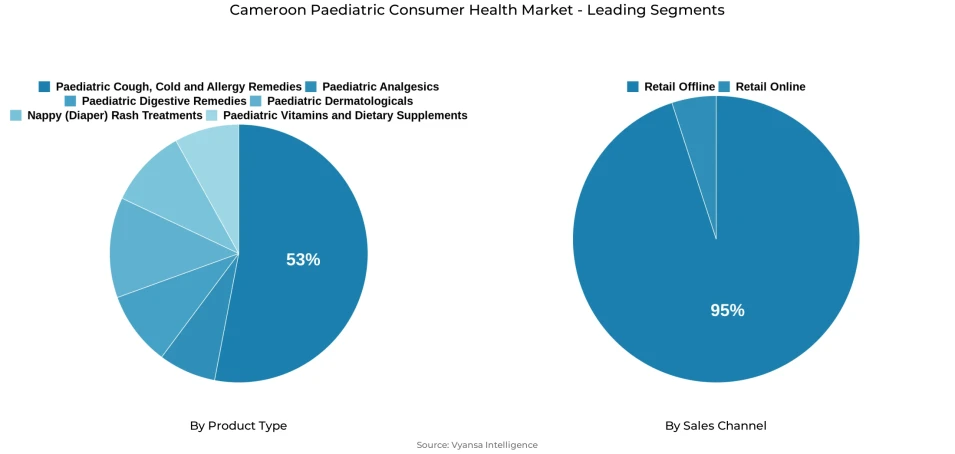
- Paediatric cough, cold and allergy remedies grabbed market share of 53%.
- Competition
- More than 10 companies are actively engaged in producing paediatric consumer health in Cameroon.
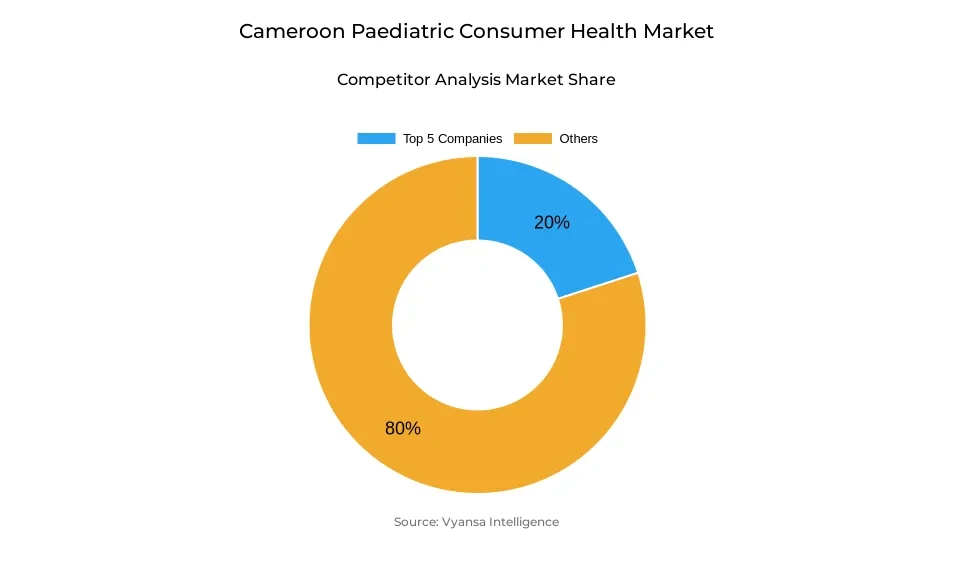
- Top 5 companies acquired around 20% of the market share.
- EXPHAR SA, Pierre Fabre, Biofar Laboratories, Afripharma Sarl, Nestlé etc., are few of the top companies.
- Sales Channel
- Retail offline grabbed 95% of the market.
Cameroon Paediatric Consumer Health Market Outlook
The Cameroon paediatric consumer health Market is estimated at USD 26.97 million in 2025. Projections indicate an increase to USD 29.25 million in 2026 and to USD 33.14 million by 2032, representing a compound annual growth rate of 2.99%. This growth trajectory indicates a steadily expanding category supported by essential household demand rather than discretionary spending. The market’s long-term viability remains underpinned by Cameroon’s young population and sustained parental focus on child-safe healthcare solutions.
Demand is being propelled by everyday acute-care needs, especially in cough, cold, and allergy solutions. This category accounts for 53% of total market revenue, underscoring its central role in routine paediatric treatment. Parents continue to prioritize fast symptom relief, particularly in cough-related illnesses that interfere with sleep and cause concerns about breathing complications. That purchasing logic reinforces steady demand across a broad range of formulations and accessible price points.
Nutritional concerns also remain a major pillar of category expansion. The chronic micronutrient deficiencies associated with iron, vitamin A, and more general undernutrition are driving the use of paediatric vitamins, supplements, and specific liquid preparations. This dynamic supports demand expansion by positioning paediatric consumer health as a treatment category and a preventive wellness instrument. It also reflects rising parental preference for products that are easy to administer and have functional child-specific advantages.
The market continues to be shaped by pharmacy-led retail, with offline sales accounting for 95% of total revenue. This channel concentration reflects strong parental preference for certified purchase environments and professional advice in choosing medicines to use on children. Low penetration of e-commerce continues to place formal pharmacies at the heart of category access and trust. Over the forecast period, market expansion will remain supported by acute-care demand, nutritional relevance, and professionally guided retail access until 2032.
Cameroon Paediatric Consumer Health Market Growth DriverYoung Demographics Keep Demand Flowing
A large child population in Cameroon remains the primary growth driver of paediatric consumer health demand. A substantial youth base keeps baseline purchasing active in remedies, supplements, and child-specific wellness products. Parents tend to respond quickly when children fall ill, and they place high value on safe and age-appropriate formulations. This behavior supports recurring demand of cough, cold, fever relief, and preventive care products, which strengthens the category in the daily health management of households.
The demographic foundation validates this demand pattern with clear structural strength. Cameroon has more than 14.6 million children, representing 49% of the national population, while children under five account for 17%. This broad and renewing child base creates durable volume potential in both fundamental treatment groups and nutritional support products. It also provides manufacturers with a greater reason to increase child-oriented portfolios and market penetration across routine health requirements by 2032.
Cameroon Paediatric Consumer Health Market ChallengeQuality Concerns Keep Channel Expansion Tight
Medicine-safety concerns remain the principal challenge limiting broader channel expansion in the paediatric consumer health market in Cameroon. When buying children, parents are extremely sensitive to authenticity, dosage precision, and quality of formulation. This caution strengthens dependence on formal pharmacies and limits the expansion opportunities of informal retail and online distribution. The market therefore remains tightly controlled, preserving trust but retarding commercial diversification and reducing broader distribution freedom.
The structural weight of this challenge is supported by official quality-control data. In 2024, 19 out of 175 medical products that were presented to be approved were rejected due to quality defects. A program to enhance pharmacovigilance and medicine-safety monitoring was also initiated in April 2025, supported by the Ministry, and until the end of the year. These measures indicate ongoing regulatory vigilance and support the reasons why pharmacist control, product certification, and trusted retail settings continue to be the focus of paediatric purchasing decisions up to 2032.
Unlock Market Intelligence
Explore the market potential with our data-driven report
Cameroon Paediatric Consumer Health Market TrendCombination Care Gains Ground
A discernible trend in Cameroon is the shift towards more comprehensive paediatric treatment with combination-based solutions and nutrient-specific support. Parents increasingly prefer solutions that can treat several symptoms or deficiencies in one formulation. This change is part of a broader trend of abandoning simple single-benefit products in favor of more holistic child-centered care. The trend supports demand expansion by matching convenience, therapeutic effectiveness, and parental reassurance in a single purchase decision.
This trend in product development is being materially supported by nutrition pressure. More than one million children under five are affected by stunting, while 39% face vitamin A deficiency and nearly 60% are affected by anaemia. These health gaps drive manufacturers beyond simple multivitamins to formulations that integrate symptom management with more comprehensive nutritional support. The outcome is a more functionally stratified product mix that is more responsive to household health priorities and category innovation requirements up to 2032.
Cameroon Paediatric Consumer Health Market OpportunityLocal Production Opens Strategic Headroom
Local manufacturing represents a strategic opportunity for expanding the paediatric consumer health market in Cameroon. Stronger domestic production can improve product availability, reduce response time of supply, and enable more affordable prices of child-friendly syrups and supplements. This opening is especially attractive in a market where parents always appreciate reliable fever relievers, cough syrups, and nutrient-support products. Localized production also creates scope for formulations that are more in line with daily household treatment preferences.
Government policy support is beginning to create favorable conditions for that transition. In February 2025, the Ministry of Public Health discussed a roadmap targeting 30% local market penetration and highlighted support through a government guarantee fund. The authorities also cited 57 locally manufactured molecules that would enjoy less competition in imports. These measures strengthen the commercial case of domestic paediatric manufacturers to portfolio scale and better align with national health priorities by 2032.
Unlock Market Intelligence
Explore the market potential with our data-driven report
Cameroon Paediatric Consumer Health Market Segmentation Analysis
By Product Type
- Paediatric Analgesics
- Paediatric Acetaminophen
- Paediatric Aspirin
- Paediatric Combination Products Analgesics
- Paediatric Dipyrone
- Paediatric Ibuprofen
- Paediatric Naproxen
- Paediatric Cough, Cold and Allergy Remedies
- Paediatric Allergy Remedies
- Paediatric Cough/Cold Remedies
- Paediatric Digestive Remedies
- Paediatric Diarrhoeal Remedies
- Paediatric Indigestion and Heartburn Remedies
- Paediatric Laxatives
- Paediatric Motion Sickness Remedies
- Paediatric Dermatologicals
- Nappy (Diaper) Rash Treatments
- Paediatric Vitamins and Dietary Supplements
The segment with highest market share under the Product Type is Paediatric Cough, Cold and Allergy Remedies, accounting for approximately 53% of the total market. Its leadership is indicative of the high and recurrent demand of rapid symptom alleviation in children, particularly in cough-related illnesses that interfere with sleep and increase parental anxiety regarding respiratory issues. This maintains the segment in close contact with urgent treatment behaviour as opposed to discretionary wellness expenditure. The category also enjoys wide household applicability, with these conditions being repeated across age groups and seasons.
Its leadership is also supported by the presence of different formulations and price levels. Syrups, expectorants, mucolytics, and multi-ingredient remedies are available to parents as they are seen as both accessible and effective. These products are more in line with immediate household treatment priorities compared to more occasional or preventive categories. Such positioning underpins repeat demand, enhanced shelf turnover, and enduring commercial leadership up to 2032.
By Sales Channel
- Retail Online
- Online Pharmacies
- E-commerce Platforms
- Brand Websites
- Retail Offline
- Hospital Pharmacies
- Retail Pharmacies / Drugstores
- Supermarkets & Hypermarkets
- Specialty Baby Stores
The segment with highest market share under the Sales Channel is Retail Offline, accounting for approximately 95% of the total market. This hegemony is indicative of the pivotal position of licensed pharmacies in the paediatric consumer health ecosystem in Cameroon. When purchasing medicines to treat children, parents are highly inclined to certified stores since authenticity, assurance of dosage, and guidance of pharmacists are still important factors to consider during purchases. This trust-based purchasing behavior provides physical retail with a structural edge, particularly in a category where safety issues directly influence channel selection.
Regulatory oversight and low e-commerce maturity also strengthen its leadership. The most reliable and convenient path to paediatric products is still formal pharmacies, whereas digital channels are less penetrated and less trusted by parents. Offline stores thus integrate instant access with greater reassurance at the point of sale. That business role maintains retail offline as the leading channel to market up to 2032.
List of Companies Covered in Cameroon Paediatric Consumer Health Market
The companies listed below are highly influential in the Cameroon paediatric consumer health market, with a significant market share and a strong impact on industry developments.
- EXPHAR SA
- Pierre Fabre
- Biofar Laboratories
- Afripharma Sarl
- Nestlé
- Haleon
- UPSA
- Aventis/Sanofi
- Novartis
- Bristol Myers Squibb
Market News & Updates
- Nestlé, 2025:
Nestlé Ghana announced in October 2025 that it would launch a CERELAC “no refined sugar” variant and gradually export it to other Central and West African countries. This is highly relevant to Cameroon’s paediatric consumer health market because Cameroon sits in that regional footprint and the product directly supports the early-childhood nutrition segment with a reformulated infant cereal option.
- Sanofi, 2025:
Sanofi said in June 2025 that it had started early shipments of Beyfortus for the 2025–2026 RSV season to ensure broad infant access ahead of the season, backed by tripled production capacity since launch. This matters for Cameroon’s paediatric market because it is an official infant-health product update from one of the listed players and is directly tied to protection of newborns and infants.
Frequently Asked Questions
Related Report
- Market Segmentation
- Research Scope
- Research Methodology
- Definitions and Assumptions
- Executive Summary
- Cameroon Paediatric Consumer Health Market Policies, Regulations, and Standards
- Cameroon Paediatric Consumer Health Market Dynamics
- Growth Factors
- Challenges
- Trends
- Opportunities
- Cameroon Paediatric Consumer Health Market Statistics, 2022-2032F
- Market Size & Growth Outlook
- By Revenues in USD Million
- Market Segmentation & Growth Outlook
- By Product Type
- Paediatric Analgesics- Market Insights and Forecast 2022-2032, USD Million
- Paediatric Acetaminophen- Market Insights and Forecast 2022-2032, USD Million
- Paediatric Aspirin- Market Insights and Forecast 2022-2032, USD Million
- Paediatric Combination Products Analgesics- Market Insights and Forecast 2022-2032, USD Million
- Paediatric Dipyrone- Market Insights and Forecast 2022-2032, USD Million
- Paediatric Ibuprofen- Market Insights and Forecast 2022-2032, USD Million
- Paediatric Naproxen- Market Insights and Forecast 2022-2032, USD Million
- Paediatric Cough, Cold and Allergy Remedies- Market Insights and Forecast 2022-2032, USD Million
- Paediatric Allergy Remedies- Market Insights and Forecast 2022-2032, USD Million
- Paediatric Cough/Cold Remedies- Market Insights and Forecast 2022-2032, USD Million
- Paediatric Digestive Remedies- Market Insights and Forecast 2022-2032, USD Million
- Paediatric Diarrhoeal Remedies- Market Insights and Forecast 2022-2032, USD Million
- Paediatric Indigestion and Heartburn Remedies- Market Insights and Forecast 2022-2032, USD Million
- Paediatric Laxatives- Market Insights and Forecast 2022-2032, USD Million
- Paediatric Motion Sickness Remedies- Market Insights and Forecast 2022-2032, USD Million
- Paediatric Dermatologicals- Market Insights and Forecast 2022-2032, USD Million
- Nappy (Diaper) Rash Treatments- Market Insights and Forecast 2022-2032, USD Million
- Paediatric Vitamins and Dietary Supplements- Market Insights and Forecast 2022-2032, USD Million
- Paediatric Analgesics- Market Insights and Forecast 2022-2032, USD Million
- By Dosage Form
- Liquid Syrups- Market Insights and Forecast 2022-2032, USD Million
- Chewable Tablets- Market Insights and Forecast 2022-2032, USD Million
- Drops- Market Insights and Forecast 2022-2032, USD Million
- Powders/Sachets- Market Insights and Forecast 2022-2032, USD Million
- Gummies- Market Insights and Forecast 2022-2032, USD Million
- Topical Creams & Ointments- Market Insights and Forecast 2022-2032, USD Million
- By Age Group
- Infants & Toddlers (0-3 Years)- Market Insights and Forecast 2022-2032, USD Million
- Children (4-12 Years)- Market Insights and Forecast 2022-2032, USD Million
- Adolescents (13-18 Years)- Market Insights and Forecast 2022-2032, USD Million
- By Treatment Type
- Acute Treatment- Market Insights and Forecast 2022-2032, USD Million
- Chronic Condition Management- Market Insights and Forecast 2022-2032, USD Million
- Genetic & Rare Disease Management- Market Insights and Forecast 2022-2032, USD Million
- By Sales Channel
- Retail Online- Market Insights and Forecast 2022-2032, USD Million
- Online Pharmacies- Market Insights and Forecast 2022-2032, USD Million
- E-commerce Platforms- Market Insights and Forecast 2022-2032, USD Million
- Brand Websites- Market Insights and Forecast 2022-2032, USD Million
- Retail Offline- Market Insights and Forecast 2022-2032, USD Million
- Hospital Pharmacies- Market Insights and Forecast 2022-2032, USD Million
- Retail Pharmacies / Drugstores- Market Insights and Forecast 2022-2032, USD Million
- Supermarkets & Hypermarkets- Market Insights and Forecast 2022-2032, USD Million
- Specialty Baby Stores
- Retail Online- Market Insights and Forecast 2022-2032, USD Million
- By Competitors
- Competition Characteristics
- Market Share & Analysis
- By Product Type
- Market Size & Growth Outlook
- Cameroon Paediatric Analgesics Market Statistics, 2022-2032
- Market Size & Growth Outlook
- By Revenues in USD Million
- Market Segmentation & Growth Outlook
- By Dosage Form- Market Insights and Forecast 2022-2032, USD Million
- By Age Group- Market Insights and Forecast 2022-2032, USD Million
- By Treatment Type- Market Insights and Forecast 2022-2032, USD Million
- By Sales Channel- Market Insights and Forecast 2022-2032, USD Million
- Market Size & Growth Outlook
- Cameroon Paediatric Cough, Cold and Allergy Remedies Market Statistics, 2022-2032
- Market Size & Growth Outlook
- By Revenues in USD Million
- Market Segmentation & Growth Outlook
- By Dosage Form- Market Insights and Forecast 2022-2032, USD Million
- By Age Group- Market Insights and Forecast 2022-2032, USD Million
- By Treatment Type- Market Insights and Forecast 2022-2032, USD Million
- By Sales Channel- Market Insights and Forecast 2022-2032, USD Million
- Market Size & Growth Outlook
- Cameroon Paediatric Digestive Remedies Market Statistics, 2022-2032
- Market Size & Growth Outlook
- By Revenues in USD Million
- Market Segmentation & Growth Outlook
- By Dosage Form- Market Insights and Forecast 2022-2032, USD Million
- By Age Group- Market Insights and Forecast 2022-2032, USD Million
- By Treatment Type- Market Insights and Forecast 2022-2032, USD Million
- By Sales Channel- Market Insights and Forecast 2022-2032, USD Million
- Market Size & Growth Outlook
- Cameroon Paediatric Dermatologicals Market Statistics, 2022-2032
- Market Size & Growth Outlook
- By Revenues in USD Million
- Market Segmentation & Growth Outlook
- By Dosage Form- Market Insights and Forecast 2022-2032, USD Million
- By Age Group- Market Insights and Forecast 2022-2032, USD Million
- By Treatment Type- Market Insights and Forecast 2022-2032, USD Million
- By Sales Channel- Market Insights and Forecast 2022-2032, USD Million
- Market Size & Growth Outlook
- Cameroon Nappy (Diaper) Rash Treatments Market Statistics, 2022-2032
- Market Size & Growth Outlook
- By Revenues in USD Million
- Market Segmentation & Growth Outlook
- By Dosage Form- Market Insights and Forecast 2022-2032, USD Million
- By Age Group- Market Insights and Forecast 2022-2032, USD Million
- By Treatment Type- Market Insights and Forecast 2022-2032, USD Million
- By Sales Channel- Market Insights and Forecast 2022-2032, USD Million
- Market Size & Growth Outlook
- Cameroon Paediatric Vitamins and Dietary Supplements Market Statistics, 2022-2032
- Market Size & Growth Outlook
- By Revenues in USD Million
- Market Segmentation & Growth Outlook
- By Dosage Form- Market Insights and Forecast 2022-2032, USD Million
- By Age Group- Market Insights and Forecast 2022-2032, USD Million
- By Treatment Type- Market Insights and Forecast 2022-2032, USD Million
- By Sales Channel- Market Insights and Forecast 2022-2032, USD Million
- Market Size & Growth Outlook
- Competitive Outlook
- Company Profiles
- Afripharma Sarl
- Business Description
- Product Portfolio
- Collaborations & Alliances
- Recent Developments
- Financial Details
- Others
- Nestlé
- Business Description
- Product Portfolio
- Collaborations & Alliances
- Recent Developments
- Financial Details
- Others
- Haleon
- Business Description
- Product Portfolio
- Collaborations & Alliances
- Recent Developments
- Financial Details
- Others
- UPSA
- Business Description
- Product Portfolio
- Collaborations & Alliances
- Recent Developments
- Financial Details
- Others
- Aventis/Sanofi
- Business Description
- Product Portfolio
- Collaborations & Alliances
- Recent Developments
- Financial Details
- Others
- EXPHAR SA
- Business Description
- Product Portfolio
- Collaborations & Alliances
- Recent Developments
- Financial Details
- Others
- Pierre Fabre
- Business Description
- Product Portfolio
- Collaborations & Alliances
- Recent Developments
- Financial Details
- Others
- Biofar Laboratories
- Business Description
- Product Portfolio
- Collaborations & Alliances
- Recent Developments
- Financial Details
- Others
- Novartis
- Business Description
- Product Portfolio
- Collaborations & Alliances
- Recent Developments
- Financial Details
- Others
- Bristol Myers Squibb
- Business Description
- Product Portfolio
- Collaborations & Alliances
- Recent Developments
- Financial Details
- Others
- Afripharma Sarl
- Company Profiles
- Disclaimer
| Segment | Sub-Segment |
|---|---|
| By Product Type |
|
| By Dosage Form |
|
| By Age Group |
|
| By Treatment Type |
|
| By Sales Channel |
|
Research Methodology
This study followed a structured approach comprising four key phases to assess the size and scope of the electro-oxidation market. The process began with thorough secondary research to collect data on the target market, related markets, and broader industry context. These findings, along with preliminary assumptions and estimates, were then validated through extensive primary research involving industry experts from across the value chain. To calculate the overall market size, both top-down and bottom-up methodologies were employed. Finally, market segmentation and data triangulation techniques were applied to refine and validate segment-level estimations.
Secondary Research
The secondary research phase involved gathering data from a wide range of credible and published sources. This step helped in identifying industry trends, defining market segmentation, and understanding the market landscape and value chain.
Sources consulted during this phase included:
- Company annual reports, investor presentations, and press releases
- Industry white papers and certified publications
- Trade directories and market-recognized databases
- Articles from authoritative authors and reputable journals
- Gold and silver standard websites
Secondary research was critical in mapping out the industry's value chain and monetary flow, identifying key market segments, understanding regional variations, and tracking significant industry developments.
Other key sources:
- Financial disclosures
- Industry associations and trade bodies
- News outlets and business magazines
- Academic journals and research studies
- Paid industry databases
Primary Research
To validate secondary data and gain deeper market insights, primary research was conducted with key stakeholders across both the supply and demand sides of the market.
On the demand side, participants included decision-makers and influencers from end-user industries—such as CIOs, CTOs, and CSOs—who provided first-hand perspectives on market needs, product usage, and future expectations.
On the supply side, interviews were conducted with manufacturers, industry associations, and institutional participants to gather insights into current offerings, product pipelines, and market challenges.
Primary interviews provided critical inputs such as:
- Market size and revenue data
- Product and service breakdowns
- Market forecasts
- Regional and application-specific trends
Stakeholders consulted included:
- Leading OEM and solution providers
- Channel and distribution partners
- End users across various applications
- Independent consultants and industry specialists
Market Size Estimation and Data Triangulation
- Identifying Key Market Participants (Secondary Research)
- Goal: To identify the major players or companies in the target market. This typically involves using publicly available data sources such as industry reports, market research publications, and financial statements of companies.
- Tools: Reports from firms like Gartner, Forrester, Euromonitor, Statista, IBISWorld, and others. Public financial statements, news articles, and press releases from top market players.
- Extracting Earnings of Key Market Participants
- Goal: To estimate the earnings generated from the product or service being analyzed. This step helps in understanding the revenue potential of each market player in a specific geography.
- Methods: Earnings data can be gathered from:
- Publicly available financial reports (for listed companies).
- Interviews and primary data sources from professionals, such as Directors, VPs, SVPs, etc. This is especially useful for understanding more nuanced, internal data that isn't publicly disclosed.
- Annual reports and investor presentations of key players.
- Data Collation and Development of a Relevant Data Model
- Goal: To collate inputs from both primary and secondary sources into a structured, data-driven model for market estimation. This model will incorporate key market KPIs and any independent variables relevant to the market.
- Key KPIs: These could include:
- Market size, growth rate, and demand drivers.
- Industry-specific metrics like market share, average revenue per customer (ARPC), or average deal size.
- External variables, such as economic growth rates, inflation rates, or commodity prices, that could affect the market.
- Data Modeling: Based on this data, the market forecasts are developed for the next 5 years. A combination of trend analysis, scenario modeling, and statistical regression might be used to generate projections.
- Scenario Analysis
- Goal: To test different assumptions and validate how sensitive the market is to changes in key variables (e.g., market demand, regulatory changes, technological disruptions).
- Types of Scenarios:
- Base Case: Based on current assumptions and historical data.
- Best-Case Scenario: Assuming favorable market conditions, regulatory environments, and technological advancements.
- Worst-Case Scenario: Accounting for adverse factors, such as economic downturns, stricter regulations, or unexpected disruptions.












