Brazil Advanced Energy Storage Systems Market Report: Trends, Growth and Forecast (2026-2032)
By Technology (Batteries, Thermal Energy Storage, Pumped Hydro Storage, Compressed Air Energy Storage, Flywheel Energy Storage, Hydrogen Energy Storage, Others), By Application (Grid Balancing and Ancillary Services, Renewable Energy Firming and Time Shifting, Backup Power and Energy Resilience, Microgrid and Off-Grid Power Systems, Transportation and Mobility, Industrial Process Energy Management, Others), By End Use (Residential, Commercial, Industrial, Utility), By Storage Duration (Short-Duration Storage, Medium-Duration Storage, Long-Duration Storage), By Region (North, Center-West, Northeast, Southeast, South) ... Read more
|
Major Players
|
Brazil Advanced Energy Storage Systems Market Overview
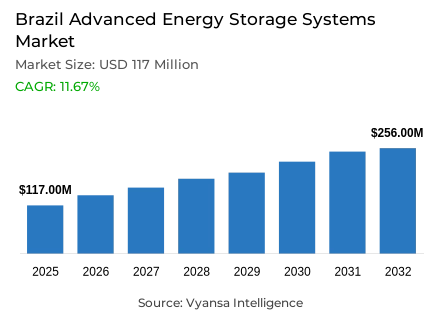
Advanced energy storage systems are critical technologies used to store and manage electrical energy, enabling grid stability, renewable energy integration, and reliable power supply across utility, commercial, and industrial applications. The advanced energy storage systems market in Brazil is projected to expand at an 11.67% CAGR during 2026-2032, as Brazil strengthens grid flexibility and renewable integration.
Key Highlights of the Brazil Advanced Energy Storage Systems Market:
- The Brazil advanced energy storage systems market stood at USD 117 million in 2025 and USD 132 million in 2026, with revenue projected to reach USD 256 million by 2032.
- The market is forecast to grow at a CAGR of approximately 11.67% during 2026–2032.
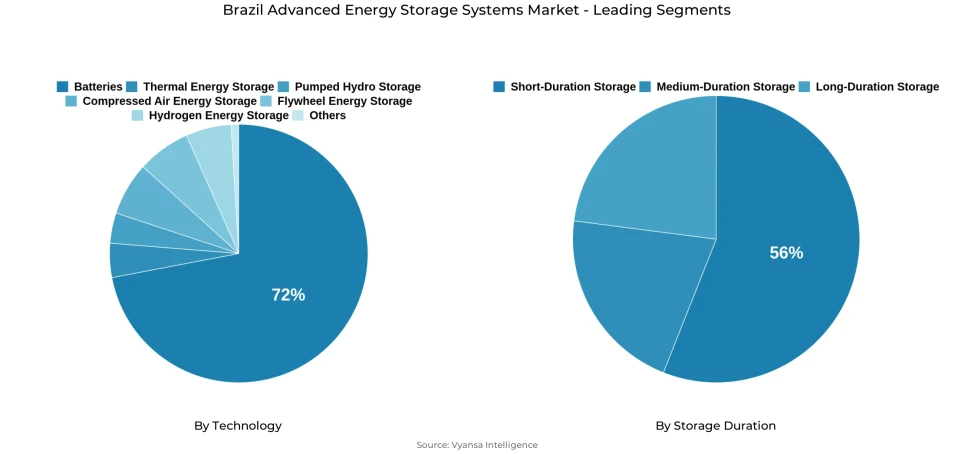
- Battery energy storage systems lead the technology segment with a 72% share in 2026.
- However, pumped hydro storage is projected to record the fastest CAGR among non-battery technologies, at approximately 5.23% during 2026–2032.
- Short-duration storage leads the storage-duration segment with a modelled 56% share in 2026.
- Meanwhile, long-duration storage is projected to record the fastest duration-segment CAGR, at approximately 20.30% during 2026–2032.
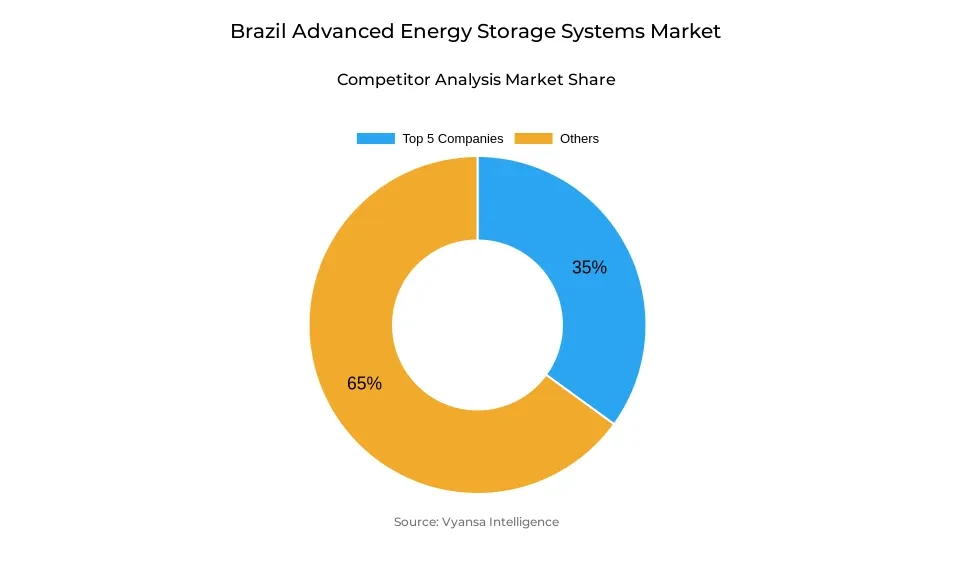
- The five leading companies account for an estimated 35% of market revenue, indicating a moderately fragmented competitive structure.
Advanced energy storage systems are becoming an essential part of Brazil's evolving electricity sector as the country expands renewable energy capacity and modernizes its power infrastructure. Increasing solar and wind generation is creating greater demand for energy storage systems that can store excess electricity and supply power when renewable output declines. At the same time, hydropower's share in Brazil's electricity mix is expected to decline from more than half of total generation today to 36% by 2034, increasing the need for advanced energy storage systems across utility-scale projects, commercial and industrial facilities, and isolated microgrids throughout the country.
The market is also benefiting from a more supportive regulatory environment. In June 2026, ANEEL approved Brazil's first national regulatory framework for energy storage, providing renewable energy developers with a clear pathway to integrate batteries with new and existing solar, wind, and hydropower projects. This regulatory clarity is expected to encourage greater investment in battery energy storage systems and accelerate project development over the coming years, strengthening demand from utilities, independent power producers, and private investors.
As the market expands, demand is expected to shift from standalone battery systems to integrated energy storage solutions. Future projects are likely to combine batteries with power conversion systems, energy management software, grid-forming inverters, digital monitoring, thermal management, safety technologies, and long-term maintenance services. At the same time, government support for domestic manufacturing and local value addition is expected to create new opportunities for system integrators, component suppliers, software providers, engineering firms, and after-sales service companies.
Overall, the advanced energy storage systems industry in Brazil is expected to witness strong growth over the forecast period, supported by renewable energy expansion, supportive regulations, grid modernization, and increasing demand for reliable and flexible electricity supply. Although financing costs, imported component dependence, currency fluctuations, and technical compliance requirements may continue to influence project economics, companies with localized operations, integrated technology portfolios, strong service capabilities, and established partnerships are expected to be well positioned to capture future market opportunities.
Key Regulatory Framework Supporting the Brazil Advanced Energy Storage Systems Market
Law No. 15,269/2025-Legal Framework for Energy Storage
Law No. 15,269/2025 establishes Brazil’s legal foundation for electricity storage by assigning ANEEL responsibility for regulating access, remuneration, installation, operation, and supervision. It permits storage to operate independently or alongside generation, transmission, distribution, and commercialization assets, while supporting services such as flexibility, capacity, ancillary services, and energy trading. The law also enables planned storage projects to be auctioned where network studies identify specific grid needs. This framework reduces uncertainty over asset classification and revenue generation, improving investor confidence and project bankability. Consequently, it supports greater deployment of batteries, hybrid renewable systems, and other advanced energy storage technologies across Brazil nationwide.
MME Normative Ordinance No. 136/2026-Dedicated Battery Storage Capacity Auctions
MME Normative Ordinance No. 136/2026 establishes two dedicated 2026 capacity-reserve auctions for new battery energy storage systems: one for projects using qualifying Brazilian equipment and another allowing national or imported systems. The auctions are designed to secure electrical capacity for the National Interconnected System, with selected projects scheduled to begin operation on August 1, 2028. By creating a formal procurement route, the policy converts grid flexibility requirements into bankable commercial demand. It improves revenue visibility, attracts private financing, encourages utility-scale project development, and supports domestic manufacturing, system integration, engineering services, and technology transfer within Brazil’s advanced energy storage market industry.
Brazil Advanced Energy Storage Systems Market Drivers
Rising Solar and Wind Capacity Is Creating Structural Demand for Battery Storage
Brazil's rapid expansion of solar and wind capacity is a key driver of the Brazil advanced energy storage systems market. As renewable electricity generation continues to grow, the need for battery storage is increasing to manage variable power output and provide reliable electricity when renewable generation declines. As a result, generators and independent power producers are increasingly integrating battery storage with new and existing renewable energy projects to improve grid stability and support reliable power delivery. This is creating sustained demand for advanced energy storage systems, as every new utility-scale solar or wind project entering Brazil's grid connection pipeline presents an opportunity for co-located battery storage deployment.
EPE's Plano Decenal de Expansão de Energia (PDE 2035) projects that Brazil could incorporate approximately 7 gigawatts of battery energy storage capacity by 2035, reflecting the growing importance of storage in the national electricity system. This planned expansion is expected to increase demand for batteries, power conversion systems, and grid-forming inverters as utilities and renewable energy developers prepare future projects. In addition, the rising levels of renewable energy curtailment across Brazil are further strengthening the need for battery energy storage systems, as they help capture excess renewable electricity, improve grid flexibility, and maximize the utilization of expanding solar and wind capacity nationwide.
Restraints
High Capital Costs and Elevated Financing Rates Constraining Project Investment
The high capital intensity of battery energy storage projects remains one of the most significant barriers to the growth of the Brazil advanced energy storage systems market. Developing a storage project requires substantial upfront investment in battery cells, power conversion systems, transformers, thermal management and fire protection systems, grid interconnection infrastructure, energy management software, installation, and long-term maintenance and replacement reserves. Moreover, Brazil continues to rely heavily on imported battery cells and advanced power electronics, exposing project economics to exchange rate volatility and international logistics costs. These factors collectively increase project costs and limit the ability of commercial and industrial users, as well as smaller developers, to invest in advanced energy storage solutions.
The financing environment further compounds this challenge. In June 2026, the Banco Central do Brasil maintained the Selic policy rate at 14.25%, keeping borrowing costs elevated for capital-intensive energy infrastructure projects. Higher financing expenses weaken project returns by increasing the overall cost of capital, making battery energy storage investments less attractive for applications such as peak shaving, energy arbitrage, and capacity reserve services. In addition, dual grid tariffs and continued dependence on imported equipment place further pressure on project economics. Consequently, developers may postpone investment decisions, reduce project scale, or delay deployment until financing conditions improve and equipment costs become more competitive.
Recent Trends
Compact, Liquid-Cooled Battery Architectures Improving Deployment Efficiency
A key technological trend in the Brazil advanced energy storage systems market is the adoption of compact, liquid-cooled battery energy storage system architectures that integrate battery cells, thermal management, power conversion equipment, control systems, and safety features into a single modular enclosure. This integrated design minimizes on-site installation complexity, shortens commissioning timelines, and reduces maintenance requirements. Furthermore, liquid-cooling technology enables more effective temperature regulation than conventional air-cooled systems, improving battery performance, operational reliability, and service life under Brazil's high ambient temperatures. The compact footprint also makes these systems well suited for utility-scale projects, commercial and industrial facilities, and space-constrained urban installations.
Recent product developments reflect this technological evolution. Contemporary Amperex Technology Co. Limited's (CATL) TENER Stack platform offers up to 9 MWh of storage capacity within a compact footprint, demonstrating higher energy density and more efficient land utilization than conventional containerized BESS designs. Similarly, Sungrow's PowerTitan 3.0 platform supports discharge durations ranging from 2 to 12 hours while achieving a maximum power conversion efficiency of 99.3%. Although these specifications represent commercially available technologies rather than widespread deployment across Brazil, they highlight the industry's direction toward high-density, integrated, and thermally optimized energy storage solutions capable of improving project economics and accelerating future BESS deployment.
Future Opportunities
Hybrid Solar-Storage Micro-Grids for Isolated Amazon Communities
Hybrid solar-plus-storage micro-grids are expected to create significant growth opportunities for the Brazil battery energy storage system market over the coming years. Many communities across the Amazon region remain outside the National Interconnected System and continue to rely on diesel generators for electricity. As Brazil expands electricity access and accelerates the adoption of cleaner energy solutions, hybrid solar-storage systems are expected to replace diesel-based generation across more remote locations. This transition is likely to drive demand for battery energy storage systems, solar equipment, remote monitoring solutions, and long-term operation and maintenance services, creating new revenue opportunities for technology providers, EPC companies, and system developers while supporting the future expansion of the Brazil battery energy storage system market.
The Ministry of Mines and Energy has announced an isolated-system project in Jacareacanga, Pará, combining 18 MW of solar generation with 30 MW of battery energy storage, with completion scheduled for December 2027. In addition, the 2025 SISOL auction secured around USD 60.8 million in investments to supply electricity to more than 30,000 people across Pará and Amazonas. As similar projects are implemented in other remote regions, they are expected to create long-term opportunities for battery manufacturers, EPC companies, digital energy management providers, remote monitoring services, and local maintenance networks, strengthening project deployment and supporting the sustained growth of the Brazil battery energy storage system market.
Unlock Market Intelligence
Explore the market potential with our data-driven report
Segmentation Analysis
By Technology
- Batteries
- Thermal Energy Storage
- Pumped Hydro Storage
- Compressed Air Energy Storage
- Flywheel Energy Storage
- Hydrogen Energy Storage
- Others
Batteries Lead, While Pumped Hydro Storage Records the Fastest Growth Among Non-Battery Technologies
Batteries lead the technology segment with a 72% share in 2026, a position supported by rapid installation timelines, modular sizing, and applicability across grid-scale, industrial, commercial, and isolated-system projects alike. Trade data compiled by the International Trade Administration shows that Brazil's planned battery capacity-reserve auction targets approximately 2 gigawatts, equal to roughly 8 gigawatt-hours, with an estimated 18 gigawatts of battery projects already ready for formal registration. This substantial auction pipeline, therefore, sustains recurring demand for battery modules, power-conversion equipment, control software, and ongoing maintenance services nationwide.
However, pumped hydro storage is projected to record the fastest CAGR among non-battery technologies, at approximately 5.23% during 2026–2032, supported by Brazil's extensive hydroelectric reservoir infrastructure. EPE identified 642 potential pumped-storage project sites with a combined theoretical capacity of 1,355 gigawatts across the South, Southeast, and Northeast regions. Although this theoretical potential is substantial, EPE has explicitly described the figure as a preliminary site inventory that still requires updated environmental, geological, land-use, and cost assessment, rather than an investable, near-term project pipeline. Actual development will, therefore, proceed considerably more slowly than the battery segment.
By Storage Duration
- Short-Duration Storage
- Medium-Duration Storage
- Long-Duration Storage
Short-Duration Storage Dominates Deployment, While Long-Duration Storage Accelerates on Reliability Needs
Short-duration storage leads the duration segment with a 56% share in 2026, reflecting its suitability for frequency regulation, voltage support, daily solar shifting, peak shaving, and backup power, all applications requiring rapid discharge over shorter windows. Lithium iron phosphate battery chemistry dominates these use cases because it is modular, cost-competitive, and compatible with both commercial-and-industrial and utility-scale projects. Four-hour battery storage configurations, moreover, align closely with the minimum discharge threshold defined under Brazil's initial capacity-reserve auction criteria, which reinforces this segment's near-term leadership.
Long-duration storage, by comparison, is projected to record the fastest CAGR within the duration segment, at approximately 20.30% during 2026–2032, considerably outpacing short-duration systems. This accelerated growth is supported by multi-hour reliability requirements, renewable-firming needs, drought-sensitive hydropower operating conditions, and capacity planning in regions with variable solar and wind output. Utilities increasingly need long-duration storage that can cover extended generation ramps and prolonged curtailment periods that standard four-hour batteries cannot economically address, positioning these technologies for accelerated adoption and multi-day flexibility.
Unlock Market Intelligence
Explore the market potential with our data-driven report
Competitive Landscape
The Brazil advanced energy storage systems market is moderately fragmented, with the five leading companies accounting for an estimated 35% of market revenue in 2026. Competition is shaped by battery-cell availability, power-conversion-system integration, domestic assembly and manufacturing scale, service-network reach, project-financing access, software sophistication, warranty strength, and auction-qualification readiness.
Key Companies
- UCB Indústria de Componentes Eletrônicos e Informática S.A.
- WEG S.A.
- Acumuladores Moura S.A.
- BYD Indústria de Baterias Ltda.
- Sungrow Power Supply Co., Ltd.
- Huawei Digital Power Technologies Co., Ltd.
- Contemporary Amperex Technology Co., Limited
- Tesla, Inc.
- Powin LLC
- Growatt New Energy Technology Co., Ltd.
Recent Developments in the Brazil Advanced Energy Storage Systems Industry
- February 2026: WEG S.A. announced construction of a new battery energy storage system manufacturing plant in Itajaí, Santa Catarina, backed by BRL 280 million in BNDES financing and expected to create approximately 90 direct jobs, with completion targeted for the second half of 2027. The facility strengthens local BESS manufacturing capability for grid storage and renewable integration, positioning WEG for stronger participation in Brazil's forthcoming national-content-qualified capacity-reserve auctions.
- March 2026: UCB Indústria de Componentes Eletrônicos e Informática S.A. launched a Uni Power 48V EN battery dedicated to the solar market, as listed on the company's official communications channel. The launch supports Brazil's expanding solar-plus-storage ecosystem through stationary battery solutions for renewable energy applications, reinforcing UCB's positioning as a leading domestic energy storage manufacturer.
Frequently Asked Questions
Related Report
- Market Segmentation
- Research Scope
- Research Methodology
- Definitions and Assumptions
- Executive Summary
- Brazil Advanced Energy Storage Systems Market Policies, Regulations, and Standards
- Brazil Advanced Energy Storage Systems Market Dynamics
- Growth Factors
- Challenges
- Trends
- Opportunities
- Brazil Advanced Energy Storage Systems Market Statistics, 2022-2032F
- Market Size & Growth Outlook
- By Revenues in USD Million
- By Quantity Sold in Megawatt (MW)
- Market Segmentation & Growth Outlook
- By Technology
- Batteries- Market Insights and Forecast 2022-2032, USD Million
- Thermal Energy Storage- Market Insights and Forecast 2022-2032, USD Million
- Pumped Hydro Storage- Market Insights and Forecast 2022-2032, USD Million
- Compressed Air Energy Storage- Market Insights and Forecast 2022-2032, USD Million
- Flywheel Energy Storage- Market Insights and Forecast 2022-2032, USD Million
- Hydrogen Energy Storage- Market Insights and Forecast 2022-2032, USD Million
- Others- Market Insights and Forecast 2022-2032, USD Million
- By Application
- Grid Balancing and Ancillary Services- Market Insights and Forecast 2022-2032, USD Million
- Renewable Energy Firming and Time Shifting- Market Insights and Forecast 2022-2032, USD Million
- Backup Power and Energy Resilience- Market Insights and Forecast 2022-2032, USD Million
- Microgrid and Off-Grid Power Systems- Market Insights and Forecast 2022-2032, USD Million
- Transportation and Mobility- Market Insights and Forecast 2022-2032, USD Million
- Industrial Process Energy Management- Market Insights and Forecast 2022-2032, USD Million
- Others- Market Insights and Forecast 2022-2032, USD Million
- By End Use
- Residential- Market Insights and Forecast 2022-2032, USD Million
- Commercial- Market Insights and Forecast 2022-2032, USD Million
- Industrial- Market Insights and Forecast 2022-2032, USD Million
- Utility- Market Insights and Forecast 2022-2032, USD Million
- By Storage Duration
- Short-Duration Storage- Market Insights and Forecast 2022-2032, USD Million
- Medium-Duration Storage- Market Insights and Forecast 2022-2032, USD Million
- Long-Duration Storage- Market Insights and Forecast 2022-2032, USD Million
- By Region
- North- Market Insights and Forecast 2022-2032, USD Million
- Center-West- Market Insights and Forecast 2022-2032, USD Million
- Northeast- Market Insights and Forecast 2022-2032, USD Million
- Southeast- Market Insights and Forecast 2022-2032, USD Million
- South- Market Insights and Forecast 2022-2032, USD Million
- By Competitors
- Competition Characteristics
- Market Share & Analysis
- By Technology
- Market Size & Growth Outlook
- Brazil Batteries Market Statistics, 2022-2032
- Market Size & Growth Outlook
- By Revenues in USD Million
- By Quantity Sold in Megawatt (MW)
- Market Segmentation & Growth Outlook
- By Application- Market Insights and Forecast 2022-2032, USD Million
- By End Use- Market Insights and Forecast 2022-2032, USD Million
- By Storage Duration- Market Insights and Forecast 2022-2032, USD Million
- By Region- Market Insights and Forecast 2022-2032, USD Million
- Market Size & Growth Outlook
- Brazil Thermal Energy Storage Market Statistics, 2022-2032
- Market Size & Growth Outlook
- By Revenues in USD Million
- By Quantity Sold in Megawatt (MW)
- Market Segmentation & Growth Outlook
- By Application- Market Insights and Forecast 2022-2032, USD Million
- By End Use- Market Insights and Forecast 2022-2032, USD Million
- By Storage Duration- Market Insights and Forecast 2022-2032, USD Million
- By Region- Market Insights and Forecast 2022-2032, USD Million
- Market Size & Growth Outlook
- Brazil Pumped Hydro Storage Market Statistics, 2022-2032
- Market Size & Growth Outlook
- By Revenues in USD Million
- By Quantity Sold in Megawatt (MW)
- Market Segmentation & Growth Outlook
- By Application- Market Insights and Forecast 2022-2032, USD Million
- By End Use- Market Insights and Forecast 2022-2032, USD Million
- By Storage Duration- Market Insights and Forecast 2022-2032, USD Million
- By Region- Market Insights and Forecast 2022-2032, USD Million
- Market Size & Growth Outlook
- Brazil Compressed Air Energy Storage Market Statistics, 2022-2032
- Market Size & Growth Outlook
- By Revenues in USD Million
- By Quantity Sold in Megawatt (MW)
- Market Segmentation & Growth Outlook
- By Application- Market Insights and Forecast 2022-2032, USD Million
- By End Use- Market Insights and Forecast 2022-2032, USD Million
- By Storage Duration- Market Insights and Forecast 2022-2032, USD Million
- By Region- Market Insights and Forecast 2022-2032, USD Million
- Market Size & Growth Outlook
- Brazil Flywheel Energy Storage Market Statistics, 2022-2032
- Market Size & Growth Outlook
- By Revenues in USD Million
- By Quantity Sold in Megawatt (MW)
- Market Segmentation & Growth Outlook
- By Application- Market Insights and Forecast 2022-2032, USD Million
- By End Use- Market Insights and Forecast 2022-2032, USD Million
- By Storage Duration- Market Insights and Forecast 2022-2032, USD Million
- By Region- Market Insights and Forecast 2022-2032, USD Million
- Market Size & Growth Outlook
- Brazil Hydrogen Energy Storage Market Statistics, 2022-2032
- Market Size & Growth Outlook
- By Revenues in USD Million
- By Quantity Sold in Megawatt (MW)
- Market Segmentation & Growth Outlook
- By Application- Market Insights and Forecast 2022-2032, USD Million
- By End Use- Market Insights and Forecast 2022-2032, USD Million
- By Storage Duration- Market Insights and Forecast 2022-2032, USD Million
- By Region- Market Insights and Forecast 2022-2032, USD Million
- Market Size & Growth Outlook
- Brazil Others Market Statistics, 2022-2032
- Market Size & Growth Outlook
- By Revenues in USD Million
- By Quantity Sold in Megawatt (MW)
- Market Segmentation & Growth Outlook
- By Application- Market Insights and Forecast 2022-2032, USD Million
- By End Use- Market Insights and Forecast 2022-2032, USD Million
- By Storage Duration- Market Insights and Forecast 2022-2032, USD Million
- By Region- Market Insights and Forecast 2022-2032, USD Million
- Market Size & Growth Outlook
- Competitive Outlook
- Company Profiles
- UCB INDUSTRIA DE COMPONENTES ELETRONICOS E INFORMATICA S.A.
- Business Description
- Product Portfolio
- Collaborations & Alliances
- Recent Developments
- Financial Details
- Others
- WEG S.A.
- Business Description
- Product Portfolio
- Collaborations & Alliances
- Recent Developments
- Financial Details
- Others
- Acumuladores Moura S.A.
- Business Description
- Product Portfolio
- Collaborations & Alliances
- Recent Developments
- Financial Details
- Others
- BYD Indústria de Baterias Ltda.
- Business Description
- Product Portfolio
- Collaborations & Alliances
- Recent Developments
- Financial Details
- Others
- Sungrow Power Supply Co.Ltd.
- Business Description
- Product Portfolio
- Collaborations & Alliances
- Recent Developments
- Financial Details
- Others
- Huawei Digital Power Technologies Co.Ltd.
- Business Description
- Product Portfolio
- Collaborations & Alliances
- Recent Developments
- Financial Details
- Others
- Contemporary Amperex Technology Co.Limited
- Business Description
- Product Portfolio
- Collaborations & Alliances
- Recent Developments
- Financial Details
- Others
- TeslaInc.
- Business Description
- Product Portfolio
- Collaborations & Alliances
- Recent Developments
- Financial Details
- Others
- Powin LLC
- Business Description
- Product Portfolio
- Collaborations & Alliances
- Recent Developments
- Financial Details
- Others
- Growatt New Energy Technology Co. Ltd.
- Business Description
- Product Portfolio
- Collaborations & Alliances
- Recent Developments
- Financial Details
- Others
- UCB INDUSTRIA DE COMPONENTES ELETRONICOS E INFORMATICA S.A.
- Company Profiles
- Disclaimer
| Segment | Sub-Segment |
|---|---|
| By Technology |
|
| By Application |
|
| By End Use |
|
| By Storage Duration |
|
| By Region |
|
Research Methodology
This study followed a structured approach comprising four key phases to assess the size and scope of the electro-oxidation market. The process began with thorough secondary research to collect data on the target market, related markets, and broader industry context. These findings, along with preliminary assumptions and estimates, were then validated through extensive primary research involving industry experts from across the value chain. To calculate the overall market size, both top-down and bottom-up methodologies were employed. Finally, market segmentation and data triangulation techniques were applied to refine and validate segment-level estimations.
Secondary Research
The secondary research phase involved gathering data from a wide range of credible and published sources. This step helped in identifying industry trends, defining market segmentation, and understanding the market landscape and value chain.
Sources consulted during this phase included:
- Company annual reports, investor presentations, and press releases
- Industry white papers and certified publications
- Trade directories and market-recognized databases
- Articles from authoritative authors and reputable journals
- Gold and silver standard websites
Secondary research was critical in mapping out the industry's value chain and monetary flow, identifying key market segments, understanding regional variations, and tracking significant industry developments.
Other key sources:
- Financial disclosures
- Industry associations and trade bodies
- News outlets and business magazines
- Academic journals and research studies
- Paid industry databases
Primary Research
To validate secondary data and gain deeper market insights, primary research was conducted with key stakeholders across both the supply and demand sides of the market.
On the demand side, participants included decision-makers and influencers from end-user industries—such as CIOs, CTOs, and CSOs—who provided first-hand perspectives on market needs, product usage, and future expectations.
On the supply side, interviews were conducted with manufacturers, industry associations, and institutional participants to gather insights into current offerings, product pipelines, and market challenges.
Primary interviews provided critical inputs such as:
- Market size and revenue data
- Product and service breakdowns
- Market forecasts
- Regional and application-specific trends
Stakeholders consulted included:
- Leading OEM and solution providers
- Channel and distribution partners
- End users across various applications
- Independent consultants and industry specialists
Market Size Estimation and Data Triangulation
- Identifying Key Market Participants (Secondary Research)
- Goal: To identify the major players or companies in the target market. This typically involves using publicly available data sources such as industry reports, market research publications, and financial statements of companies.
- Tools: Reports from firms like Gartner, Forrester, Euromonitor, Statista, IBISWorld, and others. Public financial statements, news articles, and press releases from top market players.
- Extracting Earnings of Key Market Participants
- Goal: To estimate the earnings generated from the product or service being analyzed. This step helps in understanding the revenue potential of each market player in a specific geography.
- Methods: Earnings data can be gathered from:
- Publicly available financial reports (for listed companies).
- Interviews and primary data sources from professionals, such as Directors, VPs, SVPs, etc. This is especially useful for understanding more nuanced, internal data that isn't publicly disclosed.
- Annual reports and investor presentations of key players.
- Data Collation and Development of a Relevant Data Model
- Goal: To collate inputs from both primary and secondary sources into a structured, data-driven model for market estimation. This model will incorporate key market KPIs and any independent variables relevant to the market.
- Key KPIs: These could include:
- Market size, growth rate, and demand drivers.
- Industry-specific metrics like market share, average revenue per customer (ARPC), or average deal size.
- External variables, such as economic growth rates, inflation rates, or commodity prices, that could affect the market.
- Data Modeling: Based on this data, the market forecasts are developed for the next 5 years. A combination of trend analysis, scenario modeling, and statistical regression might be used to generate projections.
- Scenario Analysis
- Goal: To test different assumptions and validate how sensitive the market is to changes in key variables (e.g., market demand, regulatory changes, technological disruptions).
- Types of Scenarios:
- Base Case: Based on current assumptions and historical data.
- Best-Case Scenario: Assuming favorable market conditions, regulatory environments, and technological advancements.
- Worst-Case Scenario: Accounting for adverse factors, such as economic downturns, stricter regulations, or unexpected disruptions.












