Bolivia Digestive Remedies Market Report: Trends, Growth and Forecast (2026-2032)
By Product Type (Paediatric Digestive Remedies (Paediatric Diarrhoeal Remedies, Paediatric Indigestion & Heartburn Remedies, Paediatric Laxatives, Paediatric Motion Sickness Remedies), Diarrhoeal Remedies, IBS Treatments, Indigestion & Heartburn Remedies (Antacids, Antiflatulents, Digestive Enzymes, H2 Blockers, Proton Pump Inhibitors), Laxatives, Motion Sickness Remedies), By Age Group (Children & Adolescents (01-17 years), Adults (18-65 years), Geriatric (65+ years)), By Sales Channel (Retail Online, Retail Offline (Hospitals, Clinics, Pharmacies)) ... Read more
|
Major Players
|
Bolivia Digestive Remedies Market Statistics and Insights, 2026
- Market Size Statistics
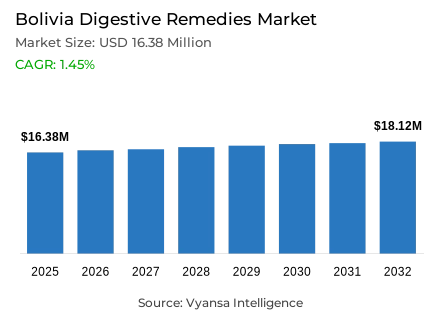
- Digestive remedies market size in Bolivia was valued at USD 16.38 million in 2025 and is estimated at USD 17.5 million in 2026.
- The market size is expected to grow to USD 18.12 million by 2032.
- Market to register a CAGR of around 1.45% during 2026-32.
- Product Type Shares
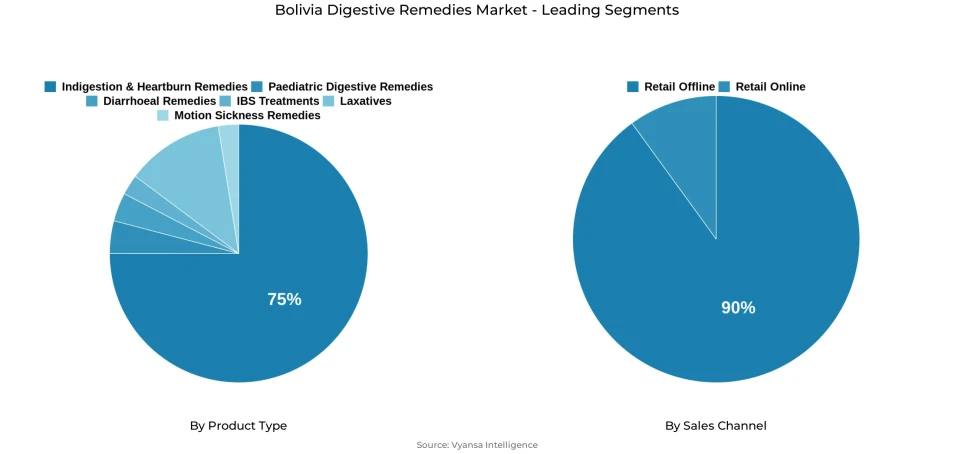
- Indigestion & heartburn remedies grabbed market share of 75%.
- Competition
- More than 10 companies are actively engaged in producing digestive remedies in Bolivia.
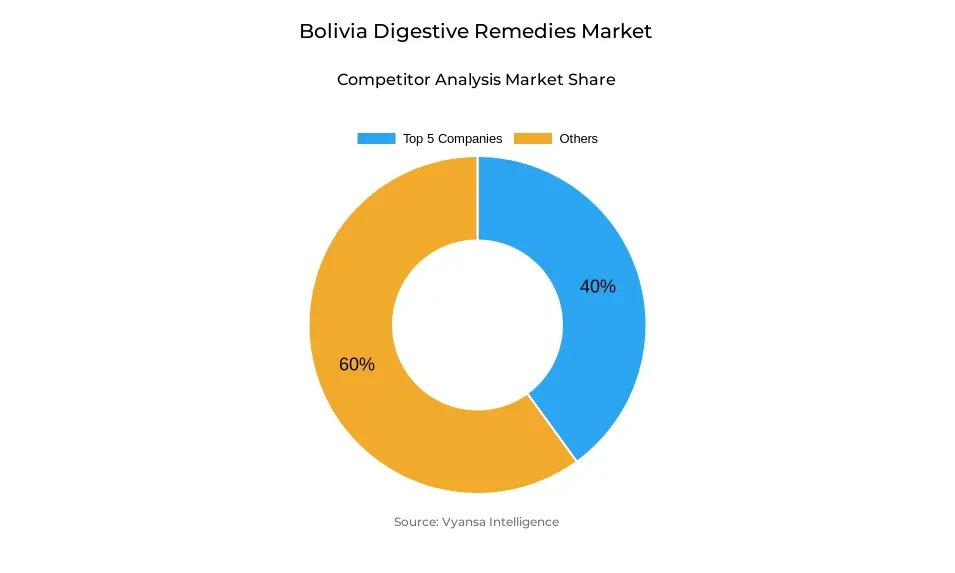
- Top 5 companies acquired around 40% of the market share.
- Megalabs Bolivia SRL, Laboratorios COFAR SA, Camsa Industria & Comercio SA, Laboratorios Vita SA, Laboratorios Bago de Bolivia SA etc., are few of the top companies.
- Sales Channel
- Retail offline grabbed 90% of the market.
Bolivia Digestive Remedies Market Outlook
The Bolivia digestive remedies market was valued at USD 16.38 million in 2025 and is projected to grow from USD 17.5 million in 2026 to USD 18.12 million by 2032, reflecting a CAGR of 1.45% over the forecast period. This growth is fueled by increasing gastrointestinal distress associated with stress, economic strain, and lifestyle alterations. Increased inflation and financial insecurity are the factors that lead to the rise in the cases of gastric reflux, indigestion, and irritable bowel syndrome, which makes consumers turn to self-medication as the immediate, readily available remedy. As a result, digestive-health solutions are gaining increased topicality in terms of daily symptom management.
Economic stress continues to shape purchasing behaviour, influencing how consumers engage with digestive remedies. The National Institute of Statistics reports that the cumulative consumer price index inflation reached 20.40% in 2025, highlighting robust household price pressure. As a reaction, a significant number of consumers turn to pharmacies to obtain common and convenient remedies to common gastrointestinal disorders. Within product categories, indigestion and heartburn remedies maintain dominance with a 75% market share, underscoring their importance in addressing persistent symptoms such as reflux, bloating, and abdominal discomfort.
As a result of the reliance on imported medications, materials (raw materials), and the cost of transportation, escalating costs will also continue to be an issue. According to the INE, the Wholesale Price Index (WPI) has seen an increase of 24.73% cumulatively for 2023, further emphasizing an escalating cost environment. As a result, consumer demand for digestive remedies that offer both effective treatment options and affordability will continue to rise as consumers have begun implementing more selective purchasing behaviors when considering their digestive remedies.
Distribution patterns also shape how digestive remedies reach consumers. Retail offline channels hold around 90% of total sales, with pharmacies acting as the main access point because of convenience and nationwide availability. At the same time, digital access is gradually expanding. The Central Bank of Bolivia reports that the country processes 605 million electronic payment transactions in the first five months of 2025, up 89% from the same period of 2024, indicating that online purchasing and digital payment adoption are steadily influencing consumer access to health products.
Bolivia Digestive Remedies Market Growth DriverEconomic Stress Keeps Stomach Relief in Daily Demand
In Bolivia, the principal driver of demand for digestive remedies is the escalation of stress‑related gastrointestinal discomfort amid sustained economic pressure. Prolonged periods of uncertainty, anxiety and inflationary pressures are becoming more and more related to cases of gastric reflux and irritable bowel syndrome. As a result, an increased percentage of consumers are pursuing quick, easily accessible therapeutic treatments, especially with gastrointestinal symptoms being associated not only with dietary influences but also with daily financial burden and mental stress.
This demand environment is supported by official inflation statistics. According to the National Institute of Statistics (INE), the cumulative Consumer Price Index rose to 20.40% in 2025, underscoring the persistence of acute household price pressure. In this kind of setting, the nexus between economic strain and high gastrointestinal distress gains more importance in the demand of self-medication.
Bolivia Digestive Remedies Market ChallengeImported Cost Pressure Tests Product Affordability
One of the major threats facing the digestiveremedy market in Bolivia is the expensive nature of the structure of imported finished products, raw materials, freight expenses, and logistics. The period of sustained price growth began in 2024 and continued into 2025, thus limiting the ability of a price-sensitive consumer base to afford it. With the increasing retail prices, companies are under pressure to balance product innovation and value proposition, and consumers are gradually tightening their buying requirements.
According to recent official data, the pressure of costs is still intense. The INE indicates that the Wholesale Price Index recorded a cumulative increase of 24.73% in 2025, and its December 2025 bulletin documented price volatility affecting imported pharmaceutical commodities. At the same time, in December 2025, Health Supply and Procurement Center (CEASS) announced the arrival of the eleventh batch of imported pharmaceutical products that will be delivered to the Caja Petrolera de Salud, thus highlighting the continued reliance on imports.
Unlock Market Intelligence
Explore the market potential with our data-driven report
Bolivia Digestive Remedies Market TrendDigital Access Starts Reshaping the Purchase Journey
A salient trend in Bolivia is the expanding role of digital access in the acquisition of digestive remedies. Despite the fact that e-commerce started at a small scale, it has been the fastest growing phenomenon, as large pharmacy chains expand online storefronts, mobile apps, home delivery, virtual consultations, and online payment systems. This development progressively transforms the purchase of digestive remedies from a purely walk‑in transaction into a more adaptable, comparison‑driven retail experience.
Behavioural change is already reflected in the payments ecosystem. The Central Bank of Bolivia has reported that in the first 5 months of 2025 there were 605 million electronic payment transactions made by the nation an increase of 89% compared to the same period in 2024. The 347 million electronic fund transfers made during this time represented the majority (57%) of all electronic payment transactions, while QR‑based payments accounted for 85% of those total electronic fund transfers.
Bolivia Digestive Remedies Market OpportunityLocal, Value-Oriented Solutions Create White-Space Growth
There is a significant market in Bolivia of affordable, trusted, locally based digestive solutions that combine prevention and symptom management. Consumers are becoming more active in the enzymes and probiotics; however, the ongoing inflation is pushing them towards value-based buying. This trend gives the local manufacturers the opportunity to diversify their portfolios with sachets, chewables and multisymptom formats that are both convenient and affordable.
The inflationary environment in Bolivia supports the value-led brands. The INE reports a 20.40% cumulative CPI increase in 2025, while the Wholesale Price Index ascended 24.73% over the same year. Under these conditions, the focus on home-made brands and low-cost combination formats becomes a commercial necessity, with consumers becoming more and more conscious of trust, price, and convenience as a unit.
Unlock Market Intelligence
Explore the market potential with our data-driven report
Bolivia Digestive Remedies Market Segmentation Analysis
By Product Type
- Paediatric Digestive Remedies
- Paediatric Diarrhoeal Remedies
- Paediatric Indigestion & Heartburn Remedies
- Paediatric Laxatives
- Paediatric Motion Sickness Remedies
- Diarrhoeal Remedies
- IBS Treatments
- Indigestion & Heartburn Remedies
- Antacids
- Antiflatulents
- Digestive Enzymes
- H2 Blockers
- Proton Pump Inhibitors
- Laxatives
- Motion Sickness Remedies
Within the product type category, the segment commands the highest market share, with indigestion & heartburn remedies representing 75% of total volume. This dominance shows that the most common purchase motivators are reflux, bloating, indigestion, and mild abdominal discomfort. With the frequency and urgency of such symptoms, consumers still rely on the well-known digestive solutions that offer quick and convenient relief during various episodes of discomfort.
The segment is also benefited by the wider market trend of self-medication in the pharmacy channels. In an environment where stress-related gastric disorders are still visible and cost-consciousness dictates the buying behavior, indigestion and heartburn solutions will be central since they are viewed as necessary, convenient, and ubiquitous. Their wide applicability in a wide range of gastrointestinal issues makes them the biggest product category.
By Sales Channel
- Retail Online
- Retail Offline
- Hospitals
- Clinics
- Pharmacies
In terms of sales channel, the segment enjoys the greatest market share, with retail offline capturing 90% of overall sales. Pharmacies constitute the primary access point for digestive remedies in Bolivia, owing to their nationwide footprint, convenience, and relative affordability. The independent pharmacies, especially, are of paramount significance, since they offer consumers a quicker access to remedies without the increased time and cost of specialist consultations.
At the same time, digital access is enhancing in favor of this offline base instead of replacing it. The Central Bank of Bolivia reported 605 million electronic payment transactions within the first five months of 2025, an 89% year‑on‑year increase, indicative of the expanding role of digital tools across retail behaviour. This fact confirms the fact that the availability of online pharmacies is increasing, despite the fact that physical stores are still leading.
List of Companies Covered in Bolivia Digestive Remedies Market
The companies listed below are highly influential in the Bolivia digestive remedies market, with a significant market share and a strong impact on industry developments.
- Megalabs Bolivia SRL
- Laboratorios COFAR SA
- Camsa Industria & Comercio SA
- Laboratorios Vita SA
- Laboratorios Bago de Bolivia SA
- Laboratorios Drogueria INTI SA
- Pharmatech Boliviana SA
- Generics
- Bayer Boliviana Ltda
- Farmaval Bolivia Srl
Competitive Landscape
The competitive landscape of digestive remedies in Bolivia is characterised by the presence of both established domestic players and companies focusing on innovation in probiotics and digestive health solutions. Laboratorios Vita SA leads the market with a value share of 16.5%, supported by its well-diversified portfolio and flagship brand Digestan, which is widely used to address gastrointestinal issues such as bloating, indigestion and mild stomach discomfort. The product is available in several formats, including effervescent powders and tablets, and benefits from strong nationwide distribution and consumer trust in locally manufactured products. Laboratorios Bago de Bolivia SA follows with a value share of 8.5% and is the most dynamic player, driven by the expansion of Bagó Vital Digest, a clinically supported probiotic powder designed to promote gut health and digestive balance. The company also benefits from the continued popularity of its traditional herbal digestive remedy.
Frequently Asked Questions
Related Report
- Market Segmentation
- Research Scope
- Research Methodology
- Definitions and Assumptions
- Executive Summary
- Bolivia Digestive Remedies Market Policies, Regulations, and Standards
- Bolivia Digestive Remedies Market Dynamics
- Growth Factors
- Challenges
- Trends
- Opportunities
- Bolivia Digestive Remedies Market Statistics, 2022-2032F
- Market Size & Growth Outlook
- By Revenues in USD Million
- Market Segmentation & Growth Outlook
- By Product Type
- Paediatric Digestive Remedies- Market Insights and Forecast 2022-2032, USD Million
- Paediatric Diarrhoeal Remedies- Market Insights and Forecast 2022-2032, USD Million
- Paediatric Indigestion & Heartburn Remedies- Market Insights and Forecast 2022-2032, USD Million
- Paediatric Laxatives- Market Insights and Forecast 2022-2032, USD Million
- Paediatric Motion Sickness Remedies- Market Insights and Forecast 2022-2032, USD Million
- Diarrhoeal Remedies- Market Insights and Forecast 2022-2032, USD Million
- IBS Treatments- Market Insights and Forecast 2022-2032, USD Million
- Indigestion & Heartburn Remedies- Market Insights and Forecast 2022-2032, USD Million
- Antacids- Market Insights and Forecast 2022-2032, USD Million
- Antiflatulents- Market Insights and Forecast 2022-2032, USD Million
- Digestive Enzymes- Market Insights and Forecast 2022-2032, USD Million
- H2 Blockers- Market Insights and Forecast 2022-2032, USD Million
- Proton Pump Inhibitors- Market Insights and Forecast 2022-2032, USD Million
- Laxatives- Market Insights and Forecast 2022-2032, USD Million
- Motion Sickness Remedies- Market Insights and Forecast 2022-2032, USD Million
- Paediatric Digestive Remedies- Market Insights and Forecast 2022-2032, USD Million
- By Age Group
- Children & Adolescents (01-17 years)- Market Insights and Forecast 2022-2032, USD Million
- Adults (18-65 years)- Market Insights and Forecast 2022-2032, USD Million
- Geriatric (65+ years)- Market Insights and Forecast 2022-2032, USD Million
- By Sales Channel
- Retail Online- Market Insights and Forecast 2022-2032, USD Million
- Retail Offline- Market Insights and Forecast 2022-2032, USD Million
- Hospitals- Market Insights and Forecast 2022-2032, USD Million
- Clinics- Market Insights and Forecast 2022-2032, USD Million
- Pharmacies- Market Insights and Forecast 2022-2032, USD Million
- By Competitors
- Competition Characteristics
- Market Share & Analysis
- By Product Type
- Market Size & Growth Outlook
- Bolivia Paediatric Digestive Remedies Market Statistics, 2022-2032
- Market Size & Growth Outlook
- By Revenues in USD Million
- Market Segmentation & Growth Outlook
- By Age Group- Market Insights and Forecast 2022-2032, USD Million
- By Sales Channel- Market Insights and Forecast 2022-2032, USD Million
- Market Size & Growth Outlook
- Bolivia Diarrhoeal Remedies Market Statistics, 2022-2032
- Market Size & Growth Outlook
- By Revenues in USD Million
- Market Segmentation & Growth Outlook
- By Age Group- Market Insights and Forecast 2022-2032, USD Million
- By Sales Channel- Market Insights and Forecast 2022-2032, USD Million
- Market Size & Growth Outlook
- Bolivia IBS Treatments Market Statistics, 2022-2032
- Market Size & Growth Outlook
- By Revenues in USD Million
- Market Segmentation & Growth Outlook
- By Age Group- Market Insights and Forecast 2022-2032, USD Million
- By Sales Channel- Market Insights and Forecast 2022-2032, USD Million
- Market Size & Growth Outlook
- Bolivia Indigestion & Heartburn Remedies Market Statistics, 2022-2032
- Market Size & Growth Outlook
- By Revenues in USD Million
- Market Segmentation & Growth Outlook
- By Age Group- Market Insights and Forecast 2022-2032, USD Million
- By Sales Channel- Market Insights and Forecast 2022-2032, USD Million
- Market Size & Growth Outlook
- Bolivia Laxatives Market Statistics, 2022-2032
- Market Size & Growth Outlook
- By Revenues in USD Million
- Market Segmentation & Growth Outlook
- By Age Group- Market Insights and Forecast 2022-2032, USD Million
- By Sales Channel- Market Insights and Forecast 2022-2032, USD Million
- Market Size & Growth Outlook
- Bolivia Motion Sickness Remedies Market Statistics, 2022-2032
- Market Size & Growth Outlook
- By Revenues in USD Million
- Market Segmentation & Growth Outlook
- By Age Group- Market Insights and Forecast 2022-2032, USD Million
- By Sales Channel- Market Insights and Forecast 2022-2032, USD Million
- Market Size & Growth Outlook
- Competitive Outlook
- Company Profiles
- Laboratorios Vita SA
- Business Description
- Product Portfolio
- Collaborations & Alliances
- Recent Developments
- Financial Details
- Others
- Laboratorios Bago de Bolivia SA
- Business Description
- Product Portfolio
- Collaborations & Alliances
- Recent Developments
- Financial Details
- Others
- Laboratorios Drogueria INTI SA
- Business Description
- Product Portfolio
- Collaborations & Alliances
- Recent Developments
- Financial Details
- Others
- Pharmatech Boliviana SA
- Business Description
- Product Portfolio
- Collaborations & Alliances
- Recent Developments
- Financial Details
- Others
- Megalabs Bolivia SRL
- Business Description
- Product Portfolio
- Collaborations & Alliances
- Recent Developments
- Financial Details
- Others
- Laboratorios COFAR SA
- Business Description
- Product Portfolio
- Collaborations & Alliances
- Recent Developments
- Financial Details
- Others
- Camsa Industria & Comercio SA
- Business Description
- Product Portfolio
- Collaborations & Alliances
- Recent Developments
- Financial Details
- Others
- Bayer Boliviana Ltda
- Business Description
- Product Portfolio
- Collaborations & Alliances
- Recent Developments
- Financial Details
- Others
- Farmaval Bolivia Srl
- Business Description
- Product Portfolio
- Collaborations & Alliances
- Recent Developments
- Financial Details
- Others
- South American Express SA (SAE)
- Business Description
- Product Portfolio
- Collaborations & Alliances
- Recent Developments
- Financial Details
- Others
- Laboratorios Vita SA
- Company Profiles
- Disclaimer
| Segment | Sub-Segment |
|---|---|
| By Product Type |
|
| By Age Group |
|
| By Sales Channel |
|
Research Methodology
This study followed a structured approach comprising four key phases to assess the size and scope of the electro-oxidation market. The process began with thorough secondary research to collect data on the target market, related markets, and broader industry context. These findings, along with preliminary assumptions and estimates, were then validated through extensive primary research involving industry experts from across the value chain. To calculate the overall market size, both top-down and bottom-up methodologies were employed. Finally, market segmentation and data triangulation techniques were applied to refine and validate segment-level estimations.
Secondary Research
The secondary research phase involved gathering data from a wide range of credible and published sources. This step helped in identifying industry trends, defining market segmentation, and understanding the market landscape and value chain.
Sources consulted during this phase included:
- Company annual reports, investor presentations, and press releases
- Industry white papers and certified publications
- Trade directories and market-recognized databases
- Articles from authoritative authors and reputable journals
- Gold and silver standard websites
Secondary research was critical in mapping out the industry's value chain and monetary flow, identifying key market segments, understanding regional variations, and tracking significant industry developments.
Other key sources:
- Financial disclosures
- Industry associations and trade bodies
- News outlets and business magazines
- Academic journals and research studies
- Paid industry databases
Primary Research
To validate secondary data and gain deeper market insights, primary research was conducted with key stakeholders across both the supply and demand sides of the market.
On the demand side, participants included decision-makers and influencers from end-user industries—such as CIOs, CTOs, and CSOs—who provided first-hand perspectives on market needs, product usage, and future expectations.
On the supply side, interviews were conducted with manufacturers, industry associations, and institutional participants to gather insights into current offerings, product pipelines, and market challenges.
Primary interviews provided critical inputs such as:
- Market size and revenue data
- Product and service breakdowns
- Market forecasts
- Regional and application-specific trends
Stakeholders consulted included:
- Leading OEM and solution providers
- Channel and distribution partners
- End users across various applications
- Independent consultants and industry specialists
Market Size Estimation and Data Triangulation
- Identifying Key Market Participants (Secondary Research)
- Goal: To identify the major players or companies in the target market. This typically involves using publicly available data sources such as industry reports, market research publications, and financial statements of companies.
- Tools: Reports from firms like Gartner, Forrester, Euromonitor, Statista, IBISWorld, and others. Public financial statements, news articles, and press releases from top market players.
- Extracting Earnings of Key Market Participants
- Goal: To estimate the earnings generated from the product or service being analyzed. This step helps in understanding the revenue potential of each market player in a specific geography.
- Methods: Earnings data can be gathered from:
- Publicly available financial reports (for listed companies).
- Interviews and primary data sources from professionals, such as Directors, VPs, SVPs, etc. This is especially useful for understanding more nuanced, internal data that isn't publicly disclosed.
- Annual reports and investor presentations of key players.
- Data Collation and Development of a Relevant Data Model
- Goal: To collate inputs from both primary and secondary sources into a structured, data-driven model for market estimation. This model will incorporate key market KPIs and any independent variables relevant to the market.
- Key KPIs: These could include:
- Market size, growth rate, and demand drivers.
- Industry-specific metrics like market share, average revenue per customer (ARPC), or average deal size.
- External variables, such as economic growth rates, inflation rates, or commodity prices, that could affect the market.
- Data Modeling: Based on this data, the market forecasts are developed for the next 5 years. A combination of trend analysis, scenario modeling, and statistical regression might be used to generate projections.
- Scenario Analysis
- Goal: To test different assumptions and validate how sensitive the market is to changes in key variables (e.g., market demand, regulatory changes, technological disruptions).
- Types of Scenarios:
- Base Case: Based on current assumptions and historical data.
- Best-Case Scenario: Assuming favorable market conditions, regulatory environments, and technological advancements.
- Worst-Case Scenario: Accounting for adverse factors, such as economic downturns, stricter regulations, or unexpected disruptions.












