Argentina Menstrual Care Market Report: Trends, Growth and Forecast (2026-2032)
Product Type (Pantyliners, Tampons (Applicator Tampons, Digital Tampons), Towels (Standard Towels (Standard Towels with Wings, Standard Towels Without Wings), Slim/Thin/Ultra-Thin Towels (Slim/Thin/Ultra-Thin Towels with Wings, Slim/Thin/Ultra-Thin Towels Without Wings)), Intimate Wipes, Menstrual Cups, Period Underwear), Nature (Disposable, Reusable), Age Group (Up to 18 Years, 19-30 Years, 31-40 Years, 40 Years and Above), Sales Channel (Retail Offline, Retail Online) ... Read more
|
Major Players
|
Argentina Menstrual Care Market Statistics and Insights, 2026
- Market Size Statistics
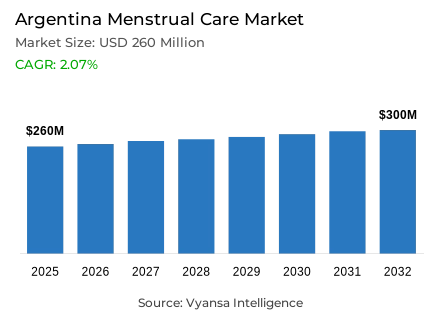
- Menstrual care in Argentina is estimated at USD 260 million.
- The market size is expected to grow to USD 300 million by 2032.
- Market to register a cagr of around 2.07% during 2026-32.
- Product Type Shares
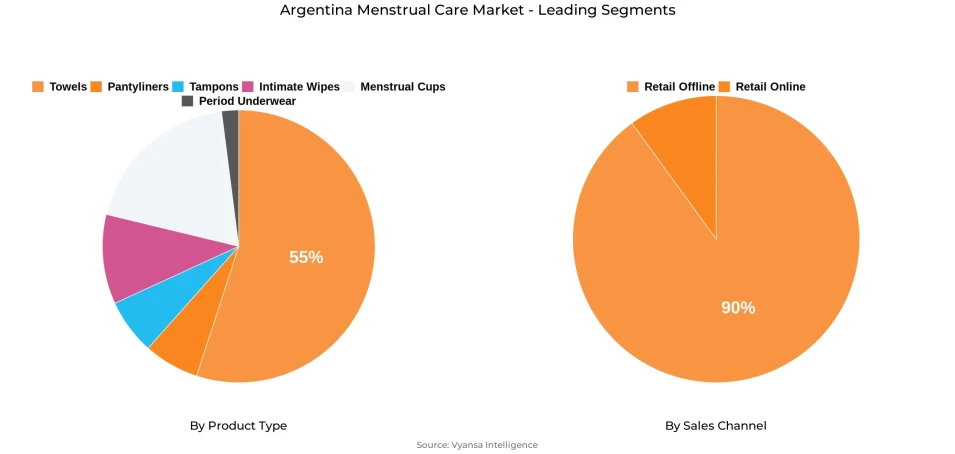
- Towels grabbed market share of 55%.
- Competition
- More than 5 companies are actively engaged in producing menstrual care in Argentina.
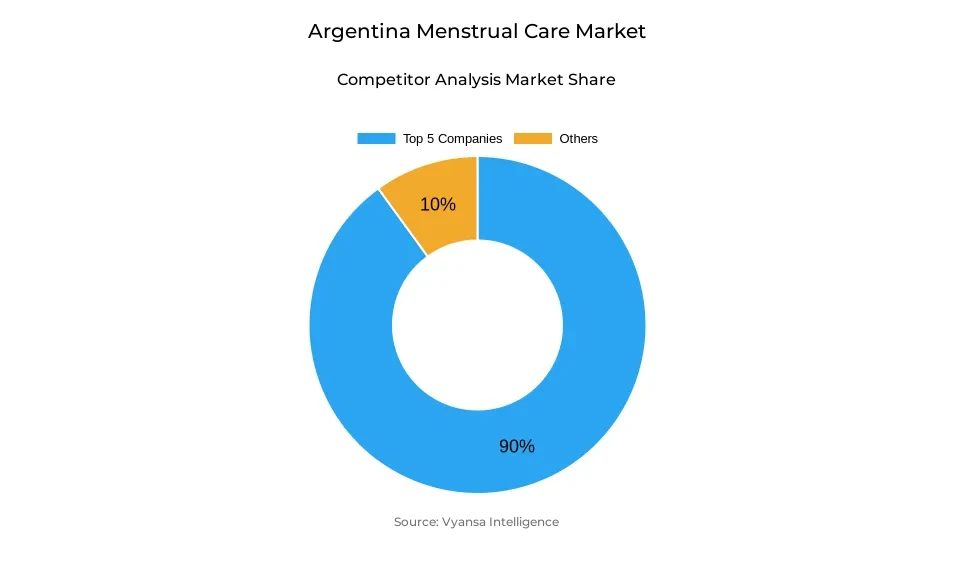
- Top 5 companies acquired around 90% of the market share.
- JVA Swiss Personal Products SRL, Papelera del Plata SA, La, Softys Argentina SA, Johnson & Johnson de Argentina SAC, Algodonera Aconcagua SA etc., are few of the top companies.
- Sales Channel
- Retail offline grabbed 90% of the market.
Argentina Menstrual Care Market Outlook
The Argentina menstrual care market is expected to increase from USD 260 million in 2025 to approximately USD 300 million by 2032, at a CAGR of around 2.07% during 2026-2032. The outlook is positive as improving macroeconomic conditions, easing inflation, and rising disposable incomes are expected to boost retail volume and value sales. With enhanced purchasing power, end users are likely to move toward branded and multifunctional menstrual care products, offering a balance between affordability and comfort. The towels category, holding around 55% of the total market, will keep its leading position due to high usage frequency and product availability across both modern and traditional channels.
Tampons will continue to see the fastest value growth throughout the forecast period because of their relatively higher unit prices and wider availability via hypermarkets and retail online. Meanwhile, menstrual cups are likely to remain a niche product, limited to more affluent, environmentally aware end users. As generally price-sensitive end end users will continue to opt for more reliable and affordable products, value-for-money brands will remain in an advantageous position compared to more premium, eco-friendly offerings.
The competitive landscape will continue to be concentrated, with Johnson & Johnson de Argentina SAC still maintaining the leading position thanks to its solid domestic production and widely recognized brand names like Siempre Libre, Carefree, and O.B. Other key players, such as Essity AB, Kimberly-Clark, and Softys, will further enhance their portfolios through innovation. These include pH-indicating pantyliners, and there is also a wider availability of enhanced absorbent materials. Meanwhile, private labels from Carrefour, Jumbo, and Farmacity are expected to increase their share as modern retail gains share once again.
By sales channel, retail offline will continue to dominate, with a market share of approximately 90%, driven by hypermarkets, supermarkets, and pharmacies that offer membership discounts and loyalty programs. Retail retail online will grow at a gradual pace, driven by social media promotions and an improvement in the services offered for delivery, which will allow brands to reach more efficiently the female population, who is becoming increasingly digitally savvy in Argentina.
Argentina Menstrual Care Market Growth DriverEconomic Stabilisation and Rising Disposable Incomes Stimulate Market Recovery
Argentina Menstrual Care market is seeing fresh impetus due to the country's gradual economic stabilization after years of high inflation and weak end users confidence. According to the IMF, Argentina's GDP is forecasted to grow by 4.5%% in 2025, supported by fiscal reforms and easing inflation. This is restoring purchasing power, enabling end users to shift back toward branded menstrual products instead of cheaper substitutes. Similarly, the World Bank expects inflation to decrease from 220% in 2024 to about 45% in 2025, relieving affordability pressures.
As real incomes have stabilized, end users started giving priority to comfort and quality rather than price alone. This has benefited the leading players such as Johnson & Johnson and Kimberly-Clark. In addition, urbanization at over 93% of Argentines living in cities according to the United Nations, improves access and awareness via modern retail and digital channels. This improving economic stability gives a strong basis for steady volume recovery across the menstrual care segment.
Argentina Menstrual Care Market TrendRising Importance of Value-Oriented Local Brands
The competitive structure of Argentina menstrual care market is shifting due to the rise of value-oriented local brands. Companies like Algodonera Aconcagua SA, with its very affordable brand Calipso, appeal to price-conscious end users looking for lower-priced but still effective menstrual care products. This mirrors broader expenditure changes tracked by the National Institute of Statistics and Census, or INDEC, which tallied a 35% decline in real wages from 2017 to 2024 and prompted spending shifts to more budget-friendly options.
Meanwhile, domestic production offers advantages in cost control and stability in view of currency fluctuations. Brands that manufacture locally, like Johnson & Johnson's Siempre Libre and Carefree, have maintained leading positions in the market. World Bank estimates unemployment to stand at 7.1% in 2024, a fact that supports the trend to value-based purchasing. Therefore, locally manufactured, affordable products are setting a new competitive environment for Argentina menstrual care market.
Unlock Market Intelligence
Explore the market potential with our data-driven report
Argentina Menstrual Care Market OpportunityInnovation and engagement in social media strengthen brand visibility.
Innovation and digital engagement are expected to bring strong growth opportunities to Argentina's menstrual care market. As social media becomes a vital source of marketing, brands have taken up channels like Instagram and TikTok to interact with the audience and promote product innovation. According to the National Communications Agency of Argentina, ENACOM, more than 60% of Argentines use social media, therefore, brands have a big base for targeted and interactive engagement.
Product innovation has also emerged as a key differentiator. For example, Kimberly-Clark's Kotex introduced pantyliners with a pH-sensitive color change feature, reflecting increased demand for multi-functional hygiene solutions. According to UN Women, 63% of Argentine women aged 15-49 seek improved comfort and safety in menstrual care products, suggesting further opportunities for innovation-driven growth. The combination of digital outreach with product advancements will help companies improve visibility, enhance brand loyalty, and tap emerging end-user segments over the forecast period.
Unlock Market Intelligence
Explore the market potential with our data-driven report
Argentina Menstrual Care Market Segmentation Analysis
By Product Type
- Pantyliners
- Tampons
- Towels
- Intimate Wipes
- Menstrual Cups
- Period Underwear
The segment with highest market share under product type is towels dominated Argentina menstrual care market and accounted for approximately 55% of the market share. Towels remain dominant because of their wide availability, affordability, and preference among women for reliable protection. Comfort and effectiveness keep standard towels with wings at the top, with higher value sales compared to other categories. Higher price points have helped towels achieve value growth even during high inflationary periods.
Added to this, the category enjoys excellent brand exposure: from Johnson & Johnson to Kimberly-Clark and Procter & Gamble, all products are very well available across retail channels. Other alternatives, like tampons and menstrual cups, will gain more exposure, but will remain niche due to affordability and a general lack of awareness. Towels will continue to enjoy their leading position as the most trusted and accessible option for end users in Argentina.
By Sales Channel
- Retail Offline
- Retail Online
The segment with highest market share under Sales Channel is retail offline captured about 90% share, the leading segment in the Argentina menstrual care market. end users still heavily rely on in-store purchases of menstrual care products, primarily through hypermarkets, supermarkets, and health and beauty specialists. These formats offer wide assortments, frequent promotions, and strong private-label options from chains like Carrefour and Jumbo that increase affordability for price-sensitive end users.
Though online sales have increased, especially through MercadoLibre and brand websites, offline retail remains predominant due to end users preference for immediate availability and trusted product handling. Besides, pharmacies and hypermarkets secure regular footfall by offering membership discounts and partnerships with banks. As inflationary pressures relax and purchasing power recuperates, offline retail is poised to continue its lead as the top distribution channel for menstrual care products across Argentina.
Top Companies in Argentina Menstrual Care Market
The top companies operating in the market include JVA Swiss Personal Products SRL, Papelera del Plata SA, La, Softys Argentina SA, Johnson & Johnson de Argentina SAC, Algodonera Aconcagua SA, Kimberly-Clark Argentina Holdings SA, Procter & Gamble Interamericas Inc, etc., are the top players operating in the Argentina menstrual care market.
Market News & Updates
- Johnson & Johnson, 2023-2025:
Johnson & Johnson has continued brand activity and awareness campaigns for menstrual-care brands such as Stayfree and o.b., with ongoing product activity and marketing in the region
- Kimberly‑Clark Argentina, 2023-2025:
Kimberly‑Clark has kept the Kotex/Intimus portfolio active, rolling out regional initiatives focused on sustainability and education in Latin America.
Frequently Asked Questions
Related Report
1. Market Segmentation
1.1. Research Scope
1.2. Research Methodology
1.3. Definitions and Assumptions
2. Executive Summary
3. Argentina Menstrual Care Market Policies, Regulations, and Standards
4. Argentina Menstrual Care Market Dynamics
4.1. Growth Factors
4.2. Challenges
4.3. Trends
4.4. Opportunities
5. Argentina Menstrual Care Market Statistics, 2022-2032F
5.1. Market Size & Growth Outlook
5.1.1.By Revenues in USD Million
5.2. Market Segmentation & Growth Outlook
5.2.1.By Product Type
5.2.1.1. Pantyliners- Market Insights and Forecast 2022-2032, USD Million
5.2.1.2. Tampons- Market Insights and Forecast 2022-2032, USD Million
5.2.1.2.1. Applicator Tampons- Market Insights and Forecast 2022-2032, USD Million
5.2.1.2.2. Digital Tampons- Market Insights and Forecast 2022-2032, USD Million
5.2.1.3. Towels- Market Insights and Forecast 2022-2032, USD Million
5.2.1.3.1. Standard Towels- Market Insights and Forecast 2022-2032, USD Million
5.2.1.3.1.1. Standard Towels with Wings- Market Insights and Forecast 2022-2032, USD Million
5.2.1.3.1.2. Standard Towels Without Wings- Market Insights and Forecast 2022-2032, USD Million
5.2.1.3.2. Slim/Thin/Ultra-Thin Towels- Market Insights and Forecast 2022-2032, USD Million
5.2.1.3.2.1. Slim/Thin/Ultra-Thin Towels with Wings- Market Insights and Forecast 2022-2032, USD Million
5.2.1.3.2.2. Slim/Thin/Ultra-Thin Towels Without Wings- Market Insights and Forecast 2022-2032, USD Million
5.2.1.4. Intimate Wipes- Market Insights and Forecast 2022-2032, USD Million
5.2.1.5. Menstrual Cups- Market Insights and Forecast 2022-2032, USD Million
5.2.1.6. Period Underwear- Market Insights and Forecast 2022-2032, USD Million
5.2.2.By Nature
5.2.2.1. Disposable- Market Insights and Forecast 2022-2032, USD Million
5.2.2.2. Reusable- Market Insights and Forecast 2022-2032, USD Million
5.2.3.By Age Group
5.2.3.1. Up to 18 Years- Market Insights and Forecast 2022-2032, USD Million
5.2.3.2. 19-30 Years- Market Insights and Forecast 2022-2032, USD Million
5.2.3.3. 31-40 Years- Market Insights and Forecast 2022-2032, USD Million
5.2.3.4. 40 Years and Above- Market Insights and Forecast 2022-2032, USD Million
5.2.4.By Sales Channel
5.2.4.1. Retail Offline- Market Insights and Forecast 2022-2032, USD Million
5.2.4.2. Retail Online- Market Insights and Forecast 2022-2032, USD Million
5.2.5.By Competitors
5.2.5.1. Competition Characteristics
5.2.5.2. Market Share & Analysis
6. Argentina Pantyliners Menstrual Care Market Statistics, 2022-2032
6.1. Market Size & Growth Outlook
6.1.1.By Revenues in USD Million
6.2. Market Segmentation & Growth Outlook
6.2.1.By Nature- Market Insights and Forecast 2022-2032, USD Million
6.2.2.By Age Group- Market Insights and Forecast 2022-2032, USD Million
6.2.3.By Sales Channel- Market Insights and Forecast 2022-2032, USD Million
7. Argentina Tampons Menstrual Care Market Statistics, 2022-2032
7.1. Market Size & Growth Outlook
7.1.1.By Revenues in USD Million
7.2. Market Segmentation & Growth Outlook
7.2.1.By Product Type- Market Insights and Forecast 2022-2032, USD Million
7.2.2.By Nature- Market Insights and Forecast 2022-2032, USD Million
7.2.3.By Age Group- Market Insights and Forecast 2022-2032, USD Million
7.2.4.By Sales Channel- Market Insights and Forecast 2022-2032, USD Million
8. Argentina Towels Menstrual Care Market Statistics, 2022-2032
8.1. Market Size & Growth Outlook
8.1.1.By Revenues in USD Million
8.2. Market Segmentation & Growth Outlook
8.2.1.By Product Type- Market Insights and Forecast 2022-2032, USD Million
8.2.2.By Nature- Market Insights and Forecast 2022-2032, USD Million
8.2.3.By Age Group- Market Insights and Forecast 2022-2032, USD Million
8.2.4.By Sales Channel- Market Insights and Forecast 2022-2032, USD Million
9. Argentina Intimate Wipes Market Statistics, 2022-2032
9.1. Market Size & Growth Outlook
9.1.1.By Revenues in USD Million
9.2. Market Segmentation & Growth Outlook
9.2.1.By Nature- Market Insights and Forecast 2022-2032, USD Million
9.2.2.By Age Group- Market Insights and Forecast 2022-2032, USD Million
9.2.3.By Sales Channel- Market Insights and Forecast 2022-2032, USD Million
10. Argentina Menstrual Cups Menstrual Care Market Statistics, 2022-2032
10.1. Market Size & Growth Outlook
10.1.1. By Revenues in USD Million
10.2. Market Segmentation & Growth Outlook
10.2.1. By Nature- Market Insights and Forecast 2022-2032, USD Million
10.2.2. By Age Group- Market Insights and Forecast 2022-2032, USD Million
10.2.3. By Sales Channel- Market Insights and Forecast 2022-2032, USD Million
11. Argentina Period Underwear Menstrual Care Market Statistics, 2022-2032
11.1. Market Size & Growth Outlook
11.1.1. By Revenues in USD Million
11.2. Market Segmentation & Growth Outlook
11.2.1. By Nature- Market Insights and Forecast 2022-2032, USD Million
11.2.2. By Age Group- Market Insights and Forecast 2022-2032, USD Million
11.2.3. By Sales Channel- Market Insights and Forecast 2022-2032, USD Million
12. Competitive Outlook
12.1. Company Profiles
12.1.1. Johnson & Johnson de Argentina SAC
12.1.1.1. Business Description
12.1.1.2. Product Portfolio
12.1.1.3. Collaborations & Alliances
12.1.1.4. Recent Developments
12.1.1.5. Financial Details
12.1.1.6. Others
12.1.2. Algodonera Aconcagua SA
12.1.2.1. Business Description
12.1.2.2. Product Portfolio
12.1.2.3. Collaborations & Alliances
12.1.2.4. Recent Developments
12.1.2.5. Financial Details
12.1.2.6. Others
12.1.3. Kimberly-Clark Argentina Holdings SA
12.1.3.1. Business Description
12.1.3.2. Product Portfolio
12.1.3.3. Collaborations & Alliances
12.1.3.4. Recent Developments
12.1.3.5. Financial Details
12.1.3.6. Others
12.1.4. Procter & Gamble Interamericas Inc
12.1.4.1. Business Description
12.1.4.2. Product Portfolio
12.1.4.3. Collaborations & Alliances
12.1.4.4. Recent Developments
12.1.4.5. Financial Details
12.1.4.6. Others
12.1.5. Softys Argentina SA
12.1.5.1. Business Description
12.1.5.2. Product Portfolio
12.1.5.3. Collaborations & Alliances
12.1.5.4. Recent Developments
12.1.5.5. Financial Details
12.1.5.6. Others
12.1.6. JVA Swiss Personal Products SRL
12.1.6.1. Business Description
12.1.6.2. Product Portfolio
12.1.6.3. Collaborations & Alliances
12.1.6.4. Recent Developments
12.1.6.5. Financial Details
12.1.6.6. Others
12.1.7. Papelera del Plata SA, La
12.1.7.1. Business Description
12.1.7.2. Product Portfolio
12.1.7.3. Collaborations & Alliances
12.1.7.4. Recent Developments
12.1.7.5. Financial Details
12.1.7.6. Others
13. Disclaimer
| Segment | Sub-Segment |
|---|---|
| By Product Type |
|
| By Nature |
|
| By Age Group |
|
| By Sales Channel |
|
Research Methodology
This study followed a structured approach comprising four key phases to assess the size and scope of the electro-oxidation market. The process began with thorough secondary research to collect data on the target market, related markets, and broader industry context. These findings, along with preliminary assumptions and estimates, were then validated through extensive primary research involving industry experts from across the value chain. To calculate the overall market size, both top-down and bottom-up methodologies were employed. Finally, market segmentation and data triangulation techniques were applied to refine and validate segment-level estimations.
Secondary Research
The secondary research phase involved gathering data from a wide range of credible and published sources. This step helped in identifying industry trends, defining market segmentation, and understanding the market landscape and value chain.
Sources consulted during this phase included:
- Company annual reports, investor presentations, and press releases
- Industry white papers and certified publications
- Trade directories and market-recognized databases
- Articles from authoritative authors and reputable journals
- Gold and silver standard websites
Secondary research was critical in mapping out the industry's value chain and monetary flow, identifying key market segments, understanding regional variations, and tracking significant industry developments.
Other key sources:
- Financial disclosures
- Industry associations and trade bodies
- News outlets and business magazines
- Academic journals and research studies
- Paid industry databases
Primary Research
To validate secondary data and gain deeper market insights, primary research was conducted with key stakeholders across both the supply and demand sides of the market.
On the demand side, participants included decision-makers and influencers from end-user industries—such as CIOs, CTOs, and CSOs—who provided first-hand perspectives on market needs, product usage, and future expectations.
On the supply side, interviews were conducted with manufacturers, industry associations, and institutional participants to gather insights into current offerings, product pipelines, and market challenges.
Primary interviews provided critical inputs such as:
- Market size and revenue data
- Product and service breakdowns
- Market forecasts
- Regional and application-specific trends
Stakeholders consulted included:
- Leading OEM and solution providers
- Channel and distribution partners
- End users across various applications
- Independent consultants and industry specialists
Market Size Estimation and Data Triangulation
- Identifying Key Market Participants (Secondary Research)
- Goal: To identify the major players or companies in the target market. This typically involves using publicly available data sources such as industry reports, market research publications, and financial statements of companies.
- Tools: Reports from firms like Gartner, Forrester, Euromonitor, Statista, IBISWorld, and others. Public financial statements, news articles, and press releases from top market players.
- Extracting Earnings of Key Market Participants
- Goal: To estimate the earnings generated from the product or service being analyzed. This step helps in understanding the revenue potential of each market player in a specific geography.
- Methods: Earnings data can be gathered from:
- Publicly available financial reports (for listed companies).
- Interviews and primary data sources from professionals, such as Directors, VPs, SVPs, etc. This is especially useful for understanding more nuanced, internal data that isn't publicly disclosed.
- Annual reports and investor presentations of key players.
- Data Collation and Development of a Relevant Data Model
- Goal: To collate inputs from both primary and secondary sources into a structured, data-driven model for market estimation. This model will incorporate key market KPIs and any independent variables relevant to the market.
- Key KPIs: These could include:
- Market size, growth rate, and demand drivers.
- Industry-specific metrics like market share, average revenue per customer (ARPC), or average deal size.
- External variables, such as economic growth rates, inflation rates, or commodity prices, that could affect the market.
- Data Modeling: Based on this data, the market forecasts are developed for the next 5 years. A combination of trend analysis, scenario modeling, and statistical regression might be used to generate projections.
- Scenario Analysis
- Goal: To test different assumptions and validate how sensitive the market is to changes in key variables (e.g., market demand, regulatory changes, technological disruptions).
- Types of Scenarios:
- Base Case: Based on current assumptions and historical data.
- Best-Case Scenario: Assuming favorable market conditions, regulatory environments, and technological advancements.
- Worst-Case Scenario: Accounting for adverse factors, such as economic downturns, stricter regulations, or unexpected disruptions.












