Global Agricultural Microbials Market Report: Trends, Growth and Forecast (2026-2032)
By Function (Crop Protection, Soil Amendment), By Type (Bacteria, Fungi, Virus, Protozoa, Others), By Formulation (Liquid, Dry), By Application Method (Foliar Spray, Soil Treatment, Seed Treatment, Others), By Crop Type (Cereals and Grains, Oilseeds and Pulses, Fruits and Vegetables, Others), By Region (North America, South America, Europe, Middle East and Africa, Asia Pacific) ... Read more
|
Major Players
|
Global Agricultural Microbials Market Statistics and Insights, 2026
- Market Size Statistics
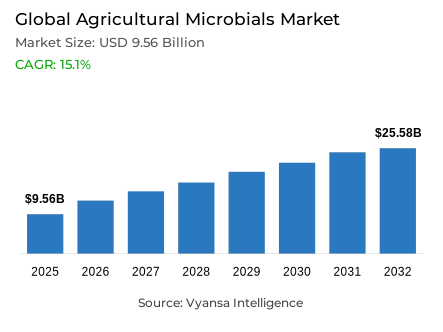
- Agricultural microbials market size in Global was valued at USD 9.56 billion in 2025 and is estimated at USD 11 billion in 2026.
- The market size is expected to grow to USD 25.58 billion by 2032.
- Market to register a CAGR of around 15.1% during 2026-32.
- Function Shares
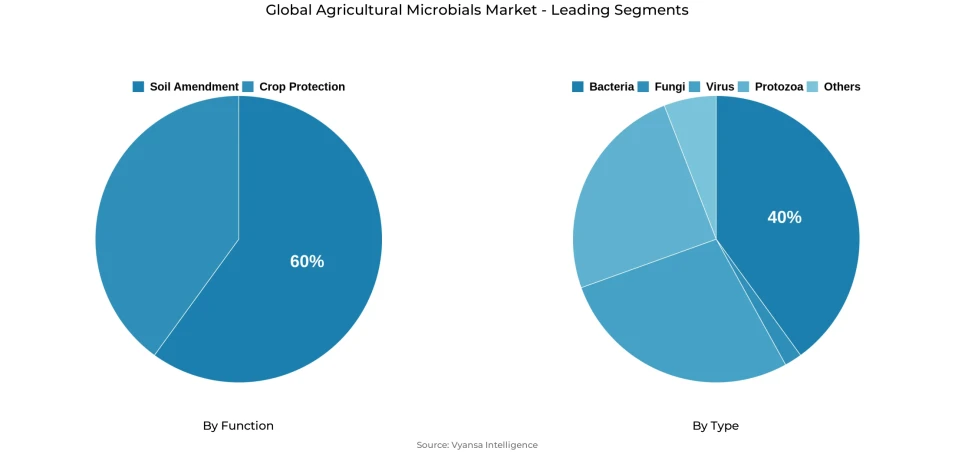
- Soil amendment grabbed market share of 60%.
- Competition
- Global agricultural microbials market is currently being catered to by more than 25 companies.
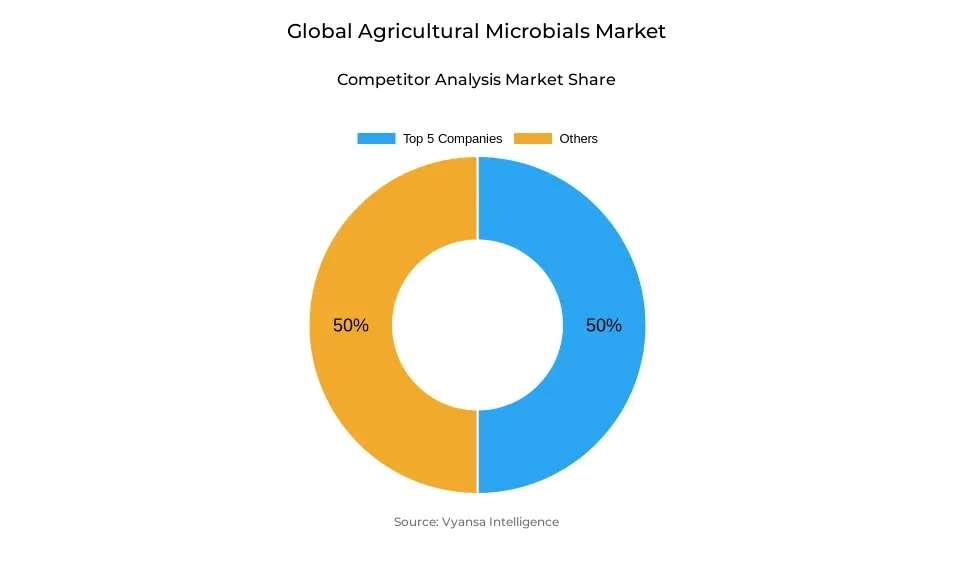
- Top 5 companies acquired around 50% of the market share.
- UPL Limited, Sumitomo Chemical Co. Ltd., Rovensa Next, Bayer AG, BASF SE etc., are few of the top companies.
- Type
- Bacteria grabbed 40% of the market.
- Region
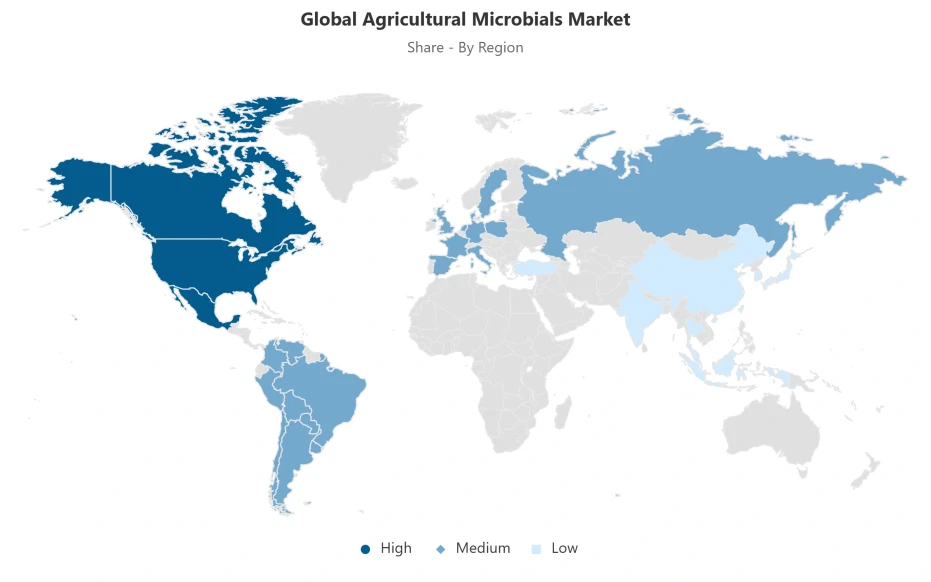
- North America leads with a 35% share of the global market.
Global Agricultural Microbials Market Outlook
The Global Agricultural Microbials Market is valued at USD 9.56 Billion in 2025 and USD 11 Billion in 2026, and is projected to reach USD 25.58 Billion by 2032, growing at a CAGR of 15.1% from 2026 to 2032. It covers microbial pesticides, biofertilizers, microbial inoculants, microbial biostimulants, and soil microbial products used by growers, distributors, seed companies, and crop protection suppliers.
Across regions, North America benefits from biological seed treatment adoption, strong regulatory pathways, and advanced row-crop input distribution. Europe is shaped by plant biostimulant compliance and residue-reduction programs. Asia-Pacific demand is linked to nutrient-use efficiency and soil fertility enhancement. MEA adoption is supported by water-stressed farming systems, while South America relies on soybean, corn, and sugarcane inoculant use, reinforcing global demand diversity. North America and Europe also support premium biological formulations through clearer compliance routes, while Asia-Pacific and South America create scale opportunities for bacterial biofertilizers, seed treatment microbials, and soil treatment microbials across high-acreage crops and export-oriented horticulture systems globally.
The Global Agricultural Microbials Industry strengthens agricultural input diversification by reducing dependence on synthetic crop nutrition and chemical crop protection where microbial alternatives improve nutrient uptake, disease suppression, and rhizosphere performance. For suppliers, scale depends on fermentation capacity, shelf-stable bioinputs, strain validation, and evidence-led registration. This keeps procurement focused on proven field performance, storage stability, agronomic consistency, and compatibility with integrated crop programs.
The 2026 trajectory favors companies that integrate strain development, biological formulation technology, and regional registration capabilities. The Global Agricultural Microbials Market is moving from niche biological input adoption toward broader crop management programs, supported by organic farming expansion, integrated pest management adoption, and climate-resilient farming priorities. FiBL and IFOAM state that organic agriculture is practiced in more than 180 countries, giving the Global Agricultural Microbials Industry a wider application base for microbial crop inputs.
Global Agricultural Microbials Market Growth Driver
Soil Health and Low-Residue Farming Accelerate Adoption
Sustainable agriculture adoption is increasing demand for microbial biofertilizers, biopesticides, and microbial biostimulants as growers seek lower-residue crop protection and stronger soil health improvement. The Global Agricultural Microbials Market benefits when microbial inoculants support nutrient uptake, root vigor, and plant disease suppression across cereals, grains, fruits, vegetables, oilseeds, and pulses, especially where buyers require verifiable stewardship.
FiBL and IFOAM reported in 2026 that global organic farmland remained near 99 million hectares and organic producers reached 4.8 million worldwide. That production base strengthens biological input demand by expanding acreage where synthetic input substitution, soil microbiome solutions, and integrated pest management adoption are central procurement criteria. The Global Agricultural Microbials Industry therefore gains demand visibility from farm systems that prioritize residue-free crop production, fertilizer efficiency improvement, and climate-resilient farming while maintaining yield security across commercial rotations. This supports repeat purchases, distributor training, and localized microbial product registration pipelines across major farm clusters.
Global Agricultural Microbials Market Challenge
Regulatory Complexity Restrains Faster Commercial Rollout
Microbial product efficacy variability and registration complexity continue to restrict faster commercialization, especially when suppliers must prove strain identity, field performance, safety, shelf stability, and claim accuracy across different jurisdictions. The Global Agricultural Microbials Market faces slower product launches when microbial survival under field conditions differs by soil type, storage environment, crop system, and application method, raising validation costs for smaller developers.
APHIS stated in 2026 that environmental release of certain microorganisms is jointly regulated by APHIS and the U.S. EPA, while EPA regulates microbial pesticides under FIFRA. This layered oversight supports safety and compliance readiness, but it also increases documentation burden for biopesticide companies, microbial inoculant suppliers, and agricultural biologicals manufacturers. The Global Agricultural Microbials Industry must therefore invest in regulatory science, quality testing, and field evidence before expanding market access, which can extend commercialization cycles and slow distributor onboarding across multiple crop-input channels and regional approval systems worldwide.
Unlock Market Intelligence
Explore the market potential with our data-driven report
Global Agricultural Microbials Market Trend
Fermentation Scale-Up and Strain Libraries Reshape Innovation
Microbial fermentation technology, strain development, and biological formulation technology are reshaping competitive positioning as suppliers move beyond single-strain products toward precision biological inputs and microbial consortia development. The Global Agricultural Microbials Market is increasingly influenced by companies that can combine discovery platforms, analytics, downstream processing, and field validation into scalable biological crop inputs, with consistent performance under variable climates.
Syngenta reported in 2025 that it acquired Novartis natural products and genetic strain assets for agricultural use and gained access to fermentation pilot plant and science laboratories in Basel. The company also started a world-scale agricultural biologicals production facility in South Carolina. These capabilities strengthen the Global Agricultural Microbials Industry by improving supply capacity, accelerating product screening, and supporting commercialization of shelf-stable microbial formulations across North and Latin American crop systems, where distributors need dependable inventories and agronomic proof before expanding biological portfolios across high-acreage planting seasons and specialty crops globally.
Global Agricultural Microbials Market Opportunity
Nitrogen Efficiency Platforms Open Scalable Commercial White Space
Nitrogen-use efficiency creates an opportunity for microbial seed treatment expansion, biofertilizer commercialization, and farm input diversification as growers seek productivity support without increasing synthetic fertilizer dependency. The Global Agricultural Microbials Market can improve demand capture when suppliers package bacterial biofertilizers with advisory support, soil testing, and crop-specific application protocols, especially in nutrient-stressed production areas.
Syngenta and Ceres Biotics announced in 2025 a global agreement to increase access to VIXERAN, an endophytic bacteria-based biostimulant using Azotobacter salinestris strain CECT9690. The product is designed to complement standard nitrogen fertilization programs and support crop performance under constrained nitrogen availability. This gives the Global Agricultural Microbials Industry an opportunity to expand microbial solutions for organic farming and conventional row crops by linking biological nitrogen access with measurable nutrient-use efficiency, stronger distributor education, and localized agronomy packages for growers across cereals, oilseeds, pulses, and horticulture production systems globally where input efficiency is a procurement priority.
Global Agricultural Microbials Market Regional Analysis
By Region
- North America
- South America
- Europe
- Middle East and Africa
- Asia Pacific
North America holds 35% share, supported by advanced row-crop systems, biological seed treatment channels, regulatory familiarity, and strong supplier presence in microbial crop inputs. The Global Agricultural Microbials Market benefits from U.S. and Canadian grower exposure to soil microbial inoculants, biological seed treatment companies, and crop biologicals market players serving corn, soybean, cereal, pulse, and horticulture systems at commercial acreage scale.
EPA states that biopesticides fall into biochemical, microbial, and plant-incorporated protectant classifications, while its biopesticide registration pathway provides applicants with pre-submission meetings to confirm data and labeling requirements. This supports regional compliance readiness and gives the Global Agricultural Microbials Industry a structured route for microbial product registration, distributor confidence, and adoption across commercial crop protection programs. Clearer regulatory touchpoints also strengthen procurement visibility for manufacturers, retailers, and agronomy advisers managing sustainable crop inputs, microbial crop protection, and integrated pest management programs across high-value production regions and input networks regionally.
Unlock Market Intelligence
Explore the market potential with our data-driven report
Global Agricultural Microbials Market Segmentation Analysis
By Function
- Crop Protection
- Soil Amendment
Soil amendment holds 60% share under function, supported by its operational fit with soil fertility enhancement, nutrient uptake improvement, and regenerative agriculture practices. The Global Agricultural Microbials Market benefits from this segment because microbial products are applied directly into soil, seed furrows, or rhizosphere zones where root development, microbial survival, and nutrient mobilization determine agronomic value for broad-acre and specialty crop systems.
KEMI stated in 2026 that EU fertilising products include soil improvers and plant biostimulants, while allowed component materials can include microorganisms. Its guidance also notes that plant biostimulants improve crop nutrition processes, nutrient-use efficiency, abiotic stress tolerance, quality traits, and availability of confined nutrients in soil or rhizosphere. This regulatory framing strengthens soil amendment demand by clarifying how microbial agricultural products support compliance, product claims, and supply planning for microbial formulation developers, distributors, and certified biological input programs across regulated agriculture supply chains and procurement networks globally today.
By Type
- Bacteria
- Fungi
- Virus
- Protozoa
- Others
Bacteria holds 40% share under type, reflecting its broad use in nitrogen fixation, phosphate solubilization, plant-growth promotion, and biological crop protection. The Global Agricultural Microbials Market gains scale from bacterial biofertilizers because strains such as Bacillus, Pseudomonas, Rhizobium, Azospirillum, and Azotobacter fit seed-applied biologicals, in-furrow microbial application, and soil treatment programs across multiple crop calendars.
A 2024 ScienceDirect review on biofertilizer development mined 12,880 related articles and identified Pseudomonas, Azotobacter, and Bacillus as major microorganisms for biofertilizer research. That evidence supports the 40% bacteria share by showing how bacterial platforms dominate scientific development, strain screening, and microbial inoculant commercialization. The Global Agricultural Microbials Market also benefits because bacteria-based products can be formulated as liquid microbial formulations, spore-based formulations, and microbial seed coatings for scalable distribution, storage resilience, and regional distributor adoption in cereals, oilseeds, pulses, vegetables, and fruit cultivation systems where biological input reliability supports procurement confidence and repeatability.
Market Players in Global Agricultural Microbials Market
These market players maintain a significant presence in the Global agricultural microbials market sector and contribute to its ongoing evolution.
- UPL Limited
- Sumitomo Chemical Co. Ltd.
- Rovensa Next
- Bayer AG
- BASF SE
- Syngenta Group
- Corteva Inc.
- Novonesis A/S
- Koppert B.V.
- Lallemand Plant Care
- FMC Corporation
- Certis Biologicals
- Verdesian Life Sciences
- Andermatt Group AG
- Bioceres Crop Solutions Corp.
Market News & Updates
- BASF SE, 2026:
BASF Agricultural Solutions commissioned its BioHub fermentation plant in Ludwigshafen for biological and biotechnology-based crop protection products. The facility started commercial production of key biological active ingredients, including Bacillus amyloliquefaciens for Serifel biological fungicide and components for Inscalis insecticide. The update expands fermentation-backed biological input production capacity.
- Certis Biologicals, 2025:
Certis Biologicals announced the first EU authorization of NemaClean in March 2025. NemaClean is a new biocontrol nematicide formulated with the Purpureocillium lilacinum microorganism strain PL11 for root-knot nematode control in fruiting vegetables. The update adds an authorized microbial crop protection product for European horticulture and specialty-crop programs.
Frequently Asked Questions
Related Report
- Market Segmentation
- Research Scope
- Research Methodology
- Definitions and Assumptions
- Executive Summary
- Global Agricultural Microbials Market Policies, Regulations, and Standards
- Global Agricultural Microbials Market Dynamics
- Growth Factors
- Challenges
- Trends
- Opportunities
- Global Agricultural Microbials Market Statistics, 2022-2032F
- Market Size & Growth Outlook
- By Revenues in USD Million
- Market Segmentation & Growth Outlook
- By Function
- Crop Protection- Market Insights and Forecast 2022-2032, USD Million
- Soil Amendment- Market Insights and Forecast 2022-2032, USD Million
- By Type
- Bacteria- Market Insights and Forecast 2022-2032, USD Million
- Fungi- Market Insights and Forecast 2022-2032, USD Million
- Virus- Market Insights and Forecast 2022-2032, USD Million
- Protozoa- Market Insights and Forecast 2022-2032, USD Million
- Others- Market Insights and Forecast 2022-2032, USD Million
- By Formulation
- Liquid- Market Insights and Forecast 2022-2032, USD Million
- Dry- Market Insights and Forecast 2022-2032, USD Million
- By Application Method
- Foliar Spray- Market Insights and Forecast 2022-2032, USD Million
- Soil Treatment- Market Insights and Forecast 2022-2032, USD Million
- Seed Treatment- Market Insights and Forecast 2022-2032, USD Million
- Others- Market Insights and Forecast 2022-2032, USD Million
- By Crop Type
- Cereals and Grains- Market Insights and Forecast 2022-2032, USD Million
- Oilseeds and Pulses- Market Insights and Forecast 2022-2032, USD Million
- Fruits and Vegetables- Market Insights and Forecast 2022-2032, USD Million
- Others- Market Insights and Forecast 2022-2032, USD Million
- By Region
- North America
- South America
- Europe
- Middle East and Africa
- Asia Pacific
- By Competitors
- Competition Characteristics
- Market Share & Analysis
- By Function
- Market Size & Growth Outlook
- North America Agricultural Microbials Market Statistics, 2022-2032F
- Market Size & Growth Outlook
- By Revenues in USD Million
- Market Segmentation & Growth Outlook
- By Function- Market Insights and Forecast 2022-2032, USD Million
- By Type- Market Insights and Forecast 2022-2032, USD Million
- By Formulation- Market Insights and Forecast 2022-2032, USD Million
- By Application Method- Market Insights and Forecast 2022-2032, USD Million
- By Crop Type- Market Insights and Forecast 2022-2032, USD Million
- By Country
- The US
- Canada
- Mexico
- Rest of North America
- The US Agricultural Microbials Market Statistics, 2022-2032F
- Market Size & Growth Outlook
- By Revenues in USD Million
- Market Segmentation & Growth Outlook
- By Function- Market Insights and Forecast 2022-2032, USD Million
- By Type- Market Insights and Forecast 2022-2032, USD Million
- By Formulation- Market Insights and Forecast 2022-2032, USD Million
- By Application Method- Market Insights and Forecast 2022-2032, USD Million
- By Crop Type- Market Insights and Forecast 2022-2032, USD Million
- Market Size & Growth Outlook
- Canada Agricultural Microbials Market Statistics, 2022-2032F
- Market Size & Growth Outlook
- By Revenues in USD Million
- Market Segmentation & Growth Outlook
- By Function- Market Insights and Forecast 2022-2032, USD Million
- By Type- Market Insights and Forecast 2022-2032, USD Million
- By Formulation- Market Insights and Forecast 2022-2032, USD Million
- By Application Method- Market Insights and Forecast 2022-2032, USD Million
- By Crop Type- Market Insights and Forecast 2022-2032, USD Million
- Market Size & Growth Outlook
- Mexico Agricultural Microbials Market Statistics, 2022-2032F
- Market Size & Growth Outlook
- By Revenues in USD Million
- Market Segmentation & Growth Outlook
- By Function- Market Insights and Forecast 2022-2032, USD Million
- By Type- Market Insights and Forecast 2022-2032, USD Million
- By Formulation- Market Insights and Forecast 2022-2032, USD Million
- By Application Method- Market Insights and Forecast 2022-2032, USD Million
- By Crop Type- Market Insights and Forecast 2022-2032, USD Million
- Market Size & Growth Outlook
- Market Size & Growth Outlook
- South America Agricultural Microbials Market Statistics, 2022-2032F
- Market Size & Growth Outlook
- By Revenues in USD Million
- Market Segmentation & Growth Outlook
- By Function- Market Insights and Forecast 2022-2032, USD Million
- By Type- Market Insights and Forecast 2022-2032, USD Million
- By Formulation- Market Insights and Forecast 2022-2032, USD Million
- By Application Method- Market Insights and Forecast 2022-2032, USD Million
- By Crop Type- Market Insights and Forecast 2022-2032, USD Million
- By Country
- Brazil
- Argentina
- Rest of South America
- Brazil Agricultural Microbials Market Statistics, 2022-2032F
- Market Size & Growth Outlook
- By Revenues in USD Million
- Market Segmentation & Growth Outlook
- By Function- Market Insights and Forecast 2022-2032, USD Million
- By Type- Market Insights and Forecast 2022-2032, USD Million
- By Formulation- Market Insights and Forecast 2022-2032, USD Million
- By Application Method- Market Insights and Forecast 2022-2032, USD Million
- By Crop Type- Market Insights and Forecast 2022-2032, USD Million
- Market Size & Growth Outlook
- Argentina Agricultural Microbials Market Statistics, 2022-2032F
- Market Size & Growth Outlook
- By Revenues in USD Million
- Market Segmentation & Growth Outlook
- By Function- Market Insights and Forecast 2022-2032, USD Million
- By Type- Market Insights and Forecast 2022-2032, USD Million
- By Formulation- Market Insights and Forecast 2022-2032, USD Million
- By Application Method- Market Insights and Forecast 2022-2032, USD Million
- By Crop Type- Market Insights and Forecast 2022-2032, USD Million
- Market Size & Growth Outlook
- Market Size & Growth Outlook
- Europe Agricultural Microbials Market Statistics, 2022-2032F
- Market Size & Growth Outlook
- By Revenues in USD Million
- Market Segmentation & Growth Outlook
- By Function- Market Insights and Forecast 2022-2032, USD Million
- By Type- Market Insights and Forecast 2022-2032, USD Million
- By Formulation- Market Insights and Forecast 2022-2032, USD Million
- By Application Method- Market Insights and Forecast 2022-2032, USD Million
- By Crop Type- Market Insights and Forecast 2022-2032, USD Million
- By Country
- Germany
- The UK
- France
- Spain
- Italy
- Netherlands
- Rest of Europe
- Germany Agricultural Microbials Market Statistics, 2022-2032F
- Market Size & Growth Outlook
- By Revenues in USD Million
- Market Segmentation & Growth Outlook
- By Function- Market Insights and Forecast 2022-2032, USD Million
- By Type- Market Insights and Forecast 2022-2032, USD Million
- By Formulation- Market Insights and Forecast 2022-2032, USD Million
- By Application Method- Market Insights and Forecast 2022-2032, USD Million
- By Crop Type- Market Insights and Forecast 2022-2032, USD Million
- Market Size & Growth Outlook
- The UK Agricultural Microbials Market Statistics, 2022-2032F
- Market Size & Growth Outlook
- By Revenues in USD Million
- Market Segmentation & Growth Outlook
- By Function- Market Insights and Forecast 2022-2032, USD Million
- By Type- Market Insights and Forecast 2022-2032, USD Million
- By Formulation- Market Insights and Forecast 2022-2032, USD Million
- By Application Method- Market Insights and Forecast 2022-2032, USD Million
- By Crop Type- Market Insights and Forecast 2022-2032, USD Million
- Market Size & Growth Outlook
- France Agricultural Microbials Market Statistics, 2022-2032F
- Market Size & Growth Outlook
- By Revenues in USD Million
- Market Segmentation & Growth Outlook
- By Function- Market Insights and Forecast 2022-2032, USD Million
- By Type- Market Insights and Forecast 2022-2032, USD Million
- By Formulation- Market Insights and Forecast 2022-2032, USD Million
- By Application Method- Market Insights and Forecast 2022-2032, USD Million
- By Crop Type- Market Insights and Forecast 2022-2032, USD Million
- Market Size & Growth Outlook
- Spain Agricultural Microbials Market Statistics, 2022-2032F
- Market Size & Growth Outlook
- By Revenues in USD Million
- Market Segmentation & Growth Outlook
- By Function- Market Insights and Forecast 2022-2032, USD Million
- By Type- Market Insights and Forecast 2022-2032, USD Million
- By Formulation- Market Insights and Forecast 2022-2032, USD Million
- By Application Method- Market Insights and Forecast 2022-2032, USD Million
- By Crop Type- Market Insights and Forecast 2022-2032, USD Million
- Market Size & Growth Outlook
- Italy Agricultural Microbials Market Statistics, 2022-2032F
- Market Size & Growth Outlook
- By Revenues in USD Million
- Market Segmentation & Growth Outlook
- By Function- Market Insights and Forecast 2022-2032, USD Million
- By Type- Market Insights and Forecast 2022-2032, USD Million
- By Formulation- Market Insights and Forecast 2022-2032, USD Million
- By Application Method- Market Insights and Forecast 2022-2032, USD Million
- By Crop Type- Market Insights and Forecast 2022-2032, USD Million
- Market Size & Growth Outlook
- Netherlands Agricultural Microbials Market Statistics, 2022-2032F
- Market Size & Growth Outlook
- By Revenues in USD Million
- Market Segmentation & Growth Outlook
- By Function- Market Insights and Forecast 2022-2032, USD Million
- By Type- Market Insights and Forecast 2022-2032, USD Million
- By Formulation- Market Insights and Forecast 2022-2032, USD Million
- By Application Method- Market Insights and Forecast 2022-2032, USD Million
- By Crop Type- Market Insights and Forecast 2022-2032, USD Million
- Market Size & Growth Outlook
- Market Size & Growth Outlook
- Middle East and Africa Agricultural Microbials Market Statistics, 2022-2032F
- Market Size & Growth Outlook
- By Revenues in USD Million
- Market Segmentation & Growth Outlook
- By Function- Market Insights and Forecast 2022-2032, USD Million
- By Type- Market Insights and Forecast 2022-2032, USD Million
- By Formulation- Market Insights and Forecast 2022-2032, USD Million
- By Application Method- Market Insights and Forecast 2022-2032, USD Million
- By Crop Type- Market Insights and Forecast 2022-2032, USD Million
- By Country
- Saudi Arabia
- The UAE
- South Africa
- Egypt
- Rest of Middle East & Africa
- Saudi Arabia Agricultural Microbials Market Statistics, 2022-2032F
- Market Size & Growth Outlook
- By Revenues in USD Million
- Market Segmentation & Growth Outlook
- By Function- Market Insights and Forecast 2022-2032, USD Million
- By Type- Market Insights and Forecast 2022-2032, USD Million
- By Formulation- Market Insights and Forecast 2022-2032, USD Million
- By Application Method- Market Insights and Forecast 2022-2032, USD Million
- By Crop Type- Market Insights and Forecast 2022-2032, USD Million
- Market Size & Growth Outlook
- The UAE Agricultural Microbials Market Statistics, 2022-2032F
- Market Size & Growth Outlook
- By Revenues in USD Million
- Market Segmentation & Growth Outlook
- By Function- Market Insights and Forecast 2022-2032, USD Million
- By Type- Market Insights and Forecast 2022-2032, USD Million
- By Formulation- Market Insights and Forecast 2022-2032, USD Million
- By Application Method- Market Insights and Forecast 2022-2032, USD Million
- By Crop Type- Market Insights and Forecast 2022-2032, USD Million
- Market Size & Growth Outlook
- South Africa Agricultural Microbials Market Statistics, 2022-2032F
- Market Size & Growth Outlook
- By Revenues in USD Million
- Market Segmentation & Growth Outlook
- By Function- Market Insights and Forecast 2022-2032, USD Million
- By Type- Market Insights and Forecast 2022-2032, USD Million
- By Formulation- Market Insights and Forecast 2022-2032, USD Million
- By Application Method- Market Insights and Forecast 2022-2032, USD Million
- By Crop Type- Market Insights and Forecast 2022-2032, USD Million
- Market Size & Growth Outlook
- Egypt Agricultural Microbials Market Statistics, 2022-2032F
- Market Size & Growth Outlook
- By Revenues in USD Million
- Market Segmentation & Growth Outlook
- By Function- Market Insights and Forecast 2022-2032, USD Million
- By Type- Market Insights and Forecast 2022-2032, USD Million
- By Formulation- Market Insights and Forecast 2022-2032, USD Million
- By Application Method- Market Insights and Forecast 2022-2032, USD Million
- By Crop Type- Market Insights and Forecast 2022-2032, USD Million
- Market Size & Growth Outlook
- Market Size & Growth Outlook
- Asia Pacific Agricultural Microbials Market Statistics, 2022-2032F
- Market Size & Growth Outlook
- By Revenues in USD Million
- Market Segmentation & Growth Outlook
- By Function- Market Insights and Forecast 2022-2032, USD Million
- By Type- Market Insights and Forecast 2022-2032, USD Million
- By Formulation- Market Insights and Forecast 2022-2032, USD Million
- By Application Method- Market Insights and Forecast 2022-2032, USD Million
- By Crop Type- Market Insights and Forecast 2022-2032, USD Million
- By Country
- China
- India
- Japan
- Australia
- South Korea
- Thailand
- Indonesia
- Singapore
- Rest of Asia Pacific
- China Agricultural Microbials Market Statistics, 2022-2032F
- Market Size & Growth Outlook
- By Revenues in USD Million
- Market Segmentation & Growth Outlook
- By Function- Market Insights and Forecast 2022-2032, USD Million
- By Type- Market Insights and Forecast 2022-2032, USD Million
- By Formulation- Market Insights and Forecast 2022-2032, USD Million
- By Application Method- Market Insights and Forecast 2022-2032, USD Million
- By Crop Type- Market Insights and Forecast 2022-2032, USD Million
- Market Size & Growth Outlook
- India Agricultural Microbials Market Statistics, 2022-2032F
- Market Size & Growth Outlook
- By Revenues in USD Million
- Market Segmentation & Growth Outlook
- By Function- Market Insights and Forecast 2022-2032, USD Million
- By Type- Market Insights and Forecast 2022-2032, USD Million
- By Formulation- Market Insights and Forecast 2022-2032, USD Million
- By Application Method- Market Insights and Forecast 2022-2032, USD Million
- By Crop Type- Market Insights and Forecast 2022-2032, USD Million
- Market Size & Growth Outlook
- Japan Agricultural Microbials Market Statistics, 2022-2032F
- Market Size & Growth Outlook
- By Revenues in USD Million
- Market Segmentation & Growth Outlook
- By Function- Market Insights and Forecast 2022-2032, USD Million
- By Type- Market Insights and Forecast 2022-2032, USD Million
- By Formulation- Market Insights and Forecast 2022-2032, USD Million
- By Application Method- Market Insights and Forecast 2022-2032, USD Million
- By Crop Type- Market Insights and Forecast 2022-2032, USD Million
- Market Size & Growth Outlook
- Australia Agricultural Microbials Market Statistics, 2022-2032F
- Market Size & Growth Outlook
- By Revenues in USD Million
- Market Segmentation & Growth Outlook
- By Function- Market Insights and Forecast 2022-2032, USD Million
- By Type- Market Insights and Forecast 2022-2032, USD Million
- By Formulation- Market Insights and Forecast 2022-2032, USD Million
- By Application Method- Market Insights and Forecast 2022-2032, USD Million
- By Crop Type- Market Insights and Forecast 2022-2032, USD Million
- Market Size & Growth Outlook
- South Korea Agricultural Microbials Market Statistics, 2022-2032F
- Market Size & Growth Outlook
- By Revenues in USD Million
- Market Segmentation & Growth Outlook
- By Function- Market Insights and Forecast 2022-2032, USD Million
- By Type- Market Insights and Forecast 2022-2032, USD Million
- By Formulation- Market Insights and Forecast 2022-2032, USD Million
- By Application Method- Market Insights and Forecast 2022-2032, USD Million
- By Crop Type- Market Insights and Forecast 2022-2032, USD Million
- Market Size & Growth Outlook
- Thailand Agricultural Microbials Market Statistics, 2022-2032F
- Market Size & Growth Outlook
- By Revenues in USD Million
- Market Segmentation & Growth Outlook
- By Function- Market Insights and Forecast 2022-2032, USD Million
- By Type- Market Insights and Forecast 2022-2032, USD Million
- By Formulation- Market Insights and Forecast 2022-2032, USD Million
- By Application Method- Market Insights and Forecast 2022-2032, USD Million
- By Crop Type- Market Insights and Forecast 2022-2032, USD Million
- Market Size & Growth Outlook
- Indonesia Agricultural Microbials Market Statistics, 2022-2032F
- Market Size & Growth Outlook
- By Revenues in USD Million
- Market Segmentation & Growth Outlook
- By Function- Market Insights and Forecast 2022-2032, USD Million
- By Type- Market Insights and Forecast 2022-2032, USD Million
- By Formulation- Market Insights and Forecast 2022-2032, USD Million
- By Application Method- Market Insights and Forecast 2022-2032, USD Million
- By Crop Type- Market Insights and Forecast 2022-2032, USD Million
- Market Size & Growth Outlook
- Singapore Agricultural Microbials Market Statistics, 2022-2032F
- Market Size & Growth Outlook
- By Revenues in USD Million
- Market Segmentation & Growth Outlook
- By Function- Market Insights and Forecast 2022-2032, USD Million
- By Type- Market Insights and Forecast 2022-2032, USD Million
- By Formulation- Market Insights and Forecast 2022-2032, USD Million
- By Application Method- Market Insights and Forecast 2022-2032, USD Million
- By Crop Type- Market Insights and Forecast 2022-2032, USD Million
- Market Size & Growth Outlook
- Market Size & Growth Outlook
- Competitive Outlook
- Company Profiles
- Bayer AG
- Business Description
- Product Portfolio
- Collaborations & Alliances
- Recent Developments
- Financial Details
- Others
- BASF SE
- Business Description
- Product Portfolio
- Collaborations & Alliances
- Recent Developments
- Financial Details
- Others
- Syngenta Group
- Business Description
- Product Portfolio
- Collaborations & Alliances
- Recent Developments
- Financial Details
- Others
- Corteva Inc.
- Business Description
- Product Portfolio
- Collaborations & Alliances
- Recent Developments
- Financial Details
- Others
- Novonesis A/S
- Business Description
- Product Portfolio
- Collaborations & Alliances
- Recent Developments
- Financial Details
- Others
- UPL Limited
- Business Description
- Product Portfolio
- Collaborations & Alliances
- Recent Developments
- Financial Details
- Others
- Sumitomo Chemical Co. Ltd.
- Business Description
- Product Portfolio
- Collaborations & Alliances
- Recent Developments
- Financial Details
- Others
- Rovensa Next
- Business Description
- Product Portfolio
- Collaborations & Alliances
- Recent Developments
- Financial Details
- Others
- Koppert B.V.
- Business Description
- Product Portfolio
- Collaborations & Alliances
- Recent Developments
- Financial Details
- Others
- Lallemand Plant Care
- Business Description
- Product Portfolio
- Collaborations & Alliances
- Recent Developments
- Financial Details
- Others
- FMC Corporation
- Business Description
- Product Portfolio
- Collaborations & Alliances
- Recent Developments
- Financial Details
- Others
- Certis Biologicals
- Business Description
- Product Portfolio
- Collaborations & Alliances
- Recent Developments
- Financial Details
- Others
- Verdesian Life Sciences
- Business Description
- Product Portfolio
- Collaborations & Alliances
- Recent Developments
- Financial Details
- Others
- Andermatt Group AG
- Business Description
- Product Portfolio
- Collaborations & Alliances
- Recent Developments
- Financial Details
- Others
- Bayer AG
- Company Profiles
- Disclaimer
| Segment | Sub-Segment |
|---|---|
| By Function |
|
| By Type |
|
| By Formulation |
|
| By Application Method |
|
| By Crop Type |
|
| By Region |
|
Research Methodology
This study followed a structured approach comprising four key phases to assess the size and scope of the electro-oxidation market. The process began with thorough secondary research to collect data on the target market, related markets, and broader industry context. These findings, along with preliminary assumptions and estimates, were then validated through extensive primary research involving industry experts from across the value chain. To calculate the overall market size, both top-down and bottom-up methodologies were employed. Finally, market segmentation and data triangulation techniques were applied to refine and validate segment-level estimations.
Secondary Research
The secondary research phase involved gathering data from a wide range of credible and published sources. This step helped in identifying industry trends, defining market segmentation, and understanding the market landscape and value chain.
Sources consulted during this phase included:
- Company annual reports, investor presentations, and press releases
- Industry white papers and certified publications
- Trade directories and market-recognized databases
- Articles from authoritative authors and reputable journals
- Gold and silver standard websites
Secondary research was critical in mapping out the industry's value chain and monetary flow, identifying key market segments, understanding regional variations, and tracking significant industry developments.
Other key sources:
- Financial disclosures
- Industry associations and trade bodies
- News outlets and business magazines
- Academic journals and research studies
- Paid industry databases
Primary Research
To validate secondary data and gain deeper market insights, primary research was conducted with key stakeholders across both the supply and demand sides of the market.
On the demand side, participants included decision-makers and influencers from end-user industries—such as CIOs, CTOs, and CSOs—who provided first-hand perspectives on market needs, product usage, and future expectations.
On the supply side, interviews were conducted with manufacturers, industry associations, and institutional participants to gather insights into current offerings, product pipelines, and market challenges.
Primary interviews provided critical inputs such as:
- Market size and revenue data
- Product and service breakdowns
- Market forecasts
- Regional and application-specific trends
Stakeholders consulted included:
- Leading OEM and solution providers
- Channel and distribution partners
- End users across various applications
- Independent consultants and industry specialists
Market Size Estimation and Data Triangulation
- Identifying Key Market Participants (Secondary Research)
- Goal: To identify the major players or companies in the target market. This typically involves using publicly available data sources such as industry reports, market research publications, and financial statements of companies.
- Tools: Reports from firms like Gartner, Forrester, Euromonitor, Statista, IBISWorld, and others. Public financial statements, news articles, and press releases from top market players.
- Extracting Earnings of Key Market Participants
- Goal: To estimate the earnings generated from the product or service being analyzed. This step helps in understanding the revenue potential of each market player in a specific geography.
- Methods: Earnings data can be gathered from:
- Publicly available financial reports (for listed companies).
- Interviews and primary data sources from professionals, such as Directors, VPs, SVPs, etc. This is especially useful for understanding more nuanced, internal data that isn't publicly disclosed.
- Annual reports and investor presentations of key players.
- Data Collation and Development of a Relevant Data Model
- Goal: To collate inputs from both primary and secondary sources into a structured, data-driven model for market estimation. This model will incorporate key market KPIs and any independent variables relevant to the market.
- Key KPIs: These could include:
- Market size, growth rate, and demand drivers.
- Industry-specific metrics like market share, average revenue per customer (ARPC), or average deal size.
- External variables, such as economic growth rates, inflation rates, or commodity prices, that could affect the market.
- Data Modeling: Based on this data, the market forecasts are developed for the next 5 years. A combination of trend analysis, scenario modeling, and statistical regression might be used to generate projections.
- Scenario Analysis
- Goal: To test different assumptions and validate how sensitive the market is to changes in key variables (e.g., market demand, regulatory changes, technological disruptions).
- Types of Scenarios:
- Base Case: Based on current assumptions and historical data.
- Best-Case Scenario: Assuming favorable market conditions, regulatory environments, and technological advancements.
- Worst-Case Scenario: Accounting for adverse factors, such as economic downturns, stricter regulations, or unexpected disruptions.












