Africa Poultry Market Report: Trends, Growth and Forecast (2026-2032)
By Product Type (Chicken, Turkey, Duck, Others), By Nature (Conventional, Organic), By Production Type (Broiler Production, Layer Production, Breeder Production), By Purpose (Meat Production, Egg Production, Breeding & Hatchery, Dual Purpose (Meat and Eggs)), By Production Scale (Backyard/Village Poultry, Smallholder Semi-Commercial, Independent Commercial Farms, Integrated Commercial Groups), By Country (South Africa, Egypt, Morocco, Nigeria, Algeria, Kenya, Ghana, Ethiopia, Côte dIvoire, Rest of Africa) ... Read more
|
Major Players
|
Africa Poultry Market Outlook
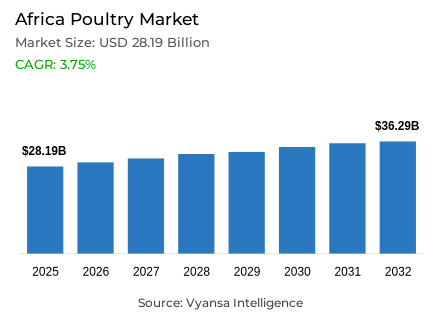
- Africa poultry market was valued at USD 28.19 Billion in 2025 and is set to grow from USD 29.09 Billion in 2026, to USD 36.29 Billion in 2032
- South Africa dominated the market with the market share of around 16%
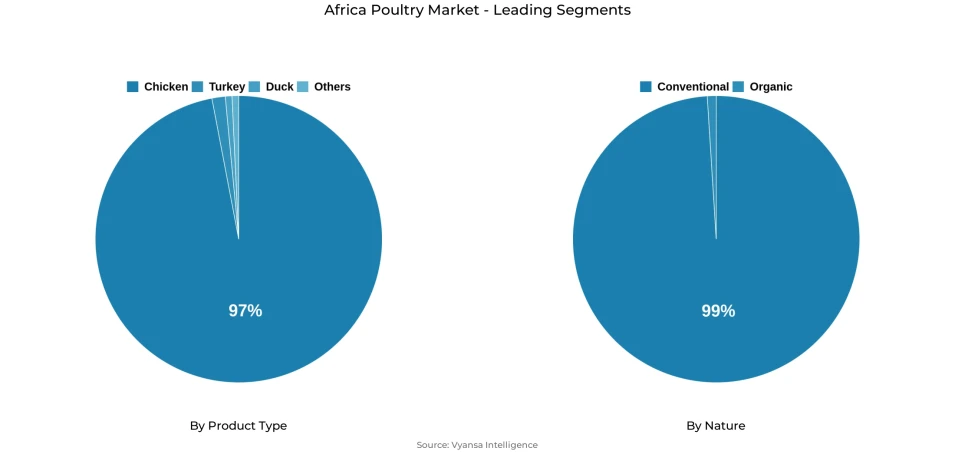
- Chicken dominated the market with 97% of the market share
- Conventional poultry had the market share of around 99%. The market share is set to witness a marginal decline to around 98.11% by 2032
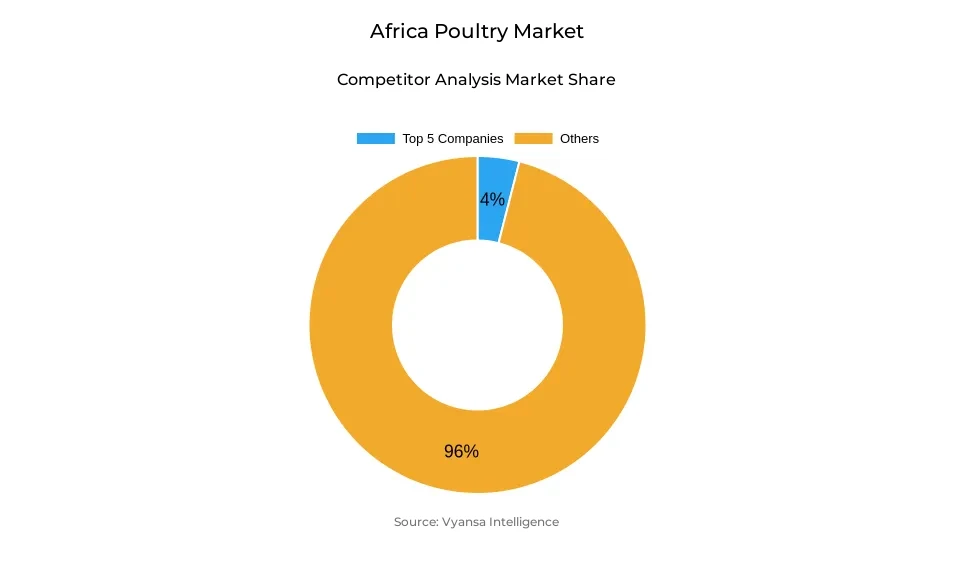
- Top five companies grabbed the market share of around 4% in the regional market
Africa's poultry meat production is set to grow from about 7 million tons to 8.7 million tons in 2025 and 2032, while egg production grows from 3.8 million to 4.1 million tons over the same period. Poultry meat consumption is expected to rise from 9.1 million to 12.6 million tons across the same span. Chickens already make up 97% of Africa's 2.4 billion poultry birds, and chicken meat alone accounts for 83% of all poultry meat eaten on the continent. In value terms, the continent's gross poultry production runs at roughly USD 20.4 Billion a year, split about 76% to meat and 24% to eggs.
Demand and supply are moving in different directions on cost. Africa's population is set to grow from 1.4 billion in 2021 to 2.5 billion by 2050, with urbanization rising from 43% to almost 60% over the same period. This is lifting demand for cheap animal protein, since poultry meat and eggs are already the most affordable source of protein for most African households. At the same time, feed remains the binding constraint on supply. In fully intensive systems, feed can account for 60% to 80% of total input cost, and most of that feed, particularly maize and soybean meal, is either imported or priced against import parity in local currency, which makes producer margins highly sensitive to currency swings.
South Africa and Egypt show two very different ways of managing this tension. Egypt has pushed past self sufficiency, raising about 1.4 billion broiler chickens on specialized farms in 2024, with output running close to 30% ahead of consumption needs, pushing farm gate prices down and covering egg demand outright with 15.5 billion eggs a year. South Africa has instead protected its industry through tariffs. A Most Favored Nation duty of 62% on bone in chicken, alongside anti-dumping duties as high as 265% on Brazilian poultry, has kept import volumes suppressed even as local production climbs toward 1.68 million tons in 2026. Morocco sits somewhere between the two, meeting most of its own demand through vertically integrated groups while building a separate export business in day old chicks and hatching eggs rather than bulk meat.
Disease control has become just as important as production cost in deciding who wins market share. South Africa's poultry industry lost close to 10 million birds to Highly Pathogenic Avian Influenza in 2023, and fresh outbreaks hit the Northwest, Mpumalanga and Western Cape provinces again in June and August 2025. A vaccination rollout for breeder and layer flocks was proposed in June 2025, but producers had not yet vaccinated as of the latest report because they found the rules too costly to implement, with only Astral Foods attempting to comply on a single 200,000 bird breeder flock. Markets that manage disease well, keep clean trade status with export partners and get vaccination programs running are increasingly the ones capturing new investment.
Competition
Market Concentration
The African poultry market is highly fragmented with innumerable small scale farmers operating in the market. The top five companies grabbed merely 4% of the market in 2026.
South Africa shows the clearest concentration on the continent. Two producers, Astral Foods and Rainbow Chicken, together account for roughly 50% of national broiler production, and the South African Poultry Association counted 973 poultry farms nationwide as of July 2023, of which 684 are large commercial operations. Just 48 farms house more than 500,000 birds each, and 17 farms hold more than 700,000 birds each. Morocco's poultry sector is led by Zalar Holding across its full value chain, alongside Koutoubia Holding. In Egypt, the market is anchored by large integrators such as Wadi Group and Cairo Poultry Company, beneath which sits a long tail of smaller, fragmented producers.
Market Structure
Morocco counted roughly 8,550 authorized poultry units in its last national count, split across 7,600 chicken farms and 950 turkey farms, with chicken broiling described as extremely fragmented even though turkey broiling is controlled mostly by Zalar and two other groups. South Africa's structure sits at the other end, with a small number of very large sites, 48 farms alone housing more than 500,000 birds each, driving most national output. Egypt sits between the two, with Wadi Group and Cairo Poultry Company holding scale advantages while a large number of smaller producers compete underneath them for local and regional demand.
Organized versus Unorganized
Across Sub Saharan Africa, roughly 80% of poultry is kept in extensive scavenging or lightly supplemented systems rather than fully intensive commercial operations. More than 70% of small scale chicken farming on the continent is owned and run by women. The organized tier is concentrated almost entirely in South Africa, Morocco and Egypt, where vertically integrated, brand led groups dominate. Multinational feed and genetics suppliers compete for share within that organized tier, while the bigger volume opportunity across the rest of the continent lies in formalizing and supplying the unorganized smallholder base.
Operating Model
Full vertical integration from feed milling through hatchery, farming and processing is now the standard model among leading African groups. Zalar Holding runs grain trading, animal feed, hatchery, broiler and meat processing operations, with subsidiaries in Senegal and Mauritania. South Africa's broiler industry consumes about four million tons of feed a year, and most of that is produced domestically by the same integrated companies that own the broiler flocks. South Africa's top five broiler producers supply most of the feed used across the whole value chain, giving them a clear cost advantage over independent growers who must buy feed at market rates. The country's Competition Commission has raised concerns about this structure, though the South African Poultry Association has dismissed the inquiry as baseless. Egypt's Wadi Group and Cairo Poultry Company run comparable integrated models, pairing feed and farm operations with strong wholesaler and wet market distribution.
Differentiation
Feed integration protects margins from currency driven input cost swings that hit unintegrated growers hardest, and this is the clearest advantage held by South Africa's largest producers. Trade protection and disease status matter just as much. South Africa's tariff wall, 62% on bone in chicken, 42% on boneless cuts, 82% on whole frozen birds, plus anti-dumping duties up to 265% on Brazil, keeps import competition contained, while Egypt's production surplus removes much of the need for that kind of protection at all. Genetics is another differentiator. South Africa's broiler industry switched almost entirely from the Cobb breed to the Indian River breed by 2023 because of its stronger feed conversion and meat yield, and the rights to distribute parent stock for each major breed sit with only three companies nationwide, keeping genetic supply tightly controlled even in an otherwise competitive market. Regional hub positioning rounds out the picture. Morocco has built an export business in day old chicks and hatching eggs sent across West Africa, turning breeding stock and feed capability into a cross border revenue stream rather than just a domestic supply advantage.
Unlock Market Intelligence
Explore the market potential with our data-driven report
Market Segmentation and Growth Outlook
Product Type, Chicken Makes Up 97% of Africa's Poultry Numbers
Chickens dominate Africa's poultry population, accounting for 2,352 million of the continent's 2,425 million poultry birds, with turkeys, geese and ducks making up the rest. Chicken meat alone made up 83% of poultry meat consumption. This dominance rests on the short broiler cycle of about 6 to 8 weeks to reach market weight, against 18 to 20 weeks for a layer to start producing, and on chicken's position as the cheapest widely available animal protein. Turkey meat production is heavily concentrated in Northern Africa, which accounts for 93% of the continent's turkey meat output, driven mainly by Morocco and Egypt. These smaller categories remain niche products serving specific regional food traditions rather than mass market staples.
Conventional Poultry Lead Formal Trade with 99% Market Share, Free Range Systems Hold Most of the Flock
Conventional, input fed commercial production accounts for 99% market share of Africa's formally traded poultry value, run by integrated groups such as Astral Foods, Zalar Holding, Wadi Group and Cairo Poultry Company. By bird count, though, the picture flips. Extensive scavenging systems, where birds forage with little or no feed supplementation, hold about 50% of Africa's poultry stock, and intensified systems with light supplementation hold another 30%. That means roughly 80% of Africa's flock already lives under conditions close to organic practice by default, since these birds are raised without commercial feed or drug regimes. Only the fully intensive system, holding about 20% of the flock, sits outside organic compatible practice. Formal organic certification remains almost non-existent on the continent even though the underlying practice is already widespread, because certified buyers and urban retail chains rarely reach the remote areas where most free range flocks are kept.
Meat Production Holds About 76% of Poultry Value, Egg Production Holds the Rest
Africa's gross poultry production value splits roughly 76% to meat and 24% to eggs. Meat production leads because broiler cycles are short and because quick service restaurant chains, led by KFC's more than 1,000 outlets across the continent, are formalizing demand through standard supply contracts, a trend visible across South Africa, Egypt and Morocco alike. Egg production remains the steadier purpose category, and Egypt is the clearest example on the continent, with 15.5 billion eggs a year meeting domestic demand outright. Breeding and hatchery work as a standalone purpose is concentrated among the same integrated groups already named, and increasingly earns revenue across borders on its own, shown clearly by Morocco's day old chick and hatching egg exports into West Africa. Dual purpose activity, where a single integrated group runs meat, egg and breeding operations together rather than specializing, is the model followed by Zalar Holding in Morocco and by Wadi Group and Cairo Poultry Company in Egypt, letting each capture value across the full chain rather than a single product line.
Backyard and Village Systems Hold 50% of the Flock, Intensive Farms Hold 20%
Africa's poultry stock splits roughly 50% backyard or village, 30% smallholder or semi commercial, and 20% independent and integrated commercial farms combined. Backyard and village poultry remains the largest tier by bird count even in the more industrialized focus markets, though it contributes a small share of formal market value. Smallholder semi commercial production is the tier most exposed to formalization pressure as governments and private integrators look to bring more supply into contracted, quality controlled channels. Independent commercial farms and integrated commercial groups sit at the top of the value chain despite holding a small share of total bird numbers, South Africa alone counting 684 large commercial farms among its 973 total poultry farms, Morocco's Zalar Holding running fully integrated operations across five business lines, and Egypt's Wadi Group and Cairo Poultry Company anchoring the country's formal commercial tier.
Unlock Market Intelligence
Explore the market potential with our data-driven report
South Africa Emerged as the Largest Regional Market Grabbing Around 16% Market Share
South Africa is estimated to produce 1.68 million tons of chicken meat in 2026, up 2% on the year, as the industry fully recovers from the 2023 HPAI outbreak and benefits from lower feed prices following a strong local grain harvest. Chicken meat consumption is forecast to reach 1.92 million tons in 2026 and already makes up 60% of total meat consumption in the country. Imports are forecast to fall 5% to 308,000 tons in 2026 as tariffs and anti-dumping duties limit competition, while exports are forecast to rise 5% to 65,000 tons, sent mostly to neighboring Southern African Customs Union countries. The poultry industry contributes 15% of South Africa's total agricultural production, with a gross value of 65.77 billion rand, roughly USD 3.6 Billion at current exchange rates, and the industry invested 2.1 billion rand between 2019 and 2023 to expand production facilities. Per capita chicken consumption has slipped from a peak near 41 kilograms a year to about 35 kilograms in 2024, as cost pressure pushes lower income consumers toward cheaper cuts such as offal and mechanically deboned meat.
Egypt has moved past self-sufficiency, with 98% of poultry meat demand and all egg demand met domestically. The country raised about 1.4 billion broiler chickens on specialized farms in 2024, and total production ran roughly 30% ahead of consumption needs, pushing prices down for consumers. The market is anchored by large integrators such as Wadi Group and Cairo Poultry Company, beneath which sits a long tail of smaller, fragmented producers. A reliable continent wide USD value figure specific to Egypt's poultry market is not available from primary production data, though the scale of output, close to 1.4 billion birds a year plus 15.5 billion eggs, places it among the largest poultry economies in Africa by volume.
Morocco produced about 653,000 tonnes of poultry in the most recent year reported, ranking third in Africa behind only Egypt and South Africa, with the three countries together supplying nearly 64% of all poultry meat produced on the continent. Moroccans eat about 20.9 kilograms of chicken a year. The sector supports roughly 500,000 jobs and generates about 45 billion dirhams in sales, roughly USD 4.6 Billion at current exchange rates, making up roughly a quarter of the country's farm economy. Rather than compete on bulk frozen meat, Morocco has built an export business in day old chicks and hatching eggs, with trade to Mali and Benin alone crossing USD 170 Million in 2026. Zalar Holding and Koutoubia Holding are the sector's dominant integrated groups.
Africa Poultry Market Drivers, Trends and Opportunities
Drivers
- South Africa's tariff and anti-dumping regime, including a 62% duty on bone in chicken and duties up to 265% on Brazilian imports, is protecting a domestic production run that is forecast to reach 1.68 million tons in 2026, even as the industry recovers from its worst HPAI outbreak on record.
- Egypt's production surplus, running close to 30% ahead of domestic consumption in 2024, is pushing farm gate prices down and strengthening the country's position as a low cost regional supplier.
- Quick service restaurant growth, led by KFC's more than 1,000 outlets across the continent, is standardizing broiler supply contracts and pulling demand out of unstructured wet markets and into formal, volume committed channels across all three focus markets.
- Morocco's export business in day old chicks and hatching eggs, with trade to Mali and Benin alone crossing USD 170 Million in 2026, shows how a producer with a strong genetics base can grow beyond its own borders without competing on bulk frozen meat.
- Urbanization and population growth across the continent, with Africa's population set to grow from 1.4 billion to 2.5 billion by 2050, keep underlying demand for affordable poultry protein rising in all three markets.
Trends
- Vertical integration from feed milling through processing remains the default model among South Africa's, Morocco's and Egypt's leading groups, protecting margins from the currency driven feed cost swings that remain the sector's biggest source of earnings volatility.
- Biosecurity investment is rising sharply after repeated HPAI shocks. South Africa's 2023 outbreak alone culled close to 10 million birds, and fresh outbreaks in mid 2025 pushed the government to propose a vaccination program for breeder and layer flocks, though producers had not yet begun vaccinating as of the latest report because of cost concerns.
- South Africa's own data shows a clear shift in what gets imported once tariffs bite, mechanically deboned meat rose from 37% of poultry imports in 2019 to 63% by 2024, as buyers moved toward the cheapest available cuts once bone in and whole bird imports became too expensive to compete with local supply.
- Genetics upgrades are reshaping production economics, South Africa's broiler industry moved almost entirely from the Cobb breed to the Indian River breed by 2023 for stronger feed conversion and meat yield.
Opportunities
- South Africa's Phase 2 Poultry Value Chain Masterplan is pushing toward cooked and heat treated poultry exports, with a United Kingdom market access audit already completed and further work underway toward Saudi Arabia and the European Union.
- Egypt's ongoing production surplus opens a clear opportunity to build export capacity and processing infrastructure aimed at nearby regional markets rather than relying solely on domestic absorption.
- Morocco's breeding stock and hatching egg export model into West Africa offers a repeatable regional hub approach that other advanced producers such as South Africa and Egypt could copy to earn higher margin trade rather than competing directly with Brazilian bulk meat.
- Certification and market access infrastructure for Africa's large free range flock, which already covers roughly 80% of the continent's birds by some estimates, remains almost entirely undeveloped, leaving open a clear opportunity in aggregation, certification and cold chain logistics to connect already organic style village production to premium urban retail.
Unmet Needs
Feed Security and Local Grain Supply
Feed can account for 60% to 80% of production cost in fully intensive systems, and South Africa's own broiler industry alone reports feed at 70% of total production expense. Because much of this feed relies on imported maize and soybean meal priced against hard currency, producer margins across South Africa, Egypt and Morocco all stay exposed to exchange rate swings and global grain price cycles. Local grain production and crushing capacity have not scaled fast enough to close this gap, leaving even the continent's most advanced producers structurally dependent on imported feed inputs.
Disease Control and Vaccination Capacity
South Africa's 2023 HPAI event culled close to 10 million birds, and fresh outbreaks hit the Northwest, Mpumalanga and Western Cape provinces again in mid 2025, showing that disease control capacity, not demand, is now the binding constraint on growth even in the continent's most developed poultry market. South Africa's own vaccination rollout for breeder and layer flocks has stalled because producers see the compliance rules as too costly, with only Astral Foods attempting to comply so far on a single flock. Closing this gap needs funding support and simpler rollout rules, not just a vaccination policy on paper.
Frequently Asked Questions
Related Report
- Market Segmentation
- Research Scope
- Research Methodology
- Definitions and Assumptions
- Executive Summary
- Africa Poultry Market Policies, Regulations, and Standards
- Africa Poultry Market Import & Export Analysis
- Africa Poultry Market Dynamics
- Growth Factors
- Challenges
- Trends
- Opportunities
- Africa Poultry Market Statistics, 2022-2032F
- Market Size & Growth Outlook
- By Revenues in USD Million
- By Quantity Sold in Thousand Tons
- Market Segmentation & Growth Outlook
- By Product Type
- Chicken- Market Insights and Forecast 2022-2032, USD Million
- Turkey- Market Insights and Forecast 2022-2032, USD Million
- Duck- Market Insights and Forecast 2022-2032, USD Million
- Others- Market Insights and Forecast 2022-2032, USD Million
- By Nature
- Conventional- Market Insights and Forecast 2022-2032, USD Million
- Organic- Market Insights and Forecast 2022-2032, USD Million
- By Production Type
- Broiler Production- Market Insights and Forecast 2022-2032, USD Million
- Layer Production- Market Insights and Forecast 2022-2032, USD Million
- Breeder Production- Market Insights and Forecast 2022-2032, USD Million
- By Purpose
- Meat Production- Market Insights and Forecast 2022-2032, USD Million
- Egg Production- Market Insights and Forecast 2022-2032, USD Million
- Breeding & Hatchery- Market Insights and Forecast 2022-2032, USD Million
- Dual Purpose (Meat and Eggs)- Market Insights and Forecast 2022-2032, USD Million
- By Production Scale
- Backyard/Village Poultry- Market Insights and Forecast 2022-2032, USD Million
- Smallholder Semi-Commercial- Market Insights and Forecast 2022-2032, USD Million
- Independent Commercial Farms- Market Insights and Forecast 2022-2032, USD Million
- Integrated Commercial Groups- Market Insights and Forecast 2022-2032, USD Million
- By Country
- South Africa
- Egypt
- Morocco
- Nigeria
- Algeria
- Kenya
- Ghana
- Ethiopia
- Côte d'Ivoire
- Rest of Africa
- By Competitors
- Competition Characteristics
- Market Share & Analysis
- By Product Type
- Market Size & Growth Outlook
- South Africa Poultry Market Statistics, 2022-2032F
- Market Size & Growth Outlook
- By Revenues in USD Million
- By Quantity Sold in Thousand Tons
- Market Segmentation & Growth Outlook
- By Product Type- Market Insights and Forecast 2022-2032, USD Million
- By Nature- Market Insights and Forecast 2022-2032, USD Million
- By Production Type- Market Insights and Forecast 2022-2032, USD Million
- By Purpose- Market Insights and Forecast 2022-2032, USD Million
- By Production Scale- Market Insights and Forecast 2022-2032, USD Million
- Market Size & Growth Outlook
- Egypt Poultry Market Statistics, 2022-2032F
- Market Size & Growth Outlook
- By Revenues in USD Million
- By Quantity Sold in Thousand Tons
- Market Segmentation & Growth Outlook
- By Product Type- Market Insights and Forecast 2022-2032, USD Million
- By Nature- Market Insights and Forecast 2022-2032, USD Million
- By Production Type- Market Insights and Forecast 2022-2032, USD Million
- By Purpose- Market Insights and Forecast 2022-2032, USD Million
- By Production Scale- Market Insights and Forecast 2022-2032, USD Million
- Market Size & Growth Outlook
- Morocco Poultry Market Statistics, 2022-2032F
- Market Size & Growth Outlook
- By Revenues in USD Million
- By Quantity Sold in Thousand Tons
- Market Segmentation & Growth Outlook
- By Product Type- Market Insights and Forecast 2022-2032, USD Million
- By Nature- Market Insights and Forecast 2022-2032, USD Million
- By Production Type- Market Insights and Forecast 2022-2032, USD Million
- By Purpose- Market Insights and Forecast 2022-2032, USD Million
- By Production Scale- Market Insights and Forecast 2022-2032, USD Million
- Market Size & Growth Outlook
- Nigeria Poultry Market Statistics, 2022-2032F
- Market Size & Growth Outlook
- By Revenues in USD Million
- By Quantity Sold in Thousand Tons
- Market Segmentation & Growth Outlook
- By Product Type- Market Insights and Forecast 2022-2032, USD Million
- By Nature- Market Insights and Forecast 2022-2032, USD Million
- By Production Type- Market Insights and Forecast 2022-2032, USD Million
- By Purpose- Market Insights and Forecast 2022-2032, USD Million
- By Production Scale- Market Insights and Forecast 2022-2032, USD Million
- Market Size & Growth Outlook
- Algeria Poultry Market Statistics, 2022-2032F
- Market Size & Growth Outlook
- By Revenues in USD Million
- By Quantity Sold in Thousand Tons
- Market Segmentation & Growth Outlook
- By Product Type- Market Insights and Forecast 2022-2032, USD Million
- By Nature- Market Insights and Forecast 2022-2032, USD Million
- By Production Type- Market Insights and Forecast 2022-2032, USD Million
- By Purpose- Market Insights and Forecast 2022-2032, USD Million
- By Production Scale- Market Insights and Forecast 2022-2032, USD Million
- Market Size & Growth Outlook
- Kenya Poultry Market Statistics, 2022-2032F
- Market Size & Growth Outlook
- By Revenues in USD Million
- By Quantity Sold in Thousand Tons
- Market Segmentation & Growth Outlook
- By Product Type- Market Insights and Forecast 2022-2032, USD Million
- By Nature- Market Insights and Forecast 2022-2032, USD Million
- By Production Type- Market Insights and Forecast 2022-2032, USD Million
- By Purpose- Market Insights and Forecast 2022-2032, USD Million
- By Production Scale- Market Insights and Forecast 2022-2032, USD Million
- Market Size & Growth Outlook
- Ghana Poultry Market Statistics, 2022-2032F
- Market Size & Growth Outlook
- By Revenues in USD Million
- By Quantity Sold in Thousand Tons
- Market Segmentation & Growth Outlook
- By Product Type- Market Insights and Forecast 2022-2032, USD Million
- By Nature- Market Insights and Forecast 2022-2032, USD Million
- By Production Type- Market Insights and Forecast 2022-2032, USD Million
- By Purpose- Market Insights and Forecast 2022-2032, USD Million
- By Production Scale- Market Insights and Forecast 2022-2032, USD Million
- Market Size & Growth Outlook
- Ethiopia Poultry Market Statistics, 2022-2032F
- Market Size & Growth Outlook
- By Revenues in USD Million
- By Quantity Sold in Thousand Tons
- Market Segmentation & Growth Outlook
- By Product Type- Market Insights and Forecast 2022-2032, USD Million
- By Nature- Market Insights and Forecast 2022-2032, USD Million
- By Production Type- Market Insights and Forecast 2022-2032, USD Million
- By Purpose- Market Insights and Forecast 2022-2032, USD Million
- By Production Scale- Market Insights and Forecast 2022-2032, USD Million
- Market Size & Growth Outlook
- Côte d'Ivoire Poultry Market Statistics, 2022-2032F
- Market Size & Growth Outlook
- By Revenues in USD Million
- By Quantity Sold in Thousand Tons
- Market Segmentation & Growth Outlook
- By Product Type- Market Insights and Forecast 2022-2032, USD Million
- By Nature- Market Insights and Forecast 2022-2032, USD Million
- By Production Type- Market Insights and Forecast 2022-2032, USD Million
- By Purpose- Market Insights and Forecast 2022-2032, USD Million
- By Production Scale- Market Insights and Forecast 2022-2032, USD Million
- Market Size & Growth Outlook
- Competitive Outlook
- Company Profiles
- Astral Foods
- Business Description
- Product Portfolio
- Collaborations & Alliances
- Recent Developments
- Financial Details
- Others
- Rainbow Chicken
- Business Description
- Product Portfolio
- Collaborations & Alliances
- Recent Developments
- Financial Details
- Others
- RCL Foods
- Business Description
- Product Portfolio
- Collaborations & Alliances
- Recent Developments
- Financial Details
- Others
- Cairo Poultry Company
- Business Description
- Product Portfolio
- Collaborations & Alliances
- Recent Developments
- Financial Details
- Others
- Wadi Group
- Business Description
- Product Portfolio
- Collaborations & Alliances
- Recent Developments
- Financial Details
- Others
- Zalar Holding
- Business Description
- Product Portfolio
- Collaborations & Alliances
- Recent Developments
- Financial Details
- Others
- Olam Agri
- Business Description
- Product Portfolio
- Collaborations & Alliances
- Recent Developments
- Financial Details
- Others
- Poulina Group Holding
- Business Description
- Product Portfolio
- Collaborations & Alliances
- Recent Developments
- Financial Details
- Others
- Irvine's Africa
- Business Description
- Product Portfolio
- Collaborations & Alliances
- Recent Developments
- Financial Details
- Others
- EthioChicken
- Business Description
- Product Portfolio
- Collaborations & Alliances
- Recent Developments
- Financial Details
- Others
- Country Bird Holdings
- Business Description
- Product Portfolio
- Collaborations & Alliances
- Recent Developments
- Financial Details
- Others
- Quantum Foods
- Business Description
- Product Portfolio
- Collaborations & Alliances
- Recent Developments
- Financial Details
- Others
- Ugachick Poultry Breeders
- Business Description
- Product Portfolio
- Collaborations & Alliances
- Recent Developments
- Financial Details
- Others
- Innodis Ltd
- Business Description
- Product Portfolio
- Collaborations & Alliances
- Recent Developments
- Financial Details
- Others
- Kenchic
- Business Description
- Product Portfolio
- Collaborations & Alliances
- Recent Developments
- Financial Details
- Others
- Daybreak Foods
- Business Description
- Product Portfolio
- Collaborations & Alliances
- Recent Developments
- Financial Details
- Others
- Astral Foods
- Company Profiles
- Disclaimer
| Segment | Sub-Segment |
|---|---|
| By Product Type |
|
| By Nature |
|
| By Production Type |
|
| By Purpose |
|
| By Production Scale |
|
| By Country |
|
Research Methodology
This study followed a structured approach comprising four key phases to assess the size and scope of the electro-oxidation market. The process began with thorough secondary research to collect data on the target market, related markets, and broader industry context. These findings, along with preliminary assumptions and estimates, were then validated through extensive primary research involving industry experts from across the value chain. To calculate the overall market size, both top-down and bottom-up methodologies were employed. Finally, market segmentation and data triangulation techniques were applied to refine and validate segment-level estimations.
Secondary Research
The secondary research phase involved gathering data from a wide range of credible and published sources. This step helped in identifying industry trends, defining market segmentation, and understanding the market landscape and value chain.
Sources consulted during this phase included:
- Company annual reports, investor presentations, and press releases
- Industry white papers and certified publications
- Trade directories and market-recognized databases
- Articles from authoritative authors and reputable journals
- Gold and silver standard websites
Secondary research was critical in mapping out the industry's value chain and monetary flow, identifying key market segments, understanding regional variations, and tracking significant industry developments.
Other key sources:
- Financial disclosures
- Industry associations and trade bodies
- News outlets and business magazines
- Academic journals and research studies
- Paid industry databases
Primary Research
To validate secondary data and gain deeper market insights, primary research was conducted with key stakeholders across both the supply and demand sides of the market.
On the demand side, participants included decision-makers and influencers from end-user industries—such as CIOs, CTOs, and CSOs—who provided first-hand perspectives on market needs, product usage, and future expectations.
On the supply side, interviews were conducted with manufacturers, industry associations, and institutional participants to gather insights into current offerings, product pipelines, and market challenges.
Primary interviews provided critical inputs such as:
- Market size and revenue data
- Product and service breakdowns
- Market forecasts
- Regional and application-specific trends
Stakeholders consulted included:
- Leading OEM and solution providers
- Channel and distribution partners
- End users across various applications
- Independent consultants and industry specialists
Market Size Estimation and Data Triangulation
- Identifying Key Market Participants (Secondary Research)
- Goal: To identify the major players or companies in the target market. This typically involves using publicly available data sources such as industry reports, market research publications, and financial statements of companies.
- Tools: Reports from firms like Gartner, Forrester, Euromonitor, Statista, IBISWorld, and others. Public financial statements, news articles, and press releases from top market players.
- Extracting Earnings of Key Market Participants
- Goal: To estimate the earnings generated from the product or service being analyzed. This step helps in understanding the revenue potential of each market player in a specific geography.
- Methods: Earnings data can be gathered from:
- Publicly available financial reports (for listed companies).
- Interviews and primary data sources from professionals, such as Directors, VPs, SVPs, etc. This is especially useful for understanding more nuanced, internal data that isn't publicly disclosed.
- Annual reports and investor presentations of key players.
- Data Collation and Development of a Relevant Data Model
- Goal: To collate inputs from both primary and secondary sources into a structured, data-driven model for market estimation. This model will incorporate key market KPIs and any independent variables relevant to the market.
- Key KPIs: These could include:
- Market size, growth rate, and demand drivers.
- Industry-specific metrics like market share, average revenue per customer (ARPC), or average deal size.
- External variables, such as economic growth rates, inflation rates, or commodity prices, that could affect the market.
- Data Modeling: Based on this data, the market forecasts are developed for the next 5 years. A combination of trend analysis, scenario modeling, and statistical regression might be used to generate projections.
- Scenario Analysis
- Goal: To test different assumptions and validate how sensitive the market is to changes in key variables (e.g., market demand, regulatory changes, technological disruptions).
- Types of Scenarios:
- Base Case: Based on current assumptions and historical data.
- Best-Case Scenario: Assuming favorable market conditions, regulatory environments, and technological advancements.
- Worst-Case Scenario: Accounting for adverse factors, such as economic downturns, stricter regulations, or unexpected disruptions.












