Vietnam Video Surveillance Storage Market Report: Trends, Growth and Forecast (2026-2032)
By Storage Architecture (Edge Storage, Recorder-Based Storage, DVR-Based Storage, NVR-Based Storage, Centralized On-Premises Storage, Cloud Storage, Hybrid Storage), By End-User Vertical (Commercial Buildings, Retail and Hospitality, Industrial and Warehousing, Transport and Logistics, Government Sector, Critical Infrastructure and Utilities, Healthcare, Education, Residential and Multi-Dwelling), By Retention and Search Complexity (Basic Operational Recording, Standard Investigation-Centric Storage, Analytics-Assisted Searchable Storage, Evidence-Grade and Compliance-Sensitive Archival), By Sales Channel (Direct Sales, System Integrators, Value-Added Resellers, Distributors, Online Sales/E-Procurement, Managed Service Providers/Cloud Partners) ... Read more
|
Major Players
|
Vietnam Video Surveillance Storage Market Statistics and Insights, 2026
- Market Size Statistics
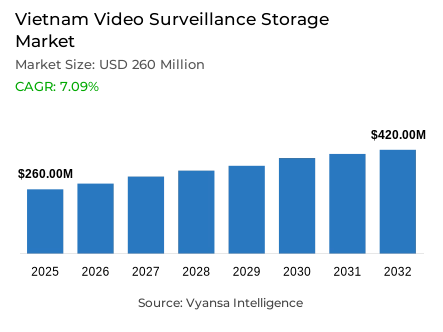
- Video surveillance storage market size in Vietnam was valued at USD 260 million in 2025 and is estimated at USD 290 million in 2026.
- The market size is expected to grow to USD 420 million by 2032.
- Market to register a CAGR of around 7.09% during 2026-32.
- Storage Architecture Shares
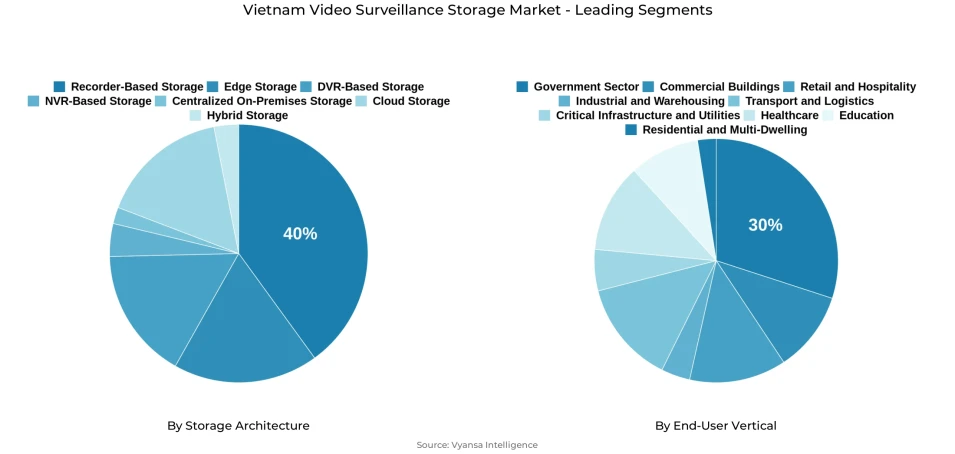
- Recorder-based storage grabbed market share of 40%.
- Competition
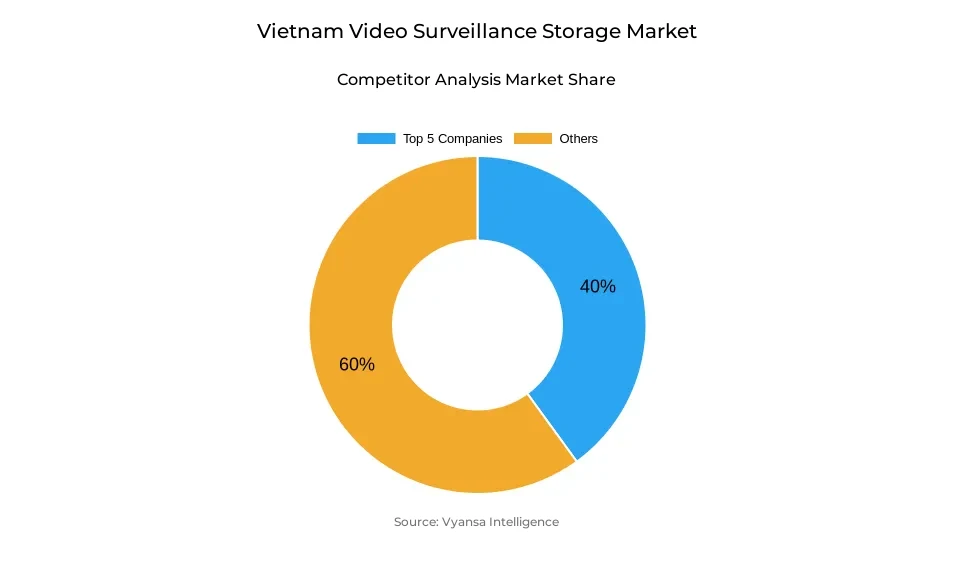
- More than 10 companies are actively engaged in producing video surveillance storage in Vietnam.
- Top 5 companies acquired around 40% of the market share.
- Bosch Security Systems, Honeywell, Uniview, Hikvision, Dahua Technology etc., are few of the top companies.
- End-User Vertical
- Government sector grabbed 30% of the market.
Vietnam Video Surveillance Storage Market Outlook
The Vietnam Video Surveillance Storage Market was valued at USD 260 million in 2025, establishing a commercially purposeful and operationally well-anchored foundation within Southeast Asia's most rapidly modernizing public security infrastructure ecosystem. Projected to advance from USD 290 million in 2026 to USD 420 million by 2032, the sector registers a CAGR of 7.09% across the forecast horizon. This steady and structurally supported expansion trajectory reflects the systematic deepening of institutional reliance on recorded video footage for civic monitoring, public administration support, transportation oversight, and operational evidence documentation across Vietnam's expanding urban centers and government service networks. Growth is anchored in genuine operational necessity rather than technology adoption cycles, giving this market a commercial resilience that sustains consistent storage capacity investment across diverse institutional and commercial deployment environments.
The storage architecture defining this market's commercial structure is anchored in recorder-based configurations. Recorder-Based Storage commands approximately 40% of total storage architecture market share, reflecting the consistent and deeply embedded institutional preference for structured, locally managed footage capture and retention systems whose operational familiarity, practical retrieval workflows, and direct control characteristics align naturally with the surveillance management requirements of Vietnam's most commercially significant user segments. This architecture concentration confirms that Vietnamese surveillance system operators continue to prioritize proven, operationally predictable storage configurations whose management simplicity and reliability credentials sustain disproportionate procurement share across both new installation and system upgrade demand cycles within the country's evolving monitoring infrastructure landscape.
The end-user architecture reinforces the structural centrality of the government sector as the category's dominant demand source. The Government Sector accounts for approximately 30% of total end-user vertical market share, reflecting the foundational role of public surveillance infrastructure in civic administration, transportation security, public facility protection, and institutional monitoring programs across national and municipal government deployments throughout Vietnam. This government concentration signals that state-led demand remains the primary commercial driver of video surveillance storage procurement across the nation, where consistent recording availability, controlled access management, and reliable footage retention are non-negotiable operational requirements linked directly to public service delivery performance.
The future outlook is defined by four converging structural forces whose combined commercial impact creates a video surveillance storage market of sustained and well-grounded expansion momentum. Vietnam's internet penetration reaching 84% of the population in 2024, documented by the World Bank, establishes a digital connectivity foundation that sustains institutional demand for surveillance infrastructure whose storage requirements scale directly with the breadth and intensity of connected monitoring deployments across urban and administrative environments. The Ministry of Science and Technology's documentation of more than 22,400 5G base stations deployed nationwide in 2025 confirms the network infrastructure advancement that is enabling higher-bandwidth surveillance applications and increasingly data-intensive monitoring workflows whose storage capacity requirements are expanding accordingly. The opening of National Data Center No. 1 in Ha Noi in August 2025, spanning more than 20 hectares and introducing 21 digital platforms integrated within a national digital ecosystem, signals Vietnam's institutional commitment to centralized data infrastructure that is progressively reshaping storage system architecture preferences toward unified, scalable deployment models. The International Trade Administration's documentation of 41 active data centers with 221 megawatts total power capacity, combined with Viettel's May 2025 commencement of a 140-megawatt hyperscale data center in Ho Chi Minh City, confirms the expanding backend infrastructure base that is creating improved conditions for larger-scale surveillance storage deployment across both public and private institutional segments over the forecast period.
Vietnam Video Surveillance Storage Market Growth Driver
Digital Infrastructure Expansion Sustains Core Surveillance Storage Demand
The rapid and institutionally documented expansion of Vietnam's digital connectivity and network infrastructure represents the primary structural driver of video surveillance storage demand, functioning as a persistent capacity expansion imperative that sustains consistent surveillance system deployment, data generation volume growth, and storage capacity investment across both government and private sector institutional environments throughout the country. This digital infrastructure-driven demand dynamic transcends cyclical technology spending fluctuations, reflecting a durable operational necessity whose procurement volume generation is structurally anchored in the expanding role of connected monitoring systems across urban administration, transportation management, public safety, and institutional service delivery programs whose operational performance increasingly depends on reliable video surveillance infrastructure and data retention capability.
The quantitative evidence validating this infrastructure-driven demand dynamic is documented with precision by the World Bank and the Ministry of Science and Technology. Vietnam's internet penetration reached 84% of the population in 2024, confirming that digital connectivity has become central to institutional operations and public engagement across the country's most commercially significant administrative and commercial centers. The Ministry of Science and Technology's documentation of more than 22,400 5G base stations deployed nationwide in 2025 confirms the rapid network infrastructure advancement that is enabling increasingly sophisticated surveillance applications and higher-data-volume monitoring deployments whose storage capacity requirements scale directly with application breadth and sensor network density. These connectivity metrics validate a digital infrastructure expansion dynamic of sufficient scale and momentum to sustain structural video surveillance storage market growth over the forecast period.
Vietnam Video Surveillance Storage Market Challenge
Cybersecurity Threats Elevate Storage System Resilience Requirements
The rapidly escalating cybersecurity threat environment surrounding Vietnam's connected surveillance infrastructure and institutional data systems represents the most consequential structural challenge confronting the video surveillance storage market, creating systematic security architecture, resilience planning, and incident recovery investment burdens that elevate operational complexity and raise the technical requirements threshold for storage system procurement across the market's most institutionally significant buyer segments. In a surveillance storage operating environment where footage integrity, system availability, and access control performance are directly linked to the operational value of entire monitoring programs, the consequences of cyberattack, data breach, or system compromise events are materially more severe than in general-purpose data storage contexts, making cybersecurity resilience a procurement prerequisite rather than an optional capability enhancement.
The structural depth and escalating frequency of this cybersecurity challenge are quantified with precision by government records and institutional reports. Vietnam's information systems faced approximately 552,000 cyberattacks in 2025, confirming the frequency and national scale of the threat activity that storage system operators must defend against through robust access controls and continuous monitoring investment. The documentation that 52.30% of agencies and businesses reported damage from cyberattacks in 2025, up from 46.15% in 2024, confirms that cybersecurity impact is not only widespread but also accelerating at an alarming rate that is progressively elevating institutional risk awareness and storage security investment priorities across all major buyer segments. For storage system providers, navigating this cybersecurity challenge demands proactive investment in hardened architecture design, encrypted retention management, and rapid recovery capability that satisfies the resilience expectations of Vietnam's most security-conscious institutional buyers over the forecast period.
Unlock Market Intelligence
Explore the market potential with our data-driven report
Vietnam Video Surveillance Storage Market Trend
Centralized Data Ecosystem Development Reshapes Storage Architecture Preferences
The systematic development of centralized national data infrastructure, including National Data Center No. 1 and integrated digital platforms, represents the defining structural trend reshaping video surveillance storage architecture preferences, deployment model expectations, and competitive access requirements across Vietnam's government and institutional buyer segments. This centralized data ecosystem trend is progressively standardizing the digital environment within which government surveillance systems operate, creating organizational familiarity with unified data platform approaches that is translating into growing institutional openness toward centrally managed and cloud-compatible surveillance storage architectures as alternatives to purely distributed, locally managed recorder-based configurations. For storage system providers, this trend creates both a competitive access imperative and a significant product development opportunity whose commercial implications are directly tied to the pace and comprehensiveness of centralized data ecosystem adoption across Vietnam's government and institutional operational base.
The institutional scope and implementation momentum of this centralized data ecosystem trend are documented with authority by the Government of Vietnam News and official announcements. National Data Center No. 1 opened in Ha Noi in August 2025 and spans more than 20 hectares, establishing a physical infrastructure foundation for centralized data management at a scale that signals sustained commitment to unified digital architecture development. The documentation that 21 digital platforms and core utilities were introduced at the facility launch confirms that the centralized data infrastructure development extends beyond physical facility provision into comprehensive digital ecosystem standardization and integration. As centralized data platform adoption advances across government operations and municipal service delivery networks, storage architecture preferences within the government surveillance buyer segment are expected to progressively shift toward unified and cloud-compatible configurations that align with the national digital infrastructure standardization direction over the forecast period.
Vietnam Video Surveillance Storage Market Opportunity
Hyperscale Data Center Expansion Creates Advanced Storage Deployment Pathways
The accelerating expansion of large-scale data center infrastructure investment across Vietnam's major metropolitan centers creates a structurally significant and commercially compelling opportunity for video surveillance storage providers whose systems combine the scalability, resilience, and integration capability required to support increasingly sophisticated centralized monitoring programs across Ho Chi Minh City, Ha Noi, and emerging secondary urban markets. This data center expansion opportunity is distinguished from conventional surveillance storage demand by its backend infrastructure improvement, its alignment with national digital ecosystem development priorities, and its direct support for the transition from distributed to centralized surveillance storage architectures whose commercial activation depends on adequate physical and digital backbone infrastructure. For vendors whose products and services are architected for integration with hyperscale data center environments and centralized digital platforms, this infrastructure opportunity represents a compelling and progressively more accessible expansion pathway into Vietnam's most commercially significant institutional surveillance storage market segments.
The quantitative scale and investment momentum of this data center expansion opportunity are documented with precision by the International Trade Administration and official development announcements. Vietnam currently operates 41 active data centers with a combined power capacity of 221 megawatts, confirming that the existing data infrastructure base is substantial and actively supporting enterprise and institutional digital operations across the nation. Viettel's commencement of construction on a 140-megawatt hyperscale data center in Ho Chi Minh City in May 2025, combined with the active participation of 12 major data center investors across the market, confirms that backend infrastructure investment momentum is accelerating at a pace that is progressively expanding the physical capacity available for centralized surveillance storage deployment. Storage providers that align their product architecture, deployment capability, and service models with the expanding hyperscale data center infrastructure ecosystem will capture disproportionate value from Vietnam's most structurally supported and policy-aligned surveillance storage growth opportunity over the forecast period.
Unlock Market Intelligence
Explore the market potential with our data-driven report
Vietnam Video Surveillance Storage Market Segmentation Analysis
By Storage Architecture
- Edge Storage
- Recorder-Based Storage
- DVR-Based Storage
- NVR-Based Storage
- Centralized On-Premises Storage
- Cloud Storage
- Hybrid Storage
The segment with highest market share under the Storage Architecture is Recorder-Based Storage, accounting for approximately 40% of the total market. This commanding position reflects the deep structural alignment between recorder-based system characteristics and the specific footage management requirements of Vietnam's most institutionally significant surveillance operator segments, where operational familiarity, direct recording capability, structured retention management, and practical footage retrieval workflows make recorder-based configurations the reference storage architecture across government facilities, municipal operations, transportation networks, and institutional deployments nationwide. With two-fifths of total market value concentrated within a single architecture category, Recorder-Based Storage defines the commercial priorities, system integration frameworks, and procurement evaluation standards of the Vietnam video surveillance storage market.
The structural leadership of Recorder-Based Storage is sustained by the operational workflow integration and institutional familiarity that have established this architecture as the default storage specification across Vietnam's most volume-significant surveillance operator segments. As Vietnam's digital infrastructure modernization advances and centralized data platforms reshape institutional thinking around unified storage architectures, recorder-based storage systems are progressively evolving to support cloud-compatible retention management and more flexible data access models that align with the country's emerging digital ecosystem direction. This architectural evolution positions established recorder-based platform providers to capture both near-term replacement demand and longer-term infrastructure modernization procurement activity across Vietnam's government and enterprise surveillance buyer base. The segment's structural market leadership is expected to remain intact over the forecast period.
By End-User Vertical
- Commercial Buildings
- Retail and Hospitality
- Industrial and Warehousing
- Transport and Logistics
- Government Sector
- Critical Infrastructure and Utilities
- Healthcare
- Education
- Residential and Multi-Dwelling
The segment with highest market share under the End-User Vertical is the Government Sector, accounting for approximately 30% of the total market. This dominant position reflects the foundational role of public surveillance infrastructure in civic administration, law enforcement support, public facility security, and transportation oversight across national and municipal government deployments throughout Vietnam, where reliable footage retention, controlled access management, and consistent recording system availability are non-negotiable operational requirements that generate disproportionate storage capacity investment relative to private sector buyer segments of comparable organizational scale. With nearly one-third of total market value anchored in government sector demand, this end-user vertical defines the compliance frameworks, retention policy standards, and system reliability expectations of the Vietnam video surveillance storage market.
The structural leadership of the Government Sector is being actively sustained by the accelerating institutional investment in public administration digitalization and urban monitoring infrastructure expansion across Vietnam's major administrative centers and emerging smart city development programs. Vietnam's government sector demand continues to expand as public safety monitoring, civic administration support, and urban management requirements scale in proportion to the country's rapid urbanization and institutional service expansion momentum. The government sector's position as the market's dominant commercial demand anchor reflects both the operational scale of public institutions and their consistent and non-discretionary requirements for surveillance storage infrastructure whose deployment timelines and procurement volumes generate the highest-value contract opportunities within the national market. The Government Sector's structural authority as the primary market demand driver is expected to deepen over the forecast period.
List of Companies Covered in Vietnam Video Surveillance Storage Market
The companies listed below are highly influential in the Vietnam video surveillance storage market, with a significant market share and a strong impact on industry developments.
- Bosch Security Systems
- Honeywell
- Uniview
- Hikvision
- Dahua Technology
- Panasonic/i-PRO
- Hanwha Vision
- Axis Communications
- Avigilon
- Pelco
Market News & Updates
- Honeywell, 2026:
Honeywell announced a collaboration with Rhombus to expand its portfolio with AI-driven, cloud-connected video and access solutions, saying the move addresses rising demand for integrated cloud security across multiple facilities. For the Vietnam video surveillance storage market, this is one of the strongest verified updates among the listed vendors because it directly supports the shift toward cloud and hybrid video architectures, where centralized management, remote access, and scalable storage are becoming more important for multi-site enterprise and commercial users
- Hikvision, 2025:
Hikvision’s Vietnam site announced the company’s participation in Intersec 2025 to showcase its broader AIoT ecosystem and end-to-end industry solutions; on its Vietnam storage-technology pages, Hikvision also highlights H.265+ as a way to reduce transmission bandwidth and storage consumption, along with edge-storage workflows that can move duplicated recordings to centralized network or cloud storage through scheduled backup. For the Vietnam video surveillance storage market, this is a significant official development because it signals a continued shift toward more storage-efficient, bandwidth-aware, and hybrid-ready surveillance deployments rather than simple standalone recording.
Frequently Asked Questions
Related Report
- Market Segmentation
- Research Scope
- Research Methodology
- Definitions and Assumptions
- Executive Summary
- Vietnam Video Surveillance Storage Market Policies, Regulations, and Standards
- Vietnam Video Surveillance Storage Market Dynamics
- Growth Factors
- Challenges
- Trends
- Opportunities
- Vietnam Video Surveillance Storage Market Statistics, 2022-2032F
- Market Size & Growth Outlook
- By Revenues in USD Million
- Market Segmentation & Growth Outlook
- By Storage Architecture
- Edge Storage- Market Insights and Forecast 2022-2032, USD Million
- Recorder-Based Storage- Market Insights and Forecast 2022-2032, USD Million
- DVR-Based Storage- Market Insights and Forecast 2022-2032, USD Million
- NVR-Based Storage- Market Insights and Forecast 2022-2032, USD Million
- Centralized On-Premises Storage- Market Insights and Forecast 2022-2032, USD Million
- Cloud Storage- Market Insights and Forecast 2022-2032, USD Million
- Hybrid Storage- Market Insights and Forecast 2022-2032, USD Million
- By End-User Vertical
- Commercial Buildings- Market Insights and Forecast 2022-2032, USD Million
- Retail and Hospitality- Market Insights and Forecast 2022-2032, USD Million
- Industrial and Warehousing- Market Insights and Forecast 2022-2032, USD Million
- Transport and Logistics- Market Insights and Forecast 2022-2032, USD Million
- Government Sector- Market Insights and Forecast 2022-2032, USD Million
- Critical Infrastructure and Utilities- Market Insights and Forecast 2022-2032, USD Million
- Healthcare- Market Insights and Forecast 2022-2032, USD Million
- Education- Market Insights and Forecast 2022-2032, USD Million
- Residential and Multi-Dwelling- Market Insights and Forecast 2022-2032, USD Million
- By Retention and Search Complexity
- Basic Operational Recording- Market Insights and Forecast 2022-2032, USD Million
- Standard Investigation-Centric Storage- Market Insights and Forecast 2022-2032, USD Million
- Analytics-Assisted Searchable Storage- Market Insights and Forecast 2022-2032, USD Million
- Evidence-Grade and Compliance-Sensitive Archival- Market Insights and Forecast 2022-2032, USD Million
- By Sales Channel
- Direct Sales- Market Insights and Forecast 2022-2032, USD Million
- System Integrators- Market Insights and Forecast 2022-2032, USD Million
- Value-Added Resellers- Market Insights and Forecast 2022-2032, USD Million
- Distributors- Market Insights and Forecast 2022-2032, USD Million
- Online Sales/E-Procurement- Market Insights and Forecast 2022-2032, USD Million
- Managed Service Providers/Cloud Partners- Market Insights and Forecast 2022-2032, USD Million
- By Competitors
- Competition Characteristics
- Market Share & Analysis
- By Storage Architecture
- Market Size & Growth Outlook
- Vietnam Edge Storage Market Statistics, 2022-2032
- Market Size & Growth Outlook
- By Revenues in USD Million
- Market Segmentation & Growth Outlook
- By End-User Vertical- Market Insights and Forecast 2022-2032, USD Million
- By Retention and Search Complexity- Market Insights and Forecast 2022-2032, USD Million
- By Sales Channel- Market Insights and Forecast 2022-2032, USD Million
- Market Size & Growth Outlook
- Vietnam Recorder-Based Storage Market Statistics, 2022-2032
- Market Size & Growth Outlook
- By Revenues in USD Million
- Market Segmentation & Growth Outlook
- By End-User Vertical- Market Insights and Forecast 2022-2032, USD Million
- By Retention and Search Complexity- Market Insights and Forecast 2022-2032, USD Million
- By Sales Channel- Market Insights and Forecast 2022-2032, USD Million
- Market Size & Growth Outlook
- Vietnam DVR-Based Storage Market Statistics, 2022-2032
- Market Size & Growth Outlook
- By Revenues in USD Million
- Market Segmentation & Growth Outlook
- By End-User Vertical- Market Insights and Forecast 2022-2032, USD Million
- By Retention and Search Complexity- Market Insights and Forecast 2022-2032, USD Million
- By Sales Channel- Market Insights and Forecast 2022-2032, USD Million
- Market Size & Growth Outlook
- Vietnam NVR-Based Storage Market Statistics, 2022-2032
- Market Size & Growth Outlook
- By Revenues in USD Million
- Market Segmentation & Growth Outlook
- By End-User Vertical- Market Insights and Forecast 2022-2032, USD Million
- By Retention and Search Complexity- Market Insights and Forecast 2022-2032, USD Million
- By Sales Channel- Market Insights and Forecast 2022-2032, USD Million
- Market Size & Growth Outlook
- Vietnam Centralized On-Premises Storage Market Statistics, 2022-2032
- Market Size & Growth Outlook
- By Revenues in USD Million
- Market Segmentation & Growth Outlook
- By End-User Vertical- Market Insights and Forecast 2022-2032, USD Million
- By Retention and Search Complexity- Market Insights and Forecast 2022-2032, USD Million
- By Sales Channel- Market Insights and Forecast 2022-2032, USD Million
- Market Size & Growth Outlook
- Vietnam Cloud Storage Market Statistics, 2022-2032
- Market Size & Growth Outlook
- By Revenues in USD Million
- Market Segmentation & Growth Outlook
- By End-User Vertical- Market Insights and Forecast 2022-2032, USD Million
- By Retention and Search Complexity- Market Insights and Forecast 2022-2032, USD Million
- By Sales Channel- Market Insights and Forecast 2022-2032, USD Million
- Market Size & Growth Outlook
- Vietnam Hybrid Storage Market Statistics, 2022-2032
- Market Size & Growth Outlook
- By Revenues in USD Million
- Market Segmentation & Growth Outlook
- By End-User Vertical- Market Insights and Forecast 2022-2032, USD Million
- By Retention and Search Complexity- Market Insights and Forecast 2022-2032, USD Million
- By Sales Channel- Market Insights and Forecast 2022-2032, USD Million
- Market Size & Growth Outlook
- Competitive Outlook
- Company Profiles
- Hikvision
- Business Description
- Product Portfolio
- Collaborations & Alliances
- Recent Developments
- Financial Details
- Others
- Dahua Technology
- Business Description
- Product Portfolio
- Collaborations & Alliances
- Recent Developments
- Financial Details
- Others
- Panasonic/i-PRO
- Business Description
- Product Portfolio
- Collaborations & Alliances
- Recent Developments
- Financial Details
- Others
- Hanwha Vision
- Business Description
- Product Portfolio
- Collaborations & Alliances
- Recent Developments
- Financial Details
- Others
- Axis Communications
- Business Description
- Product Portfolio
- Collaborations & Alliances
- Recent Developments
- Financial Details
- Others
- Bosch Security Systems
- Business Description
- Product Portfolio
- Collaborations & Alliances
- Recent Developments
- Financial Details
- Others
- Honeywell
- Business Description
- Product Portfolio
- Collaborations & Alliances
- Recent Developments
- Financial Details
- Others
- Uniview
- Business Description
- Product Portfolio
- Collaborations & Alliances
- Recent Developments
- Financial Details
- Others
- Avigilon
- Business Description
- Product Portfolio
- Collaborations & Alliances
- Recent Developments
- Financial Details
- Others
- Pelco
- Business Description
- Product Portfolio
- Collaborations & Alliances
- Recent Developments
- Financial Details
- Others
- Hikvision
- Company Profiles
- Disclaimer
| Segment | Sub-Segment |
|---|---|
| By Storage Architecture |
|
| By End-User Vertical |
|
| By Retention and Search Complexity |
|
| By Sales Channel |
|
Research Methodology
This study followed a structured approach comprising four key phases to assess the size and scope of the electro-oxidation market. The process began with thorough secondary research to collect data on the target market, related markets, and broader industry context. These findings, along with preliminary assumptions and estimates, were then validated through extensive primary research involving industry experts from across the value chain. To calculate the overall market size, both top-down and bottom-up methodologies were employed. Finally, market segmentation and data triangulation techniques were applied to refine and validate segment-level estimations.
Secondary Research
The secondary research phase involved gathering data from a wide range of credible and published sources. This step helped in identifying industry trends, defining market segmentation, and understanding the market landscape and value chain.
Sources consulted during this phase included:
- Company annual reports, investor presentations, and press releases
- Industry white papers and certified publications
- Trade directories and market-recognized databases
- Articles from authoritative authors and reputable journals
- Gold and silver standard websites
Secondary research was critical in mapping out the industry's value chain and monetary flow, identifying key market segments, understanding regional variations, and tracking significant industry developments.
Other key sources:
- Financial disclosures
- Industry associations and trade bodies
- News outlets and business magazines
- Academic journals and research studies
- Paid industry databases
Primary Research
To validate secondary data and gain deeper market insights, primary research was conducted with key stakeholders across both the supply and demand sides of the market.
On the demand side, participants included decision-makers and influencers from end-user industries—such as CIOs, CTOs, and CSOs—who provided first-hand perspectives on market needs, product usage, and future expectations.
On the supply side, interviews were conducted with manufacturers, industry associations, and institutional participants to gather insights into current offerings, product pipelines, and market challenges.
Primary interviews provided critical inputs such as:
- Market size and revenue data
- Product and service breakdowns
- Market forecasts
- Regional and application-specific trends
Stakeholders consulted included:
- Leading OEM and solution providers
- Channel and distribution partners
- End users across various applications
- Independent consultants and industry specialists
Market Size Estimation and Data Triangulation
- Identifying Key Market Participants (Secondary Research)
- Goal: To identify the major players or companies in the target market. This typically involves using publicly available data sources such as industry reports, market research publications, and financial statements of companies.
- Tools: Reports from firms like Gartner, Forrester, Euromonitor, Statista, IBISWorld, and others. Public financial statements, news articles, and press releases from top market players.
- Extracting Earnings of Key Market Participants
- Goal: To estimate the earnings generated from the product or service being analyzed. This step helps in understanding the revenue potential of each market player in a specific geography.
- Methods: Earnings data can be gathered from:
- Publicly available financial reports (for listed companies).
- Interviews and primary data sources from professionals, such as Directors, VPs, SVPs, etc. This is especially useful for understanding more nuanced, internal data that isn't publicly disclosed.
- Annual reports and investor presentations of key players.
- Data Collation and Development of a Relevant Data Model
- Goal: To collate inputs from both primary and secondary sources into a structured, data-driven model for market estimation. This model will incorporate key market KPIs and any independent variables relevant to the market.
- Key KPIs: These could include:
- Market size, growth rate, and demand drivers.
- Industry-specific metrics like market share, average revenue per customer (ARPC), or average deal size.
- External variables, such as economic growth rates, inflation rates, or commodity prices, that could affect the market.
- Data Modeling: Based on this data, the market forecasts are developed for the next 5 years. A combination of trend analysis, scenario modeling, and statistical regression might be used to generate projections.
- Scenario Analysis
- Goal: To test different assumptions and validate how sensitive the market is to changes in key variables (e.g., market demand, regulatory changes, technological disruptions).
- Types of Scenarios:
- Base Case: Based on current assumptions and historical data.
- Best-Case Scenario: Assuming favorable market conditions, regulatory environments, and technological advancements.
- Worst-Case Scenario: Accounting for adverse factors, such as economic downturns, stricter regulations, or unexpected disruptions.












