US Herbal Supplements Market Report: Trends, Growth and Forecast (2026-2032)
By Therapeutic Area (Immunity Support, Digestive & Gut Health, Stress Sleep & Mood Support, Energy & Fatigue Management, Cognitive/Memory Support, Heart & Circulatory Health, Metabolic Health (Weight Blood Sugar Cholesterol Support), Joint Bone & Mobility Health, Women’s Health (PMS Fertility Support Menopause), Men’s Health (Vitality Prostate Support), Respiratory Health, Liver & Detox Support, Skin Hair & Beauty-from-Within, General Wellness/Preventive Health), By Consumer Group (Preventive Wellness Consumers, Lifestyle-Risk Adults, Healthy Aging/50+ Population, Women by Life Stage, Men’s Preventive Health Users, Parents/Pediatric Buyers, Sports & Active Lifestyle Users, Recovery/Low-Immunity Users), By Product Type (Single-Herb Supplements, Multi-Herb/Blend Formulations, Standardized Extracts, Whole-Herb/Traditional Preparations, Condition-Specific Formulations), By Form (Capsules/Tablets, Softgels, Gummies, Powders, Liquids/Syrups/Tinctures, Teas/Sachets), By Sales Channel (Retail Offline (Pharmacy/Drugstore, Practitioner-Led Channels, Clinics/Wellness Centers, Health & Nutrition Stores, Modern Trade/Supermarkets), Retail Online (E-Commerce/D2C)), By Region (West, Midwest, South, North, Northeast) ... Read more
|
Major Players
|
US Herbal Supplements Market Statistics and Insights, 2026
- Market Size Statistics
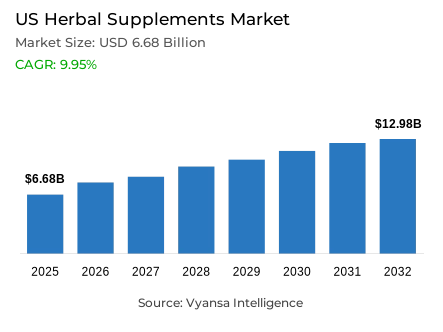
- Herbal supplements market size in US was valued at USD 6.68 billion in 2025 and is estimated at USD 7.09 billion in 2026.
- The market size is expected to grow to USD 12.98 billion by 2032.
- Market to register a CAGR of around 9.95% during 2026-32.
- Therapeutic Area Shares
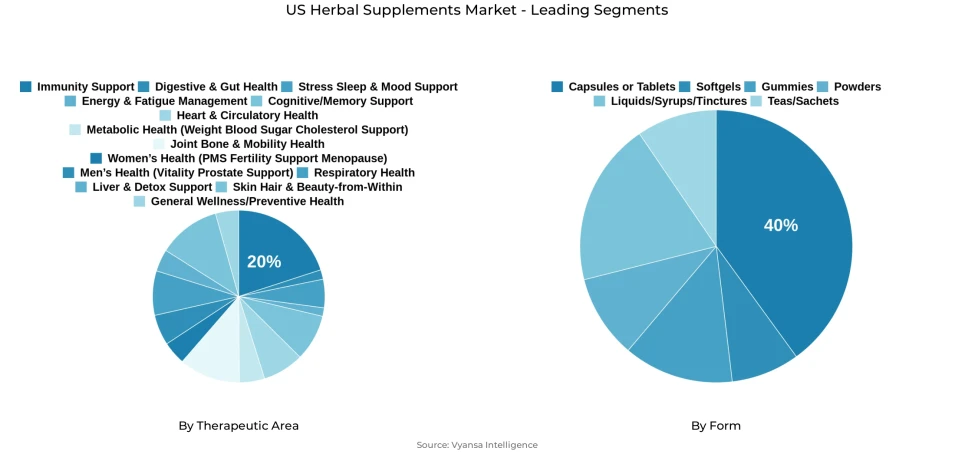
- Immunity support grabbed market share of 20%.
- Competition
- More than 10 companies are actively engaged in producing herbal supplements in US.
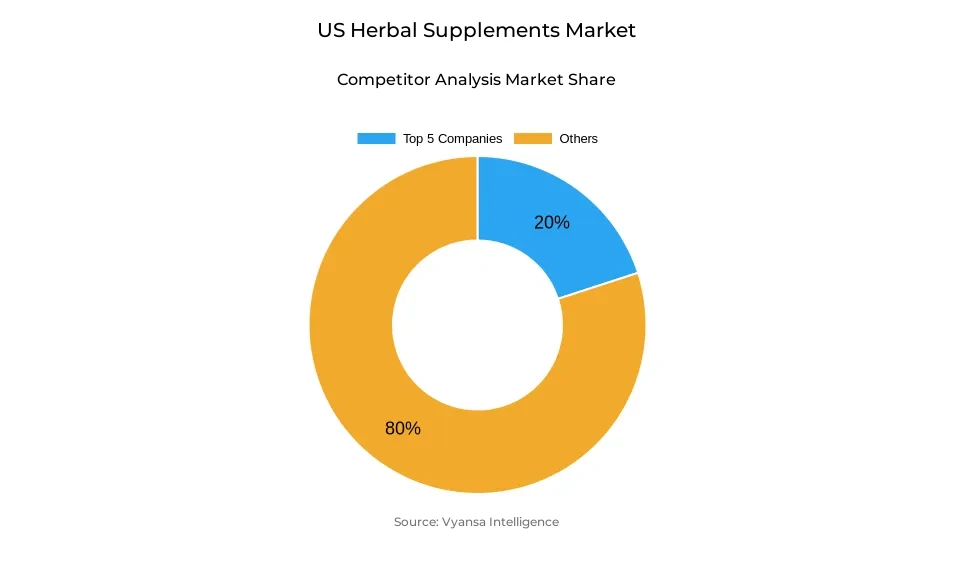
- Top 5 companies acquired around 20% of the market share.
- Gaia Herbs Inc., Himalaya Global Holdings Ltd., MartinBauer, The Nature’s Bounty Co., Herbalife International of America Inc. etc., are few of the top companies.
- Form
- Capsules/tablets grabbed 40% of the market.
US Herbal Supplements Market Outlook
The US herbal supplements market was valued at USD 6.68 billion in 2025, establishing a commercially robust and structurally well-supported foundation within the country's expanding natural wellness ecosystem. Projected to advance from USD 7.09 billion in 2026 to USD 12.98 billion by 2032, the sector registers a compound annual growth rate of 9.95% across the forecast horizon representing a near-doubling of market value that reflects the progressive mainstreaming of herbal supplements within everyday American preventive health and wellness routines. This sustained expansion trajectory is driven not by episodic health-crisis purchasing behavior but by a durable consumer reorientation toward natural, plant-based wellness solutions that fit seamlessly into established daily self-care habits a behavioral shift that creates structurally more resilient and commercially more valuable demand patterns across the category.
The therapeutic logic underpinning this market's growth architecture centers on the dominant role of prevention-oriented consumption as the category's primary demand anchor. Immunity support commands approximately 20% of total therapeutic area share the highest within the category reflecting the strong alignment between botanical immune-support formulations and the US consumer's deepening commitment to proactive, routine-integrated health management. This therapeutic concentration creates a commercially stable demand foundation characterized by high purchase frequency, strong repeat consumption loyalty, and broad demographic relevance characteristics that collectively sustain category revenue resilience through both peak seasonal wellness awareness periods and normalized everyday health management cycles.
Format preference patterns within this market reinforce the primacy of consumer familiarity, dosage convenience, and routine compatibility in herbal supplement purchasing decisions. Capsules and tablets command approximately 40% of total form share the market's dominant delivery format confirming that US herbal supplement consumers strongly favor structured, portable, and precisely dosed delivery systems over less familiar or more preparation-intensive alternatives. The format's universal recognition across the broader dietary supplement category reduces adoption friction for new herbal supplement users, creating a lower behavioral entry barrier that supports accelerated category trial and repeat purchase establishment across diverse consumer segments.
The retail and distribution landscape reflects a market in active structural evolution, where established physical commerce dominance is being progressively complemented by expanding digital engagement. Retail offline commands approximately 70% of total market distribution share confirming the continued commercial importance of pharmacy, health food store, and mass retail environments as primary herbal supplement purchase venues where in-store browsing, product comparison, and health advisor consultation remain influential decision factors. Simultaneously, the category is being reshaped by growing digital discovery behavior, online repeat purchasing, and rising consumer exposure to education-led wellness content that deepens ingredient awareness and brand engagement beyond the physical retail touchpoint. The convergence of trusted store-based purchasing infrastructure and accelerating digital channel adoption defines the market's dual-track commercial growth pathway through 2032.
US Herbal Supplements Market Growth DriverPrevention-Oriented Wellness Culture Creates Structural Supplement Demand
The deeply embedded US consumer orientation toward preventive health management and daily wellness optimization represents the foundational structural driver of herbal supplement demand, creating a culturally validated behavioral framework within which botanical health products can capture meaningful and growing consumer budget allocation without requiring fundamental lifestyle behavior change. The normalization of dietary supplement use across the US adult population documented by the NIH Office of Dietary Supplements as encompassing approximately one-half of all US adults confirms that herbal supplement consumption operates within an established wellness investment culture rather than a niche health subculture, providing brands with a substantially larger addressable consumer universe than product category awareness metrics alone might suggest. This prevention-first cultural orientation creates a commercial demand foundation of exceptional breadth and stability.
The institutional reinforcement of this prevention-oriented driver is validated through two complementary official evidence streams. The NIH Office of Dietary Supplements documents a US dietary supplement product universe exceeding 100,000 products a market scale that reflects the depth of consumer demand and commercial investment that prevention-led wellness culture has generated across the supplement category. Simultaneously, the 2025-2030 Dietary Guidelines for Americans published by the US Departments of Agriculture and Health and Human Services and specifically designed to help Americans meet nutrient needs, promote health, and prevent disease create a formal public health framework that institutionally validates the preventive wellness consumption behaviors that drive herbal supplement demand. The convergence of established supplement use culture and formal dietary guidance reinforcement creates a structurally favorable demand environment that supports sustained herbal supplement market expansion through 2032.
US Herbal Supplements Market ChallengeFDA Regulatory Scrutiny Raises Compliance Standards Across the Category
The progressive intensification of FDA enforcement activity around dietary supplement manufacturing compliance, labeling accuracy, and structure/function claim substantiation constitutes a critical structural challenge for herbal supplement brands operating in the US market, creating a regulatory accountability environment that demands sustained operational investment in quality management systems, documentation infrastructure, and claims review processes. In a product universe exceeding 100,000 dietary supplements where the NIH Office of Dietary Supplements acknowledges persistent questions around efficacy, safety, quality, and health effects the FDA's active enforcement posture creates asymmetric commercial pressure that differentiates compliance-capable brands from those whose quality systems and claims management processes are insufficiently rigorous to withstand regulatory scrutiny.
The operational specificity and commercial immediacy of this compliance challenge are documented with precision by the FDA. Warning letters issued on June 3, July 24, and November 13 of 2024 identify significant violations tied to dietary supplement manufacturing and Current Good Manufacturing Practice compliance demonstrating that enforcement activity is active, specific, and commercially consequential for brands whose operational standards fall below regulatory expectations. The FDA's requirement that structure/function and related claims require notification within 30 days after first marketing a dietary supplement creates an ongoing compliance management obligation that imposes recurring operational demands on brand teams responsible for new product launches and marketing claim development. For smaller and emerging herbal supplement brands, the investment required to build and maintain CGMP-compliant manufacturing systems and claims substantiation documentation competes directly with brand-building and product innovation capital allocation creating a structural advantage for well-resourced compliance incumbents through 2032.
Unlock Market Intelligence
Explore the market potential with our data-driven report
US Herbal Supplements Market TrendDigital Commerce Normalization Transforms Supplement Discovery and Repeat Purchase Behavior
The progressive normalization of online channels as the primary supplement discovery, comparison, and repeat purchase environment represents a defining structural trend reshaping the US herbal supplement market's distribution economics, consumer acquisition strategies, and brand-building investment priorities. Digital commerce platforms are uniquely suited to the herbal supplement category's consumer engagement requirements providing the ingredient education depth, clinical evidence communication capability, consumer review infrastructure, and subscription purchase convenience that routine wellness product consumption patterns demand. For brands whose botanical ingredient complexity and clinical substantiation narratives require more consumer communication than physical retail shelf space can effectively accommodate, digital channels transform formulation transparency from a comprehension challenge into a competitive differentiation asset.
The quantitative scale of this digital commerce trend is documented with authority by the US Census Bureau. Total US retail e-commerce sales reached USD 1.2337 trillion in 2025, reflecting 5.4% growth from 2024 and accounting for 16.4% of total retail sales confirming that digital commerce has achieved structural mainstream penetration across the US consumer economy. In Q4 2025 specifically, adjusted e-commerce sales reached USD 316.1 billion up 5.3% year-on-year and representing 16.6% of total quarterly retail sales demonstrating continued acceleration rather than maturation of the digital commerce growth trajectory. Within the herbal supplement category, where repeat purchase frequency, subscription model compatibility, and ingredient education engagement create natural alignment with digital channel capabilities, this broader e-commerce momentum creates expanding commercial infrastructure for brands seeking to build scalable direct-to-consumer relationships and precision-targeted consumer acquisition programs through 2032.
US Herbal Supplements Market OpportunityScience-Led Innovation Pipeline Creates Regulatory-Aligned Premium Positioning
The FDA's active development of its New Dietary Ingredient Notification framework and its engagement with the broader question of dietary supplement ingredient scope creates a structurally significant opportunity for herbal supplement brands capable of investing in clinical substantiation, safety documentation, and regulatory-aligned innovation pipelines that position new botanical ingredient launches on the right side of the agency's evolving evidence standards. In a market where consumer skepticism toward unsubstantiated wellness claims is progressively intensifying and retail partner demand for compliance documentation is rising, brands that achieve regulatory validation for novel herbal ingredients through the NDI notification process command a defensible premium positioning advantage that competitors without equivalent evidence infrastructure cannot readily replicate.
The institutional framework defining this innovation opportunity is established with regulatory specificity by the FDA. On June 11, 2025, the agency released two educational videos and a supplemental fact sheet to help manufacturers prepare complete New Dietary Ingredient Notifications confirming that the NDI process represents its primary mechanism for evaluating the safety and identity of new dietary ingredients before market entry. Further amplifying the opportunity scope, the FDA announced a public meeting for March 27, 2026 on exploring the scope of dietary supplement ingredients covering ingredient categories, new production methodologies, and specific ingredient types including proteins, enzymes, and microbials. For herbal supplement brands with the scientific resources to engage proactively with this regulatory evolution, the meeting signals a structured dialogue opportunity that can inform innovation pipeline development, strengthen NDI submission quality, and position evidence-backed herbal ingredient launches for favorable regulatory treatment and premium consumer positioning through 2032.
Unlock Market Intelligence
Explore the market potential with our data-driven report
US Herbal Supplements Market Segmentation Analysis
By Therapeutic Area
- Immunity Support
- Digestive & Gut Health
- Stress Sleep & Mood Support
- Energy & Fatigue Management
- Cognitive/Memory Support
- Heart & Circulatory Health
- Metabolic Health (Weight Blood Sugar Cholesterol Support)
- Joint Bone & Mobility Health
- Women’s Health (PMS Fertility Support Menopause)
- Men’s Health (Vitality Prostate Support)
- Respiratory Health
- Liver & Detox Support
- Skin Hair & Beauty-from-Within
- General Wellness/Preventive Health
The segment with highest market share under the Therapeutic Area is Immunity Support, accounting for approximately 20% of the total market. This leading position reflects the fundamental alignment between botanical immune-support formulations and the prevention-led wellness consumption paradigm that defines the US herbal supplement market's demand architecture a therapeutic positioning that resonates across all demographic cohorts because it addresses a universally relevant daily health maintenance objective rather than a condition-specific or age-limited wellness concern. Immunity support's commanding share confirms that the US herbal supplement consumer's primary purchase motivation is proactive health optimization rather than reactive symptom management a behavioral orientation that creates structurally more durable and commercially more valuable repeat purchase loyalty than episodic illness-driven consumption cycles.
The structural leadership of immunity support is reinforced by its exceptional repeat purchase dynamics, broad age-group relevance, and seasonal purchasing amplification that collectively create a demand pattern with both consistent baseline velocity and predictable peak-period acceleration. Consumers who integrate immunity-support herbal supplements into daily wellness routines demonstrate strong brand loyalty and refill purchasing consistency characteristics that generate predictable revenue streams and justify sustained marketing investment for brands competing within this therapeutic space. As the 2025-2030 Dietary Guidelines for Americans progressively normalize the prevention-health management behavioral framework that underpins immunity supplement consumption, the segment's structural demand foundation will deepen further sustaining its category-defining leadership position and driving continued product innovation investment within the immunity support therapeutic space through 2032.
By Form
- Capsules/Tablets
- Softgels
- Gummies
- Powders
- Liquids/Syrups/Tinctures
- Teas/Sachets
The segment with highest market share under the Product Form is Capsules/Tablets, accounting for approximately 40% of the total market. This dominant position reflects the deep structural alignment between encapsulated and compressed dosage formats and the consumer requirements of a category built around consistent, habit-integrated daily consumption wherein portability, precise dosage control, shelf stability, and consumption simplicity are non-negotiable purchase prerequisites for the routine-use wellness buyer. With two-fifths of total market value concentrated within a single delivery format, capsules and tablets define the commercial and operational priorities of the US herbal supplements industry establishing the packaging conventions, dosage communication standards, and retail shelf presence expectations that shape brand investment decisions and consumer category navigation behavior across the competitive landscape.
The structural dominance of capsules and tablets is sustained by their dual commercial advantage of supporting both accessible mass-market price positioning and credible premium wellness brand architecture within the same delivery system. Unlike liquid, powder, or tincture formats that require preparation infrastructure and consumption occasion coordination, capsule and tablet products integrate seamlessly into established daily supplement routines reducing the behavioral adoption barrier that represents the primary category trial friction point for new herbal supplement consumers. As the US retail e-commerce ecosystem documented by the US Census Bureau at USD 1.2337 trillion in total sales in 2025 creates expanding digital repeat purchase infrastructure, the capsule and tablet format's superior logistics compatibility, subscription purchase suitability, and auto-refill program compatibility will further entrench its category leadership position through 2032.
List of Companies Covered in US Herbal Supplements Market
The companies listed below are highly influential in the US herbal supplements market, with a significant market share and a strong impact on industry developments.
- Gaia Herbs Inc.
- Himalaya Global Holdings Ltd.
- MartinBauer
- The Nature’s Bounty Co.
- Herbalife International of America Inc.
- Glanbia plc
- NOW Health Group Inc.
- Amway Corp.
- Vitality Works
- Nutraceuticals Factory LLC
Market News & Updates
- Herbalife International of America, 2025:
Herbalife launched MultiBurn™ in July 2025 as a science-backed weight-management supplement formulated with clinically studied botanical extracts to support metabolic health, healthy fat reduction, and energy expenditure. This is a strong US herbal supplements market development because it targets one of the category’s biggest growth areas metabolic and weight support while using a modern, clean-label botanical positioning designed for mainstream wellness consumers.
- Inc, 2025:
Gaia Herbs introduced Berberine & Milk Thistle in October 2025 as a new herbal supplement designed to support healthy metabolism and liver function. This matters for the US herbal supplements market because it combines one of the most sought-after botanical compounds, berberine, with liver-support positioning, giving Gaia a timely product in the fast-growing metabolic-health segment of herbal supplementation.
Frequently Asked Questions
Related Report
- Market Segmentation
- Research Scope
- Research Methodology
- Definitions and Assumptions
- Executive Summary
- US Herbal Supplements Market Policies, Regulations, and Standards
- US Herbal Supplements Market Dynamics
- Growth Factors
- Challenges
- Trends
- Opportunities
- US Herbal Supplements Market Statistics, 2022-2032F
- Market Size & Growth Outlook
- By Revenues in USD Million
- Market Segmentation & Growth Outlook
- By Therapeutic Area
- Immunity Support- Market Insights and Forecast 2022-2032, USD Million
- Digestive & Gut Health- Market Insights and Forecast 2022-2032, USD Million
- Stress Sleep & Mood Support- Market Insights and Forecast 2022-2032, USD Million
- Energy & Fatigue Management- Market Insights and Forecast 2022-2032, USD Million
- Cognitive/Memory Support- Market Insights and Forecast 2022-2032, USD Million
- Heart & Circulatory Health- Market Insights and Forecast 2022-2032, USD Million
- Metabolic Health (Weight Blood Sugar Cholesterol Support)- Market Insights and Forecast 2022-2032, USD Million
- Joint Bone & Mobility Health- Market Insights and Forecast 2022-2032, USD Million
- Women’s Health (PMS Fertility Support Menopause)- Market Insights and Forecast 2022-2032, USD Million
- Men’s Health (Vitality Prostate Support)- Market Insights and Forecast 2022-2032, USD Million
- Respiratory Health- Market Insights and Forecast 2022-2032, USD Million
- Liver & Detox Support- Market Insights and Forecast 2022-2032, USD Million
- Skin Hair & Beauty-from-Within- Market Insights and Forecast 2022-2032, USD Million
- General Wellness/Preventive Health- Market Insights and Forecast 2022-2032, USD Million
- By Consumer Group
- Preventive Wellness Consumers- Market Insights and Forecast 2022-2032, USD Million
- Lifestyle-Risk Adults- Market Insights and Forecast 2022-2032, USD Million
- Healthy Aging/50+ Population- Market Insights and Forecast 2022-2032, USD Million
- Women by Life Stage- Market Insights and Forecast 2022-2032, USD Million
- Men’s Preventive Health Users- Market Insights and Forecast 2022-2032, USD Million
- Parents/Pediatric Buyers- Market Insights and Forecast 2022-2032, USD Million
- Sports & Active Lifestyle Users- Market Insights and Forecast 2022-2032, USD Million
- Recovery/Low-Immunity Users- Market Insights and Forecast 2022-2032, USD Million
- By Product Type
- Single-Herb Supplements- Market Insights and Forecast 2022-2032, USD Million
- Multi-Herb/Blend Formulations- Market Insights and Forecast 2022-2032, USD Million
- Standardized Extracts- Market Insights and Forecast 2022-2032, USD Million
- Whole-Herb/Traditional Preparations- Market Insights and Forecast 2022-2032, USD Million
- Condition-Specific Formulations- Market Insights and Forecast 2022-2032, USD Million
- By Form
- Capsules/Tablets- Market Insights and Forecast 2022-2032, USD Million
- Softgels- Market Insights and Forecast 2022-2032, USD Million
- Gummies- Market Insights and Forecast 2022-2032, USD Million
- Powders- Market Insights and Forecast 2022-2032, USD Million
- Liquids/Syrups/Tinctures- Market Insights and Forecast 2022-2032, USD Million
- Teas/Sachets- Market Insights and Forecast 2022-2032, USD Million
- By Sales Channel
- Retail Offline- Market Insights and Forecast 2022-2032, USD Million
- Pharmacy/Drugstore- Market Insights and Forecast 2022-2032, USD Million
- Practitioner-Led Channels- Market Insights and Forecast 2022-2032, USD Million
- Clinics/Wellness Centers- Market Insights and Forecast 2022-2032, USD Million
- Health & Nutrition Stores- Market Insights and Forecast 2022-2032, USD Million
- Modern Trade/Supermarkets - Market Insights and Forecast 2022-2032, USD Million
- Retail Online- Market Insights and Forecast 2022-2032, USD Million
- E-Commerce/D2C- Market Insights and Forecast 2022-2032, USD Million
- Retail Offline- Market Insights and Forecast 2022-2032, USD Million
- By Region
- West
- Midwest
- South
- North
- Northeast
- By Competitors
- Competition Characteristics
- Market Share & Analysis
- By Therapeutic Area
- Market Size & Growth Outlook
- US Immunity Support Market Statistics, 2022-2032
- Market Size & Growth Outlook
- By Revenues in USD Million
- Market Segmentation & Growth Outlook
- By Consumer Group- Market Insights and Forecast 2022-2032, USD Million
- By Product Type- Market Insights and Forecast 2022-2032, USD Million
- By Form- Market Insights and Forecast 2022-2032, USD Million
- By Sales Channel- Market Insights and Forecast 2022-2032, USD Million
- By Region- Market Insights and Forecast 2022-2032, USD Million
- Market Size & Growth Outlook
- US Digestive & Gut Health Market Statistics, 2022-2032
- Market Size & Growth Outlook
- By Revenues in USD Million
- Market Segmentation & Growth Outlook
- By Consumer Group- Market Insights and Forecast 2022-2032, USD Million
- By Product Type- Market Insights and Forecast 2022-2032, USD Million
- By Form- Market Insights and Forecast 2022-2032, USD Million
- By Sales Channel- Market Insights and Forecast 2022-2032, USD Million
- By Region- Market Insights and Forecast 2022-2032, USD Million
- Market Size & Growth Outlook
- US Stress Sleep & Mood Support Market Statistics, 2022-2032
- Market Size & Growth Outlook
- By Revenues in USD Million
- Market Segmentation & Growth Outlook
- By Consumer Group- Market Insights and Forecast 2022-2032, USD Million
- By Product Type- Market Insights and Forecast 2022-2032, USD Million
- By Form- Market Insights and Forecast 2022-2032, USD Million
- By Sales Channel- Market Insights and Forecast 2022-2032, USD Million
- By Region- Market Insights and Forecast 2022-2032, USD Million
- Market Size & Growth Outlook
- US Energy & Fatigue Management Market Statistics, 2022-2032
- Market Size & Growth Outlook
- By Revenues in USD Million
- Market Segmentation & Growth Outlook
- By Consumer Group- Market Insights and Forecast 2022-2032, USD Million
- By Product Type- Market Insights and Forecast 2022-2032, USD Million
- By Form- Market Insights and Forecast 2022-2032, USD Million
- By Sales Channel- Market Insights and Forecast 2022-2032, USD Million
- By Region- Market Insights and Forecast 2022-2032, USD Million
- Market Size & Growth Outlook
- US Cognitive/Memory Support Market Statistics, 2022-2032
- Market Size & Growth Outlook
- By Revenues in USD Million
- Market Segmentation & Growth Outlook
- By Consumer Group- Market Insights and Forecast 2022-2032, USD Million
- By Product Type- Market Insights and Forecast 2022-2032, USD Million
- By Form- Market Insights and Forecast 2022-2032, USD Million
- By Sales Channel- Market Insights and Forecast 2022-2032, USD Million
- By Region- Market Insights and Forecast 2022-2032, USD Million
- Market Size & Growth Outlook
- US Heart & Circulatory Health Market Statistics, 2022-2032
- Market Size & Growth Outlook
- By Revenues in USD Million
- Market Segmentation & Growth Outlook
- By Consumer Group- Market Insights and Forecast 2022-2032, USD Million
- By Product Type- Market Insights and Forecast 2022-2032, USD Million
- By Form- Market Insights and Forecast 2022-2032, USD Million
- By Sales Channel- Market Insights and Forecast 2022-2032, USD Million
- By Region- Market Insights and Forecast 2022-2032, USD Million
- Market Size & Growth Outlook
- US Metabolic Health (Weight Blood Sugar Cholesterol Support) Market Statistics, 2022-2032
- Market Size & Growth Outlook
- By Revenues in USD Million
- Market Segmentation & Growth Outlook
- By Consumer Group- Market Insights and Forecast 2022-2032, USD Million
- By Product Type- Market Insights and Forecast 2022-2032, USD Million
- By Form- Market Insights and Forecast 2022-2032, USD Million
- By Sales Channel- Market Insights and Forecast 2022-2032, USD Million
- By Region- Market Insights and Forecast 2022-2032, USD Million
- Market Size & Growth Outlook
- US Joint Bone & Mobility Health Market Statistics, 2022-2032
- Market Size & Growth Outlook
- By Revenues in USD Million
- Market Segmentation & Growth Outlook
- By Consumer Group- Market Insights and Forecast 2022-2032, USD Million
- By Product Type- Market Insights and Forecast 2022-2032, USD Million
- By Form- Market Insights and Forecast 2022-2032, USD Million
- By Sales Channel- Market Insights and Forecast 2022-2032, USD Million
- By Region- Market Insights and Forecast 2022-2032, USD Million
- Market Size & Growth Outlook
- US Women’s Health (PMS Fertility Support Menopause) Market Statistics, 2022-2032
- Market Size & Growth Outlook
- By Revenues in USD Million
- Market Segmentation & Growth Outlook
- By Consumer Group- Market Insights and Forecast 2022-2032, USD Million
- By Product Type- Market Insights and Forecast 2022-2032, USD Million
- By Form- Market Insights and Forecast 2022-2032, USD Million
- By Sales Channel- Market Insights and Forecast 2022-2032, USD Million
- By Region- Market Insights and Forecast 2022-2032, USD Million
- Market Size & Growth Outlook
- US Men’s Health (Vitality Prostate Support) Market Statistics, 2022-2032
- Market Size & Growth Outlook
- By Revenues in USD Million
- Market Segmentation & Growth Outlook
- By Consumer Group- Market Insights and Forecast 2022-2032, USD Million
- By Product Type- Market Insights and Forecast 2022-2032, USD Million
- By Form- Market Insights and Forecast 2022-2032, USD Million
- By Sales Channel- Market Insights and Forecast 2022-2032, USD Million
- By Region- Market Insights and Forecast 2022-2032, USD Million
- Market Size & Growth Outlook
- US Respiratory Health Market Statistics, 2022-2032
- Market Size & Growth Outlook
- By Revenues in USD Million
- Market Segmentation & Growth Outlook
- By Consumer Group- Market Insights and Forecast 2022-2032, USD Million
- By Product Type- Market Insights and Forecast 2022-2032, USD Million
- By Form- Market Insights and Forecast 2022-2032, USD Million
- By Sales Channel- Market Insights and Forecast 2022-2032, USD Million
- By Region- Market Insights and Forecast 2022-2032, USD Million
- Market Size & Growth Outlook
- US Liver & Detox Support Market Statistics, 2022-2032
- Market Size & Growth Outlook
- By Revenues in USD Million
- Market Segmentation & Growth Outlook
- By Consumer Group- Market Insights and Forecast 2022-2032, USD Million
- By Product Type- Market Insights and Forecast 2022-2032, USD Million
- By Form- Market Insights and Forecast 2022-2032, USD Million
- By Sales Channel- Market Insights and Forecast 2022-2032, USD Million
- By Region- Market Insights and Forecast 2022-2032, USD Million
- Market Size & Growth Outlook
- US Skin Hair & Beauty-from-Within Market Statistics, 2022-2032
- Market Size & Growth Outlook
- By Revenues in USD Million
- Market Segmentation & Growth Outlook
- By Consumer Group- Market Insights and Forecast 2022-2032, USD Million
- By Product Type- Market Insights and Forecast 2022-2032, USD Million
- By Form- Market Insights and Forecast 2022-2032, USD Million
- By Sales Channel- Market Insights and Forecast 2022-2032, USD Million
- By Region- Market Insights and Forecast 2022-2032, USD Million
- Market Size & Growth Outlook
- US General Wellness/Preventive Health Market Statistics, 2022-2032
- Market Size & Growth Outlook
- By Revenues in USD Million
- Market Segmentation & Growth Outlook
- By Consumer Group- Market Insights and Forecast 2022-2032, USD Million
- By Product Type- Market Insights and Forecast 2022-2032, USD Million
- By Form- Market Insights and Forecast 2022-2032, USD Million
- By Sales Channel- Market Insights and Forecast 2022-2032, USD Million
- By Region- Market Insights and Forecast 2022-2032, USD Million
- Market Size & Growth Outlook
- Competitive Outlook
- Company Profiles
- The Nature’s Bounty Co.
- Business Description
- Product Portfolio
- Collaborations & Alliances
- Recent Developments
- Financial Details
- Others
- Herbalife International of America Inc.
- Business Description
- Product Portfolio
- Collaborations & Alliances
- Recent Developments
- Financial Details
- Others
- Glanbia plc
- Business Description
- Product Portfolio
- Collaborations & Alliances
- Recent Developments
- Financial Details
- Others
- NOW Health Group Inc.
- Business Description
- Product Portfolio
- Collaborations & Alliances
- Recent Developments
- Financial Details
- Others
- Amway Corp.
- Business Description
- Product Portfolio
- Collaborations & Alliances
- Recent Developments
- Financial Details
- Others
- Gaia Herbs Inc.
- Business Description
- Product Portfolio
- Collaborations & Alliances
- Recent Developments
- Financial Details
- Others
- Himalaya Global Holdings Ltd.
- Business Description
- Product Portfolio
- Collaborations & Alliances
- Recent Developments
- Financial Details
- Others
- MartinBauer
- Business Description
- Product Portfolio
- Collaborations & Alliances
- Recent Developments
- Financial Details
- Others
- Vitality Works
- Business Description
- Product Portfolio
- Collaborations & Alliances
- Recent Developments
- Financial Details
- Others
- Nutraceuticals Factory LLC
- Business Description
- Product Portfolio
- Collaborations & Alliances
- Recent Developments
- Financial Details
- Others
- The Nature’s Bounty Co.
- Company Profiles
- Disclaimer
| Segment | Sub-Segment |
|---|---|
| By Therapeutic Area |
|
| By Consumer Group |
|
| By Product Type |
|
| By Form |
|
| By Sales Channel |
|
| By Region |
|
Research Methodology
This study followed a structured approach comprising four key phases to assess the size and scope of the electro-oxidation market. The process began with thorough secondary research to collect data on the target market, related markets, and broader industry context. These findings, along with preliminary assumptions and estimates, were then validated through extensive primary research involving industry experts from across the value chain. To calculate the overall market size, both top-down and bottom-up methodologies were employed. Finally, market segmentation and data triangulation techniques were applied to refine and validate segment-level estimations.
Secondary Research
The secondary research phase involved gathering data from a wide range of credible and published sources. This step helped in identifying industry trends, defining market segmentation, and understanding the market landscape and value chain.
Sources consulted during this phase included:
- Company annual reports, investor presentations, and press releases
- Industry white papers and certified publications
- Trade directories and market-recognized databases
- Articles from authoritative authors and reputable journals
- Gold and silver standard websites
Secondary research was critical in mapping out the industry's value chain and monetary flow, identifying key market segments, understanding regional variations, and tracking significant industry developments.
Other key sources:
- Financial disclosures
- Industry associations and trade bodies
- News outlets and business magazines
- Academic journals and research studies
- Paid industry databases
Primary Research
To validate secondary data and gain deeper market insights, primary research was conducted with key stakeholders across both the supply and demand sides of the market.
On the demand side, participants included decision-makers and influencers from end-user industries—such as CIOs, CTOs, and CSOs—who provided first-hand perspectives on market needs, product usage, and future expectations.
On the supply side, interviews were conducted with manufacturers, industry associations, and institutional participants to gather insights into current offerings, product pipelines, and market challenges.
Primary interviews provided critical inputs such as:
- Market size and revenue data
- Product and service breakdowns
- Market forecasts
- Regional and application-specific trends
Stakeholders consulted included:
- Leading OEM and solution providers
- Channel and distribution partners
- End users across various applications
- Independent consultants and industry specialists
Market Size Estimation and Data Triangulation
- Identifying Key Market Participants (Secondary Research)
- Goal: To identify the major players or companies in the target market. This typically involves using publicly available data sources such as industry reports, market research publications, and financial statements of companies.
- Tools: Reports from firms like Gartner, Forrester, Euromonitor, Statista, IBISWorld, and others. Public financial statements, news articles, and press releases from top market players.
- Extracting Earnings of Key Market Participants
- Goal: To estimate the earnings generated from the product or service being analyzed. This step helps in understanding the revenue potential of each market player in a specific geography.
- Methods: Earnings data can be gathered from:
- Publicly available financial reports (for listed companies).
- Interviews and primary data sources from professionals, such as Directors, VPs, SVPs, etc. This is especially useful for understanding more nuanced, internal data that isn't publicly disclosed.
- Annual reports and investor presentations of key players.
- Data Collation and Development of a Relevant Data Model
- Goal: To collate inputs from both primary and secondary sources into a structured, data-driven model for market estimation. This model will incorporate key market KPIs and any independent variables relevant to the market.
- Key KPIs: These could include:
- Market size, growth rate, and demand drivers.
- Industry-specific metrics like market share, average revenue per customer (ARPC), or average deal size.
- External variables, such as economic growth rates, inflation rates, or commodity prices, that could affect the market.
- Data Modeling: Based on this data, the market forecasts are developed for the next 5 years. A combination of trend analysis, scenario modeling, and statistical regression might be used to generate projections.
- Scenario Analysis
- Goal: To test different assumptions and validate how sensitive the market is to changes in key variables (e.g., market demand, regulatory changes, technological disruptions).
- Types of Scenarios:
- Base Case: Based on current assumptions and historical data.
- Best-Case Scenario: Assuming favorable market conditions, regulatory environments, and technological advancements.
- Worst-Case Scenario: Accounting for adverse factors, such as economic downturns, stricter regulations, or unexpected disruptions.












