Netherlands Digestive Remedies Market Report: Trends, Growth and Forecast (2026-2032)
By Product Type (Paediatric Digestive Remedies (Paediatric Diarrhoeal Remedies, Paediatric Indigestion & Heartburn Remedies, Paediatric Laxatives, Paediatric Motion Sickness Remedies), Diarrhoeal Remedies, IBS Treatments, Indigestion & Heartburn Remedies (Antacids, Antiflatulents, Digestive Enzymes, H2 Blockers, Proton Pump Inhibitors), Laxatives, Motion Sickness Remedies), By Age Group (Children & Adolescents (01-17 years), Adults (18-65 years), Geriatric (65+ years)), By Sales Channel (Retail Online, Retail Offline (Hospitals, Clinics, Pharmacies)) ... Read more
|
Major Players
|
Netherlands Digestive Remedies Market Statistics and Insights, 2026
- Market Size Statistics
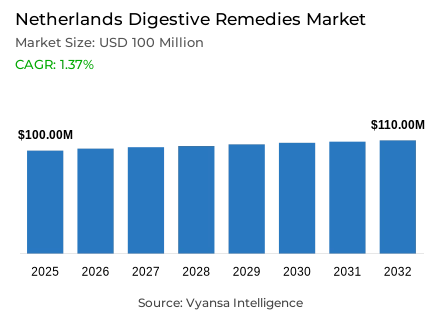
- Digestive remedies market size in Netherlands was valued at USD 100 million in 2025 and is estimated at USD 100.7 Million in 2026.
- The market size is expected to grow to USD 110 million by 2032.
- Market to register a CAGR of around 1.37% during 2026-32.
- Product Type Shares
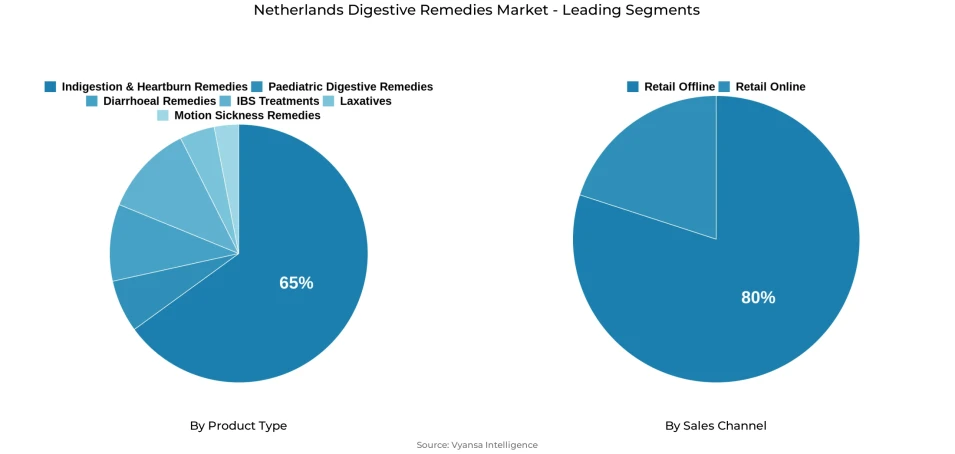
- Indigestion & heartburn remedies grabbed market share of 65%.
- Competition
- More than 20 companies are actively engaged in producing digestive remedies in Netherlands.
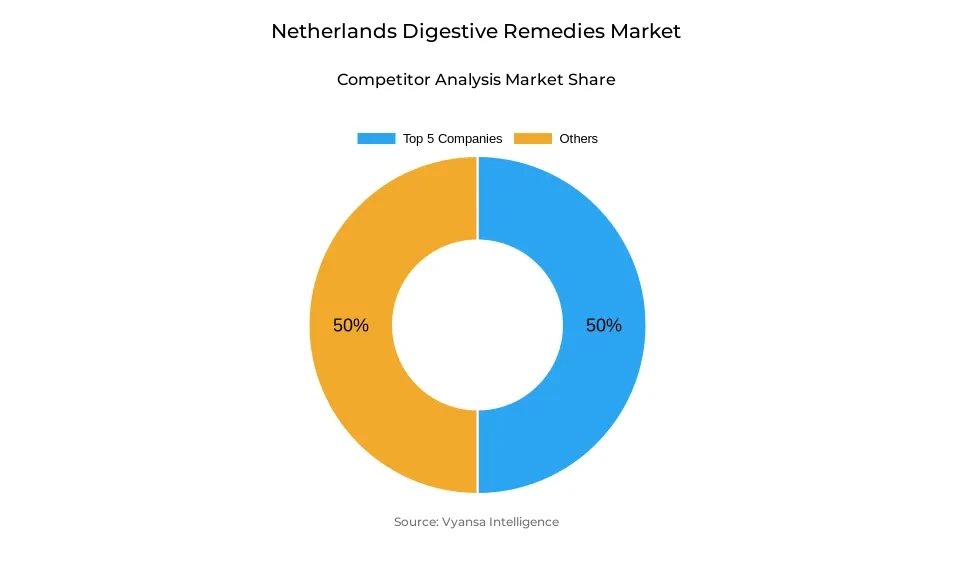
- Top 5 companies acquired around 50% of the market share.
- Solgar Vitamins Holland BV, AS Watson (Health & Beauty Benelux), STADA Arzneimittel AG, Bayer Consumer Care BV, Reckitt Benckiser Nederland BV etc., are few of the top companies.
- Sales Channel
- Retail offline grabbed 80% of the market.
Netherlands Digestive Remedies Market Outlook
The Netherlands digestive remedies market size was valued at USD 100 million in 2025 and is projected to grow from USD 100.7 million in 2026 to USD 110 million by 2032, exhibiting a CAGR of around 1.37% during the forecast period. Growth remains moderate as the category stays relatively small within the wider OTC healthcare sector. Demand continues to be supported by everyday digestive discomfort linked to fast routines, irregular meals, and lifestyle-related stress.
Lifestyle pressure continues to support regular use of digestive remedies. National Institute for Public Health and the Environment (RIVM) reports that 45.8% of adults aged 18 to 64 in the Netherlands experience anxiety or depression feelings in the previous four weeks in 2024, reflecting a high level of mental strain that often contributes to digestive complaints. Within product categories, indigestion and heartburn remedies account for about 65% of the segment, reflecting strong reliance on antacids and similar solutions that provide quick relief for acid reflux and related symptoms.
However, the category still develops within a cautious self-medication culture. Dutch consumers tend to use non-prescription medicines carefully and often seek reassurance before treatment. Regulatory guidance also reinforces responsible usage. The Medicines Evaluation Board states that OTC medicines are an important supplement to care but require clear guidance, while Business.gov.nl explains that some OTC medicines must be sold with pharmacy or drugstore supervision. This environment keeps digestive remedies relevant but limits rapid category expansion.
Sales remain dominated by traditional retail channels. Retail offline accounts for about 80% of sales, reflecting the continued role of pharmacies, drugstores, and other supervised outlets in OTC purchases. Dutch regulations also allow certain OTC medicines to be sold in supermarkets, but professional guidance often influences consumer confidence. As a result, physical retail continues to anchor access, advice, and purchasing behaviour for digestive remedies in the country.
Netherlands Digestive Remedies Market Growth DriverStress-Driven Stomach Issues Support Everyday Demand
A key driver for the Netherlands digestive remedies market is the rise in digestive discomfort linked to faster routines and higher stress. As more consumers deal with acid reflux, heartburn, bloating, cramping, diarrhoea, and constipation, the need for quick and low-risk OTC relief continues to grow. This supports steady demand for digestive remedies even though the category remains relatively small compared with some other OTC areas.
Official Dutch health data backs up this pressure in the market for digestive remedies in the Netherlands. RIVM found that in 2024, 45.8% of adults in the Netherlands aged 18-64 years experience anxiety/depression feelings in the previous four weeks. This is a high level of mental pressure and fits in with a lifestyle where increased levels of stress are causing digestive issues, thus fueling demand for digestive remedies, especially fast-relief ones.
Netherlands Digestive Remedies Market ChallengeCautious Self-Care Keeps the Category Relatively Small
A significant problem within the Dutch digestive remedies market stems from the cautiousness of the Dutch towards using OTC products for self-treatment. Many Dutch are able to see the benefit in low-risk OTC products; however, a number of Dutch people still take a very cautious approach towards the treatment of their digestive issues and are not as willing to try new non-prescription remedies as a result of this careful nature. This attitude means that the category itself is relatively small in size, which is also one of the reasons that there has not been a large amount of new product development.
The official regulatory framework reflects that caution. The Medicines Evaluation Board states that OTC medicines are an important supplement to care, but also carry risk and therefore require clear responsible use and guidance. Business.gov.nl further explains that some OTC medicines are pharmacy-only, some require pharmacy or drugstore supervision, and certain categories require mandatory patient consultation. This supports a market where digestive remedies grow, but within a careful and controlled self-care culture.
Unlock Market Intelligence
Explore the market potential with our data-driven report
Netherlands Digestive Remedies Market TrendAI-Led Optimisation Shapes the Next Retail Phase
AI-enhanced automation/robotics will significantly affect the availability, retailers’ marketing precision and distribution efficiency of these companies products. To provide optimum assortment and lower prices, and provide better targeting of customers, retailers and manufacturers are using AI to enhance product assortments and connect customers with a larger variety of manufacturers. AI aligns with the focus on improving fulfillment through the technology development provided by major companies like Etos and Bayer.
Official business data confirms that this is a broader structural shift. CBS reports that 13% of Dutch companies with 2 or more employees use AI in 2024, up from 8% in 2023. It also states that 35% of AI-using companies apply it for marketing or sales, the largest use case. That supports a digestive remedies environment where AI increasingly influences both shelf strategy and consumer engagement.
Netherlands Digestive Remedies Market OpportunityTravel Habits Create More Space for Preventive Relief
One significant opportunity for the digestive remedies market in the Netherlands has been through travel; however, this particularly applies to remedies for diarrhoea (travellers' diarrhoea) and preventative over-the-counter (OTC) products that can be used on long journeys to reduce the risk of experiencing digestive problems. As travelling is becoming increasingly common among Dutch consumers there is an increasing opportunity for retailers to sell and promote digestive product lines as essential travel items. This creates opportunity for established brands and private labels to grow through targeted holiday campaigns and clearer education around preventive use.
According to official tourism data, the extent of this opening can be gauged by CBS reporting that 72% of people aged 15 years or older in the Netherlands take summer holidays in 2024, which results in an estimated total of 21.6 million summer holiday trips. With this high volume of outbound travel, it is evident that the marketplace has great opportunity to develop greater relevance for digestive remedies associated with international travel, new or different foods, and stomach problems related to travel.
Unlock Market Intelligence
Explore the market potential with our data-driven report
Netherlands Digestive Remedies Market Segmentation Analysis
By Product Type
- Paediatric Digestive Remedies
- Paediatric Diarrhoeal Remedies
- Paediatric Indigestion & Heartburn Remedies
- Paediatric Laxatives
- Paediatric Motion Sickness Remedies
- Diarrhoeal Remedies
- IBS Treatments
- Indigestion & Heartburn Remedies
- Antacids
- Antiflatulents
- Digestive Enzymes
- H2 Blockers
- Proton Pump Inhibitors
- Laxatives
- Motion Sickness Remedies
The segment has the highest share around segment under the product type, where indigestion & heartburn remedies grabbed market share of 65%. This leading position fits the market because indigestion and heartburn are directly linked with the faster, more stressful lifestyles described above. Consumers want rapid relief for acid-related discomfort, which keeps antacids and similar products at the centre of digestive remedy demand.
As RIVM stated that, as of 2024, 45.8% of adults aged 18-64 experience feelings of anxiety or depression, which can contribute to daily stress and bodily discomfort.
By Sales Channel
- Retail Online
- Retail Offline
- Hospitals
- Clinics
- Pharmacies
The segment has the highest share around segment under the sales channel, where retail offline grabbed 80% of the market. This dominance fits the Dutch digestive remedies market because physical outlets still play a central role in OTC purchase decisions. Pharmacies, drugstores, and stores with qualified staff remain important when consumers want reassurance, quick availability, and advice for responsible self-medication.
Official Dutch rules support this channel structure. Business.gov.nl explains that OTC medicines can be sold through pharmacies, drugstores, and in some cases supermarkets, but also notes that certain categories require counselling or supervised sale. That keeps physical retail important for digestive remedies, especially when product guidance influences consumer confidence.
List of Companies Covered in Netherlands Digestive Remedies Market
The companies listed below are highly influential in the Netherlands digestive remedies market, with a significant market share and a strong impact on industry developments.
- Solgar Vitamins Holland BV
- AS Watson (Health & Beauty Benelux)
- STADA Arzneimittel AG
- Bayer Consumer Care BV
- Reckitt Benckiser Nederland BV
- MCO Health BV
- Vemedia BV
- Johnson & Johnson Consumer Health BV
- Omega Pharma Nederland BV
- Meda Pharma BV
Competitive Landscape
In 2025, the competitive landscape of digestive remedies in the Netherlands was led by Bayer Consumer Care BV with a 28.5% retail value share, followed by Reckitt Benckiser Nederland BV at 6.4%. Bayer Consumer Care maintains a dominant position largely due to the strong performance of its Rennie brand in the antacids segment, which remains the largest category within digestive remedies. The company has strengthened its presence through targeted marketing campaigns highlighting rapid relief and multiple product formats, while also offering higher-dose solutions such as Losecosan containing omeprazole for longer-lasting protection against stomach acid symptoms. Reckitt Benckiser also maintains a notable position with well-known gastrointestinal relief brands. Although digestive remedies remains a relatively small category in the Netherlands due to traditionally cautious attitudes toward self-medication, consumer behaviour is gradually shifting as more individuals choose OTC solutions for common digestive issues such as heartburn, acid reflux and bloating. At the same time, private label products from retailers such as Etos are expanding their presence by offering more affordable alternatives, increasing competition and broadening consumer access to digestive health treatments. Growth in the category is also supported by rising stress levels, faster-paced lifestyles and increasing international travel, which contribute to a higher prevalence of digestive complaints and sustain demand for OTC digestive remedies.
Frequently Asked Questions
Related Report
- Market Segmentation
- Research Scope
- Research Methodology
- Definitions and Assumptions
- Executive Summary
- Netherlands Digestive Remedies Market Policies, Regulations, and Standards
- Netherlands Digestive Remedies Market Dynamics
- Growth Factors
- Challenges
- Trends
- Opportunities
- Netherlands Digestive Remedies Market Statistics, 2022-2032F
- Market Size & Growth Outlook
- By Revenues in USD Million
- Market Segmentation & Growth Outlook
- By Product Type
- Paediatric Digestive Remedies- Market Insights and Forecast 2022-2032, USD Million
- Paediatric Diarrhoeal Remedies- Market Insights and Forecast 2022-2032, USD Million
- Paediatric Indigestion & Heartburn Remedies- Market Insights and Forecast 2022-2032, USD Million
- Paediatric Laxatives- Market Insights and Forecast 2022-2032, USD Million
- Paediatric Motion Sickness Remedies- Market Insights and Forecast 2022-2032, USD Million
- Diarrhoeal Remedies- Market Insights and Forecast 2022-2032, USD Million
- IBS Treatments- Market Insights and Forecast 2022-2032, USD Million
- Indigestion & Heartburn Remedies- Market Insights and Forecast 2022-2032, USD Million
- Antacids- Market Insights and Forecast 2022-2032, USD Million
- Antiflatulents- Market Insights and Forecast 2022-2032, USD Million
- Digestive Enzymes- Market Insights and Forecast 2022-2032, USD Million
- H2 Blockers- Market Insights and Forecast 2022-2032, USD Million
- Proton Pump Inhibitors- Market Insights and Forecast 2022-2032, USD Million
- Laxatives- Market Insights and Forecast 2022-2032, USD Million
- Motion Sickness Remedies- Market Insights and Forecast 2022-2032, USD Million
- Paediatric Digestive Remedies- Market Insights and Forecast 2022-2032, USD Million
- By Age Group
- Children & Adolescents (01-17 years)- Market Insights and Forecast 2022-2032, USD Million
- Adults (18-65 years)- Market Insights and Forecast 2022-2032, USD Million
- Geriatric (65+ years)- Market Insights and Forecast 2022-2032, USD Million
- By Sales Channel
- Retail Online- Market Insights and Forecast 2022-2032, USD Million
- Retail Offline- Market Insights and Forecast 2022-2032, USD Million
- Hospitals- Market Insights and Forecast 2022-2032, USD Million
- Clinics- Market Insights and Forecast 2022-2032, USD Million
- Pharmacies- Market Insights and Forecast 2022-2032, USD Million
- By Competitors
- Competition Characteristics
- Market Share & Analysis
- By Product Type
- Market Size & Growth Outlook
- Netherlands Paediatric Digestive Remedies Market Statistics, 2022-2032
- Market Size & Growth Outlook
- By Revenues in USD Million
- Market Segmentation & Growth Outlook
- By Age Group- Market Insights and Forecast 2022-2032, USD Million
- By Sales Channel- Market Insights and Forecast 2022-2032, USD Million
- Market Size & Growth Outlook
- Netherlands Diarrhoeal Remedies Market Statistics, 2022-2032
- Market Size & Growth Outlook
- By Revenues in USD Million
- Market Segmentation & Growth Outlook
- By Age Group- Market Insights and Forecast 2022-2032, USD Million
- By Sales Channel- Market Insights and Forecast 2022-2032, USD Million
- Market Size & Growth Outlook
- Netherlands IBS Treatments Market Statistics, 2022-2032
- Market Size & Growth Outlook
- By Revenues in USD Million
- Market Segmentation & Growth Outlook
- By Age Group- Market Insights and Forecast 2022-2032, USD Million
- By Sales Channel- Market Insights and Forecast 2022-2032, USD Million
- Market Size & Growth Outlook
- Netherlands Indigestion & Heartburn Remedies Market Statistics, 2022-2032
- Market Size & Growth Outlook
- By Revenues in USD Million
- Market Segmentation & Growth Outlook
- By Age Group- Market Insights and Forecast 2022-2032, USD Million
- By Sales Channel- Market Insights and Forecast 2022-2032, USD Million
- Market Size & Growth Outlook
- Netherlands Laxatives Market Statistics, 2022-2032
- Market Size & Growth Outlook
- By Revenues in USD Million
- Market Segmentation & Growth Outlook
- By Age Group- Market Insights and Forecast 2022-2032, USD Million
- By Sales Channel- Market Insights and Forecast 2022-2032, USD Million
- Market Size & Growth Outlook
- Netherlands Motion Sickness Remedies Market Statistics, 2022-2032
- Market Size & Growth Outlook
- By Revenues in USD Million
- Market Segmentation & Growth Outlook
- By Age Group- Market Insights and Forecast 2022-2032, USD Million
- By Sales Channel- Market Insights and Forecast 2022-2032, USD Million
- Market Size & Growth Outlook
- Competitive Outlook
- Company Profiles
- Bayer Consumer Care BV
- Business Description
- Product Portfolio
- Collaborations & Alliances
- Recent Developments
- Financial Details
- Others
- Reckitt Benckiser Nederland BV
- Business Description
- Product Portfolio
- Collaborations & Alliances
- Recent Developments
- Financial Details
- Others
- MCO Health BV
- Business Description
- Product Portfolio
- Collaborations & Alliances
- Recent Developments
- Financial Details
- Others
- Vemedia BV
- Business Description
- Product Portfolio
- Collaborations & Alliances
- Recent Developments
- Financial Details
- Others
- Johnson & Johnson Consumer Health BV
- Business Description
- Product Portfolio
- Collaborations & Alliances
- Recent Developments
- Financial Details
- Others
- Solgar Vitamins Holland BV
- Business Description
- Product Portfolio
- Collaborations & Alliances
- Recent Developments
- Financial Details
- Others
- AS Watson (Health & Beauty Benelux)
- Business Description
- Product Portfolio
- Collaborations & Alliances
- Recent Developments
- Financial Details
- Others
- STADA Arzneimittel AG
- Business Description
- Product Portfolio
- Collaborations & Alliances
- Recent Developments
- Financial Details
- Others
- Omega Pharma Nederland BV
- Business Description
- Product Portfolio
- Collaborations & Alliances
- Recent Developments
- Financial Details
- Others
- Meda Pharma BV
- Business Description
- Product Portfolio
- Collaborations & Alliances
- Recent Developments
- Financial Details
- Others
- Bayer Consumer Care BV
- Company Profiles
- Disclaimer
| Segment | Sub-Segment |
|---|---|
| By Product Type |
|
| By Age Group |
|
| By Sales Channel |
|
Research Methodology
This study followed a structured approach comprising four key phases to assess the size and scope of the electro-oxidation market. The process began with thorough secondary research to collect data on the target market, related markets, and broader industry context. These findings, along with preliminary assumptions and estimates, were then validated through extensive primary research involving industry experts from across the value chain. To calculate the overall market size, both top-down and bottom-up methodologies were employed. Finally, market segmentation and data triangulation techniques were applied to refine and validate segment-level estimations.
Secondary Research
The secondary research phase involved gathering data from a wide range of credible and published sources. This step helped in identifying industry trends, defining market segmentation, and understanding the market landscape and value chain.
Sources consulted during this phase included:
- Company annual reports, investor presentations, and press releases
- Industry white papers and certified publications
- Trade directories and market-recognized databases
- Articles from authoritative authors and reputable journals
- Gold and silver standard websites
Secondary research was critical in mapping out the industry's value chain and monetary flow, identifying key market segments, understanding regional variations, and tracking significant industry developments.
Other key sources:
- Financial disclosures
- Industry associations and trade bodies
- News outlets and business magazines
- Academic journals and research studies
- Paid industry databases
Primary Research
To validate secondary data and gain deeper market insights, primary research was conducted with key stakeholders across both the supply and demand sides of the market.
On the demand side, participants included decision-makers and influencers from end-user industries—such as CIOs, CTOs, and CSOs—who provided first-hand perspectives on market needs, product usage, and future expectations.
On the supply side, interviews were conducted with manufacturers, industry associations, and institutional participants to gather insights into current offerings, product pipelines, and market challenges.
Primary interviews provided critical inputs such as:
- Market size and revenue data
- Product and service breakdowns
- Market forecasts
- Regional and application-specific trends
Stakeholders consulted included:
- Leading OEM and solution providers
- Channel and distribution partners
- End users across various applications
- Independent consultants and industry specialists
Market Size Estimation and Data Triangulation
- Identifying Key Market Participants (Secondary Research)
- Goal: To identify the major players or companies in the target market. This typically involves using publicly available data sources such as industry reports, market research publications, and financial statements of companies.
- Tools: Reports from firms like Gartner, Forrester, Euromonitor, Statista, IBISWorld, and others. Public financial statements, news articles, and press releases from top market players.
- Extracting Earnings of Key Market Participants
- Goal: To estimate the earnings generated from the product or service being analyzed. This step helps in understanding the revenue potential of each market player in a specific geography.
- Methods: Earnings data can be gathered from:
- Publicly available financial reports (for listed companies).
- Interviews and primary data sources from professionals, such as Directors, VPs, SVPs, etc. This is especially useful for understanding more nuanced, internal data that isn't publicly disclosed.
- Annual reports and investor presentations of key players.
- Data Collation and Development of a Relevant Data Model
- Goal: To collate inputs from both primary and secondary sources into a structured, data-driven model for market estimation. This model will incorporate key market KPIs and any independent variables relevant to the market.
- Key KPIs: These could include:
- Market size, growth rate, and demand drivers.
- Industry-specific metrics like market share, average revenue per customer (ARPC), or average deal size.
- External variables, such as economic growth rates, inflation rates, or commodity prices, that could affect the market.
- Data Modeling: Based on this data, the market forecasts are developed for the next 5 years. A combination of trend analysis, scenario modeling, and statistical regression might be used to generate projections.
- Scenario Analysis
- Goal: To test different assumptions and validate how sensitive the market is to changes in key variables (e.g., market demand, regulatory changes, technological disruptions).
- Types of Scenarios:
- Base Case: Based on current assumptions and historical data.
- Best-Case Scenario: Assuming favorable market conditions, regulatory environments, and technological advancements.
- Worst-Case Scenario: Accounting for adverse factors, such as economic downturns, stricter regulations, or unexpected disruptions.












