US Bags and Luggage Market Report: Trends, Growth and Forecast (2026-2032)
By Category (Bags (Cross Body Bags, Bags and Backpacks, Business Bags, Duffle Bags, Clutches, Others), Luggage (Soft Luggage, Hard Luggage, Wheeled Luggage, Non-Wheeled Luggage)), By Sales Channel (Retail Offline, Retail Online), By Material Type (Soft Case (Nylon, Polyester, Ballistic Nylon), Hard Case (Polycarbonate, ABS (Acrylonitrile Butadiene Styrene), Polypropylene)), By Price Category (Luxury, Mass/Economy, Premium), By Application (Travel, Business), By Region (West, Midwest, South, North, Northeast) ... Read more
|
Major Players
|
US Bags and Luggage Market Statistics and Insights, 2026
- Market Size Statistics
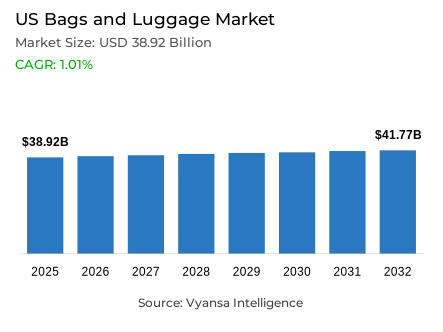
- Bags and luggage market size in US was estimated at USD 38.92 billion in 2025.
- The market size is expected to grow to USD 41.77 billion by 2032.
- Market to register a CAGR of around 1.01% during 2026-32.
- Category Shares
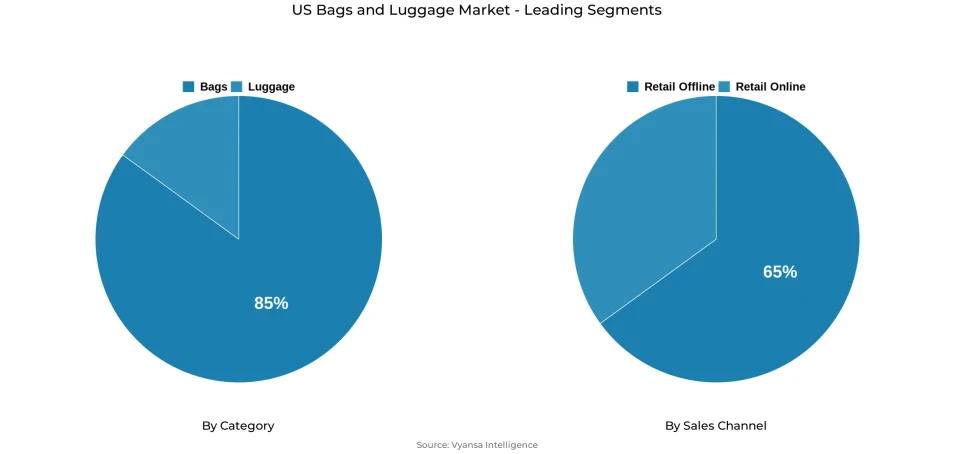
- Bags grabbed market share of 85%.
- Competition
- More than 20 companies are actively engaged in producing bags and luggage in US.
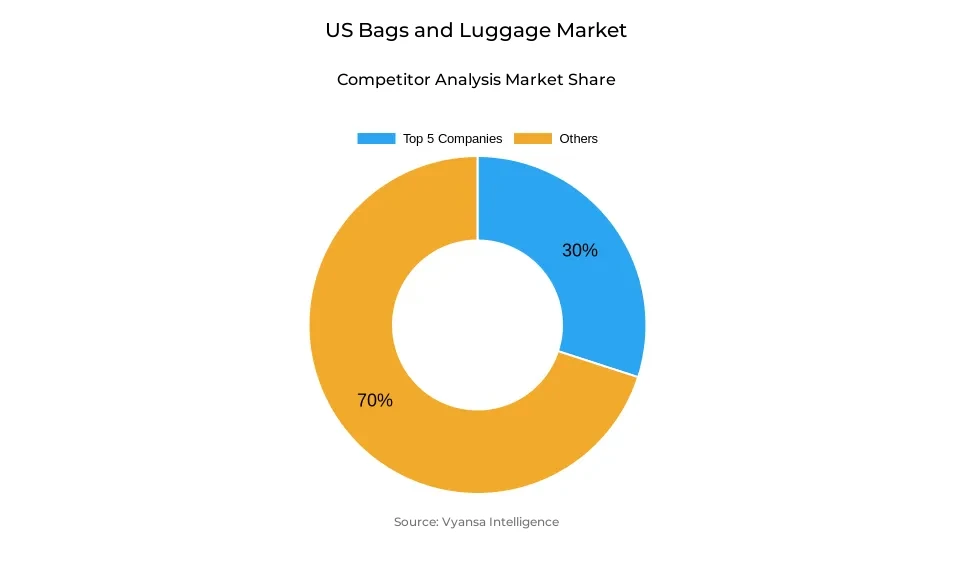
- Top 5 companies acquired around 30% of the market share.
- Hermès International SCA, Nike Inc, VF Outdoor Inc, LVMH Moët Hennessy Louis Vuitton Inc, Tapestry Inc etc., are few of the top companies.
- Sales Channel
- Retail offline grabbed 65% of the market.
US Bags and Luggage Market Outlook
The US bags and luggage market is entering a phase of healthy normalisation, supported by strong travel activity and growing preference for versatile, high-quality products. Despite cost-of-living pressures, consumers continue prioritising experiential spending, particularly domestic and international travel. The market is valued at USD 38.92 billion in 2025 and is projected to reach USD 41.67 billion by 2032, reflecting a stable CAGR of approximately 1.01% during 2026-32.
Consumer preferences are increasingly practical and value-driven, with bags dominating the market at an 85% share. Versatility remains the key driver, as multi-purpose backpacks and crossbody bags outperform traditional business formats. While ultra-luxury brands such as Hermès and Chanel remain resilient due to high-income demand, entry-level luxury faces growing competition from imitation and trend-driven products amplified by social media.
Innovation is increasingly centred on sustainability and evolving distribution models. Brands are responding to rising demand for environmentally friendly attributes, including recycled and waterproof materials, while resale platforms gain traction among value-conscious consumers. Retail offline holds approximately 65% of the market, though traditional department stores are gradually losing share to immersive brand-led stores and selective wholesale partnerships.
Overall, the market outlook remains positive. While luggage replacement cycles may moderate following recent upgrades, sustained demand for practical everyday bags and enduring appeal of luxury craftsmanship are expected to support value growth through 2032.
US Bags and Luggage Market Growth DriverTravel Volumes Keep Luggage Demand Firm
Travel activity remains strong, supporting sustained demand for luggage and travel-oriented bags. In 2024, US resident outbound travel reached a record 107.7 million trips, a 9.2% increase over 2023, indicating continued strength in international travel according to NTTO, U.S. Department of Commerce. Among overseas outbound air travellers, the average length of stay reached 15.3 nights, with average expenditure outside the US of USD 1,907.
Air travel volumes also remain elevated. In December 2024, U.S. airlines transported 83.3 million systemwide scheduled passengers, 4.7% more than in December 2023 according to Bureau of Transportation Statistics. This level of mobility accelerates wear and tear on suitcases and travel bags, supporting replacement and upgrade purchases. Consumers increasingly prioritise durable shells, well-organised compartments, and weather-resistant materials, encouraging innovation in capacity and functional design.
US Bags and Luggage Market ChallengeCost-of-Living Pressures Tighten Discretionary Spend
Rising living costs continue to make shoppers cautious about discretionary purchases such as bags and luggage. In the 12 months to December 2024, the US Consumer Price Index rose 2.9%, while core inflation increased 3.2% according to U.S. Bureau of Labor Statistics. Key household expenses remain elevated, with the shelter index rising 4.6% and food away from home increasing 3.6% over the same period.
As essential costs absorb a larger share of household budgets, consumers increasingly trade down, delay upgrades, or opt for value-oriented products when purchasing luggage. This pressure affects entry-level luxury and premium brands more than ultra-luxury labels with established high-income clientele. Retailers rely more heavily on promotions to stimulate demand, while brands face growing difficulty passing on cost increases without slowing sell-through.
Unlock Market Intelligence
Explore the market potential with our data-driven report
US Bags and Luggage Market TrendDigital Commerce Gains Ground in Distribution
Shopping behaviour continues to shift toward digital platforms, reshaping how bags and luggage are discovered and purchased. According to the U.S. Census Bureau, total retail Retail online sales are projected to reach USD 1,192.6 billion in 2024, up 8.1% year on year. Fourth-quarter retail online sales alone amounted to USD 308.9 billion, representing 9.4% annual growth.
As online purchasing becomes standard, traditional department stores face intensifying competition, prompting brands to diversify distribution strategies. Digitally native players expand through owned stores and selective wholesale partnerships that support immersive merchandising, while established brands strengthen omnichannel capabilities. Online presence, consumer reviews, and transparent price comparison increasingly influence purchasing decisions across both luggage and everyday bag categories.
US Bags and Luggage Market OpportunityMobile Payments Support Smaller, Phone-First Carry Options
Rapid adoption of mobile payments is creating strong demand for compact, phone-first carry formats. According to the Federal Reserve Bank of Atlanta, 71% of consumers made at least one mobile phone payment in the 12 months ending October 2024. The share of payments made via mobile phone increased from 28% in 2023 to 32% in 2024.
As smartphones become central to payments and identification, demand rises for small crossbody bags, belt bags, and modular accessories that secure phones and key cards while ensuring easy access. Design differentiation increasingly focuses on phone sleeves, slim card storage, waterproofing, and lightweight construction, positioning these products as daily essentials for commuting, travel, and casual use. This phone-centric shift favours innovation beyond traditional wallets and large handbags.
Unlock Market Intelligence
Explore the market potential with our data-driven report
US Bags and Luggage Market Segmentation Analysis
By Category
- Bags
- Cross Body Bags
- Bags and Backpacks
- Business Bags
- Duffle Bags
- Clutches
- Others
- Luggage
- Soft Luggage
- Hard Luggage
- Wheeled Luggage
- Non-Wheeled Luggage
The segment with highest market share under category is Bags, accounting for approximately 85% of total market value. This dominance reflects strong consumer preference for versatile, functional designs suitable for work, travel, and daily use. Product appeal is enhanced through innovations such as organised compartments and water-resistant materials.
While luxury handbags continue to anchor desirability, the availability of trend-led designs and counterfeit products has supported volume growth, particularly in social-media-driven segments. Compared to the recent surge in luggage sales, bags are expected to register steadier, more sustainable growth, driven by demand for compact crossbody bags and multifunctional formats. Hybrid work patterns continue to reduce reliance on traditional business bags, while backpacks and multi-purpose handbags fill the gap. Sustainability-focused brands offering durable products at accessible prices are well positioned to sustain category leadership through 2032.
By Sales Channel
- Retail Offline
- Retail Online
Retail offline remains the dominant sales channel, holding approximately 65% market share. Specialist retailers continue to lead, offering curated environments that effectively communicate brand identity and product quality. Although retail online growth and brand-owned stores place pressure on traditional department stores, physical retail remains critical for tactile evaluation of materials, durability, and craftsmanship.
Offline retail is also evolving through creative collaborations, with digitally native brands entering wholesale spaces to extend reach. These environments enable immersive brand experiences that online-only competitors struggle to replicate. Despite the growing importance of omnichannel shopping, offline retail is expected to remain the primary consumer entry point by combining online research convenience with high-engagement in-store experiences.
List of Companies Covered in US Bags and Luggage Market
The companies listed below are highly influential in the US bags and luggage market, with a significant market share and a strong impact on industry developments.
- Hermès International SCA
- Nike Inc
- VF Outdoor Inc
- LVMH Moët Hennessy Louis Vuitton Inc
- Tapestry Inc
- Capri Holdings Ltd
- Samsonite International SA
- Gucci America Inc
- Kate Spade & Co Inc
- Tumi Inc
Competitive Landscape
The bags and luggage market in the US remains highly competitive, shaped by polarised demand and evolving retail strategies. Established players such as Samsonite continue to benefit from strong brand recognition in the mid-priced segment, although premium labels like Tumi face pressure from more value-conscious travellers. In luxury, Hermès and Chanel show greater resilience, supported by high-income consumers, while entry-level luxury brands experience softer demand. Distribution strategies are also shifting, with brands such as Away and Herschel Supply increasingly exploring wholesale partnerships and stand-alone experiential stores to offset department store decline and broaden consumer reach.
Frequently Asked Questions
Related Report
- Market Segmentation
- Research Scope
- Research Methodology
- Definitions and Assumptions
- Executive Summary
- US Bags and Luggage Market Policies, Regulations, and Standards
- US Bags and Luggage Market Dynamics
- Growth Factors
- Challenges
- Trends
- Opportunities
- US Bags and Luggage Market Statistics, 2022-2032F
- Market Size & Growth Outlook
- By Revenues in USD Million
- By Units Sold in Thousand Units
- Market Segmentation & Growth Outlook
- By Category
- Bags- Market Insights and Forecast 2022-2032, USD Million
- Cross Body Bags- Market Insights and Forecast 2022-2032, USD Million
- Bags and Backpacks- Market Insights and Forecast 2022-2032, USD Million
- Business Bags- Market Insights and Forecast 2022-2032, USD Million
- Duffle Bags- Market Insights and Forecast 2022-2032, USD Million
- Clutches- Market Insights and Forecast 2022-2032, USD Million
- Others- Market Insights and Forecast 2022-2032, USD Million
- Luggage- Market Insights and Forecast 2022-2032, USD Million
- Soft Luggage- Market Insights and Forecast 2022-2032, USD Million
- Hard Luggage- Market Insights and Forecast 2022-2032, USD Million
- Wheeled Luggage- Market Insights and Forecast 2022-2032, USD Million
- Non-Wheeled Luggage- Market Insights and Forecast 2022-2032, USD Million
- Bags- Market Insights and Forecast 2022-2032, USD Million
- By Sales Channel
- Retail Offline- Market Insights and Forecast 2022-2032, USD Million
- Retail Online- Market Insights and Forecast 2022-2032, USD Million
- By Material Type
- Soft Case- Market Insights and Forecast 2022-2032, USD Million
- Nylon- Market Insights and Forecast 2022-2032, USD Million
- Polyester- Market Insights and Forecast 2022-2032, USD Million
- Ballistic Nylon- Market Insights and Forecast 2022-2032, USD Million
- Hard Case- Market Insights and Forecast 2022-2032, USD Million
- Polycarbonate- Market Insights and Forecast 2022-2032, USD Million
- ABS (Acrylonitrile Butadiene Styrene)- Market Insights and Forecast 2022-2032, USD Million
- Polypropylene- Market Insights and Forecast 2022-2032, USD Million
- Soft Case- Market Insights and Forecast 2022-2032, USD Million
- By Price Category
- Luxury- Market Insights and Forecast 2022-2032, USD Million
- Mass/Economy- Market Insights and Forecast 2022-2032, USD Million
- Premium- Market Insights and Forecast 2022-2032, USD Million
- By Application
- Travel- Market Insights and Forecast 2022-2032, USD Million
- Business- Market Insights and Forecast 2022-2032, USD Million
- By Region
- West
- Midwest
- South
- North
- Northeast
- By Competitors
- Competition Characteristics
- Market Share & Analysis
- By Category
- Market Size & Growth Outlook
- US Bags Market Statistics, 2022-2032
- Market Size & Growth Outlook
- By Revenues in USD Million
- By Units Sold in Thousand Units
- Market Segmentation & Growth Outlook
- By Category- Market Insights and Forecast 2022-2032, USD Million
- By Sales Channel- Market Insights and Forecast 2022-2032, USD Million
- By Material Type- Market Insights and Forecast 2022-2032, USD Million
- By Price Category- Market Insights and Forecast 2022-2032, USD Million
- By Application- Market Insights and Forecast 2022-2032, USD Million
- By Region- Market Insights and Forecast 2022-2032, USD Million
- Market Size & Growth Outlook
- US Luggage Market Statistics, 2022-2032
- Market Size & Growth Outlook
- By Revenues in USD Million
- By Units Sold in Thousand Units
- Market Segmentation & Growth Outlook
- By Category- Market Insights and Forecast 2022-2032, USD Million
- By Sales Channel- Market Insights and Forecast 2022-2032, USD Million
- By Material Type- Market Insights and Forecast 2022-2032, USD Million
- By Price Category- Market Insights and Forecast 2022-2032, USD Million
- By Application- Market Insights and Forecast 2022-2032, USD Million
- By Region- Market Insights and Forecast 2022-2032, USD Million
- Market Size & Growth Outlook
- Competitive Outlook
- Company Profiles
- LVMH Moët Hennessy Louis Vuitton Inc
- Business Description
- Product Portfolio
- Collaborations & Alliances
- Recent Developments
- Financial Details
- Others
- Tapestry Inc
- Business Description
- Product Portfolio
- Collaborations & Alliances
- Recent Developments
- Financial Details
- Others
- Capri Holdings Ltd
- Business Description
- Product Portfolio
- Collaborations & Alliances
- Recent Developments
- Financial Details
- Others
- Samsonite International SA
- Business Description
- Product Portfolio
- Collaborations & Alliances
- Recent Developments
- Financial Details
- Others
- Gucci America Inc
- Business Description
- Product Portfolio
- Collaborations & Alliances
- Recent Developments
- Financial Details
- Others
- Hermès International SCA
- Business Description
- Product Portfolio
- Collaborations & Alliances
- Recent Developments
- Financial Details
- Others
- Nike Inc
- Business Description
- Product Portfolio
- Collaborations & Alliances
- Recent Developments
- Financial Details
- Others
- VF Outdoor Inc
- Business Description
- Product Portfolio
- Collaborations & Alliances
- Recent Developments
- Financial Details
- Others
- Kate Spade & Co Inc
- Business Description
- Product Portfolio
- Collaborations & Alliances
- Recent Developments
- Financial Details
- Others
- Tumi Inc
- Business Description
- Product Portfolio
- Collaborations & Alliances
- Recent Developments
- Financial Details
- Others
- LVMH Moët Hennessy Louis Vuitton Inc
- Company Profiles
- Disclaimer
| Segment | Sub-Segment |
|---|---|
| By Category |
|
| By Sales Channel |
|
| By Material Type |
|
| By Price Category |
|
| By Application |
|
| By Region |
|
Research Methodology
This study followed a structured approach comprising four key phases to assess the size and scope of the electro-oxidation market. The process began with thorough secondary research to collect data on the target market, related markets, and broader industry context. These findings, along with preliminary assumptions and estimates, were then validated through extensive primary research involving industry experts from across the value chain. To calculate the overall market size, both top-down and bottom-up methodologies were employed. Finally, market segmentation and data triangulation techniques were applied to refine and validate segment-level estimations.
Secondary Research
The secondary research phase involved gathering data from a wide range of credible and published sources. This step helped in identifying industry trends, defining market segmentation, and understanding the market landscape and value chain.
Sources consulted during this phase included:
- Company annual reports, investor presentations, and press releases
- Industry white papers and certified publications
- Trade directories and market-recognized databases
- Articles from authoritative authors and reputable journals
- Gold and silver standard websites
Secondary research was critical in mapping out the industry's value chain and monetary flow, identifying key market segments, understanding regional variations, and tracking significant industry developments.
Other key sources:
- Financial disclosures
- Industry associations and trade bodies
- News outlets and business magazines
- Academic journals and research studies
- Paid industry databases
Primary Research
To validate secondary data and gain deeper market insights, primary research was conducted with key stakeholders across both the supply and demand sides of the market.
On the demand side, participants included decision-makers and influencers from end-user industries—such as CIOs, CTOs, and CSOs—who provided first-hand perspectives on market needs, product usage, and future expectations.
On the supply side, interviews were conducted with manufacturers, industry associations, and institutional participants to gather insights into current offerings, product pipelines, and market challenges.
Primary interviews provided critical inputs such as:
- Market size and revenue data
- Product and service breakdowns
- Market forecasts
- Regional and application-specific trends
Stakeholders consulted included:
- Leading OEM and solution providers
- Channel and distribution partners
- End users across various applications
- Independent consultants and industry specialists
Market Size Estimation and Data Triangulation
- Identifying Key Market Participants (Secondary Research)
- Goal: To identify the major players or companies in the target market. This typically involves using publicly available data sources such as industry reports, market research publications, and financial statements of companies.
- Tools: Reports from firms like Gartner, Forrester, Euromonitor, Statista, IBISWorld, and others. Public financial statements, news articles, and press releases from top market players.
- Extracting Earnings of Key Market Participants
- Goal: To estimate the earnings generated from the product or service being analyzed. This step helps in understanding the revenue potential of each market player in a specific geography.
- Methods: Earnings data can be gathered from:
- Publicly available financial reports (for listed companies).
- Interviews and primary data sources from professionals, such as Directors, VPs, SVPs, etc. This is especially useful for understanding more nuanced, internal data that isn't publicly disclosed.
- Annual reports and investor presentations of key players.
- Data Collation and Development of a Relevant Data Model
- Goal: To collate inputs from both primary and secondary sources into a structured, data-driven model for market estimation. This model will incorporate key market KPIs and any independent variables relevant to the market.
- Key KPIs: These could include:
- Market size, growth rate, and demand drivers.
- Industry-specific metrics like market share, average revenue per customer (ARPC), or average deal size.
- External variables, such as economic growth rates, inflation rates, or commodity prices, that could affect the market.
- Data Modeling: Based on this data, the market forecasts are developed for the next 5 years. A combination of trend analysis, scenario modeling, and statistical regression might be used to generate projections.
- Scenario Analysis
- Goal: To test different assumptions and validate how sensitive the market is to changes in key variables (e.g., market demand, regulatory changes, technological disruptions).
- Types of Scenarios:
- Base Case: Based on current assumptions and historical data.
- Best-Case Scenario: Assuming favorable market conditions, regulatory environments, and technological advancements.
- Worst-Case Scenario: Accounting for adverse factors, such as economic downturns, stricter regulations, or unexpected disruptions.












