UAE Skin Care Market Report: Trends, Growth and Forecast (2025-2030)
By Product (Body Care, Facial Care, Hand Care, Skin Care Sets/Kits), By Category (Premium, Mass), By Gender (Men, Women, Unisex), By End User (Adults, Teenagers, Children), By Packaging (Tubes, Bottles, Jars, Others), By Sales Channel (Online, Offline) ... Read more
|
Major Players
|
UAE Skin Care Market Statistics, 2025
- Market Size Statistics
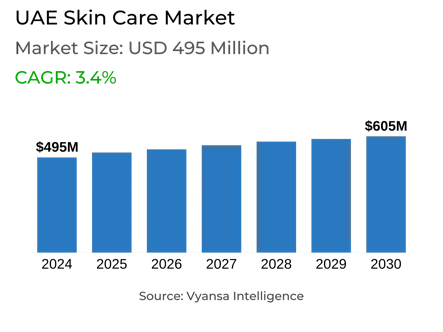
- Skin Care in UAE is estimated at $ 495 Million.
- The market size is expected to grow to $ 605 Million by 2030.
- Market to register a CAGR of around 3.4% during 2025-30.
- Product Shares
- Facial Care grabbed market share of 70%.
- Competition
- More than 20 companies are actively engaged in producing Skin Care in UAE.
- Top 5 companies acquired 35% of the market share.
- Dabur International Ltd, Clarins Group Middle East Ltd, Estée Lauder Middle East FZE, L'Oréal Middle East FZE, Beiersdorf Middle East etc., are few of the top companies.
- Sales Channel
- Retail Offline grabbed 85% of the market.
UAE Skin Care Market Outlook
United Arab Emirates skin care industry will keep growing from 2025 to 2030, driven by an increased emphasis on wellness and longevity. Customers are more and more linking emotional health and physical appearance, and there is increased knowledge of how stress and hormones impact the skin. Words such as "dopamine" and "cortisol" are increasingly heard in the world of beauty, as there is a turn toward holistic treatment that combines science, skincare, and mental health.
Skin care continues to be the largest and quickest-growing segment because of the nation's adverse climate, which leads to skin issues like dehydration, pigmentation, and ageing. High-end products, particularly those prescribed by dermatologists, are finding more favour, with brands like Bioderma and La Roche-Posay leading in consumer confidence and scientific authenticity. Clinics like The Longevity Clinic and Ouronyx are also pushing demand for cutting-edge, science-backed treatments beyond traditional skin care.
Distribution is changing, with beauty specialist retailers such as Sephora holding on to leadership positions, while pharmacies and internet retailing are experiencing strong growth. Pharmacies, in specific, are enjoying growth in response to increasing demand for clinically supported products, while online channels are becoming central channels both for mass and premium products.
Cultural heritage and local pride are also influencing the market. Gen Z consumers are interested in ingredients with strong regional heritage, such as dates and black seed, and are adopting brands that resonate with their identity. Such a trend is revolutionizing skin care as a means of self-expression, blurring lines between modern science and authenticity along with community connection.

UAE Skin Care Market Growth Driver
End Users in the UAE are increasingly prioritising long-term skin health and consequently increasing demand for products that extend beyond mere hydration. While moisturising and skin barrier support continue to be the major issues, interest is now building in anti-ageing actives such as retinol. The discussion is moving away from masking signs of ageing towards preventing or even reversing them, which is consistent with wider aspirations for longevity and well-being.
The change is due to the emerging high end wellness ideas such as The Longevity Clinic by Clinique La Prairie, which combines the skin care with science-driven treatments and supplements to provide long-term outcomes. Similarly, Ouronyx, which is a facial aesthetics business in the UAE, integrates advanced beauty treatments with science and technology. Its consultation process involves medical evaluations, personality profiling, and detailed facial analysis. These clinics are projected to grow during the forecast period, favoring the market's shifting emphasis on longevity.
UAE Skin Care Market Trend
One increasing trend in the UAE skin care market is the emergence of local ingredients rooted in Arab culture. Saudi brand Aiza exemplifies this with the use of locally respected ingredients such as dates, honey, and black seed, renowned for their healing and anti-inflammatory properties. These ingredients, which hold great significance within the region's heritage, are at the forefront of Aiza's brand identity. The company emphasizes their ancient uses and advantages, appealing powerfully to Gen Z consumers who are looking for natural and genuine products.
Younger generations are increasingly relating well-being to cultural pride and identity. That's why this transformation is being observed in the way brands are positioning themselves—featuring Middle Eastern or African-looking models and shunning the European look. Emirati influencer-led brands are also catching up by highlighting real consumers rather than models. This new focus on cultural representation and authenticity is transforming the beauty scene in the region.
Unlock Market Intelligence
Explore the market potential with our data-driven report
| Report Coverage | Details |
|---|---|
| Market Forecast | 2025-30 |
| USD Value 2024 | $ 495 Million |
| USD Value 2030 | $ 605 Million |
| CAGR 2025-2030 | 3.4% |
| Largest Category | Facial Care segment leads with 70% market share |
| Top Drivers | Rising Consumer Interest in Longevity and Skin Vitality |
| Top Trends | Embracing Local Ingredients and Cultural Identity |
| Key Players | Dabur International Ltd, Clarins Group Middle East Ltd, Estée Lauder Middle East FZE, L'Oréal Middle East FZE, Beiersdorf Middle East, Unilever Gulf FZE, NAOS SAS, Procter & Gamble Gulf FZE, Johnson & Johnson Middle East FZ-LLC, La Prairie Group AG and Others. |
Unlock Market Intelligence
Explore the market potential with our data-driven report
UAE Skin Care Market Segmentation Analysis
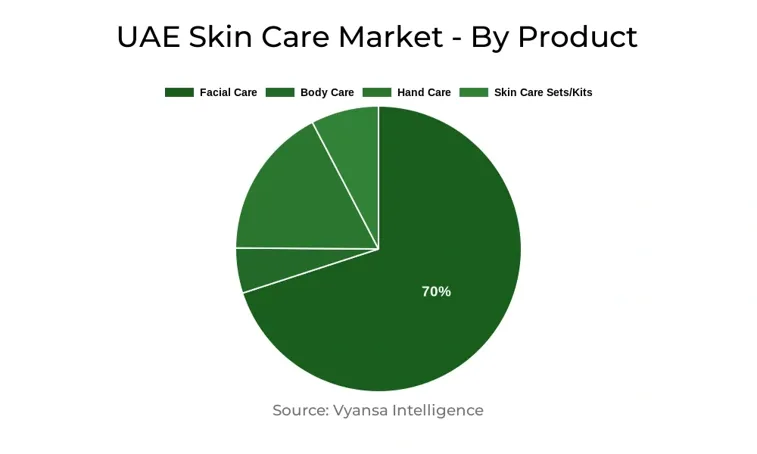
The largest market share under the product type segment is Facial Care in the UAE skin care market. It is largely due to the facial care unit prices being higher overall, and customers are willing to invest more in high-quality items for their face than for the rest of their body. The upscale presence of high-income consumers, both locals and expatriates, continues to drive the development of high-end and dermatologist-recommended facial care brands.
The hot climate in the UAE is characterized by hot sunshine, dry air, and copious dust which produces typical skin issues such as pigmentation, dehydration, and premature ageing. This generates high demand for facial products such as moisturisers, sunscreens, serums, and anti-ageing treatments. Consequently, facial care is the best-performing category in the market and is forecast to drive growth between 2025 and 2030.
Top Companies in UAE Skin Care Market
The top companies operating in the market include Dabur International Ltd, Clarins Group Middle East Ltd, Estée Lauder Middle East FZE, L'Oréal Middle East FZE, Beiersdorf Middle East, Unilever Gulf FZE, NAOS SAS, Procter & Gamble Gulf FZE, Johnson & Johnson Middle East FZ-LLC, La Prairie Group AG, etc., are the top players operating in the UAE Skin Care Market.
Frequently Asked Questions
Related Report
1. Market Segmentation
1.1. Research Scope
1.2. Research Methodology
1.3. Definitions and Assumptions
2. Executive Summary
3. UAE Skin Care Market Policies, Regulations, and Standards
4. UAE Skin Care Market Dynamics
4.1. Growth Factors
4.2. Challenges
4.3. Trends
4.4. Opportunities
5. UAE Skin Care Market Statistics, 2020-2030F
5.1. Market Size & Growth Outlook
5.1.1.By Revenues in US$ Million
5.2. Market Segmentation & Growth Outlook
5.2.1.By Product
5.2.1.1. Body Care- Market Insights and Forecast 2020-2030, USD Million
5.2.1.1.1. Firming Body Care- Market Insights and Forecast 2020-2030, USD Million
5.2.1.1.2. General Purpose Body Care- Market Insights and Forecast 2020-2030, USD Million
5.2.1.2. Facial Care- Market Insights and Forecast 2020-2030, USD Million
5.2.1.2.1. Acne Treatments- Market Insights and Forecast 2020-2030, USD Million
5.2.1.2.2. Face Masks- Market Insights and Forecast 2020-2030, USD Million
5.2.1.2.3. Facial Cleansers- Market Insights and Forecast 2020-2030, USD Million
5.2.1.2.3.1. Liquid- Market Insights and Forecast 2020-2030, USD Million
5.2.1.2.3.2. Cream- Market Insights and Forecast 2020-2030, USD Million
5.2.1.2.3.3. Gel- Market Insights and Forecast 2020-2030, USD Million
5.2.1.2.3.4. Bar Cleansers- Market Insights and Forecast 2020-2030, USD Million
5.2.1.2.3.5. Facial Cleansing Wipes- Market Insights and Forecast 2020-2030, USD Million
5.2.1.2.4. Moisturisers and Treatments- Market Insights and Forecast 2020-2030, USD Million
5.2.1.2.4.1. Basic Moisturisers- Market Insights and Forecast 2020-2030, USD Million
5.2.1.2.4.2. Anti-Agers- Market Insights and Forecast 2020-2030, USD Million
5.2.1.2.5. Lip Care- Market Insights and Forecast 2020-2030, USD Million
5.2.1.2.6. Toners- Market Insights and Forecast 2020-2030, USD Million
5.2.1.3. Hand Care- Market Insights and Forecast 2020-2030, USD Million
5.2.1.4. Skin Care Sets/Kits- Market Insights and Forecast 2020-2030, USD Million
5.2.2.By Category
5.2.2.1. Premium- Market Insights and Forecast 2020-2030, USD Million
5.2.2.2. Mass- Market Insights and Forecast 2020-2030, USD Million
5.2.3.By Gender
5.2.3.1. Men- Market Insights and Forecast 2020-2030, USD Million
5.2.3.2. Women- Market Insights and Forecast 2020-2030, USD Million
5.2.3.3. Unisex- Market Insights and Forecast 2020-2030, USD Million
5.2.4.By End User
5.2.4.1. Adults- Market Insights and Forecast 2020-2030, USD Million
5.2.4.2. Teenagers- Market Insights and Forecast 2020-2030, USD Million
5.2.4.3. Children- Market Insights and Forecast 2020-2030, USD Million
5.2.5.By Packaging
5.2.5.1. Tubes- Market Insights and Forecast 2020-2030, USD Million
5.2.5.2. Bottles- Market Insights and Forecast 2020-2030, USD Million
5.2.5.3. Jars- Market Insights and Forecast 2020-2030, USD Million
5.2.5.4. Others- Market Insights and Forecast 2020-2030, USD Million
5.2.6.By Sales Channel
5.2.6.1. Online- Market Insights and Forecast 2020-2030, USD Million
5.2.6.2. Offline- Market Insights and Forecast 2020-2030, USD Million
5.2.7.By Competitors
5.2.7.1. Competition Characteristics
5.2.7.2. Market Share & Analysis
6. UAE Body Care Market Statistics, 2020-2030F
6.1. Market Size & Growth Outlook
6.1.1.By Revenues in US$ Million
6.2. Market Segmentation & Growth Outlook
6.2.1.By Product- Market Insights and Forecast 2020-2030, USD Million
6.2.2.By Category- Market Insights and Forecast 2020-2030, USD Million
6.2.3.By Gender- Market Insights and Forecast 2020-2030, USD Million
6.2.4.By End User- Market Insights and Forecast 2020-2030, USD Million
6.2.5.By Packaging- Market Insights and Forecast 2020-2030, USD Million
6.2.6.By Sales Channel- Market Insights and Forecast 2020-2030, USD Million
7. UAE Facial Care Market Statistics, 2020-2030F
7.1. Market Size & Growth Outlook
7.1.1.By Revenues in US$ Million
7.2. Market Segmentation & Growth Outlook
7.2.1.By Product- Market Insights and Forecast 2020-2030, USD Million
7.2.2.By Category- Market Insights and Forecast 2020-2030, USD Million
7.2.3.By Gender- Market Insights and Forecast 2020-2030, USD Million
7.2.4.By End User- Market Insights and Forecast 2020-2030, USD Million
7.2.5.By Packaging- Market Insights and Forecast 2020-2030, USD Million
7.2.6.By Sales Channel- Market Insights and Forecast 2020-2030, USD Million
8. UAE Hand Care Market Statistics, 2020-2030F
8.1. Market Size & Growth Outlook
8.1.1.By Revenues in US$ Million
8.2. Market Segmentation & Growth Outlook
8.2.1.By Category- Market Insights and Forecast 2020-2030, USD Million
8.2.2.By Gender- Market Insights and Forecast 2020-2030, USD Million
8.2.3.By End User- Market Insights and Forecast 2020-2030, USD Million
8.2.4.By Packaging- Market Insights and Forecast 2020-2030, USD Million
8.2.5.By Sales Channel- Market Insights and Forecast 2020-2030, USD Million
9. UAE Skin Care Sets/Kits Market Statistics, 2020-2030F
9.1. Market Size & Growth Outlook
9.1.1.By Revenues in US$ Million
9.2. Market Segmentation & Growth Outlook
9.2.1.By Category- Market Insights and Forecast 2020-2030, USD Million
9.2.2.By Gender- Market Insights and Forecast 2020-2030, USD Million
9.2.3.By End User- Market Insights and Forecast 2020-2030, USD Million
9.2.4.By Packaging- Market Insights and Forecast 2020-2030, USD Million
9.2.5.By Sales Channel- Market Insights and Forecast 2020-2030, USD Million
10. Competitive Outlook
10.1. Company Profiles
10.1.1. L'Oréal Middle East FZE
10.1.1.1. Business Description
10.1.1.2. Product Portfolio
10.1.1.3. Collaborations & Alliances
10.1.1.4. Recent Developments
10.1.1.5. Financial Details
10.1.1.6. Others
10.1.2. Beiersdorf Middle East
10.1.2.1. Business Description
10.1.2.2. Product Portfolio
10.1.2.3. Collaborations & Alliances
10.1.2.4. Recent Developments
10.1.2.5. Financial Details
10.1.2.6. Others
10.1.3. Unilever Gulf FZE
10.1.3.1. Business Description
10.1.3.2. Product Portfolio
10.1.3.3. Collaborations & Alliances
10.1.3.4. Recent Developments
10.1.3.5. Financial Details
10.1.3.6. Others
10.1.4. NAOS SAS
10.1.4.1. Business Description
10.1.4.2. Product Portfolio
10.1.4.3. Collaborations & Alliances
10.1.4.4. Recent Developments
10.1.4.5. Financial Details
10.1.4.6. Others
10.1.5. Procter & Gamble Gulf FZE
10.1.5.1. Business Description
10.1.5.2. Product Portfolio
10.1.5.3. Collaborations & Alliances
10.1.5.4. Recent Developments
10.1.5.5. Financial Details
10.1.5.6. Others
10.1.6. Dabur International Ltd
10.1.6.1. Business Description
10.1.6.2. Product Portfolio
10.1.6.3. Collaborations & Alliances
10.1.6.4. Recent Developments
10.1.6.5. Financial Details
10.1.6.6. Others
10.1.7. Clarins Group Middle East Ltd
10.1.7.1. Business Description
10.1.7.2. Product Portfolio
10.1.7.3. Collaborations & Alliances
10.1.7.4. Recent Developments
10.1.7.5. Financial Details
10.1.7.6. Others
10.1.8. Estée Lauder Middle East FZE
10.1.8.1. Business Description
10.1.8.2. Product Portfolio
10.1.8.3. Collaborations & Alliances
10.1.8.4. Recent Developments
10.1.8.5. Financial Details
10.1.8.6. Others
10.1.9. Johnson & Johnson Middle East FZ-LLC
10.1.9.1. Business Description
10.1.9.2. Product Portfolio
10.1.9.3. Collaborations & Alliances
10.1.9.4. Recent Developments
10.1.9.5. Financial Details
10.1.9.6. Others
10.1.10. La Prairie Group AG
10.1.10.1.Business Description
10.1.10.2.Product Portfolio
10.1.10.3.Collaborations & Alliances
10.1.10.4.Recent Developments
10.1.10.5.Financial Details
10.1.10.6.Others
11. Disclaimer
| Segment | Sub-Segment |
|---|---|
| By Product |
|
| By Category |
|
| By Gender |
|
| By End User |
|
| By Packaging |
|
| By Sales Channel |
|
Research Methodology
This study followed a structured approach comprising four key phases to assess the size and scope of the electro-oxidation market. The process began with thorough secondary research to collect data on the target market, related markets, and broader industry context. These findings, along with preliminary assumptions and estimates, were then validated through extensive primary research involving industry experts from across the value chain. To calculate the overall market size, both top-down and bottom-up methodologies were employed. Finally, market segmentation and data triangulation techniques were applied to refine and validate segment-level estimations.
Secondary Research
The secondary research phase involved gathering data from a wide range of credible and published sources. This step helped in identifying industry trends, defining market segmentation, and understanding the market landscape and value chain.
Sources consulted during this phase included:
- Company annual reports, investor presentations, and press releases
- Industry white papers and certified publications
- Trade directories and market-recognized databases
- Articles from authoritative authors and reputable journals
- Gold and silver standard websites
Secondary research was critical in mapping out the industry's value chain and monetary flow, identifying key market segments, understanding regional variations, and tracking significant industry developments.
Other key sources:
- Financial disclosures
- Industry associations and trade bodies
- News outlets and business magazines
- Academic journals and research studies
- Paid industry databases
Primary Research
To validate secondary data and gain deeper market insights, primary research was conducted with key stakeholders across both the supply and demand sides of the market.
On the demand side, participants included decision-makers and influencers from end-user industries—such as CIOs, CTOs, and CSOs—who provided first-hand perspectives on market needs, product usage, and future expectations.
On the supply side, interviews were conducted with manufacturers, industry associations, and institutional participants to gather insights into current offerings, product pipelines, and market challenges.
Primary interviews provided critical inputs such as:
- Market size and revenue data
- Product and service breakdowns
- Market forecasts
- Regional and application-specific trends
Stakeholders consulted included:
- Leading OEM and solution providers
- Channel and distribution partners
- End users across various applications
- Independent consultants and industry specialists
Market Size Estimation and Data Triangulation
- Identifying Key Market Participants (Secondary Research)
- Goal: To identify the major players or companies in the target market. This typically involves using publicly available data sources such as industry reports, market research publications, and financial statements of companies.
- Tools: Reports from firms like Gartner, Forrester, Euromonitor, Statista, IBISWorld, and others. Public financial statements, news articles, and press releases from top market players.
- Extracting Earnings of Key Market Participants
- Goal: To estimate the earnings generated from the product or service being analyzed. This step helps in understanding the revenue potential of each market player in a specific geography.
- Methods: Earnings data can be gathered from:
- Publicly available financial reports (for listed companies).
- Interviews and primary data sources from professionals, such as Directors, VPs, SVPs, etc. This is especially useful for understanding more nuanced, internal data that isn't publicly disclosed.
- Annual reports and investor presentations of key players.
- Data Collation and Development of a Relevant Data Model
- Goal: To collate inputs from both primary and secondary sources into a structured, data-driven model for market estimation. This model will incorporate key market KPIs and any independent variables relevant to the market.
- Key KPIs: These could include:
- Market size, growth rate, and demand drivers.
- Industry-specific metrics like market share, average revenue per customer (ARPC), or average deal size.
- External variables, such as economic growth rates, inflation rates, or commodity prices, that could affect the market.
- Data Modeling: Based on this data, the market forecasts are developed for the next 5 years. A combination of trend analysis, scenario modeling, and statistical regression might be used to generate projections.
- Scenario Analysis
- Goal: To test different assumptions and validate how sensitive the market is to changes in key variables (e.g., market demand, regulatory changes, technological disruptions).
- Types of Scenarios:
- Base Case: Based on current assumptions and historical data.
- Best-Case Scenario: Assuming favorable market conditions, regulatory environments, and technological advancements.
- Worst-Case Scenario: Accounting for adverse factors, such as economic downturns, stricter regulations, or unexpected disruptions.












