UAE Construction Equipment Rental Market Report: Trends, Growth and Forecast (2026-2032)
By Type of Equipment (Earthmoving Equipment (Excavators, Loaders, Bulldozers, Skid Steer Loaders, Motor Graders, Crawler Loaders, Trenchers, Dump Trucks, Others), Material Handling Equipment (Cranes, Forklifts, Tippers, Others), Other Construction Equipment (Road Rollers, Diesel Generators, Others)), By Propulsion (Diesel, Gas (CNG, LPG), Electric), By Application (Power & Utilities, Mining, Hospitality, Residential, Healthcare & Educational, Roads & Highway, Manufacturing Units, Others), By Engine Capacity (<5L, 5-10L, 10L), By Power Output (<100 HP, 101-200 HP, 201-400 HP, 400 HP) ... Read more
|
Major Players
|
UAE Construction Equipment Rental Market Statistics and Insights, 2026
- Market Size Statistics
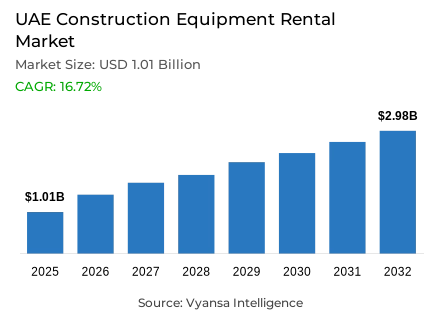
- Construction equipment rental market size in UAE was estimated at USD 1.01 billion in 2025.
- The market size is expected to grow to USD 2.98 billion by 2032.
- Market to register a CAGR of around 16.72% during 2026-32.
- Type of Equipment Shares
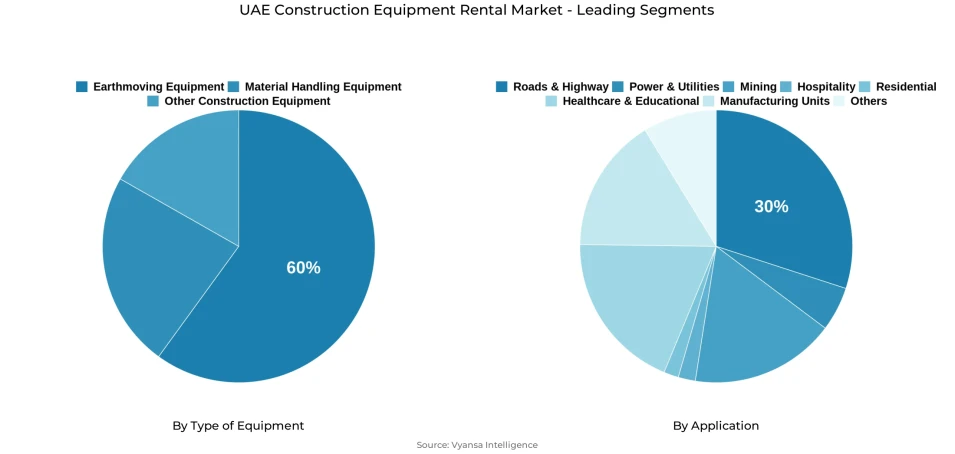
- Earthmoving equipment grabbed market share of 60%.
- Competition
- Construction equipment rental in UAE is currently being catered to by more than 10 companies.
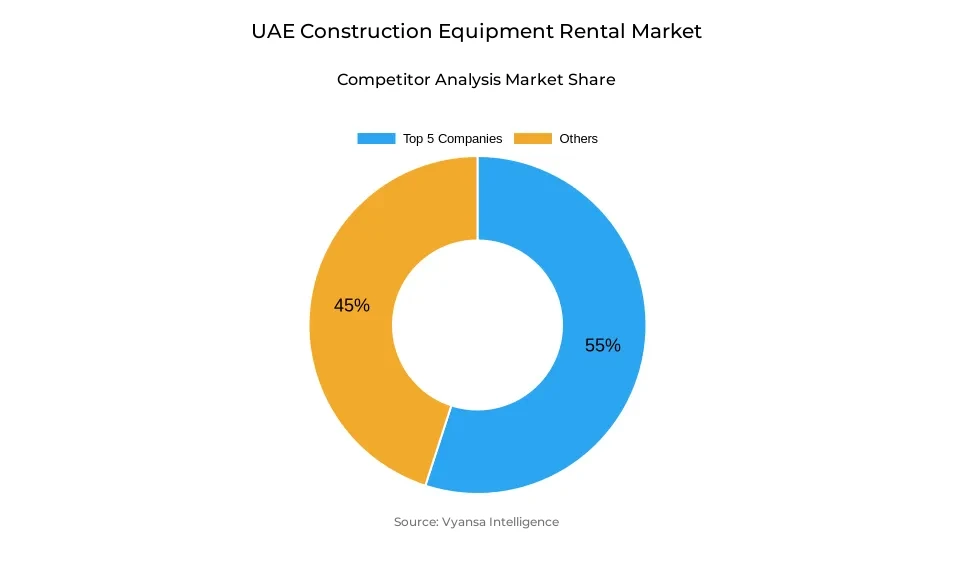
- Top 5 companies acquired around 55% of the market share.
- Johnson Arabia, Al Faris Group, Al Shola Rental, Byrne Equipment Rental, Al Jaber Leasing Services (ALES) etc., are few of the top companies.
- Application
- Roads & highway grabbed 30% of the market.
UAE Construction Equipment Rental Market Outlook
The UAE construction equipment rental market size was valued at USD 1.01 billion in 2025 and is projected to grow from USD 1.24 billion in 2026 to USD 2.98 billion by 2032, exhibiting a CAGR of 16.72% during the forecast period. Growth is supported by sustained infrastructure execution, disciplined fiscal planning, and rising preference for asset-light project models across large civil and transport developments.
Government spending in 2026 continues to fuel project development. The general budget for the country is AED 92.4 billion, a 29% increase from 2025, and Dubai’s budget is AED 99.5 billion, with 48% allocated to infrastructure. Projects are being implemented in roads, bridges, tunnels, and utilities at various locations, thereby increasing the demand for construction equipment rental to manage peak development without incurring the costs of ownership. This enables contractors to expand their fleet size for earthworks and civils and then demobilize quickly once development milestones are achieved.
The financial environment in 2026 is also influencing the manner in which these purchases will be executed. The Central Bank of the UAE maintained the Base Rate at 3.65% as of January 2026, thereby maintaining high financing costs and tighter liquidity for contractors and equipment rental companies. Under these conditions, the construction equipment rental industry provides a platform to enhance cash flow, reduce development costs, and manage balance sheet risk, particularly for contractors working on phased infrastructure development projects with government funding.
Dynamics within the industry further contribute to a stable outlook. In 2025, Earthmoving Equipment dominated demand at 60% of the total, thereby emphasizing its importance in excavation, grading, and site development. By application, Roads & Highways contributed 30% of demand, primarily due to parallel development of projects that require a comprehensive fleet consisting of excavators, graders, rollers, and ancillary equipment. With the continued focus on infrastructure development and logistics-driven real estate, it is likely that strategic fleet management approaches will remain in place until 2032.
UAE Construction Equipment Rental Market Growth Driver
Sustained Public Capital Allocation Reinforcing Project Activity
Government expenditure in 2026 remains a key driver of demand for equipment rentals in the UAE construction equipment market. The UAE federal general budget for 2026 is AED 92.4 billion, an increase of 29% from 2025, indicating continued fiscal strength to pursue development initiatives and public infrastructure. Dubai’s government expenditure budget for 2026 is AED 99.5 billion, with 48% allocated to infrastructure projects such as roads, bridges, tunnels, utilities, and public transportation systems.
From an execution perspective, contractors undertaking multiple public infrastructure projects increasingly turn to equipment rental solutions to efficiently manage peak construction periods without taking on long-term equipment ownership risks. Rental solutions support rapid scaling during earthworks, civils, and utility installation projects, followed by demobilization after project milestones are reached. This approach minimizes equipment downtime, maintenance costs, and balance sheet risks, solidifying equipment rental as a strategic asset-light management solution for end-users undertaking publicly funded infrastructure projects.
UAE Construction Equipment Rental Market Challenge
Elevated Financing Costs Pressuring Project Liquidity
Tighter monetary policy environment in 2026 is reducing liquidity for contractors and equipment fleet operators in the UAE construction equipment rental industry. The Central Bank of the UAE maintained the Base Rate for the Overnight Deposit Facility at 3.65% as of 28 January 2026, and the cost of borrowing for standing credit facilities is 50 basis points above the Base Rate. This makes the cost of equipment purchased through bank loans, hire-purchase agreements, and operating leases higher due to increased monthly payments and working capital cycles.
For contractors, this means tighter management of project cash flows, longer mobilization times, and a focus on delivering only mission-critical equipment. At the same time, rental companies must contend with heightened receivables risk while financing their fleets. This has led to a scenario where credit screening criteria are being tightened, utilization targets are being more closely tracked, and financing risk is increasingly being incorporated into pricing structures. These factors, taken together, serve to temper growth rates despite continued infrastructure spending.
Unlock Market Intelligence
Explore the market potential with our data-driven report
UAE Construction Equipment Rental Market Trend
Multi-Year Budget Visibility Shaping Long-Term Rental Frameworks
The UAE construction equipment rental market is being transformed by the adoption of structured multi-year fiscal planning. Dubai’s approved three-year government budget cycle for 2026-2028 sets total spending of AED 302.7 billion against expected revenues of AED 329.2 billion, effectively incorporating the 2026 annual budget within a broader planning framework. With 48% of 2026 spending committed to infrastructure spending, contractors now have greater visibility of their projects over the medium term, especially within the context of phased civil and transport sector projects.
This increased visibility is propelling a transition toward framework-based rental agreements and longer-term structured contracts rather than piecemeal short-term hires. Contractors are increasingly demanding guaranteed equipment availability, substitution, and maintenance commitments over multi-stage project timelines. Rental companies are adapting by structuring longer-term contracts centered on uptime and service commitments, effectively positioning themselves as project partners rather than mere asset suppliers. The focus is increasingly shifting from daily rate competitiveness to lifecycle reliability and continuity.
UAE Construction Equipment Rental Market Opportunity
Expanding Trade Activity Broadening Rental Deployment Scenarios
The positive non-oil trade trend is also opening up new ways of deploying rental fleets of equipment outside of the construction industry. Abu Dhabi Customs recorded a 34.7% increase in non-oil foreign trade during H1 2025, amounting to AED 195.4 billion, up from AED 145 billion in H1 2024. In this respect, non-oil exports increased by 64% to AED 78.5 billion, imports by 15% to AED 80 billion, and re-exports by 35% to above AED 36 billion, which indicates the increasing cargo processing activity at ports and border points.
The increasing cargo processing activities require the development of new logistics infrastructure, storage facilities, and industrial zones. These developments require equipment deployment with a short cycle duration but high intensity, such as material handling equipment, loaders, compact earthmoving equipment, and support equipment for the construction site. This makes equipment rental a viable option for the end-user with fluctuating throughput cycles, seasonal peaks, and staged industrial zone development, thus expanding the addressable market within the construction equipment rental industry.
Unlock Market Intelligence
Explore the market potential with our data-driven report
UAE Construction Equipment Rental Market Segmentation Analysis
By Type of Equipment
- Earthmoving Equipment
- Material Handling Equipment
- Other Construction Equipment
Under the type of equipment segment, Earthmoving Equipment holds the majority share of approximately 60% within the UAE construction equipment rental market, reflecting its centrality to nearly all construction phases. Most projects across roads, residential developments, commercial complexes, and industrial plots begin with extensive site preparation activities such as clearing, excavation, grading, trenching, and backfilling. These foundational tasks create consistent baseline demand for excavators, backhoe loaders, wheel loaders, dozers, and compactors before structural and finishing stages commence.
Earthmoving assets typically operate under high-hour, high-wear conditions, exposing owners to elevated maintenance risk and depreciation pressure. Renting mitigates resale uncertainty and repair cost volatility for end users, particularly when project timelines are compressed. Rental companies further strengthen their positioning by offering attachment flexibility, rapid equipment swaps, and on-site technical support, ensuring productivity continuity as ground conditions and site specifications evolve across project lifecycles.
By Application
- Power & Utilities
- Mining
- Hospitality
- Residential
- Healthcare & Educational
- Roads & Highway
- Manufacturing Units
- Others
In application terms, Roads & Highway holds the majority share of around 30% share of demand in the UAE construction equipment rental market. Road packages commonly involve parallel work fronts encompassing earthworks, drainage systems, subgrade preparation, asphalt laying, and interchange integration. The simultaneous execution of these activities generates sustained need for diversified fleets that can be mobilised across multiple segments while adhering to strict traffic management and milestone schedules.
Such projects require a comprehensive equipment stack, including excavators, graders, rollers, pavers, loaders, dump support units, lighting towers, and generators for extended or night-shift operations. Rental structures provide the flexibility to shift machinery between crews and align fleet size with evolving site conditions. Bundled maintenance, standby replacements, and rapid mobilisation services are increasingly critical in ensuring continuity, enabling end users to meet phased delivery targets within constrained execution windows.
List of Companies Covered in UAE Construction Equipment Rental Market
The companies listed below are highly influential in the UAE construction equipment rental market, with a significant market share and a strong impact on industry developments.
- Johnson Arabia
- Al Faris Group
- Al Shola Rental
- Byrne Equipment Rental
- Al Jaber Leasing Services (ALES)
- Al Marwan Machinery
- Dayim Equipment Rental
- Mohamed Abdulrahman Al-Bahar (Cat Rental)
- Aggreko
- Gallagher International
Market News & Updates
- Byrne Equipment Rental, 2026:
On February 3, 2026, Byrne stated that GFH Financial Group completed the acquisition of a majority stake in Byrne Equipment Rental alongside an ~US$400M investment/capex program, explicitly positioning the transaction to accelerate Byrne’s expansion across priority GCC markets (including the UAE) via broader product range and deeper vertical penetration; with Byrne citing an UAE-rooted fleet scale of ~16,000 units and a multi-depot operating footprint, the deal is a near-term capacity-and-capability catalyst that can tighten competitive dynamics in the UAE rental market by enabling faster fleet refresh/expansion, larger project coverage, and more bundled “one-stop” rental/service offerings for infrastructure and construction clients.
- Al Marwan Machinery, 2026:
On January 15, 2026, Al Marwan detailed its role as the primary equipment partner for Sharjah’s Al Dhaid Lake & Bridge infrastructure initiative (stated project value AED 85M), highlighting the mobilization of a large rental deployment (including a cited fleet of 58 machines) and on-site support/logistics model designed to sustain high uptime (the company claims >95% equipment uptime) under harsh operating conditions; market-wise, this kind of execution-backed, large-package rental delivery tends to shift demand toward operators that can supply both fleet depth and on-site engineering/maintenance support, raising the bar on service reliability and favoring scaled rental providers as UAE public-works and contractor megaproject pipelines intensify.
Frequently Asked Questions
Related Report
- Market Segmentation
- Research Scope
- Research Methodology
- Definitions and Assumptions
- Executive Summary
- UAE Construction Equipment Rental Market Policies, Regulations, and Standards
- UAE Construction Equipment Rental Market Dynamics
- Growth Factors
- Challenges
- Trends
- Opportunities
- UAE Construction Equipment Rental Market Statistics, 2022-2032F
- Market Size & Growth Outlook
- By Revenues in USD Million
- Market Segmentation & Growth Outlook
- By Type of Equipment
- Earthmoving Equipment- Market Insights and Forecast 2022-2032, USD Million
- Excavators- Market Insights and Forecast 2022-2032, USD Million
- Loaders- Market Insights and Forecast 2022-2032, USD Million
- Bulldozers- Market Insights and Forecast 2022-2032, USD Million
- Skid Steer Loaders- Market Insights and Forecast 2022-2032, USD Million
- Motor Graders- Market Insights and Forecast 2022-2032, USD Million
- Crawler Loaders- Market Insights and Forecast 2022-2032, USD Million
- Trenchers- Market Insights and Forecast 2022-2032, USD Million
- Dump Trucks- Market Insights and Forecast 2022-2032, USD Million
- Others- Market Insights and Forecast 2022-2032, USD Million
- Material Handling Equipment- Market Insights and Forecast 2022-2032, USD Million
- Cranes- Market Insights and Forecast 2022-2032, USD Million
- Forklifts- Market Insights and Forecast 2022-2032, USD Million
- Tippers- Market Insights and Forecast 2022-2032, USD Million
- Others- Market Insights and Forecast 2022-2032, USD Million
- Other Construction Equipment- Market Insights and Forecast 2022-2032, USD Million
- Road Rollers- Market Insights and Forecast 2022-2032, USD Million
- Diesel Generators- Market Insights and Forecast 2022-2032, USD Million
- Others- Market Insights and Forecast 2022-2032, USD Million
- Earthmoving Equipment- Market Insights and Forecast 2022-2032, USD Million
- By Propulsion
- Diesel- Market Insights and Forecast 2022-2032, USD Million
- Gas- Market Insights and Forecast 2022-2032, USD Million
- CNG- Market Insights and Forecast 2022-2032, USD Million
- LPG- Market Insights and Forecast 2022-2032, USD Million
- Electric- Market Insights and Forecast 2022-2032, USD Million
- By Application
- Power & Utilities- Market Insights and Forecast 2022-2032, USD Million
- Mining- Market Insights and Forecast 2022-2032, USD Million
- Hospitality- Market Insights and Forecast 2022-2032, USD Million
- Residential- Market Insights and Forecast 2022-2032, USD Million
- Healthcare & Educational- Market Insights and Forecast 2022-2032, USD Million
- Roads & Highway- Market Insights and Forecast 2022-2032, USD Million
- Manufacturing Units- Market Insights and Forecast 2022-2032, USD Million
- Others- Market Insights and Forecast 2022-2032, USD Million
- By Engine Capacity
- <5L- Market Insights and Forecast 2022-2032, USD Million
- 5-10L- Market Insights and Forecast 2022-2032, USD Million
- 10L- Market Insights and Forecast 2022-2032, USD Million
- By Power Output
- <100 HP- Market Insights and Forecast 2022-2032, USD Million
- 101-200 HP- Market Insights and Forecast 2022-2032, USD Million
- 201-400 HP- Market Insights and Forecast 2022-2032, USD Million
- 400 HP- Market Insights and Forecast 2022-2032, USD Million
- By Competitors
- Competition Characteristics
- Market Share & Analysis
- By Type of Equipment
- Market Size & Growth Outlook
- UAE Earthmoving Equipment Rental Market Statistics, 2022-2032
- Market Size & Growth Outlook
- By Revenues in USD Million
- Market Segmentation & Growth Outlook
- By Propulsion - Market Insights and Forecast 2022-2032, USD Million
- By Application - Market Insights and Forecast 2022-2032, USD Million
- By Engine Capacity - Market Insights and Forecast 2022-2032, USD Million
- By Power Output - Market Insights and Forecast 2022-2032, USD Million
- Market Size & Growth Outlook
- UAE Material Handling Equipment Rental Market Statistics, 2022-2032
- Market Size & Growth Outlook
- By Revenues in USD Million
- Market Segmentation & Growth Outlook
- By Propulsion - Market Insights and Forecast 2022-2032, USD Million
- By Application - Market Insights and Forecast 2022-2032, USD Million
- By Engine Capacity - Market Insights and Forecast 2022-2032, USD Million
- By Power Output - Market Insights and Forecast 2022-2032, USD Million
- Market Size & Growth Outlook
- UAE Other Construction Equipment Rental Market Statistics, 2022-2032
- Market Size & Growth Outlook
- By Revenues in USD Million
- Market Segmentation & Growth Outlook
- By Propulsion - Market Insights and Forecast 2022-2032, USD Million
- By Application - Market Insights and Forecast 2022-2032, USD Million
- By Engine Capacity - Market Insights and Forecast 2022-2032, USD Million
- By Power Output - Market Insights and Forecast 2022-2032, USD Million
- Market Size & Growth Outlook
- Competitive Outlook
- Company Profiles
- Byrne Equipment Rental
- Business Description
- Product Portfolio
- Collaborations & Alliances
- Recent Developments
- Financial Details
- Others
- Al Jaber Leasing Services (ALES)
- Business Description
- Product Portfolio
- Collaborations & Alliances
- Recent Developments
- Financial Details
- Others
- Al Marwan Machinery
- Business Description
- Product Portfolio
- Collaborations & Alliances
- Recent Developments
- Financial Details
- Others
- Dayim Equipment Rental
- Business Description
- Product Portfolio
- Collaborations & Alliances
- Recent Developments
- Financial Details
- Others
- Mohamed Abdulrahman Al-Bahar (Cat Rental)
- Business Description
- Product Portfolio
- Collaborations & Alliances
- Recent Developments
- Financial Details
- Others
- Johnson Arabia
- Business Description
- Product Portfolio
- Collaborations & Alliances
- Recent Developments
- Financial Details
- Others
- Al Faris Group
- Business Description
- Product Portfolio
- Collaborations & Alliances
- Recent Developments
- Financial Details
- Others
- Al Shola Rental
- Business Description
- Product Portfolio
- Collaborations & Alliances
- Recent Developments
- Financial Details
- Others
- Aggreko
- Business Description
- Product Portfolio
- Collaborations & Alliances
- Recent Developments
- Financial Details
- Others
- Gallagher International
- Business Description
- Product Portfolio
- Collaborations & Alliances
- Recent Developments
- Financial Details
- Others
- Byrne Equipment Rental
- Company Profiles
- Disclaimer
| Segment | Sub-Segment |
|---|---|
| By Type of Equipment |
|
| By Propulsion |
|
| By Application |
|
| By Engine Capacity |
|
| By Power Output |
|
Research Methodology
This study followed a structured approach comprising four key phases to assess the size and scope of the electro-oxidation market. The process began with thorough secondary research to collect data on the target market, related markets, and broader industry context. These findings, along with preliminary assumptions and estimates, were then validated through extensive primary research involving industry experts from across the value chain. To calculate the overall market size, both top-down and bottom-up methodologies were employed. Finally, market segmentation and data triangulation techniques were applied to refine and validate segment-level estimations.
Secondary Research
The secondary research phase involved gathering data from a wide range of credible and published sources. This step helped in identifying industry trends, defining market segmentation, and understanding the market landscape and value chain.
Sources consulted during this phase included:
- Company annual reports, investor presentations, and press releases
- Industry white papers and certified publications
- Trade directories and market-recognized databases
- Articles from authoritative authors and reputable journals
- Gold and silver standard websites
Secondary research was critical in mapping out the industry's value chain and monetary flow, identifying key market segments, understanding regional variations, and tracking significant industry developments.
Other key sources:
- Financial disclosures
- Industry associations and trade bodies
- News outlets and business magazines
- Academic journals and research studies
- Paid industry databases
Primary Research
To validate secondary data and gain deeper market insights, primary research was conducted with key stakeholders across both the supply and demand sides of the market.
On the demand side, participants included decision-makers and influencers from end-user industries—such as CIOs, CTOs, and CSOs—who provided first-hand perspectives on market needs, product usage, and future expectations.
On the supply side, interviews were conducted with manufacturers, industry associations, and institutional participants to gather insights into current offerings, product pipelines, and market challenges.
Primary interviews provided critical inputs such as:
- Market size and revenue data
- Product and service breakdowns
- Market forecasts
- Regional and application-specific trends
Stakeholders consulted included:
- Leading OEM and solution providers
- Channel and distribution partners
- End users across various applications
- Independent consultants and industry specialists
Market Size Estimation and Data Triangulation
- Identifying Key Market Participants (Secondary Research)
- Goal: To identify the major players or companies in the target market. This typically involves using publicly available data sources such as industry reports, market research publications, and financial statements of companies.
- Tools: Reports from firms like Gartner, Forrester, Euromonitor, Statista, IBISWorld, and others. Public financial statements, news articles, and press releases from top market players.
- Extracting Earnings of Key Market Participants
- Goal: To estimate the earnings generated from the product or service being analyzed. This step helps in understanding the revenue potential of each market player in a specific geography.
- Methods: Earnings data can be gathered from:
- Publicly available financial reports (for listed companies).
- Interviews and primary data sources from professionals, such as Directors, VPs, SVPs, etc. This is especially useful for understanding more nuanced, internal data that isn't publicly disclosed.
- Annual reports and investor presentations of key players.
- Data Collation and Development of a Relevant Data Model
- Goal: To collate inputs from both primary and secondary sources into a structured, data-driven model for market estimation. This model will incorporate key market KPIs and any independent variables relevant to the market.
- Key KPIs: These could include:
- Market size, growth rate, and demand drivers.
- Industry-specific metrics like market share, average revenue per customer (ARPC), or average deal size.
- External variables, such as economic growth rates, inflation rates, or commodity prices, that could affect the market.
- Data Modeling: Based on this data, the market forecasts are developed for the next 5 years. A combination of trend analysis, scenario modeling, and statistical regression might be used to generate projections.
- Scenario Analysis
- Goal: To test different assumptions and validate how sensitive the market is to changes in key variables (e.g., market demand, regulatory changes, technological disruptions).
- Types of Scenarios:
- Base Case: Based on current assumptions and historical data.
- Best-Case Scenario: Assuming favorable market conditions, regulatory environments, and technological advancements.
- Worst-Case Scenario: Accounting for adverse factors, such as economic downturns, stricter regulations, or unexpected disruptions.












