Turkey Footwear Market Report: Trends, Growth and Forecast (2026-2032)
By Category (Children's Footwear (Infants (0-9 Months) Foot Length (CM) (8.3-8.9, 9.2-9.5, 10.1-10.5), Toddlers (9 Months - 4 Years) Foot Length (CM) (10.8, 11.4-11.7, 12.1-12.7, 13.0-13.3, 14.0-14.3, 14.6-15.2, 15.6-15.9, 16.5), Little Kids (4-7 Years) Foot Length (CM) (16.8, 17.1-17.8, 18.1-18.4, 19.1-19.4, 19.7-20.6, 21.0-21.6), Big Kids (7-12 Years) Foot Length (CM) (21.9, 22.2-23.5, 24.1-24.8)), Women's Footwear (Foot Length (CM) (20.8, 21.3-21.6, 22.2-22.5, 23.0-23.8, 24.1-24.6, 25.1-25.9, 26.2-26.7, 27.6)), Men's Footwear (Foot Length (CM) (23.5, 24.1-24.8, 25.4-25.7, 26.0-26.7, 27.0-27.9, 28.3-28.6, 29.4, 30.2, 31.0-31.8))), By Product Type (Casual, Athletic/Sports, Formal, Others), By Sales Channel (Retail Online, Retail Offline), By Material (Leather, Textile, Rubber, Synthetic, Canvas), By Price (Mass, Premium), By Footwear Type (Shoes (Sneakers, Boots), Sandals & Slippers (Flip-Flops)), By Application (Conventional Footwear (Daily Wear, Work/Office Wear, Outdoor & Adventure, Sports & Fitness, Party/Occasion Wear), Functional/Therapeutic Footwear (Therapeutic/Orthopedic, Medicated Slippers, Acupressure Slippers)) ... Read more
|
Major Players
|
Turkey Footwear Market Statistics and Insights, 2026
- Market Size Statistics
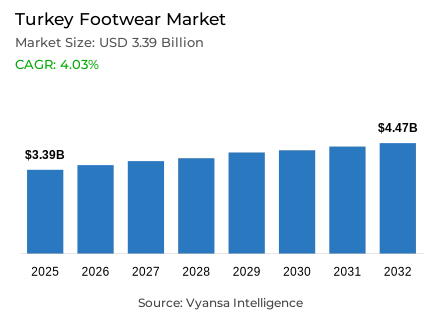
- Footwear market size in Turkey was estimated at USD 3.39 billion in 2025.
- The market size is expected to grow to USD 4.47 billion by 2032.
- Market to register a CAGR of around 4.03% during 2026-32.
- Category Shares
- Women's footwear grabbed market share of 54%.
- Competition
- More than 20 companies are actively engaged in producing footwear in Turkey.
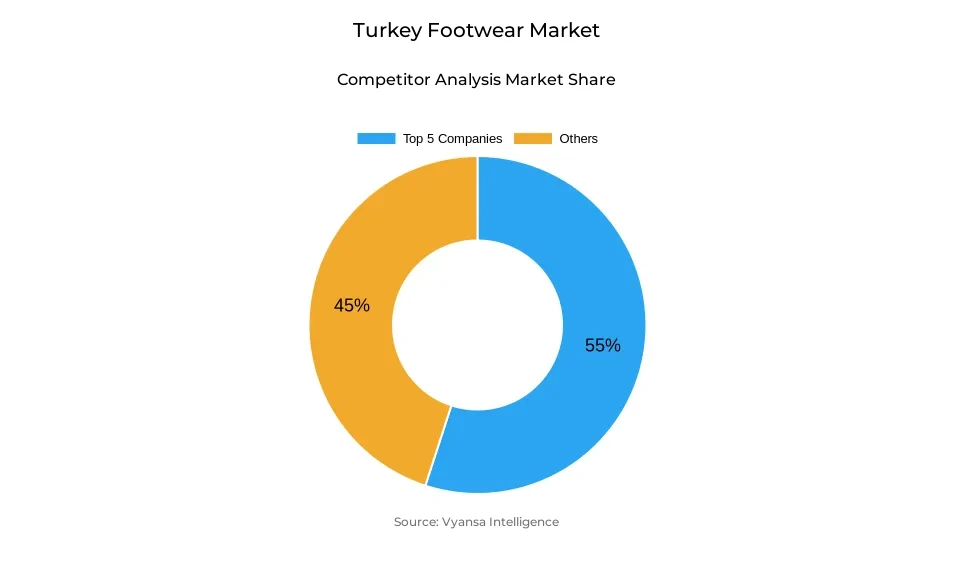
- Top 5 companies acquired around 55% of the market share.
- Deichmann Ayakkabicilik San ve Tic Ltd Sti, Derimod Konfeksiyon Ayakkabi Deri San ve Tic AS, LC Waikiki Magazacilik Hizmetleri Tic AS, Ziylan Ayakkabi San ve Tic AS, adidas Spor Malzemeleri Satis ve Pazarlama AS etc., are few of the top companies.
- Sales Channel
- Retail offline grabbed 75% of the market.
Turkey Footwear Market Outlook
The Turkey footwear market will continue to record strong growth in the next 2026–32 projections, which are as a result of the growing interest in fashion, growing involvement in sporting activities, and gradual shift to branded footwear. It is projected that the market will grow by approximately 4.03% per annum to reach USD 3.39 billion in 2025 and then reach USD 4.47 billion in 2032. Despite the effect of inflation and changes in regulations on the pattern of buying behaviour, footwear demand has been strong because they relate well with the lifestyle, comfort, and image driven consumption patterns. Women footwear is still leading the category with a market share of about 54% total, which indicates that they are very fashionsensitive and change the footwear more often.
The sports footwear will continue to be a major source of growth in the outlook period. The increase in the number of people indulging in fitness related activities, running, casual athleisure lifestyles is justifying the continued growth in sneaker and performance related footwear demand. The presence of international brands with Nike, adidas, Puma, and Skechers is still able to draw end users with innovative products, comfortdriven designs and brand recognition and the local companies offer a wide variety of products at various prices. In addition to sports usage, casual footwear and comfort shoes are also used in less formal and semiformal environments and this extends the usage situations.
The sales channel is retail offline which is dominating the sales channel with about 75% of the total footwear sales since customers like to test the footwear instore to determine the fit, comfort and durability features. The shopping malls, monobrand shops, and footwear specialists still contribute to the sales performance, and the store expansion strategies of the major domestic players like Derimod and FLO contribute to the performance as well. Although it is observed that the increasing rate of retail online has slowed down following the tightening of the customs restrictions on foreign sites, the trend should favor the domestic retailers with wellestablished physical and online networks.
In the future, Turkish footwear market will have the advantage of low per capita footwear consumption compared to European markets, and this demonstrates the potential to grow in the long run. Ongoing innovation, growth of retail chain, and increased demand of sports, casual, and branded footwear are geared to achieve consistent market growth till 2032.
Turkey Footwear Market Growth Driver
Urban Lifestyle and Comfort Prioritisation Propel Footwear Demand
A prominent driver shaping footwear demand in Turkey is the country’s high level of urbanisation, which steers end users toward multifunctional and comfort-oriented footwear solutions. The population of Turkey is said to be 89% urban as of 2024 according to the World Bank, which illustrates a longterm demographic transition to urban living, where walking, commutes, and active lifestyle are the norm. The city dwellers often have to combine their business, social, and leisure, thus, creating a need to use footwear that will enable them fulfill their comfort and everyday mobility needs.
This urbanization further promotes increased exposure to international fashion and lifestyle trends especially among the younger end user groups. City centres include Istanbul, Ankara, and Izmir, and have a large population with varying tastes, which increases the demand of sneakers, sportswear and athleisure items that combine comfort with casual style fashion. With the ongoing urbanisation, the demands that may be satisfied by a dynamic urban lifestyle are, among others, shoes that conform to the lifestyle.
Turkey Footwear Market Challenge
Persistent Inflation Weakens Consumer Purchasing Power
The greatest challange that the footwear market in Turkey is facing is the high inflation rates that are lowering the purchasing power of end users, and putting a strain on the cost sensitivity. The Presidential Strategy and Budget Directorate predicts that the rate of inflation in Turkey will continue to be way above the targets, with the predictions of the programme showing about 28.5% in 2025 and a gradual decline to the single digits in 2027. Even though the inflation rate is dropping to the levels that are lower than the levels that were observed before, the constant inflationary pressure increases prices restrictions in the key areas of expenditures like food, housing, and utilities, and as such discretionary spending on non essential goods such as fashion footwear is curtailed.
High inflation makes decisionmaking in the end user market more difficult since it changes the orientation of decisions towards the pricesaving approach and end user needs rather than style and performance innovations. Regardless of the moderation of inflation, high living expenses still limit discretion spending. This economic climate is structurally problematic to high priced or higherend footwear categories as households attach more importance to essential categories spending, thus limiting volume expansion and forcing brands to focus on products with an emphasis on valuebased offerings.
Unlock Market Intelligence
Explore the market potential with our data-driven report
Turkey Footwear Market Trend
Retail Online Expansion Reshapes Footwear Access and Retailing
The trends that have been experienced in the Turkish footwear market is the increasing influence of the retail online as a end user access platform due to the popular internet penetration. The latest demographics show that a high level of urbanisation is associated with a high level of digital uptake because the share of the urban population in Turkey was about 89% in 2024. City end users usually enjoy better connections to broadband and mobile internet infrastructure, which facilitates online shopping habits of footwear and apparel products.
The online retail trend is in line with the general digital retail development in Turkey with end users increasingly relying on the online platform as a way of product discovery, price comparison, and convenience in making purchases. Digital channels can help retailers to provide a broader product range, focused promotional activities, and customized serviceswhich is especially attractive to younger customers who are technologically advanced. With online retailing growing, it transforms brand distribution and marketing of footwear, and justifies the significance of the omnichannel strategies and digital communication with end users.
Turkey Footwear Market Opportunity
Active Lifestyles and Fitness Culture Expand Footwear Use Cases
The emergence of interest in fitness, sports and outdoor activities is a major potential in the footwear market in Turkey, especially with performance and lifestyle. Although particular levels of national engagement in organised sport are not centrally published by the government apparatus, health and lifestyle indicators show greater activity in physical activities, which is represented by the popularity of sports and casual footwear within end user retail settings. The urban population also displays a high level of gymnasium membership, running communities and outdoor recreation activities, which increases the need to purchase specialised athletic footwear.
The health and wellness orientation of the culture also promotes the categories that are not related to conventional sports since many end users have incorporated sneakers and other footwear that focus on comfort in their daytoday fashion. The combination of performance and lifestyle usage widens the possible buying occasions and enhances how often the footwear is replaced. Brands which innovate fluidly around comfort, support and sportrelated design are poised to capitalise on this expanding lifestyle segment and this will expand the market past the entrylevel casual footwear and assist in developing segments in the long run.
Unlock Market Intelligence
Explore the market potential with our data-driven report
Turkey Footwear Market Segmentation Analysis
By Category
- Children's Footwear
- Infants (0-9 Months) Foot Length (CM)
- 8.3-8.9
- 9.2-9.5
- 10.1-10.5
- Toddlers (9 Months - 4 Years) Foot Length (CM)
- 10.8
- 11.4-11.7
- 12.1-12.7
- 13.0-13.3
- 14.0-14.3
- 14.6-15.2
- 15.6-15.9
- 16.5
- Little Kids (4-7 Years) Foot Length (CM)
- 16.8
- 17.1-17.8
- 18.1-18.4
- 19.1-19.4
- 19.7-20.6
- 21.0-21.6
- Big Kids (7-12 Years) Foot Length (CM)
- 21.9
- 22.2-23.5
- 24.1-24.8
- Infants (0-9 Months) Foot Length (CM)
- Women's Footwear
- Foot Length (CM)
- 20.8
- 21.3-21.6
- 22.2-22.5
- 23.0-23.8
- 24.1-24.6
- 25.1-25.9
- 26.2-26.7
- 27.6
- Foot Length (CM)
- Men's Footwear
- Foot Length (CM)
- 23.5
- 24.1-24.8
- 25.4-25.7
- 26.0-26.7
- 27.0-27.9
- 28.3-28.6
- 29.4
- 30.2
- 31.0-31.8
- Foot Length (CM)
Women's footwear constitutes the segment with the highest share within the category segmentation, accounting for approximately 54% of total market value in Turkey during the forecast period. This dominance reflects the broad usage of footwear among women across daily wear, workplace attire, casual styles, and sportsinspired designs. Women's footwear benefits from elevated purchase frequency, stronger fashion orientation, and a wider variety of design options, ranging from stylish leather footwear to sneakers and athleisure products.
Throughout the 2026–32 forecast period, women's footwear is expected to maintain its leading category position as Turkish end users continue to prioritise comfort, style, and foot health. The growing popularity of sneakers in both casual and semiformal settings, in conjunction with rising interest in sports and fitness activities, will further support demand within this segment. Both local and international brands are actively targeting this segment through frequent product launches, competitive pricing strategies, and fashionable collections, thereby reinforcing its leading market position.

By Sales Channel
- Retail Online
- Retail Offline
Retail offline represents the segment with the highest share within the sales channel segmentation, accounting for approximately 75% of total footwear sales in Turkey. Physical retail establishments remain the preferred distribution channel as end users value the ability to physically evaluate footwear for fit, comfort, and quality attributes prior to purchase. Brand stores, shopping mall locations, and footwear specialists fulfill a key role, supported by comprehensive product assortments and instore promotional activities.
Throughout the 2026–32 forecast period, retail offline is expected to retain its dominant position notwithstanding the gradual growth of domestic retail online. Store expansion plans by leading Turkish market players and the introduction of largerformat retail outlets will strengthen offline presence. Additionally, recent restrictions on foreign retail online purchases may further encourage end users to purchase from local physical retailers, thereby sustaining the strong position of offline sales within Turkey's footwear market.
List of Companies Covered in Turkey Footwear Market
The companies listed below are highly influential in the Turkey footwear market, with a significant market share and a strong impact on industry developments.
- Deichmann Ayakkabicilik San ve Tic Ltd Sti
- Derimod Konfeksiyon Ayakkabi Deri San ve Tic AS
- LC Waikiki Magazacilik Hizmetleri Tic AS
- Ziylan Ayakkabi San ve Tic AS
- adidas Spor Malzemeleri Satis ve Pazarlama AS
- Nike Türkiye AS
- Puma Turkiye
- Olka Spor Malzemeleri Tic AS
- Decathlon Turkiye
- Vepa Group
Competitive Landscape
Turkey footwear market is highly competitive, shaped by a broad mix of international sportswear brands and strong domestic players. Global brands such as adidas, Nike, Puma, and Skechers dominate the sports and athleisure segment, benefiting from rising demand for comfort-driven and fitness-oriented footwear. At the same time, well-established Turkish brands including Hotiç, Beymen, Derimod, Mavi, Kinetix, Polaris, and LC Waikiki maintain strong relevance by offering fashionable products across varied price points and catering to local preferences. Luxury retailers such as Beymen are further differentiating through initiatives like Beymen Reborn, tapping into second-hand luxury demand among younger consumers. While new customs regulations have constrained foreign e-commerce, they have indirectly strengthened domestic retailers, intensifying competition within the local footwear landscape.
Frequently Asked Questions
Related Report
1. Market Segmentation
1.1. Research Scope
1.2. Research Methodology
1.3. Definitions and Assumptions
2. Executive Summary
3. Turkey Footwear Market Policies, Regulations, and Standards
4. Turkey Footwear Market Dynamics
4.1. Growth Factors
4.2. Challenges
4.3. Trends
4.4. Opportunities
5. Turkey Footwear Market Statistics, 2022-2032F
5.1. Market Size & Growth Outlook
5.1.1.By Revenues in USD Million
5.1.2.By Units Sold in Thousand Units
5.2. Market Segmentation & Growth Outlook
5.2.1.By Category
5.2.1.1. Children's Footwear- Market Insights and Forecast 2022-2032, USD Million
5.2.1.1.1. Infants (0-9 Months) Foot Length (CM)- Market Insights and Forecast 2022-2032, USD Million
5.2.1.1.1.1. 8.3-8.9- Market Insights and Forecast 2022-2032, USD Million
5.2.1.1.1.2. 9.2-9.5- Market Insights and Forecast 2022-2032, USD Million
5.2.1.1.1.3. 10.1-10.5- Market Insights and Forecast 2022-2032, USD Million
5.2.1.1.2. Toddlers (9 Months - 4 Years) Foot Length (CM)- Market Insights and Forecast 2022-2032, USD Million
5.2.1.1.2.1. 10.8- Market Insights and Forecast 2022-2032, USD Million
5.2.1.1.2.2. 11.4-11.7- Market Insights and Forecast 2022-2032, USD Million
5.2.1.1.2.3. 12.1-12.7- Market Insights and Forecast 2022-2032, USD Million
5.2.1.1.2.4. 13.0-13.3- Market Insights and Forecast 2022-2032, USD Million
5.2.1.1.2.5. 14.0-14.3- Market Insights and Forecast 2022-2032, USD Million
5.2.1.1.2.6. 14.6-15.2- Market Insights and Forecast 2022-2032, USD Million
5.2.1.1.2.7. 15.6-15.9- Market Insights and Forecast 2022-2032, USD Million
5.2.1.1.2.8. 16.5- Market Insights and Forecast 2022-2032, USD Million
5.2.1.1.3. Little Kids (4-7 Years) Foot Length (CM)- Market Insights and Forecast 2022-2032, USD Million
5.2.1.1.3.1. 16.8- Market Insights and Forecast 2022-2032, USD Million
5.2.1.1.3.2. 17.1-17.8- Market Insights and Forecast 2022-2032, USD Million
5.2.1.1.3.3. 18.1-18.4- Market Insights and Forecast 2022-2032, USD Million
5.2.1.1.3.4. 19.1-19.4- Market Insights and Forecast 2022-2032, USD Million
5.2.1.1.3.5. 19.7-20.6- Market Insights and Forecast 2022-2032, USD Million
5.2.1.1.3.6. 21.0-21.6- Market Insights and Forecast 2022-2032, USD Million
5.2.1.1.4. Big Kids (7-12 Years) Foot Length (CM)- Market Insights and Forecast 2022-2032, USD Million
5.2.1.1.4.1. 21.9- Market Insights and Forecast 2022-2032, USD Million
5.2.1.1.4.2. 22.2-23.5- Market Insights and Forecast 2022-2032, USD Million
5.2.1.1.4.3. 24.1-24.8- Market Insights and Forecast 2022-2032, USD Million
5.2.1.2. Women's Footwear- Market Insights and Forecast 2022-2032, USD Million
5.2.1.2.1. Foot Length (CM)- Market Insights and Forecast 2022-2032, USD Million
5.2.1.2.1.1. 20.8- Market Insights and Forecast 2022-2032, USD Million
5.2.1.2.1.2. 21.3-21.6- Market Insights and Forecast 2022-2032, USD Million
5.2.1.2.1.3. 22.2-22.5- Market Insights and Forecast 2022-2032, USD Million
5.2.1.2.1.4. 23.0-23.8- Market Insights and Forecast 2022-2032, USD Million
5.2.1.2.1.5. 24.1-24.6- Market Insights and Forecast 2022-2032, USD Million
5.2.1.2.1.6. 25.1-25.9- Market Insights and Forecast 2022-2032, USD Million
5.2.1.2.1.7. 26.2-26.7- Market Insights and Forecast 2022-2032, USD Million
5.2.1.2.1.8. 27.6- Market Insights and Forecast 2022-2032, USD Million
5.2.1.3. Men's Footwear- Market Insights and Forecast 2022-2032, USD Million
5.2.1.3.1. Foot Length (CM)- Market Insights and Forecast 2022-2032, USD Million
5.2.1.3.1.1. 23.5- Market Insights and Forecast 2022-2032, USD Million
5.2.1.3.1.2. 24.1-24.8- Market Insights and Forecast 2022-2032, USD Million
5.2.1.3.1.3. 25.4-25.7- Market Insights and Forecast 2022-2032, USD Million
5.2.1.3.1.4. 26.0-26.7- Market Insights and Forecast 2022-2032, USD Million
5.2.1.3.1.5. 27.0-27.9- Market Insights and Forecast 2022-2032, USD Million
5.2.1.3.1.6. 28.3-28.6- Market Insights and Forecast 2022-2032, USD Million
5.2.1.3.1.7. 29.4- Market Insights and Forecast 2022-2032, USD Million
5.2.1.3.1.8. 30.2- Market Insights and Forecast 2022-2032, USD Million
5.2.1.3.1.9. 31.0-31.8- Market Insights and Forecast 2022-2032, USD Million
5.2.2.By Product Type
5.2.2.1. Casual- Market Insights and Forecast 2022-2032, USD Million
5.2.2.2. Athletic/Sports- Market Insights and Forecast 2022-2032, USD Million
5.2.2.3. Formal- Market Insights and Forecast 2022-2032, USD Million
5.2.2.4. Others- Market Insights and Forecast 2022-2032, USD Million
5.2.3.By Sales Channel
5.2.3.1. Retail Online- Market Insights and Forecast 2022-2032, USD Million
5.2.3.2. Retail Offline- Market Insights and Forecast 2022-2032, USD Million
5.2.4.By Material
5.2.4.1. Leather- Market Insights and Forecast 2022-2032, USD Million
5.2.4.2. Textile- Market Insights and Forecast 2022-2032, USD Million
5.2.4.3. Rubber- Market Insights and Forecast 2022-2032, USD Million
5.2.4.4. Synthetic- Market Insights and Forecast 2022-2032, USD Million
5.2.4.5. Canvas- Market Insights and Forecast 2022-2032, USD Million
5.2.5.By Price
5.2.5.1. Mass- Market Insights and Forecast 2022-2032, USD Million
5.2.5.2. Premium- Market Insights and Forecast 2022-2032, USD Million
5.2.6.By Footwear Type
5.2.6.1. Shoes- Market Insights and Forecast 2022-2032, USD Million
5.2.6.1.1. Sneakers- Market Insights and Forecast 2022-2032, USD Million
5.2.6.1.2. Boots- Market Insights and Forecast 2022-2032, USD Million
5.2.6.2. Sandals & Slippers- Market Insights and Forecast 2022-2032, USD Million
5.2.6.2.1. Flip-Flops- Market Insights and Forecast 2022-2032, USD Million
5.2.7.By Application
5.2.7.1. Conventional Footwear- Market Insights and Forecast 2022-2032, USD Million
5.2.7.1.1. Daily Wear- Market Insights and Forecast 2022-2032, USD Million
5.2.7.1.2. Work/Office Wear- Market Insights and Forecast 2022-2032, USD Million
5.2.7.1.3. Outdoor & Adventure- Market Insights and Forecast 2022-2032, USD Million
5.2.7.1.4. Sports & Fitness- Market Insights and Forecast 2022-2032, USD Million
5.2.7.1.5. Party/Occasion Wear- Market Insights and Forecast 2022-2032, USD Million
5.2.7.2. Functional/Therapeutic Footwear- Market Insights and Forecast 2022-2032, USD Million
5.2.7.2.1. Therapeutic/Orthopedic- Market Insights and Forecast 2022-2032, USD Million
5.2.7.2.2. Medicated Slippers- Market Insights and Forecast 2022-2032, USD Million
5.2.7.2.3. Acupressure Slippers- Market Insights and Forecast 2022-2032, USD Million
5.2.8.By Competitors
5.2.8.1. Competition Characteristics
5.2.8.2. Market Share & Analysis
6. Turkey Children's Footwear Market Statistics, 2022-2032
6.1. Market Size & Growth Outlook
6.1.1.By Revenues in USD Million
6.1.2.By Units Sold in Thousand Units
6.2. Market Segmentation & Growth Outlook
6.2.1.By Category- Market Insights and Forecast 2022-2032, USD Million
6.2.2.By Product Type- Market Insights and Forecast 2022-2032, USD Million
6.2.3.By Sales Channel- Market Insights and Forecast 2022-2032, USD Million
6.2.4.By Material- Market Insights and Forecast 2022-2032, USD Million
6.2.5.By Price- Market Insights and Forecast 2022-2032, USD Million
6.2.6.By Footwear Type- Market Insights and Forecast 2022-2032, USD Million
6.2.7.By Application- Market Insights and Forecast 2022-2032, USD Million
7. Turkey Women's Footwear Market Statistics, 2022-2032
7.1. Market Size & Growth Outlook
7.1.1.By Revenues in USD Million
7.1.2.By Units Sold in Thousand Units
7.2. Market Segmentation & Growth Outlook
7.2.1.By Category- Market Insights and Forecast 2022-2032, USD Million
7.2.2.By Product Type- Market Insights and Forecast 2022-2032, USD Million
7.2.3.By Sales Channel- Market Insights and Forecast 2022-2032, USD Million
7.2.4.By Material- Market Insights and Forecast 2022-2032, USD Million
7.2.5.By Price- Market Insights and Forecast 2022-2032, USD Million
7.2.6.By Footwear Type- Market Insights and Forecast 2022-2032, USD Million
7.2.7.By Application- Market Insights and Forecast 2022-2032, USD Million
8. Turkey Men's Footwear Market Statistics, 2022-2032
8.1. Market Size & Growth Outlook
8.1.1.By Revenues in USD Million
8.1.2.By Units Sold in Thousand Units
8.2. Market Segmentation & Growth Outlook
8.2.1.By Category- Market Insights and Forecast 2022-2032, USD Million
8.2.2.By Product Type- Market Insights and Forecast 2022-2032, USD Million
8.2.3.By Sales Channel- Market Insights and Forecast 2022-2032, USD Million
8.2.4.By Material- Market Insights and Forecast 2022-2032, USD Million
8.2.5.By Price- Market Insights and Forecast 2022-2032, USD Million
8.2.6.By Footwear Type- Market Insights and Forecast 2022-2032, USD Million
8.2.7.By Application- Market Insights and Forecast 2022-2032, USD Million
9. Competitive Outlook
9.1. Company Profiles
9.1.1.Ziylan Ayakkabi San ve Tic AS
9.1.1.1. Business Description
9.1.1.2. Product Portfolio
9.1.1.3. Collaborations & Alliances
9.1.1.4. Recent Developments
9.1.1.5. Financial Details
9.1.1.6. Others
9.1.2.adidas Spor Malzemeleri Satis ve Pazarlama AS
9.1.2.1. Business Description
9.1.2.2. Product Portfolio
9.1.2.3. Collaborations & Alliances
9.1.2.4. Recent Developments
9.1.2.5. Financial Details
9.1.2.6. Others
9.1.3.Nike Türkiye AS
9.1.3.1. Business Description
9.1.3.2. Product Portfolio
9.1.3.3. Collaborations & Alliances
9.1.3.4. Recent Developments
9.1.3.5. Financial Details
9.1.3.6. Others
9.1.4.Puma Turkiye
9.1.4.1. Business Description
9.1.4.2. Product Portfolio
9.1.4.3. Collaborations & Alliances
9.1.4.4. Recent Developments
9.1.4.5. Financial Details
9.1.4.6. Others
9.1.5.Olka Spor Malzemeleri Tic AS
9.1.5.1. Business Description
9.1.5.2. Product Portfolio
9.1.5.3. Collaborations & Alliances
9.1.5.4. Recent Developments
9.1.5.5. Financial Details
9.1.5.6. Others
9.1.6.Deichmann Ayakkabicilik San ve Tic Ltd Sti
9.1.6.1. Business Description
9.1.6.2. Product Portfolio
9.1.6.3. Collaborations & Alliances
9.1.6.4. Recent Developments
9.1.6.5. Financial Details
9.1.6.6. Others
9.1.7.Derimod Konfeksiyon Ayakkabi Deri San ve Tic AS
9.1.7.1. Business Description
9.1.7.2. Product Portfolio
9.1.7.3. Collaborations & Alliances
9.1.7.4. Recent Developments
9.1.7.5. Financial Details
9.1.7.6. Others
9.1.8.LC Waikiki Magazacilik Hizmetleri Tic AS
9.1.8.1. Business Description
9.1.8.2. Product Portfolio
9.1.8.3. Collaborations & Alliances
9.1.8.4. Recent Developments
9.1.8.5. Financial Details
9.1.8.6. Others
9.1.9.Decathlon Turkiye
9.1.9.1. Business Description
9.1.9.2. Product Portfolio
9.1.9.3. Collaborations & Alliances
9.1.9.4. Recent Developments
9.1.9.5. Financial Details
9.1.9.6. Others
9.1.10. Vepa Group
9.1.10.1. Business Description
9.1.10.2. Product Portfolio
9.1.10.3. Collaborations & Alliances
9.1.10.4. Recent Developments
9.1.10.5. Financial Details
9.1.10.6. Others
10. Disclaimer
| Segment | Sub-Segment |
|---|---|
| By Category |
|
| By Product Type |
|
| By Sales Channel |
|
| By Material |
|
| By Price |
|
| By Footwear Type |
|
| By Application |
|
Research Methodology
This study followed a structured approach comprising four key phases to assess the size and scope of the electro-oxidation market. The process began with thorough secondary research to collect data on the target market, related markets, and broader industry context. These findings, along with preliminary assumptions and estimates, were then validated through extensive primary research involving industry experts from across the value chain. To calculate the overall market size, both top-down and bottom-up methodologies were employed. Finally, market segmentation and data triangulation techniques were applied to refine and validate segment-level estimations.
Secondary Research
The secondary research phase involved gathering data from a wide range of credible and published sources. This step helped in identifying industry trends, defining market segmentation, and understanding the market landscape and value chain.
Sources consulted during this phase included:
- Company annual reports, investor presentations, and press releases
- Industry white papers and certified publications
- Trade directories and market-recognized databases
- Articles from authoritative authors and reputable journals
- Gold and silver standard websites
Secondary research was critical in mapping out the industry's value chain and monetary flow, identifying key market segments, understanding regional variations, and tracking significant industry developments.
Other key sources:
- Financial disclosures
- Industry associations and trade bodies
- News outlets and business magazines
- Academic journals and research studies
- Paid industry databases
Primary Research
To validate secondary data and gain deeper market insights, primary research was conducted with key stakeholders across both the supply and demand sides of the market.
On the demand side, participants included decision-makers and influencers from end-user industries—such as CIOs, CTOs, and CSOs—who provided first-hand perspectives on market needs, product usage, and future expectations.
On the supply side, interviews were conducted with manufacturers, industry associations, and institutional participants to gather insights into current offerings, product pipelines, and market challenges.
Primary interviews provided critical inputs such as:
- Market size and revenue data
- Product and service breakdowns
- Market forecasts
- Regional and application-specific trends
Stakeholders consulted included:
- Leading OEM and solution providers
- Channel and distribution partners
- End users across various applications
- Independent consultants and industry specialists
Market Size Estimation and Data Triangulation
- Identifying Key Market Participants (Secondary Research)
- Goal: To identify the major players or companies in the target market. This typically involves using publicly available data sources such as industry reports, market research publications, and financial statements of companies.
- Tools: Reports from firms like Gartner, Forrester, Euromonitor, Statista, IBISWorld, and others. Public financial statements, news articles, and press releases from top market players.
- Extracting Earnings of Key Market Participants
- Goal: To estimate the earnings generated from the product or service being analyzed. This step helps in understanding the revenue potential of each market player in a specific geography.
- Methods: Earnings data can be gathered from:
- Publicly available financial reports (for listed companies).
- Interviews and primary data sources from professionals, such as Directors, VPs, SVPs, etc. This is especially useful for understanding more nuanced, internal data that isn't publicly disclosed.
- Annual reports and investor presentations of key players.
- Data Collation and Development of a Relevant Data Model
- Goal: To collate inputs from both primary and secondary sources into a structured, data-driven model for market estimation. This model will incorporate key market KPIs and any independent variables relevant to the market.
- Key KPIs: These could include:
- Market size, growth rate, and demand drivers.
- Industry-specific metrics like market share, average revenue per customer (ARPC), or average deal size.
- External variables, such as economic growth rates, inflation rates, or commodity prices, that could affect the market.
- Data Modeling: Based on this data, the market forecasts are developed for the next 5 years. A combination of trend analysis, scenario modeling, and statistical regression might be used to generate projections.
- Scenario Analysis
- Goal: To test different assumptions and validate how sensitive the market is to changes in key variables (e.g., market demand, regulatory changes, technological disruptions).
- Types of Scenarios:
- Base Case: Based on current assumptions and historical data.
- Best-Case Scenario: Assuming favorable market conditions, regulatory environments, and technological advancements.
- Worst-Case Scenario: Accounting for adverse factors, such as economic downturns, stricter regulations, or unexpected disruptions.












