Sweden Footwear Market Report: Trends, Growth and Forecast (2026-2032)
By Category (Children's Footwear (Infants (0-9 Months) Foot Length (CM) (8.3-8.9, 9.2-9.5, 10.1-10.5), Toddlers (9 Months - 4 Years) Foot Length (CM) (10.8, 11.4-11.7, 12.1-12.7, 13.0-13.3, 14.0-14.3, 14.6-15.2, 15.6-15.9, 16.5), Little Kids (4-7 Years) Foot Length (CM) (16.8, 17.1-17.8, 18.1-18.4, 19.1-19.4, 19.7-20.6, 21.0-21.6), Big Kids (7-12 Years) Foot Length (CM) (21.9, 22.2-23.5, 24.1-24.8)), Women's Footwear (Foot Length (CM) (20.8, 21.3-21.6, 22.2-22.5, 23.0-23.8, 24.1-24.6, 25.1-25.9, 26.2-26.7, 27.6)), Men's Footwear (Foot Length (CM) (23.5, 24.1-24.8, 25.4-25.7, 26.0-26.7, 27.0-27.9, 28.3-28.6, 29.4, 30.2, 31.0-31.8))), By Product Type (Casual, Athletic/Sports, Formal, Others), By Sales Channel (Retail Online, Retail Offline), By Material (Leather, Textile, Rubber, Synthetic, Canvas), By Price (Mass, Premium), By Footwear Type (Shoes (Sneakers, Boots), Sandals & Slippers (Flip-Flops)), By Application (Conventional Footwear (Daily Wear, Work/Office Wear, Outdoor & Adventure, Sports & Fitness, Party/Occasion Wear), Functional/Therapeutic Footwear (Therapeutic/Orthopedic, Medicated Slippers, Acupressure Slippers)) ... Read more
|
Major Players
|
Sweden Footwear Market Statistics and Insights, 2026
- Market Size Statistics
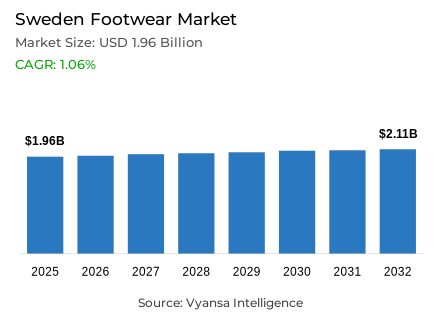
- Footwear market size in Sweden was estimated at USD 1.96 billion in 2025.
- The market size is expected to grow to USD 2.11 billion by 2032.
- Market to register a CAGR of around 1.06% during 2026-32.
- Category Shares
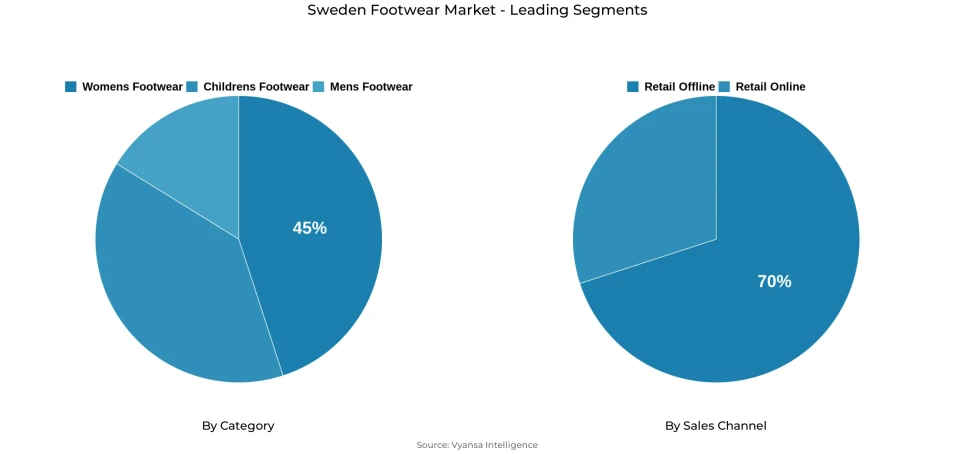
- Women's footwear grabbed market share of 45%.
- Competition
- More than 20 companies are actively engaged in producing footwear in Sweden.
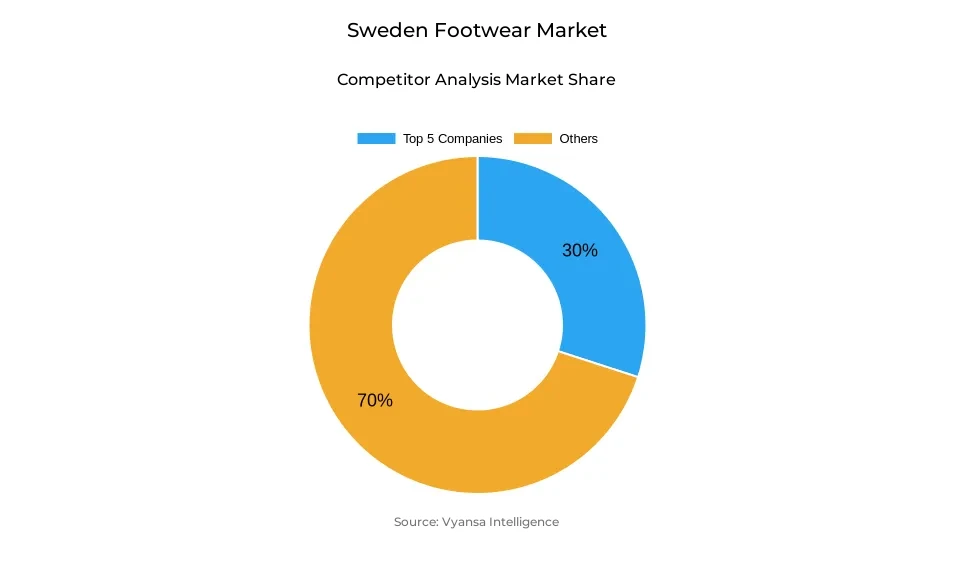
- Top 5 companies acquired around 30% of the market share.
- Ecco Sverige AB, VF Sweden AB, Vagabond International AB, adidas Sverige AB, Nike Sweden AB etc., are few of the top companies.
- Sales Channel
- Retail offline grabbed 70% of the market.
Sweden Footwear Market Outlook
Sweden Footwear market is expected to show a moderate and stable growth during the forecast period, which is an indication of a mature market and reserved end user behaviour. In 2025, footwear sales in Sweden are estimated to be at USD 1.96 billion and are projected to grow to USD 2.11 billion by 2032 with a compound annual growth rate of about 1.06%. Value addition will be the key driver of market expansion, instead of volume growth, as end user will pay more attention to quality, durability, and fit features instead of buying new products regularly. Women footwear will continue to be a cornerstone of the market with an estimated 45% of the total sales volume, backed by the steady demand of daily trainers, high-end casual wear, and all-purpose footwear that can be used in the workplace and recreational activities.
During the forecast period, the demand is expected to be gradually moving towards specialised, performance-based, and premium footwear segments. Although mass sports footwear is experiencing market saturation, outdoor and performance segments will probably pick up again as the trend of fitness and outdoor activities levels off. end users are showing readiness to spend on professional-grade shoes that provide comfort, durability, and long-term value propositions. At the same time, formal shoes and unique designs with the use of high-quality materials will be appealing to end user, which will supplement the culture of a casual workplace that is predominant in Sweden.
The retail dynamics will keep on changing and retail offline will still hold the majority at about 70% of the market share. Physical retail outlets will not lose their significance because end user will want to test the footwear in terms of comfort and fit features, especially when it comes to more expensive product lines. However, omnichannel strategies will continue to be at the heart of the retail business, and brands will incorporate online solutions like improved sizing advice to minimize product returns. Retail retail online will still play a supportive role particularly in niche and high-end brand segments.
The concept of sustainability will also play a bigger role in the purchasing decision-making process by focusing on recyclable materials and durability of design features. Instead of fueling fast growth, sustainability will help in value retention, which will allow brands to distinguish themselves in a competitive and discount-driven market environment.
Sweden Footwear Market Growth Driver
Economic Retail Recovery Supports Consumer Purchasing
Retail sales of durable goods in Sweden, including footwear, are demonstrating sustained positive momentum, reflecting a gradual stabilisation of end user expenditure on non-essential items. Statistics Sweden reported that the retail sales volume in the durables category grew by 9.0% year-on-year in December 2024 relative to December 2023, indicating a rise in end user purchases of durable goods, such as footwear and related products. This is indicative of resilience in retail demand amidst macroeconomic strains.
Retail volume gains continued to be consistent through 2025, with durables rising by 7.9% year-on-year in August 2025 versus August 2024, which supports the idea that end user demand in the durable categories is still positive. These trends imply that, despite the cautious spending behaviour, the consistent retail activity underpins the demand of footwear at the base in Sweden.
Sweden Footwear Market Challenge
Market Saturation and Discounting Challenge Growth
The challenges that continue to face stronger footwear growth are a mature retail market and regular promotional discounting. Swedish retail statistics show that the volume of sales of durable goods is increasing, but the total volume change of the total retail trade was small in some years of 2025, reflecting mixed retail performance that can suppress discretionary items like footwear. As an example, the retail trade index of total retail indicates that there are slight changes in 2025 compared to 2024 over a few months, which means that there is not much acceleration.
Moreover, regular promotional discounting, which is typical of a very competitive market with significant retail online penetration, keeps the price expectations of end user low, which limits the value growth of high-end footwear markets. As end user have become used to promotional sales events, discretionary spending can be spread more sparingly across categories, limiting volume and value growth of some footwear segments despite the positive retail volume trends.
Unlock Market Intelligence
Explore the market potential with our data-driven report
Sweden Footwear Market Trend
Casual and Premium Footwear Demand Is Emerging
The end user tastes in Sweden are still moving towards casual everyday and high-end footwear, in line with the general retail trends and changes in lifestyles. Although the official growth percentages of footwear are not released by Statistics Sweden, the overall retail sales of durable goods, including footwear, show volume growth that confirms this trend. As an illustration, the durable retail volume growth of 9.0% in December 2024 relative to December 2023 shows that end user are spending more money on categories that encompass footwear and related products.
At the same time, online and omnichannel retailing approaches are becoming popular in Swedish retailing as end user combine in-store and online shopping behaviours. Formal retail turnover statistics prove that Swedish retail is changing according to end user behaviour, and it is in favour of niche and premium retailing where brands provide differentiated products with a combination of casual styling and quality features.
Sweden Footwear Market Opportunity
Sustainability and Durability Offer Value-Led Opportunities
Swedish end user are becoming more concerned with sustainability, durability, and long-lasting product features—trends that are also in line with the general Nordic end user behaviour trends. Although there are no direct statistics on the sustainability of Swedish footwear in the retail turnover data published by Statistics Sweden, the price-level analysis of footwear in Eurostat indicates that, in 2024, the price level indices of footwear in the European Union countries differ considerably and reflect the quality and sustainability expectations in the markets.
The location of Sweden in the context of the developed market in the European Union indicates that sustainability and quality issues pursue high-end market positioning. Also, the increase in retail sales in the durable goods category, which also covers footwear, shows that end user are willing to spend on quality and durability of products that can be used regularly. The opportunity is supported by year-on-year growth in the volumes of sales of durable goods, which are associated with the brands focusing on sustainable materials and designs that decrease the frequency of replacement and environmental impact.
Unlock Market Intelligence
Explore the market potential with our data-driven report
Sweden Footwear Market Segmentation Analysis
By Category
- Children's Footwear
- Infants (0-9 Months) Foot Length (CM)
- 8.3-8.9
- 9.2-9.5
- 10.1-10.5
- Toddlers (9 Months - 4 Years) Foot Length (CM)
- 10.8
- 11.4-11.7
- 12.1-12.7
- 13.0-13.3
- 14.0-14.3
- 14.6-15.2
- 15.6-15.9
- 16.5
- Little Kids (4-7 Years) Foot Length (CM)
- 16.8
- 17.1-17.8
- 18.1-18.4
- 19.1-19.4
- 19.7-20.6
- 21.0-21.6
- Big Kids (7-12 Years) Foot Length (CM)
- 21.9
- 22.2-23.5
- 24.1-24.8
- Infants (0-9 Months) Foot Length (CM)
- Women's Footwear
- Foot Length (CM)
- 20.8
- 21.3-21.6
- 22.2-22.5
- 23.0-23.8
- 24.1-24.6
- 25.1-25.9
- 26.2-26.7
- 27.6
- Foot Length (CM)
- Men's Footwear
- Foot Length (CM)
- 23.5
- 24.1-24.8
- 25.4-25.7
- 26.0-26.7
- 27.0-27.9
- 28.3-28.6
- 29.4
- 30.2
- 31.0-31.8
- Foot Length (CM)
Women’s footwear constitutes the segment with the highest share within the category segmentation, accounting for approximately 45% of total market value during the forecast period. This strong market position is supported by steady demand for everyday footwear, including dress trainers and premium casual footwear, which align effectively with Sweden's relaxed workplace culture. Throughout the period, women’s footwear continues to benefit from end user balancing value-conscious purchasing behaviour with willingness to invest in quality, durable products that offer both comfort and stylistic appeal.
Prospectively, women’s footwear is expected to retain its leading market share as end user increasingly favour premium and niche designs over mass-market options. Trainers featuring refined aesthetics, muted colour palettes, and high-quality materials are likely to remain popular for daily wear applications. Notwithstanding frequent promotional discounting, the category’s elevated replacement rates and consistent fashion relevance will enable women’s footwear to remain the most influential segment within Sweden’s footwear market.
By Sales Channel
- Retail Online
- Retail Offline
Retail offline represents the segment with the highest share within the sales channel segmentation, capturing approximately 70% of total footwear sales in Sweden. Physical retail establishments remain important as end user value the ability to physically try on footwear, assess fit characteristics, and compare quality attributes, particularly for premium and niche brand offerings. Footwear specialists, department stores, and branded retail outlets continue to fulfil a central role, notwithstanding pressure from retail online channels and discount-led competition.
Throughout the forecast period, retail offline is expected to maintain its dominant position, supported by omnichannel strategies that integrate in-store experiences with online services. A substantial proportion of end user prefer researching products online prior to completing in-store purchases, particularly to avoid sizing-related product returns. As brands refine store assortments and emphasise premium, performance-driven footwear offerings, physical retail will remain a critical distribution channel within Sweden’s footwear market.
List of Companies Covered in Sweden Footwear Market
The companies listed below are highly influential in the Sweden footwear market, with a significant market share and a strong impact on industry developments.
- Ecco Sverige AB
- VF Sweden AB
- Vagabond International AB
- adidas Sverige AB
- Nike Sweden AB
- Nilson Group AB
- Puma Nordic AB
- Asics Sverige AB
- Rieker Schuh AG
- Scorett Footwear AB
Competitive Landscape
Sweden footwear market is increasingly fragmented, shaped by a shift towards niche, premium, and performance-focused brands. While global sportswear leaders such as adidas and Nike faced pressure from a cooling sports footwear segment, specialised brands like Hoka continued to gain traction as consumers sought professional-grade and outdoor-oriented footwear. Domestic premium labels such as Axel Arigato and Myrqvist benefited from demand for quality, durability, and understated design. Retail e-commerce platforms, notably Zalando, strengthened their competitive role by offering broad access to niche brands, while traditional footwear specialists like Nilson Group and Ecco Sverige worked to stabilise performance amid store rationalisation. Overall, competition is driven by premiumisation, brand differentiation, and omnichannel capabilities rather than volume-led expansion.
Frequently Asked Questions
Related Report
1. Market Segmentation
1.1. Research Scope
1.2. Research Methodology
1.3. Definitions and Assumptions
2. Executive Summary
3. Sweden Footwear Market Policies, Regulations, and Standards
4. Sweden Footwear Market Dynamics
4.1. Growth Factors
4.2. Challenges
4.3. Trends
4.4. Opportunities
5. Sweden Footwear Market Statistics, 2022-2032F
5.1. Market Size & Growth Outlook
5.1.1.By Revenues in USD Million
5.1.2.By Units Sold in Thousand Units
5.2. Market Segmentation & Growth Outlook
5.2.1.By Category
5.2.1.1. Children's Footwear- Market Insights and Forecast 2022-2032, USD Million
5.2.1.1.1. Infants (0-9 Months) Foot Length (CM)- Market Insights and Forecast 2022-2032, USD Million
5.2.1.1.1.1. 8.3-8.9- Market Insights and Forecast 2022-2032, USD Million
5.2.1.1.1.2. 9.2-9.5- Market Insights and Forecast 2022-2032, USD Million
5.2.1.1.1.3. 10.1-10.5- Market Insights and Forecast 2022-2032, USD Million
5.2.1.1.2. Toddlers (9 Months - 4 Years) Foot Length (CM)- Market Insights and Forecast 2022-2032, USD Million
5.2.1.1.2.1. 10.8- Market Insights and Forecast 2022-2032, USD Million
5.2.1.1.2.2. 11.4-11.7- Market Insights and Forecast 2022-2032, USD Million
5.2.1.1.2.3. 12.1-12.7- Market Insights and Forecast 2022-2032, USD Million
5.2.1.1.2.4. 13.0-13.3- Market Insights and Forecast 2022-2032, USD Million
5.2.1.1.2.5. 14.0-14.3- Market Insights and Forecast 2022-2032, USD Million
5.2.1.1.2.6. 14.6-15.2- Market Insights and Forecast 2022-2032, USD Million
5.2.1.1.2.7. 15.6-15.9- Market Insights and Forecast 2022-2032, USD Million
5.2.1.1.2.8. 16.5- Market Insights and Forecast 2022-2032, USD Million
5.2.1.1.3. Little Kids (4-7 Years) Foot Length (CM)- Market Insights and Forecast 2022-2032, USD Million
5.2.1.1.3.1. 16.8- Market Insights and Forecast 2022-2032, USD Million
5.2.1.1.3.2. 17.1-17.8- Market Insights and Forecast 2022-2032, USD Million
5.2.1.1.3.3. 18.1-18.4- Market Insights and Forecast 2022-2032, USD Million
5.2.1.1.3.4. 19.1-19.4- Market Insights and Forecast 2022-2032, USD Million
5.2.1.1.3.5. 19.7-20.6- Market Insights and Forecast 2022-2032, USD Million
5.2.1.1.3.6. 21.0-21.6- Market Insights and Forecast 2022-2032, USD Million
5.2.1.1.4. Big Kids (7-12 Years) Foot Length (CM)- Market Insights and Forecast 2022-2032, USD Million
5.2.1.1.4.1. 21.9- Market Insights and Forecast 2022-2032, USD Million
5.2.1.1.4.2. 22.2-23.5- Market Insights and Forecast 2022-2032, USD Million
5.2.1.1.4.3. 24.1-24.8- Market Insights and Forecast 2022-2032, USD Million
5.2.1.2. Women's Footwear- Market Insights and Forecast 2022-2032, USD Million
5.2.1.2.1. Foot Length (CM)- Market Insights and Forecast 2022-2032, USD Million
5.2.1.2.1.1. 20.8- Market Insights and Forecast 2022-2032, USD Million
5.2.1.2.1.2. 21.3-21.6- Market Insights and Forecast 2022-2032, USD Million
5.2.1.2.1.3. 22.2-22.5- Market Insights and Forecast 2022-2032, USD Million
5.2.1.2.1.4. 23.0-23.8- Market Insights and Forecast 2022-2032, USD Million
5.2.1.2.1.5. 24.1-24.6- Market Insights and Forecast 2022-2032, USD Million
5.2.1.2.1.6. 25.1-25.9- Market Insights and Forecast 2022-2032, USD Million
5.2.1.2.1.7. 26.2-26.7- Market Insights and Forecast 2022-2032, USD Million
5.2.1.2.1.8. 27.6- Market Insights and Forecast 2022-2032, USD Million
5.2.1.3. Men's Footwear- Market Insights and Forecast 2022-2032, USD Million
5.2.1.3.1. Foot Length (CM)- Market Insights and Forecast 2022-2032, USD Million
5.2.1.3.1.1. 23.5- Market Insights and Forecast 2022-2032, USD Million
5.2.1.3.1.2. 24.1-24.8- Market Insights and Forecast 2022-2032, USD Million
5.2.1.3.1.3. 25.4-25.7- Market Insights and Forecast 2022-2032, USD Million
5.2.1.3.1.4. 26.0-26.7- Market Insights and Forecast 2022-2032, USD Million
5.2.1.3.1.5. 27.0-27.9- Market Insights and Forecast 2022-2032, USD Million
5.2.1.3.1.6. 28.3-28.6- Market Insights and Forecast 2022-2032, USD Million
5.2.1.3.1.7. 29.4- Market Insights and Forecast 2022-2032, USD Million
5.2.1.3.1.8. 30.2- Market Insights and Forecast 2022-2032, USD Million
5.2.1.3.1.9. 31.0-31.8- Market Insights and Forecast 2022-2032, USD Million
5.2.2.By Product Type
5.2.2.1. Casual- Market Insights and Forecast 2022-2032, USD Million
5.2.2.2. Athletic/Sports- Market Insights and Forecast 2022-2032, USD Million
5.2.2.3. Formal- Market Insights and Forecast 2022-2032, USD Million
5.2.2.4. Others- Market Insights and Forecast 2022-2032, USD Million
5.2.3.By Sales Channel
5.2.3.1. Retail Online- Market Insights and Forecast 2022-2032, USD Million
5.2.3.2. Retail Offline- Market Insights and Forecast 2022-2032, USD Million
5.2.4.By Material
5.2.4.1. Leather- Market Insights and Forecast 2022-2032, USD Million
5.2.4.2. Textile- Market Insights and Forecast 2022-2032, USD Million
5.2.4.3. Rubber- Market Insights and Forecast 2022-2032, USD Million
5.2.4.4. Synthetic- Market Insights and Forecast 2022-2032, USD Million
5.2.4.5. Canvas- Market Insights and Forecast 2022-2032, USD Million
5.2.5.By Price
5.2.5.1. Mass- Market Insights and Forecast 2022-2032, USD Million
5.2.5.2. Premium- Market Insights and Forecast 2022-2032, USD Million
5.2.6.By Footwear Type
5.2.6.1. Shoes- Market Insights and Forecast 2022-2032, USD Million
5.2.6.1.1. Sneakers- Market Insights and Forecast 2022-2032, USD Million
5.2.6.1.2. Boots- Market Insights and Forecast 2022-2032, USD Million
5.2.6.2. Sandals & Slippers- Market Insights and Forecast 2022-2032, USD Million
5.2.6.2.1. Flip-Flops- Market Insights and Forecast 2022-2032, USD Million
5.2.7.By Application
5.2.7.1. Conventional Footwear- Market Insights and Forecast 2022-2032, USD Million
5.2.7.1.1. Daily Wear- Market Insights and Forecast 2022-2032, USD Million
5.2.7.1.2. Work/Office Wear- Market Insights and Forecast 2022-2032, USD Million
5.2.7.1.3. Outdoor & Adventure- Market Insights and Forecast 2022-2032, USD Million
5.2.7.1.4. Sports & Fitness- Market Insights and Forecast 2022-2032, USD Million
5.2.7.1.5. Party/Occasion Wear- Market Insights and Forecast 2022-2032, USD Million
5.2.7.2. Functional/Therapeutic Footwear- Market Insights and Forecast 2022-2032, USD Million
5.2.7.2.1. Therapeutic/Orthopedic- Market Insights and Forecast 2022-2032, USD Million
5.2.7.2.2. Medicated Slippers- Market Insights and Forecast 2022-2032, USD Million
5.2.7.2.3. Acupressure Slippers- Market Insights and Forecast 2022-2032, USD Million
5.2.8.By Competitors
5.2.8.1. Competition Characteristics
5.2.8.2. Market Share & Analysis
6. Sweden Children's Footwear Market Statistics, 2022-2032
6.1. Market Size & Growth Outlook
6.1.1.By Revenues in USD Million
6.1.2.By Units Sold in Thousand Units
6.2. Market Segmentation & Growth Outlook
6.2.1.By Category- Market Insights and Forecast 2022-2032, USD Million
6.2.2.By Product Type- Market Insights and Forecast 2022-2032, USD Million
6.2.3.By Sales Channel- Market Insights and Forecast 2022-2032, USD Million
6.2.4.By Material- Market Insights and Forecast 2022-2032, USD Million
6.2.5.By Price- Market Insights and Forecast 2022-2032, USD Million
6.2.6.By Footwear Type- Market Insights and Forecast 2022-2032, USD Million
6.2.7.By Application- Market Insights and Forecast 2022-2032, USD Million
7. Sweden Women's Footwear Market Statistics, 2022-2032
7.1. Market Size & Growth Outlook
7.1.1.By Revenues in USD Million
7.1.2.By Units Sold in Thousand Units
7.2. Market Segmentation & Growth Outlook
7.2.1.By Category- Market Insights and Forecast 2022-2032, USD Million
7.2.2.By Product Type- Market Insights and Forecast 2022-2032, USD Million
7.2.3.By Sales Channel- Market Insights and Forecast 2022-2032, USD Million
7.2.4.By Material- Market Insights and Forecast 2022-2032, USD Million
7.2.5.By Price- Market Insights and Forecast 2022-2032, USD Million
7.2.6.By Footwear Type- Market Insights and Forecast 2022-2032, USD Million
7.2.7.By Application- Market Insights and Forecast 2022-2032, USD Million
8. Sweden Men's Footwear Market Statistics, 2022-2032
8.1. Market Size & Growth Outlook
8.1.1.By Revenues in USD Million
8.1.2.By Units Sold in Thousand Units
8.2. Market Segmentation & Growth Outlook
8.2.1.By Category- Market Insights and Forecast 2022-2032, USD Million
8.2.2.By Product Type- Market Insights and Forecast 2022-2032, USD Million
8.2.3.By Sales Channel- Market Insights and Forecast 2022-2032, USD Million
8.2.4.By Material- Market Insights and Forecast 2022-2032, USD Million
8.2.5.By Price- Market Insights and Forecast 2022-2032, USD Million
8.2.6.By Footwear Type- Market Insights and Forecast 2022-2032, USD Million
8.2.7.By Application- Market Insights and Forecast 2022-2032, USD Million
9. Competitive Outlook
9.1. Company Profiles
9.1.1.adidas Sverige AB
9.1.1.1. Business Description
9.1.1.2. Product Portfolio
9.1.1.3. Collaborations & Alliances
9.1.1.4. Recent Developments
9.1.1.5. Financial Details
9.1.1.6. Others
9.1.2.Nike Sweden AB
9.1.2.1. Business Description
9.1.2.2. Product Portfolio
9.1.2.3. Collaborations & Alliances
9.1.2.4. Recent Developments
9.1.2.5. Financial Details
9.1.2.6. Others
9.1.3.Nilson Group AB
9.1.3.1. Business Description
9.1.3.2. Product Portfolio
9.1.3.3. Collaborations & Alliances
9.1.3.4. Recent Developments
9.1.3.5. Financial Details
9.1.3.6. Others
9.1.4.Puma Nordic AB
9.1.4.1. Business Description
9.1.4.2. Product Portfolio
9.1.4.3. Collaborations & Alliances
9.1.4.4. Recent Developments
9.1.4.5. Financial Details
9.1.4.6. Others
9.1.5.Asics Sverige AB
9.1.5.1. Business Description
9.1.5.2. Product Portfolio
9.1.5.3. Collaborations & Alliances
9.1.5.4. Recent Developments
9.1.5.5. Financial Details
9.1.5.6. Others
9.1.6.Ecco Sverige AB
9.1.6.1. Business Description
9.1.6.2. Product Portfolio
9.1.6.3. Collaborations & Alliances
9.1.6.4. Recent Developments
9.1.6.5. Financial Details
9.1.6.6. Others
9.1.7.VF Sweden AB
9.1.7.1. Business Description
9.1.7.2. Product Portfolio
9.1.7.3. Collaborations & Alliances
9.1.7.4. Recent Developments
9.1.7.5. Financial Details
9.1.7.6. Others
9.1.8.Vagabond International AB
9.1.8.1. Business Description
9.1.8.2. Product Portfolio
9.1.8.3. Collaborations & Alliances
9.1.8.4. Recent Developments
9.1.8.5. Financial Details
9.1.8.6. Others
9.1.9.Rieker Schuh AG
9.1.9.1. Business Description
9.1.9.2. Product Portfolio
9.1.9.3. Collaborations & Alliances
9.1.9.4. Recent Developments
9.1.9.5. Financial Details
9.1.9.6. Others
9.1.10. Scorett Footwear AB
9.1.10.1. Business Description
9.1.10.2. Product Portfolio
9.1.10.3. Collaborations & Alliances
9.1.10.4. Recent Developments
9.1.10.5. Financial Details
9.1.10.6. Others
10. Disclaimer
| Segment | Sub-Segment |
|---|---|
| By Category |
|
| By Product Type |
|
| By Sales Channel |
|
| By Material |
|
| By Price |
|
| By Footwear Type |
|
| By Application |
|
Research Methodology
This study followed a structured approach comprising four key phases to assess the size and scope of the electro-oxidation market. The process began with thorough secondary research to collect data on the target market, related markets, and broader industry context. These findings, along with preliminary assumptions and estimates, were then validated through extensive primary research involving industry experts from across the value chain. To calculate the overall market size, both top-down and bottom-up methodologies were employed. Finally, market segmentation and data triangulation techniques were applied to refine and validate segment-level estimations.
Secondary Research
The secondary research phase involved gathering data from a wide range of credible and published sources. This step helped in identifying industry trends, defining market segmentation, and understanding the market landscape and value chain.
Sources consulted during this phase included:
- Company annual reports, investor presentations, and press releases
- Industry white papers and certified publications
- Trade directories and market-recognized databases
- Articles from authoritative authors and reputable journals
- Gold and silver standard websites
Secondary research was critical in mapping out the industry's value chain and monetary flow, identifying key market segments, understanding regional variations, and tracking significant industry developments.
Other key sources:
- Financial disclosures
- Industry associations and trade bodies
- News outlets and business magazines
- Academic journals and research studies
- Paid industry databases
Primary Research
To validate secondary data and gain deeper market insights, primary research was conducted with key stakeholders across both the supply and demand sides of the market.
On the demand side, participants included decision-makers and influencers from end-user industries—such as CIOs, CTOs, and CSOs—who provided first-hand perspectives on market needs, product usage, and future expectations.
On the supply side, interviews were conducted with manufacturers, industry associations, and institutional participants to gather insights into current offerings, product pipelines, and market challenges.
Primary interviews provided critical inputs such as:
- Market size and revenue data
- Product and service breakdowns
- Market forecasts
- Regional and application-specific trends
Stakeholders consulted included:
- Leading OEM and solution providers
- Channel and distribution partners
- End users across various applications
- Independent consultants and industry specialists
Market Size Estimation and Data Triangulation
- Identifying Key Market Participants (Secondary Research)
- Goal: To identify the major players or companies in the target market. This typically involves using publicly available data sources such as industry reports, market research publications, and financial statements of companies.
- Tools: Reports from firms like Gartner, Forrester, Euromonitor, Statista, IBISWorld, and others. Public financial statements, news articles, and press releases from top market players.
- Extracting Earnings of Key Market Participants
- Goal: To estimate the earnings generated from the product or service being analyzed. This step helps in understanding the revenue potential of each market player in a specific geography.
- Methods: Earnings data can be gathered from:
- Publicly available financial reports (for listed companies).
- Interviews and primary data sources from professionals, such as Directors, VPs, SVPs, etc. This is especially useful for understanding more nuanced, internal data that isn't publicly disclosed.
- Annual reports and investor presentations of key players.
- Data Collation and Development of a Relevant Data Model
- Goal: To collate inputs from both primary and secondary sources into a structured, data-driven model for market estimation. This model will incorporate key market KPIs and any independent variables relevant to the market.
- Key KPIs: These could include:
- Market size, growth rate, and demand drivers.
- Industry-specific metrics like market share, average revenue per customer (ARPC), or average deal size.
- External variables, such as economic growth rates, inflation rates, or commodity prices, that could affect the market.
- Data Modeling: Based on this data, the market forecasts are developed for the next 5 years. A combination of trend analysis, scenario modeling, and statistical regression might be used to generate projections.
- Scenario Analysis
- Goal: To test different assumptions and validate how sensitive the market is to changes in key variables (e.g., market demand, regulatory changes, technological disruptions).
- Types of Scenarios:
- Base Case: Based on current assumptions and historical data.
- Best-Case Scenario: Assuming favorable market conditions, regulatory environments, and technological advancements.
- Worst-Case Scenario: Accounting for adverse factors, such as economic downturns, stricter regulations, or unexpected disruptions.












