Poland Room Air Conditioners Market Report: Trends, Growth and Forecast (2026-2032)
By Product Type (Split Air Conditioners (Up to 9,000 BTU/h, 9,001-12,000 BTU/h, 12,001-18,000 BTU/h, 18,001-24,000 BTU/h, Above 24,000 BTU/h), Window Air Conditioners (Up to 9,000 BTU/h, 9,001-12,000 BTU/h, 12,001-18,000 BTU/h, 18,001-24,000 BTU/h, Above 24,000 BTU/h), Others), By Technology (Inverter, Non-Inverter), By Price (Up to USD 300, USD 301 to USD 600, USD 601 to USD 1,000, Above USD 1,000), By End User (Residential (Individual Households, Apartments/Condominiums, Vacation/Secondary Homes), Commercial (Offices, Retail Stores/Showrooms, Hospitality, Healthcare Facilities, Educational Institutions, Small Commercial Establishments, Others)), By Sales Channel (Retail Online (Brand-Owned Websites/D2C, E-Commerce Marketplaces), Retail Offline (Exclusive Brand Stores, Multi-Brand Electronics & Appliance Stores, Specialty Stores, Hypermarkets/Supermarkets, Home Improvement Stores, Dealer/Distributor Network, Direct Sales/Institutional Sales, Local Independent Retailers)), By Refrigerant Type (R-32, R-410A, R-290, R-454B, Others), By Connectivity (Smart/Connected, Conventional/Non-Smart), By Energy Efficiency (1 Star, 2 Star, 3 Star, 4 Star, 5 Star) ... Read more
|
Major Players
|
Poland Room Air Conditioners Market Statistics and Insights, 2026
- Market Size Statistics
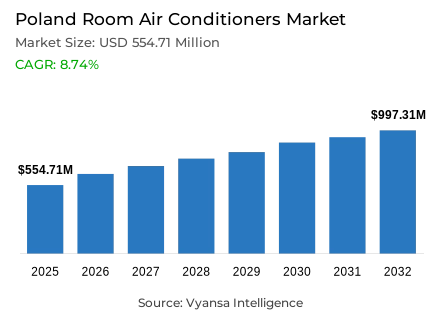
- Room air conditioners market size in Poland was valued at USD 554.71 million in 2025 and is estimated at USD 605.91 million in 2026.
- The market size is expected to grow to USD 997.31 million by 2032.
- Market to register a CAGR of around 8.74% during 2026-32.
- Product Type Shares
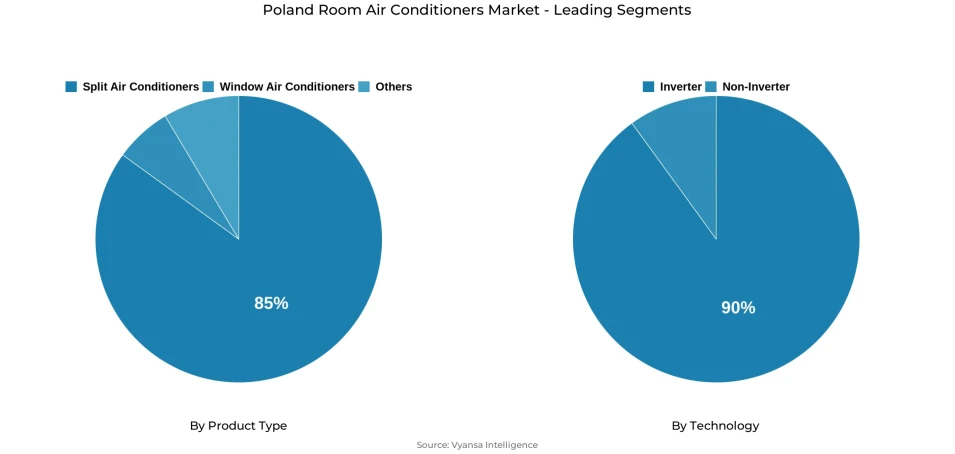
- Split air conditioners grabbed market share of 85%.
- Competition
- More than 10 companies are actively engaged in producing room air conditioners in Poland.
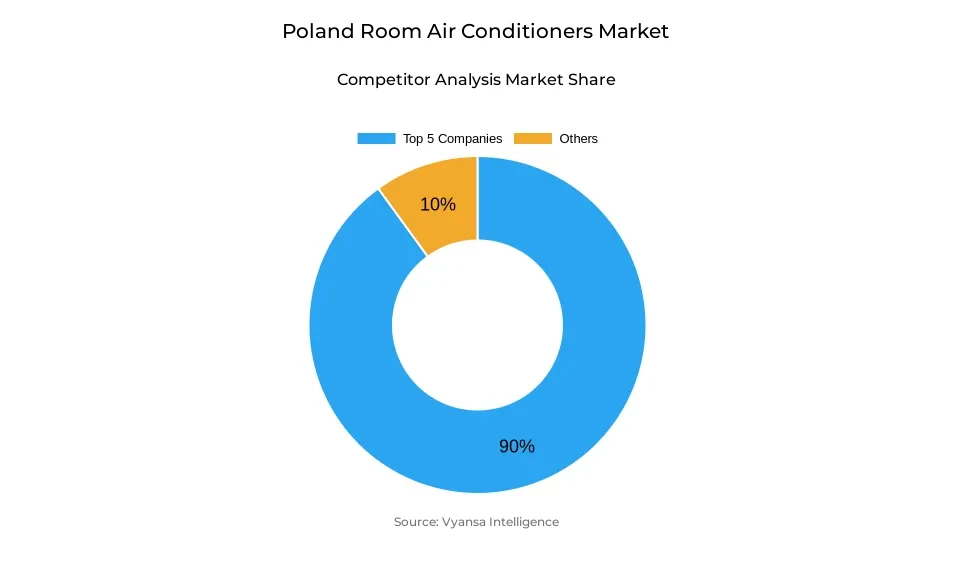
- Top 5 companies acquired around 90% of the market share.
- Hisense Group, Samsung Corp, Grass Cavagna Group Polska Sp zoo, Gree Electric Appliances Inc of Zhuhai, LG Corp etc., are few of the top companies.
- Technology
- Inverter grabbed 90% of the market.
Poland Room Air Conditioners Market Outlook
The Poland room air conditioners market size was valued at USD 554.71 million in 2025 and is projected to grow from USD 605.91 million in 2026 to USD 997.31 million by 2032, exhibiting a CAGR of 8.74% during the forecast period. The growth pattern indicates a robust expansionary period, which is backed by an observable movement toward comfort-first buying and a more intensive emphasis on running-cost effectiveness in daily cooling devices. The market is growing not due to short-term spikes, but due to a mix of structural upgrades, replacement demand, and growing acceptance of cooling as a normal household requirement.
In the wider market context, manufacturers are still focusing on energy-efficient designs, easier temperature control, and smaller sizes that fit apartments and smaller interior spaces. In EMEA, variations are seen in the speed at which end users shift to higher-end systems compared to entry-level replacements, but the general trend is the same, toward more efficient solutions with more robust service networks. Here, the reliability of installation, availability of servicing and clarity in communication regarding energy consumption are becoming key factors in influencing purchase decisions.
The market structure in Poland indicates a definite mainstream residential cooling. Split air conditioners hold around 85% share, demonstrating strong preference for room air conditioners suited for both apartments and single-family homes. Technology preference is equally concentrated, with inverter systems accounting for around 90% share, reinforcing the importance of stable cooling, quieter operation, and reduced electricity consumption in daily use.
Growth in the market is primarily supported by replacement cycles and first-time installations, particularly as households shift away from older, less efficient systems. With split and inverter systems already dominating the structure, value expansion is increasingly driven by upgrades, additional room installations, and service-based offerings across the country.
Poland Room Air Conditioners Market Growth DriverRising Cooling Demand Driven by Increasing Temperature Variability
Rising temperatures are making indoor cooling a more consistent part of daily living rather than a seasonal requirement. The Institute of Meteorology and Water Management (IMGW-PIB) reported that the average air temperature in the area in 2024 was 10.9 C, which is approximately 2.2 C above the long-term average temperature per year and the year was considered extremely warm.
This change directly affects the household behavior, since passive cooling systems are less efficient and the need to have controlled indoor comfort grows. The outcome is the expansion and more frequent application of air conditioning in residential and small business settings. Extended summers and increased heat waves also prompt end users to increase cooling coverage in more rooms and focus on quicker installation schedules, which supports consistent demand expansion.
Poland Room Air Conditioners Market ChallengeElevated Electricity Costs Influencing Consumer Purchase Decisions
Electricity pricing remains a critical factor influencing purchase decisions and usage behavior. The Energy Regulatory Office of Poland (URE) announced that in the first half of 2024 household electricity prices and tariff rates will be frozen at 412 PLN/MWh up to consumption limits, and 693 PLN/MWh above consumption limits, and in the second half of 2024 the maximum price will be 500 PLN/MWh.
This pricing model ensures that the operating cost is very visible and the end user is more concerned with the total cost of ownership and not only the initial purchase price. Consequently, there are delays in replacement by some households, the use of smaller units, or reduced use during peak times. Such an environment enhances the significance of transparent energy labeling, consumption disclosure, and payback justification at the point of sale, and suppliers need to prove efficiency value more effectively.
Unlock Market Intelligence
Explore the market potential with our data-driven report
Poland Room Air Conditioners Market TrendTransition Toward Low-GWP and Energy-Efficient Cooling Technologies
The visible shift in product design and supply chain practices is being caused by regulatory changes surrounding refrigerants. According to Germany Federal Environment Agency (Umweltbundesamt), Regulation (EU) 2024/573 is applicable since 11 March 2024 and licensing of importation and exportation of regulated substances and equipment is required, irrespective of quantity. The exemption limit is lowered to 10 tonnes of CO2 equivalent of HFCs in pre-filled appliances according to Umweltbundesamt.
This regulatory change is hastening the move to lower-GWP refrigerants and more compliant system designs. Product portfolios are being modified by manufacturers, and certified components and trained service networks are becoming more relied upon by supply chains. Consequently, competition is not only growing in the cooling performance but also in regulatory preparedness, documentation clarity, and technician competency, and compliance is becoming a component of product positioning in the market.
Poland Room Air Conditioners Market OpportunityGovernment-Led Energy Retrofit Programs Supporting Residential Adoption
New avenues of household upgrades are being established through energy-efficiency programs and retrofit funding. The Clean Air Priority Program in Poland, according to the World Bank, will have 1 million applications in November 2024, and 840,000 contracts will be signed by January 2025, after which it will be temporarily suspended. The Ministry of Climate and Environment of Poland concludes a funding agreement worth EUR 250 million on 18 April 2024 to facilitate implementation via local programs and financial institutions.
These programs are motivating homeowners to participate in larger renovation projects, in which cooling systems can be incorporated into energy-efficient home improvements. This opens up the possibility of suppliers to market room air conditioners as a component of an overall efficient home package, especially when used with insulation or heating upgrades. The best opportunity lies in the retrofit cases, where the end users are already ready to install it in a bundle, with professional commissioning and extended service contracts.
Unlock Market Intelligence
Explore the market potential with our data-driven report
Poland Room Air Conditioners Market Segmentation Analysis
By Product Type
- Split Air Conditioners
- Up to 9,000 BTU/h
- 9,001-12,000 BTU/h
- 12,001-18,000 BTU/h
- 18,001-24,000 BTU/h
- Above 24,000 BTU/h
- Window Air Conditioners
- Up to 9,000 BTU/h
- 9,001-12,000 BTU/h
- 12,001-18,000 BTU/h
- 18,001-24,000 BTU/h
- Above 24,000 BTU/h
- Others
The segment with the highest share under the Product Type category is Split Air Conditioners, accounting for around 85% of the market. This overwhelming dominance is an indication of the fact that room-by-room cooling solutions are still preferred and they fit well with apartment layouts and refurbished houses.
Replacement demand is also concentrated in this segment with such a large installed base, which supports its status as the key volume driver. The competitive differentiation is moving more towards efficiency ratings, interior unit design, and service availability than the basic cooling performance. Split systems are the most viable and scalable systems as households increase their cooling coverage in bedrooms and living spaces.
By Technology
- Inverter
- Non-Inverter
The segment with the highest share under the Technology category is Inverter, holding around 90% of the market. This leadership is an indication of a high end user preference to smoother temperature control, less noise and better energy efficiency, particularly with the air conditioning becoming a daily use appliance.
The penetration of inverter systems is also high and this alters the evaluation of the products with more focus on energy consumption, system sizing and long term operating value. Suppliers are competing more on quantifiable efficiency, intelligent functionality, and reliability of service, and installers are instrumental in making sure that the performance is as expected. This dynamic underpins continuous upgrades of older fixed-speed systems and helps to gradually premiumize the category.
List of Companies Covered in Poland Room Air Conditioners Market
The companies listed below are highly influential in the Poland room air conditioners market, with a significant market share and a strong impact on industry developments.
- Hisense Group
- Samsung Corp
- Grass Cavagna Group Polska Sp zoo
- Gree Electric Appliances Inc of Zhuhai
- LG Corp
- Daikin Industries Ltd
- Mitsubishi Electric Corp
- Fujitsu Ltd
- Hon Hai Precision Industry Co Ltd
- MPM AGD SA
Market News & Updates
- Daikin Industries Ltd, 2026:
Daikin Europe expanded the Stylish air-to-air heat pump line in March 2026 with five new finishes, adding a broader premium wall-mounted split offering for European households. This is significant for the Poland room air conditioners market because it strengthens the premium residential inverter segment with A+++ efficiency, connected control through the Onecta app, and a more design-focused proposition for apartments and houses where split AC adoption is increasingly linked to year-round comfort and appearance.
- Samsung Corp, 2025:
Samsung said in Poland in June 2025 that its air conditioners’ Good Sleep mode had been updated to work with Galaxy Watch and Galaxy Ring, allowing automatic activation of sleep-focused cooling based on the user going to bed. This is an important innovation for the Poland room air conditioners market because it pushes the smart/connected AC category beyond remote control into wellness-linked automation, improving comfort and differentiation in residential inverter models.
Frequently Asked Questions
Related Report
- Market Segmentation
- Research Scope
- Research Methodology
- Definitions and Assumptions
- Executive Summary
- Poland Room Air Conditioners Market Policies, Regulations, and Standards
- Poland Room Air Conditioners Market Dynamics
- Growth Factors
- Challenges
- Trends
- Opportunities
- Poland Room Air Conditioners Market Statistics, 2022-2032F
- Market Size & Growth Outlook
- By Revenues in USD Million
- By Units Sold in Thousand Units
- Market Segmentation & Growth Outlook
- By Product Type
- Split Air Conditioners- Market Insights and Forecast 2022-2032, USD Million
- Up to 9,000 BTU/h- Market Insights and Forecast 2022-2032, USD Million
- 9,001-12,000 BTU/h- Market Insights and Forecast 2022-2032, USD Million
- 12,001-18,000 BTU/h- Market Insights and Forecast 2022-2032, USD Million
- 18,001-24,000 BTU/h- Market Insights and Forecast 2022-2032, USD Million
- Above 24,000 BTU/h- Market Insights and Forecast 2022-2032, USD Million
- Window Air Conditioners- Market Insights and Forecast 2022-2032, USD Million
- Up to 9,000 BTU/h- Market Insights and Forecast 2022-2032, USD Million
- 9,001-12,000 BTU/h- Market Insights and Forecast 2022-2032, USD Million
- 12,001-18,000 BTU/h- Market Insights and Forecast 2022-2032, USD Million
- 18,001-24,000 BTU/h- Market Insights and Forecast 2022-2032, USD Million
- Above 24,000 BTU/h- Market Insights and Forecast 2022-2032, USD Million
- Others- Market Insights and Forecast 2022-2032, USD Million
- Split Air Conditioners- Market Insights and Forecast 2022-2032, USD Million
- By Technology
- Inverter- Market Insights and Forecast 2022-2032, USD Million
- Non-Inverter- Market Insights and Forecast 2022-2032, USD Million
- By Price
- Up to USD 300- Market Insights and Forecast 2022-2032, USD Million
- USD 301 to USD 600- Market Insights and Forecast 2022-2032, USD Million
- USD 601 to USD 1,000- Market Insights and Forecast 2022-2032, USD Million
- Above USD 1,000- Market Insights and Forecast 2022-2032, USD Million
- By End User
- Residential- Market Insights and Forecast 2022-2032, USD Million
- Individual Households- Market Insights and Forecast 2022-2032, USD Million
- Apartments/Condominiums- Market Insights and Forecast 2022-2032, USD Million
- Vacation/Secondary Homes- Market Insights and Forecast 2022-2032, USD Million
- Commercial- Market Insights and Forecast 2022-2032, USD Million
- Offices- Market Insights and Forecast 2022-2032, USD Million
- Retail Stores/Showrooms- Market Insights and Forecast 2022-2032, USD Million
- Hospitality- Market Insights and Forecast 2022-2032, USD Million
- Healthcare Facilities- Market Insights and Forecast 2022-2032, USD Million
- Educational Institutions- Market Insights and Forecast 2022-2032, USD Million
- Small Commercial Establishments- Market Insights and Forecast 2022-2032, USD Million
- Others- Market Insights and Forecast 2022-2032, USD Million
- Residential- Market Insights and Forecast 2022-2032, USD Million
- By Sales Channel
- Retail Online- Market Insights and Forecast 2022-2032, USD Million
- Brand-Owned Websites/D2C- Market Insights and Forecast 2022-2032, USD Million
- E-Commerce Marketplaces- Market Insights and Forecast 2022-2032, USD Million
- Retail Offline- Market Insights and Forecast 2022-2032, USD Million
- Exclusive Brand Stores- Market Insights and Forecast 2022-2032, USD Million
- Multi-Brand Electronics & Appliance Stores- Market Insights and Forecast 2022-2032, USD Million
- Specialty Stores- Market Insights and Forecast 2022-2032, USD Million
- Hypermarkets/Supermarkets- Market Insights and Forecast 2022-2032, USD Million
- Home Improvement Stores- Market Insights and Forecast 2022-2032, USD Million
- Dealer/Distributor Network- Market Insights and Forecast 2022-2032, USD Million
- Direct Sales/Institutional Sales- Market Insights and Forecast 2022-2032, USD Million
- Local Independent Retailers- Market Insights and Forecast 2022-2032, USD Million
- Retail Online- Market Insights and Forecast 2022-2032, USD Million
- By Refrigerant Type
- R-32- Market Insights and Forecast 2022-2032, USD Million
- R-410A- Market Insights and Forecast 2022-2032, USD Million
- R-290- Market Insights and Forecast 2022-2032, USD Million
- R-454B- Market Insights and Forecast 2022-2032, USD Million
- Others- Market Insights and Forecast 2022-2032, USD Million
- By Connectivity
- Smart/Connected- Market Insights and Forecast 2022-2032, USD Million
- Conventional/Non-Smart- Market Insights and Forecast 2022-2032, USD Million
- By Energy Efficiency
- 1 Star- Market Insights and Forecast 2022-2032, USD Million
- 2 Star- Market Insights and Forecast 2022-2032, USD Million
- 3 Star- Market Insights and Forecast 2022-2032, USD Million
- 4 Star- Market Insights and Forecast 2022-2032, USD Million
- 5 Star- Market Insights and Forecast 2022-2032, USD Million
- By Competitors
- Competition Characteristics
- Market Share & Analysis
- By Product Type
- Market Size & Growth Outlook
- Poland Split Air Conditioners Market Statistics, 2022-2032
- Market Size & Growth Outlook
- By Revenues in USD Million
- By Units Sold in Thousand Units
- Market Segmentation & Growth Outlook
- By Technology- Market Insights and Forecast 2022-2032, USD Million
- By Price- Market Insights and Forecast 2022-2032, USD Million
- By End User- Market Insights and Forecast 2022-2032, USD Million
- By Sales Channel- Market Insights and Forecast 2022-2032, USD Million
- By Refrigerant Type- Market Insights and Forecast 2022-2032, USD Million
- By Connectivity- Market Insights and Forecast 2022-2032, USD Million
- By Energy Efficiency- Market Insights and Forecast 2022-2032, USD Million
- Market Size & Growth Outlook
- Poland Window Air Conditioners Market Statistics, 2022-2032
- Market Size & Growth Outlook
- By Revenues in USD Million
- By Units Sold in Thousand Units
- Market Segmentation & Growth Outlook
- By Technology- Market Insights and Forecast 2022-2032, USD Million
- By Price- Market Insights and Forecast 2022-2032, USD Million
- By End User- Market Insights and Forecast 2022-2032, USD Million
- By Sales Channel- Market Insights and Forecast 2022-2032, USD Million
- By Refrigerant Type- Market Insights and Forecast 2022-2032, USD Million
- By Connectivity- Market Insights and Forecast 2022-2032, USD Million
- By Energy Efficiency- Market Insights and Forecast 2022-2032, USD Million
- Market Size & Growth Outlook
- Competitive Outlook
- Company Profiles
- Gree Electric Appliances Inc of Zhuhai
- Business Description
- Product Portfolio
- Collaborations & Alliances
- Recent Developments
- Financial Details
- Others
- LG Corp
- Business Description
- Product Portfolio
- Collaborations & Alliances
- Recent Developments
- Financial Details
- Others
- Daikin Industries Ltd
- Business Description
- Product Portfolio
- Collaborations & Alliances
- Recent Developments
- Financial Details
- Others
- Mitsubishi Electric Corp
- Business Description
- Product Portfolio
- Collaborations & Alliances
- Recent Developments
- Financial Details
- Others
- Fujitsu Ltd
- Business Description
- Product Portfolio
- Collaborations & Alliances
- Recent Developments
- Financial Details
- Others
- Hisense Group
- Business Description
- Product Portfolio
- Collaborations & Alliances
- Recent Developments
- Financial Details
- Others
- Samsung Corp
- Business Description
- Product Portfolio
- Collaborations & Alliances
- Recent Developments
- Financial Details
- Others
- Grass Cavagna Group Polska Sp zoo
- Business Description
- Product Portfolio
- Collaborations & Alliances
- Recent Developments
- Financial Details
- Others
- Hon Hai Precision Industry Co Ltd
- Business Description
- Product Portfolio
- Collaborations & Alliances
- Recent Developments
- Financial Details
- Others
- MPM AGD SA
- Business Description
- Product Portfolio
- Collaborations & Alliances
- Recent Developments
- Financial Details
- Others
- Gree Electric Appliances Inc of Zhuhai
- Company Profiles
- Disclaimer
| Segment | Sub-Segment |
|---|---|
| By Product Type |
|
| By Technology |
|
| By Price |
|
| By End User |
|
| By Sales Channel |
|
| By Refrigerant Type |
|
| By Connectivity |
|
| By Energy Efficiency |
|
Research Methodology
This study followed a structured approach comprising four key phases to assess the size and scope of the electro-oxidation market. The process began with thorough secondary research to collect data on the target market, related markets, and broader industry context. These findings, along with preliminary assumptions and estimates, were then validated through extensive primary research involving industry experts from across the value chain. To calculate the overall market size, both top-down and bottom-up methodologies were employed. Finally, market segmentation and data triangulation techniques were applied to refine and validate segment-level estimations.
Secondary Research
The secondary research phase involved gathering data from a wide range of credible and published sources. This step helped in identifying industry trends, defining market segmentation, and understanding the market landscape and value chain.
Sources consulted during this phase included:
- Company annual reports, investor presentations, and press releases
- Industry white papers and certified publications
- Trade directories and market-recognized databases
- Articles from authoritative authors and reputable journals
- Gold and silver standard websites
Secondary research was critical in mapping out the industry's value chain and monetary flow, identifying key market segments, understanding regional variations, and tracking significant industry developments.
Other key sources:
- Financial disclosures
- Industry associations and trade bodies
- News outlets and business magazines
- Academic journals and research studies
- Paid industry databases
Primary Research
To validate secondary data and gain deeper market insights, primary research was conducted with key stakeholders across both the supply and demand sides of the market.
On the demand side, participants included decision-makers and influencers from end-user industries—such as CIOs, CTOs, and CSOs—who provided first-hand perspectives on market needs, product usage, and future expectations.
On the supply side, interviews were conducted with manufacturers, industry associations, and institutional participants to gather insights into current offerings, product pipelines, and market challenges.
Primary interviews provided critical inputs such as:
- Market size and revenue data
- Product and service breakdowns
- Market forecasts
- Regional and application-specific trends
Stakeholders consulted included:
- Leading OEM and solution providers
- Channel and distribution partners
- End users across various applications
- Independent consultants and industry specialists
Market Size Estimation and Data Triangulation
- Identifying Key Market Participants (Secondary Research)
- Goal: To identify the major players or companies in the target market. This typically involves using publicly available data sources such as industry reports, market research publications, and financial statements of companies.
- Tools: Reports from firms like Gartner, Forrester, Euromonitor, Statista, IBISWorld, and others. Public financial statements, news articles, and press releases from top market players.
- Extracting Earnings of Key Market Participants
- Goal: To estimate the earnings generated from the product or service being analyzed. This step helps in understanding the revenue potential of each market player in a specific geography.
- Methods: Earnings data can be gathered from:
- Publicly available financial reports (for listed companies).
- Interviews and primary data sources from professionals, such as Directors, VPs, SVPs, etc. This is especially useful for understanding more nuanced, internal data that isn't publicly disclosed.
- Annual reports and investor presentations of key players.
- Data Collation and Development of a Relevant Data Model
- Goal: To collate inputs from both primary and secondary sources into a structured, data-driven model for market estimation. This model will incorporate key market KPIs and any independent variables relevant to the market.
- Key KPIs: These could include:
- Market size, growth rate, and demand drivers.
- Industry-specific metrics like market share, average revenue per customer (ARPC), or average deal size.
- External variables, such as economic growth rates, inflation rates, or commodity prices, that could affect the market.
- Data Modeling: Based on this data, the market forecasts are developed for the next 5 years. A combination of trend analysis, scenario modeling, and statistical regression might be used to generate projections.
- Scenario Analysis
- Goal: To test different assumptions and validate how sensitive the market is to changes in key variables (e.g., market demand, regulatory changes, technological disruptions).
- Types of Scenarios:
- Base Case: Based on current assumptions and historical data.
- Best-Case Scenario: Assuming favorable market conditions, regulatory environments, and technological advancements.
- Worst-Case Scenario: Accounting for adverse factors, such as economic downturns, stricter regulations, or unexpected disruptions.












