Poland Bags and Luggage Market Report: Trends, Growth and Forecast (2026-2032)
By Category (Bags (Cross Body Bags, Bags and Backpacks, Business Bags, Duffle Bags, Clutches, Others), Luggage (Soft Luggage, Hard Luggage, Wheeled Luggage, Non-Wheeled Luggage)), By Sales Channel (Retail Offline, Retail Online), By Material Type (Soft Case (Nylon, Polyester, Ballistic Nylon), Hard Case (Polycarbonate, ABS (Acrylonitrile Butadiene Styrene), Polypropylene)), By Price Category (Luxury, Mass/Economy, Premium), By Application (Travel, Business) ... Read more

|
Major Players
|
Poland Bags and Luggage Market Statistics and Insights, 2026
- Market Size Statistics
- Bags and luggage in Poland is estimated at USD 1.15 billion in 2025.
- The market size is expected to grow to USD 1.3 billion by 2032.
- Market to register a cagr of around 1.77% during 2026-32.
- Category Shares
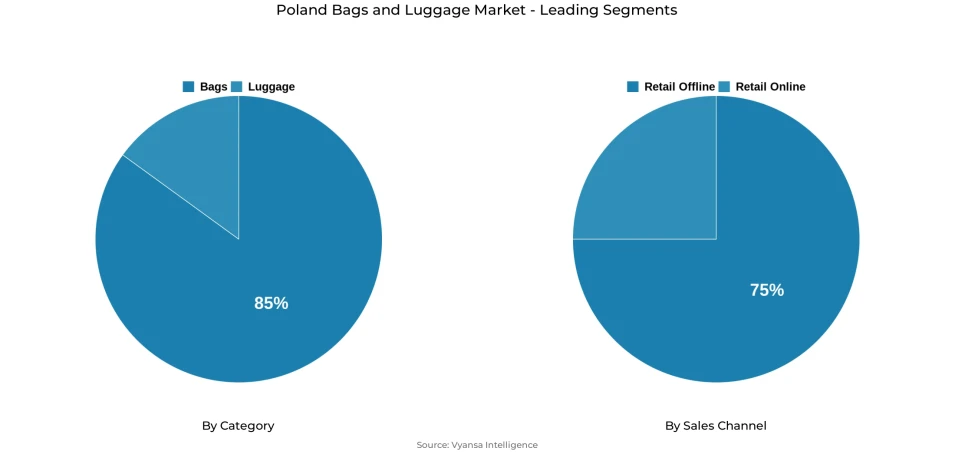
- Bags grabbed market share of 85%.
- Competition
- More than 20 companies are actively engaged in producing bags and luggage in Poland.
- Top 5 companies acquired around 20% of the market share.
- Kering SA; CCC SA; H&M Hennes & Mauritz Sp zoo; Wittchen SA; LPP SA etc., are few of the top companies.
- Sales Channel
- Retail offline grabbed 75% of the market.
Poland Bags and Luggage Market Outlook
Poland bags and luggage market will be valued at US$1.15 billion in 2025 and 1.30 billion in 2032, thus achieving a compound annual growth rate of about 1.77% in 2026-2032. The growth during the forecast horizon is expected to be moderate, as it is a shift to more selective and experience-based consumption patterns. After a strong performance in the previous years, the growth trend has slowed down with end users re-evaluating discretionary spending and focusing on value, longevity and need rather than replacement.
Bags are predicted to remain the main driver of growth, supported by their daily use and the fact that they are still relevant in fashion. Conversely, the luggage segment growth will probably be modest, with a significant share of customers having already purchased new suitcases during the last travel booms and now feeling that they do not need to buy new ones. Travel activity is high, but the expenditure is shifting towards experiential consumption and not accessories. This tendency supports the structural superiority of bags to luggage in the general category.
Domestic brands are expected to be central during the forecast period. The Polish end users are increasingly favoring the locally produced products, thus supporting the brands like LPP, Wittchen and Ochnik. These domestic players have gained end user loyalty and market share through retail innovation, extensive price positioning, and emotionally engaging brand engagement. At the same time, the concept of sustainability and the desire to have ethically positioned brands are likely to shape the future product development trends.
It is estimated that retail online will keep growing due to convenience and competitive prices, especially in younger end users. However, physical retail will still be very relevant, particularly in bags and luggage where customers appreciate tactile assessment. In general, bags, domestic brand strength, and a gradual development of distribution channels will support steady growth instead of a rapid increase in volumes.

Poland Bags and Luggage Market Growth Driver
Tourism and Experience-Led Spending Supporting Bag Demand
The increasing popularity of tourism in Poland and the tendency of people to choose traveling experiences rather than material improvements is one of the main factors that will drive the demand of bags, especially those that are used on a daily and short-term basis. Statistics Poland reported that 38.8 million tourists stayed in tourist establishments in 2024, which provided 97.6 million overnight stays, an increase of 7.2%and 5.2% respectively compared to 2023. This growth in the travel business, particularly in the summer, increases the significance of practical and stylish bags that travel with them, commuting and recreational pursuits, although the families delay the replacement of the durable bags they had bought previously.
This behaviour is supported by the role of tourism in household expenditure. According to Statistics Poland, the number of Polish residents visiting tourism and the amount they spend on it has been increasing in the post-2022 period, which proves that traveling is still one of the priority items in end user budgets despite the selective spending in other areas. Here, end users will be more willing to refresh visible, style-driven products like handbags and everyday bags that can improve their travel and lifestyle experiences, and delay the replacement of durable suitcases and trolleys that were bought during the immediate post-pandemic travel boom. This selective replacement trend is the reason why bags become the most successful element in the general bags and luggage category.
Poland Bags and Luggage Market Challenge
Inflation and Cost Pressures Limiting Replacement of Durable Luggage
The ongoing inflation and increasing operating expenses are a fundamental threat to the bags and luggage market in Poland, especially to those items that are viewed as long lasting, like large suitcases. The end user price inflation in Poland stood at 14.4% in 2022 and then dropped to 11.5% in 2023, which is significantly above the target range of the National Bank of Poland. High and unstable prices reduce real household incomes, and stimulate end users to spend on essential expenditure and travel experiences instead of substituting goods that continue to serve satisfactorily, like luggage bought in previous years of intensive travel recovery.
The supply side also experiences cost pressures. According to official inflation data, the rise in prices is not limited to energy and food but also to manufactured goods and services, which increases transportation, rental and production expenses of brands that operate in Poland. This complicates the ability of luggage manufacturers and retailers to remain price competitive without compromising margins, particularly when end users have just recently upgraded their luggage and are not willing to buy again. Consequently, large suitcase sales slow down even as travel volumes increase, and brands experience a squeeze in margins, between the rising cost of inputs and the growing price sensitivity and selective buying behaviour of end users.
Unlock Market Intelligence
Explore the market potential with our data-driven report
Poland Bags and Luggage Market Trend
Growing Emphasis on Sustainability and Eco-Conscious Materials
The trends that have influenced the bags and luggage market in Poland is the increased focus on sustainability and environmentally friendly materials, which are in accordance with the EU and national climate goals. According to the European Environment Agency and the European Commission, textiles and fashion are some of the industries that have high environmental footprints in Europe, which has led to EU-level policies on circularity, extended producer responsibility and sustainable product design. These policy guidelines affect the expectations of end users in the member states such as Poland where the awareness of climate change and waste reduction is gradually growing.
According to Eurobarometer surveys, 93 per cent of EU citizens regard climate change as a serious issue and most of them think that they should change their consumption habits, such as purchasing more durable and repairable goods, to address environmental problems. In the case of bags and luggage, this is reflected in the increasing end user interest in products made of recycled plastics, plant-based leathers and other low-impact materials, and in durable designs that increase the life of products. Brands that express clear sourcing, recycling and repair choices are more in line with these changing preferences. This sustainability-oriented change is becoming more apparent in Poland as a part of the wider EU market trends, where both local and international actors are encouraged to invest in environmentally friendly materials and circular business strategies.
Poland Bags and Luggage Market Opportunity
Digital Adoption and E‑Commerce Expansion Enabling New Retail Models
The increased digital use and retail online in Poland is a significant opportunity to diversify the retail model and target younger and tech-savvy end users. Eurostat data indicate that the proportion of people in Poland aged 16-74 who purchased or ordered goods or services online in the last 12 months increased by 57 to 62 percent in 2020 and 2023, respectively, and that retail online use is on a steady rise. This is especially noticeable in younger generations and urban dwellers, who are more open to online-first brands and cross-border platforms.
Simultaneously, the macroeconomic perspective of Poland is generally favorable to further digital investment. According to the IMF 2025 Article IV Consultation, Poland has strong growth fundamentals, and the authors of the article note that digitalisation and innovation are the primary drivers of productivity and competitiveness. As end users grow more comfortable with blending online research, mobile buying and in-store pickup, bags and luggage brands can use omnichannel frameworks, personalised digital marketing and online-only launches to generate engagement and sales. This climate is conducive to players that combine the physical retail tactile advantages with the reach, convenience and data-driven targeting of retail online, allowing them to capture incremental demand without having to resort to broad discounting or massive expansion of physical presence.
Unlock Market Intelligence
Explore the market potential with our data-driven report
Poland Bags and Luggage Market Segmentation Analysis
By Category
- Bags
- Cross Body Bags
- Bags and Backpacks
- Business Bags
- Duffle Bags
- Clutches
- Others
- Luggage
- Soft Luggage
- Hard Luggage
- Wheeled Luggage
- Non-Wheeled Luggage
The segment with highest market share under category is Bags represent the largest category, accounting for approximately 90% of total market value. Their dominance reflects high purchase frequency and relevance across everyday use cases, including commuting, education, leisure, and sports. Unlike luggage, which is replaced infrequently, bags benefit from fashion rotation and functional diversification.
Handbags remain a key value driver, supported by premiumisation at the high end and consistent demand for affordable daily-use options. Backpacks also maintain relevance due to outdoor activities, student demand, and multifunctional lifestyle use. Together, these dynamics ensure bags remain the primary revenue anchor throughout the forecast period.
By Sales Channel
- Retail Offline
- Retail Online
Retail offline accounts for approximately 75% of market sales, reflecting strong end user preference for physical inspection prior to purchase. Fit, comfort, material quality, and durability remain decisive factors, particularly for premium bags and luggage.
Specialist stores, shopping centres, and multi-brand retailers dominate purchasing behaviour, especially during peak travel and back-to-school seasons. While online retail continues to expand gradually, it complements rather than replaces brick-and-mortar channels. retail offlinewill remain structurally dominant due to trust, service, and experiential value.
List of Companies Covered in Poland Bags and Luggage Market
The companies listed below are highly influential in the Poland bags and luggage market, with a significant market share and a strong impact on industry developments.
- Kering SA
- CCC SA
- H&M Hennes & Mauritz Sp zoo
- Wittchen SA
- LPP SA
- Ochnik SA
- adidas Poland Sp zoo
- Louis Vuitton Polska Sp zoo
- Puma Polska Sp zoo
- Puccini Sp zoo
Competitive Landscape
Poland bags and luggage market is characterised by strong domestic players competing alongside international brands, with local companies retaining significant influence. LPP SA remains a key player by leveraging its multi-brand portfolio and frequent promotions to appeal to a broad consumer base, particularly in bags. Wittchen SA continues to lead in luggage through its extensive assortment across price tiers, maintaining relevance despite the slowdown in luggage replacement cycles. Ochnik strengthened its position in 2024 through an innovative dual-store format combining apparel and accessories, enhancing footfall and cross-category appeal. Local brands are also reinforcing competitiveness through emotional branding and social initiatives, as seen with Monnari’s charitable activities. Meanwhile, the expansion of e-commerce and the presence of online-only players such as Shein are intensifying price competition, pushing established brands to balance physical retail strength with digital growth.
Frequently Asked Questions
Related Report
1. Market Segmentation
1.1. Research Scope
1.2. Research Methodology
1.3. Definitions and Assumptions
2. Executive Summary
3. Poland Bags and Luggage Market Policies, Regulations, and Standards
4. Poland Bags and Luggage Market Dynamics
4.1. Growth Factors
4.2. Challenges
4.3. Trends
4.4. Opportunities
5. Poland Bags and Luggage Market Statistics, 2022-2032F
5.1. Market Size & Growth Outlook
5.1.1.By Revenues in USD Million
5.1.2.By Units Sold in Thousand Units
5.2. Market Segmentation & Growth Outlook
5.2.1.By Category
5.2.1.1. Bags- Market Insights and Forecast 2022-2032, USD Million
5.2.1.1.1. Cross Body Bags- Market Insights and Forecast 2022-2032, USD Million
5.2.1.1.2. Bags and Backpacks- Market Insights and Forecast 2022-2032, USD Million
5.2.1.1.3. Business Bags- Market Insights and Forecast 2022-2032, USD Million
5.2.1.1.4. Duffle Bags- Market Insights and Forecast 2022-2032, USD Million
5.2.1.1.5. Clutches- Market Insights and Forecast 2022-2032, USD Million
5.2.1.1.6. Others- Market Insights and Forecast 2022-2032, USD Million
5.2.1.2. Luggage- Market Insights and Forecast 2022-2032, USD Million
5.2.1.2.1. Soft Luggage- Market Insights and Forecast 2022-2032, USD Million
5.2.1.2.2. Hard Luggage- Market Insights and Forecast 2022-2032, USD Million
5.2.1.2.3. Wheeled Luggage- Market Insights and Forecast 2022-2032, USD Million
5.2.1.2.4. Non-Wheeled Luggage- Market Insights and Forecast 2022-2032, USD Million
5.2.2.By Sales Channel
5.2.2.1. Retail Offline- Market Insights and Forecast 2022-2032, USD Million
5.2.2.2. Retail Online- Market Insights and Forecast 2022-2032, USD Million
5.2.3.By Material Type
5.2.3.1. Soft Case- Market Insights and Forecast 2022-2032, USD Million
5.2.3.1.1. Nylon- Market Insights and Forecast 2022-2032, USD Million
5.2.3.1.2. Polyester- Market Insights and Forecast 2022-2032, USD Million
5.2.3.1.3. Ballistic Nylon- Market Insights and Forecast 2022-2032, USD Million
5.2.3.2. Hard Case- Market Insights and Forecast 2022-2032, USD Million
5.2.3.2.1. Polycarbonate- Market Insights and Forecast 2022-2032, USD Million
5.2.3.2.2. ABS (Acrylonitrile Butadiene Styrene)- Market Insights and Forecast 2022-2032, USD Million
5.2.3.2.3. Polypropylene- Market Insights and Forecast 2022-2032, USD Million
5.2.4.By Price Category
5.2.4.1. Luxury- Market Insights and Forecast 2022-2032, USD Million
5.2.4.2. Mass/Economy- Market Insights and Forecast 2022-2032, USD Million
5.2.4.3. Premium- Market Insights and Forecast 2022-2032, USD Million
5.2.5.By Application
5.2.5.1. Travel- Market Insights and Forecast 2022-2032, USD Million
5.2.5.2. Business- Market Insights and Forecast 2022-2032, USD Million
5.2.6.By Competitors
5.2.6.1. Competition Characteristics
5.2.6.2. Market Share & Analysis
6. Poland Bags Market Statistics, 2022-2032
6.1. Market Size & Growth Outlook
6.1.1.By Revenues in USD Million
6.1.2.By Units Sold in Thousand Units
6.2. Market Segmentation & Growth Outlook
6.2.1.By Category- Market Insights and Forecast 2022-2032, USD Million
6.2.2.By Sales Channel- Market Insights and Forecast 2022-2032, USD Million
6.2.3.By Material Type- Market Insights and Forecast 2022-2032, USD Million
6.2.4.By Price Category- Market Insights and Forecast 2022-2032, USD Million
6.2.5.By Application- Market Insights and Forecast 2022-2032, USD Million
7. Poland Luggage Market Statistics, 2022-2032
7.1. Market Size & Growth Outlook
7.1.1.By Revenues in USD Million
7.1.2.By Units Sold in Thousand Units
7.2. Market Segmentation & Growth Outlook
7.2.1.By Category- Market Insights and Forecast 2022-2032, USD Million
7.2.2.By Sales Channel- Market Insights and Forecast 2022-2032, USD Million
7.2.3.By Material Type- Market Insights and Forecast 2022-2032, USD Million
7.2.4.By Price Category- Market Insights and Forecast 2022-2032, USD Million
7.2.5.By Application- Market Insights and Forecast 2022-2032, USD Million
8. Competitive Outlook
8.1. Company Profiles
8.1.1.Wittchen SA
8.1.1.1. Business Description
8.1.1.2. Product Portfolio
8.1.1.3. Collaborations & Alliances
8.1.1.4. Recent Developments
8.1.1.5. Financial Details
8.1.1.6. Others
8.1.2.LPP SA
8.1.2.1. Business Description
8.1.2.2. Product Portfolio
8.1.2.3. Collaborations & Alliances
8.1.2.4. Recent Developments
8.1.2.5. Financial Details
8.1.2.6. Others
8.1.3.Ochnik SA
8.1.3.1. Business Description
8.1.3.2. Product Portfolio
8.1.3.3. Collaborations & Alliances
8.1.3.4. Recent Developments
8.1.3.5. Financial Details
8.1.3.6. Others
8.1.4.adidas Poland Sp zoo
8.1.4.1. Business Description
8.1.4.2. Product Portfolio
8.1.4.3. Collaborations & Alliances
8.1.4.4. Recent Developments
8.1.4.5. Financial Details
8.1.4.6. Others
8.1.5.Louis Vuitton Polska Sp zoo
8.1.5.1. Business Description
8.1.5.2. Product Portfolio
8.1.5.3. Collaborations & Alliances
8.1.5.4. Recent Developments
8.1.5.5. Financial Details
8.1.5.6. Others
8.1.6.Kering SA
8.1.6.1. Business Description
8.1.6.2. Product Portfolio
8.1.6.3. Collaborations & Alliances
8.1.6.4. Recent Developments
8.1.6.5. Financial Details
8.1.6.6. Others
8.1.7.CCC SA
8.1.7.1. Business Description
8.1.7.2. Product Portfolio
8.1.7.3. Collaborations & Alliances
8.1.7.4. Recent Developments
8.1.7.5. Financial Details
8.1.7.6. Others
8.1.8.H&M Hennes & Mauritz Sp zoo
8.1.8.1. Business Description
8.1.8.2. Product Portfolio
8.1.8.3. Collaborations & Alliances
8.1.8.4. Recent Developments
8.1.8.5. Financial Details
8.1.8.6. Others
8.1.9.Puma Polska Sp zoo
8.1.9.1. Business Description
8.1.9.2. Product Portfolio
8.1.9.3. Collaborations & Alliances
8.1.9.4. Recent Developments
8.1.9.5. Financial Details
8.1.9.6. Others
8.1.10. Puccini Sp zoo
8.1.10.1. Business Description
8.1.10.2. Product Portfolio
8.1.10.3. Collaborations & Alliances
8.1.10.4. Recent Developments
8.1.10.5. Financial Details
8.1.10.6. Others
9. Disclaimer
| Segment | Sub-Segment |
|---|---|
| By Category |
|
| By Sales Channel |
|
| By Material Type |
|
| By Price Category |
|
| By Application |
|
Research Methodology
This study followed a structured approach comprising four key phases to assess the size and scope of the electro-oxidation market. The process began with thorough secondary research to collect data on the target market, related markets, and broader industry context. These findings, along with preliminary assumptions and estimates, were then validated through extensive primary research involving industry experts from across the value chain. To calculate the overall market size, both top-down and bottom-up methodologies were employed. Finally, market segmentation and data triangulation techniques were applied to refine and validate segment-level estimations.
Secondary Research
The secondary research phase involved gathering data from a wide range of credible and published sources. This step helped in identifying industry trends, defining market segmentation, and understanding the market landscape and value chain.
Sources consulted during this phase included:
- Company annual reports, investor presentations, and press releases
- Industry white papers and certified publications
- Trade directories and market-recognized databases
- Articles from authoritative authors and reputable journals
- Gold and silver standard websites
Secondary research was critical in mapping out the industry's value chain and monetary flow, identifying key market segments, understanding regional variations, and tracking significant industry developments.
Other key sources:
- Financial disclosures
- Industry associations and trade bodies
- News outlets and business magazines
- Academic journals and research studies
- Paid industry databases
Primary Research
To validate secondary data and gain deeper market insights, primary research was conducted with key stakeholders across both the supply and demand sides of the market.
On the demand side, participants included decision-makers and influencers from end-user industries—such as CIOs, CTOs, and CSOs—who provided first-hand perspectives on market needs, product usage, and future expectations.
On the supply side, interviews were conducted with manufacturers, industry associations, and institutional participants to gather insights into current offerings, product pipelines, and market challenges.
Primary interviews provided critical inputs such as:
- Market size and revenue data
- Product and service breakdowns
- Market forecasts
- Regional and application-specific trends
Stakeholders consulted included:
- Leading OEM and solution providers
- Channel and distribution partners
- End users across various applications
- Independent consultants and industry specialists
Market Size Estimation and Data Triangulation
- Identifying Key Market Participants (Secondary Research)
- Goal: To identify the major players or companies in the target market. This typically involves using publicly available data sources such as industry reports, market research publications, and financial statements of companies.
- Tools: Reports from firms like Gartner, Forrester, Euromonitor, Statista, IBISWorld, and others. Public financial statements, news articles, and press releases from top market players.
- Extracting Earnings of Key Market Participants
- Goal: To estimate the earnings generated from the product or service being analyzed. This step helps in understanding the revenue potential of each market player in a specific geography.
- Methods: Earnings data can be gathered from:
- Publicly available financial reports (for listed companies).
- Interviews and primary data sources from professionals, such as Directors, VPs, SVPs, etc. This is especially useful for understanding more nuanced, internal data that isn't publicly disclosed.
- Annual reports and investor presentations of key players.
- Data Collation and Development of a Relevant Data Model
- Goal: To collate inputs from both primary and secondary sources into a structured, data-driven model for market estimation. This model will incorporate key market KPIs and any independent variables relevant to the market.
- Key KPIs: These could include:
- Market size, growth rate, and demand drivers.
- Industry-specific metrics like market share, average revenue per customer (ARPC), or average deal size.
- External variables, such as economic growth rates, inflation rates, or commodity prices, that could affect the market.
- Data Modeling: Based on this data, the market forecasts are developed for the next 5 years. A combination of trend analysis, scenario modeling, and statistical regression might be used to generate projections.
- Scenario Analysis
- Goal: To test different assumptions and validate how sensitive the market is to changes in key variables (e.g., market demand, regulatory changes, technological disruptions).
- Types of Scenarios:
- Base Case: Based on current assumptions and historical data.
- Best-Case Scenario: Assuming favorable market conditions, regulatory environments, and technological advancements.
- Worst-Case Scenario: Accounting for adverse factors, such as economic downturns, stricter regulations, or unexpected disruptions.












