Nigeria Small Cooking Appliances Market Report: Trends, Growth and Forecast (2026-2032)
By Appliances (Breadmakers, Coffee Machines (Standard Coffee Machines (Espresso Coffee Machines, Filter Coffee Machines), Pod Coffee Machines (Hard Pods, Soft Pods)), Coffee Mills, Fryers (Air Fryers, Oil Based Fryers), Electric Grills, Electric Steamers, Freestanding Hobs (Gas, Induction, Standard Electric, Mixed, Vitroceramic), Kettles, Rice Cookers, Slow Cookers, Others), By Sales Channel (Retail Offline (Grocery Retailers (Hypermarkets), Non-Grocery Retailers (General Merchandise Stores, Department Stores, Variety Stores, Appliances and Electronics Specialists, Home Products Specialists)), Retail Online), By Region (North Central, North East, North West, South East, Others) ... Read more
|
Major Players
|
Nigeria Small Cooking Appliances Market Statistics and Insights, 2026
- Market Size Statistics
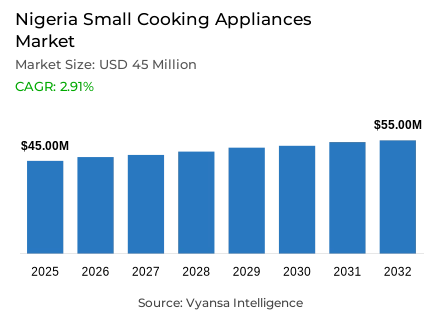
- Small cooking appliances market size in Nigeria was valued at USD 45 million in 2025 and is estimated at USD 49 million in 2026.
- The market size is expected to grow to USD 55 million by 2032.
- Market to register a CAGR of around 2.91% during 2026-32.
- Appliances Shares
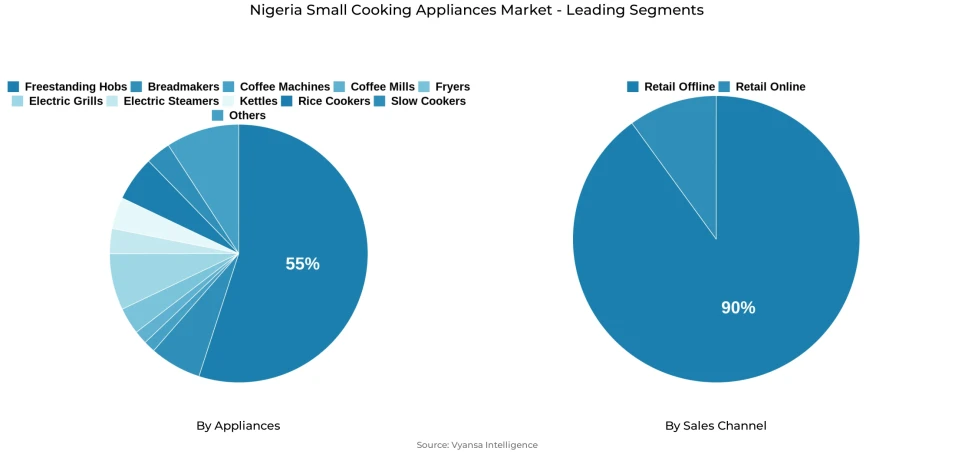
- Freestanding hobs grabbed market share of 55%.
- Competition
- More than 15 companies are actively engaged in producing small cooking appliances in Nigeria.
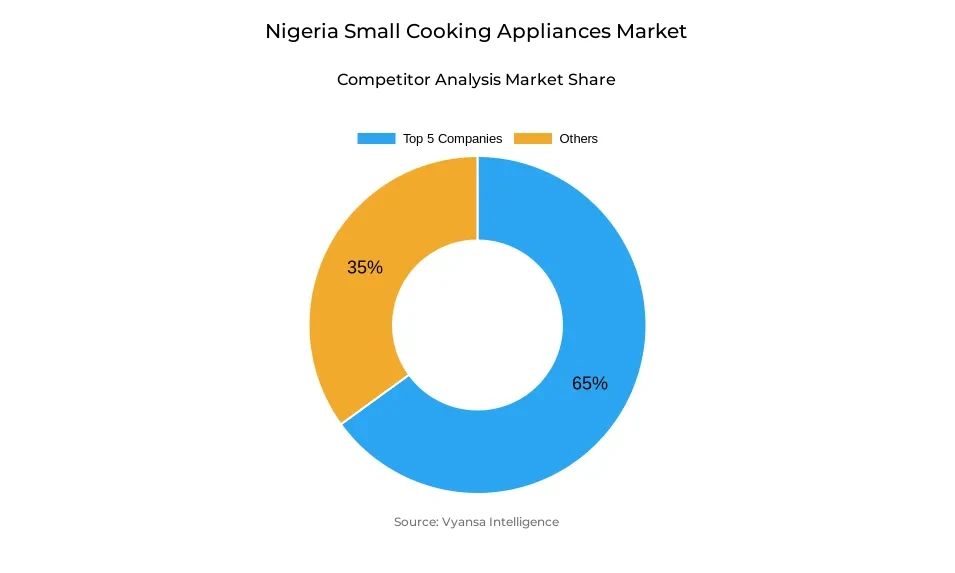
- Top 5 companies acquired around 65% of the market share.
- Panaserv Nigeria Ltd, Sonik appliances, Pricerite Products Ltd, Global Appliances Nigeria Ltd, Fareast Mercantile Co Ltd etc., are few of the top companies.
- Sales Channel
- Retail offline grabbed 90% of the market.
Nigeria Small Cooking Appliances Market Outlook
Nigeria small cooking appliances market size was valued at USD 45 million in 2025 and is projected to grow from USD 49 million in 2026 to USD 55 million by 2032, exhibiting a CAGR of 2.91% during the forecast period. Expansion is facilitated by the increasing interest in healthier cooking, the increasing demand of practical low-cost appliances, and the necessity to have convenient solutions that can fit the daily cooking routine of Nigerian families.
Demand within small cooking appliances remains strongest in products that are affordable, space-saving, and closely linked to daily food preparation. Freestanding hobs hold the highest share at 55%, supported by their lower cost, compact size, and better fit with local cooking habits compared with full cookers. Air fryers are also receiving more focus as more consumers are moving towards appliances that can be used to prepare healthier meals and also save them the hassle of spending the same money on frying oil over and over again.
At the same time, performance across small cooking appliances remains under pressure from weak purchasing power. There are still a lot of products that are considered as non-essential and this makes households postpone their purchases or even change to cheaper brands and other simpler alternatives. This influences coffee machine, kettle, and rice cooker categories more, and low-end purchasing continues to influence the demand throughout the category. Online discovery is also gaining relevance, particularly in younger consumers who are more active in product comparison and digital promotions.
Distribution continues to be led by physical stores, with retail offline accounting for 90% of the market. For many buyers, small cooking appliances are still products they prefer to inspect in person, especially when price, immediate access, and product familiarity strongly influence the final decision. Simultaneously, the growth of urban housing and the increasing popularity of compact cooking tools are leaving more space to practical appliances that can fit in smaller houses and meet the needs of daily life.
Nigeria Small Cooking Appliances Market Growth DriverHealth and Oil Savings Support Air Fryer Demand
In Nigeria, health-conscious cooking is emerging as a powerful demand driver. The demand of air fryers is being maintained by more consumers, particularly middle-aged buyers, seeking to prepare meals with reduced fat content. The reason why these appliances are becoming popular is that they not only assist in light cooking but also enable households to save on the repetitive expenditure on frying oil, which makes them attractive not only in terms of convenience.
This shift is reinforced by cost pressure. According to the National Bureau of Statistics of Nigeria, the average price of groundnut oil (75cl) is NGN 3,250.32 in April 2025. Air fryers are more appealing when oil is still costly since it reduces the consumption of oil, yet it does not sacrifice daily home cooking. This health value plus cost saving continues to make air fryers more demanded in the category.
Nigeria Small Cooking Appliances Market ChallengeHigh Inflation Limits Appliance Affordability
Weak consumer purchasing power remains a major challenge for small cooking appliances in Nigeria. A lot of products in this category are still considered as non-essential and thus households put off purchases when the budgets are tight. This has a greater impact on products like coffee machines, kettles and rice cookers and even the well-established brands lose market share as people turn to less expensive options to cope with the daily costs.
The severity of this pressure is indicated by official data. Nigeria’s National Bureau of Statistics reports that the headline inflation rate is 22.22% in June 2025. Price-sensitive households will tend to delay replacement purchases or switch to low-cost brands and less complex cooking methods in this environment. This keeps broad-based demand under pressure across many small cooking appliance categories.
Unlock Market Intelligence
Explore the market potential with our data-driven report
Nigeria Small Cooking Appliances Market TrendOnline Visibility Is Gaining More Influence
Online discovery is becoming a clearer trend in Nigeria’s small cooking appliances space. Younger customers are becoming more at ease with product comparison on the internet, social media promotions, and reacting to online discounts. This is assisting e-commerce to have a stronger impact particularly on convenient cooking products and low-cost appliances that are simple to comprehend using online content and they have comparisons.
The digital base of Nigeria facilitates this transition. According to the Nigerian Communications Commission, there are 144.15 million mobile internet subscribers in November 2025. In January 2026, 4G accounts for 53.41% of internet subscriptions and 5G for 3.94% in the same month. This renders online advertising, online product discovery, and demand driven by social-media more significant in influencing the purchase of appliances, particularly among younger urban consumers.
Nigeria Small Cooking Appliances Market OpportunityNew Housing Development Supports Compact Cooking Solutions
Urban housing expansion is creating a practical opening for small cooking appliances in Nigeria. With the increasing number of households shifting to newer houses, small and affordable appliances are becoming more applicable, particularly in kitchens with limited space. This justifies freestanding hobs since they can be installed in smaller houses, are cheaper than bigger cookers and they fit the local cooking culture where the use of ovens is not a significant concern.
This opportunity is supported by official housing data. According to the Federal Ministry of Housing and Urban Development, phase one of the Renewed Hope Housing Programme is expected to provide 50,000 housing units in Nigeria. This leaves more space to accommodate smaller appliances that suit the new urban households and help in daily cooking without having to use bigger kitchen designs.
Unlock Market Intelligence
Explore the market potential with our data-driven report
Nigeria Small Cooking Appliances Market Segmentation Analysis
By Appliances
- Breadmakers
- Coffee Machines
- Standard Coffee Machines
- Espresso Coffee Machines
- Filter Coffee Machines
- Pod Coffee Machines
- Hard Pods
- Soft Pods
- Standard Coffee Machines
- Coffee Mills
- Fryers
- Air Fryers
- Oil Based Fryers
- Electric Grills
- Electric Steamers
- Freestanding Hobs
- Gas
- Induction
- Standard Electric
- Mixed
- Vitroceramic
- Kettles
- Rice Cookers
- Slow Cookers
- Others
The segment with the highest share under the appliance category is freestanding hobs, accounting for around 55% of the market. This powerful stance is due to their practical use in daily cooking in Nigeria. They are regarded as cheaper and less bulky compared to full cookers, and thus they are more convenient to most households. They are also very relevant as cooking on a hob is more compatible with local traditions than ovens or grills.
Freestanding hobs also remain in the lead since they attract a broad income group. They are usually preferred by consumers seeking simple, basic cooking assistance, as opposed to more costly options. Although they are competing with low-cost camping gas stoves and electric induction stoves, their high household penetration, daily use, and suitability to local kitchen requirements make them the most popular appliance segment in Nigeria.
By Sales Channel
- Retail Offline
- Grocery Retailers
- Hypermarkets
- Non-Grocery Retailers
- General Merchandise Stores
- Department Stores
- Variety Stores
- Appliances and Electronics Specialists
- Home Products Specialists
- Grocery Retailers
- Retail Online
The segment with the highest share under the sales channel category is retail offline, holding around 90% of the market. The physical stores are still predominant as a number of consumers still want to view the product, directly compare prices and make instant buying choices face to face. This is particularly critical in a price-sensitive market such as Nigeria where consumers tend to consider affordability and instant value prior to making an appliance purchase.
Offline stores also remain stronger because many small cooking appliances are bought as essential household items rather than aspirational products. Consumers usually desire to have access to low-cost brands and easy cooking solutions without having to wait to be delivered or to be guided by online product descriptions. Consequently, the category remains dominated by retail offline, which is backed by familiarity, physical comparison, and easier access by everyday buyers.
List of Companies Covered in Nigeria Small Cooking Appliances Market
The companies listed below are highly influential in the Nigeria small cooking appliances market, with a significant market share and a strong impact on industry developments.
- Panaserv Nigeria Ltd
- Sonik appliances
- Pricerite Products Ltd
- Global Appliances Nigeria Ltd
- Fareast Mercantile Co Ltd
- PZ Cussons Nigeria Plc
- Winia Group
- Philips Nigeria (Pty) Ltd
- Fouani Nigeria Ltd
- Somotex Nigeria Ltd
Competitive Landscape
In 2025, small cooking appliances in Nigeria recorded a strong decline in retail volume terms due to weak economic conditions and low purchasing power, which pushed consumers towards cheaper alternatives and limited demand for non-essential appliances such as coffee machines, kettles, and rice cookers, while freestanding hobs remained the most essential and resilient category given their affordability and practicality, and air fryers saw some growth supported by rising health awareness and long-term cost savings despite their higher upfront price; within this challenging environment, Global Appliances Nigeria Ltd emerged as the leading player, while Fareast Mercantile Co Ltd followed closely, with both maintaining strong positions by catering to price-sensitive consumers and leveraging demand for essential, cost-effective cooking solutions amid a constrained market landscape.
Frequently Asked Questions
Related Report
- Market Segmentation
- Research Scope
- Research Methodology
- Definitions and Assumptions
- Executive Summary
- Nigeria Small Cooking Appliances Market Policies, Regulations, and Standards
- Nigeria Small Cooking Appliances Market Dynamics
- Growth Factors
- Challenges
- Trends
- Opportunities
- Nigeria Small Cooking Appliances Market Statistics, 2022-2032F
- Market Size & Growth Outlook
- By Revenues in USD Million
- Market Segmentation & Growth Outlook
- By Appliances
- Breadmakers- Market Insights and Forecast 2022-2032, USD Million
- Coffee Machines- Market Insights and Forecast 2022-2032, USD Million
- Standard Coffee Machines- Market Insights and Forecast 2022-2032, USD Million
- Espresso Coffee Machines- Market Insights and Forecast 2022-2032, USD Million
- Filter Coffee Machines- Market Insights and Forecast 2022-2032, USD Million
- Pod Coffee Machines- Market Insights and Forecast 2022-2032, USD Million
- Hard Pods- Market Insights and Forecast 2022-2032, USD Million
- Soft Pods- Market Insights and Forecast 2022-2032, USD Million
- Standard Coffee Machines- Market Insights and Forecast 2022-2032, USD Million
- Coffee Mills- Market Insights and Forecast 2022-2032, USD Million
- Fryers- Market Insights and Forecast 2022-2032, USD Million
- Air Fryers- Market Insights and Forecast 2022-2032, USD Million
- Oil Based Fryers- Market Insights and Forecast 2022-2032, USD Million
- Electric Grills- Market Insights and Forecast 2022-2032, USD Million
- Electric Steamers- Market Insights and Forecast 2022-2032, USD Million
- Freestanding Hobs- Market Insights and Forecast 2022-2032, USD Million
- Gas- Market Insights and Forecast 2022-2032, USD Million
- Induction- Market Insights and Forecast 2022-2032, USD Million
- Standard Electric- Market Insights and Forecast 2022-2032, USD Million
- Mixed- Market Insights and Forecast 2022-2032, USD Million
- Vitroceramic- Market Insights and Forecast 2022-2032, USD Million
- Kettles- Market Insights and Forecast 2022-2032, USD Million
- Rice Cookers- Market Insights and Forecast 2022-2032, USD Million
- Slow Cookers- Market Insights and Forecast 2022-2032, USD Million
- Others- Market Insights and Forecast 2022-2032, USD Million
- By Sales Channel
- Retail Offline- Market Insights and Forecast 2022-2032, USD Million
- Grocery Retailers- Market Insights and Forecast 2022-2032, USD Million
- Hypermarkets- Market Insights and Forecast 2022-2032, USD Million
- Non-Grocery Retailers- Market Insights and Forecast 2022-2032, USD Million
- General Merchandise Stores- Market Insights and Forecast 2022-2032, USD Million
- Department Stores- Market Insights and Forecast 2022-2032, USD Million
- Variety Stores- Market Insights and Forecast 2022-2032, USD Million
- Appliances and Electronics Specialists- Market Insights and Forecast 2022-2032, USD Million
- Home Products Specialists- Market Insights and Forecast 2022-2032, USD Million
- Grocery Retailers- Market Insights and Forecast 2022-2032, USD Million
- Retail Online- Market Insights and Forecast 2022-2032, USD Million
- Retail Offline- Market Insights and Forecast 2022-2032, USD Million
- By Region
- North Central
- North East
- North West
- South East
- Others
- By Competitors
- Competition Characteristics
- Market Share & Analysis
- By Appliances
- Market Size & Growth Outlook
- Nigeria Breadmakers Market Statistics, 2022-2032
- Market Size & Growth Outlook
- By Revenues in USD Million
- Market Segmentation & Growth Outlook
- By Sales Channel- Market Insights and Forecast 2022-2032, USD Million
- By Region- Market Insights and Forecast 2022-2032, USD Million
- Market Size & Growth Outlook
- Nigeria Coffee Machines Market Statistics, 2022-2032
- Market Size & Growth Outlook
- By Revenues in USD Million
- Market Segmentation & Growth Outlook
- By Sales Channel- Market Insights and Forecast 2022-2032, USD Million
- By Region- Market Insights and Forecast 2022-2032, USD Million
- Market Size & Growth Outlook
- Nigeria Coffee Mills Market Statistics, 2022-2032
- Market Size & Growth Outlook
- By Revenues in USD Million
- Market Segmentation & Growth Outlook
- By Sales Channel- Market Insights and Forecast 2022-2032, USD Million
- By Region- Market Insights and Forecast 2022-2032, USD Million
- Market Size & Growth Outlook
- Nigeria Fryers Market Statistics, 2022-2032
- Market Size & Growth Outlook
- By Revenues in USD Million
- Market Segmentation & Growth Outlook
- By Sales Channel- Market Insights and Forecast 2022-2032, USD Million
- By Region- Market Insights and Forecast 2022-2032, USD Million
- Market Size & Growth Outlook
- Nigeria Electric Grills Market Statistics, 2022-2032
- Market Size & Growth Outlook
- By Revenues in USD Million
- Market Segmentation & Growth Outlook
- By Sales Channel- Market Insights and Forecast 2022-2032, USD Million
- By Region- Market Insights and Forecast 2022-2032, USD Million
- Market Size & Growth Outlook
- Nigeria Electric Steamers Market Statistics, 2022-2032
- Market Size & Growth Outlook
- By Revenues in USD Million
- Market Segmentation & Growth Outlook
- By Sales Channel- Market Insights and Forecast 2022-2032, USD Million
- By Region- Market Insights and Forecast 2022-2032, USD Million
- Market Size & Growth Outlook
- Nigeria Freestanding Hobs Market Statistics, 2022-2032
- Market Size & Growth Outlook
- By Revenues in USD Million
- Market Segmentation & Growth Outlook
- By Sales Channel- Market Insights and Forecast 2022-2032, USD Million
- By Region- Market Insights and Forecast 2022-2032, USD Million
- Market Size & Growth Outlook
- Nigeria Kettles Market Statistics, 2022-2032
- Market Size & Growth Outlook
- By Revenues in USD Million
- Market Segmentation & Growth Outlook
- By Sales Channel- Market Insights and Forecast 2022-2032, USD Million
- By Region- Market Insights and Forecast 2022-2032, USD Million
- Market Size & Growth Outlook
- Nigeria Rice Cookers Market Statistics, 2022-2032
- Market Size & Growth Outlook
- By Revenues in USD Million
- Market Segmentation & Growth Outlook
- By Sales Channel- Market Insights and Forecast 2022-2032, USD Million
- By Region- Market Insights and Forecast 2022-2032, USD Million
- Market Size & Growth Outlook
- Nigeria Slow Cookers Market Statistics, 2022-2032
- Market Size & Growth Outlook
- By Revenues in USD Million
- Market Segmentation & Growth Outlook
- By Sales Channel- Market Insights and Forecast 2022-2032, USD Million
- By Region- Market Insights and Forecast 2022-2032, USD Million
- Market Size & Growth Outlook
- Competitive Outlook
- Company Profiles
- Global Appliances Nigeria Ltd
- Business Description
- Product Portfolio
- Collaborations & Alliances
- Recent Developments
- Financial Details
- Others
- Fareast Mercantile Co Ltd
- Business Description
- Product Portfolio
- Collaborations & Alliances
- Recent Developments
- Financial Details
- Others
- PZ Cussons Nigeria Plc
- Business Description
- Product Portfolio
- Collaborations & Alliances
- Recent Developments
- Financial Details
- Others
- Philips Nigeria (Pty) Ltd
- Business Description
- Product Portfolio
- Collaborations & Alliances
- Recent Developments
- Financial Details
- Others
- Winia Group
- Business Description
- Product Portfolio
- Collaborations & Alliances
- Recent Developments
- Financial Details
- Others
- Panaserv Nigeria Ltd
- Business Description
- Product Portfolio
- Collaborations & Alliances
- Recent Developments
- Financial Details
- Others
- Sonik appliances
- Business Description
- Product Portfolio
- Collaborations & Alliances
- Recent Developments
- Financial Details
- Others
- Fouani Nigeria Ltd
- Business Description
- Product Portfolio
- Collaborations & Alliances
- Recent Developments
- Financial Details
- Others
- Pricerite Products Ltd
- Business Description
- Product Portfolio
- Collaborations & Alliances
- Recent Developments
- Financial Details
- Others
- Somotex Nigeria Ltd
- Business Description
- Product Portfolio
- Collaborations & Alliances
- Recent Developments
- Financial Details
- Others
- Global Appliances Nigeria Ltd
- Company Profiles
- Disclaimer
| Segment | Sub-Segment |
|---|---|
| By Appliances |
|
| By Sales Channel |
|
| By Region |
|
Research Methodology
This study followed a structured approach comprising four key phases to assess the size and scope of the electro-oxidation market. The process began with thorough secondary research to collect data on the target market, related markets, and broader industry context. These findings, along with preliminary assumptions and estimates, were then validated through extensive primary research involving industry experts from across the value chain. To calculate the overall market size, both top-down and bottom-up methodologies were employed. Finally, market segmentation and data triangulation techniques were applied to refine and validate segment-level estimations.
Secondary Research
The secondary research phase involved gathering data from a wide range of credible and published sources. This step helped in identifying industry trends, defining market segmentation, and understanding the market landscape and value chain.
Sources consulted during this phase included:
- Company annual reports, investor presentations, and press releases
- Industry white papers and certified publications
- Trade directories and market-recognized databases
- Articles from authoritative authors and reputable journals
- Gold and silver standard websites
Secondary research was critical in mapping out the industry's value chain and monetary flow, identifying key market segments, understanding regional variations, and tracking significant industry developments.
Other key sources:
- Financial disclosures
- Industry associations and trade bodies
- News outlets and business magazines
- Academic journals and research studies
- Paid industry databases
Primary Research
To validate secondary data and gain deeper market insights, primary research was conducted with key stakeholders across both the supply and demand sides of the market.
On the demand side, participants included decision-makers and influencers from end-user industries—such as CIOs, CTOs, and CSOs—who provided first-hand perspectives on market needs, product usage, and future expectations.
On the supply side, interviews were conducted with manufacturers, industry associations, and institutional participants to gather insights into current offerings, product pipelines, and market challenges.
Primary interviews provided critical inputs such as:
- Market size and revenue data
- Product and service breakdowns
- Market forecasts
- Regional and application-specific trends
Stakeholders consulted included:
- Leading OEM and solution providers
- Channel and distribution partners
- End users across various applications
- Independent consultants and industry specialists
Market Size Estimation and Data Triangulation
- Identifying Key Market Participants (Secondary Research)
- Goal: To identify the major players or companies in the target market. This typically involves using publicly available data sources such as industry reports, market research publications, and financial statements of companies.
- Tools: Reports from firms like Gartner, Forrester, Euromonitor, Statista, IBISWorld, and others. Public financial statements, news articles, and press releases from top market players.
- Extracting Earnings of Key Market Participants
- Goal: To estimate the earnings generated from the product or service being analyzed. This step helps in understanding the revenue potential of each market player in a specific geography.
- Methods: Earnings data can be gathered from:
- Publicly available financial reports (for listed companies).
- Interviews and primary data sources from professionals, such as Directors, VPs, SVPs, etc. This is especially useful for understanding more nuanced, internal data that isn't publicly disclosed.
- Annual reports and investor presentations of key players.
- Data Collation and Development of a Relevant Data Model
- Goal: To collate inputs from both primary and secondary sources into a structured, data-driven model for market estimation. This model will incorporate key market KPIs and any independent variables relevant to the market.
- Key KPIs: These could include:
- Market size, growth rate, and demand drivers.
- Industry-specific metrics like market share, average revenue per customer (ARPC), or average deal size.
- External variables, such as economic growth rates, inflation rates, or commodity prices, that could affect the market.
- Data Modeling: Based on this data, the market forecasts are developed for the next 5 years. A combination of trend analysis, scenario modeling, and statistical regression might be used to generate projections.
- Scenario Analysis
- Goal: To test different assumptions and validate how sensitive the market is to changes in key variables (e.g., market demand, regulatory changes, technological disruptions).
- Types of Scenarios:
- Base Case: Based on current assumptions and historical data.
- Best-Case Scenario: Assuming favorable market conditions, regulatory environments, and technological advancements.
- Worst-Case Scenario: Accounting for adverse factors, such as economic downturns, stricter regulations, or unexpected disruptions.












