Netherlands Room Air Conditioners Market Report: Trends, Growth and Forecast (2026-2032)
By Product Type (Split Air Conditioners (Up to 9,000 BTU/h, 9,001-12,000 BTU/h, 12,001-18,000 BTU/h, 18,001-24,000 BTU/h, Above 24,000 BTU/h), Window Air Conditioners (Up to 9,000 BTU/h, 9,001-12,000 BTU/h, 12,001-18,000 BTU/h, 18,001-24,000 BTU/h, Above 24,000 BTU/h), Others), By Technology (Inverter, Non-Inverter), By Price (Up to USD 300, USD 301 to USD 600, USD 601 to USD 1,000, Above USD 1,000), By End User (Residential (Individual Households, Apartments/Condominiums, Vacation/Secondary Homes), Commercial (Offices, Retail Stores/Showrooms, Hospitality, Healthcare Facilities, Educational Institutions, Small Commercial Establishments, Others)), By Sales Channel (Retail Online (Brand-Owned Websites/D2C, E-Commerce Marketplaces), Retail Offline (Exclusive Brand Stores, Multi-Brand Electronics & Appliance Stores, Specialty Stores, Hypermarkets/Supermarkets, Home Improvement Stores, Dealer/Distributor Network, Direct Sales/Institutional Sales, Local Independent Retailers)), By Refrigerant Type (R-32, R-410A, R-290, R-454B, Others), By Connectivity (Smart/Connected, Conventional/Non-Smart), By Energy Efficiency (1 Star, 2 Star, 3 Star, 4 Star, 5 Star) ... Read more
|
Major Players
|
Netherlands Room Air Conditioners Market Statistics and Insights, 2026
- Market Size Statistics
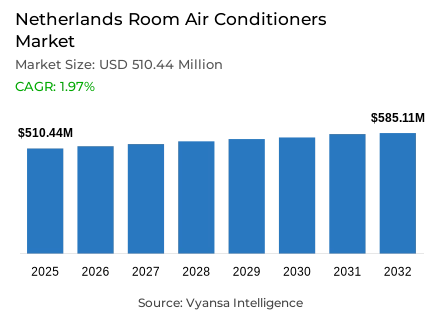
- Room air conditioners market size in Netherlands was valued at USD 510.44 million in 2025 and is estimated at USD 524.12 million in 2026.
- The market size is expected to grow to USD 585.11 million by 2032.
- Market to register a CAGR of around 1.97% during 2026-32.
- Product Type Shares
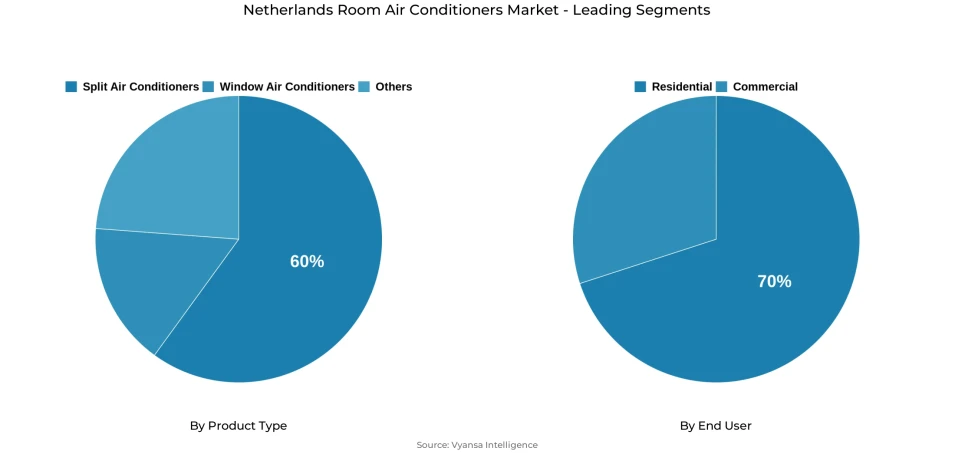
- Split air conditioners grabbed market share of 60%.
- Competition
- More than 10 companies are actively engaged in producing room air conditioners in Netherlands.
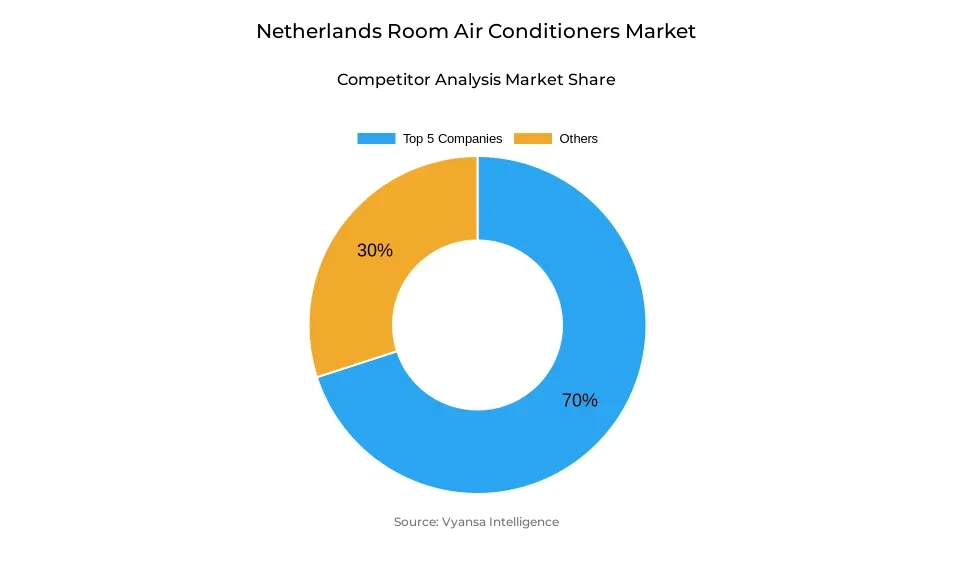
- Top 5 companies acquired around 70% of the market share.
- Hon Hai Precision Industry Co Ltd, Whirlpool Corp, Hisense Group, PVG Group, Euromac BV etc., are few of the top companies.
- End User
- Residential grabbed 70% of the market.
Netherlands Room Air Conditioners Market Outlook
The Netherlands room air conditioners market was valued at USD 510.44 million in 2025, establishing a commercially stable foundation within one of Northern Europe's most rapidly transitioning residential cooling appliance ecosystems. Projected to advance from USD 524.12 million in 2026 to USD 585.11 million by 2032, the sector registers a CAGR rate of approximately 1.97% across the forecast horizon. The category advances at a measured but structurally supported pace as cooling becomes progressively more relevant in everyday Dutch residential comfort management sustained by replacement demand momentum, rising household awareness of summer heat management requirements, and the normalization of room air conditioners as practical residential comfort infrastructure rather than discretionary seasonal appliances. This steady expansion trajectory reflects a market whose commercial momentum is anchored in the gradual deepening of household cooling adoption rather than aggressive penetration-driven volume acceleration.
The product architecture defining this market's commercial structure is characterized by meaningful format concentration within the split system category. Split air conditioners command approximately 60% of total product share a leading position that reflects sustained end user and installer preference for fixed, room-level cooling systems whose installation practicality, operational efficiency, and residential integration characteristics align more naturally with Dutch household cooling requirements than portable or window-unit alternatives. This format concentration creates a focused competitive environment where brand differentiation is increasingly constructed on energy efficiency credentials, F-gas regulatory compliance, and after-sales service reliability dimensions that have assumed progressively greater commercial importance as European regulatory frameworks simultaneously elevate minimum performance standards and tighten refrigerant phase-down obligations across the residential cooling segment.
The end-user architecture of this market reinforces the primacy of residential demand as the category's primary commercial engine. Residential buyers account for approximately 70% of total market share confirming that home-based cooling demand defines the category's volume base, replacement cycle dynamics, and product specification priorities. CBS's documentation of the Netherlands' housing stock expanding to over 8.3 million homes in 2025 following a net addition of 70 thousand dwellings validates the structural expansion of the residential installation base that is generating consistent new-unit and replacement demand across the country's diverse housing geography. The accelerating pace of housing stock growth signals that room air conditioners are acquiring a progressively broader residential addressable market as each new dwelling entering the stock represents a potential cooling system installation site.
The forward outlook through 2032 is defined by the simultaneous operation of four structural market forces the continued climatic intensification documented by KNMI that is elevating household cooling relevance across the Netherlands' previously cooling-averse residential base, the progressive electrification of Dutch homes that is expanding the addressable market for electrically driven cooling systems, the tightening F-gas regulatory compliance framework established under Regulation (EU) 2024/573 that is reshaping product and service economics across the supply chain, and the steady housing construction activity documented by CBS with nearly 80 thousand homes added to the stock in 2025 and construction permits issued for almost 86 thousand new homes that generates consistent first-installation demand across newly completed residential properties. These converging forces collectively define a commercial environment that rewards suppliers with compliant, energy-efficient product portfolios, transparent performance communication, and robust residential distribution and installation service networks through 2032.
Netherlands Room Air Conditioners Market Growth DriverClimatic Intensification Elevates Structural Household Cooling Demand Across the Residential Base
The measurable and accelerating intensification of summer climate conditions across the Netherlands represents the primary structural driver of room air conditioner demand functioning as a persistent environmental motivator that systematically elevates household cooling investment priority among a Dutch end user base that has historically operated with limited mechanical cooling infrastructure relative to its Southern European counterparts. This climatic demand driver is not a cyclical weather-response phenomenon generating episodic purchase spikes but a structural behavioral shift reflecting the progressive normalization of mechanical cooling as a standard residential comfort infrastructure expectation among Dutch households that have experienced repeated summer heat intensity, documented heatwave episodes, and indoor thermal discomfort at a frequency and severity that has fundamentally altered the perceived necessity of cooling appliance ownership across demographic and housing segments.
The quantitative evidence validating this climate-driven demand dynamic is documented with precision by KNMI. The average annual temperature recorded at De Bilt in 2025 reaches 11.4°C compared with the long-term normal level of 10.5°C making 2025 the sixth warmest year since systematic temperature records began in 1901. The Netherlands experiences two confirmed heatwaves in 2025, with a national peak temperature of 39.0°C recorded across the same period conditions that create acute indoor thermal discomfort across the country's housing stock and generate powerful first-purchase and upgrade motivation among households previously operating without mechanical cooling. These documented climatic parameters confirm that cooling demand in the Netherlands is transitioning from a weather-opportunistic purchase category into a structurally motivated residential comfort investment whose demand base is progressively insulated from year-to-year temperature variability. For market participants, the climatic intensification driver creates a strategic imperative to position room air conditioners not as seasonal luxury appliances but as standard residential comfort infrastructure whose ownership rationale is validated by documented and persistent summer heat conditions through 2032.
Netherlands Room Air Conditioners Market ChallengeF-Gas Regulatory Compliance Elevates Operational Complexity and Supply Chain Transition Costs
The implementation and ongoing tightening of the European F-gas regulatory framework represents the most structurally significant operational challenge confronting suppliers, distributors, and service providers operating in the Netherlands room air conditioners market creating a compliance transition environment that simultaneously elevates product development requirements, service technician certification obligations, reporting and documentation burdens, and refrigerant procurement economics across the entire residential cooling supply chain. This regulatory challenge is particularly consequential for market participants whose product portfolios, service operations, and distributor networks retain substantial legacy exposure to high-global-warming-potential fluorinated gases a structural dependency that the F-gas phase-down trajectory makes commercially and legally unsustainable across the forecast horizon, requiring systematic and capital-intensive portfolio and operational transitions that compress margin structures and elevate competitive differentiation requirements.
The regulatory specificity and implementation timeline of this challenge are established with authority by the European Commission. F-gas Regulation (EU) 2024/573 adopted on 7 February 2024 and commencing application on 11 March 2024 introduces a progressively tightening phase-down schedule for fluorinated gases used in cooling equipment that materially reshapes the refrigerant economics and product engineering requirements of the Netherlands residential cooling market. The September 2024 adoption of implementing rules governing labelling, reporting, technician certification, and the F-gas Portal with certain labelling obligations applying from 1 January 2025 further elevates the operational compliance architecture that market participants must navigate with precision and consistency. For brands and distributors, this regulatory environment creates a strategic imperative to accelerate refrigerant transition investment, upgrade technician certification infrastructure, and systematically communicate compliance credentials to retail and installer channel partners positioning F-gas compliance readiness as a prerequisite for sustained market participation rather than a voluntary operational enhancement through 2032.
Unlock Market Intelligence
Explore the market potential with our data-driven report
Netherlands Room Air Conditioners Market TrendResidential Electrification Transition Expands the Structural Addressable Market for Cooling Systems
The progressive structural decarbonization of Dutch residential energy infrastructure characterized by the systematic transition of the Netherlands' housing stock away from natural gas heating toward all-electric and hybrid residential energy configurations represents a defining trend reshaping the demand environment for room air conditioners in ways that extend substantially beyond seasonal cooling requirements. As households adopt electrically driven indoor climate management systems within broader home energy decarbonization programs, room air conditioners are acquiring a broadened functional relevance within the residential energy architecture positioning them not merely as supplementary summer comfort appliances but as structurally integrated components of an evolving all-electric living ecosystem. This behavioral and infrastructural realignment creates a commercially significant demand expansion dynamic that reinforces the category's long-term growth trajectory independently of weather-driven purchase motivations.
The quantitative evidence documenting this electrification transition is established with precision by CBS. Fully gas-free homes in the Netherlands advanced from 8.7% of the total housing stock in 2022 to 11.2% in 2024 a 2.5 percentage point structural expansion that confirms the accelerating pace of residential decarbonization across the country's diverse housing geography. Simultaneously, the hybrid residential energy category expanded from 1.5% to 3.7% over the same period reflecting the breadth of transitional energy configurations through which Dutch households are progressively reducing natural gas dependence while building toward full electrification. CBS further documents that homes constructed since 2015 demonstrate significantly elevated adoption rates for electrically driven heating and climate management systems including heat pumps and air conditioning establishing a generational housing cohort within which room air conditioners occupy a structurally normalized role in the residential energy management framework. For market participants, the electrification trend creates a strategic imperative to position room air conditioner offerings within the broader all-electric home narrative communicating cooling performance credentials alongside heating-mode efficiency, grid compatibility, and smart home integration capabilities as composite product value propositions that resonate with an increasingly electrification-oriented Dutch residential end user base through 2032.
Netherlands Room Air Conditioners Market OpportunityHousing Stock Expansion Creates Scalable and Geographically Distributed First-Installation Demand
The continued and measurable expansion of the Netherlands' residential housing stock represents the market's most immediately scalable and structurally durable commercial opportunity providing a large, geographically distributed, and progressively more cooling-motivated first-installation demand base that will sustain new unit sales generation independently of replacement cycle timing across the forecast period. This housing-driven installation opportunity is particularly compelling because the behavioral and climatic conditions activating its conversion rising summer temperature intensity, expanding household awareness of energy-efficient cooling system economics, and the progressive normalization of room-level cooling as a standard residential comfort expectation are structural trends that systematically reduce the adoption friction keeping newly housed occupants from making first cooling system investments at the point of property acquisition or early occupancy.
The quantitative scale of this opportunity is established with precision by CBS. Nearly 80 thousand homes are added to the Netherlands' housing stock in 2025 including 69.2 thousand newbuild completions while construction permits are issued for almost 86 thousand new homes across the same period, confirming a robust forward pipeline of residential installation opportunities that extends the first-installation demand horizon well beyond 2025. The total housing stock reaching over 8.3 million homes in 2025 confirms the structural scale of the addressable residential base within which cooling system penetration expansion is occurring a base whose cooling adoption momentum is being simultaneously reinforced by the climatic intensification documented by KNMI and the home electrification transition documented by CBS. Suppliers that combine competitive first-installation pricing, energy efficiency communication credibility, F-gas compliance transparency, and accessible installation service networks across the Netherlands' geographically diverse residential construction markets will capture disproportionate value from this structural opportunity through 2032.
Unlock Market Intelligence
Explore the market potential with our data-driven report
Netherlands Room Air Conditioners Market Segmentation Analysis
By Product Type
- Split Air Conditioners
- Up to 9,000 BTU/h
- 9,001-12,000 BTU/h
- 12,001-18,000 BTU/h
- 18,001-24,000 BTU/h
- Above 24,000 BTU/h
- Window Air Conditioners
- Up to 9,000 BTU/h
- 9,001-12,000 BTU/h
- 12,001-18,000 BTU/h
- 18,001-24,000 BTU/h
- Above 24,000 BTU/h
- Others
The segment commanding the highest market share within the product type dimension is Split Air Conditioners, accounting for approximately 60% of total Netherlands room air conditioners market value a dominant position that reflects the deep structural alignment between split system technology characteristics and the specific installation, operational, and comfort management requirements of Dutch residential housing typologies. Split systems' capacity to deliver room-level precision cooling through compact, wall-mounted configurations that require no whole-building infrastructure modification positions them as the unambiguous product of choice within a residential market defined by apartment-dense urban housing, retrofit installation constraints, and end user preference for targeted, room-specific cooling deployment over centralized system investment. This format preference is reinforced by the replacement-driven demand dynamics that characterize the Netherlands room air conditioners market an environment in which households upgrading aging cooling equipment instinctively gravitate toward the split system format whose installation familiarity, operational reliability, and room-specific flexibility they have already validated through prior ownership experience.
The structural durability of split air conditioners' market leadership is actively reinforced by the European regulatory compliance architecture now governing the residential cooling category. F-gas Regulation (EU) 2024/573 which commenced application on 11 March 2024 and introduced comprehensive implementing rules on labelling, reporting, technician certification, and the F-gas Portal in September 2024 creates a product compliance differentiation axis that progressively disadvantages legacy refrigerant-dependent portfolios while generating sustainable competitive advantage for brands with certified, next-generation refrigerant split system offerings. As regulatory obligations become more granular and enforcement more systematic, product compliance credentials are transitioning from a background operational requirement into a front-line commercial differentiator that shapes retail consideration and installer recommendation behavior. The segment's commanding position as the primary revenue contributor and competitive focal point is expected to remain structurally intact through 2032 as replacement cycle activity and new installation demand sustain split systems' dominance within the overall market architecture.
By End User
- Residential
- Individual Households
- Apartments/Condominiums
- Vacation/Secondary Homes
- Commercial
- Offices
- Retail Stores/Showrooms
- Hospitality
- Healthcare Facilities
- Educational Institutions
- Small Commercial Establishments
- Others
The segment commanding the highest market share within the end user dimension is Residential, accounting for approximately 70% of total Netherlands room air conditioners market value a dominant position that confirms household-based cooling demand as the category's primary commercial engine, volume generation mechanism, and product specification reference framework. The primacy of residential demand within the Netherlands market reflects the fundamentally experiential and comfort-driven nature of household cooling acquisition where purchase decisions are motivated by recurring summer discomfort, indoor heat retention in urban apartment environments, and the progressive normalization of room-level cooling as a standard residential comfort infrastructure expectation rather than a discretionary seasonal convenience. With seven-tenths of total market revenue anchored in residential consumption, the category's commercial performance trajectory is structurally inseparable from the behavioral, climatic, and housing market dynamics shaping Dutch household cooling adoption patterns.
The structural concentration of demand within the residential segment is validated and amplified by CBS's documentation of the Netherlands' housing stock expansion with over 8.3 million homes recorded in 2025 following a net addition of 70 thousand dwellings and construction permits issued for almost 86 thousand new homes across the same period. Each newly completed or transacted residential property represents a structurally credible first-installation demand opportunity in a cooling category whose relevance is being systematically elevated by the climatic intensification documented by KNMI with 2025 recording the sixth warmest annual average temperature since 1901, two confirmed heatwaves, and a peak temperature of 39.0°C that reinforces household cooling investment motivation across the residential buyer base. Combined with the progressive electrification of Dutch housing documented by CBS with 11.2% of homes fully gas-free in 2024, up from 8.7% in 2022 the residential segment's structural position as the market's dominant demand architecture is expected to deepen through 2032 as household cooling adoption continues its normalization trajectory across the country's diverse residential geography.
List of Companies Covered in Netherlands Room Air Conditioners Market
The companies listed below are highly influential in the Netherlands room air conditioners market, with a significant market share and a strong impact on industry developments.
- Hon Hai Precision Industry Co Ltd
- Whirlpool Corp
- Hisense Group
- PVG Group
- Euromac BV
- Midea Group Co Ltd
- LG Corp
- De'Longhi SpA
- Honeywell International Inc
- Smartwares Group
Market News & Updates
- Euromac BV, 2025:
Eurom upgraded the AC5201 Caravan and Home Air Conditioner in 2025 as a higher-capacity split solution for Dutch consumers, with its March 2025 leaflet highlighting a new version with improved capacity and energy class A, while the official product page positions the model for caravan, camper and home use with Wi-Fi app control, R290 refrigerant, Window Way-Out adapter compatibility and retail availability through channels such as bol.com, Praxis, Wehkamp and Obelink. In the Netherlands, this matters because it expands room-AC demand beyond standard fixed residential installs into flexible small-space, seasonal and recreational-use cooling, effectively widening the addressable market across mobile, split and hybrid home-leisure applications
- LG Corp, 2025:
LG’s Dutch site is now pushing the new DUALCOOL AI residential range with features such as AI Air with ThinQ, Soft Air, Dual Vane, All Cleaning, Comfort Humidity Control and Proactive Energy Control, while local product listings frame the lineup as the “new LG airconditioners” and attach 2025 iF Design Award recognition to the Dutch-market models. The market impact is that LG is clearly premiumizing the category in the Netherlands: instead of selling cooling alone, it is bundling personalized airflow, connected energy management, self-cleaning and design into a higher-value proposition that should support growth in inverter, smart/connected and premium-price bands, especially among households trading up from basic mobile units to more feature-rich split systems.
Frequently Asked Questions
Related Report
- Market Segmentation
- Research Scope
- Research Methodology
- Definitions and Assumptions
- Executive Summary
- Netherlands Room Air Conditioners Market Policies, Regulations, and Standards
- Netherlands Room Air Conditioners Market Dynamics
- Growth Factors
- Challenges
- Trends
- Opportunities
- Netherlands Room Air Conditioners Market Statistics, 2022-2032F
- Market Size & Growth Outlook
- By Revenues in USD Million
- By Units Sold in Thousand Units
- Market Segmentation & Growth Outlook
- By Product Type
- Split Air Conditioners- Market Insights and Forecast 2022-2032, USD Million
- Up to 9,000 BTU/h- Market Insights and Forecast 2022-2032, USD Million
- 9,001-12,000 BTU/h- Market Insights and Forecast 2022-2032, USD Million
- 12,001-18,000 BTU/h- Market Insights and Forecast 2022-2032, USD Million
- 18,001-24,000 BTU/h- Market Insights and Forecast 2022-2032, USD Million
- Above 24,000 BTU/h- Market Insights and Forecast 2022-2032, USD Million
- Window Air Conditioners- Market Insights and Forecast 2022-2032, USD Million
- Up to 9,000 BTU/h- Market Insights and Forecast 2022-2032, USD Million
- 9,001-12,000 BTU/h- Market Insights and Forecast 2022-2032, USD Million
- 12,001-18,000 BTU/h- Market Insights and Forecast 2022-2032, USD Million
- 18,001-24,000 BTU/h- Market Insights and Forecast 2022-2032, USD Million
- Above 24,000 BTU/h- Market Insights and Forecast 2022-2032, USD Million
- Others- Market Insights and Forecast 2022-2032, USD Million
- Split Air Conditioners- Market Insights and Forecast 2022-2032, USD Million
- By Technology
- Inverter- Market Insights and Forecast 2022-2032, USD Million
- Non-Inverter- Market Insights and Forecast 2022-2032, USD Million
- By Price
- Up to USD 300- Market Insights and Forecast 2022-2032, USD Million
- USD 301 to USD 600- Market Insights and Forecast 2022-2032, USD Million
- USD 601 to USD 1,000- Market Insights and Forecast 2022-2032, USD Million
- Above USD 1,000- Market Insights and Forecast 2022-2032, USD Million
- By End User
- Residential- Market Insights and Forecast 2022-2032, USD Million
- Individual Households- Market Insights and Forecast 2022-2032, USD Million
- Apartments/Condominiums- Market Insights and Forecast 2022-2032, USD Million
- Vacation/Secondary Homes- Market Insights and Forecast 2022-2032, USD Million
- Commercial- Market Insights and Forecast 2022-2032, USD Million
- Offices- Market Insights and Forecast 2022-2032, USD Million
- Retail Stores/Showrooms- Market Insights and Forecast 2022-2032, USD Million
- Hospitality- Market Insights and Forecast 2022-2032, USD Million
- Healthcare Facilities- Market Insights and Forecast 2022-2032, USD Million
- Educational Institutions- Market Insights and Forecast 2022-2032, USD Million
- Small Commercial Establishments- Market Insights and Forecast 2022-2032, USD Million
- Others- Market Insights and Forecast 2022-2032, USD Million
- Residential- Market Insights and Forecast 2022-2032, USD Million
- By Sales Channel
- Retail Online- Market Insights and Forecast 2022-2032, USD Million
- Brand-Owned Websites/D2C- Market Insights and Forecast 2022-2032, USD Million
- E-Commerce Marketplaces- Market Insights and Forecast 2022-2032, USD Million
- Retail Offline- Market Insights and Forecast 2022-2032, USD Million
- Exclusive Brand Stores- Market Insights and Forecast 2022-2032, USD Million
- Multi-Brand Electronics & Appliance Stores- Market Insights and Forecast 2022-2032, USD Million
- Specialty Stores- Market Insights and Forecast 2022-2032, USD Million
- Hypermarkets/Supermarkets- Market Insights and Forecast 2022-2032, USD Million
- Home Improvement Stores- Market Insights and Forecast 2022-2032, USD Million
- Dealer/Distributor Network- Market Insights and Forecast 2022-2032, USD Million
- Direct Sales/Institutional Sales- Market Insights and Forecast 2022-2032, USD Million
- Local Independent Retailers- Market Insights and Forecast 2022-2032, USD Million
- Retail Online- Market Insights and Forecast 2022-2032, USD Million
- By Refrigerant Type
- R-32- Market Insights and Forecast 2022-2032, USD Million
- R-410A- Market Insights and Forecast 2022-2032, USD Million
- R-290- Market Insights and Forecast 2022-2032, USD Million
- R-454B- Market Insights and Forecast 2022-2032, USD Million
- Others- Market Insights and Forecast 2022-2032, USD Million
- By Connectivity
- Smart/Connected- Market Insights and Forecast 2022-2032, USD Million
- Conventional/Non-Smart- Market Insights and Forecast 2022-2032, USD Million
- By Energy Efficiency
- 1 Star- Market Insights and Forecast 2022-2032, USD Million
- 2 Star- Market Insights and Forecast 2022-2032, USD Million
- 3 Star- Market Insights and Forecast 2022-2032, USD Million
- 4 Star- Market Insights and Forecast 2022-2032, USD Million
- 5 Star- Market Insights and Forecast 2022-2032, USD Million
- By Competitors
- Competition Characteristics
- Market Share & Analysis
- By Product Type
- Market Size & Growth Outlook
- Netherlands Split Air Conditioners Market Statistics, 2022-2032
- Market Size & Growth Outlook
- By Revenues in USD Million
- By Units Sold in Thousand Units
- Market Segmentation & Growth Outlook
- By Technology- Market Insights and Forecast 2022-2032, USD Million
- By Price- Market Insights and Forecast 2022-2032, USD Million
- By End User- Market Insights and Forecast 2022-2032, USD Million
- By Sales Channel- Market Insights and Forecast 2022-2032, USD Million
- By Refrigerant Type- Market Insights and Forecast 2022-2032, USD Million
- By Connectivity- Market Insights and Forecast 2022-2032, USD Million
- By Energy Efficiency- Market Insights and Forecast 2022-2032, USD Million
- Market Size & Growth Outlook
- Netherlands Window Air Conditioners Market Statistics, 2022-2032
- Market Size & Growth Outlook
- By Revenues in USD Million
- By Units Sold in Thousand Units
- Market Segmentation & Growth Outlook
- By Technology- Market Insights and Forecast 2022-2032, USD Million
- By Price- Market Insights and Forecast 2022-2032, USD Million
- By End User- Market Insights and Forecast 2022-2032, USD Million
- By Sales Channel- Market Insights and Forecast 2022-2032, USD Million
- By Refrigerant Type- Market Insights and Forecast 2022-2032, USD Million
- By Connectivity- Market Insights and Forecast 2022-2032, USD Million
- By Energy Efficiency- Market Insights and Forecast 2022-2032, USD Million
- Market Size & Growth Outlook
- Competitive Outlook
- Company Profiles
- PVG Group
- Business Description
- Product Portfolio
- Collaborations & Alliances
- Recent Developments
- Financial Details
- Others
- Euromac BV
- Business Description
- Product Portfolio
- Collaborations & Alliances
- Recent Developments
- Financial Details
- Others
- Midea Group Co Ltd
- Business Description
- Product Portfolio
- Collaborations & Alliances
- Recent Developments
- Financial Details
- Others
- LG Corp
- Business Description
- Product Portfolio
- Collaborations & Alliances
- Recent Developments
- Financial Details
- Others
- De'Longhi SpA
- Business Description
- Product Portfolio
- Collaborations & Alliances
- Recent Developments
- Financial Details
- Others
- Hon Hai Precision Industry Co Ltd
- Business Description
- Product Portfolio
- Collaborations & Alliances
- Recent Developments
- Financial Details
- Others
- Whirlpool Corp
- Business Description
- Product Portfolio
- Collaborations & Alliances
- Recent Developments
- Financial Details
- Others
- Hisense Group
- Business Description
- Product Portfolio
- Collaborations & Alliances
- Recent Developments
- Financial Details
- Others
- Honeywell International Inc
- Business Description
- Product Portfolio
- Collaborations & Alliances
- Recent Developments
- Financial Details
- Others
- Smartwares Group
- Business Description
- Product Portfolio
- Collaborations & Alliances
- Recent Developments
- Financial Details
- Others
- PVG Group
- Company Profiles
- Disclaimer
| Segment | Sub-Segment |
|---|---|
| By Product Type |
|
| By Technology |
|
| By Price |
|
| By End User |
|
| By Sales Channel |
|
| By Refrigerant Type |
|
| By Connectivity |
|
| By Energy Efficiency |
|
Research Methodology
This study followed a structured approach comprising four key phases to assess the size and scope of the electro-oxidation market. The process began with thorough secondary research to collect data on the target market, related markets, and broader industry context. These findings, along with preliminary assumptions and estimates, were then validated through extensive primary research involving industry experts from across the value chain. To calculate the overall market size, both top-down and bottom-up methodologies were employed. Finally, market segmentation and data triangulation techniques were applied to refine and validate segment-level estimations.
Secondary Research
The secondary research phase involved gathering data from a wide range of credible and published sources. This step helped in identifying industry trends, defining market segmentation, and understanding the market landscape and value chain.
Sources consulted during this phase included:
- Company annual reports, investor presentations, and press releases
- Industry white papers and certified publications
- Trade directories and market-recognized databases
- Articles from authoritative authors and reputable journals
- Gold and silver standard websites
Secondary research was critical in mapping out the industry's value chain and monetary flow, identifying key market segments, understanding regional variations, and tracking significant industry developments.
Other key sources:
- Financial disclosures
- Industry associations and trade bodies
- News outlets and business magazines
- Academic journals and research studies
- Paid industry databases
Primary Research
To validate secondary data and gain deeper market insights, primary research was conducted with key stakeholders across both the supply and demand sides of the market.
On the demand side, participants included decision-makers and influencers from end-user industries—such as CIOs, CTOs, and CSOs—who provided first-hand perspectives on market needs, product usage, and future expectations.
On the supply side, interviews were conducted with manufacturers, industry associations, and institutional participants to gather insights into current offerings, product pipelines, and market challenges.
Primary interviews provided critical inputs such as:
- Market size and revenue data
- Product and service breakdowns
- Market forecasts
- Regional and application-specific trends
Stakeholders consulted included:
- Leading OEM and solution providers
- Channel and distribution partners
- End users across various applications
- Independent consultants and industry specialists
Market Size Estimation and Data Triangulation
- Identifying Key Market Participants (Secondary Research)
- Goal: To identify the major players or companies in the target market. This typically involves using publicly available data sources such as industry reports, market research publications, and financial statements of companies.
- Tools: Reports from firms like Gartner, Forrester, Euromonitor, Statista, IBISWorld, and others. Public financial statements, news articles, and press releases from top market players.
- Extracting Earnings of Key Market Participants
- Goal: To estimate the earnings generated from the product or service being analyzed. This step helps in understanding the revenue potential of each market player in a specific geography.
- Methods: Earnings data can be gathered from:
- Publicly available financial reports (for listed companies).
- Interviews and primary data sources from professionals, such as Directors, VPs, SVPs, etc. This is especially useful for understanding more nuanced, internal data that isn't publicly disclosed.
- Annual reports and investor presentations of key players.
- Data Collation and Development of a Relevant Data Model
- Goal: To collate inputs from both primary and secondary sources into a structured, data-driven model for market estimation. This model will incorporate key market KPIs and any independent variables relevant to the market.
- Key KPIs: These could include:
- Market size, growth rate, and demand drivers.
- Industry-specific metrics like market share, average revenue per customer (ARPC), or average deal size.
- External variables, such as economic growth rates, inflation rates, or commodity prices, that could affect the market.
- Data Modeling: Based on this data, the market forecasts are developed for the next 5 years. A combination of trend analysis, scenario modeling, and statistical regression might be used to generate projections.
- Scenario Analysis
- Goal: To test different assumptions and validate how sensitive the market is to changes in key variables (e.g., market demand, regulatory changes, technological disruptions).
- Types of Scenarios:
- Base Case: Based on current assumptions and historical data.
- Best-Case Scenario: Assuming favorable market conditions, regulatory environments, and technological advancements.
- Worst-Case Scenario: Accounting for adverse factors, such as economic downturns, stricter regulations, or unexpected disruptions.












