Netherlands Consumer Lending Market Report: Trends, Growth and Forecast (2026-2032)
By Category (Outstanding Balance, Gross Lending), By Loan Type (Personal Loans, Unsecured Personal Loans, Secured Personal Loans, Auto Loans, Mortgages / Home Loans, Credit Card Loans, Student Loans), By Interest Rate Type (Fixed Interest Rate Loans, Floating / Variable Interest Rate Loans), By Payment Method (Direct Deposit (Salary Transfers, Government Benefits, Tax Refunds), Debit Card, Credit Card, Mobile Wallet / UPI, Cheque), By Borrower Type (Individual Borrowers, Joint Borrowers), By Distribution Channel (Bank Branches, Online / Digital Lending Platforms, Non-Banking Financial Institutions (NBFCs)), By Collateral Type (Secured Loans (Vehicle Collateral, Property Collateral), Unsecured Loans), By Age Group (Youth (up to 24 years), Young Adults (25-34 years), Adults (35-54 years), Pre-Retirement (55-64 years), Seniors (65+ years)) ... Read more
|
Major Players
|
Netherlands Consumer Lending Market Statistics and Insights, 2026
- Market Size Statistics
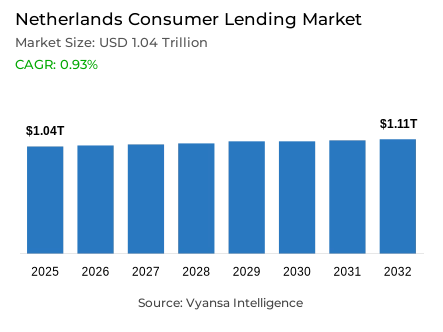
- Consumer lending in Netherlands outstanding balance is estimated at USD 1.04 trillion and gross lending is estimated at USD 143.07 billion in 2025.
- An outstanding balance market size is expected to grow to USD 1.11 trillion and gross lending USD 156.66 billion by 2032.
- Market to register an outstanding balance cagr of around 0.93% and gross lending cagr of around 1.3% during 2026-32.
- Loan Type Shares
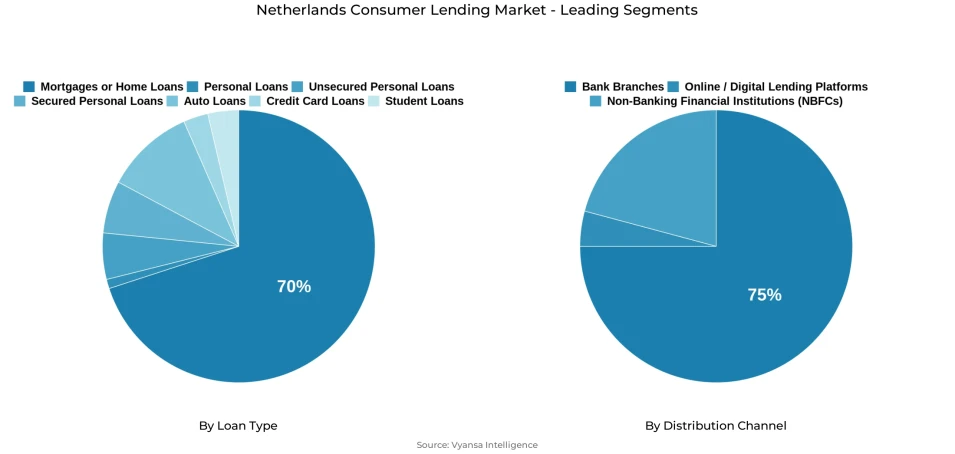
- Mortgages / home loans grabbed market share of 70%.
- Competition
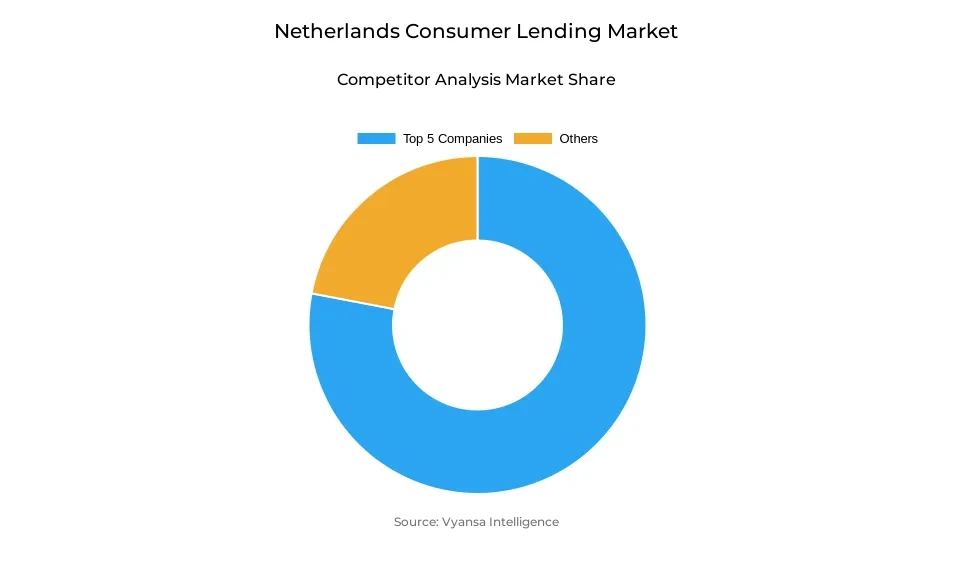
- Consumer lending in Netherlands is currently being catered to by more than 5 companies.
- Top 5 companies acquired the maximum share of the market.
- Klarna; Riverty; Billink; ING Groep NV; Rabobank Groep NV etc., are few of the top companies.
- Distribution Channel
- Bank branches grabbed 75% of the market.
Netherlands Consumer Lending Market Outlook
The Netherlands Consumer Lending Market is forecast to grow moderately during 2026–2032, supported by regulation, a stable mortgage base, and expanding auto lending. Outstanding balances are expected to rise from USD 1.04196 trillion in 2025 to USD 1.11854 trillion in 2032, at a CAGR of 1.02%. Gross lending is projected to grow from USD 143.07 billion to USD 156.66 billion, a CAGR of 1.30%. Mortgages/Home Loans, with 70% market share, will remain dominant due to high home prices and limited supply.
Regulation will remain the main shaping force. AFM and DNB will continue strict lending standards to prevent reckless borrowing, limiting growth in personal, card, and revolving credit. About 75% of lending will continue through branches.
BNPL will undergo major change from 2026 with mandatory credit checks and age verification, slowing earlier rapid growth but remaining relevant due to e-commerce expansion.
Auto lending will grow steadily with higher car prices and EV adoption. Mortgage values will also rise as home prices approach record highs despite low supply. Overall, the sector will grow steadily under strong regulation, stable secured-lending demand, and increasing household financial discipline.
Netherlands Consumer Lending Market Growth DriverRegulatory Focus on Financial Well-Being and Responsible Lending
The regulatory framework, led by the Netherlands Authority for the Financial Markets (AFM) and De Nederlandsche Bank (DNB), continues to influence consumer lending practices by prioritizing financial stability and responsible lending behavior. Inflation in the Netherlands stood at 4.1% in 2023 but eased to 3.2% in 2024, although continued pressure from rents, utilities, and services still weighs on disposable incomes. Living costs remain high, even as inflation has moderated under regulatory guidance.
This regulatory framework supports financial stability through prudent control of high-risk credit expansion. With rising rental costs and mortgage payments, regulations aim to ensure sustainable household borrowing. Financial well-being and responsible credit behavior remain central to long-term stability and controlled lending growth.
Netherlands Consumer Lending Market ChallengeHousing Market Constraints from Limited Supply
The persistent shortage of housing supply is a major structural challenge to the Netherlands Consumer Lending market. Housing completions totaled 69,129 units in 2024, down from about 73,000 units in the previous year, a decline of 6.99%, and still far below demand. The national housing shortage is estimated at around 400,000 units and continues to grow.
Average prices for existing homes were around EUR 470,028 in Q1 2025, with forecasts suggesting EUR 488,000 – 520,000 later in 2025. Rapid price growth combined with limited supply constrains borrowing capacity and slows the expansion of gross mortgage lending. Housing supply remains the key structural bottleneck for consumer lending growth.
Unlock Market Intelligence
Explore the market potential with our data-driven report
Netherlands Consumer Lending Market TrendStrengthening BNPL Regulation Across the EU
A stricter regulatory framework for Buy Now, Pay Later (BNPL) has become a defining structural trend in the Netherlands and the EU. The European Commission’s Consumer Credit Directive 2 (CCD2) extends regulation to BNPL, introducing stronger consumer protections, mandatory creditworthiness checks, stricter advertising rules, and a 14-day cooling-off period. Member states must transpose CCD2 by 20 November 2025, with full implementation by 20 November 2026.
Netherlands authorities and the AFM have added national measures. Providers such as Klarna, Riverty, Billink, and in3 have begun mandatory age verification to prevent minors from using BNPL. This represents a major shift in digital credit services driven by both EU-level and national regulation.
Netherlands Consumer Lending Market OpportunityRising Auto Lending Driven by Vehicle Demand
Automotive lending shows strong growth potential due to rapid electric-vehicle (EV) adoption. In 2024, EV registrations reached 132,166 units, representing 34.9% of new car sales up from 30.7% in 2023, while hybrids accounted for 159,705 units or 41.9% of sales. Higher EV prices compared with conventional cars raise average loan values.
Total new car sales reached 381,227 units in 2024, up 3.1% from 2023. The Tesla Model Y led EV sales with 19,058 registrations, or 14.4% of EV volume. The shift toward higher-priced electric vehicles and demand for sustainable transport make auto lending a strong growth opportunity.
Unlock Market Intelligence
Explore the market potential with our data-driven report
Netherlands Consumer Lending Market Segmentation Analysis
By Loan Type
- Personal Loans
- Unsecured Personal Loans
- Secured Personal Loans
- Auto Loans
- Mortgages / Home Loans
- Credit Card Loans
- Student Loans
The highest loan type segment is Mortgages/Home Loans, accounting for about 70% of the market. This dominance is expected to continue through 2026–2032 due to rising home prices and limited housing supply pushing up average mortgage values. Despite tighter AFM and DNB rules, demand will stay strong because of housing shortages and the desire for home ownership.
Fixed mortgage rates and demand for smaller dwellings will keep mortgages as the leading category, even though stricter credit testing may limit access for younger and single borrowers.
By Distribution Channel
- Bank Branches
- Online / Digital Lending Platforms
- Non-Banking Financial Institutions (NBFCs)
The largest distribution channel is Bank Branches, holding about 75% of the market. Despite fintech growth, traditional banks remain dominant, reinforced by strict regulation favoring prudent risk assessment.
From 2026 to 2032, branches will stay central for mortgage advice, refinancing, and large secured loans. Online platforms will grow for simple products, but tighter regulation and the removal of some loan schemes will keep many consumers relying on banks.
List of Companies Covered in Netherlands Consumer Lending Market
The companies associated with the Netherlands consumer lending market are outlined below.
- Klarna
- Riverty
- Billink
- ING Groep NV
- Rabobank Groep NV
- ABN AMRO Bank NV
- Citigroup Inc
Competitive Landscape
The Netherlands consumer lending market in 2024 is shaped mainly by regulatory pressure rather than aggressive competition. Traditional banks and regulated lenders dominate, operating under strict supervision from the AFM and De Nederlandsche Bank, which limits risk-taking and product expansion. Revolving credit and card lending are being scaled back as regulators push for responsible lending. In the BNPL space, players such as Klarna, Riverty, Billink, and in3 face rising compliance costs due to new EU and national rules, especially around age verification and credit checks. Mortgage and auto lenders remain active, but competition is constrained by housing shortages and affordability challenges, keeping market rivalry moderate and highly regulation-driven.
Frequently Asked Questions
Related Report
1. Market Segmentation
1.1. Research Scope
1.2. Research Methodology
1.3. Definitions and Assumptions
2. Executive Summary
3. Netherlands Consumer Lending Market Policies, Regulations, and Standards
4. Netherlands Consumer Lending Market Dynamics
4.1. Growth Factors
4.2. Challenges
4.3. Trends
4.4. Opportunities
5. Netherlands Consumer Lending Market Statistics, 2022-2032F
5.1. Market Size & Growth Outlook
5.1.1.By Revenues in USD Million
5.2. Market Segmentation & Growth Outlook
5.2.1.By Category
5.2.1.1. Outstanding Balance- Market Insights and Forecast 2022-2032, USD Million
5.2.1.2. Gross Lending- Market Insights and Forecast 2022-2032, USD Million
5.2.2.By Loan Type
5.2.2.1. Personal Loans- Market Insights and Forecast 2022-2032, USD Million
5.2.2.2. Unsecured Personal Loans- Market Insights and Forecast 2022-2032, USD Million
5.2.2.3. Secured Personal Loans- Market Insights and Forecast 2022-2032, USD Million
5.2.2.4. Auto Loans- Market Insights and Forecast 2022-2032, USD Million
5.2.2.5. Mortgages / Home Loans- Market Insights and Forecast 2022-2032, USD Million
5.2.2.6. Credit Card Loans- Market Insights and Forecast 2022-2032, USD Million
5.2.2.7. Student Loans- Market Insights and Forecast 2022-2032, USD Million
5.2.3.By Interest Rate Type
5.2.3.1. Fixed Interest Rate Loans- Market Insights and Forecast 2022-2032, USD Million
5.2.3.2. Floating / Variable Interest Rate Loans- Market Insights and Forecast 2022-2032, USD Million
5.2.4.By Payment Method
5.2.4.1. Direct Deposit- Market Insights and Forecast 2022-2032, USD Million
5.2.4.1.1. Salary Transfers- Market Insights and Forecast 2022-2032, USD Million
5.2.4.1.2. Government Benefits- Market Insights and Forecast 2022-2032, USD Million
5.2.4.1.3. Tax Refunds- Market Insights and Forecast 2022-2032, USD Million
5.2.4.2. Debit Card- Market Insights and Forecast 2022-2032, USD Million
5.2.4.3. Credit Card- Market Insights and Forecast 2022-2032, USD Million
5.2.4.4. Mobile Wallet / UPI- Market Insights and Forecast 2022-2032, USD Million
5.2.4.5. Cheque- Market Insights and Forecast 2022-2032, USD Million
5.2.5.By Borrower Type
5.2.5.1. Individual Borrowers- Market Insights and Forecast 2022-2032, USD Million
5.2.5.2. Joint Borrowers- Market Insights and Forecast 2022-2032, USD Million
5.2.6.By Distribution Channel
5.2.6.1. Bank Branches- Market Insights and Forecast 2022-2032, USD Million
5.2.6.2. Online / Digital Lending Platforms- Market Insights and Forecast 2022-2032, USD Million
5.2.6.3. Non-Banking Financial Institutions (NBFCs)- Market Insights and Forecast 2022-2032, USD Million
5.2.7.By Collateral Type
5.2.7.1. Secured Loans- Market Insights and Forecast 2022-2032, USD Million
5.2.7.1.1. Vehicle Collateral- Market Insights and Forecast 2022-2032, USD Million
5.2.7.1.2. Property Collateral- Market Insights and Forecast 2022-2032, USD Million
5.2.7.2. Unsecured Loans- Market Insights and Forecast 2022-2032, USD Million
5.2.8.By Age Group
5.2.8.1. Youth (up to 24 years)- Market Insights and Forecast 2022-2032, USD Million
5.2.8.2. Young Adults (25-34 years)- Market Insights and Forecast 2022-2032, USD Million
5.2.8.3. Adults (35-54 years)- Market Insights and Forecast 2022-2032, USD Million
5.2.8.4. Pre-Retirement (55-64 years)- Market Insights and Forecast 2022-2032, USD Million
5.2.8.5. Seniors (65+ years)- Market Insights and Forecast 2022-2032, USD Million
5.2.9.By Competitors
5.2.9.1. Competition Characteristics
5.2.9.2. Market Share & Analysis
6. Netherlands Outstanding Balance Market Statistics, 2022-2032
6.1. Market Size & Growth Outlook
6.1.1.By Revenues in USD Million
6.2. Market Segmentation & Growth Outlook
6.2.1.By Loan Type- Market Insights and Forecast 2022-2032, USD Million
6.2.2.By Interest Rate Type- Market Insights and Forecast 2022-2032, USD Million
6.2.3.By Payment Method- Market Insights and Forecast 2022-2032, USD Million
6.2.4.By Borrower Type- Market Insights and Forecast 2022-2032, USD Million
6.2.5.By Distribution Channel- Market Insights and Forecast 2022-2032, USD Million
6.2.6.By Collateral Type- Market Insights and Forecast 2022-2032, USD Million
6.2.7.By Age Group- Market Insights and Forecast 2022-2032, USD Million
7. Netherlands Gross Lending Market Statistics, 2022-2032
7.1. Market Size & Growth Outlook
7.1.1.By Revenues in USD Million
7.2. Market Segmentation & Growth Outlook
7.2.1.By Loan Type- Market Insights and Forecast 2022-2032, USD Million
7.2.2.By Interest Rate Type- Market Insights and Forecast 2022-2032, USD Million
7.2.3.By Payment Method- Market Insights and Forecast 2022-2032, USD Million
7.2.4.By Borrower Type- Market Insights and Forecast 2022-2032, USD Million
7.2.5.By Distribution Channel- Market Insights and Forecast 2022-2032, USD Million
7.2.6.By Collateral Type- Market Insights and Forecast 2022-2032, USD Million
7.2.7.By Age Group- Market Insights and Forecast 2022-2032, USD Million
8. Competitive Outlook
8.1. Company Profiles
8.1.1.ING Groep NV
8.1.1.1. Business Description
8.1.1.2. Product Portfolio
8.1.1.3. Collaborations & Alliances
8.1.1.4. Recent Developments
8.1.1.5. Financial Details
8.1.1.6. Others
8.1.2.Rabobank Groep NV
8.1.2.1. Business Description
8.1.2.2. Product Portfolio
8.1.2.3. Collaborations & Alliances
8.1.2.4. Recent Developments
8.1.2.5. Financial Details
8.1.2.6. Others
8.1.3.ABN AMRO Bank NV
8.1.3.1. Business Description
8.1.3.2. Product Portfolio
8.1.3.3. Collaborations & Alliances
8.1.3.4. Recent Developments
8.1.3.5. Financial Details
8.1.3.6. Others
8.1.4.Citigroup Inc
8.1.4.1. Business Description
8.1.4.2. Product Portfolio
8.1.4.3. Collaborations & Alliances
8.1.4.4. Recent Developments
8.1.4.5. Financial Details
8.1.4.6. Others
8.1.5.Klarna
8.1.5.1. Business Description
8.1.5.2. Product Portfolio
8.1.5.3. Collaborations & Alliances
8.1.5.4. Recent Developments
8.1.5.5. Financial Details
8.1.5.6. Others
8.1.6.Riverty
8.1.6.1. Business Description
8.1.6.2. Product Portfolio
8.1.6.3. Collaborations & Alliances
8.1.6.4. Recent Developments
8.1.6.5. Financial Details
8.1.6.6. Others
8.1.7.Billink
8.1.7.1. Business Description
8.1.7.2. Product Portfolio
8.1.7.3. Collaborations & Alliances
8.1.7.4. Recent Developments
8.1.7.5. Financial Details
8.1.7.6. Others
8.1.8.in3
8.1.8.1. Business Description
8.1.8.2. Product Portfolio
8.1.8.3. Collaborations & Alliances
8.1.8.4. Recent Developments
8.1.8.5. Financial Details
8.1.8.6. Others
8.1.9.Company 9
8.1.9.1. Business Description
8.1.9.2. Product Portfolio
8.1.9.3. Collaborations & Alliances
8.1.9.4. Recent Developments
8.1.9.5. Financial Details
8.1.9.6. Others
8.1.10. company 10
8.1.10.1. Business Description
8.1.10.2. Product Portfolio
8.1.10.3. Collaborations & Alliances
8.1.10.4. Recent Developments
8.1.10.5. Financial Details
8.1.10.6. Others
9. Disclaimer
| Segment | Sub-Segment |
|---|---|
| By Category |
|
| By Loan Type |
|
| By Interest Rate Type |
|
| By Payment Method |
|
| By Borrower Type |
|
| By Distribution Channel |
|
| By Collateral Type |
|
| By Age Group |
|
Research Methodology
This study followed a structured approach comprising four key phases to assess the size and scope of the electro-oxidation market. The process began with thorough secondary research to collect data on the target market, related markets, and broader industry context. These findings, along with preliminary assumptions and estimates, were then validated through extensive primary research involving industry experts from across the value chain. To calculate the overall market size, both top-down and bottom-up methodologies were employed. Finally, market segmentation and data triangulation techniques were applied to refine and validate segment-level estimations.
Secondary Research
The secondary research phase involved gathering data from a wide range of credible and published sources. This step helped in identifying industry trends, defining market segmentation, and understanding the market landscape and value chain.
Sources consulted during this phase included:
- Company annual reports, investor presentations, and press releases
- Industry white papers and certified publications
- Trade directories and market-recognized databases
- Articles from authoritative authors and reputable journals
- Gold and silver standard websites
Secondary research was critical in mapping out the industry's value chain and monetary flow, identifying key market segments, understanding regional variations, and tracking significant industry developments.
Other key sources:
- Financial disclosures
- Industry associations and trade bodies
- News outlets and business magazines
- Academic journals and research studies
- Paid industry databases
Primary Research
To validate secondary data and gain deeper market insights, primary research was conducted with key stakeholders across both the supply and demand sides of the market.
On the demand side, participants included decision-makers and influencers from end-user industries—such as CIOs, CTOs, and CSOs—who provided first-hand perspectives on market needs, product usage, and future expectations.
On the supply side, interviews were conducted with manufacturers, industry associations, and institutional participants to gather insights into current offerings, product pipelines, and market challenges.
Primary interviews provided critical inputs such as:
- Market size and revenue data
- Product and service breakdowns
- Market forecasts
- Regional and application-specific trends
Stakeholders consulted included:
- Leading OEM and solution providers
- Channel and distribution partners
- End users across various applications
- Independent consultants and industry specialists
Market Size Estimation and Data Triangulation
- Identifying Key Market Participants (Secondary Research)
- Goal: To identify the major players or companies in the target market. This typically involves using publicly available data sources such as industry reports, market research publications, and financial statements of companies.
- Tools: Reports from firms like Gartner, Forrester, Euromonitor, Statista, IBISWorld, and others. Public financial statements, news articles, and press releases from top market players.
- Extracting Earnings of Key Market Participants
- Goal: To estimate the earnings generated from the product or service being analyzed. This step helps in understanding the revenue potential of each market player in a specific geography.
- Methods: Earnings data can be gathered from:
- Publicly available financial reports (for listed companies).
- Interviews and primary data sources from professionals, such as Directors, VPs, SVPs, etc. This is especially useful for understanding more nuanced, internal data that isn't publicly disclosed.
- Annual reports and investor presentations of key players.
- Data Collation and Development of a Relevant Data Model
- Goal: To collate inputs from both primary and secondary sources into a structured, data-driven model for market estimation. This model will incorporate key market KPIs and any independent variables relevant to the market.
- Key KPIs: These could include:
- Market size, growth rate, and demand drivers.
- Industry-specific metrics like market share, average revenue per customer (ARPC), or average deal size.
- External variables, such as economic growth rates, inflation rates, or commodity prices, that could affect the market.
- Data Modeling: Based on this data, the market forecasts are developed for the next 5 years. A combination of trend analysis, scenario modeling, and statistical regression might be used to generate projections.
- Scenario Analysis
- Goal: To test different assumptions and validate how sensitive the market is to changes in key variables (e.g., market demand, regulatory changes, technological disruptions).
- Types of Scenarios:
- Base Case: Based on current assumptions and historical data.
- Best-Case Scenario: Assuming favorable market conditions, regulatory environments, and technological advancements.
- Worst-Case Scenario: Accounting for adverse factors, such as economic downturns, stricter regulations, or unexpected disruptions.












