Malaysia Herbal/Traditional Products Market Report: Trends, Growth and Forecast (2026-2032)
By Category (Topical Analgesics, Sleep Aids, Cough, Cold & Allergy Remedies, Digestive Remedies, Dermatologicals, Paediatric Dietary Supplements, Dietary Supplements, Tonics), By Form (Capsules/Tablets, Powder, Syrups, Oils & Ointments, Others), By Health Benefit (General Wellness, Cardiovascular Health, Cognitive & Mental Health, Digestive & Gut Health, Immunity Support, Respiratory Health, Bone & Joint Health, Others), By Source (Leaves, Roots, Barks, Flowers, Seeds, Others), By Ingredient Type (Single-Herb Products, Multi-Herb Products), By Function (Preventive Care, Curative/Relief Care), By End User (Adults, Geriatric Population, Children), By Prescription Type (Over-the-Counter (OTC), Prescription Herbal Medicines), By Sales Channel (Retail Offline, Retail Online) ... Read more
|
Major Players
|
Malaysia Herbal/Traditional Products Market Statistics and Insights, 2026
- Market Size Statistics
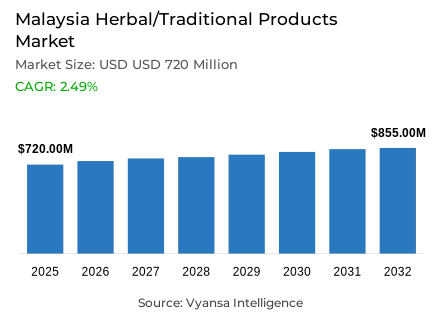
- Herbal/traditional products in Malaysia is estimated at USD 720 million in 2025.
- The market size is expected to grow to USD 855 million by 2032.
- Market to register a cagr of around 2.49% during 2026-32.
- Category Shares
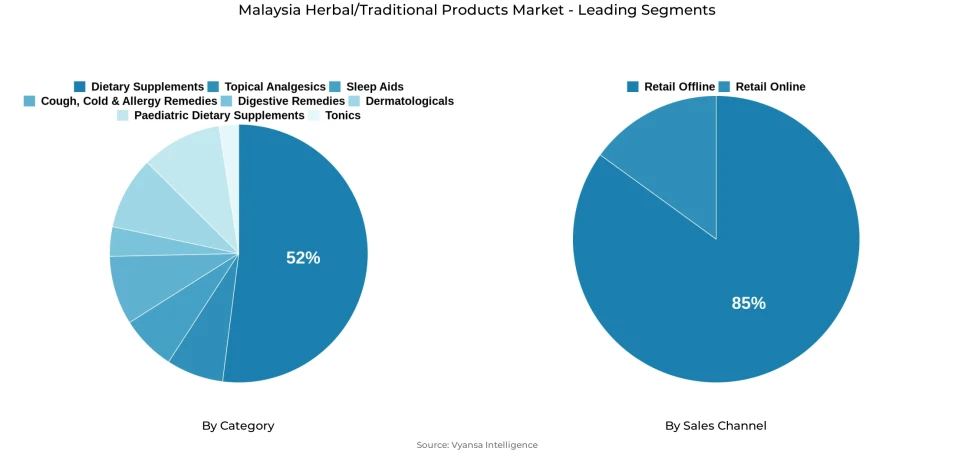
- Dietary supplements grabbed market share of 52%.
- Competition
- More than 20 companies are actively engaged in producing herbal/traditional products in Malaysia.
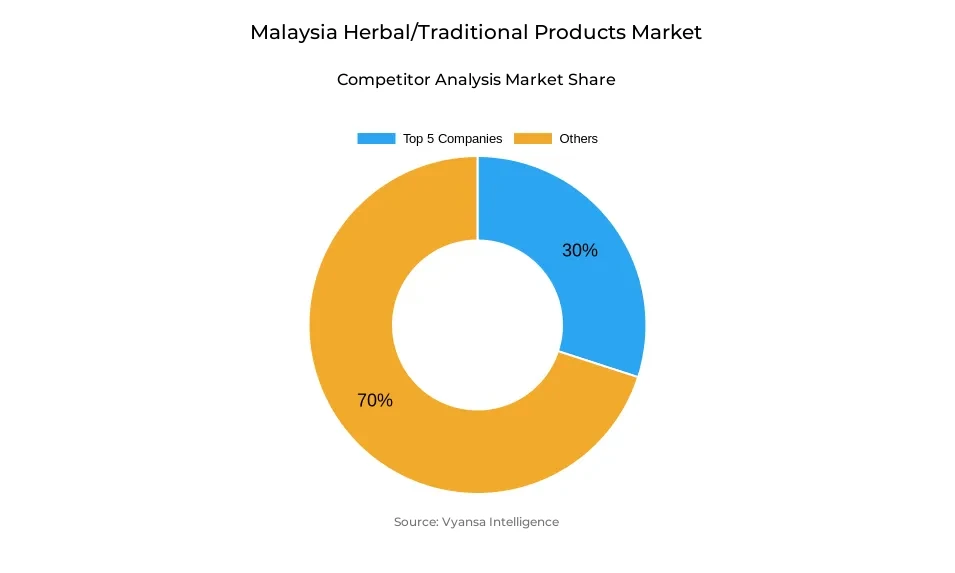
- Top 5 companies acquired around 30% of the market share.
- Lofthouse of Fleetwood Ltd; Leung Kai Fook Medical (M) Sdn Bhd; Eu Yan Sang (1959) Sdn Bhd; Brand's Suntory (M) Sdn Bhd; Elken Sdn Bhd etc., are few of the top companies.
- Sales Channel
- Retail offline grabbed 85% of the market.
Malaysia Herbal/Traditional Products Market Outlook
The Malaysia herbal/traditional products market is expected to show steady growth in the forecast period due to the growing end user interest in natural and plant-based wellness products. The market is expected to grow to USD 720 million in 2025, which can be mainly explained by the presence of dietary supplements and herbal tonics sold as immune boosters, respiratory support, and general wellbeing improvement. End user are increasingly demanding substitutes to synthetic ingredient formulations, thus promoting the broader use of traditional remedies based on local cultural practices and heritage-based knowledge systems.
Dietary supplements occupy about 52% of the market share by category classification, with increased end user acceptance of ingredients like tiger milk mushroom, Tongkat Ali, saffron extract, and Boswellia. The products enjoy the advantage of multipurpose positioning strategies that cater to the immune enhancement, joint health maintenance, mood balance optimisation, and vitality support goals. The dynamics of premiumisation trends, development of ingredient formulations, and end user trust developed over the long-term herbal tradition frameworks further support growth.
In terms of distribution channel structure, retail offline covers almost 85% of the total market sales, with pharmacies, traditional medicine halls, and health and beauty specialist retail establishments as the leaders. These retail stores are still important because of face-to-face consultation, product familiarity features, and good brand presence establishment. Even though e-commerce is a smaller market share, it is picking up with the adoption of promotional measures, online pharmacy platform expansion, and the provision of same-day delivery services.
The market is projected to grow at a compound annual growth rate of about 2.49% in the 2026–2032 period to USD 855 million in 2032. The preventive-health end user attitudes, the availability of locally sourced herbal ingredients, and the growing end user confidence in the effectiveness of traditional formulations continue to support market expansion. The regulatory improvements related to the substantiation of product claims and compliance with safety standards are also expected to enhance the transparency frameworks and build end user confidence in the categories of herbal and traditional wellness products.
Malaysia Herbal/Traditional Products Market Growth Driver
Growing Preference for Preventive and Natural Health Solutions
The increasing end user interest in preventive wellness is one of the key market forces, as Malaysian end user are turning to herbal and traditional products to support their immune system, maintain respiratory health, and optimise their daily vitality. End user relate natural ingredient formulations with safer long-term use profiles, thus justifying strong product acceptance of products with tiger milk mushroom, Tongkat Ali, saffron, and Boswellia botanical extracts.
The use of traditional and complementary medicine by the population of more than 88% of World Health Organization member states is reported, and the integration of traditional medicine by governments has increased since 58 member states had national programmes in 2012 to 79 member states in 2018, indicating a high level of relevance in the framework of preventive healthcare practices worldwide.
Malaysia Herbal/Traditional Products Market Challenge
Regulatory Compliance and Product Safety Concerns
The most important challange facing the market is the increasing demand of improved product validation procedures, safety assurance systems, and proper substantiation of health claims. With the growing number of herbal and traditional products entering the market, regulatory bodies are increasingly concerned with the need to ensure that formulations comply with the set safety and labeling standards. In 2023, the National Pharmaceutical Regulatory Agency of Malaysia approved revised guidance on natural products, and the Guideline on Natural Products with Modern Claim came into effect on April 4, 2024.
This guidance creates new regulatory avenues of natural products whose claims are backed by scientific evidence documentation, to safeguard end user against misleading claim representations and allow industry market access to formulations with evidence-based modern claims.
Unlock Market Intelligence
Explore the market potential with our data-driven report
Malaysia Herbal/Traditional Products Market Trend
Rising Demand for Beauty-, Mood- and Wellness-Positioned Herbal Products
The trends that are influencing the market dynamics is the increasing demand of herbal supplements that are placed in the context of beauty enhancement, mood stabilization, stress reduction, and relaxation support. end user are increasingly associating emotional wellbeing and physical appearance attributes with overall health outcome perceptions. Saffron extract, chamomile, lavender, and adaptogenic botanical compounds are ingredients that are finding their way into the market due to their calming and mood-supportive profile.
Since 2020, the global prevalence of anxiety and depression has increased by approximately 25%, with mental-wellbeing concerns and stress-related health behaviours rising notably, particularly among young adult and female end user groups.
Malaysia Herbal/Traditional Products Market Opportunity
Innovation Opportunities in Locally-Sourced Herbal Ingredients
There is a huge market potential in the increased use and marketing of locally available herbal products such as Tongkat Ali, tiger milk mushroom, and Kacip Fatimah. Tongkat Ali (Eurycoma longifolia) is established as one of the most valuable natural resource assets in Malaysia, and the global supplement market is projected to reach USD 119.31 billion by 2032. Recent studies between Biotropics Malaysia and Universiti Putra Malaysia have developed sustainability frameworks and product innovation capabilities by November 2025. Kacip Fatimah (Labisia pumila) has a long history of traditional use as a women health support agent and has been the focus of safety and efficacy studies that have reported anti-inflammatory, antioxidant, cytotoxic, and antimicrobial profiles.
The Malaysian government actively supports traditional health product development initiatives and indigenous botanical resource preservation through the Ministry of Health's Traditional and Complementary Medicine Units and the National Traditional and Complementary Medicine Blueprint framework covering 2018–2027. The Forest Research Institute Malaysia leads documentation initiatives preserving knowledge of 131 medicinal plants with documented medicinal value characteristics, and recent academic-industry collaboration programmes continue advancing research on locally-derived ingredient applications. This creates scope for premium formulation development, functional ingredient blend innovation, and wellness-focused product line expansion that differentiates local brand portfolios within both domestic and regional market contexts. As end user trust in heritage-based herbal knowledge remains robust, expanding product innovation around locally derived ingredients can support sustained category growth trajectories.
Unlock Market Intelligence
Explore the market potential with our data-driven report
Malaysia Herbal/Traditional Products Market Segmentation Analysis
By Category
- Topical Analgesics
- Sleep Aids
- Cough, Cold & Allergy Remedies
- Digestive Remedies
- Dermatologicals
- Paediatric Dietary Supplements
- Dietary Supplements
- Tonics
Dietary Supplements represent the dominant segment by category classification, accounting for approximately 52% of total market share. This leadership position is supported by strong end user preference for herbal supplement formats that address immunity enhancement, joint health maintenance, energy balance optimization, and general wellbeing support. Products featuring tiger milk mushroom, Tongkat Ali, saffron extract, and Boswellia benefit from cultural familiarity, widespread end user acceptance, and multipurpose usage application versatility.
Additionally, dietary supplements offer format versatility across capsules, powder formulations, and tonic compositions, rendering them suitable for daily consumption patterns and preventive-health routine integration. Premium ingredient combination strategies and improved product presentation approaches further strengthen end user demand dynamics, ensuring that dietary supplements remain the core growth anchor within Malaysia's herbal and traditional products market landscape.
By Sales Channel
- Retail Offline
- Retail Online
Retail Offline channels constitute the dominant segment by sales channel classification, capturing approximately 85% of total market sales volume. Pharmacies, traditional medicine halls, and health and beauty specialist establishments continue dominating distribution channel structures attributable to strong end user trust frameworks and convenient access to in-person product guidance and consultation service provision.
Offline retail establishments additionally play an important role in supporting brand familiarity and repeat purchase behavioural patterns, especially for long-established herbal and traditional remedy product lines. Although online purchasing channels are gradually increasing in market penetration, retail offline distribution networks remain central to product discovery processes, consultation-based sales interactions, and community-based purchasing behaviour patterns, reinforcing their dominant market share positioning across the distribution landscape.
List of Companies Covered in Malaysia Herbal/Traditional Products Market
The companies listed below are highly influential in the Malaysia herbal/traditional products market, with a significant market share and a strong impact on industry developments.
- Lofthouse of Fleetwood Ltd
- Leung Kai Fook Medical (M) Sdn Bhd
- Eu Yan Sang (1959) Sdn Bhd
- Brand's Suntory (M) Sdn Bhd
- Elken Sdn Bhd
- Forever Living Products (M) Sdn Bhd
- Herbalife Products (M) Sdn Bhd
- Tiger Balm (M) Sdn Bhd
- Ricola Asia Pacific Pte Ltd
- Amway (M) Sdn Bhd
Competitive Landscape
The competitive landscape for herbal/traditional products in Malaysia in 2024 is shaped largely by strong local and regional players that capitalise on long-standing consumer trust in traditional remedies and locally sourced ingredients. Brands associated with popular formulations such as Tongkat Ali, Tiger Milk Mushroom, Kacip Fatimah, and herbal tonics continue to gain traction, supported by expanding portfolios in dietary supplements, immune-boosting tonics, and products positioned for beauty, vitality, and respiratory health. Companies are also increasingly incorporating ingredients such as Sacha Inchi Extract, Saffron Extract, and Boswellia Extract to address cholesterol management, mood support, and inflammation relief. While health and beauty specialists and traditional medicine halls remain core distribution channels, growing online promotions by retailers such as Watsons and Guardian are gradually strengthening the e-commerce presence of established brands, reinforcing competitiveness through convenience, product accessibility, and targeted consumer engagement.
Frequently Asked Questions
Related Report
1. Market Segmentation
1.1. Research Scope
1.2. Research Methodology
1.3. Definitions and Assumptions
2. Executive Summary
3. Malaysia Herbal/Traditional Products Market Policies, Regulations, and Standards
4. Malaysia Herbal/Traditional Products Market Dynamics
4.1. Growth Factors
4.2. Challenges
4.3. Trends
4.4. Opportunities
5. Malaysia Herbal/Traditional Products Market Statistics, 2022-2032F
5.1. Market Size & Growth Outlook
5.1.1.By Revenues in USD Million
5.2. Market Segmentation & Growth Outlook
5.2.1.By Category
5.2.1.1. Topical Analgesics- Market Insights and Forecast 2022-2032, USD Million
5.2.1.2. Sleep Aids- Market Insights and Forecast 2022-2032, USD Million
5.2.1.3. Cough, Cold & Allergy Remedies- Market Insights and Forecast 2022-2032, USD Million
5.2.1.4. Digestive Remedies- Market Insights and Forecast 2022-2032, USD Million
5.2.1.5. Dermatologicals- Market Insights and Forecast 2022-2032, USD Million
5.2.1.6. Paediatric Dietary Supplements- Market Insights and Forecast 2022-2032, USD Million
5.2.1.7. Dietary Supplements- Market Insights and Forecast 2022-2032, USD Million
5.2.1.8. Tonics- Market Insights and Forecast 2022-2032, USD Million
5.2.2.By Form
5.2.2.1. Capsules/Tablets- Market Insights and Forecast 2022-2032, USD Million
5.2.2.2. Powder- Market Insights and Forecast 2022-2032, USD Million
5.2.2.3. Syrups- Market Insights and Forecast 2022-2032, USD Million
5.2.2.4. Oils & Ointments- Market Insights and Forecast 2022-2032, USD Million
5.2.2.5. Others- Market Insights and Forecast 2022-2032, USD Million
5.2.3.By Health Benefit
5.2.3.1. General Wellness- Market Insights and Forecast 2022-2032, USD Million
5.2.3.2. Cardiovascular Health- Market Insights and Forecast 2022-2032, USD Million
5.2.3.3. Cognitive & Mental Health- Market Insights and Forecast 2022-2032, USD Million
5.2.3.4. Digestive & Gut Health- Market Insights and Forecast 2022-2032, USD Million
5.2.3.5. Immunity Support- Market Insights and Forecast 2022-2032, USD Million
5.2.3.6. Respiratory Health- Market Insights and Forecast 2022-2032, USD Million
5.2.3.7. Bone & Joint Health- Market Insights and Forecast 2022-2032, USD Million
5.2.3.8. Others- Market Insights and Forecast 2022-2032, USD Million
5.2.4.By Source
5.2.4.1. Leaves- Market Insights and Forecast 2022-2032, USD Million
5.2.4.2. Roots- Market Insights and Forecast 2022-2032, USD Million
5.2.4.3. Barks- Market Insights and Forecast 2022-2032, USD Million
5.2.4.4. Flowers- Market Insights and Forecast 2022-2032, USD Million
5.2.4.5. Seeds- Market Insights and Forecast 2022-2032, USD Million
5.2.4.6. Others- Market Insights and Forecast 2022-2032, USD Million
5.2.5.By Ingredient Type
5.2.5.1. Single-Herb Products- Market Insights and Forecast 2022-2032, USD Million
5.2.5.2. Multi-Herb Products- Market Insights and Forecast 2022-2032, USD Million
5.2.6.By Function
5.2.6.1. Preventive Care- Market Insights and Forecast 2022-2032, USD Million
5.2.6.2. Curative/Relief Care- Market Insights and Forecast 2022-2032, USD Million
5.2.7.By End User
5.2.7.1. Adults- Market Insights and Forecast 2022-2032, USD Million
5.2.7.2. Geriatric Population- Market Insights and Forecast 2022-2032, USD Million
5.2.7.3. Children- Market Insights and Forecast 2022-2032, USD Million
5.2.8.By Prescription Type
5.2.8.1. Over-the-Counter (OTC)- Market Insights and Forecast 2022-2032, USD Million
5.2.8.2. Prescription Herbal Medicines- Market Insights and Forecast 2022-2032, USD Million
5.2.9.By Sales Channel
5.2.9.1. Retail Offline- Market Insights and Forecast 2022-2032, USD Million
5.2.9.2. Retail Online- Market Insights and Forecast 2022-2032, USD Million
5.2.10. By Competitors
5.2.10.1. Competition Characteristics
5.2.10.2. Market Share & Analysis
6. Malaysia Topical Analgesics Herbal/Traditional Products Market Statistics, 2022-2032
6.1. Market Size & Growth Outlook
6.1.1.By Revenues in USD Million
6.2. Market Segmentation & Growth Outlook
6.2.1.By Form- Market Insights and Forecast 2022-2032, USD Million
6.2.2.By Health Benefit - Market Insights and Forecast 2022-2032, USD Million
6.2.3.By Source- Market Insights and Forecast 2022-2032, USD Million
6.2.4.By Ingredient Type- Market Insights and Forecast 2022-2032, USD Million
6.2.5.By Function- Market Insights and Forecast 2022-2032, USD Million
6.2.6.By End User- Market Insights and Forecast 2022-2032, USD Million
6.2.7.By Prescription Type- Market Insights and Forecast 2022-2032, USD Million
6.2.8.By Sales Channel- Market Insights and Forecast 2022-2032, USD Million
7. Malaysia Sleep Aids Herbal/Traditional Products Market Statistics, 2022-2032
7.1. Market Size & Growth Outlook
7.1.1.By Revenues in USD Million
7.2. Market Segmentation & Growth Outlook
7.2.1.By Form- Market Insights and Forecast 2022-2032, USD Million
7.2.2.By Health Benefit - Market Insights and Forecast 2022-2032, USD Million
7.2.3.By Source- Market Insights and Forecast 2022-2032, USD Million
7.2.4.By Ingredient Type- Market Insights and Forecast 2022-2032, USD Million
7.2.5.By Function- Market Insights and Forecast 2022-2032, USD Million
7.2.6.By End User- Market Insights and Forecast 2022-2032, USD Million
7.2.7.By Prescription Type- Market Insights and Forecast 2022-2032, USD Million
7.2.8.By Sales Channel- Market Insights and Forecast 2022-2032, USD Million
8. Malaysia Cough, Cold & Allergy Remedies Herbal/Traditional Products Market Statistics, 2022-2032
8.1. Market Size & Growth Outlook
8.1.1.By Revenues in USD Million
8.2. Market Segmentation & Growth Outlook
8.2.1.By Form- Market Insights and Forecast 2022-2032, USD Million
8.2.2.By Health Benefit - Market Insights and Forecast 2022-2032, USD Million
8.2.3.By Source- Market Insights and Forecast 2022-2032, USD Million
8.2.4.By Ingredient Type- Market Insights and Forecast 2022-2032, USD Million
8.2.5.By Function- Market Insights and Forecast 2022-2032, USD Million
8.2.6.By End User- Market Insights and Forecast 2022-2032, USD Million
8.2.7.By Prescription Type- Market Insights and Forecast 2022-2032, USD Million
8.2.8.By Sales Channel- Market Insights and Forecast 2022-2032, USD Million
9. Malaysia Digestive Remedies Herbal/Traditional Products Market Statistics, 2022-2032
9.1. Market Size & Growth Outlook
9.1.1.By Revenues in USD Million
9.2. Market Segmentation & Growth Outlook
9.2.1.By Form- Market Insights and Forecast 2022-2032, USD Million
9.2.2.By Health Benefit - Market Insights and Forecast 2022-2032, USD Million
9.2.3.By Source- Market Insights and Forecast 2022-2032, USD Million
9.2.4.By Ingredient Type- Market Insights and Forecast 2022-2032, USD Million
9.2.5.By Function- Market Insights and Forecast 2022-2032, USD Million
9.2.6.By End User- Market Insights and Forecast 2022-2032, USD Million
9.2.7.By Prescription Type- Market Insights and Forecast 2022-2032, USD Million
9.2.8.By Sales Channel- Market Insights and Forecast 2022-2032, USD Million
10. Malaysia Dermatologicals Herbal/Traditional Products Market Statistics, 2022-2032
10.1. Market Size & Growth Outlook
10.1.1. By Revenues in USD Million
10.2. Market Segmentation & Growth Outlook
10.2.1. By Form- Market Insights and Forecast 2022-2032, USD Million
10.2.2. By Health Benefit - Market Insights and Forecast 2022-2032, USD Million
10.2.3. By Source- Market Insights and Forecast 2022-2032, USD Million
10.2.4. By Ingredient Type- Market Insights and Forecast 2022-2032, USD Million
10.2.5. By Function- Market Insights and Forecast 2022-2032, USD Million
10.2.6. By End User- Market Insights and Forecast 2022-2032, USD Million
10.2.7. By Prescription Type- Market Insights and Forecast 2022-2032, USD Million
10.2.8. By Sales Channel- Market Insights and Forecast 2022-2032, USD Million
11. Malaysia Paediatric Dietary Supplements Herbal/Traditional Products Market Statistics, 2022-2032
11.1. Market Size & Growth Outlook
11.1.1. By Revenues in USD Million
11.2. Market Segmentation & Growth Outlook
11.2.1. By Form- Market Insights and Forecast 2022-2032, USD Million
11.2.2. By Health Benefit - Market Insights and Forecast 2022-2032, USD Million
11.2.3. By Source- Market Insights and Forecast 2022-2032, USD Million
11.2.4. By Ingredient Type- Market Insights and Forecast 2022-2032, USD Million
11.2.5. By Function- Market Insights and Forecast 2022-2032, USD Million
11.2.6. By End User- Market Insights and Forecast 2022-2032, USD Million
11.2.7. By Prescription Type- Market Insights and Forecast 2022-2032, USD Million
11.2.8. By Sales Channel- Market Insights and Forecast 2022-2032, USD Million
12. Malaysia Dietary Supplements Herbal/Traditional Products Market Statistics, 2022-2032
12.1. Market Size & Growth Outlook
12.1.1. By Revenues in USD Million
12.2. Market Segmentation & Growth Outlook
12.2.1. By Form- Market Insights and Forecast 2022-2032, USD Million
12.2.2. By Health Benefit - Market Insights and Forecast 2022-2032, USD Million
12.2.3. By Source- Market Insights and Forecast 2022-2032, USD Million
12.2.4. By Ingredient Type- Market Insights and Forecast 2022-2032, USD Million
12.2.5. By Function- Market Insights and Forecast 2022-2032, USD Million
12.2.6. By End User- Market Insights and Forecast 2022-2032, USD Million
12.2.7. By Prescription Type- Market Insights and Forecast 2022-2032, USD Million
12.2.8. By Sales Channel- Market Insights and Forecast 2022-2032, USD Million
13. Malaysia Tonics Herbal/Traditional Products Market Statistics, 2022-2032
13.1. Market Size & Growth Outlook
13.1.1. By Revenues in USD Million
13.2. Market Segmentation & Growth Outlook
13.2.1. By Form- Market Insights and Forecast 2022-2032, USD Million
13.2.2. By Health Benefit - Market Insights and Forecast 2022-2032, USD Million
13.2.3. By Source- Market Insights and Forecast 2022-2032, USD Million
13.2.4. By Ingredient Type- Market Insights and Forecast 2022-2032, USD Million
13.2.5. By Function- Market Insights and Forecast 2022-2032, USD Million
13.2.6. By End User- Market Insights and Forecast 2022-2032, USD Million
13.2.7. By Prescription Type- Market Insights and Forecast 2022-2032, USD Million
13.2.8. By Sales Channel- Market Insights and Forecast 2022-2032, USD Million
14. Competitive Outlook
14.1. Company Profiles
14.1.1. Brand's Suntory (M) Sdn Bhd
14.1.1.1. Business Description
14.1.1.2. Product Portfolio
14.1.1.3. Collaborations & Alliances
14.1.1.4. Recent Developments
14.1.1.5. Financial Details
14.1.1.6. Others
14.1.2. Elken Sdn Bhd
14.1.2.1. Business Description
14.1.2.2. Product Portfolio
14.1.2.3. Collaborations & Alliances
14.1.2.4. Recent Developments
14.1.2.5. Financial Details
14.1.2.6. Others
14.1.3. Forever Living Products (M) Sdn Bhd
14.1.3.1. Business Description
14.1.3.2. Product Portfolio
14.1.3.3. Collaborations & Alliances
14.1.3.4. Recent Developments
14.1.3.5. Financial Details
14.1.3.6. Others
14.1.4. Herbalife Products (M) Sdn Bhd
14.1.4.1. Business Description
14.1.4.2. Product Portfolio
14.1.4.3. Collaborations & Alliances
14.1.4.4. Recent Developments
14.1.4.5. Financial Details
14.1.4.6. Others
14.1.5. Tiger Balm (M) Sdn Bhd
14.1.5.1. Business Description
14.1.5.2. Product Portfolio
14.1.5.3. Collaborations & Alliances
14.1.5.4. Recent Developments
14.1.5.5. Financial Details
14.1.5.6. Others
14.1.6. Lofthouse of Fleetwood Ltd
14.1.6.1. Business Description
14.1.6.2. Product Portfolio
14.1.6.3. Collaborations & Alliances
14.1.6.4. Recent Developments
14.1.6.5. Financial Details
14.1.6.6. Others
14.1.7. Leung Kai Fook Medical (M) Sdn Bhd
14.1.7.1. Business Description
14.1.7.2. Product Portfolio
14.1.7.3. Collaborations & Alliances
14.1.7.4. Recent Developments
14.1.7.5. Financial Details
14.1.7.6. Others
14.1.8. Eu Yan Sang (1959) Sdn Bhd
14.1.8.1. Business Description
14.1.8.2. Product Portfolio
14.1.8.3. Collaborations & Alliances
14.1.8.4. Recent Developments
14.1.8.5. Financial Details
14.1.8.6. Others
14.1.9. Ricola Asia Pacific Pte Ltd
14.1.9.1. Business Description
14.1.9.2. Product Portfolio
14.1.9.3. Collaborations & Alliances
14.1.9.4. Recent Developments
14.1.9.5. Financial Details
14.1.9.6. Others
14.1.10. Amway (M) Sdn Bhd
14.1.10.1.Business Description
14.1.10.2.Product Portfolio
14.1.10.3.Collaborations & Alliances
14.1.10.4.Recent Developments
14.1.10.5.Financial Details
14.1.10.6.Others
15. Disclaimer
| Segment | Sub-Segment |
|---|---|
| By Category |
|
| By Form |
|
| By Health Benefit |
|
| By Source |
|
| By Ingredient Type |
|
| By Function |
|
| By End User |
|
| By Prescription Type |
|
| By Sales Channel |
|
Research Methodology
This study followed a structured approach comprising four key phases to assess the size and scope of the electro-oxidation market. The process began with thorough secondary research to collect data on the target market, related markets, and broader industry context. These findings, along with preliminary assumptions and estimates, were then validated through extensive primary research involving industry experts from across the value chain. To calculate the overall market size, both top-down and bottom-up methodologies were employed. Finally, market segmentation and data triangulation techniques were applied to refine and validate segment-level estimations.
Secondary Research
The secondary research phase involved gathering data from a wide range of credible and published sources. This step helped in identifying industry trends, defining market segmentation, and understanding the market landscape and value chain.
Sources consulted during this phase included:
- Company annual reports, investor presentations, and press releases
- Industry white papers and certified publications
- Trade directories and market-recognized databases
- Articles from authoritative authors and reputable journals
- Gold and silver standard websites
Secondary research was critical in mapping out the industry's value chain and monetary flow, identifying key market segments, understanding regional variations, and tracking significant industry developments.
Other key sources:
- Financial disclosures
- Industry associations and trade bodies
- News outlets and business magazines
- Academic journals and research studies
- Paid industry databases
Primary Research
To validate secondary data and gain deeper market insights, primary research was conducted with key stakeholders across both the supply and demand sides of the market.
On the demand side, participants included decision-makers and influencers from end-user industries—such as CIOs, CTOs, and CSOs—who provided first-hand perspectives on market needs, product usage, and future expectations.
On the supply side, interviews were conducted with manufacturers, industry associations, and institutional participants to gather insights into current offerings, product pipelines, and market challenges.
Primary interviews provided critical inputs such as:
- Market size and revenue data
- Product and service breakdowns
- Market forecasts
- Regional and application-specific trends
Stakeholders consulted included:
- Leading OEM and solution providers
- Channel and distribution partners
- End users across various applications
- Independent consultants and industry specialists
Market Size Estimation and Data Triangulation
- Identifying Key Market Participants (Secondary Research)
- Goal: To identify the major players or companies in the target market. This typically involves using publicly available data sources such as industry reports, market research publications, and financial statements of companies.
- Tools: Reports from firms like Gartner, Forrester, Euromonitor, Statista, IBISWorld, and others. Public financial statements, news articles, and press releases from top market players.
- Extracting Earnings of Key Market Participants
- Goal: To estimate the earnings generated from the product or service being analyzed. This step helps in understanding the revenue potential of each market player in a specific geography.
- Methods: Earnings data can be gathered from:
- Publicly available financial reports (for listed companies).
- Interviews and primary data sources from professionals, such as Directors, VPs, SVPs, etc. This is especially useful for understanding more nuanced, internal data that isn't publicly disclosed.
- Annual reports and investor presentations of key players.
- Data Collation and Development of a Relevant Data Model
- Goal: To collate inputs from both primary and secondary sources into a structured, data-driven model for market estimation. This model will incorporate key market KPIs and any independent variables relevant to the market.
- Key KPIs: These could include:
- Market size, growth rate, and demand drivers.
- Industry-specific metrics like market share, average revenue per customer (ARPC), or average deal size.
- External variables, such as economic growth rates, inflation rates, or commodity prices, that could affect the market.
- Data Modeling: Based on this data, the market forecasts are developed for the next 5 years. A combination of trend analysis, scenario modeling, and statistical regression might be used to generate projections.
- Scenario Analysis
- Goal: To test different assumptions and validate how sensitive the market is to changes in key variables (e.g., market demand, regulatory changes, technological disruptions).
- Types of Scenarios:
- Base Case: Based on current assumptions and historical data.
- Best-Case Scenario: Assuming favorable market conditions, regulatory environments, and technological advancements.
- Worst-Case Scenario: Accounting for adverse factors, such as economic downturns, stricter regulations, or unexpected disruptions.












