Japan Soil Treatment Market Report: Trends, Growth and Forecast (2026-2032)
By Type (Organic Amendments (Animal Manure, Crop Residue, Compost, Sewage Sludge and Biosolids), pH Adjusters and Soil Conditioners (Aglime, Gypsum, Others), Soil Protection Products (Herbicides, Insecticides, Fungicides, Nematicides)), By Technology (Physicochemical Treatment, Biological Treatment, Thermal Treatment), By Application (Soil Fertility Improvement, Soil Remediation, pH Correction, Weed Management, Pest Management, Soil Structure Improvement), By Crop Type (Grains and Cereals, Fruits and Vegetables, Pulses and Oilseeds, Commercial Crops, Turf and Ornamentals) ... Read more
|
Major Players
|
Japan Soil Treatment Market Statistics and Insights, 2026
- Market Size Statistics
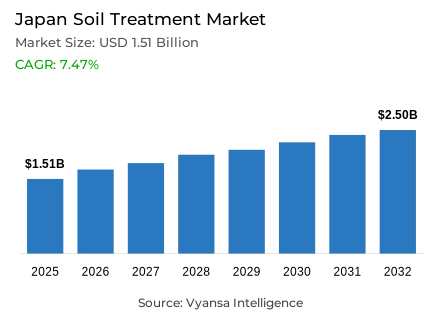
- Soil treatment market size in Japan was valued at USD 1.51 billion in 2025 and is estimated at USD 1.62 billion in 2026.
- The market size is expected to grow to USD 2.5 billion by 2032.
- Market to register a CAGR of around 7.47% during 2026-32.
- Type Shares
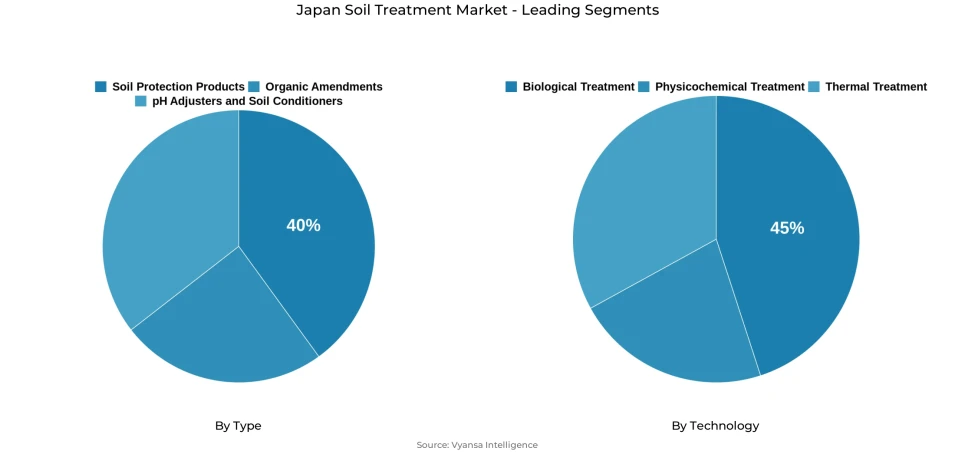
- Soil protection products grabbed market share of 40%.
- Competition
- Soil treatment in Japan is currently being catered to by more than 10 companies.
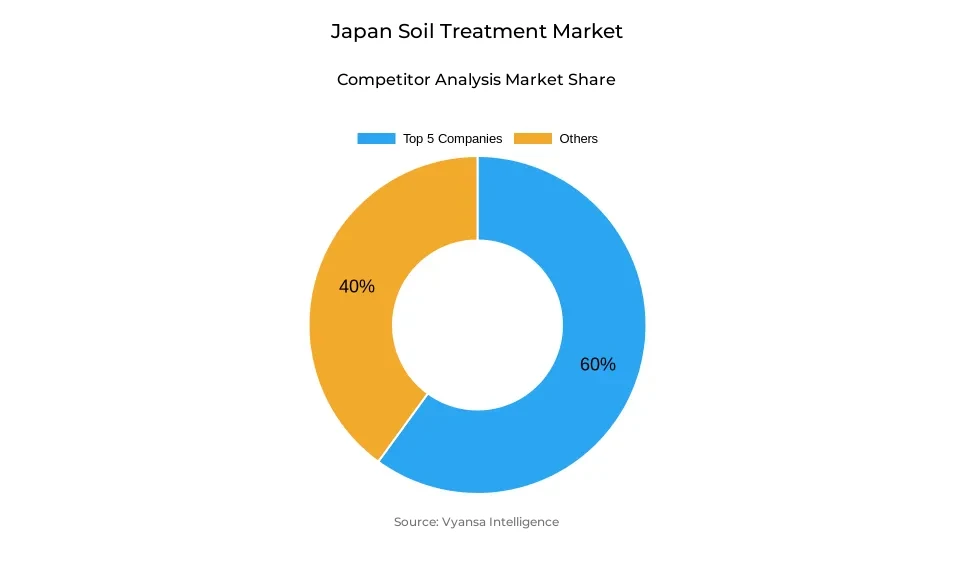
- Top 5 companies acquired around 60% of the market share.
- Kumiai Chemical Industry Co. Ltd., Ishihara Sangyo Kaisha Ltd. (Ishihara Bioscience Co. Ltd.), Syngenta Japan K.K., Mitsui Chemicals Crop & Life Solutions Inc., AGRO-KANESHO CO. LTD. etc., are few of the top companies.
- Technology
- Biological treatment grabbed 45% of the market.
Japan Soil Treatment Market Outlook
The Japan soil treatment market covers agricultural soil conditioning, biological treatment, soil protection products, contaminated soil remediation, and fertility restoration services used across farms, industrial sites, redevelopment projects, and controlled-environment cultivation. The Japan soil treatment industry is valued at USD 1.51 billion in 2025 and USD 1.62 billion in 2026, reaching USD 2.50 billion by 2032 at a CAGR of 7.47% from 2026 to 2032, supported by soil productivity, compliance needs, and land governance.
Farmland pressure, fertilizer dependency reduction, and contamination control are shaping procurement across the Japan soil treatment market. MAFF’s 2025 Basic Plan reference states that farmland decreased from 4.83 million hectares in 2000 to 4.27 million hectares in 2024, intensifying the need for soil fertility management, soil health improvement, and productivity-preserving amendments across constrained production zones and high-value crops. This narrows land-use flexibility and strengthens demand for treatment that protects usable agricultural and redevelopment land.
The Japan soil treatment industry supports crop output stability, brownfield redevelopment, environmental compliance, and localized input efficiency. Soil remediation in Japan is tied to land conversion, industrial legacy sites, construction due diligence, and regulated handling of hazardous substances, while agricultural soil treatment supports rice, horticulture, vegetables, tea, and greenhouse production. The Japan soil treatment market therefore connects farm productivity, urban land reuse, and regulatory risk management within one demand base across Japanese agricultural and urban systems.
The 2026 trajectory favors biological inputs, organic amendments, microbial soil treatment, precision soil testing, and lower-chemical soil protection. The Japan soil treatment industry is also moving toward solutions aligned with MAFF’s environmentally harmonized food system agenda, including organic conversion, compost supply systems, and technology-enabled fertilization planning. Suppliers able to combine agronomic performance, compliance documentation, and localized service coverage are positioned to improve demand capture in the Japan soil treatment market through 2026 planning cycles.
Japan Soil Treatment Market Growth Driver
Soil Fertility Preservation is Accelerating Treatment Demand
Fertilizer efficiency and soil organic matter restoration are strengthening demand for treatment programs that help farms maintain yield with fewer synthetic inputs. The Japan soil treatment market benefits as growers, cooperatives, and input suppliers shift procurement toward compost-based amendments, microbial solutions, biological soil remediation, and soil conditioners that improve nutrient retention. This demand profile supports the Japan soil treatment industry by linking soil health improvement with domestic food security and lower input exposure.
OECD’s 2025 agricultural policy review reports that Japan’s MIDORI targets include a 30% reduction in chemical fertiliser use, a 50% reduction in risk-weighted chemical pesticide use, and expansion of organic farming area to 1 million hectares, equal to 25% of farmland. Those policy targets strengthen procurement visibility for biological treatment, soil amendment products, and advisory services that can support fertilizer reduction without weakening crop reliability across rice, vegetable, fruit, tea, greenhouse, and cooperative procurement systems.
Japan Soil Treatment Market Challenge
Conversion Cost and Field-Level Technical Complexity are Slowing Uptake
Conversion economics and technical uncertainty constrain wider adoption of biological treatment and organic soil amendments. Farmers moving from conventional nutrient and pesticide routines face transition risk, yield variability, soil preparation requirements, and limited field-specific guidance. The Japan soil treatment market therefore depends on advisory capacity as much as product availability, while the Japan soil treatment industry must prove performance under varied paddy, upland, greenhouse, and orchard conditions.
MAFF’s 2025 organic agriculture material states that starting organic agriculture involves challenges such as lower yields and increased production costs, and it provides conversion support for soil preparation and related first-year expenses. This barrier affects adoption speed because biological treatment buyers require evidence, training, and localized protocols before replacing conventional soil protection inputs across commercial production areas. Without consistent agronomic data, distributors face slower trials, narrower repeat purchasing, and higher education costs for soil conditioners and microbial inoculants in priority crop systems.
Unlock Market Intelligence
Explore the market potential with our data-driven report
Japan Soil Treatment Market Trend
Precision Diagnostics are Reshaping Treatment Planning
Precision soil diagnostics and data-enabled field planning are shifting treatment decisions from routine product application toward condition-specific programs. The Japan soil treatment market is gaining from farm digitization because soil moisture data, growth monitoring, satellite diagnostics, and variable fertilization maps help identify where amendments, biological inputs, or soil protection products should be deployed. This trend strengthens the Japan soil treatment industry by improving treatment timing and measurable agronomic outcomes.
MAFF’s October 2025 smart agriculture material states that the Act on the Promotion of Smart Agricultural Technology Utilization was enforced in 2024, while the WAGRI data platform includes a soil API alongside weather, farmland, map, sensor, growth prediction, and statistics APIs. This infrastructure supports precision soil analysis and gives input suppliers stronger data pathways for recommendations, technical support, and differentiated service models across greenhouse, paddy, orchard, upland, and cooperative treatment planning for farm-level procurement decisions and supplier positioning in 2026.
Japan Soil Treatment Market Opportunity
Organic Conversion Programs are Expanding Supplier Access
Organic village expansion creates an addressable opportunity for suppliers of compost systems, microbial inoculants, biochar soil amendment, biological soil remediation, and advisory services. The Japan soil treatment market can capture demand where municipalities coordinate farmers, processors, distributors, schools, and local residents around region-wide organic agriculture. This structure improves route-to-market efficiency for the Japan soil treatment industry by concentrating demonstrations, procurement education, and soil preparation activity within defined production areas.
MAFF’s 2025 organic agriculture material reports 131 Organic Village municipalities in 2024 and highlights support for compost material supply, collection and shipping systems, local processing, and conversion to green cultivation systems. These programs expand market access by turning isolated farm-level trials into organized demand pools for sustainable soil treatment Japan, soil conditioners, and technical guidance linked to organic production. This improves demand capture for suppliers able to provide field evidence, product training, and localized aftersales support during conversion cycles.
Unlock Market Intelligence
Explore the market potential with our data-driven report
Japan Soil Treatment Market Segmentation Analysis
By Type
- Organic Amendments
- Animal Manure
- Crop Residue
- Compost
- Sewage Sludge and Biosolids
- pH Adjusters and Soil Conditioners
- Aglime
- Gypsum
- Others
- Soil Protection Products
- Herbicides
- Insecticides
- Fungicides
- Nematicides
Soil Protection Products hold 40% share under Type, supported by Japan’s need to protect productive land, control soil-borne pressures, and maintain crop reliability across rice, vegetable, fruit, tea, and greenhouse systems. Their leadership reflects procurement preference for familiar protective inputs, residue-conscious use patterns, and solutions that can be integrated with fertility programs. Within the Japan soil treatment market, this segment anchors recurring demand where growers prioritize preventive soil quality management and stable production outcomes.
MAFF’s 2025 smart agriculture material cites a certified NTT e-Drone Technology plan supplying domestically produced large drones for citrus pest control on slopes, with technology contributing to an 80% reduction in working hours for pest control. This operational indicator supports soil protection product demand because labor-saving application systems improve the feasibility of timely protection programs across fragmented and sloped Japanese cultivation zones where application windows remain narrow and labor availability remains uneven during seasons.
By Technology
- Physicochemical Treatment
- Biological Treatment
- Thermal Treatment
Biological Treatment holds 45% share under Technology, driven by Japan’s transition toward microbial soil treatment, compost-based soil preparation, low-chemical fertility programs, and organic soil amendments. The segment is influential because it aligns agronomic performance with fertilizer reduction, biodiversity protection, and regulated organic conversion. Within the Japan soil treatment market, biological treatment supports both agricultural soil treatment and contaminated soil treatment where remediation plans favor lower-impact processes and measurable soil health improvement.
MAFF’s 2025 organic agriculture material states that direct payment for environmentally friendly agriculture requires soil analysis plus compost application and either cover crops, living mulch, or meadow cultivation, while farm products except coarse cereals and forage crops can receive 14,000 yen per 10a. This policy design reinforces demand for biological treatment by embedding soil preparation, organic matter management, and field-level verification into supported practices for suppliers serving organic conversion and farming projects across Japanese production areas.
List of Companies Covered in Japan Soil Treatment Market
The companies listed below are highly influential in the Japan soil treatment market, with a significant market share and a strong impact on industry developments.
- Kumiai Chemical Industry Co. Ltd.
- Ishihara Sangyo Kaisha Ltd. (Ishihara Bioscience Co. Ltd.)
- Syngenta Japan K.K.
- Mitsui Chemicals Crop & Life Solutions Inc.
- AGRO-KANESHO CO. LTD.
- Nankai Chemical Co. Ltd.
- Nippon Kayaku Co. Ltd.
- Bayer CropScience K.K.
- Nihon Nohyaku Co. Ltd.
- Nissan Chemical Corporation
Market News & Updates
- Kumiai Chemical Industry Co. Ltd., 2026:
Kumiai announced in January 2026 that it would launch ECOARK, a novel biological control agent for crown gall disease, in Japan’s domestic market in spring 2026. The product is positioned as a biological crop protection solution for disease management. The update expands Japan-specific biological treatment availability for growers seeking lower-chemical disease-control options.
- Nissan Chemical Corporation, 2025:
Nissan Chemical stated in its 2025 sustainability communication that it built a new plant for its new herbicide VERDAD at the Onoda Plant in Japan. The investment strengthens product supply capability for a soil protection-related crop input. The update supports domestic production readiness for Japan’s agricultural chemical and soil protection product supply chain.
Frequently Asked Questions
Related Report
- Market Segmentation
- Research Scope
- Research Methodology
- Definitions and Assumptions
- Executive Summary
- Japan Soil Treatment Market Policies, Regulations, and Standards
- Japan Soil Treatment Market Dynamics
- Growth Factors
- Challenges
- Trends
- Opportunities
- Japan Soil Treatment Market Statistics, 2022-2032F
- Market Size & Growth Outlook
- By Revenues in USD Million
- Market Segmentation & Growth Outlook
- By Type
- Organic Amendments- Market Insights and Forecast 2022-2032, USD Million
- Animal Manure- Market Insights and Forecast 2022-2032, USD Million
- Crop Residue- Market Insights and Forecast 2022-2032, USD Million
- Compost- Market Insights and Forecast 2022-2032, USD Million
- Sewage Sludge and Biosolids- Market Insights and Forecast 2022-2032, USD Million
- pH Adjusters and Soil Conditioners- Market Insights and Forecast 2022-2032, USD Million
- Aglime- Market Insights and Forecast 2022-2032, USD Million
- Gypsum- Market Insights and Forecast 2022-2032, USD Million
- Others- Market Insights and Forecast 2022-2032, USD Million
- Soil Protection Products- Market Insights and Forecast 2022-2032, USD Million
- Herbicides- Market Insights and Forecast 2022-2032, USD Million
- Insecticides- Market Insights and Forecast 2022-2032, USD Million
- Fungicides- Market Insights and Forecast 2022-2032, USD Million
- Nematicides- Market Insights and Forecast 2022-2032, USD Million
- Organic Amendments- Market Insights and Forecast 2022-2032, USD Million
- By Technology
- Physicochemical Treatment- Market Insights and Forecast 2022-2032, USD Million
- Biological Treatment- Market Insights and Forecast 2022-2032, USD Million
- Thermal Treatment- Market Insights and Forecast 2022-2032, USD Million
- By Application
- Soil Fertility Improvement- Market Insights and Forecast 2022-2032, USD Million
- Soil Remediation- Market Insights and Forecast 2022-2032, USD Million
- pH Correction- Market Insights and Forecast 2022-2032, USD Million
- Weed Management- Market Insights and Forecast 2022-2032, USD Million
- Pest Management- Market Insights and Forecast 2022-2032, USD Million
- Soil Structure Improvement- Market Insights and Forecast 2022-2032, USD Million
- By Crop Type
- Grains and Cereals- Market Insights and Forecast 2022-2032, USD Million
- Fruits and Vegetables- Market Insights and Forecast 2022-2032, USD Million
- Pulses and Oilseeds- Market Insights and Forecast 2022-2032, USD Million
- Commercial Crops- Market Insights and Forecast 2022-2032, USD Million
- Turf and Ornamentals- Market Insights and Forecast 2022-2032, USD Million
- By Competitors
- Competition Characteristics
- Market Share & Analysis
- By Type
- Market Size & Growth Outlook
- Japan Organic Amendments Market Statistics, 2022-2032
- Market Size & Growth Outlook
- By Revenues in USD Million
- Market Segmentation & Growth Outlook
- By Technology- Market Insights and Forecast 2022-2032, USD Million
- By Application- Market Insights and Forecast 2022-2032, USD Million
- By Crop Type- Market Insights and Forecast 2022-2032, USD Million
- Market Size & Growth Outlook
- Japan pH Adjusters and Soil Conditioners Market Statistics, 2022-2032
- Market Size & Growth Outlook
- By Revenues in USD Million
- Market Segmentation & Growth Outlook
- By Technology- Market Insights and Forecast 2022-2032, USD Million
- By Application- Market Insights and Forecast 2022-2032, USD Million
- By Crop Type- Market Insights and Forecast 2022-2032, USD Million
- Market Size & Growth Outlook
- Japan Soil Protection Products Market Statistics, 2022-2032
- Market Size & Growth Outlook
- By Revenues in USD Million
- Market Segmentation & Growth Outlook
- By Technology- Market Insights and Forecast 2022-2032, USD Million
- By Application- Market Insights and Forecast 2022-2032, USD Million
- By Crop Type- Market Insights and Forecast 2022-2032, USD Million
- Market Size & Growth Outlook
- Competitive Outlook
- Company Profiles
- Mitsui Chemicals Crop & Life Solutions Inc.
- Business Description
- Product Portfolio
- Collaborations & Alliances
- Recent Developments
- Financial Details
- Others
- AGRO-KANESHO CO. LTD.
- Business Description
- Product Portfolio
- Collaborations & Alliances
- Recent Developments
- Financial Details
- Others
- Nankai Chemical Co. Ltd.
- Business Description
- Product Portfolio
- Collaborations & Alliances
- Recent Developments
- Financial Details
- Others
- Nippon Kayaku Co. Ltd.
- Business Description
- Product Portfolio
- Collaborations & Alliances
- Recent Developments
- Financial Details
- Others
- Bayer CropScience K.K.
- Business Description
- Product Portfolio
- Collaborations & Alliances
- Recent Developments
- Financial Details
- Others
- Kumiai Chemical Industry Co. Ltd.
- Business Description
- Product Portfolio
- Collaborations & Alliances
- Recent Developments
- Financial Details
- Others
- Ishihara Sangyo Kaisha Ltd. (Ishihara Bioscience Co. Ltd.)
- Business Description
- Product Portfolio
- Collaborations & Alliances
- Recent Developments
- Financial Details
- Others
- Syngenta Japan K.K.
- Business Description
- Product Portfolio
- Collaborations & Alliances
- Recent Developments
- Financial Details
- Others
- Nihon Nohyaku Co. Ltd.
- Business Description
- Product Portfolio
- Collaborations & Alliances
- Recent Developments
- Financial Details
- Others
- Nissan Chemical Corporation
- Business Description
- Product Portfolio
- Collaborations & Alliances
- Recent Developments
- Financial Details
- Others
- Mitsui Chemicals Crop & Life Solutions Inc.
- Company Profiles
- Disclaimer
| Segment | Sub-Segment |
|---|---|
| By Type |
|
| By Technology |
|
| By Application |
|
| By Crop Type |
|
Research Methodology
This study followed a structured approach comprising four key phases to assess the size and scope of the electro-oxidation market. The process began with thorough secondary research to collect data on the target market, related markets, and broader industry context. These findings, along with preliminary assumptions and estimates, were then validated through extensive primary research involving industry experts from across the value chain. To calculate the overall market size, both top-down and bottom-up methodologies were employed. Finally, market segmentation and data triangulation techniques were applied to refine and validate segment-level estimations.
Secondary Research
The secondary research phase involved gathering data from a wide range of credible and published sources. This step helped in identifying industry trends, defining market segmentation, and understanding the market landscape and value chain.
Sources consulted during this phase included:
- Company annual reports, investor presentations, and press releases
- Industry white papers and certified publications
- Trade directories and market-recognized databases
- Articles from authoritative authors and reputable journals
- Gold and silver standard websites
Secondary research was critical in mapping out the industry's value chain and monetary flow, identifying key market segments, understanding regional variations, and tracking significant industry developments.
Other key sources:
- Financial disclosures
- Industry associations and trade bodies
- News outlets and business magazines
- Academic journals and research studies
- Paid industry databases
Primary Research
To validate secondary data and gain deeper market insights, primary research was conducted with key stakeholders across both the supply and demand sides of the market.
On the demand side, participants included decision-makers and influencers from end-user industries—such as CIOs, CTOs, and CSOs—who provided first-hand perspectives on market needs, product usage, and future expectations.
On the supply side, interviews were conducted with manufacturers, industry associations, and institutional participants to gather insights into current offerings, product pipelines, and market challenges.
Primary interviews provided critical inputs such as:
- Market size and revenue data
- Product and service breakdowns
- Market forecasts
- Regional and application-specific trends
Stakeholders consulted included:
- Leading OEM and solution providers
- Channel and distribution partners
- End users across various applications
- Independent consultants and industry specialists
Market Size Estimation and Data Triangulation
- Identifying Key Market Participants (Secondary Research)
- Goal: To identify the major players or companies in the target market. This typically involves using publicly available data sources such as industry reports, market research publications, and financial statements of companies.
- Tools: Reports from firms like Gartner, Forrester, Euromonitor, Statista, IBISWorld, and others. Public financial statements, news articles, and press releases from top market players.
- Extracting Earnings of Key Market Participants
- Goal: To estimate the earnings generated from the product or service being analyzed. This step helps in understanding the revenue potential of each market player in a specific geography.
- Methods: Earnings data can be gathered from:
- Publicly available financial reports (for listed companies).
- Interviews and primary data sources from professionals, such as Directors, VPs, SVPs, etc. This is especially useful for understanding more nuanced, internal data that isn't publicly disclosed.
- Annual reports and investor presentations of key players.
- Data Collation and Development of a Relevant Data Model
- Goal: To collate inputs from both primary and secondary sources into a structured, data-driven model for market estimation. This model will incorporate key market KPIs and any independent variables relevant to the market.
- Key KPIs: These could include:
- Market size, growth rate, and demand drivers.
- Industry-specific metrics like market share, average revenue per customer (ARPC), or average deal size.
- External variables, such as economic growth rates, inflation rates, or commodity prices, that could affect the market.
- Data Modeling: Based on this data, the market forecasts are developed for the next 5 years. A combination of trend analysis, scenario modeling, and statistical regression might be used to generate projections.
- Scenario Analysis
- Goal: To test different assumptions and validate how sensitive the market is to changes in key variables (e.g., market demand, regulatory changes, technological disruptions).
- Types of Scenarios:
- Base Case: Based on current assumptions and historical data.
- Best-Case Scenario: Assuming favorable market conditions, regulatory environments, and technological advancements.
- Worst-Case Scenario: Accounting for adverse factors, such as economic downturns, stricter regulations, or unexpected disruptions.












