Japan Laboratory Information Management System Market Report: Trends, Growth and Forecast (2026-2032)
By Product Type (Clinical Operations LIMS (Hospital Laboratory LIMS, Physician Office Laboratory LIMS, Routine Diagnostics Laboratory LIMS), High-Throughput Testing LIMS (Independent Laboratory LIMS, Commercial Laboratory LIMS, Reference Laboratory LIMS, Multi-site Laboratory Network LIMS), Public Health & Reporting LIMS (Public Health Laboratory LIMS, Surveillance-linked Laboratory LIMS, Reference Network Laboratory LIMS), Research & Repository LIMS (Academic Research Laboratory LIMS, Translational Research Laboratory LIMS, Biobank & Repository LIMS), Regulated QA/QC LIMS (Pharmaceutical Laboratory LIMS, Biotechnology Laboratory LIMS, Food Testing Laboratory LIMS, Environmental Testing Laboratory LIMS, Forensic Laboratory LIMS)), By Workflow Type (Accessioning-to-Result Management (Sample Registration, Sample Tracking, Test Assignment, Result Entry & Release), Instrument-Integrated Workflow Management (Analyzer Connectivity, Automated Data Capture, Bidirectional Instrument Communication), Quality-Controlled Laboratory Workflow (Quality Control Management, Quality Assurance Workflow, Exception & Deviation Handling), Traceability & Repository Workflow (Chain-of-Custody Tracking, Storage & Retrieval Management, Biobank Sample Lifecycle Tracking), Interoperability & Reporting Workflow (External System Connectivity, Standards-based Data Exchange, Regulatory & Public Health Reporting)), By Deployment Model (Controlled Environment Deployment, Scalable Digital Deployment, Mixed Infrastructure Deployment), By End-User Cluster (Care Delivery Laboratories (Hospital Laboratories, Health-System Laboratories, Physician Office Laboratories, Community & Decentralized Testing Laboratories), Commercial Testing Laboratories (Independent Laboratories, Commercial Laboratories, Reference Laboratories), Government & Public Health Laboratories (Public Health Laboratories, Central Reference Laboratories, Disease Surveillance Laboratories), Research & Translational Laboratories (Academic Laboratories, Research Institutes, Biobanks, Clinical Research Support Laboratories), Regulated Scientific & Industrial Laboratories (Pharmaceutical Laboratories, Biotechnology Laboratories, Food Safety Laboratories, Environmental Laboratories, Forensic Laboratories)), By Purchase Model (Perpetual License, Subscription License, Usage-Based Model, Hybrid Commercial Model) ... Read more
|
Major Players
|
Japan Laboratory Information Management System Market Statistics and Insights, 2026
- Market Size Statistics
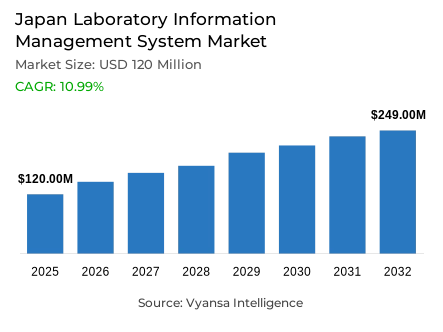
- Laboratory information management system market size in Japan was valued at USD 120 million in 2025 and is estimated at USD 133.2 million in 2026.
- The market size is expected to grow to USD 249 million by 2032.
- Market to register a CAGR of around 10.99% during 2026-32.
- Product Type Shares
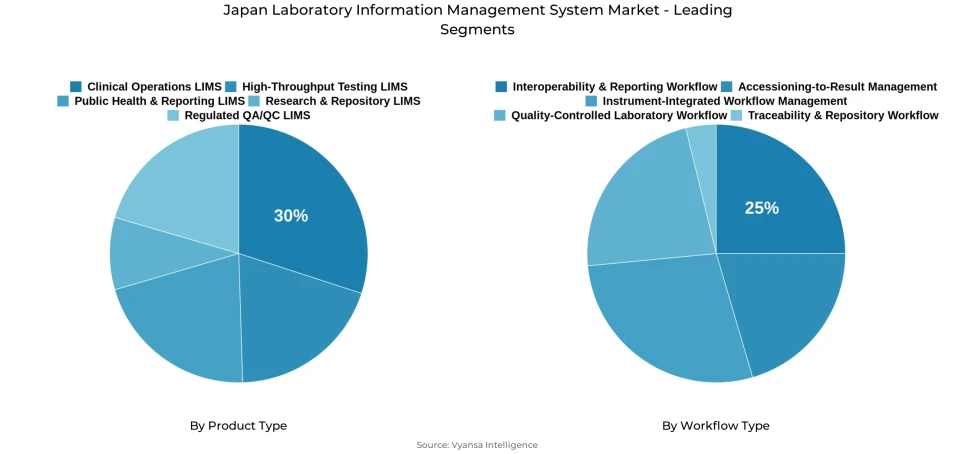
- Clinical operations lims grabbed market share of 30%.
- Competition
- More than 10 companies are actively engaged in producing laboratory information management system in Japan.
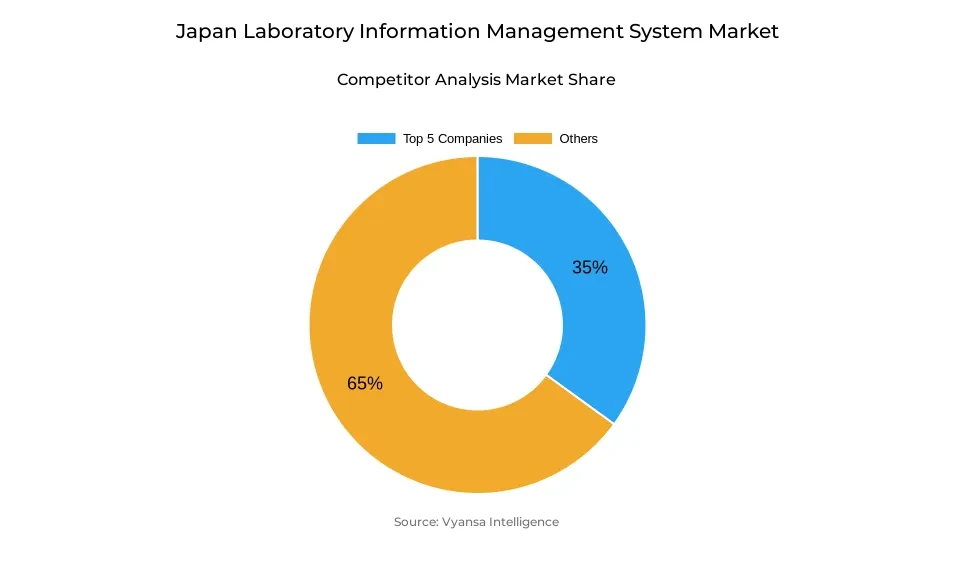
- Top 5 companies acquired around 35% of the market share.
- Sapio Sciences, CloudLIMS, QBench, LabWare, Thermo Fisher Scientific etc., are few of the top companies.
- Workflow Type
- Interoperability & reporting workflow grabbed 25% of the market.
Japan Laboratory Information Management System Market Outlook
Japan laboratory information management system market was valued at USD 120 million in 2025 and is projected to grow from USD 133.2 million in 2026 to USD 249 million by 2032, registering a CAGR of 10.99% across the forecast period. This trajectory reflects rising institutional demand for better laboratory data handling, workflow control, and reporting efficiency as Japan's healthcare and research environments undergo accelerated digital modernization. The market is advancing on the strength of structured policy investment, expanding digital health infrastructure, and a growing preference for lab automation software that integrates seamlessly with national data-sharing frameworks.
Product-level demand continues to be anchored by Clinical Operations LIMS, which holds 30% of the overall market share. Laboratories across Japan are prioritizing systems that support daily testing activity, result recording, and structured process management with operational consistency, making barcode-based sample tracking an increasingly important functional requirement across clinical and diagnostic environments. As operational precision becomes a baseline expectation rather than a differentiating feature, platforms that embed traceability directly into routine workflows are being selected with greater institutional regularity.
Workflow preferences are equally shaping the industry's direction. Interoperability and Reporting Workflow accounts for 25% of the market, reflecting growing demand for connected systems that improve data exchange quality and reporting structure across laboratories, clinicians, and national health networks. The broader push toward smart laboratories and automation across Japan's healthcare sector is reinforcing this demand, as laboratories are expected to deliver not only accurate results but also structured, audit-ready data outputs that connect with wider institutional systems.
These converging dynamics point to a stable and well-supported growth outlook through 2032. Rising market value, the operational leadership of Clinical Operations LIMS, and the growing institutional relevance of interoperability-led workflows are jointly reinforcing the role of the scientific data management system in improving laboratory efficiency, reporting quality, and data consistency across Japan's evolving informatics landscape.
Japan Laboratory Information Management System Market Growth Driver
Healthcare Digitalization Broadens Laboratory Adoption
Japan's national Medical DX agenda is establishing a durable policy foundation for laboratory software adoption across the country. As per data published by the Ministry of Health, Labour and Welfare and the Digital Agency of Japan, a nationwide healthcare information platform is being advanced under the Medical DX program, covering electronic medical record sharing, standardized digital systems, and structured data exchange across medical institutions and pharmacies. This policy infrastructure is creating direct demand for LIMS in biotechnology and clinical settings where traceable, connected, and audit-ready operations are now formally expected.
The institutional base supporting this demand is considerable. According to statistics released by the Ministry of Health, Labour and Welfare of Japan, 8,060 hospitals and 105,207 general clinics were active across Japan in 2024, providing a wide and diverse facility network for digital workflow adoption. As providers align with national data-sharing requirements, laboratory systems must deliver cleaner records, faster reporting, and stronger coordination across increasingly interconnected healthcare environments in Japan.
Japan Laboratory Information Management System Market Challenge
Uneven Digital Readiness Slows Full Integration
Digital adoption across Japan's laboratory and clinical network remains uneven, creating a structural barrier to broad-based informatics deployment. Based on data from the Ministry of Health, Labour and Welfare of Japan, approximately 45% of clinics were still without electronic medical records in 2025, and hospitals with fewer than 200 beds showed approximately 40% operating without electronic medical record systems. This gap means a significant share of laboratory environments are not yet structured for Industry 4.0 in laboratory systems integration, limiting the pace at which standardized informatics platforms can be rolled out across smaller facilities.
Implementation barriers extend well beyond technical readiness into operational and financial constraints. As indicated by authoritative sources at the Ministry of Health, Labour and Welfare of Japan, a survey covering 5,466 clinics still using paper charts found that 54.2% identified electronic medical record introduction as not feasible, citing unfamiliarity with IT systems and high initial costs as the most common barriers. These conditions create friction for ELN integration and broader laboratory workflow standardization, particularly in smaller facilities where resource constraints continue to delay adoption timelines.
Unlock Market Intelligence
Explore the market potential with our data-driven report
Japan Laboratory Information Management System Market Trend
Interoperability Standards Reshape Reporting Expectations
Structured data exchange is shifting from an advanced capability to a baseline operational requirement across Japan's healthcare settings. Evidence drawn from public data released by the Ministry of Health, Labour and Welfare of Japan confirms that the electronic medical record information sharing service supports four core functions, including electronic referral sharing, access to health check results, access to six core clinical information items, and patient summary viewing. This standardization is accelerating demand for cloud-based LIMS solutions that can operate within national health data ecosystems and deliver compliant, traceable reporting outputs without friction.
The institutional momentum behind this shift is strengthening with each policy update. According to statistics released by the Digital Agency of Japan, a standardized electronic medical record is targeted for adoption across almost all medical institutions by 2030, with development carried out in fiscal 2024 and trial implementation at selected institutions following that phase. Updated technical guidance from the Ministry of Health, Labour and Welfare published in both January and March 2026 is further reinforcing interoperability-focused workflow design, driving stronger uptake of SaaS LIMS platforms built for connected reporting environments in Japan.
Japan Laboratory Information Management System Market Opportunity
Standardized Cloud Models Open Institutional Headroom
Japan's move toward standardized, lower-cost digital health systems is creating a commercially significant opportunity for laboratory informatics providers across the country. As per official figures from the Ministry of Health, Labour and Welfare of Japan, the standard electronic medical record for clinics is being designed to support shared services, government cloud compatibility, standard APIs, and data portability, with a concrete dissemination plan scheduled for summer 2026. This policy direction creates a favorable operating environment for LIMS in CROs and multi-site laboratory providers seeking to connect workflows with national health data infrastructure at scale.
The opportunity is made more compelling by the sheer size of Japan's institutional network. Data compiled from internationally recognized public authorities at the Ministry of Health, Labour and Welfare confirms that Japan supports 105,207 general clinics and 8,060 hospitals, giving software providers a substantial and diverse deployment base across multiple facility types. As standard digital specifications extend across healthcare settings, demand for scalable laboratory management systems capable of managing connected reporting, audit trails, and multi-site data coordination is expected to grow meaningfully through the forecast period.
Unlock Market Intelligence
Explore the market potential with our data-driven report
Japan Laboratory Information Management System Market Segmentation Analysis
By Product Type
- Clinical Operations LIMS
- Hospital Laboratory LIMS
- Physician Office Laboratory LIMS
- Routine Diagnostics Laboratory LIMS
- High-Throughput Testing LIMS
- Independent Laboratory LIMS
- Commercial Laboratory LIMS
- Reference Laboratory LIMS
- Multi-site Laboratory Network LIMS
- Public Health & Reporting LIMS
- Public Health Laboratory LIMS
- Surveillance-linked Laboratory LIMS
- Reference Network Laboratory LIMS
- Research & Repository LIMS
- Academic Research Laboratory LIMS
- Translational Research Laboratory LIMS
- Biobank & Repository LIMS
- Regulated QA/QC LIMS
- Pharmaceutical Laboratory LIMS
- Biotechnology Laboratory LIMS
- Food Testing Laboratory LIMS
- Environmental Testing Laboratory LIMS
- Forensic Laboratory LIMS
Clinical Operations LIMS commands the highest share within the product type category at 30%, driven by consistent institutional demand for platforms that manage daily testing activity, sample handling, result recording, and structured workflow execution with operational precision. Laboratories across Japan are investing in systems that reduce process gaps and improve internal coordination, with laboratory workflow automation software becoming a more prominent selection requirement as testing environments grow more data-driven and volume-intensive. Its leading position reflects a market-wide preference for platforms that deliver execution reliability as a core capability.
This segment's commercial strength also reflects the practical value laboratories place on systems that improve visibility and reduce workflow inconsistency across everyday operations. Clinical Operations LIMS is being deployed across facilities of varying sizes because it addresses the most immediate and operationally critical performance requirements that laboratory managers face in Japan. As laboratories continue to modernize and align with national digital health standards, this segment is expected to sustain its leading position throughout the forecast period.
By Workflow Type
- Accessioning-to-Result Management
- Sample Registration
- Sample Tracking
- Test Assignment
- Result Entry & Release
- Instrument-Integrated Workflow Management
- Analyzer Connectivity
- Automated Data Capture
- Bidirectional Instrument Communication
- Quality-Controlled Laboratory Workflow
- Quality Control Management
- Quality Assurance Workflow
- Exception & Deviation Handling
- Traceability & Repository Workflow
- Chain-of-Custody Tracking
- Storage & Retrieval Management
- Biobank Sample Lifecycle Tracking
- Interoperability & Reporting Workflow
- External System Connectivity
- Standards-based Data Exchange
- Regulatory & Public Health Reporting
The Interoperability and Reporting Workflow segment commands the highest share within the workflow type category at 25%, reflecting growing institutional demand for systems that move data smoothly across instruments, teams, and reporting endpoints with minimal manual handling. Laboratories in Japan are placing increasing priority on workflows that support structured result communication and cleaner data exchange, with digital transformation in laboratories accelerating the expectation that reporting environments are connected, traceable, and audit-ready as a standard operational baseline.
Its commercial importance is growing as the national interoperability agenda raises reporting expectations across all facility types. Workflow platforms that support coordinated data movement, multi-system compatibility, and structured documentation are being selected with greater frequency as laboratories in Japan align with evolving national health data standards. As reporting complexity deepens and connected workflow requirements intensify through the forecast period, this segment is expected to maintain its position as one of the most strategically significant workflow categories within the Japan laboratory information management system market.
List of Companies Covered in Japan Laboratory Information Management System Market
The companies listed below are highly influential in the Japan laboratory information management system market, with a significant market share and a strong impact on industry developments.
- Sapio Sciences
- CloudLIMS
- QBench
- LabWare
- Thermo Fisher Scientific
- LabVantage Solutions
- Agilent Technologies
- STARLIMS
- SciSure
- Dassault Systèmes BIOVIA
Frequently Asked Questions
Related Report
- Market Segmentation
- Research Scope
- Research Methodology
- Definitions and Assumptions
- Executive Summary
- Japan Laboratory Information Management System Market Policies, Regulations, and Standards
- Japan Laboratory Information Management System Market Dynamics
- Growth Factors
- Challenges
- Trends
- Opportunities
- Japan Laboratory Information Management System Market Statistics, 2022-2032F
- Market Size & Growth Outlook
- By Revenues in USD Million
- Market Segmentation & Growth Outlook
- By Product Type
- Clinical Operations LIMS- Market Insights and Forecast 2022-2032, USD Million
- Hospital Laboratory LIMS- Market Insights and Forecast 2022-2032, USD Million
- Physician Office Laboratory LIMS- Market Insights and Forecast 2022-2032, USD Million
- Routine Diagnostics Laboratory LIMS- Market Insights and Forecast 2022-2032, USD Million
- High-Throughput Testing LIMS- Market Insights and Forecast 2022-2032, USD Million
- Independent Laboratory LIMS- Market Insights and Forecast 2022-2032, USD Million
- Commercial Laboratory LIMS- Market Insights and Forecast 2022-2032, USD Million
- Reference Laboratory LIMS- Market Insights and Forecast 2022-2032, USD Million
- Multi-site Laboratory Network LIMS- Market Insights and Forecast 2022-2032, USD Million
- Public Health & Reporting LIMS- Market Insights and Forecast 2022-2032, USD Million
- Public Health Laboratory LIMS- Market Insights and Forecast 2022-2032, USD Million
- Surveillance-linked Laboratory LIMS- Market Insights and Forecast 2022-2032, USD Million
- Reference Network Laboratory LIMS- Market Insights and Forecast 2022-2032, USD Million
- Research & Repository LIMS- Market Insights and Forecast 2022-2032, USD Million
- Academic Research Laboratory LIMS- Market Insights and Forecast 2022-2032, USD Million
- Translational Research Laboratory LIMS- Market Insights and Forecast 2022-2032, USD Million
- Biobank & Repository LIMS- Market Insights and Forecast 2022-2032, USD Million
- Regulated QA/QC LIMS- Market Insights and Forecast 2022-2032, USD Million
- Pharmaceutical Laboratory LIMS- Market Insights and Forecast 2022-2032, USD Million
- Biotechnology Laboratory LIMS- Market Insights and Forecast 2022-2032, USD Million
- Food Testing Laboratory LIMS- Market Insights and Forecast 2022-2032, USD Million
- Environmental Testing Laboratory LIMS- Market Insights and Forecast 2022-2032, USD Million
- Forensic Laboratory LIMS- Market Insights and Forecast 2022-2032, USD Million
- Clinical Operations LIMS- Market Insights and Forecast 2022-2032, USD Million
- By Workflow Type
- Accessioning-to-Result Management- Market Insights and Forecast 2022-2032, USD Million
- Sample Registration- Market Insights and Forecast 2022-2032, USD Million
- Sample Tracking- Market Insights and Forecast 2022-2032, USD Million
- Test Assignment- Market Insights and Forecast 2022-2032, USD Million
- Result Entry & Release- Market Insights and Forecast 2022-2032, USD Million
- Instrument-Integrated Workflow Management- Market Insights and Forecast 2022-2032, USD Million
- Analyzer Connectivity- Market Insights and Forecast 2022-2032, USD Million
- Automated Data Capture- Market Insights and Forecast 2022-2032, USD Million
- Bidirectional Instrument Communication- Market Insights and Forecast 2022-2032, USD Million
- Quality-Controlled Laboratory Workflow- Market Insights and Forecast 2022-2032, USD Million
- Quality Control Management- Market Insights and Forecast 2022-2032, USD Million
- Quality Assurance Workflow- Market Insights and Forecast 2022-2032, USD Million
- Exception & Deviation Handling- Market Insights and Forecast 2022-2032, USD Million
- Traceability & Repository Workflow- Market Insights and Forecast 2022-2032, USD Million
- Chain-of-Custody Tracking- Market Insights and Forecast 2022-2032, USD Million
- Storage & Retrieval Management- Market Insights and Forecast 2022-2032, USD Million
- Biobank Sample Lifecycle Tracking- Market Insights and Forecast 2022-2032, USD Million
- Interoperability & Reporting Workflow- Market Insights and Forecast 2022-2032, USD Million
- External System Connectivity- Market Insights and Forecast 2022-2032, USD Million
- Standards-based Data Exchange- Market Insights and Forecast 2022-2032, USD Million
- Regulatory & Public Health Reporting- Market Insights and Forecast 2022-2032, USD Million
- Accessioning-to-Result Management- Market Insights and Forecast 2022-2032, USD Million
- By Deployment Model
- Controlled Environment Deployment- Market Insights and Forecast 2022-2032, USD Million
- Scalable Digital Deployment- Market Insights and Forecast 2022-2032, USD Million
- Mixed Infrastructure Deployment- Market Insights and Forecast 2022-2032, USD Million
- By End-User Cluster
- Care Delivery Laboratories- Market Insights and Forecast 2022-2032, USD Million
- Hospital Laboratories- Market Insights and Forecast 2022-2032, USD Million
- Health-System Laboratories- Market Insights and Forecast 2022-2032, USD Million
- Physician Office Laboratories- Market Insights and Forecast 2022-2032, USD Million
- Community & Decentralized Testing Laboratories- Market Insights and Forecast 2022-2032, USD Million
- Commercial Testing Laboratories- Market Insights and Forecast 2022-2032, USD Million
- Independent Laboratories- Market Insights and Forecast 2022-2032, USD Million
- Commercial Laboratories- Market Insights and Forecast 2022-2032, USD Million
- Reference Laboratories- Market Insights and Forecast 2022-2032, USD Million
- Government & Public Health Laboratories- Market Insights and Forecast 2022-2032, USD Million
- Public Health Laboratories- Market Insights and Forecast 2022-2032, USD Million
- Central Reference Laboratories- Market Insights and Forecast 2022-2032, USD Million
- Disease Surveillance Laboratories- Market Insights and Forecast 2022-2032, USD Million
- Research & Translational Laboratories- Market Insights and Forecast 2022-2032, USD Million
- Academic Laboratories- Market Insights and Forecast 2022-2032, USD Million
- Research Institutes- Market Insights and Forecast 2022-2032, USD Million
- Biobanks- Market Insights and Forecast 2022-2032, USD Million
- Clinical Research Support Laboratories- Market Insights and Forecast 2022-2032, USD Million
- Regulated Scientific & Industrial Laboratories- Market Insights and Forecast 2022-2032, USD Million
- Pharmaceutical Laboratories- Market Insights and Forecast 2022-2032, USD Million
- Biotechnology Laboratories- Market Insights and Forecast 2022-2032, USD Million
- Food Safety Laboratories- Market Insights and Forecast 2022-2032, USD Million
- Environmental Laboratories- Market Insights and Forecast 2022-2032, USD Million
- Forensic Laboratories- Market Insights and Forecast 2022-2032, USD Million
- Care Delivery Laboratories- Market Insights and Forecast 2022-2032, USD Million
- By Purchase Model
- Perpetual License- Market Insights and Forecast 2022-2032, USD Million
- Subscription License- Market Insights and Forecast 2022-2032, USD Million
- Usage-Based Model- Market Insights and Forecast 2022-2032, USD Million
- Hybrid Commercial Model- Market Insights and Forecast 2022-2032, USD Million
- By Competitors
- Competition Characteristics
- Market Share & Analysis
- By Product Type
- Market Size & Growth Outlook
- Japan Clinical Operations LIMS Market Statistics, 2022-2032
- Market Size & Growth Outlook
- By Revenues in USD Million
- Market Segmentation & Growth Outlook
- By Workflow Type- Market Insights and Forecast 2022-2032, USD Million
- By Deployment Model- Market Insights and Forecast 2022-2032, USD Million
- By End-User Cluster- Market Insights and Forecast 2022-2032, USD Million
- By Purchase Model- Market Insights and Forecast 2022-2032, USD Million
- Market Size & Growth Outlook
- Japan High-Throughput Testing LIMS Market Statistics, 2022-2032
- Market Size & Growth Outlook
- By Revenues in USD Million
- Market Segmentation & Growth Outlook
- By Workflow Type- Market Insights and Forecast 2022-2032, USD Million
- By Deployment Model- Market Insights and Forecast 2022-2032, USD Million
- By End-User Cluster- Market Insights and Forecast 2022-2032, USD Million
- By Purchase Model- Market Insights and Forecast 2022-2032, USD Million
- Market Size & Growth Outlook
- Japan Public Health & Reporting LIMS Market Statistics, 2022-2032
- Market Size & Growth Outlook
- By Revenues in USD Million
- Market Segmentation & Growth Outlook
- By Workflow Type- Market Insights and Forecast 2022-2032, USD Million
- By Deployment Model- Market Insights and Forecast 2022-2032, USD Million
- By End-User Cluster- Market Insights and Forecast 2022-2032, USD Million
- By Purchase Model- Market Insights and Forecast 2022-2032, USD Million
- Market Size & Growth Outlook
- Japan Research & Repository LIMS Market Statistics, 2022-2032
- Market Size & Growth Outlook
- By Revenues in USD Million
- Market Segmentation & Growth Outlook
- By Workflow Type- Market Insights and Forecast 2022-2032, USD Million
- By Deployment Model- Market Insights and Forecast 2022-2032, USD Million
- By End-User Cluster- Market Insights and Forecast 2022-2032, USD Million
- By Purchase Model- Market Insights and Forecast 2022-2032, USD Million
- Market Size & Growth Outlook
- Japan Regulated QA/QC LIMS Market Statistics, 2022-2032
- Market Size & Growth Outlook
- By Revenues in USD Million
- Market Segmentation & Growth Outlook
- By Workflow Type- Market Insights and Forecast 2022-2032, USD Million
- By Deployment Model- Market Insights and Forecast 2022-2032, USD Million
- By End-User Cluster- Market Insights and Forecast 2022-2032, USD Million
- By Purchase Model- Market Insights and Forecast 2022-2032, USD Million
- Market Size & Growth Outlook
- Competitive Outlook
- Company Profiles
- LabWare
- Business Description
- Product Portfolio
- Collaborations & Alliances
- Recent Developments
- Financial Details
- Others
- LabVantage Solutions
- Business Description
- Product Portfolio
- Collaborations & Alliances
- Recent Developments
- Financial Details
- Others
- Thermo Fisher Scientific
- Business Description
- Product Portfolio
- Collaborations & Alliances
- Recent Developments
- Financial Details
- Others
- STARLIMS
- Business Description
- Product Portfolio
- Collaborations & Alliances
- Recent Developments
- Financial Details
- Others
- Agilent Technologies
- Business Description
- Product Portfolio
- Collaborations & Alliances
- Recent Developments
- Financial Details
- Others
- Autoscribe Informatics
- Business Description
- Product Portfolio
- Collaborations & Alliances
- Recent Developments
- Financial Details
- Others
- Sapio Sciences
- Business Description
- Product Portfolio
- Collaborations & Alliances
- Recent Developments
- Financial Details
- Others
- CloudLIMS
- Business Description
- Product Portfolio
- Collaborations & Alliances
- Recent Developments
- Financial Details
- Others
- QBench
- Business Description
- Product Portfolio
- Collaborations & Alliances
- Recent Developments
- Financial Details
- Others
- SciSure
- Business Description
- Product Portfolio
- Collaborations & Alliances
- Recent Developments
- Financial Details
- Others
- LabWare
- Company Profiles
- Disclaimer
| Segment | Sub-Segment |
|---|---|
| By Product Type |
|
| By Workflow Type |
|
| By Deployment Model |
|
| By End-User Cluster |
|
| By Purchase Model |
|
Research Methodology
This study followed a structured approach comprising four key phases to assess the size and scope of the electro-oxidation market. The process began with thorough secondary research to collect data on the target market, related markets, and broader industry context. These findings, along with preliminary assumptions and estimates, were then validated through extensive primary research involving industry experts from across the value chain. To calculate the overall market size, both top-down and bottom-up methodologies were employed. Finally, market segmentation and data triangulation techniques were applied to refine and validate segment-level estimations.
Secondary Research
The secondary research phase involved gathering data from a wide range of credible and published sources. This step helped in identifying industry trends, defining market segmentation, and understanding the market landscape and value chain.
Sources consulted during this phase included:
- Company annual reports, investor presentations, and press releases
- Industry white papers and certified publications
- Trade directories and market-recognized databases
- Articles from authoritative authors and reputable journals
- Gold and silver standard websites
Secondary research was critical in mapping out the industry's value chain and monetary flow, identifying key market segments, understanding regional variations, and tracking significant industry developments.
Other key sources:
- Financial disclosures
- Industry associations and trade bodies
- News outlets and business magazines
- Academic journals and research studies
- Paid industry databases
Primary Research
To validate secondary data and gain deeper market insights, primary research was conducted with key stakeholders across both the supply and demand sides of the market.
On the demand side, participants included decision-makers and influencers from end-user industries—such as CIOs, CTOs, and CSOs—who provided first-hand perspectives on market needs, product usage, and future expectations.
On the supply side, interviews were conducted with manufacturers, industry associations, and institutional participants to gather insights into current offerings, product pipelines, and market challenges.
Primary interviews provided critical inputs such as:
- Market size and revenue data
- Product and service breakdowns
- Market forecasts
- Regional and application-specific trends
Stakeholders consulted included:
- Leading OEM and solution providers
- Channel and distribution partners
- End users across various applications
- Independent consultants and industry specialists
Market Size Estimation and Data Triangulation
- Identifying Key Market Participants (Secondary Research)
- Goal: To identify the major players or companies in the target market. This typically involves using publicly available data sources such as industry reports, market research publications, and financial statements of companies.
- Tools: Reports from firms like Gartner, Forrester, Euromonitor, Statista, IBISWorld, and others. Public financial statements, news articles, and press releases from top market players.
- Extracting Earnings of Key Market Participants
- Goal: To estimate the earnings generated from the product or service being analyzed. This step helps in understanding the revenue potential of each market player in a specific geography.
- Methods: Earnings data can be gathered from:
- Publicly available financial reports (for listed companies).
- Interviews and primary data sources from professionals, such as Directors, VPs, SVPs, etc. This is especially useful for understanding more nuanced, internal data that isn't publicly disclosed.
- Annual reports and investor presentations of key players.
- Data Collation and Development of a Relevant Data Model
- Goal: To collate inputs from both primary and secondary sources into a structured, data-driven model for market estimation. This model will incorporate key market KPIs and any independent variables relevant to the market.
- Key KPIs: These could include:
- Market size, growth rate, and demand drivers.
- Industry-specific metrics like market share, average revenue per customer (ARPC), or average deal size.
- External variables, such as economic growth rates, inflation rates, or commodity prices, that could affect the market.
- Data Modeling: Based on this data, the market forecasts are developed for the next 5 years. A combination of trend analysis, scenario modeling, and statistical regression might be used to generate projections.
- Scenario Analysis
- Goal: To test different assumptions and validate how sensitive the market is to changes in key variables (e.g., market demand, regulatory changes, technological disruptions).
- Types of Scenarios:
- Base Case: Based on current assumptions and historical data.
- Best-Case Scenario: Assuming favorable market conditions, regulatory environments, and technological advancements.
- Worst-Case Scenario: Accounting for adverse factors, such as economic downturns, stricter regulations, or unexpected disruptions.












