Australia Laboratory Information Management System Market Report: Trends, Growth and Forecast (2026-2032)
By Product Type (Clinical Operations LIMS (Hospital Laboratory LIMS, Physician Office Laboratory LIMS, Routine Diagnostics Laboratory LIMS), High-Throughput Testing LIMS (Independent Laboratory LIMS, Commercial Laboratory LIMS, Reference Laboratory LIMS, Multi-site Laboratory Network LIMS), Public Health & Reporting LIMS (Public Health Laboratory LIMS, Surveillance-linked Laboratory LIMS, Reference Network Laboratory LIMS), Research & Repository LIMS (Academic Research Laboratory LIMS, Translational Research Laboratory LIMS, Biobank & Repository LIMS), Regulated QA/QC LIMS (Pharmaceutical Laboratory LIMS, Biotechnology Laboratory LIMS, Food Testing Laboratory LIMS, Environmental Testing Laboratory LIMS, Forensic Laboratory LIMS)), By Workflow Type (Accessioning-to-Result Management (Sample Registration, Sample Tracking, Test Assignment, Result Entry & Release), Instrument-Integrated Workflow Management (Analyzer Connectivity, Automated Data Capture, Bidirectional Instrument Communication), Quality-Controlled Laboratory Workflow (Quality Control Management, Quality Assurance Workflow, Exception & Deviation Handling), Traceability & Repository Workflow (Chain-of-Custody Tracking, Storage & Retrieval Management, Biobank Sample Lifecycle Tracking), Interoperability & Reporting Workflow (External System Connectivity, Standards-based Data Exchange, Regulatory & Public Health Reporting)), By Deployment Model (Controlled Environment Deployment, Scalable Digital Deployment, Mixed Infrastructure Deployment), By End-User Cluster (Care Delivery Laboratories (Hospital Laboratories, Health-System Laboratories, Physician Office Laboratories, Community & Decentralized Testing Laboratories), Commercial Testing Laboratories (Independent Laboratories, Commercial Laboratories, Reference Laboratories), Government & Public Health Laboratories (Public Health Laboratories, Central Reference Laboratories, Disease Surveillance Laboratories), Research & Translational Laboratories (Academic Laboratories, Research Institutes, Biobanks, Clinical Research Support Laboratories), Regulated Scientific & Industrial Laboratories (Pharmaceutical Laboratories, Biotechnology Laboratories, Food Safety Laboratories, Environmental Laboratories, Forensic Laboratories)), By Purchase Model (Perpetual License, Subscription License, Usage-Based Model, Hybrid Commercial Model), By Regions (Queensland, New South Wales, Victoria, South Australia, Others) ... Read more
|
Major Players
|
Australia Laboratory Information Management System Market Statistics and Insights, 2026
- Market Size Statistics
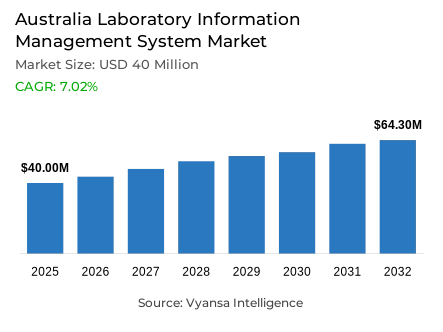
- Laboratory information management system market size in Australia was valued at USD 40 million in 2025 and is estimated at USD 42.8 million in 2026.
- The market size is expected to grow to USD 64.3 million by 2032.
- Market to register a CAGR of around 7.02% during 2026-32.
- Product Type Shares
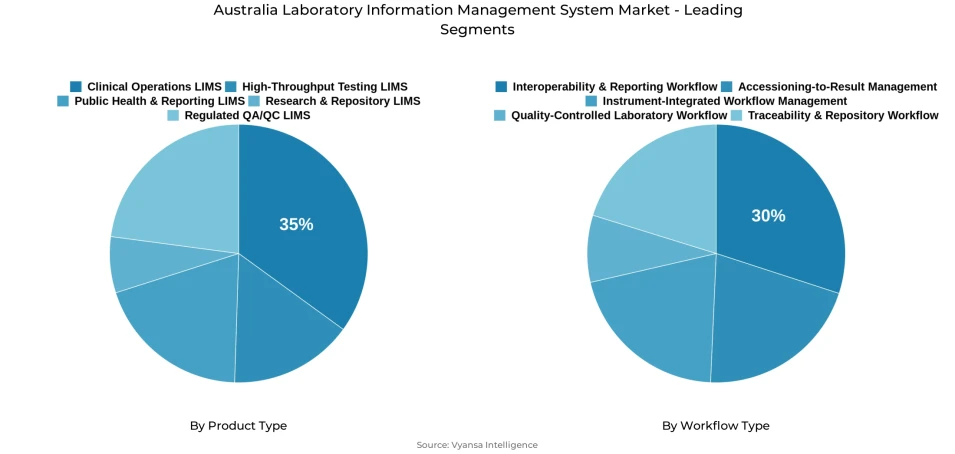
- Clinical operations lims grabbed market share of 35%.
- Competition
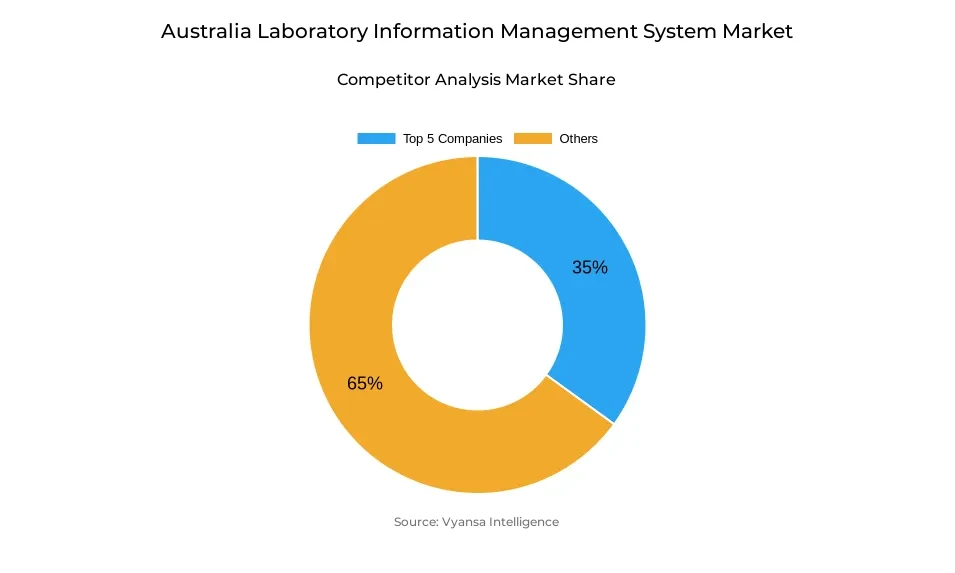
- More than 10 companies are actively engaged in producing laboratory information management system in Australia.
- Top 5 companies acquired around 35% of the market share.
- Autoscribe Informatics, Sapio Sciences, CloudLIMS, LabWare, LabVantage Solutions etc., are few of the top companies.
- Workflow Type
- Interoperability & reporting workflow grabbed 30% of the market.
Australia Laboratory Information Management System Market Outlook
Australia laboratory information management system market was valued at USD 40 million in 2025 and is projected to grow from USD 42.8 million in 2026 to USD 64.3 million by 2032, registering a CAGR of 7.02% across the forecast period. This growth reflects rising institutional demand for more organized laboratory operations, stronger digital support, and better information flow across healthcare and research settings where AI-powered laboratory information systems are gaining relevance as laboratories move toward faster, more accurate, and more connected operational environments. The market's trajectory is supported by structural investment in digital health infrastructure and a growing expectation for traceable, data-driven laboratory performance.
Product demand continues to be led by Clinical Operations LIMS, which accounts for approximately 35% of the total product type share. This position reflects the strong commercial relevance of platforms that improve routine workflow management, process visibility, and operational structure across testing environments, with LIMS for clinical diagnostics laboratories representing one of the most active product areas across Australia's healthcare network. Laboratories are selecting systems that deliver consistent execution quality as a baseline requirement rather than an advanced feature.
Workflow priorities are equally shaped by the Interoperability and Reporting Workflow segment, which holds nearly 30% of the workflow type share. This prominence reflects growing laboratory demand for smooth result communication, dependable data exchange, and more structured reporting across systems and care teams. Lab reporting and documentation software is being increasingly integrated into laboratory environments as the expectation for connected, audit-ready, and timely reporting becomes a standard operational requirement across Australia.
These converging product and workflow trends point to a stable and well-supported growth trajectory through 2032. Clinical execution platforms and interoperability-focused workflows are jointly sustaining adoption momentum across Australia, and the laboratory management software market continues to benefit from laboratory investment in connected, traceable, and reporting-capable informatics environments that align with Australia's broader digital health ambitions through the forecast period.
Australia Laboratory Information Management System Market Growth Driver
Chronic Disease Workloads Sustain Digital Lab Demand
Australia's growing chronic disease burden is creating persistent and large-scale demand for structured laboratory systems across the country. As per data published by the Australian Institute of Health and Welfare, around six in ten Australians are estimated to live with a long-term health condition, while chronic conditions account for 91% of the non-fatal burden of disease in Australia. This sustained clinical load is reinforcing demand for LIMS for pharmaceuticals industry and clinical settings where repeated testing, accurate record management, and faster information access are essential for maintaining patient pathway continuity.
Service utilization data further illustrates the scale of this demand pressure. According to statistics released by the Australian Institute of Health and Welfare, 6.4 million hospitalisations in 2021 to 2022 were linked to chronic conditions, with 4.0 million carrying a chronic condition as the principal diagnosis. As laboratory workloads grow more continuous and data-intensive, the need for better laboratory data management and compliance capabilities is intensifying, making chronic disease prevalence one of the most commercially durable drivers of LIMS adoption across Australia.
Australia Laboratory Information Management System Market Challenge
Cybersecurity Exposure Complicates Secure Deployment
Data security has become a significant and unavoidable challenge for laboratory systems operating across Australia's health information environment. Based on data from the Office of the Australian Information Commissioner, Australia recorded 532 data breach notifications in the January to June 2025 reporting period, with malicious or criminal attacks accounting for 59% of those incidents. Laboratories and healthcare organizations are approaching connected system deployment with increasing caution, as protecting sensitive clinical records while maintaining operational continuity requires substantial investment in data integrity and cybersecurity in labs frameworks from the earliest stages of implementation.
The healthcare sector's disproportionate exposure to breach incidents compounds this challenge further. As indicated by authoritative sources at the Office of the Australian Information Commissioner, the health sector accounted for 18% of all reported data breaches in the January to June 2025 period, making it the most affected sector nationally. This reality is reshaping procurement priorities across Australia, as buyers are placing stronger emphasis on regulatory compliance software for labs with robust privacy safeguards, secure system integrations, and dependable protection of laboratory and patient data as a baseline expectation.
Unlock Market Intelligence
Explore the market potential with our data-driven report
Australia Laboratory Information Management System Market Trend
National Interoperability Plan Reshapes System Design
Structured information exchange is moving to the center of Australia's healthcare system architecture, directly reshaping what laboratory platforms are expected to deliver. Evidence drawn from public data released by the Australian Digital Health Agency confirms that more than half of the 44 actions outlined in the National Healthcare Interoperability Plan have now been completed as of the 2024 to 2025 annual progress report, reflecting meaningful national progress toward connected, standards-based health information infrastructure. This momentum is accelerating demand for ELN integration and connected laboratory platforms that can operate within broader interoperable health data ecosystems across Australia.
The practical impact of this shift is already visible at the pathology reporting level. According to statistics released by the Australian Digital Health Agency, from 13 October 2025 Australians and their care teams gained faster access to most pathology reports through My Health Record and the my health app. This development is raising institutional expectations for timely, connected, and accessible reporting, pushing laboratories toward platforms that support cloud adoption in lab informatics and seamless result delivery across care networks in Australia.
Australia Laboratory Information Management System Market Opportunity
Genomics Investment Creates Advanced Informatics Demand
Australia's rapidly expanding genomics ecosystem is generating a commercially significant opportunity for advanced laboratory informatics solutions across the country. As per official figures from the Australian Government Department of Health and Aged Care, Genomics Australia was formally launched on 28 July 2025 as a new national body tasked with integrating genomics into mainstream healthcare delivery. This institutional foundation is creating direct demand for AI and machine learning in LIMS platforms capable of handling complex sample data, specialized reporting, and structured research-to-clinical information workflows at scale.
Public investment is reinforcing the commercial depth of this opportunity. Data compiled from internationally recognized public authorities at the Australian Government Department of Health and Aged Care confirms that the government has committed over USD 30 million to support Genomics Australia's first four years of operation, alongside USD 50 million in grants distributed across 30 projects under the Genomics Health Futures Mission. As genomic medicine becomes more embedded in routine care delivery, demand for enterprise LIMS solutions purpose-built for research-grade data environments and advanced diagnostics workflows is expected to grow meaningfully across Australia through the forecast period.
Unlock Market Intelligence
Explore the market potential with our data-driven report
Australia Laboratory Information Management System Market Segmentation Analysis
By Product Type
- Clinical Operations LIMS
- Hospital Laboratory LIMS
- Physician Office Laboratory LIMS
- Routine Diagnostics Laboratory LIMS
- High-Throughput Testing LIMS
- Independent Laboratory LIMS
- Commercial Laboratory LIMS
- Reference Laboratory LIMS
- Multi-site Laboratory Network LIMS
- Public Health & Reporting LIMS
- Public Health Laboratory LIMS
- Surveillance-linked Laboratory LIMS
- Reference Network Laboratory LIMS
- Research & Repository LIMS
- Academic Research Laboratory LIMS
- Translational Research Laboratory LIMS
- Biobank & Repository LIMS
- Regulated QA/QC LIMS
- Pharmaceutical Laboratory LIMS
- Biotechnology Laboratory LIMS
- Food Testing Laboratory LIMS
- Environmental Testing Laboratory LIMS
- Forensic Laboratory LIMS
Clinical Operations LIMS commands the highest share within the product type category at approximately 35%, reflecting sustained institutional demand for platforms that manage routine testing activity, process visibility, and operational clarity across laboratory environments. Laboratories across Australia are actively selecting systems that improve daily execution consistency and reduce internal workflow gaps, with quality control laboratory software capabilities being treated as a primary value criterion in system evaluation and procurement decisions. Its leadership confirms that operational reliability is the defining driver of product adoption across the Australian market.
This segment's strength also reflects a broader institutional preference for platforms that support structured process management across the full range of everyday laboratory functions rather than only specialized use cases. Clinical Operations LIMS is being valued across facilities of varying size and complexity because it addresses the most immediate performance requirements that laboratory managers face on a routine basis. The deployment of sample lifecycle management solutions within this segment is adding further commercial depth as laboratories seek greater traceability and better coordination across the end-to-end testing cycle.
By Workflow Type
- Accessioning-to-Result Management
- Sample Registration
- Sample Tracking
- Test Assignment
- Result Entry & Release
- Instrument-Integrated Workflow Management
- Analyzer Connectivity
- Automated Data Capture
- Bidirectional Instrument Communication
- Quality-Controlled Laboratory Workflow
- Quality Control Management
- Quality Assurance Workflow
- Exception & Deviation Handling
- Traceability & Repository Workflow
- Chain-of-Custody Tracking
- Storage & Retrieval Management
- Biobank Sample Lifecycle Tracking
- Interoperability & Reporting Workflow
- External System Connectivity
- Standards-based Data Exchange
- Regulatory & Public Health Reporting
The Interoperability and Reporting Workflow segment holds the highest share within the workflow type category at nearly 30%, driven by growing laboratory demand for connected reporting, smoother result communication, and more dependable data exchange across systems and care teams. Laboratories across Australia are prioritizing workflows that reduce coordination gaps and improve information movement with greater reliability, with lab data analytics and reporting tools being deployed as a core component of reporting-first workflow strategies that align with national interoperability standards. This segment's lead position confirms that reporting quality is a commercially central driver of workflow adoption decisions.
Its importance is deepening as national digital health standards raise reporting expectations across all facility types in Australia. Platforms that support structured data movement, audit-ready documentation, and cross-system compatibility are being selected with increasing frequency as laboratories align their informatics environments with evolving national requirements. As the expectation for smart laboratories and automation grows stronger through the forecast period, this segment is expected to sustain its position as one of the most strategically significant workflow categories within the Australia laboratory information management system market.
List of Companies Covered in Australia Laboratory Information Management System Market
The companies listed below are highly influential in the Australia laboratory information management system market, with a significant market share and a strong impact on industry developments.
- Autoscribe Informatics
- Sapio Sciences
- CloudLIMS
- LabWare
- LabVantage Solutions
- Thermo Fisher Scientific
- STARLIMS
- Agilent Technologies
- QBench
- SciSure
Market News & Updates
- Thermo Fisher Scientific, 2026:
Thermo Fisher released SampleManager LIMS version 21.3 on its Australia site. The update includes integration improvements, architecture and product health enhancements, and additional security-focused updates in the latest version of the SampleManager platform for laboratory workflow and data management.
- Qbench, 2026:
QBench published its March 2, 2026 product release notes for its cloud-based LIMS. The update added order history tracking, expanded linked-sample visibility, new Customer Portal filtering, uncertainty calculation in the control module, and batch cloning improvements for samples, tests, and inventory records.
Frequently Asked Questions
Related Report
- Market Segmentation
- Research Scope
- Research Methodology
- Definitions and Assumptions
- Executive Summary
- Australia Laboratory Information Management System Market Policies, Regulations, and Standards
- Australia Laboratory Information Management System Market Dynamics
- Growth Factors
- Challenges
- Trends
- Opportunities
- Australia Laboratory Information Management System Market Statistics, 2022-2032F
- Market Size & Growth Outlook
- By Revenues in USD Million
- Market Segmentation & Growth Outlook
- By Product Type
- Clinical Operations LIMS- Market Insights and Forecast 2022-2032, USD Million
- Hospital Laboratory LIMS- Market Insights and Forecast 2022-2032, USD Million
- Physician Office Laboratory LIMS- Market Insights and Forecast 2022-2032, USD Million
- Routine Diagnostics Laboratory LIMS- Market Insights and Forecast 2022-2032, USD Million
- High-Throughput Testing LIMS- Market Insights and Forecast 2022-2032, USD Million
- Independent Laboratory LIMS- Market Insights and Forecast 2022-2032, USD Million
- Commercial Laboratory LIMS- Market Insights and Forecast 2022-2032, USD Million
- Reference Laboratory LIMS- Market Insights and Forecast 2022-2032, USD Million
- Multi-site Laboratory Network LIMS- Market Insights and Forecast 2022-2032, USD Million
- Public Health & Reporting LIMS- Market Insights and Forecast 2022-2032, USD Million
- Public Health Laboratory LIMS- Market Insights and Forecast 2022-2032, USD Million
- Surveillance-linked Laboratory LIMS- Market Insights and Forecast 2022-2032, USD Million
- Reference Network Laboratory LIMS- Market Insights and Forecast 2022-2032, USD Million
- Research & Repository LIMS- Market Insights and Forecast 2022-2032, USD Million
- Academic Research Laboratory LIMS- Market Insights and Forecast 2022-2032, USD Million
- Translational Research Laboratory LIMS- Market Insights and Forecast 2022-2032, USD Million
- Biobank & Repository LIMS- Market Insights and Forecast 2022-2032, USD Million
- Regulated QA/QC LIMS- Market Insights and Forecast 2022-2032, USD Million
- Pharmaceutical Laboratory LIMS- Market Insights and Forecast 2022-2032, USD Million
- Biotechnology Laboratory LIMS- Market Insights and Forecast 2022-2032, USD Million
- Food Testing Laboratory LIMS- Market Insights and Forecast 2022-2032, USD Million
- Environmental Testing Laboratory LIMS- Market Insights and Forecast 2022-2032, USD Million
- Forensic Laboratory LIMS- Market Insights and Forecast 2022-2032, USD Million
- Clinical Operations LIMS- Market Insights and Forecast 2022-2032, USD Million
- By Workflow Type
- Accessioning-to-Result Management- Market Insights and Forecast 2022-2032, USD Million
- Sample Registration- Market Insights and Forecast 2022-2032, USD Million
- Sample Tracking- Market Insights and Forecast 2022-2032, USD Million
- Test Assignment- Market Insights and Forecast 2022-2032, USD Million
- Result Entry & Release- Market Insights and Forecast 2022-2032, USD Million
- Instrument-Integrated Workflow Management- Market Insights and Forecast 2022-2032, USD Million
- Analyzer Connectivity- Market Insights and Forecast 2022-2032, USD Million
- Automated Data Capture- Market Insights and Forecast 2022-2032, USD Million
- Bidirectional Instrument Communication- Market Insights and Forecast 2022-2032, USD Million
- Quality-Controlled Laboratory Workflow- Market Insights and Forecast 2022-2032, USD Million
- Quality Control Management- Market Insights and Forecast 2022-2032, USD Million
- Quality Assurance Workflow- Market Insights and Forecast 2022-2032, USD Million
- Exception & Deviation Handling- Market Insights and Forecast 2022-2032, USD Million
- Traceability & Repository Workflow- Market Insights and Forecast 2022-2032, USD Million
- Chain-of-Custody Tracking- Market Insights and Forecast 2022-2032, USD Million
- Storage & Retrieval Management- Market Insights and Forecast 2022-2032, USD Million
- Biobank Sample Lifecycle Tracking- Market Insights and Forecast 2022-2032, USD Million
- Interoperability & Reporting Workflow- Market Insights and Forecast 2022-2032, USD Million
- External System Connectivity- Market Insights and Forecast 2022-2032, USD Million
- Standards-based Data Exchange- Market Insights and Forecast 2022-2032, USD Million
- Regulatory & Public Health Reporting- Market Insights and Forecast 2022-2032, USD Million
- Accessioning-to-Result Management- Market Insights and Forecast 2022-2032, USD Million
- By Deployment Model
- Controlled Environment Deployment- Market Insights and Forecast 2022-2032, USD Million
- Scalable Digital Deployment- Market Insights and Forecast 2022-2032, USD Million
- Mixed Infrastructure Deployment- Market Insights and Forecast 2022-2032, USD Million
- By End-User Cluster
- Care Delivery Laboratories- Market Insights and Forecast 2022-2032, USD Million
- Hospital Laboratories- Market Insights and Forecast 2022-2032, USD Million
- Health-System Laboratories- Market Insights and Forecast 2022-2032, USD Million
- Physician Office Laboratories- Market Insights and Forecast 2022-2032, USD Million
- Community & Decentralized Testing Laboratories- Market Insights and Forecast 2022-2032, USD Million
- Commercial Testing Laboratories- Market Insights and Forecast 2022-2032, USD Million
- Independent Laboratories- Market Insights and Forecast 2022-2032, USD Million
- Commercial Laboratories- Market Insights and Forecast 2022-2032, USD Million
- Reference Laboratories- Market Insights and Forecast 2022-2032, USD Million
- Government & Public Health Laboratories- Market Insights and Forecast 2022-2032, USD Million
- Public Health Laboratories- Market Insights and Forecast 2022-2032, USD Million
- Central Reference Laboratories- Market Insights and Forecast 2022-2032, USD Million
- Disease Surveillance Laboratories- Market Insights and Forecast 2022-2032, USD Million
- Research & Translational Laboratories- Market Insights and Forecast 2022-2032, USD Million
- Academic Laboratories- Market Insights and Forecast 2022-2032, USD Million
- Research Institutes- Market Insights and Forecast 2022-2032, USD Million
- Biobanks- Market Insights and Forecast 2022-2032, USD Million
- Clinical Research Support Laboratories- Market Insights and Forecast 2022-2032, USD Million
- Regulated Scientific & Industrial Laboratories- Market Insights and Forecast 2022-2032, USD Million
- Pharmaceutical Laboratories- Market Insights and Forecast 2022-2032, USD Million
- Biotechnology Laboratories- Market Insights and Forecast 2022-2032, USD Million
- Food Safety Laboratories- Market Insights and Forecast 2022-2032, USD Million
- Environmental Laboratories- Market Insights and Forecast 2022-2032, USD Million
- Forensic Laboratories- Market Insights and Forecast 2022-2032, USD Million
- Care Delivery Laboratories- Market Insights and Forecast 2022-2032, USD Million
- By Purchase Model
- Perpetual License- Market Insights and Forecast 2022-2032, USD Million
- Subscription License- Market Insights and Forecast 2022-2032, USD Million
- Usage-Based Model- Market Insights and Forecast 2022-2032, USD Million
- Hybrid Commercial Model- Market Insights and Forecast 2022-2032, USD Million
- By Regions
- Queensland- Market Insights and Forecast 2022-2032, USD Million
- New South Wales- Market Insights and Forecast 2022-2032, USD Million
- Victoria- Market Insights and Forecast 2022-2032, USD Million
- South Australia- Market Insights and Forecast 2022-2032, USD Million
- Others- Market Insights and Forecast 2022-2032, USD Million
- By Competitors
- Competition Characteristics
- Market Share & Analysis
- By Product Type
- Market Size & Growth Outlook
- Australia Clinical Operations LIMS Market Statistics, 2022-2032
- Market Size & Growth Outlook
- By Revenues in USD Million
- Market Segmentation & Growth Outlook
- By Workflow Type- Market Insights and Forecast 2022-2032, USD Million
- By Deployment Model- Market Insights and Forecast 2022-2032, USD Million
- By End-User Cluster- Market Insights and Forecast 2022-2032, USD Million
- By Purchase Model- Market Insights and Forecast 2022-2032, USD Million
- By Regions- Market Insights and Forecast 2022-2032, USD Million
- Market Size & Growth Outlook
- Australia High-Throughput Testing LIMS Market Statistics, 2022-2032
- Market Size & Growth Outlook
- By Revenues in USD Million
- Market Segmentation & Growth Outlook
- By Workflow Type- Market Insights and Forecast 2022-2032, USD Million
- By Deployment Model- Market Insights and Forecast 2022-2032, USD Million
- By End-User Cluster- Market Insights and Forecast 2022-2032, USD Million
- By Purchase Model- Market Insights and Forecast 2022-2032, USD Million
- By Regions- Market Insights and Forecast 2022-2032, USD Million
- Market Size & Growth Outlook
- Australia Public Health & Reporting LIMS Market Statistics, 2022-2032
- Market Size & Growth Outlook
- By Revenues in USD Million
- Market Segmentation & Growth Outlook
- By Workflow Type- Market Insights and Forecast 2022-2032, USD Million
- By Deployment Model- Market Insights and Forecast 2022-2032, USD Million
- By End-User Cluster- Market Insights and Forecast 2022-2032, USD Million
- By Purchase Model- Market Insights and Forecast 2022-2032, USD Million
- By Regions- Market Insights and Forecast 2022-2032, USD Million
- Market Size & Growth Outlook
- Australia Research & Repository LIMS Market Statistics, 2022-2032
- Market Size & Growth Outlook
- By Revenues in USD Million
- Market Segmentation & Growth Outlook
- By Workflow Type- Market Insights and Forecast 2022-2032, USD Million
- By Deployment Model- Market Insights and Forecast 2022-2032, USD Million
- By End-User Cluster- Market Insights and Forecast 2022-2032, USD Million
- By Purchase Model- Market Insights and Forecast 2022-2032, USD Million
- By Regions- Market Insights and Forecast 2022-2032, USD Million
- Market Size & Growth Outlook
- Australia Regulated QA/QC LIMS Market Statistics, 2022-2032
- Market Size & Growth Outlook
- By Revenues in USD Million
- Market Segmentation & Growth Outlook
- By Workflow Type- Market Insights and Forecast 2022-2032, USD Million
- By Deployment Model- Market Insights and Forecast 2022-2032, USD Million
- By End-User Cluster- Market Insights and Forecast 2022-2032, USD Million
- By Purchase Model- Market Insights and Forecast 2022-2032, USD Million
- By Regions- Market Insights and Forecast 2022-2032, USD Million
- Market Size & Growth Outlook
- Competitive Outlook
- Company Profiles
- LabWare
- Business Description
- Product Portfolio
- Collaborations & Alliances
- Recent Developments
- Financial Details
- Others
- LabVantage Solutions
- Business Description
- Product Portfolio
- Collaborations & Alliances
- Recent Developments
- Financial Details
- Others
- Thermo Fisher Scientific
- Business Description
- Product Portfolio
- Collaborations & Alliances
- Recent Developments
- Financial Details
- Others
- STARLIMS
- Business Description
- Product Portfolio
- Collaborations & Alliances
- Recent Developments
- Financial Details
- Others
- Agilent Technologies
- Business Description
- Product Portfolio
- Collaborations & Alliances
- Recent Developments
- Financial Details
- Others
- Autoscribe Informatics
- Business Description
- Product Portfolio
- Collaborations & Alliances
- Recent Developments
- Financial Details
- Others
- Sapio Sciences
- Business Description
- Product Portfolio
- Collaborations & Alliances
- Recent Developments
- Financial Details
- Others
- CloudLIMS
- Business Description
- Product Portfolio
- Collaborations & Alliances
- Recent Developments
- Financial Details
- Others
- QBench
- Business Description
- Product Portfolio
- Collaborations & Alliances
- Recent Developments
- Financial Details
- Others
- SciSure
- Business Description
- Product Portfolio
- Collaborations & Alliances
- Recent Developments
- Financial Details
- Others
- LabWare
- Company Profiles
- Disclaimer
| Segment | Sub-Segment |
|---|---|
| By Product Type |
|
| By Workflow Type |
|
| By Deployment Model |
|
| By End-User Cluster |
|
| By Purchase Model |
|
| By Regions |
|
Research Methodology
This study followed a structured approach comprising four key phases to assess the size and scope of the electro-oxidation market. The process began with thorough secondary research to collect data on the target market, related markets, and broader industry context. These findings, along with preliminary assumptions and estimates, were then validated through extensive primary research involving industry experts from across the value chain. To calculate the overall market size, both top-down and bottom-up methodologies were employed. Finally, market segmentation and data triangulation techniques were applied to refine and validate segment-level estimations.
Secondary Research
The secondary research phase involved gathering data from a wide range of credible and published sources. This step helped in identifying industry trends, defining market segmentation, and understanding the market landscape and value chain.
Sources consulted during this phase included:
- Company annual reports, investor presentations, and press releases
- Industry white papers and certified publications
- Trade directories and market-recognized databases
- Articles from authoritative authors and reputable journals
- Gold and silver standard websites
Secondary research was critical in mapping out the industry's value chain and monetary flow, identifying key market segments, understanding regional variations, and tracking significant industry developments.
Other key sources:
- Financial disclosures
- Industry associations and trade bodies
- News outlets and business magazines
- Academic journals and research studies
- Paid industry databases
Primary Research
To validate secondary data and gain deeper market insights, primary research was conducted with key stakeholders across both the supply and demand sides of the market.
On the demand side, participants included decision-makers and influencers from end-user industries—such as CIOs, CTOs, and CSOs—who provided first-hand perspectives on market needs, product usage, and future expectations.
On the supply side, interviews were conducted with manufacturers, industry associations, and institutional participants to gather insights into current offerings, product pipelines, and market challenges.
Primary interviews provided critical inputs such as:
- Market size and revenue data
- Product and service breakdowns
- Market forecasts
- Regional and application-specific trends
Stakeholders consulted included:
- Leading OEM and solution providers
- Channel and distribution partners
- End users across various applications
- Independent consultants and industry specialists
Market Size Estimation and Data Triangulation
- Identifying Key Market Participants (Secondary Research)
- Goal: To identify the major players or companies in the target market. This typically involves using publicly available data sources such as industry reports, market research publications, and financial statements of companies.
- Tools: Reports from firms like Gartner, Forrester, Euromonitor, Statista, IBISWorld, and others. Public financial statements, news articles, and press releases from top market players.
- Extracting Earnings of Key Market Participants
- Goal: To estimate the earnings generated from the product or service being analyzed. This step helps in understanding the revenue potential of each market player in a specific geography.
- Methods: Earnings data can be gathered from:
- Publicly available financial reports (for listed companies).
- Interviews and primary data sources from professionals, such as Directors, VPs, SVPs, etc. This is especially useful for understanding more nuanced, internal data that isn't publicly disclosed.
- Annual reports and investor presentations of key players.
- Data Collation and Development of a Relevant Data Model
- Goal: To collate inputs from both primary and secondary sources into a structured, data-driven model for market estimation. This model will incorporate key market KPIs and any independent variables relevant to the market.
- Key KPIs: These could include:
- Market size, growth rate, and demand drivers.
- Industry-specific metrics like market share, average revenue per customer (ARPC), or average deal size.
- External variables, such as economic growth rates, inflation rates, or commodity prices, that could affect the market.
- Data Modeling: Based on this data, the market forecasts are developed for the next 5 years. A combination of trend analysis, scenario modeling, and statistical regression might be used to generate projections.
- Scenario Analysis
- Goal: To test different assumptions and validate how sensitive the market is to changes in key variables (e.g., market demand, regulatory changes, technological disruptions).
- Types of Scenarios:
- Base Case: Based on current assumptions and historical data.
- Best-Case Scenario: Assuming favorable market conditions, regulatory environments, and technological advancements.
- Worst-Case Scenario: Accounting for adverse factors, such as economic downturns, stricter regulations, or unexpected disruptions.












