Indonesia Bags and Luggage Market Report: Trends, Growth and Forecast (2026-2032)
By Category (Bags (Cross Body Bags, Bags and Backpacks, Business Bags, Duffle Bags, Clutches, Others), Luggage (Soft Luggage, Hard Luggage, Wheeled Luggage, Non-Wheeled Luggage)), By Sales Channel (Retail Offline, Retail Online), By Material Type (Soft Case (Nylon, Polyester, Ballistic Nylon), Hard Case (Polycarbonate, ABS (Acrylonitrile Butadiene Styrene), Polypropylene)), By Price Category (Luxury, Mass/Economy, Premium), By Application (Travel, Business), By Region (Sumatra, Java, Kalimantan, Sulawesi, Others) ... Read more
|
Major Players
|
Indonesia Bags and Luggage Market Statistics and Insights, 2026
- Market Size Statistics
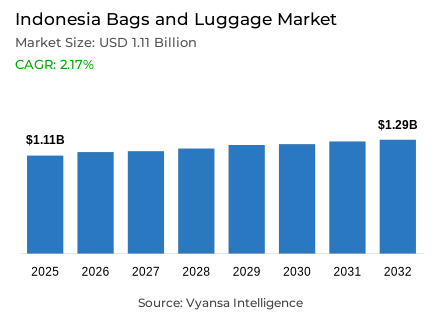
- Bags and luggage in Indonesia is estimated at USD 1.11 billion in 2025.
- The market size is expected to grow to USD 1.29 billion by 2032.
- Market to register a cagr of around 2.17% during 2026-32.
- Category Shares
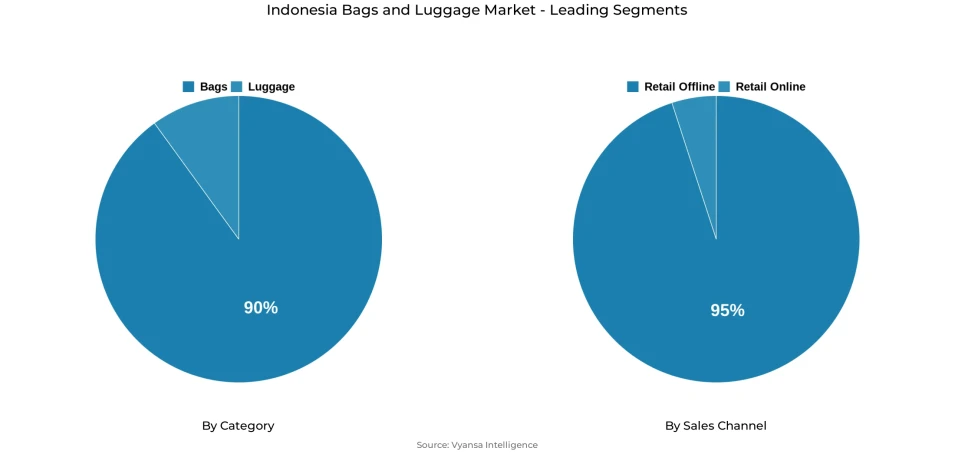
- Bags grabbed market share of 90%.
- Competition
- More than 20 companies are actively engaged in producing bags and luggage in Indonesia.
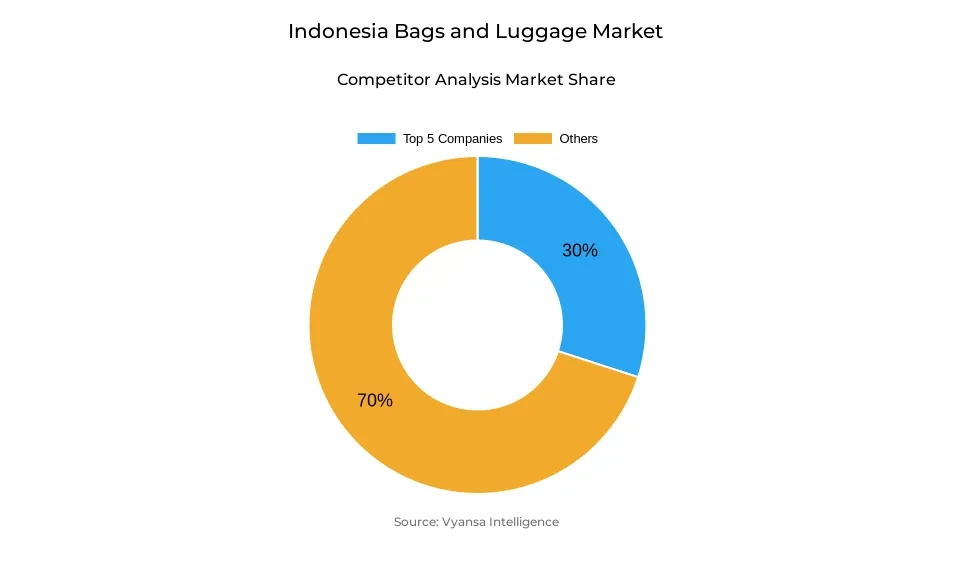
- Top 5 companies acquired around 30% of the market share.
- Hermès International SCA, Eksonindo Multi Product Industry PT, Daihiro Bag Corp, Sophie Martin Indonesia PT, Luvitasindo PT etc., are few of the top companies.
- Sales Channel
- Retail offline grabbed 95% of the market.
Indonesia Bags and Luggage Market Outlook
The market of Indonesia bags and luggage is projected to achieve stable growth in the period of 202632 because of the increase in tourism activity, enhanced purchasing power, and evolving lifestyle choices. In Indonesia, bags and luggage are estimated to have a value of 1.11 billion in 2025 and are estimated to have a value of 1.29 billion in 2032 and have a CAGR of approximately 2.17. The momentum to growth is mainly supported by the further recovery of international and domestic travel, as well as, the growing interest in outdoor and leisure activities.
The luggage is likely to continue being a major source of growth during the forecast period, as more people, both leisure travellers and business travellers, travel. The trend is towards end users spending on functional luggage to meet the various travel requirements, and the popularity of hybrid working practices and the growing popularity of trekking and camping are also supporting the demand of backpacks. Meanwhile, young professionals in the office are moving towards backpacks as opposed to traditional business bags, which further supports the need of flexible and lifestyle-friendly designs.
Overall demand remains dominated by bags, which make up approximately 90% of total market value, due to its daily usage and as a fashion and status good. Purchasing behaviour is being influenced by premiumisation and the growing role of Gen⁻ Z and millennials, especially when it comes to handbags. The luxury and second-hand luxury bags are also gaining more popularity as the awareness of sustainability and the idea of bags as long-term investments are on the rise.
Distributionally, retail offline stores make approximately 95% of the sales with end users still opting to visit brick-and-mortar stores to check their quality and design. Nevertheless, the growth of retail online is likely to come in slow waves, with the help of social commerce and advertising, as a supplementary to offline retail, but not its substitution
Indonesia Bags and Luggage Market Growth Driver
Lifestyle Change to Multi-purpose and Versatile Carry Solutions.
The demand of the bags and luggage is being actively stimulated by the changing work and lifestyle pattern in Indonesia. Hybrid working models are now in place, and people have to switch locations regularly between home, offices, cafes, and brief business travels. This commuter lifestyle increases the demand on versatile carry solutions that can be utilized in professional, casual, and traveling situations. Therefore, end users are more focused on practicality, comfort, and durability, which promote repeated buying and upgrading over a low frequency of replacement. Bags are not considered occasion-specific products but everyday necessities that facilitate active routines.
Meanwhile, active and experience-based life styles are still on the rise. Trekking, camping, short leisure trips have become more frequent, especially in younger age groups that demand flexibility in their travelling experiences. This change in behaviour has maintained a constant level in the demand of backpacks, duffls, and compact luggage that is used frequently. Collectively, the changing work styles, lifestyle based on experience make bags and luggage a practical need that is part of everyday life, which underpins steady market demand.
Indonesia Bags and Luggage Market Challenge
Very Price Sensitive Reduces Premium Volume
Even with the rising incomes, the affordability is a structural limitation to discretionary spending in Indonesia. The World Bank also reports that although inflation has decreased to 2.2% in 2024, the increase in real wages is still not equal among income groups, and non-essential goods continue to be highly price-sensitive. Consequently, the end users often postpone replacements or trade off, making it hard to drive volumes on more expensive bags and luggage.
Moreover, categories that are dependent on imports are subject to cost pressure in terms of tariffs and logistics costs. The Ministry of Finance in Indonesia confirms that the chosen finished leather products, such as handbags, still face import taxes of up to 20%, which increase retail prices of foreign brands. This space limits high-end accessibility and heightens rivalry with less expensive options, so the cost is a lasting challenge throughout the category.
Unlock Market Intelligence
Explore the market potential with our data-driven report
Indonesia Bags and Luggage Market Trend
Buyer Behaviour is Circularly Shaped
Consciousness about sustainability is becoming a key factor in the buying behavior of Indonesian end users, especially among younger urban end users. The United Nations Environment Programme lists Indonesia as one of the countries that give high priority to the adoption of a circular economy in end users goods as part of its national sustainability roadmap that was published in 2023. This policy push strengthens the acceptance of reuse, resale, and the extended life of products.
In line with policy direction, resale and repair culture is on the increase as end users demand value retention. The OECD points out that the market size of second and reuse in Southeast Asia is growing at a higher rate than new purchases of discretionary goods because of cost and environmental reasons. This trend is promoting resale-friendly high-end products and sustainable design in bags and luggage, making circularity a characteristic of consumption patterns instead of a niche trend.
Indonesia Bags and Luggage Market Opportunity
Increasing Youth Buying Power Opens Accessible Premium Space
The demographic structure of Indonesia remains at favourable positions towards consumption growth among the younger cohorts. Research indicates that the age group 15–39 years comprises approximately 35% of the Indonesian population in 2024, as more people are actively engaged in formal labor and digital trade. This segment has been shown to be more willing to spend on personal style, travel, and lifestyle accessories.
Simultaneously, the government support of the creative market in the country reduces the barriers to entry of the local based, design-oriented bags and luggage. According to the Ministry of market, small and medium manufacturers are still being incentivized through its downstreaming and local-value-addition programmes. The youthful demand, coupled with the policy support, opens up an opportunity to position affordable premiums, with design, durability, and price balance playing the key role in future category growth.
Unlock Market Intelligence
Explore the market potential with our data-driven report
Indonesia Bags and Luggage Market Segmentation Analysis
By Category
- Bags
- Cross Body Bags
- Bags and Backpacks
- Business Bags
- Duffle Bags
- Clutches
- Others
- Luggage
- Soft Luggage
- Hard Luggage
- Wheeled Luggage
- Non-Wheeled Luggage
The segment with the highest share in the Indonesia bags and luggage market is bags, accounting for around 90% of total market value. This dominance reflects the essential role of bags in daily life, including work, social occasions, and short-distance travel. Handbags and backpacks remain especially popular, driven by fashion appeal, versatility, and frequent replacement cycles compared to luggage.
Over the forecast period, bags are expected to maintain their leading position, supported by premiumisation and strong interest from younger end users. Millennials and Gen Z increasingly view bags as expressions of personal identity and status, boosting demand for both luxury and well-designed local alternatives. At the same time, growing awareness of sustainability and the circular economy is supporting interest in second-hand and eco-friendly bags, reinforcing the segment’s long-term relevance within the market.
By Sales Channel
- Retail Offline
- Retail Online
The segment with the highest share under the sales channel category is retail offline, holding around 95% of the Indonesia bags and luggage market. Department stores and specialist retailers continue to dominate, as end users prefer to physically assess material quality, durability, and design before making a purchase, particularly for higher-value bags and luggage.
During 2026–32, retail offline is expected to retain its leadership, supported by strong mall culture and the expansion of branded retail spaces in major cities. However, digital channels are gradually complementing offline sales, especially through social commerce and live-streaming platforms. While still emerging, retail online will play a growing supporting role by improving product discovery and price comparison, reinforcing an increasingly omnichannel retail environment.
List of Companies Covered in Indonesia Bags and Luggage Market
The companies listed below are highly influential in the Indonesia bags and luggage market, with a significant market share and a strong impact on industry developments.
- Hermès International SCA
- Eksonindo Multi Product Industry PT
- Daihiro Bag Corp
- Sophie Martin Indonesia PT
- Luvitasindo PT
- Kering SA
- Samsonite Indonesia PT
- Guess Inc
- Tapestry Inc
- Delsey SA
Competitive Landscape
The competitive landscape of bags and luggage in Indonesia in 2024 remains relatively fragmented, with local and international brands competing closely for share. Sophie Paris continued to lead the category as the only player holding a double-digit share, reflecting its strong domestic presence. Luxury brands such as Louis Vuitton and Gucci ranked second and third, supported by sustained premiumisation and strong brand appeal. Local players strengthened their positions through innovation and digital engagement; PT Rohartindo Nusantara Luas Tbk (TOOL) expanded the reach of its Airwheel smart luggage via social media platforms and pop-up stores, while Baller focused on product upgrades in aluminium luggage. Government support for domestic producers and rising consumer acceptance of local brands further intensified competition across price tiers.
Frequently Asked Questions
Related Report
1. Market Segmentation
1.1. Research Scope
1.2. Research Methodology
1.3. Definitions and Assumptions
2. Executive Summary
3. Indonesia Bags and Luggage Market Policies, Regulations, and Standards
4. Indonesia Bags and Luggage Market Dynamics
4.1. Growth Factors
4.2. Challenges
4.3. Trends
4.4. Opportunities
5. Indonesia Bags and Luggage Market Statistics, 2022-2032F
5.1. Market Size & Growth Outlook
5.1.1.By Revenues in USD Million
5.1.2.By Units Sold in Thousand Units
5.2. Market Segmentation & Growth Outlook
5.2.1.By Category
5.2.1.1. Bags- Market Insights and Forecast 2022-2032, USD Million
5.2.1.1.1. Cross Body Bags- Market Insights and Forecast 2022-2032, USD Million
5.2.1.1.2. Bags and Backpacks- Market Insights and Forecast 2022-2032, USD Million
5.2.1.1.3. Business Bags- Market Insights and Forecast 2022-2032, USD Million
5.2.1.1.4. Duffle Bags- Market Insights and Forecast 2022-2032, USD Million
5.2.1.1.5. Clutches- Market Insights and Forecast 2022-2032, USD Million
5.2.1.1.6. Others- Market Insights and Forecast 2022-2032, USD Million
5.2.1.2. Luggage- Market Insights and Forecast 2022-2032, USD Million
5.2.1.2.1. Soft Luggage- Market Insights and Forecast 2022-2032, USD Million
5.2.1.2.2. Hard Luggage- Market Insights and Forecast 2022-2032, USD Million
5.2.1.2.3. Wheeled Luggage- Market Insights and Forecast 2022-2032, USD Million
5.2.1.2.4. Non-Wheeled Luggage- Market Insights and Forecast 2022-2032, USD Million
5.2.2.By Sales Channel
5.2.2.1. Retail Offline- Market Insights and Forecast 2022-2032, USD Million
5.2.2.2. Retail Online- Market Insights and Forecast 2022-2032, USD Million
5.2.3.By Material Type
5.2.3.1. Soft Case- Market Insights and Forecast 2022-2032, USD Million
5.2.3.1.1. Nylon- Market Insights and Forecast 2022-2032, USD Million
5.2.3.1.2. Polyester- Market Insights and Forecast 2022-2032, USD Million
5.2.3.1.3. Ballistic Nylon- Market Insights and Forecast 2022-2032, USD Million
5.2.3.2. Hard Case- Market Insights and Forecast 2022-2032, USD Million
5.2.3.2.1. Polycarbonate- Market Insights and Forecast 2022-2032, USD Million
5.2.3.2.2. ABS (Acrylonitrile Butadiene Styrene)- Market Insights and Forecast 2022-2032, USD Million
5.2.3.2.3. Polypropylene- Market Insights and Forecast 2022-2032, USD Million
5.2.4.By Price Category
5.2.4.1. Luxury- Market Insights and Forecast 2022-2032, USD Million
5.2.4.2. Mass/Economy- Market Insights and Forecast 2022-2032, USD Million
5.2.4.3. Premium- Market Insights and Forecast 2022-2032, USD Million
5.2.5.By Application
5.2.5.1. Travel- Market Insights and Forecast 2022-2032, USD Million
5.2.5.2. Business- Market Insights and Forecast 2022-2032, USD Million
5.2.6.By Region
5.2.6.1. Sumatra
5.2.6.2. Java
5.2.6.3. Kalimantan
5.2.6.4. Sulawesi
5.2.6.5. Others
5.2.7.By Competitors
5.2.7.1. Competition Characteristics
5.2.7.2. Market Share & Analysis
6. Indonesia Bags Market Statistics, 2022-2032
6.1. Market Size & Growth Outlook
6.1.1.By Revenues in USD Million
6.1.2.By Units Sold in Thousand Units
6.2. Market Segmentation & Growth Outlook
6.2.1.By Category- Market Insights and Forecast 2022-2032, USD Million
6.2.2.By Sales Channel- Market Insights and Forecast 2022-2032, USD Million
6.2.3.By Material Type- Market Insights and Forecast 2022-2032, USD Million
6.2.4.By Price Category- Market Insights and Forecast 2022-2032, USD Million
6.2.5.By Application- Market Insights and Forecast 2022-2032, USD Million
6.2.6.By Region- Market Insights and Forecast 2022-2032, USD Million
7. Indonesia Luggage Market Statistics, 2022-2032
7.1. Market Size & Growth Outlook
7.1.1.By Revenues in USD Million
7.1.2.By Units Sold in Thousand Units
7.2. Market Segmentation & Growth Outlook
7.2.1.By Category- Market Insights and Forecast 2022-2032, USD Million
7.2.2.By Sales Channel- Market Insights and Forecast 2022-2032, USD Million
7.2.3.By Material Type- Market Insights and Forecast 2022-2032, USD Million
7.2.4.By Price Category- Market Insights and Forecast 2022-2032, USD Million
7.2.5.By Application- Market Insights and Forecast 2022-2032, USD Million
7.2.6.By Region- Market Insights and Forecast 2022-2032, USD Million
8. Competitive Outlook
8.1. Company Profiles
8.1.1.Sophie Martin Indonesia PT
8.1.1.1. Business Description
8.1.1.2. Product Portfolio
8.1.1.3. Collaborations & Alliances
8.1.1.4. Recent Developments
8.1.1.5. Financial Details
8.1.1.6. Others
8.1.2.Luvitasindo PT
8.1.2.1. Business Description
8.1.2.2. Product Portfolio
8.1.2.3. Collaborations & Alliances
8.1.2.4. Recent Developments
8.1.2.5. Financial Details
8.1.2.6. Others
8.1.3.Kering SA
8.1.3.1. Business Description
8.1.3.2. Product Portfolio
8.1.3.3. Collaborations & Alliances
8.1.3.4. Recent Developments
8.1.3.5. Financial Details
8.1.3.6. Others
8.1.4.Samsonite Indonesia PT
8.1.4.1. Business Description
8.1.4.2. Product Portfolio
8.1.4.3. Collaborations & Alliances
8.1.4.4. Recent Developments
8.1.4.5. Financial Details
8.1.4.6. Others
8.1.5.Guess Inc
8.1.5.1. Business Description
8.1.5.2. Product Portfolio
8.1.5.3. Collaborations & Alliances
8.1.5.4. Recent Developments
8.1.5.5. Financial Details
8.1.5.6. Others
8.1.6.Hermès International SCA
8.1.6.1. Business Description
8.1.6.2. Product Portfolio
8.1.6.3. Collaborations & Alliances
8.1.6.4. Recent Developments
8.1.6.5. Financial Details
8.1.6.6. Others
8.1.7.Eksonindo Multi Product Industry PT
8.1.7.1. Business Description
8.1.7.2. Product Portfolio
8.1.7.3. Collaborations & Alliances
8.1.7.4. Recent Developments
8.1.7.5. Financial Details
8.1.7.6. Others
8.1.8.Daihiro Bag Corp
8.1.8.1. Business Description
8.1.8.2. Product Portfolio
8.1.8.3. Collaborations & Alliances
8.1.8.4. Recent Developments
8.1.8.5. Financial Details
8.1.8.6. Others
8.1.9.Tapestry Inc
8.1.9.1. Business Description
8.1.9.2. Product Portfolio
8.1.9.3. Collaborations & Alliances
8.1.9.4. Recent Developments
8.1.9.5. Financial Details
8.1.9.6. Others
8.1.10. Delsey SA
8.1.10.1. Business Description
8.1.10.2. Product Portfolio
8.1.10.3. Collaborations & Alliances
8.1.10.4. Recent Developments
8.1.10.5. Financial Details
8.1.10.6. Others
9. Disclaimer
| Segment | Sub-Segment |
|---|---|
| By Category |
|
| By Sales Channel |
|
| By Material Type |
|
| By Price Category |
|
| By Application |
|
| By Region |
|
Research Methodology
This study followed a structured approach comprising four key phases to assess the size and scope of the electro-oxidation market. The process began with thorough secondary research to collect data on the target market, related markets, and broader industry context. These findings, along with preliminary assumptions and estimates, were then validated through extensive primary research involving industry experts from across the value chain. To calculate the overall market size, both top-down and bottom-up methodologies were employed. Finally, market segmentation and data triangulation techniques were applied to refine and validate segment-level estimations.
Secondary Research
The secondary research phase involved gathering data from a wide range of credible and published sources. This step helped in identifying industry trends, defining market segmentation, and understanding the market landscape and value chain.
Sources consulted during this phase included:
- Company annual reports, investor presentations, and press releases
- Industry white papers and certified publications
- Trade directories and market-recognized databases
- Articles from authoritative authors and reputable journals
- Gold and silver standard websites
Secondary research was critical in mapping out the industry's value chain and monetary flow, identifying key market segments, understanding regional variations, and tracking significant industry developments.
Other key sources:
- Financial disclosures
- Industry associations and trade bodies
- News outlets and business magazines
- Academic journals and research studies
- Paid industry databases
Primary Research
To validate secondary data and gain deeper market insights, primary research was conducted with key stakeholders across both the supply and demand sides of the market.
On the demand side, participants included decision-makers and influencers from end-user industries—such as CIOs, CTOs, and CSOs—who provided first-hand perspectives on market needs, product usage, and future expectations.
On the supply side, interviews were conducted with manufacturers, industry associations, and institutional participants to gather insights into current offerings, product pipelines, and market challenges.
Primary interviews provided critical inputs such as:
- Market size and revenue data
- Product and service breakdowns
- Market forecasts
- Regional and application-specific trends
Stakeholders consulted included:
- Leading OEM and solution providers
- Channel and distribution partners
- End users across various applications
- Independent consultants and industry specialists
Market Size Estimation and Data Triangulation
- Identifying Key Market Participants (Secondary Research)
- Goal: To identify the major players or companies in the target market. This typically involves using publicly available data sources such as industry reports, market research publications, and financial statements of companies.
- Tools: Reports from firms like Gartner, Forrester, Euromonitor, Statista, IBISWorld, and others. Public financial statements, news articles, and press releases from top market players.
- Extracting Earnings of Key Market Participants
- Goal: To estimate the earnings generated from the product or service being analyzed. This step helps in understanding the revenue potential of each market player in a specific geography.
- Methods: Earnings data can be gathered from:
- Publicly available financial reports (for listed companies).
- Interviews and primary data sources from professionals, such as Directors, VPs, SVPs, etc. This is especially useful for understanding more nuanced, internal data that isn't publicly disclosed.
- Annual reports and investor presentations of key players.
- Data Collation and Development of a Relevant Data Model
- Goal: To collate inputs from both primary and secondary sources into a structured, data-driven model for market estimation. This model will incorporate key market KPIs and any independent variables relevant to the market.
- Key KPIs: These could include:
- Market size, growth rate, and demand drivers.
- Industry-specific metrics like market share, average revenue per customer (ARPC), or average deal size.
- External variables, such as economic growth rates, inflation rates, or commodity prices, that could affect the market.
- Data Modeling: Based on this data, the market forecasts are developed for the next 5 years. A combination of trend analysis, scenario modeling, and statistical regression might be used to generate projections.
- Scenario Analysis
- Goal: To test different assumptions and validate how sensitive the market is to changes in key variables (e.g., market demand, regulatory changes, technological disruptions).
- Types of Scenarios:
- Base Case: Based on current assumptions and historical data.
- Best-Case Scenario: Assuming favorable market conditions, regulatory environments, and technological advancements.
- Worst-Case Scenario: Accounting for adverse factors, such as economic downturns, stricter regulations, or unexpected disruptions.












