India Ride Gear Market Report: Trends, Growth and Forecast (2026-2032)
By Product Type (Helmets (Protective Clothing, Jackets, Pants, Riding Suits, Base Layers & Rainwear), Gloves, Footwear, Body Armor/Protective Pads (Knee Guards, Elbow Guards, Back Protectors, Chest Protectors), Riding Accessories (Riding Goggles, Neck Braces, Hydration Packs)), By Material (Leather, Textile, Synthetic Materials, Carbon Fiber, Mesh, Composite Materials), By Distribution Channel (Retail Online, Retail Offline (Specialty Stores, Multi-brand Retail Stores, OEM/Authorized Dealers)), By Vehicle Type (Motorcycle, Scooter, ATV/Dirt Bike), By Riding Application (Daily Commuting, Touring/Long-Distance Riding, Racing/Track Riding, Adventure Riding, Off-Road/Motocross, Recreational Riding), By Price Range (Economy, Mid-Range, Premium), By Gender (Men, Women, Unisex), By Region (North, East, West, South) ... Read more
|
Major Players
|
India Ride Gear Market Statistics and Insights, 2026
- Market Size Statistics
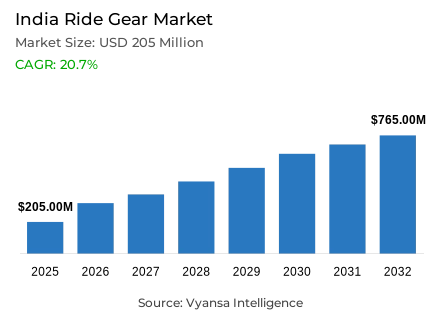
- Ride gear market size in India was valued at USD 205 million in 2025 and is estimated at USD 248.85 million in 2026.
- The market size is expected to grow to USD 765 million by 2032.
- Market to register a CAGR of around 20.7% during 2026-32.
- Product Type Shares
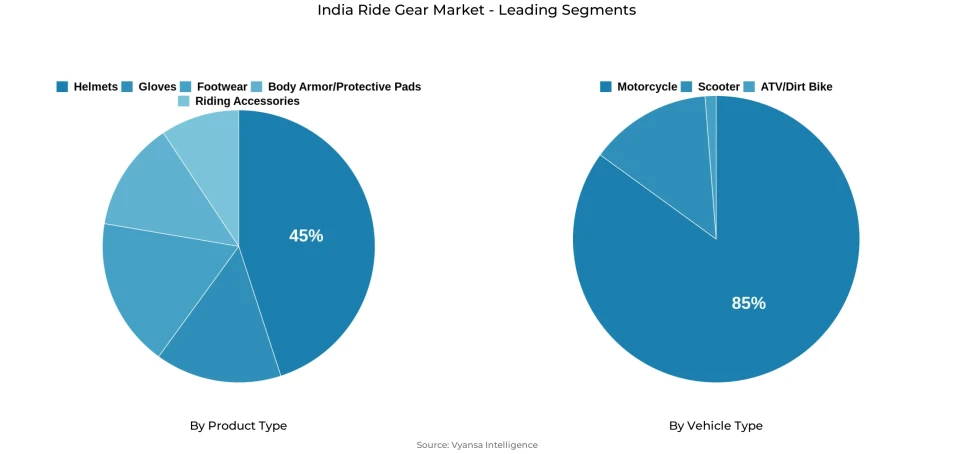
- Helmets grabbed market share of 45%.
- Competition
- More than 15 companies are actively engaged in producing ride gear in India.
- Top 5 companies acquired around 15% of the market share.
- SMK Helmets, Steelbird, Vega, Royal Enfield, Rynox Gear etc., are few of the top companies.
- Vehicle Type
- Motorcycle grabbed 85% of the market.
India Ride Gear Market Outlook
The India Ride Gear Market size was valued at USD 205 million in 2025 and is projected to grow from USD 248.85 million in 2026 to USD 765 million by 2032, exhibiting a CAGR of 20.7% during the forecast period. This rapid expansion is driven by stricter safety mandates and the institutionalization of distribution channels through new vehicle sales. While fake and non-certified products in roadside markets remain a challenge, increased enforcement by the Bureau of Indian Standards (BIS) is successfully shifting demand toward high-quality, organized options.
Helmets grabbed market share of 45%, standing out as the most critical component of the protective ecosystem due to legal requirements and frequent replacement needs. To boost consumer confidence, the government has introduced digital verification tools like the BIS Care App, allowing riders to check the validity of manufacturing licenses. This focus on certification ensures that India ride gear remains synonymous with safety, especially as 176 licensed manufacturers now provide a robust and formal supply base for the country.
The sheer volume of two-wheelers on the road significantly influences demand, as motorcycles grabbed 85% of the market. With over 21 crore two-wheelers in use and domestic sales reaching 19.6 million units in FY 2024-25, the correlation between vehicle ownership and safety equipment is stronger than ever. New regulations requiring ABS for certain categories by 2026 further emphasize the government's commitment to upgrading the standards of India ride gear for every rider.
A major growth opportunity lies in OEM-based distribution, following a June 2025 MoRTH draft notification requiring manufacturers to provide two BIS-certified helmets with every new vehicle. This move effectively integrates safety equipment into the vehicle delivery process, ensuring immediate access to compliant gear for millions of new owners. By aligning the supply of India ride gear with record-breaking vehicle sales, regulators and manufacturers are creating a seamless path toward a safer and more transparent riding culture.

India Ride Gear Market Growth Driver
Safety mandates embed gear into new two-wheeler sales
The policy framework in India is gradually incorporating safety equipment in the process of buying two-wheelers. The MoRTH draft notification (G.S.R. 415(E), June 2025) suggests that two-wheelers of L2-category produced on or after 1 January 2026 should be equipped with ABS, which further increases the regulatory emphasis on the safety of the riders. The identical proposal also demands that manufacturers provide two BIS-certified protective headgears when selling the vehicle, which means that the helmets should be provided during the delivery of the vehicle.
The magnitude of the two-wheeler market in India increases the effects of these policies. In FY 202425, domestic two-wheeler sales were 19.6 million units, which provides a huge entry point each year where certified helmets can be incorporated into the purchase transaction. Moreover, the Government estimates more than 21 crore two-wheelers already on the Indian roads, which means that there is a huge installed base where replacement cycles and compliance-based upgrades keep the demand of certified ride gear.
India Ride Gear Market Challenge
Counterfeit and non-compliant helmets erode trust
The availability of fake and non-conformity helmets is one of the biggest challenges facing the organised ride-gear market. The Department of Consumer Affairs reports that a significant number of helmets sold in roadside markets are not certified by the BIS, which poses a safety risk and misleads consumers about the quality of the products. The enforcement statistics underscore the magnitude of the problem. During FY 202425, the Bureau of Indian Standards (BIS) tested more than 500 samples of helmets and performed over 30 search-and-seizure operations against the misuse of the BIS Standard Mark.
A single enforcement operation in Delhi led to the seizure of more than 2,500 non-compliant helmets, and approximately 500 more helmets were seized in 17 retail and roadside outlets. These unofficial supply networks distort the price signals and diminish the perceived value of certified safety equipment. This climate adds expenses to legitimate manufacturers, who have to invest more in consumer education and distribution monitoring. Meanwhile, regulators should also devote more enforcement resources to eliminate low-quality products in the market.
Unlock Market Intelligence
Explore the market potential with our data-driven report
India Ride Gear Market Trend
Compliance verification and enforcement become more visible
The compliance of quality is becoming more transparent in the ecosystem of helmet in India. The Department of Consumer Affairs and BIS have stepped up the campaign to use BIS-certified helmets and to focus on the enforcement of the use of uncertified helmets in manufacturing or selling. To enhance the verification, BIS has established authenticity checks via the BIS Care App and BIS portal, which allows consumers to verify whether a helmet manufacturer has a valid licence and to file complaints about suspected non-compliance. Enforcement activity is also becoming more visible.
In FY 2024 25, BIS has tested more than 500 samples of helmets and conducted more than 30 enforcement actions against misuse of the BIS Standard Mark. The government is also combining helmet awareness programs with road-safety programs that are being carried out in conjunction with the traffic departments and local governments. By June 2025, 176 manufacturers have valid BIS licences on protective helmets, which enhances the formal supply base and boosts consumer confidence in certified safety equipment.
India Ride Gear Market Opportunity
OEM supply programs create a scale path for certified gear
OEM-based distribution models are a major expansion potential of the organised ride-gear market. The MoRTH draft notification (G.S.R. 415(E), June 2025) states that manufacturers should provide two BIS-certified helmets when selling the vehicle, which practically establishes a distribution channel built into the sale of new vehicles. This institutionalised supply channel is especially significant considering the size of the two-wheeler market in India.
Having sold 19.6 million units in FY 202425, every vehicle sold will be an opportunity to offer certified protective equipment at the delivery point. On the supply side, there are 176 BIS-licensed helmet manufacturers in the market today, which offer a well-organized supplier base that can be used to support OEM relationships, dealer networks, and own-label programs. Manufacturers and regulators can hasten the transition to certified products by matching the supply of safety gear to vehicle sales, increasing the penetration of compliant ride gear in India.
Unlock Market Intelligence
Explore the market potential with our data-driven report
India Ride Gear Market Segmentation Analysis
By Product Type
- Helmets
- Protective Clothing
- Jackets
- Pants
- Riding Suits
- Base Layers & Rainwear
- Gloves
- Footwear
- Body Armor/Protective Pads
- Knee Guards
- Elbow Guards
- Back Protectors
- Chest Protectors
- Riding Accessories
- Riding Goggles
- Neck Braces
- Hydration Packs
The segment with highest market share under Product Type is Helmets, accounting for 45% of the India Ride Gear Market. This dominance is indicative of the importance of helmets in the safety of the rider and the fact that the wearing of helmets is a legal requirement in most states. The replacement demand is also common, whereby helmets need to be replaced after some time because of wear, accidents, or changing safety standards.
The centrality of helmets in the ride-gear market is further strengthened by government initiatives. The certification has become a significant purchase criterion due to enforcement campaigns that promote BIS-certified helmets, as well as digital verification tools like the BIS Care App. Moreover, the MoRTH draft regulation that two helmets should be provided with new two-wheelers reinforces the position of helmets in OEM-based distribution channels.
By Vehicle Type
- Motorcycle
- Scooter
- ATV/Dirt Bike
Motorcycles represent the largest user base for ride gear, accounting for 85% of the market, according to the market share data provided. This density indicates the sheer prevalence of motorcycles in the two-wheeler market in India and the direct correlation between the number of motorcycles and the demand of protective equipment.
This relationship is supported by the size of the market. In FY 202425, domestic two-wheeler sales were 19.6 million units, and the Government estimates that there are more than 21 crore two-wheelers on Indian roads. Helmet demand among motorcycle riders is also supported by safety regulations. The MoRTH draft notification (June 2025) suggests that L2-category vehicles will be required to be fitted with ABS starting in January 2026, and that manufacturers will be required to provide two BIS-certified helmets with new vehicles, which will raise the availability of helmets to new riders.
List of Companies Covered in India Ride Gear Market
The companies listed below are highly influential in the India ride gear market, with a significant market share and a strong impact on industry developments.
- SMK Helmets
- Steelbird
- Vega
- Royal Enfield
- Rynox Gear
- ViaTerra
- Solace
- STUDDS
- AXOR
- LS2
Market News & Updates
- Royal Enfield, 2025:
Royal Enfield launched the Adventurer XT collection in India on January 7, 2025 as a high-performance riding gear line for extreme adventure riders, featuring CE Class AA certification, SuperFabric® reinforcement, laminated waterproofing, advanced ventilation, and a detachable winter liner rated for temperatures down to -15°C; the jacket and pants were priced at INR 24,950 and INR 15,950. This is a major development for the India ride gear market because it pushes the category toward more technical, expedition-grade protective apparel rather than basic commuter-focused gear
- SMK Helmets, 2025:
SMK Helmets, an India-origin brand, participated in India Bike Week 2025 as the Official Safety Partner and used the event to unveil the SMK Cygnus premium flip-back helmet; separately, SMK’s official new-collection page highlights a broader 2026 lineup that includes Cygnus, Delta City, Delta Tour, and Titan Carbon Forged. This is an important development for the India ride gear market because it combines high-visibility rider-community activation with fresh premium helmet introductions, helping accelerate awareness and adoption of upgraded protective gear among Indian motorcyclists.
Frequently Asked Questions
Related Report
- Market Segmentation
- Research Scope
- Research Methodology
- Definitions and Assumptions
- Executive Summary
- India Ride Gear Market Policies, Regulations, and Standards
- India Ride Gear Market Dynamics
- Growth Factors
- Challenges
- Trends
- Opportunities
- India Ride Gear Market Statistics, 2022-2032F
- Market Size & Growth Outlook
- By Revenues in USD Million
- Market Segmentation & Growth Outlook
- By Product Type
- Helmets- Market Insights and Forecast 2022-2032, USD Million
- Protective Clothing- Market Insights and Forecast 2022-2032, USD Million
- Jackets- Market Insights and Forecast 2022-2032, USD Million
- Pants- Market Insights and Forecast 2022-2032, USD Million
- Riding Suits- Market Insights and Forecast 2022-2032, USD Million
- Base Layers & Rainwear- Market Insights and Forecast 2022-2032, USD Million
- Gloves- Market Insights and Forecast 2022-2032, USD Million
- Footwear- Market Insights and Forecast 2022-2032, USD Million
- Body Armor/Protective Pads- Market Insights and Forecast 2022-2032, USD Million
- Knee Guards- Market Insights and Forecast 2022-2032, USD Million
- Elbow Guards- Market Insights and Forecast 2022-2032, USD Million
- Back Protectors- Market Insights and Forecast 2022-2032, USD Million
- Chest Protectors- Market Insights and Forecast 2022-2032, USD Million
- Riding Accessories- Market Insights and Forecast 2022-2032, USD Million
- Riding Goggles- Market Insights and Forecast 2022-2032, USD Million
- Neck Braces- Market Insights and Forecast 2022-2032, USD Million
- Hydration Packs- Market Insights and Forecast 2022-2032, USD Million
- Helmets- Market Insights and Forecast 2022-2032, USD Million
- By Material
- Leather- Market Insights and Forecast 2022-2032, USD Million
- Textile- Market Insights and Forecast 2022-2032, USD Million
- Synthetic Materials- Market Insights and Forecast 2022-2032, USD Million
- Carbon Fiber- Market Insights and Forecast 2022-2032, USD Million
- Mesh- Market Insights and Forecast 2022-2032, USD Million
- Composite Materials- Market Insights and Forecast 2022-2032, USD Million
- By Distribution Channel
- Retail Online- Market Insights and Forecast 2022-2032, USD Million
- Retail Offline- Market Insights and Forecast 2022-2032, USD Million
- Specialty Stores- Market Insights and Forecast 2022-2032, USD Million
- Multi-brand Retail Stores- Market Insights and Forecast 2022-2032, USD Million
- OEM/Authorized Dealers- Market Insights and Forecast 2022-2032, USD Million
- By Vehicle Type
- Motorcycle- Market Insights and Forecast 2022-2032, USD Million
- Scooter- Market Insights and Forecast 2022-2032, USD Million
- ATV/Dirt Bike- Market Insights and Forecast 2022-2032, USD Million
- By Riding Application
- Daily Commuting- Market Insights and Forecast 2022-2032, USD Million
- Touring/Long-Distance Riding- Market Insights and Forecast 2022-2032, USD Million
- Racing/Track Riding- Market Insights and Forecast 2022-2032, USD Million
- Adventure Riding- Market Insights and Forecast 2022-2032, USD Million
- Off-Road/Motocross- Market Insights and Forecast 2022-2032, USD Million
- Recreational Riding- Market Insights and Forecast 2022-2032, USD Million
- By Price Range
- Economy- Market Insights and Forecast 2022-2032, USD Million
- Mid-Range- Market Insights and Forecast 2022-2032, USD Million
- Premium- Market Insights and Forecast 2022-2032, USD Million
- By Gender
- Men- Market Insights and Forecast 2022-2032, USD Million
- Women- Market Insights and Forecast 2022-2032, USD Million
- Unisex- Market Insights and Forecast 2022-2032, USD Million
- By Region
- North
- East
- West
- South
- By Competitors
- Competition Characteristics
- Market Share & Analysis
- By Product Type
- Market Size & Growth Outlook
- India Helmets Market Statistics, 2022-2032
- Market Size & Growth Outlook
- By Revenues in USD Million
- Market Segmentation & Growth Outlook
- By Material- Market Insights and Forecast 2022-2032, USD Million
- By Distribution Channel- Market Insights and Forecast 2022-2032, USD Million
- By Vehicle Type- Market Insights and Forecast 2022-2032, USD Million
- By Riding Application- Market Insights and Forecast 2022-2032, USD Million
- By Price Range- Market Insights and Forecast 2022-2032, USD Million
- By Gender- Market Insights and Forecast 2022-2032, USD Million
- By Region- Market Insights and Forecast 2022-2032, USD Million
- Market Size & Growth Outlook
- India Gloves Market Statistics, 2022-2032
- Market Size & Growth Outlook
- By Revenues in USD Million
- Market Segmentation & Growth Outlook
- By Material- Market Insights and Forecast 2022-2032, USD Million
- By Distribution Channel- Market Insights and Forecast 2022-2032, USD Million
- By Vehicle Type- Market Insights and Forecast 2022-2032, USD Million
- By Riding Application- Market Insights and Forecast 2022-2032, USD Million
- By Price Range- Market Insights and Forecast 2022-2032, USD Million
- By Gender- Market Insights and Forecast 2022-2032, USD Million
- By Region- Market Insights and Forecast 2022-2032, USD Million
- Market Size & Growth Outlook
- India Footwear Market Statistics, 2022-2032
- Market Size & Growth Outlook
- By Revenues in USD Million
- Market Segmentation & Growth Outlook
- By Material- Market Insights and Forecast 2022-2032, USD Million
- By Distribution Channel- Market Insights and Forecast 2022-2032, USD Million
- By Vehicle Type- Market Insights and Forecast 2022-2032, USD Million
- By Riding Application- Market Insights and Forecast 2022-2032, USD Million
- By Price Range- Market Insights and Forecast 2022-2032, USD Million
- By Gender- Market Insights and Forecast 2022-2032, USD Million
- By Region- Market Insights and Forecast 2022-2032, USD Million
- Market Size & Growth Outlook
- India Body Armor/Protective Pads Market Statistics, 2022-2032
- Market Size & Growth Outlook
- By Revenues in USD Million
- Market Segmentation & Growth Outlook
- By Material- Market Insights and Forecast 2022-2032, USD Million
- By Distribution Channel- Market Insights and Forecast 2022-2032, USD Million
- By Vehicle Type- Market Insights and Forecast 2022-2032, USD Million
- By Riding Application- Market Insights and Forecast 2022-2032, USD Million
- By Price Range- Market Insights and Forecast 2022-2032, USD Million
- By Gender- Market Insights and Forecast 2022-2032, USD Million
- By Region- Market Insights and Forecast 2022-2032, USD Million
- Market Size & Growth Outlook
- India Riding Accessories Market Statistics, 2022-2032
- Market Size & Growth Outlook
- By Revenues in USD Million
- Market Segmentation & Growth Outlook
- By Material- Market Insights and Forecast 2022-2032, USD Million
- By Distribution Channel- Market Insights and Forecast 2022-2032, USD Million
- By Vehicle Type- Market Insights and Forecast 2022-2032, USD Million
- By Riding Application- Market Insights and Forecast 2022-2032, USD Million
- By Price Range- Market Insights and Forecast 2022-2032, USD Million
- By Gender- Market Insights and Forecast 2022-2032, USD Million
- By Region- Market Insights and Forecast 2022-2032, USD Million
- Market Size & Growth Outlook
- Competitive Outlook
- Company Profiles
- Royal Enfield
- Business Description
- Product Portfolio
- Collaborations & Alliances
- Recent Developments
- Financial Details
- Others
- Rynox Gear
- Business Description
- Product Portfolio
- Collaborations & Alliances
- Recent Developments
- Financial Details
- Others
- ViaTerra
- Business Description
- Product Portfolio
- Collaborations & Alliances
- Recent Developments
- Financial Details
- Others
- Solace
- Business Description
- Product Portfolio
- Collaborations & Alliances
- Recent Developments
- Financial Details
- Others
- STUDDS
- Business Description
- Product Portfolio
- Collaborations & Alliances
- Recent Developments
- Financial Details
- Others
- SMK Helmets
- Business Description
- Product Portfolio
- Collaborations & Alliances
- Recent Developments
- Financial Details
- Others
- Steelbird
- Business Description
- Product Portfolio
- Collaborations & Alliances
- Recent Developments
- Financial Details
- Others
- Vega
- Business Description
- Product Portfolio
- Collaborations & Alliances
- Recent Developments
- Financial Details
- Others
- AXOR
- Business Description
- Product Portfolio
- Collaborations & Alliances
- Recent Developments
- Financial Details
- Others
- LS2
- Business Description
- Product Portfolio
- Collaborations & Alliances
- Recent Developments
- Financial Details
- Others
- Royal Enfield
- Company Profiles
- Disclaimer
| Segment | Sub-Segment |
|---|---|
| By Product Type |
|
| By Material |
|
| By Distribution Channel |
|
| By Vehicle Type |
|
| By Riding Application |
|
| By Price Range |
|
| By Gender |
|
| By Region |
|
Research Methodology
This study followed a structured approach comprising four key phases to assess the size and scope of the electro-oxidation market. The process began with thorough secondary research to collect data on the target market, related markets, and broader industry context. These findings, along with preliminary assumptions and estimates, were then validated through extensive primary research involving industry experts from across the value chain. To calculate the overall market size, both top-down and bottom-up methodologies were employed. Finally, market segmentation and data triangulation techniques were applied to refine and validate segment-level estimations.
Secondary Research
The secondary research phase involved gathering data from a wide range of credible and published sources. This step helped in identifying industry trends, defining market segmentation, and understanding the market landscape and value chain.
Sources consulted during this phase included:
- Company annual reports, investor presentations, and press releases
- Industry white papers and certified publications
- Trade directories and market-recognized databases
- Articles from authoritative authors and reputable journals
- Gold and silver standard websites
Secondary research was critical in mapping out the industry's value chain and monetary flow, identifying key market segments, understanding regional variations, and tracking significant industry developments.
Other key sources:
- Financial disclosures
- Industry associations and trade bodies
- News outlets and business magazines
- Academic journals and research studies
- Paid industry databases
Primary Research
To validate secondary data and gain deeper market insights, primary research was conducted with key stakeholders across both the supply and demand sides of the market.
On the demand side, participants included decision-makers and influencers from end-user industries—such as CIOs, CTOs, and CSOs—who provided first-hand perspectives on market needs, product usage, and future expectations.
On the supply side, interviews were conducted with manufacturers, industry associations, and institutional participants to gather insights into current offerings, product pipelines, and market challenges.
Primary interviews provided critical inputs such as:
- Market size and revenue data
- Product and service breakdowns
- Market forecasts
- Regional and application-specific trends
Stakeholders consulted included:
- Leading OEM and solution providers
- Channel and distribution partners
- End users across various applications
- Independent consultants and industry specialists
Market Size Estimation and Data Triangulation
- Identifying Key Market Participants (Secondary Research)
- Goal: To identify the major players or companies in the target market. This typically involves using publicly available data sources such as industry reports, market research publications, and financial statements of companies.
- Tools: Reports from firms like Gartner, Forrester, Euromonitor, Statista, IBISWorld, and others. Public financial statements, news articles, and press releases from top market players.
- Extracting Earnings of Key Market Participants
- Goal: To estimate the earnings generated from the product or service being analyzed. This step helps in understanding the revenue potential of each market player in a specific geography.
- Methods: Earnings data can be gathered from:
- Publicly available financial reports (for listed companies).
- Interviews and primary data sources from professionals, such as Directors, VPs, SVPs, etc. This is especially useful for understanding more nuanced, internal data that isn't publicly disclosed.
- Annual reports and investor presentations of key players.
- Data Collation and Development of a Relevant Data Model
- Goal: To collate inputs from both primary and secondary sources into a structured, data-driven model for market estimation. This model will incorporate key market KPIs and any independent variables relevant to the market.
- Key KPIs: These could include:
- Market size, growth rate, and demand drivers.
- Industry-specific metrics like market share, average revenue per customer (ARPC), or average deal size.
- External variables, such as economic growth rates, inflation rates, or commodity prices, that could affect the market.
- Data Modeling: Based on this data, the market forecasts are developed for the next 5 years. A combination of trend analysis, scenario modeling, and statistical regression might be used to generate projections.
- Scenario Analysis
- Goal: To test different assumptions and validate how sensitive the market is to changes in key variables (e.g., market demand, regulatory changes, technological disruptions).
- Types of Scenarios:
- Base Case: Based on current assumptions and historical data.
- Best-Case Scenario: Assuming favorable market conditions, regulatory environments, and technological advancements.
- Worst-Case Scenario: Accounting for adverse factors, such as economic downturns, stricter regulations, or unexpected disruptions.












