India Colour Cosmetics Market Report: Trends, Growth and Forecast (2026-2032)
By Category (Eye Make-Up (Eye Liner/Pencil, Eye Shadow, Mascara, Others), Facial Make-Up (BB/CC Creams, Blusher/Bronzer/Highlighter, Foundation/Concealer, Powder, Others), Lip Products (Lip Gloss, Lip Liner/Pencil, Lipstick, Others), Nail Products (Nail Polish, Nail Treatments/Strengthener, Polish Remover, Others), Colour Cosmetics Sets/Kits), By Price (Premium, Mass), By Gender (Men, Women, Unisex), By Packaging Type (Travel/Mini Size, Standard Size, Professional/Salon Size), By Form (Creams/Gels, Lotions, Sprays, Solid, Others), By Nature (Organic, Inorganic), By Sales Channel (Retail Offline, Retail Online) ... Read more

|
Major Players
|
India Colour Cosmetics Market Statistics and Insights, 2026
- Market Size Statistics
- Colour cosmetics in India is estimated at USD 1.49 billion in 2025.
- The market size is expected to grow to USD 2.16 billion by 2032.
- Market to register a cagr of around 5.45% during 2026-32.
- Category Shares
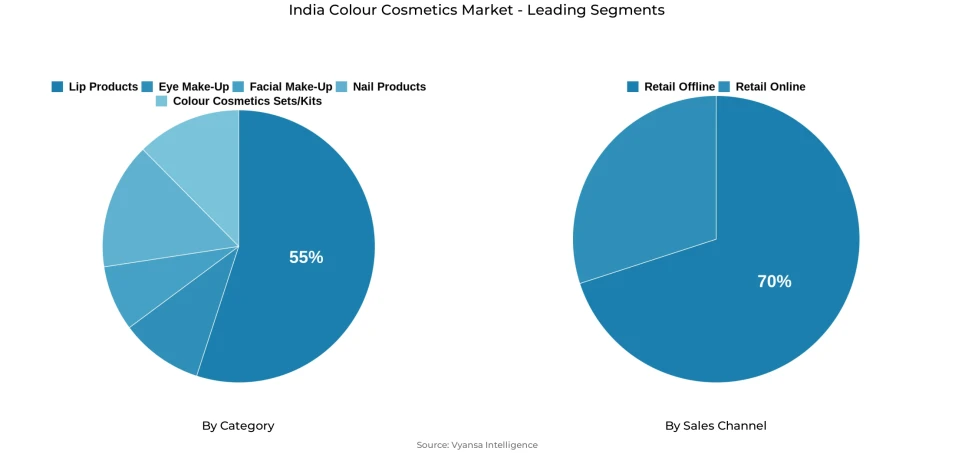
- Lip products grabbed market share of 55%.
- Competition
- More than 20 companies are actively engaged in producing colour cosmetics in India.
- Top 5 companies acquired around 35% of the market share.
- Honasa Consumer Pvt Ltd; Modicare Ltd; Lotus Herbals Pvt Ltd; Hindustan Unilever Ltd; L'Oréal India Pvt Ltd etc., are few of the top companies.
- Sales Channel
- Retail offline grabbed 70% of the market.
India Colour Cosmetics Market Outlook
The India colour cosmetics market is expected to witness considerable growth from 2026 to 2032, and it is expected to be driven by end user behavior and the adoption of the products among people. As of 2025, the market has been recorded to be USD 1.49 billion. Analyzing the year 2024, the value growth for colour cosmetics has been considerable, and the prime reason behind the growth has been the adoption and increased acceptance among people to use the products as part of everyday self-expression routines and practices. The lips category has been the most performing category for 2024, and it has been expected to be driven by products such as tint, oil, crème, and multi-sticks for the younger generation, including influence by short-video platforms and collab efforts with influencers.
Lip products continue to drive the overall business, with lip products having substantial sales, driven by the growing need for low-maintenance grooming and mood enhancement. Experimental use and gathering different lip colors, with mini and affordable prices, are a cultural move away from the idea that makeup is used only in special occasions and have instead become an identity statement.
Distribution is grounded in the offline retail sector, with Retail Offline acquiring around 70% of market sales, driven by the grocery retail and department store segments where end user can touch the products. However, online retailing, including retail online sites such as Nykaa, Tira, Myntra, and Amazon, is also on the rise.
Moving forward, the market is likely to increase to USD 2.16 billion by 2032, registering a CAGR of approximately 5.45% from 2026 to 2032. Innovation in formats, influencer-driven demand, and omni-channel retail experiences would help drive growth through the forecast period.

India Colour Cosmetics Market Growth Driver
Rising Personal Grooming and Daily Use Culture
Growth in the sales of colour cosmetics is being driven by the rising adoption of self-beautification practices across India. The market value of the overall beauty market in India in 2024 is recognized to be a staggering USD 28 billion. The market is witnessing the most dynamic changes in this age of record-breaking retail online sales. It is backed by the changing lifestyle of end users who appreciate the use of lip and eye cosmetics.
Younger end user groups, especially Generation Z and millennials, are also contributing to the use of beauty retail online and quick-commerce platforms. As per NielsenIQ, beauty retail online and quick-commerce sales have seen a 39% increase in value between June and November 2024, as opposed to the same period last year, while the increase in physical store sales stands at only 3% making beauty retail online and quick-commerce the new daily staples as opposed to periodic behaviors with online beauty shopping increasing from 13% in 2023 to 17% in 2024.
India Colour Cosmetics Market Challenge
Heightened Demand for Quality and Authenticity
The India colour cosmetics market is faced with the task of sustaining growing end user demands for quality, effectiveness, and authenticity. The end user in the Indian market is increasingly becoming conscious of the quality of ingredients and the effectiveness of products. According to a NielsenIQ survey, make-up and skincare in the Indian market attained growth of 15.5% and 10.5% value sales, respectively.
This is putting pressure on brands to deliver innovation as well as tried-and-proven efficacy, he said. A greater level of competitiveness from local as well as international brands is making this even more challenging as end users call for more openness regarding ingredients used as well as greater sustainability within those formulas. The topic of clean and sustainable beauty has been recognised as one of the major trends within the Indian market, said one expert. A lot is being said regarding ingredients and efficacy as a pre-requisite before making commitments to repurchase. Brands that fail to live up to these demands will no longer be relevant to the marketplace.
Unlock Market Intelligence
Explore the market potential with our data-driven report
India Colour Cosmetics Market Trend
Digital and Omni-Channel Shopping Dominance
The market is increasingly being shaped by a notable shift toward digital engagement and omni-channel consumption patterns. As per Nielsen IQ data, India has emerged as the fastest growing retail online market globally for beauty products. Digital platforms such as Amazon, Myntra, Blinkit, and Zepto are being increasingly driven into the discovery, review, and purchasing of color cosmetics, which reflects changing end user behavior towards embracing the online shopping experience.
The physical store still remains significant for the experience of product trials, especially for the basic consumption of cosmetics, leading to the rise of an omnichannel business format in the market, with the e-component being supplemental rather than integral to the physical store experience. The other significant shift in the market has occurred with the entry of quick commerce platforms, including the delivery of products within a short span of time, with very rapid expansion in the market, reflecting the adoption of the ‘speed-based shopping culture in the Indian market.
India Colour Cosmetics Market Opportunity
Growth Through Premiumization and Innovation
Rising demand for colour cosmetics, supported by ongoing premiumisation trends and a greater willingness among end users to invest in higher-quality products, presents substantial scope for market expansion More than 68% of young individuals in India feel using grooming products increases their confidence, which clearly portrays end user acceptance of beauty products in the country. International players like MAC, Clinique, and Dior, along with Japanese brands such as NARS Cosmetics, have either entered or extended their presence in the Indian market, which clearly represents their faith in this market and its premium segment potential.
As home and foreign brands vie for shares of the market with innovation, new opportunities arise within the dynamic Indian color cosmetics market, where brands supporting science-backed formulas, specific lines of products, and open communication about ingredients are well-positioned. The makeup category tracked the highest growth rate within color cosmetics, where sales of makeup grew 15.5% relative to 10.5% growth in skincare sales. Engaging with young, tech-savvy end users via retail online and influence partnerships positions brands in line to establish affinity and drive sales away from existing channels.
Unlock Market Intelligence
Explore the market potential with our data-driven report
India Colour Cosmetics Market Segmentation Analysis
By Category
- Eye Make-Up
- Eye Liner/Pencil
- Eye Shadow
- Mascara
- Others
- Facial Make-Up
- BB/CC Creams
- Blusher/Bronzer/Highlighter
- Foundation/Concealer
- Powder
- Others
- Lip Products
- Lip Gloss
- Lip Liner/Pencil
- Lipstick
- Others
- Nail Products
- Nail Polish
- Nail Treatments/Strengthener
- Polish Remover
- Others
- Colour Cosmetics Sets/Kits
The segment with highest market share under category is lip products these products share a total of about 55% of the total coloured cosmetics market in India. It is apparent that lip products have become an essential part of beauty and makeup practices among women who wish to express this culture without spending too much time. The products come in different forms that suit all end user.
Lip products emerged as the main drivers for the market in the year 2024, and this is because young end users like generation Z and millennials are interested in trendy colors and launches endorsed by influencers. The consumption of affordable products and the use of mini sizes that can be collected further drive the acquisition of lip products, making them the main market segment for color cosmetics.
By Sales Channel
- Retail Offline
- Retail Online
The segment with highest market share under sales channel is Retail Offline, which accounts for approximately 70% of overall market share. Conventional distribution via food retailers, department stores, and specialty beauty shops is at present the most established means of purchasing color cosmetics. The primary reason for this remains the ability to test and seek advice in-store.
Even with the rapid growth of online business, the offline channel still leads due to end user purchasing habits and the importance of hands-on experience with products. The convergence of offline and online channels serves as a driving force behind the adoption of an omnichannel approach by brands.
List of Companies Covered in India Colour Cosmetics Market
The companies listed below are highly influential in the India colour cosmetics market, with a significant market share and a strong impact on industry developments.
- Honasa Consumer Pvt Ltd
- Modicare Ltd
- Lotus Herbals Pvt Ltd
- Hindustan Unilever Ltd
- L'Oréal India Pvt Ltd
- Elca Cosmetics Pvt Ltd
- Sanghvi Beauty & Technologies Pvt Ltd
- Colorbar Cosmetics Pvt Ltd
- Modi-Mundhipharma Beauty Products Pvt Ltd
- Faces Cosmetics India Pvt Ltd
Competitive Landscape
India colour cosmetics market in 2025 became increasingly competitive as legacy leaders, global brands, premium labels, and emerging digital-first players intensified their presence across channels. Hindustan Unilever Ltd retained category leadership through Lakmé and Elle 18, supported by strong offline reach and omnichannel visibility, but lost share as rivals strengthened their portfolios. L’Oréal India gained ground with Maybelline New York and L’Oréal Paris, leveraging frequent shade extensions, influencer-led campaigns, and trend-aligned launches. In the premium segment, Elca Cosmetics Pvt Ltd sustained a strong position via curated retail partnerships and Luxe e-commerce for brands such as MAC, Clinique, Estée Lauder, and Bobbi Brown. Meanwhile, global trend-driven brands including Charlotte Tilbury, Rare Beauty, and Fenty Beauty expanded their footprint through platforms like Nykaa and Tira, improving accessibility in Tier 2 and Tier 3 cities. Competition now extends beyond price and distribution to content relevance, social visibility, and cultural resonance, as consumers increasingly mix mass and premium lines while prioritising performance, aesthetics, and brand identity.
Frequently Asked Questions
Related Report
1. Market Segmentation
1.1. Research Scope
1.2. Research Methodology
1.3. Definitions and Assumptions
2. Executive Summary
3. India Colour Cosmetics Market Policies, Regulations, and Standards
4. India Colour Cosmetics Market Dynamics
4.1. Growth Factors
4.2. Challenges
4.3. Trends
4.4. Opportunities
5. India Colour Cosmetics Market Statistics, 2022-2032F
5.1. Market Size & Growth Outlook
5.1.1.By Revenues in USD Million
5.2. Market Segmentation & Growth Outlook
5.2.1.By Category
5.2.1.1. Eye Make-Up- Market Insights and Forecast 2022-2032, USD Million
5.2.1.1.1. Eye Liner/Pencil- Market Insights and Forecast 2022-2032, USD Million
5.2.1.1.2. Eye Shadow- Market Insights and Forecast 2022-2032, USD Million
5.2.1.1.3. Mascara- Market Insights and Forecast 2022-2032, USD Million
5.2.1.1.4. Others- Market Insights and Forecast 2022-2032, USD Million
5.2.1.2. Facial Make-Up- Market Insights and Forecast 2022-2032, USD Million
5.2.1.2.1. BB/CC Creams- Market Insights and Forecast 2022-2032, USD Million
5.2.1.2.2. Blusher/Bronzer/Highlighter- Market Insights and Forecast 2022-2032, USD Million
5.2.1.2.3. Foundation/Concealer- Market Insights and Forecast 2022-2032, USD Million
5.2.1.2.4. Powder- Market Insights and Forecast 2022-2032, USD Million
5.2.1.2.5. Others- Market Insights and Forecast 2022-2032, USD Million
5.2.1.3. Lip Products- Market Insights and Forecast 2022-2032, USD Million
5.2.1.3.1. Lip Gloss- Market Insights and Forecast 2022-2032, USD Million
5.2.1.3.2. Lip Liner/Pencil- Market Insights and Forecast 2022-2032, USD Million
5.2.1.3.3. Lipstick- Market Insights and Forecast 2022-2032, USD Million
5.2.1.3.4. Others- Market Insights and Forecast 2022-2032, USD Million
5.2.1.4. Nail Products- Market Insights and Forecast 2022-2032, USD Million
5.2.1.4.1. Nail Polish- Market Insights and Forecast 2022-2032, USD Million
5.2.1.4.2. Nail Treatments/Strengthener- Market Insights and Forecast 2022-2032, USD Million
5.2.1.4.3. Polish Remover- Market Insights and Forecast 2022-2032, USD Million
5.2.1.4.4. Others- Market Insights and Forecast 2022-2032, USD Million
5.2.1.5. Colour Cosmetics Sets/Kits- Market Insights and Forecast 2022-2032, USD Million
5.2.2.By Price
5.2.2.1. Premium- Market Insights and Forecast 2022-2032, USD Million
5.2.2.2. Mass- Market Insights and Forecast 2022-2032, USD Million
5.2.3.By Gender
5.2.3.1. Men- Market Insights and Forecast 2022-2032, USD Million
5.2.3.2. Women- Market Insights and Forecast 2022-2032, USD Million
5.2.3.3. Unisex- Market Insights and Forecast 2022-2032, USD Million
5.2.4.By Packaging Type
5.2.4.1. Travel/Mini Size - Market Insights and Forecast 2022-2032, USD Million
5.2.4.2. Standard Size - Market Insights and Forecast 2022-2032, USD Million
5.2.4.3. Professional/Salon Size- Market Insights and Forecast 2022-2032, USD Million
5.2.5.By Form
5.2.5.1. Creams/Gels- Market Insights and Forecast 2022-2032, USD Million
5.2.5.2. Lotions- Market Insights and Forecast 2022-2032, USD Million
5.2.5.3. Sprays- Market Insights and Forecast 2022-2032, USD Million
5.2.5.4. Solid- Market Insights and Forecast 2022-2032, USD Million
5.2.5.5. Others- Market Insights and Forecast 2022-2032, USD Million
5.2.6.By Nature
5.2.6.1. Organic- Market Insights and Forecast 2022-2032, USD Million
5.2.6.2. Inorganic- Market Insights and Forecast 2022-2032, USD Million
5.2.7.By Sales Channel
5.2.7.1. Retail Offline- Market Insights and Forecast 2022-2032, USD Million
5.2.7.2. Retail Online- Market Insights and Forecast 2022-2032, USD Million
5.2.8.By Competitors
5.2.8.1. Competition Characteristics
5.2.8.2. Market Share & Analysis
6. India Eye Make-Up Colour Cosmetics Market Statistics, 2022-2032
6.1. Market Size & Growth Outlook
6.1.1.By Revenues in USD Million
6.2. Market Segmentation & Growth Outlook
6.2.1.By Category- Market Insights and Forecast 2022-2032, USD Million
6.2.2.By Price- Market Insights and Forecast 2022-2032, USD Million
6.2.3.By Gender- Market Insights and Forecast 2022-2032, USD Million
6.2.4.By Packaging Type- Market Insights and Forecast 2022-2032, USD Million
6.2.5.By Form- Market Insights and Forecast 2022-2032, USD Million
6.2.6.By Nature- Market Insights and Forecast 2022-2032, USD Million
6.2.7.By Sales Channel- Market Insights and Forecast 2022-2032, USD Million
7. India Facial Make-Up Colour Cosmetics Market Statistics, 2022-2032
7.1. Market Size & Growth Outlook
7.1.1.By Revenues in USD Million
7.2. Market Segmentation & Growth Outlook
7.2.1.By Category- Market Insights and Forecast 2022-2032, USD Million
7.2.2.By Price- Market Insights and Forecast 2022-2032, USD Million
7.2.3.By Gender- Market Insights and Forecast 2022-2032, USD Million
7.2.4.By Packaging Type- Market Insights and Forecast 2022-2032, USD Million
7.2.5.By Form- Market Insights and Forecast 2022-2032, USD Million
7.2.6.By Nature- Market Insights and Forecast 2022-2032, USD Million
7.2.7.By Sales Channel- Market Insights and Forecast 2022-2032, USD Million
8. India Lip Products Colour Cosmetics Market Statistics, 2022-2032
8.1. Market Size & Growth Outlook
8.1.1.By Revenues in USD Million
8.2. Market Segmentation & Growth Outlook
8.2.1.By Category- Market Insights and Forecast 2022-2032, USD Million
8.2.2.By Price- Market Insights and Forecast 2022-2032, USD Million
8.2.3.By Gender- Market Insights and Forecast 2022-2032, USD Million
8.2.4.By Packaging Type- Market Insights and Forecast 2022-2032, USD Million
8.2.5.By Form- Market Insights and Forecast 2022-2032, USD Million
8.2.6.By Nature- Market Insights and Forecast 2022-2032, USD Million
8.2.7.By Sales Channel- Market Insights and Forecast 2022-2032, USD Million
9. India Nail Products Colour Cosmetics Market Statistics, 2022-2032
9.1. Market Size & Growth Outlook
9.1.1.By Revenues in USD Million
9.2. Market Segmentation & Growth Outlook
9.2.1.By Category- Market Insights and Forecast 2022-2032, USD Million
9.2.2.By Price- Market Insights and Forecast 2022-2032, USD Million
9.2.3.By Gender- Market Insights and Forecast 2022-2032, USD Million
9.2.4.By Packaging Type- Market Insights and Forecast 2022-2032, USD Million
9.2.5.By Form- Market Insights and Forecast 2022-2032, USD Million
9.2.6.By Nature- Market Insights and Forecast 2022-2032, USD Million
9.2.7.By Sales Channel- Market Insights and Forecast 2022-2032, USD Million
10. India Colour Cosmetics Sets/Kits Colour Cosmetics Market Statistics, 2022-2032
10.1. Market Size & Growth Outlook
10.1.1. By Revenues in USD Million
10.2. Market Segmentation & Growth Outlook
10.2.1. By Price- Market Insights and Forecast 2022-2032, USD Million
10.2.2. By Gender- Market Insights and Forecast 2022-2032, USD Million
10.2.3. By Packaging Type- Market Insights and Forecast 2022-2032, USD Million
10.2.4. By Form- Market Insights and Forecast 2022-2032, USD Million
10.2.5. By Nature- Market Insights and Forecast 2022-2032, USD Million
10.2.6. By Sales Channel- Market Insights and Forecast 2022-2032, USD Million
11. Competitive Outlook
11.1. Company Profiles
11.1.1. Hindustan Unilever Ltd
11.1.1.1. Business Description
11.1.1.2. Product Portfolio
11.1.1.3. Collaborations & Alliances
11.1.1.4. Recent Developments
11.1.1.5. Financial Details
11.1.1.6. Others
11.1.2. L'Oréal India Pvt Ltd
11.1.2.1. Business Description
11.1.2.2. Product Portfolio
11.1.2.3. Collaborations & Alliances
11.1.2.4. Recent Developments
11.1.2.5. Financial Details
11.1.2.6. Others
11.1.3. Elca Cosmetics Pvt Ltd
11.1.3.1. Business Description
11.1.3.2. Product Portfolio
11.1.3.3. Collaborations & Alliances
11.1.3.4. Recent Developments
11.1.3.5. Financial Details
11.1.3.6. Others
11.1.4. Sanghvi Beauty & Technologies Pvt Ltd
11.1.4.1. Business Description
11.1.4.2. Product Portfolio
11.1.4.3. Collaborations & Alliances
11.1.4.4. Recent Developments
11.1.4.5. Financial Details
11.1.4.6. Others
11.1.5. Colorbar Cosmetics Pvt Ltd
11.1.5.1. Business Description
11.1.5.2. Product Portfolio
11.1.5.3. Collaborations & Alliances
11.1.5.4. Recent Developments
11.1.5.5. Financial Details
11.1.5.6. Others
11.1.6. Honasa Consumer Pvt Ltd
11.1.6.1. Business Description
11.1.6.2. Product Portfolio
11.1.6.3. Collaborations & Alliances
11.1.6.4. Recent Developments
11.1.6.5. Financial Details
11.1.6.6. Others
11.1.7. Modicare Ltd
11.1.7.1. Business Description
11.1.7.2. Product Portfolio
11.1.7.3. Collaborations & Alliances
11.1.7.4. Recent Developments
11.1.7.5. Financial Details
11.1.7.6. Others
11.1.8. Lotus Herbals Pvt Ltd
11.1.8.1. Business Description
11.1.8.2. Product Portfolio
11.1.8.3. Collaborations & Alliances
11.1.8.4. Recent Developments
11.1.8.5. Financial Details
11.1.8.6. Others
11.1.9. Modi-Mundhipharma Beauty Products Pvt Ltd
11.1.9.1. Business Description
11.1.9.2. Product Portfolio
11.1.9.3. Collaborations & Alliances
11.1.9.4. Recent Developments
11.1.9.5. Financial Details
11.1.9.6. Others
11.1.10. Faces Cosmetics India Pvt Ltd
11.1.10.1.Business Description
11.1.10.2.Product Portfolio
11.1.10.3.Collaborations & Alliances
11.1.10.4.Recent Developments
11.1.10.5.Financial Details
11.1.10.6.Others
12. Disclaimer
| Segment | Sub-Segment |
|---|---|
| By Category |
|
| By Price |
|
| By Gender |
|
| By Packaging Type |
|
| By Form |
|
| By Nature |
|
| By Sales Channel |
|
Research Methodology
This study followed a structured approach comprising four key phases to assess the size and scope of the electro-oxidation market. The process began with thorough secondary research to collect data on the target market, related markets, and broader industry context. These findings, along with preliminary assumptions and estimates, were then validated through extensive primary research involving industry experts from across the value chain. To calculate the overall market size, both top-down and bottom-up methodologies were employed. Finally, market segmentation and data triangulation techniques were applied to refine and validate segment-level estimations.
Secondary Research
The secondary research phase involved gathering data from a wide range of credible and published sources. This step helped in identifying industry trends, defining market segmentation, and understanding the market landscape and value chain.
Sources consulted during this phase included:
- Company annual reports, investor presentations, and press releases
- Industry white papers and certified publications
- Trade directories and market-recognized databases
- Articles from authoritative authors and reputable journals
- Gold and silver standard websites
Secondary research was critical in mapping out the industry's value chain and monetary flow, identifying key market segments, understanding regional variations, and tracking significant industry developments.
Other key sources:
- Financial disclosures
- Industry associations and trade bodies
- News outlets and business magazines
- Academic journals and research studies
- Paid industry databases
Primary Research
To validate secondary data and gain deeper market insights, primary research was conducted with key stakeholders across both the supply and demand sides of the market.
On the demand side, participants included decision-makers and influencers from end-user industries—such as CIOs, CTOs, and CSOs—who provided first-hand perspectives on market needs, product usage, and future expectations.
On the supply side, interviews were conducted with manufacturers, industry associations, and institutional participants to gather insights into current offerings, product pipelines, and market challenges.
Primary interviews provided critical inputs such as:
- Market size and revenue data
- Product and service breakdowns
- Market forecasts
- Regional and application-specific trends
Stakeholders consulted included:
- Leading OEM and solution providers
- Channel and distribution partners
- End users across various applications
- Independent consultants and industry specialists
Market Size Estimation and Data Triangulation
- Identifying Key Market Participants (Secondary Research)
- Goal: To identify the major players or companies in the target market. This typically involves using publicly available data sources such as industry reports, market research publications, and financial statements of companies.
- Tools: Reports from firms like Gartner, Forrester, Euromonitor, Statista, IBISWorld, and others. Public financial statements, news articles, and press releases from top market players.
- Extracting Earnings of Key Market Participants
- Goal: To estimate the earnings generated from the product or service being analyzed. This step helps in understanding the revenue potential of each market player in a specific geography.
- Methods: Earnings data can be gathered from:
- Publicly available financial reports (for listed companies).
- Interviews and primary data sources from professionals, such as Directors, VPs, SVPs, etc. This is especially useful for understanding more nuanced, internal data that isn't publicly disclosed.
- Annual reports and investor presentations of key players.
- Data Collation and Development of a Relevant Data Model
- Goal: To collate inputs from both primary and secondary sources into a structured, data-driven model for market estimation. This model will incorporate key market KPIs and any independent variables relevant to the market.
- Key KPIs: These could include:
- Market size, growth rate, and demand drivers.
- Industry-specific metrics like market share, average revenue per customer (ARPC), or average deal size.
- External variables, such as economic growth rates, inflation rates, or commodity prices, that could affect the market.
- Data Modeling: Based on this data, the market forecasts are developed for the next 5 years. A combination of trend analysis, scenario modeling, and statistical regression might be used to generate projections.
- Scenario Analysis
- Goal: To test different assumptions and validate how sensitive the market is to changes in key variables (e.g., market demand, regulatory changes, technological disruptions).
- Types of Scenarios:
- Base Case: Based on current assumptions and historical data.
- Best-Case Scenario: Assuming favorable market conditions, regulatory environments, and technological advancements.
- Worst-Case Scenario: Accounting for adverse factors, such as economic downturns, stricter regulations, or unexpected disruptions.












