Europe Feed Antioxidants Market Report: Trends, Growth and Forecast (2026-2032)
By Product Type (Synthetic Antioxidants, Natural Antioxidants, Chelator-Based Antioxidants, Blended Antioxidant Systems), By Antioxidant Type (BHT, BHA, Propyl Gallate, Ethoxyquin Alternatives, Mixed Tocopherols, Rosemary Extract, Plant Extracts, Others), By Form (Dry, Liquid), By Livestock (Poultry, Swine, Ruminants, Aquaculture, Pets, Others), By Application (Fat & Oil Stabilization, Premix Protection, Complete Feed Preservation, Vitamin Protection, Pigment Protection, Aquafeed Oxidation Control, Shelf-Life Extension), By Sales Channel (Feed Mills, Premix Manufacturers, Distributors, Direct Sales, Rendering & Oil Processors, Others), By Country (Germany, France, Spain, Netherlands, Poland, Italy, UK, Denmark, Belgium, Turkey, Rest of Europe) ... Read more
|
Major Players
|
Europe Feed Antioxidants Market Statistics and Insights, 2026
- Market Size Statistics
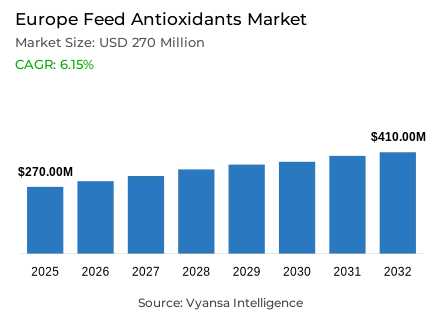
- Feed antioxidants market size in Europe was valued at USD 270 million in 2025 and is estimated at USD 290 million in 2026.
- The market size is expected to grow to USD 410 million by 2032.
- Market to register a CAGR of around 6.15% during 2026-32.
- Product Type Shares
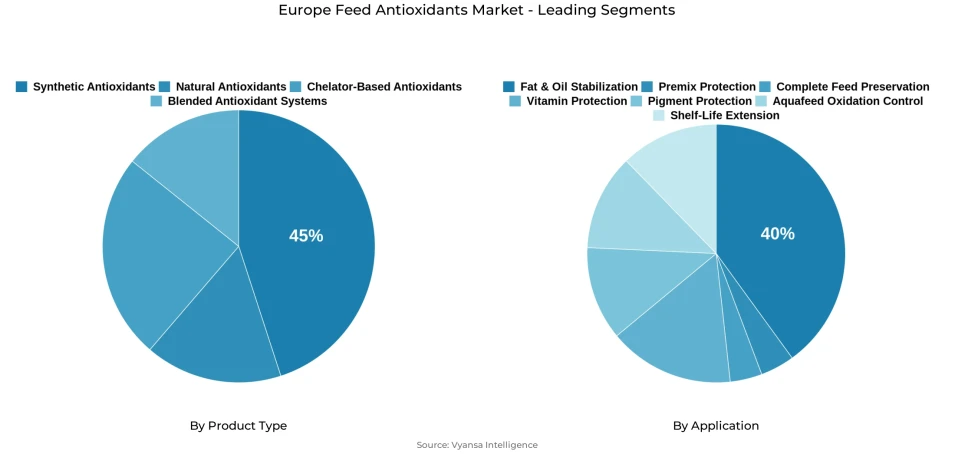
- Synthetic antioxidants grabbed market share of 45%.
- Competition
- More than 15 companies are actively engaged in producing feed antioxidants in Europe.
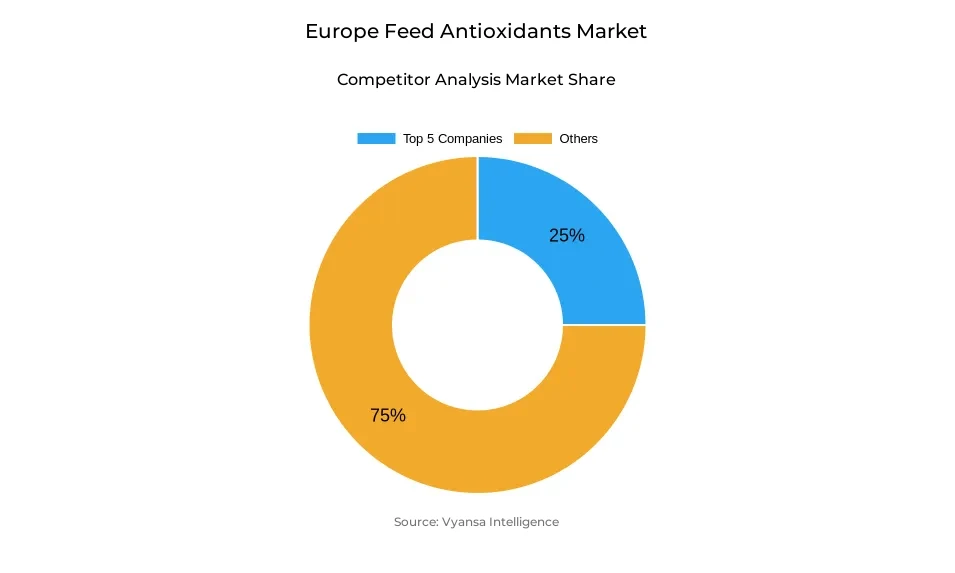
- Top 5 companies acquired around 25% of the market share.
- Impextraco, Cargill Animal Nutrition, ADM Animal Nutrition, Kemin Industries, Adisseo etc., are few of the top companies.
- Application
- Fat & Oil Stabilization grabbed 40% of the market.
- Country
- Germany leads with a 25% share of the Europe market.
Europe Feed Antioxidants Market Outlook
Feed preservation needs across compound feed, premixes, aquafeed, and pet nutrition define the Europe feed antioxidants market, which was valued at USD 270 million in 2025 and is projected to grow from USD 290 million in 2026 to USD 410 million by 2032, at a CAGR of 6.15%. Demand is shaped by lipid oxidation control, rancidity prevention, vitamin protection, fat stability, palatability retention, and feed shelf-life extension across modern animal nutrition systems.
Synthetic Antioxidants lead Product Type with 45% share, reflecting their wide use in compound feed, premixes, vitamin blends, mineral mixtures, and fat-rich formulations. These additives slow oxidation in oils, fats, amino acids, vitamins, and other oxidation-sensitive nutrients. This keeps synthetic feed antioxidants linked with predictable preservation, dosage consistency, and cost-controlled use across high-volume feed production.
Fat & Oil Stabilization holds the highest Application share at 40%, showing the importance of protecting vegetable oils, animal fats, fish oils, rendered fats, and high-energy feed systems from rancidity during storage, pelleting, transport, and farm-level handling. This keeps feed rancidity prevention tied to energy value, smell, taste, feed intake consistency, and nutrient retention across poultry, swine, dairy, aquafeed, and pet nutrition.
Germany leads with 25% share of the Europe market, supported by mature feed manufacturing, livestock production, and quality-controlled animal nutrition practices. The outlook remains tied to EU-compliant additive use, feed oxidation prevention, nutrient stability, fat and oil stabilization, and consistent preservation across compound feed and premix formulations through 2032. This keeps animal feed antioxidants Europe aligned with regulated feed quality, traceable inputs, and stable formulation performance across regional feed systems. Synthetic systems continue supporting bulk preservation needs, while natural antioxidants, tocopherols, rosemary extract, and blended systems gain relevance in premium feed formats where ingredient sensitivity, label clarity, and shelf-life discipline influence formulation choices across specialized animal nutrition channels in European markets overall.
Europe Feed Antioxidants Market Growth Driver
Energy-Dense Feed Formulations Strengthen Preservation Demand
Energy-dense feed formulations remain the strongest driver, as poultry, swine, dairy, aquafeed, and pet nutrition producers use oils, fats, oilseed meals, vitamins, pigments, amino acids, and premixes to improve feed quality and nutrient delivery. These ingredients are vulnerable to oxygen, heat, moisture, processing pressure, metals, and long storage periods. Antioxidant feed additives slow oxidation before feed develops rancid odor, weaker palatability, lower vitamin strength, or reduced fat quality. This keeps feed quality preservation linked with nutrition stability rather than simple feed volume expansion.
Synthetic antioxidants, tocopherols, ascorbyl compounds, and blended antioxidant systems support this need across high-volume and specialty formulations. Synthetic Antioxidants hold 45% share because feed mills require cost-controlled preservation across bulk batches, while Fat & Oil Stabilization holds 40% share due to the oxidation sensitivity of oils and fats. The driver remains tied to nutrient protection, shelf-life discipline, palatability control, and stable feed performance during processing, storage, transport, and farm-level handling. The strongest use cases remain poultry premixes, swine feed formulations, aquafeed lipid systems, dairy concentrates, and pet food formats where fat quality and vitamin stability influence intake consistency and nutrient delivery.
Europe Feed Antioxidants Market Challenge
Tight Safety Controls Increase Compliance Burden
Strict safety assessment and documentation create the main challenge, as European feed antioxidants operate under controlled additive rules covering target-animal safety, consumer safety, environmental impact, labeling, and technical use. Suppliers handling synthetic antioxidants, natural feed antioxidants, antioxidant blends, or botanical extracts need evidence on identity, composition, dosage, stability, efficacy, and use conditions. This raises approval, reformulation, and compliance costs, especially where products are intended for several species, premixes, pet food, aquafeed, or high-fat feed systems.
A 2025 consolidation of EFSA monitoring data highlights Europe’s food safety system, covering 392 million analytical results from more than 15.2 million samples across over 4,000 food product types. This scale reinforces the need for EU feed antioxidant regulation, traceability, contaminant control, and documentation discipline. The challenge remains tied to dossier quality, ingredient consistency, additive authorization, dosage control, and supplier reliability. Compliance pressure can slow product switching when feed mills require stable regulatory status before changing antioxidant systems. The burden is sharper for natural extracts where active compounds vary by source, processing method, and carrier system, making batch consistency, label accuracy, and verified use conditions essential for acceptance across regulated compound feed, pet nutrition, and aquafeed channels in Europe over time overall steadily.
Unlock Market Intelligence
Explore the market potential with our data-driven report
Europe Feed Antioxidants Market Trend
Cleaner and Traceable Additive Systems Reshape Formulation
Cleaner and traceable additive systems form the leading trend, as European feed producers retain synthetic antioxidants for stability and cost control while adding more plant-based and documented preservation choices. Tocopherols in animal feed, vitamin E, rosemary extract, ascorbyl compounds, and botanical blends are gaining attention in pet food, aquafeed, young animal nutrition, and specialty premixes where ingredient transparency and sensitive nutrient protection matter. The shift is selective, since bulk poultry, swine, and cattle feed still require predictable preservation across large batches.
This trend supports plant-based feed antioxidants and clean-label preservation systems without replacing synthetic products completely. Natural or blended systems are most relevant where oils, fats, vitamins, pigments, and functional ingredients require protection across storage and distribution. The direction remains tied to traceable sourcing, documented use conditions, oxidative stability, and compatibility with different feed matrices. This keeps formulation change disciplined, as feed producers need antioxidant systems that match ingredient sensitivity, processing conditions, shelf-life expectations, and regulatory clarity. Ethoxyquin-related search terms should remain in compliance and replacement contexts, while ethoxyquin-free feed antioxidants can be used where formulations require current EU-aligned preservation language and non-ethoxyquin positioning within regulated feed additive systems. This keeps the trend technical, traceable, and regulation-led across Europe steadily.
Europe Feed Antioxidants Market Opportunity
Specialty Feed Inputs Create Stability Needs
Specialty feed inputs create the clearest opportunity, as pet food, aquafeed, young animal diets, vitamin premixes, oil-rich ingredients, fishmeal, fish oil, rendered fats, and functional additives require controlled oxidation protection. Feed shelf-life additives are especially relevant where sensitive nutrients can degrade during processing, transport, retail storage, farm handling, or household use. In these categories, antioxidant systems protect aroma, fat quality, vitamin strength, pigment stability, palatability, and nutrient delivery before the feed reaches the animal.
Emerging ingredients also increase the need for precise preservation. A 2025 study on black soldier fly larvae showed that near-infrared spectroscopy can predict amino acid profiles across 204 live larval samples, supporting quality control in alternative feed ingredient production. Such innovation raises the importance of antioxidants that protect fats, proteins, and sensitive nutrients in newer feed formats. The opportunity remains tied to aquafeed antioxidants Europe, natural blends, high-fat feed preservation, vitamin protection, and EU-compliant systems where shelf life, ingredient stability, and oxidation control influence feed reliability. The strongest demand appears where product quality is more sensitive to rancidity, including dry pet food, salmon diets, piglet nutrition, calf starters, and specialty premixes that depend on stable oils, vitamins, pigments, and functional ingredients through distribution and storage stages.
Europe Feed Antioxidants Market Country Analysis
By Country
- Germany
- France
- Spain
- Netherlands
- Poland
- Italy
- UK
- Denmark
- Belgium
- Turkey
- Rest of Europe
Germany leads the regional market with 25% share, supported by compound feed scale, livestock production, pet food demand, premix use, and mature feed additive supply chains. The Germany feed antioxidants market is closely linked with industrial feed preservation, nutrient protection, premix stability, fat oxidation control, and regulated additive use. Germany’s feed system requires antioxidant protection across swine feed, poultry feed, cattle feed, aquafeed, pet nutrition, vitamin blends, oil-rich ingredients, and specialty formulations that move through storage and distribution.
The country’s leadership also reflects quality-control discipline in European animal nutrition. Feed producers need stable additives that fit compound feed systems, labeling expectations, traceability, and repeatable batch performance. Synthetic antioxidants remain important in large-scale feed, while natural blends gain relevance in premium pet food, aquafeed, and specialty nutrition. The regional outlook remains tied to EU-compliant feed antioxidants, documented additive use, feed-mill quality control, and stable ingredient protection across swine, poultry, cattle, aquafeed, pet food, and premix systems. Germany therefore remains a central reference point for feed antioxidant demand across Europe. Its position is defined by manufacturing depth, livestock output, additive compliance, and oxidation-sensitive feed inputs that require controlled preservation before farm use, retail movement, or further processing across categories consistently.
Unlock Market Intelligence
Explore the market potential with our data-driven report
Europe Feed Antioxidants Market Segmentation Analysis
By Product Type
- Synthetic Antioxidants
- Natural Antioxidants
- Chelator-Based Antioxidants
- Blended Antioxidant Systems
The segment with the highest share under Product Type is Synthetic Antioxidants, holding 45% of the Europe feed antioxidants market. This leadership reflects consistent oxidative control, dosage behavior, availability, and cost efficiency in bulk feed manufacturing. BHT feed antioxidant, BHA, propyl gallate, and synthetic antioxidant blends remain relevant where compound feed, premixes, oils, fats, vitamins, and ingredient blends need predictable preservation during processing, storage, and transport across repeated production batches.
Synthetic antioxidants remain important due to their fit with industrial feed economics. Poultry, swine, cattle, aquafeed, and pet nutrition formulations require protection against rancidity and nutrient loss, but high-volume feed mills also need cost discipline and batch consistency. Their leading position is reinforced by use in pelleted feed, premixes, rendered fats, vegetable oils, and complete feed where oxidation risk is high. Natural systems may expand in premium formats, but synthetic products remain central to broad preservation needs. This keeps synthetic antioxidants tied to industrial feed stability, controlled dosage, and proven oxidation protection across European compound feed systems. The segment’s role remains practical rather than promotional, as feed mills use these additives to preserve ingredient value where oils, fats, vitamins, pigments, and protein meals face recurring oxidation exposure daily steadily.
By Application
- Fat & Oil Stabilization
- Premix Protection
- Complete Feed Preservation
- Vitamin Protection
- Pigment Protection
- Aquafeed Oxidation Control
- Shelf-Life Extension
The segment with the highest share under Application is Fat & Oil Stabilization, holding 40% of the market. This leadership reflects the high oxidation sensitivity of vegetable oils, animal fats, fish oils, poultry fat, rendered fats, lipid carriers, and fat-soluble nutrients used across compound feed, pet food, aquafeed, premixes, and specialty nutrition. Fat oxidation control is essential where rancidity can reduce palatability, weaken energy value, damage vitamins, and create feed-quality variation before animal intake.
This application also protects related ingredients. Fats and oils often carry vitamins, pigments, flavor systems, and other sensitive components that can degrade during pelleting, storage, transport, and farm handling. In aquafeed, fish oils and pigments need stability before feeding. In pet food, fats influence aroma, taste, and acceptance. In poultry and swine feed, oils support energy density and feed efficiency. Lipid oxidation in feed therefore remains tied to nutrient stability, product freshness, premix protection, and consistent feed performance across animal nutrition channels. The segment retains leadership as feed formulas include more high-fat, vitamin-rich, and pigment-sensitive ingredients, making preservation essential for shelf-life control, feed acceptance, and ingredient value before consumption across European livestock, pet nutrition, and aquafeed systems during storage and distribution across regional feed channels consistently today.
Various Market Players in Europe Feed Antioxidants Market
The companies mentioned below are highly active in the Europe feed antioxidants market, occupying a considerable portion of the market and shaping industry progress.
- Impextraco
- Cargill Animal Nutrition
- ADM Animal Nutrition
- Kemin Industries
- Adisseo
- BASF SE
- dsm-firmenich
- Perstorp
- Selko
- Alltech
- Novus International
- Camlin Fine Sciences
Market News & Updates
- BTSA, 2025:
BTSA introduced its Oxabiol range for animal nutrition in 2025. The products are natural antioxidant solutions derived from tocopherols obtained from non-GMO vegetable oils. The range is designed to protect animal feed from lipid oxidation and support feed stability across animal nutrition applications.
- Camlin Fine Sciences, 2025:
Camlin Fine Sciences reported its Specialty Ingredients antioxidant portfolio in its FY2024–25 annual report. The portfolio includes more than 200 tailored antioxidant blends under Xtendra and NaSure for food, animal nutrition, pet food, pharmaceutical, and petrochemical applications. The update supports antioxidant blend availability for feed preservation needs.
Frequently Asked Questions
Related Report
- Market Segmentation
- Research Scope
- Research Methodology
- Definitions and Assumptions
- Executive Summary
- Europe Feed Antioxidants Market Policies, Regulations, and Standards
- Europe Feed Antioxidants Production (Thousand Ton) Trend 2022-2032
- Europe Feed Antioxidants Production (Ton) Trend By Product Type
- Synthetic Antioxidants
- Natural Antioxidants
- Chelator-Based Antioxidants
- Blended Antioxidant Systems
- Company Wise Production Plants and Statistics
- Installed Production Capacity
- Actual Production
- Planned Production Target
- Europe Feed Antioxidants Production (Ton) Trend By Product Type
- Global Feed Acidifiers Pricing Analysis 2022-2032
- Europe Feed Antioxidants Trend (USD/Ton) 2022-2032
- Europe Feed Antioxidants Trend (USD/Ton) By Country 2022-2032
- Germany
- France
- Spain
- Netherlands
- Poland
- Italy
- UK
- Denmark
- Belgium
- Turkey
- Europe Feed Antioxidants Trend (USD/Ton) By Product Type 2022-2032
- Synthetic Antioxidants
- Natural Antioxidants
- Chelator-Based Antioxidants
- Blended Antioxidant Systems
- Europe Feed Antioxidants Market Dynamics
- Growth Factors
- Challenges
- Trends
- Opportunities
- Europe Feed Antioxidants Market Statistics, 2022-2032F
- Market Size & Growth Outlook
- By Revenues in USD Million
- By Quantity Sold in Ton
- Market Segmentation & Growth Outlook
- By Product Type
- Synthetic Antioxidants- Market Insights and Forecast 2022-2032, USD Million
- Natural Antioxidants- Market Insights and Forecast 2022-2032, USD Million
- Chelator-Based Antioxidants- Market Insights and Forecast 2022-2032, USD Million
- Blended Antioxidant Systems- Market Insights and Forecast 2022-2032, USD Million
- By Antioxidant Type
- BHT- Market Insights and Forecast 2022-2032, USD Million
- BHA- Market Insights and Forecast 2022-2032, USD Million
- Propyl Gallate- Market Insights and Forecast 2022-2032, USD Million
- Ethoxyquin Alternatives- Market Insights and Forecast 2022-2032, USD Million
- Mixed Tocopherols- Market Insights and Forecast 2022-2032, USD Million
- Rosemary Extract- Market Insights and Forecast 2022-2032, USD Million
- Plant Extracts- Market Insights and Forecast 2022-2032, USD Million
- Others- Market Insights and Forecast 2022-2032, USD Million
- By Form
- Dry- Market Insights and Forecast 2022-2032, USD Million
- Liquid- Market Insights and Forecast 2022-2032, USD Million
- By Livestock
- Poultry- Market Insights and Forecast 2022-2032, USD Million
- Swine- Market Insights and Forecast 2022-2032, USD Million
- Ruminants- Market Insights and Forecast 2022-2032, USD Million
- Aquaculture- Market Insights and Forecast 2022-2032, USD Million
- Pets- Market Insights and Forecast 2022-2032, USD Million
- Others- Market Insights and Forecast 2022-2032, USD Million
- By Application
- Fat & Oil Stabilization- Market Insights and Forecast 2022-2032, USD Million
- Premix Protection- Market Insights and Forecast 2022-2032, USD Million
- Complete Feed Preservation- Market Insights and Forecast 2022-2032, USD Million
- Vitamin Protection- Market Insights and Forecast 2022-2032, USD Million
- Pigment Protection- Market Insights and Forecast 2022-2032, USD Million
- Aquafeed Oxidation Control- Market Insights and Forecast 2022-2032, USD Million
- Shelf-Life Extension- Market Insights and Forecast 2022-2032, USD Million
- By Sales Channel
- Feed Mills- Market Insights and Forecast 2022-2032, USD Million
- Premix Manufacturers- Market Insights and Forecast 2022-2032, USD Million
- Distributors- Market Insights and Forecast 2022-2032, USD Million
- Direct Sales- Market Insights and Forecast 2022-2032, USD Million
- Rendering & Oil Processors- Market Insights and Forecast 2022-2032, USD Million
- Others- Market Insights and Forecast 2022-2032, USD Million
- By Country
- Germany
- France
- Spain
- Netherlands
- Poland
- Italy
- UK
- Denmark
- Belgium
- Turkey
- Rest of Europe
- By Competitors
- Competition Characteristics
- Market Share & Analysis
- By Product Type
- Market Size & Growth Outlook
- Germany Feed Antioxidants Market Statistics, 2022-2032F
- Market Size & Growth Outlook
- By Revenues in USD Million
- By Quantity Sold in Ton
- Market Segmentation & Growth Outlook
- By Product Type- Market Insights and Forecast 2022-2032, USD Million
- By Antioxidant Type- Market Insights and Forecast 2022-2032, USD Million
- By Form- Market Insights and Forecast 2022-2032, USD Million
- By Livestock- Market Insights and Forecast 2022-2032, USD Million
- By Application- Market Insights and Forecast 2022-2032, USD Million
- By Sales Channel- Market Insights and Forecast 2022-2032, USD Million
- Market Size & Growth Outlook
- France Feed Antioxidants Market Statistics, 2022-2032F
- Market Size & Growth Outlook
- By Revenues in USD Million
- By Quantity Sold in Ton
- Market Segmentation & Growth Outlook
- By Product Type- Market Insights and Forecast 2022-2032, USD Million
- By Antioxidant Type- Market Insights and Forecast 2022-2032, USD Million
- By Form- Market Insights and Forecast 2022-2032, USD Million
- By Livestock- Market Insights and Forecast 2022-2032, USD Million
- By Application- Market Insights and Forecast 2022-2032, USD Million
- By Sales Channel- Market Insights and Forecast 2022-2032, USD Million
- Market Size & Growth Outlook
- Spain Feed Antioxidants Market Statistics, 2022-2032F
- Market Size & Growth Outlook
- By Revenues in USD Million
- By Quantity Sold in Ton
- Market Segmentation & Growth Outlook
- By Product Type- Market Insights and Forecast 2022-2032, USD Million
- By Antioxidant Type- Market Insights and Forecast 2022-2032, USD Million
- By Form- Market Insights and Forecast 2022-2032, USD Million
- By Livestock- Market Insights and Forecast 2022-2032, USD Million
- By Application- Market Insights and Forecast 2022-2032, USD Million
- By Sales Channel- Market Insights and Forecast 2022-2032, USD Million
- Market Size & Growth Outlook
- Netherlands Feed Antioxidants Market Statistics, 2022-2032F
- Market Size & Growth Outlook
- By Revenues in USD Million
- By Quantity Sold in Ton
- Market Segmentation & Growth Outlook
- By Product Type- Market Insights and Forecast 2022-2032, USD Million
- By Antioxidant Type- Market Insights and Forecast 2022-2032, USD Million
- By Form- Market Insights and Forecast 2022-2032, USD Million
- By Livestock- Market Insights and Forecast 2022-2032, USD Million
- By Application- Market Insights and Forecast 2022-2032, USD Million
- By Sales Channel- Market Insights and Forecast 2022-2032, USD Million
- Market Size & Growth Outlook
- Poland Feed Antioxidants Market Statistics, 2022-2032F
- Market Size & Growth Outlook
- By Revenues in USD Million
- By Quantity Sold in Ton
- Market Segmentation & Growth Outlook
- By Product Type- Market Insights and Forecast 2022-2032, USD Million
- By Antioxidant Type- Market Insights and Forecast 2022-2032, USD Million
- By Form- Market Insights and Forecast 2022-2032, USD Million
- By Livestock- Market Insights and Forecast 2022-2032, USD Million
- By Application- Market Insights and Forecast 2022-2032, USD Million
- By Sales Channel- Market Insights and Forecast 2022-2032, USD Million
- Market Size & Growth Outlook
- Italy Feed Antioxidants Market Statistics, 2022-2032F
- Market Size & Growth Outlook
- By Revenues in USD Million
- By Quantity Sold in Ton
- Market Segmentation & Growth Outlook
- By Product Type- Market Insights and Forecast 2022-2032, USD Million
- By Antioxidant Type- Market Insights and Forecast 2022-2032, USD Million
- By Form- Market Insights and Forecast 2022-2032, USD Million
- By Livestock- Market Insights and Forecast 2022-2032, USD Million
- By Application- Market Insights and Forecast 2022-2032, USD Million
- By Sales Channel- Market Insights and Forecast 2022-2032, USD Million
- Market Size & Growth Outlook
- UK Feed Antioxidants Market Statistics, 2022-2032F
- Market Size & Growth Outlook
- By Revenues in USD Million
- By Quantity Sold in Ton
- Market Segmentation & Growth Outlook
- By Product Type- Market Insights and Forecast 2022-2032, USD Million
- By Antioxidant Type- Market Insights and Forecast 2022-2032, USD Million
- By Form- Market Insights and Forecast 2022-2032, USD Million
- By Livestock- Market Insights and Forecast 2022-2032, USD Million
- By Application- Market Insights and Forecast 2022-2032, USD Million
- By Sales Channel- Market Insights and Forecast 2022-2032, USD Million
- Market Size & Growth Outlook
- Denmark Feed Antioxidants Market Statistics, 2022-2032F
- Market Size & Growth Outlook
- By Revenues in USD Million
- By Quantity Sold in Ton
- Market Segmentation & Growth Outlook
- By Product Type- Market Insights and Forecast 2022-2032, USD Million
- By Antioxidant Type- Market Insights and Forecast 2022-2032, USD Million
- By Form- Market Insights and Forecast 2022-2032, USD Million
- By Livestock- Market Insights and Forecast 2022-2032, USD Million
- By Application- Market Insights and Forecast 2022-2032, USD Million
- By Sales Channel- Market Insights and Forecast 2022-2032, USD Million
- Market Size & Growth Outlook
- Belgium Feed Antioxidants Market Statistics, 2022-2032F
- Market Size & Growth Outlook
- By Revenues in USD Million
- By Quantity Sold in Ton
- Market Segmentation & Growth Outlook
- By Product Type- Market Insights and Forecast 2022-2032, USD Million
- By Antioxidant Type- Market Insights and Forecast 2022-2032, USD Million
- By Form- Market Insights and Forecast 2022-2032, USD Million
- By Livestock- Market Insights and Forecast 2022-2032, USD Million
- By Application- Market Insights and Forecast 2022-2032, USD Million
- By Sales Channel- Market Insights and Forecast 2022-2032, USD Million
- Market Size & Growth Outlook
- Turkey Feed Antioxidants Market Statistics, 2022-2032F
- Market Size & Growth Outlook
- By Revenues in USD Million
- By Quantity Sold in Ton
- Market Segmentation & Growth Outlook
- By Product Type- Market Insights and Forecast 2022-2032, USD Million
- By Antioxidant Type- Market Insights and Forecast 2022-2032, USD Million
- By Form- Market Insights and Forecast 2022-2032, USD Million
- By Livestock- Market Insights and Forecast 2022-2032, USD Million
- By Application- Market Insights and Forecast 2022-2032, USD Million
- By Sales Channel- Market Insights and Forecast 2022-2032, USD Million
- Market Size & Growth Outlook
- Competitive Outlook
- Company Profiles
- Kemin Industries
- Business Description
- Product Portfolio
- Collaborations & Alliances
- Recent Developments
- Financial Details
- Others
- Adisseo
- Business Description
- Product Portfolio
- Collaborations & Alliances
- Recent Developments
- Financial Details
- Others
- BASF SE
- Business Description
- Product Portfolio
- Collaborations & Alliances
- Recent Developments
- Financial Details
- Others
- dsm-firmenich
- Business Description
- Product Portfolio
- Collaborations & Alliances
- Recent Developments
- Financial Details
- Others
- Perstorp
- Business Description
- Product Portfolio
- Collaborations & Alliances
- Recent Developments
- Financial Details
- Others
- Impextraco
- Business Description
- Product Portfolio
- Collaborations & Alliances
- Recent Developments
- Financial Details
- Others
- Cargill Animal Nutrition
- Business Description
- Product Portfolio
- Collaborations & Alliances
- Recent Developments
- Financial Details
- Others
- ADM Animal Nutrition
- Business Description
- Product Portfolio
- Collaborations & Alliances
- Recent Developments
- Financial Details
- Others
- Selko
- Business Description
- Product Portfolio
- Collaborations & Alliances
- Recent Developments
- Financial Details
- Others
- Alltech
- Business Description
- Product Portfolio
- Collaborations & Alliances
- Recent Developments
- Financial Details
- Others
- Novus International
- Business Description
- Product Portfolio
- Collaborations & Alliances
- Recent Developments
- Financial Details
- Others
- Camlin Fine Sciences
- Business Description
- Product Portfolio
- Collaborations & Alliances
- Recent Developments
- Financial Details
- Others
- BTSA
- Business Description
- Product Portfolio
- Collaborations & Alliances
- Recent Developments
- Financial Details
- Others
- EW Nutrition
- Business Description
- Product Portfolio
- Collaborations & Alliances
- Recent Developments
- Financial Details
- Others
- Orffa
- Business Description
- Product Portfolio
- Collaborations & Alliances
- Recent Developments
- Financial Details
- Others
- Kemin Industries
- Company Profiles
- Disclaimer
| Segment | Sub-Segment |
|---|---|
| By Product Type |
|
| By Antioxidant Type |
|
| By Form |
|
| By Livestock |
|
| By Application |
|
| By Sales Channel |
|
| By Country |
|
Research Methodology
This study followed a structured approach comprising four key phases to assess the size and scope of the electro-oxidation market. The process began with thorough secondary research to collect data on the target market, related markets, and broader industry context. These findings, along with preliminary assumptions and estimates, were then validated through extensive primary research involving industry experts from across the value chain. To calculate the overall market size, both top-down and bottom-up methodologies were employed. Finally, market segmentation and data triangulation techniques were applied to refine and validate segment-level estimations.
Secondary Research
The secondary research phase involved gathering data from a wide range of credible and published sources. This step helped in identifying industry trends, defining market segmentation, and understanding the market landscape and value chain.
Sources consulted during this phase included:
- Company annual reports, investor presentations, and press releases
- Industry white papers and certified publications
- Trade directories and market-recognized databases
- Articles from authoritative authors and reputable journals
- Gold and silver standard websites
Secondary research was critical in mapping out the industry's value chain and monetary flow, identifying key market segments, understanding regional variations, and tracking significant industry developments.
Other key sources:
- Financial disclosures
- Industry associations and trade bodies
- News outlets and business magazines
- Academic journals and research studies
- Paid industry databases
Primary Research
To validate secondary data and gain deeper market insights, primary research was conducted with key stakeholders across both the supply and demand sides of the market.
On the demand side, participants included decision-makers and influencers from end-user industries—such as CIOs, CTOs, and CSOs—who provided first-hand perspectives on market needs, product usage, and future expectations.
On the supply side, interviews were conducted with manufacturers, industry associations, and institutional participants to gather insights into current offerings, product pipelines, and market challenges.
Primary interviews provided critical inputs such as:
- Market size and revenue data
- Product and service breakdowns
- Market forecasts
- Regional and application-specific trends
Stakeholders consulted included:
- Leading OEM and solution providers
- Channel and distribution partners
- End users across various applications
- Independent consultants and industry specialists
Market Size Estimation and Data Triangulation
- Identifying Key Market Participants (Secondary Research)
- Goal: To identify the major players or companies in the target market. This typically involves using publicly available data sources such as industry reports, market research publications, and financial statements of companies.
- Tools: Reports from firms like Gartner, Forrester, Euromonitor, Statista, IBISWorld, and others. Public financial statements, news articles, and press releases from top market players.
- Extracting Earnings of Key Market Participants
- Goal: To estimate the earnings generated from the product or service being analyzed. This step helps in understanding the revenue potential of each market player in a specific geography.
- Methods: Earnings data can be gathered from:
- Publicly available financial reports (for listed companies).
- Interviews and primary data sources from professionals, such as Directors, VPs, SVPs, etc. This is especially useful for understanding more nuanced, internal data that isn't publicly disclosed.
- Annual reports and investor presentations of key players.
- Data Collation and Development of a Relevant Data Model
- Goal: To collate inputs from both primary and secondary sources into a structured, data-driven model for market estimation. This model will incorporate key market KPIs and any independent variables relevant to the market.
- Key KPIs: These could include:
- Market size, growth rate, and demand drivers.
- Industry-specific metrics like market share, average revenue per customer (ARPC), or average deal size.
- External variables, such as economic growth rates, inflation rates, or commodity prices, that could affect the market.
- Data Modeling: Based on this data, the market forecasts are developed for the next 5 years. A combination of trend analysis, scenario modeling, and statistical regression might be used to generate projections.
- Scenario Analysis
- Goal: To test different assumptions and validate how sensitive the market is to changes in key variables (e.g., market demand, regulatory changes, technological disruptions).
- Types of Scenarios:
- Base Case: Based on current assumptions and historical data.
- Best-Case Scenario: Assuming favorable market conditions, regulatory environments, and technological advancements.
- Worst-Case Scenario: Accounting for adverse factors, such as economic downturns, stricter regulations, or unexpected disruptions.












