Egypt Room Air Conditioners Market Report: Trends, Growth and Forecast (2026-2032)
By Product Type (Split Air Conditioners (Up to 9,000 BTU/h, 9,001-12,000 BTU/h, 12,001-18,000 BTU/h, 18,001-24,000 BTU/h, Above 24,000 BTU/h), Window Air Conditioners (Up to 9,000 BTU/h, 9,001-12,000 BTU/h, 12,001-18,000 BTU/h, 18,001-24,000 BTU/h, Above 24,000 BTU/h), Others), By Technology (Inverter, Non-Inverter), By Price (Up to USD 300, USD 301 to USD 600, USD 601 to USD 1,000, Above USD 1,000), By End User (Residential (Individual Households, Apartments/Condominiums, Vacation/Secondary Homes), Commercial (Offices, Retail Stores/Showrooms, Hospitality, Healthcare Facilities, Educational Institutions, Small Commercial Establishments, Others)), By Sales Channel (Retail Online (Brand-Owned Websites/D2C, E-Commerce Marketplaces), Retail Offline (Exclusive Brand Stores, Multi-Brand Electronics & Appliance Stores, Specialty Stores, Hypermarkets/Supermarkets, Home Improvement Stores, Dealer/Distributor Network, Direct Sales/Institutional Sales, Local Independent Retailers)), By Refrigerant Type (R-32, R-410A, R-290, R-454B, Others), By Connectivity (Smart/Connected, Conventional/Non-Smart), By Energy Efficiency (1 Star, 2 Star, 3 Star, 4 Star, 5 Star), By Region (Cairo, Alexandria, Others) ... Read more
|
Major Players
|
Egypt Room Air Conditioners Market Statistics and Insights, 2026
- Market Size Statistics
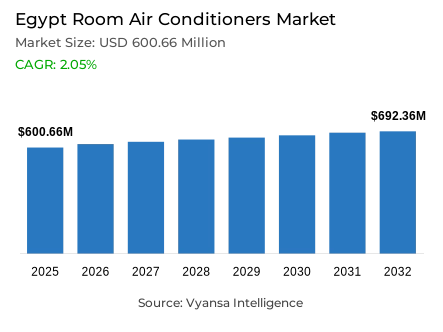
- Room air conditioners market size in Egypt was valued at USD 600.66 million in 2025 and is estimated at USD 620.53 million in 2026.
- The market size is expected to grow to USD 692.36 million by 2032.
- Market to register a CAGR of around 2.05% during 2026-32.
- Product Type Shares
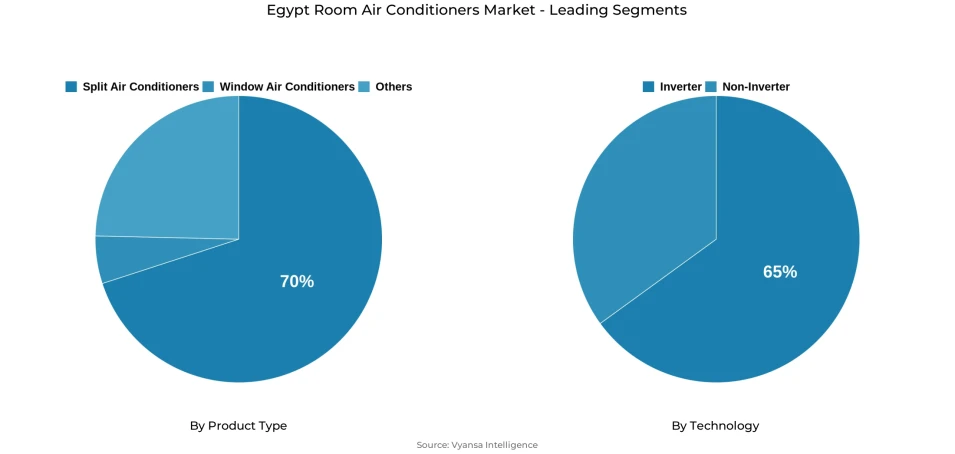
- Split air conditioners grabbed market share of 70%.
- Competition
- More than 10 companies are actively engaged in producing room air conditioners in Egypt.
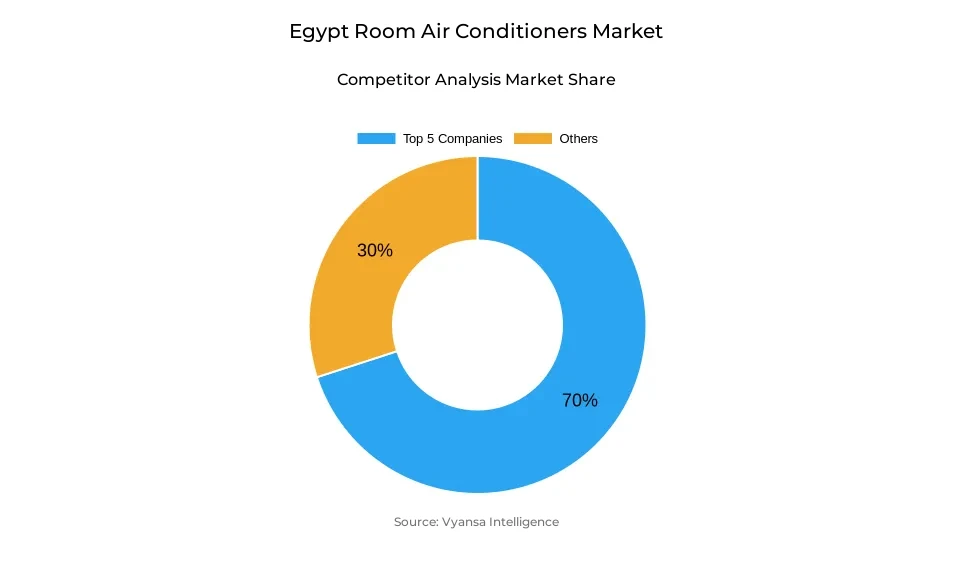
- Top 5 companies acquired around 70% of the market share.
- El Araby Group, Haier Group, Beko Corp, Midea Group Co Ltd, Hon Hai Precision Industry Co Ltd etc., are few of the top companies.
- Technology
- Inverter grabbed 65% of the market.
Egypt Room Air Conditioners Market Outlook
Egypt room air conditioners market was valued at USD 600.66 million in 2025 and is projected to grow from USD 620.53 million in 2026 to USD 692.36 million by 2032, exhibiting a CAGR of 2.05% during the forecast period. This is an indication of a slow and consistent growth pattern, with the value growth being slow and not fast. The market is still progressing steadily in a regulated fashion, with the backing of steady residential demand and the necessity of cooling in major urban settings.
The general demand pattern is stable and the growth is mainly due to the normal household consumption, replacement and the necessity of indoor comfort in the long summer seasons. Within this framework, room air conditioners remain a core household appliance, particularly in densely populated areas where indoor heat levels directly influence comfort, productivity, and daily living conditions.
From a product perspective, split air conditioners account for around 70% of the market, making them the leading category. This dominance suggests that demand is still concentrated around a single core format, which still defines product visibility, competitive positioning, and the general sales structure. Consequently, split systems will continue to be the major source of value creation and category performance over the forecast period.
On the technology side, inverter systems hold approximately 65% share, reflecting a clear preference for more efficient and performance-oriented solutions. This means that technology selection is a major factor that affects demand trends. The combination of split systems and inverter technology dominance forms a clear market structure, which will facilitate a steady and predictable growth environment up to 2032.
Egypt Room Air Conditioners Market Growth DriverHeat Keeps the Buying Cycle Active
High temperature intensity and length are driving the demand for cooling systems throughout Egypt and its people because there is an ongoing requirement for cooling solutions due to how long people have been experiencing high temperature exposure.
According to the World Meteorological Organization, the Arab region recorded its hottest year in 2024, with temperatures rising 1.08°C above the 1991–2020 average and increasing at nearly twice the global rate. At the national level, the Egyptian Meteorological Authority reports temperatures exceeding 40°C in most areas, with Greater Cairo at 38°C, North Upper Egypt at 41°C, and Luxor and Aswan reaching 44 to 45°C. These sustained conditions make room air conditioners a daily necessity rather than an occasional purchase, supporting continuous demand and regular replacement cycles.
Egypt Room Air Conditioners Market ChallengeHigher Power Bills Test Affordability
The primary challenge within the Egypt air conditioning industry is increasing costs for electricity that have a direct effect on the affordability of households and purchase decisions. With cooling systems being utilised for long hours during extreme heat, operating cost is a large factor of concern.
According to the Egyptian Electric Utility and Consumer Protection Regulatory Agency, the 0-50 kWh tariff rates are increasing from 58 to 68 pt/kWh. The 0-200 kWh tariffs increasing from 83 to 95 pt/kWh will also continue to increase as you go to larger consumption brackets, and are then periodically reviewed against foreign exchange rates leading to cost uncertainty for consumers. Therefore, consumers will be more cautious when choosing capacity and usage styles, as well as when to upgrade to new equipment based on efficiency and long term affordability versus making an immediate purchase based on price.
Unlock Market Intelligence
Explore the market potential with our data-driven report
Egypt Room Air Conditioners Market TrendEfficiency Labels Shape Product Preference
Energy efficiency labeling is rapidly changing the landscape of the room air conditioner market in Egypt and growing awareness among consumers about how energy efficient products are selected. A strong regulatory framework is creating and facilitating opportunities for consumers to be influenced by efficiency when making their purchases.
The International Energy Agency states that Egypt has enacted Standard 3795/2023 which requires that all room air conditioners (both window and split) display an energy efficiency label. This standard got into effect on January 1, 2024, with a timeline for the manufacturer to comply. The Egyptian Organization for Standardization and Quality also supports the position that energy labels will be used by consumers to compare appliances and aid in reducing electricity use. As a result, there is a shift in the market toward room air conditioners with better overall performance ratings and increased levels of energy efficiency, thereby making energy efficiency a major differentiating factor at retail locations where room air conditioners are sold.
Egypt Room Air Conditioners Market OpportunityHousing Momentum Opens New Installation Space
A strong opportunity in the Egypt room air conditioners market is emerging from the expansion of residential housing and large scale government supported housing initiatives. New housing developments create direct demand for first time installations and system upgrades.
According to Egypt’s Presidency, around 400,000 housing units were introduced in 2025, targeting multiple income segments. In addition, the Social Housing and Mortgage Finance Fund reports over 666,000 completed units, with 258,000 under implementation and 76,000 newly launched projects, alongside EGP 68.8 billion in financing support. This expanding residential base creates a continuous pipeline for room air conditioner installations. As more households enter new living spaces, demand for efficient and practical cooling solutions continues to rise, supporting long-term market growth.
Unlock Market Intelligence
Explore the market potential with our data-driven report
Egypt Room Air Conditioners Market Segmentation Analysis
By Product Type
- Split Air Conditioners
- Up to 9,000 BTU/h
- 9,001-12,000 BTU/h
- 12,001-18,000 BTU/h
- 18,001-24,000 BTU/h
- Above 24,000 BTU/h
- Window Air Conditioners
- Up to 9,000 BTU/h
- 9,001-12,000 BTU/h
- 12,001-18,000 BTU/h
- 18,001-24,000 BTU/h
- Above 24,000 BTU/h
- Others
The segment with the highest share under product type is split air conditioners, accounting for approximately 70% of the market. This leading position highlights the strong preference for split systems across residential and light commercial applications.
The dominance of split air conditioners reflects their suitability for room-by-room cooling, ease of installation, and broad availability across price ranges. With demand heavily concentrated in this segment, it continues to drive product visibility, competitive positioning, and overall market performance. As a result, split systems remain the central pillar of product demand and continue to shape the structure of the Egypt room air conditioners market.
By Technology
- Inverter
- Non-Inverter
Under technology, inverter systems account for around 65% of the market, making them the leading technology segment. This strong share reflects increasing consumer preference for energy-efficient and performance driven cooling solutions.
Inverter based room air conditioners are favored for their ability to deliver stable cooling, improved energy management, and smoother operation. As electricity costs remain a concern, consumers are increasingly prioritizing efficiency and long-term savings. This positions inverter technology as a key driver of product development, competition, and purchasing decisions, ensuring its continued influence across the market through the forecast period.
List of Companies Covered in Egypt Room Air Conditioners Market
The companies listed below are highly influential in the Egypt room air conditioners market, with a significant market share and a strong impact on industry developments.
- El Araby Group
- Haier Group
- Beko Corp
- Midea Group Co Ltd
- Hon Hai Precision Industry Co Ltd
- LG Corp
- Fresh Electric Co
- Unionaire Group
- Electrolux AB
- Hisense Group
Market News & Updates
- El Araby Group, 2025:
El Araby’s official Egypt store showed a broader TORNADO inverter split AC rollout by late 2025, including models such as the TH-VX12ZEE and TH-VX18ZEE, with 12,800–17,800 BTU/h cooling, Plasma SHIELD, inverter operation, and Egypt-made variants. This is relevant to the Egypt room AC market because it expands inverter-led split options in core household capacity bands while emphasizing air-treatment and energy-saving features.
- Unionaire Group, 2025:
Unionaire’s official 2025 product pages highlighted the Artify split AC range, including the 2.25 HP Cool/Heat and 3 HP Cool models, with R32 refrigerant and GMCC Tropical Compressor positioning. This matters for the Egypt room AC market because it reinforces local competition in mid-capacity residential split units where inverter efficiency, tropical performance, and lower operating cost are key buying factors.
Frequently Asked Questions
Related Report
- Market Segmentation
- Research Scope
- Research Methodology
- Definitions and Assumptions
- Executive Summary
- Egypt Room Air Conditioners Market Policies, Regulations, and Standards
- Egypt Room Air Conditioners Market Dynamics
- Growth Factors
- Challenges
- Trends
- Opportunities
- Egypt Room Air Conditioners Market Statistics, 2022-2032F
- Market Size & Growth Outlook
- By Revenues in USD Million
- By Units Sold in Thousand Units
- Market Segmentation & Growth Outlook
- By Product Type
- Split Air Conditioners- Market Insights and Forecast 2022-2032, USD Million
- Up to 9,000 BTU/h- Market Insights and Forecast 2022-2032, USD Million
- 9,001-12,000 BTU/h- Market Insights and Forecast 2022-2032, USD Million
- 12,001-18,000 BTU/h- Market Insights and Forecast 2022-2032, USD Million
- 18,001-24,000 BTU/h- Market Insights and Forecast 2022-2032, USD Million
- Above 24,000 BTU/h- Market Insights and Forecast 2022-2032, USD Million
- Window Air Conditioners- Market Insights and Forecast 2022-2032, USD Million
- Up to 9,000 BTU/h- Market Insights and Forecast 2022-2032, USD Million
- 9,001-12,000 BTU/h- Market Insights and Forecast 2022-2032, USD Million
- 12,001-18,000 BTU/h- Market Insights and Forecast 2022-2032, USD Million
- 18,001-24,000 BTU/h- Market Insights and Forecast 2022-2032, USD Million
- Above 24,000 BTU/h- Market Insights and Forecast 2022-2032, USD Million
- Others- Market Insights and Forecast 2022-2032, USD Million
- Split Air Conditioners- Market Insights and Forecast 2022-2032, USD Million
- By Technology
- Inverter- Market Insights and Forecast 2022-2032, USD Million
- Non-Inverter- Market Insights and Forecast 2022-2032, USD Million
- By Price
- Up to USD 300- Market Insights and Forecast 2022-2032, USD Million
- USD 301 to USD 600- Market Insights and Forecast 2022-2032, USD Million
- USD 601 to USD 1,000- Market Insights and Forecast 2022-2032, USD Million
- Above USD 1,000- Market Insights and Forecast 2022-2032, USD Million
- By End User
- Residential- Market Insights and Forecast 2022-2032, USD Million
- Individual Households- Market Insights and Forecast 2022-2032, USD Million
- Apartments/Condominiums- Market Insights and Forecast 2022-2032, USD Million
- Vacation/Secondary Homes- Market Insights and Forecast 2022-2032, USD Million
- Commercial- Market Insights and Forecast 2022-2032, USD Million
- Offices- Market Insights and Forecast 2022-2032, USD Million
- Retail Stores/Showrooms- Market Insights and Forecast 2022-2032, USD Million
- Hospitality- Market Insights and Forecast 2022-2032, USD Million
- Healthcare Facilities- Market Insights and Forecast 2022-2032, USD Million
- Educational Institutions- Market Insights and Forecast 2022-2032, USD Million
- Small Commercial Establishments- Market Insights and Forecast 2022-2032, USD Million
- Others- Market Insights and Forecast 2022-2032, USD Million
- Residential- Market Insights and Forecast 2022-2032, USD Million
- By Sales Channel
- Retail Online- Market Insights and Forecast 2022-2032, USD Million
- Brand-Owned Websites/D2C- Market Insights and Forecast 2022-2032, USD Million
- E-Commerce Marketplaces- Market Insights and Forecast 2022-2032, USD Million
- Retail Offline- Market Insights and Forecast 2022-2032, USD Million
- Exclusive Brand Stores- Market Insights and Forecast 2022-2032, USD Million
- Multi-Brand Electronics & Appliance Stores- Market Insights and Forecast 2022-2032, USD Million
- Specialty Stores- Market Insights and Forecast 2022-2032, USD Million
- Hypermarkets/Supermarkets- Market Insights and Forecast 2022-2032, USD Million
- Home Improvement Stores- Market Insights and Forecast 2022-2032, USD Million
- Dealer/Distributor Network- Market Insights and Forecast 2022-2032, USD Million
- Direct Sales/Institutional Sales- Market Insights and Forecast 2022-2032, USD Million
- Local Independent Retailers- Market Insights and Forecast 2022-2032, USD Million
- Retail Online- Market Insights and Forecast 2022-2032, USD Million
- By Refrigerant Type
- R-32- Market Insights and Forecast 2022-2032, USD Million
- R-410A- Market Insights and Forecast 2022-2032, USD Million
- R-290- Market Insights and Forecast 2022-2032, USD Million
- R-454B- Market Insights and Forecast 2022-2032, USD Million
- Others- Market Insights and Forecast 2022-2032, USD Million
- By Connectivity
- Smart/Connected- Market Insights and Forecast 2022-2032, USD Million
- Conventional/Non-Smart- Market Insights and Forecast 2022-2032, USD Million
- By Energy Efficiency
- 1 Star- Market Insights and Forecast 2022-2032, USD Million
- 2 Star- Market Insights and Forecast 2022-2032, USD Million
- 3 Star- Market Insights and Forecast 2022-2032, USD Million
- 4 Star- Market Insights and Forecast 2022-2032, USD Million
- 5 Star- Market Insights and Forecast 2022-2032, USD Million
- By Region
- Cairo
- Alexandria
- Others
- By Competitors
- Competition Characteristics
- Market Share & Analysis
- By Product Type
- Market Size & Growth Outlook
- Egypt Split Air Conditioners Market Statistics, 2022-2032
- Market Size & Growth Outlook
- By Revenues in USD Million
- By Units Sold in Thousand Units
- Market Segmentation & Growth Outlook
- By Technology- Market Insights and Forecast 2022-2032, USD Million
- By Price- Market Insights and Forecast 2022-2032, USD Million
- By End User- Market Insights and Forecast 2022-2032, USD Million
- By Sales Channel- Market Insights and Forecast 2022-2032, USD Million
- By Refrigerant Type- Market Insights and Forecast 2022-2032, USD Million
- By Connectivity- Market Insights and Forecast 2022-2032, USD Million
- By Energy Efficiency- Market Insights and Forecast 2022-2032, USD Million
- By Region- Market Insights and Forecast 2022-2032, USD Million
- Market Size & Growth Outlook
- Egypt Window Air Conditioners Market Statistics, 2022-2032
- Market Size & Growth Outlook
- By Revenues in USD Million
- By Units Sold in Thousand Units
- Market Segmentation & Growth Outlook
- By Technology- Market Insights and Forecast 2022-2032, USD Million
- By Price- Market Insights and Forecast 2022-2032, USD Million
- By End User- Market Insights and Forecast 2022-2032, USD Million
- By Sales Channel- Market Insights and Forecast 2022-2032, USD Million
- By Refrigerant Type- Market Insights and Forecast 2022-2032, USD Million
- By Connectivity- Market Insights and Forecast 2022-2032, USD Million
- By Energy Efficiency- Market Insights and Forecast 2022-2032, USD Million
- By Region- Market Insights and Forecast 2022-2032, USD Million
- Market Size & Growth Outlook
- Competitive Outlook
- Company Profiles
- Midea Group Co Ltd
- Business Description
- Product Portfolio
- Collaborations & Alliances
- Recent Developments
- Financial Details
- Others
- Hon Hai Precision Industry Co Ltd
- Business Description
- Product Portfolio
- Collaborations & Alliances
- Recent Developments
- Financial Details
- Others
- LG Corp
- Business Description
- Product Portfolio
- Collaborations & Alliances
- Recent Developments
- Financial Details
- Others
- Fresh Electric Co
- Business Description
- Product Portfolio
- Collaborations & Alliances
- Recent Developments
- Financial Details
- Others
- Unionaire Group
- Business Description
- Product Portfolio
- Collaborations & Alliances
- Recent Developments
- Financial Details
- Others
- El Araby Group
- Business Description
- Product Portfolio
- Collaborations & Alliances
- Recent Developments
- Financial Details
- Others
- Haier Group
- Business Description
- Product Portfolio
- Collaborations & Alliances
- Recent Developments
- Financial Details
- Others
- Beko Corp
- Business Description
- Product Portfolio
- Collaborations & Alliances
- Recent Developments
- Financial Details
- Others
- Electrolux AB
- Business Description
- Product Portfolio
- Collaborations & Alliances
- Recent Developments
- Financial Details
- Others
- Hisense Group
- Business Description
- Product Portfolio
- Collaborations & Alliances
- Recent Developments
- Financial Details
- Others
- Midea Group Co Ltd
- Company Profiles
- Disclaimer
| Segment | Sub-Segment |
|---|---|
| By Product Type |
|
| By Technology |
|
| By Price |
|
| By End User |
|
| By Sales Channel |
|
| By Refrigerant Type |
|
| By Connectivity |
|
| By Energy Efficiency |
|
| By Region |
|
Research Methodology
This study followed a structured approach comprising four key phases to assess the size and scope of the electro-oxidation market. The process began with thorough secondary research to collect data on the target market, related markets, and broader industry context. These findings, along with preliminary assumptions and estimates, were then validated through extensive primary research involving industry experts from across the value chain. To calculate the overall market size, both top-down and bottom-up methodologies were employed. Finally, market segmentation and data triangulation techniques were applied to refine and validate segment-level estimations.
Secondary Research
The secondary research phase involved gathering data from a wide range of credible and published sources. This step helped in identifying industry trends, defining market segmentation, and understanding the market landscape and value chain.
Sources consulted during this phase included:
- Company annual reports, investor presentations, and press releases
- Industry white papers and certified publications
- Trade directories and market-recognized databases
- Articles from authoritative authors and reputable journals
- Gold and silver standard websites
Secondary research was critical in mapping out the industry's value chain and monetary flow, identifying key market segments, understanding regional variations, and tracking significant industry developments.
Other key sources:
- Financial disclosures
- Industry associations and trade bodies
- News outlets and business magazines
- Academic journals and research studies
- Paid industry databases
Primary Research
To validate secondary data and gain deeper market insights, primary research was conducted with key stakeholders across both the supply and demand sides of the market.
On the demand side, participants included decision-makers and influencers from end-user industries—such as CIOs, CTOs, and CSOs—who provided first-hand perspectives on market needs, product usage, and future expectations.
On the supply side, interviews were conducted with manufacturers, industry associations, and institutional participants to gather insights into current offerings, product pipelines, and market challenges.
Primary interviews provided critical inputs such as:
- Market size and revenue data
- Product and service breakdowns
- Market forecasts
- Regional and application-specific trends
Stakeholders consulted included:
- Leading OEM and solution providers
- Channel and distribution partners
- End users across various applications
- Independent consultants and industry specialists
Market Size Estimation and Data Triangulation
- Identifying Key Market Participants (Secondary Research)
- Goal: To identify the major players or companies in the target market. This typically involves using publicly available data sources such as industry reports, market research publications, and financial statements of companies.
- Tools: Reports from firms like Gartner, Forrester, Euromonitor, Statista, IBISWorld, and others. Public financial statements, news articles, and press releases from top market players.
- Extracting Earnings of Key Market Participants
- Goal: To estimate the earnings generated from the product or service being analyzed. This step helps in understanding the revenue potential of each market player in a specific geography.
- Methods: Earnings data can be gathered from:
- Publicly available financial reports (for listed companies).
- Interviews and primary data sources from professionals, such as Directors, VPs, SVPs, etc. This is especially useful for understanding more nuanced, internal data that isn't publicly disclosed.
- Annual reports and investor presentations of key players.
- Data Collation and Development of a Relevant Data Model
- Goal: To collate inputs from both primary and secondary sources into a structured, data-driven model for market estimation. This model will incorporate key market KPIs and any independent variables relevant to the market.
- Key KPIs: These could include:
- Market size, growth rate, and demand drivers.
- Industry-specific metrics like market share, average revenue per customer (ARPC), or average deal size.
- External variables, such as economic growth rates, inflation rates, or commodity prices, that could affect the market.
- Data Modeling: Based on this data, the market forecasts are developed for the next 5 years. A combination of trend analysis, scenario modeling, and statistical regression might be used to generate projections.
- Scenario Analysis
- Goal: To test different assumptions and validate how sensitive the market is to changes in key variables (e.g., market demand, regulatory changes, technological disruptions).
- Types of Scenarios:
- Base Case: Based on current assumptions and historical data.
- Best-Case Scenario: Assuming favorable market conditions, regulatory environments, and technological advancements.
- Worst-Case Scenario: Accounting for adverse factors, such as economic downturns, stricter regulations, or unexpected disruptions.












