Ecuador Menstrual Care Market Report: Trends, Growth and Forecast (2026-2032)
By Product Type (Pantyliners, Tampons (Applicator Tampons, Digital Tampons), Towels (Standard Towels (Standard Towels with Wings, Standard Towels Without Wings), Slim/Thin/Ultra-Thin Towels (Slim/Thin/Ultra-Thin Towels with Wings, Slim/Thin/Ultra-Thin Towels Without Wings)), Intimate Wipes, Menstrual Cups, Period Underwear), By Nature (Disposable, Reusable), By Age Group (Up to 18 Years, 19-30 Years, 31-40 Years, 40 Years and Above), By Sales Channel (Retail Offline, Retail Online) ... Read more
|
Major Players
|
Ecuador Menstrual Care Market Statistics and Insights, 2026
- Market Size Statistics
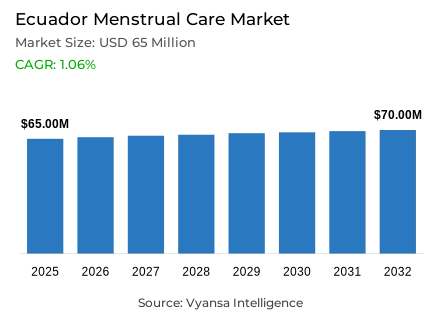
- Menstrual care in Ecuador is estimated at USD 65 million in 2025.
- The market size is expected to grow to USD 70 million by 2032.
- Market to register a cagr of around 1.06% during 2026-32.
- Product Type Shares
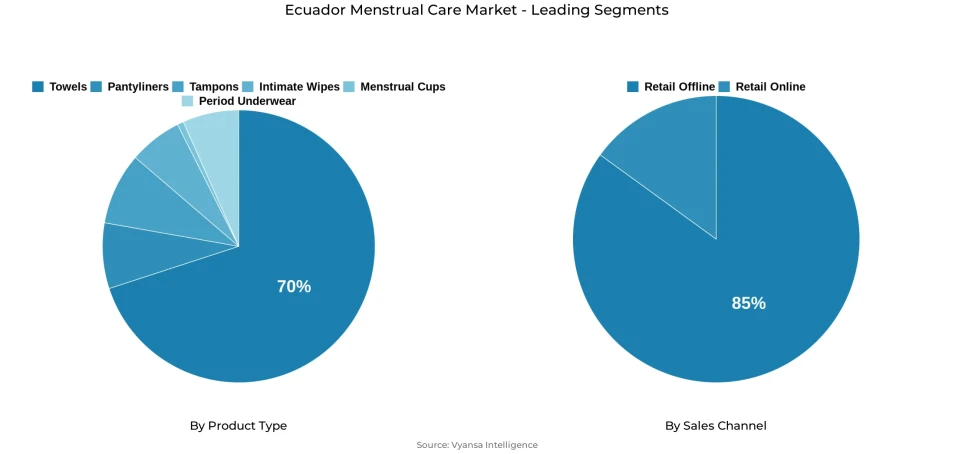
- Towels grabbed market share of 70%.
- Competition
- More than 5 companies are actively engaged in producing menstrual care in Ecuador.
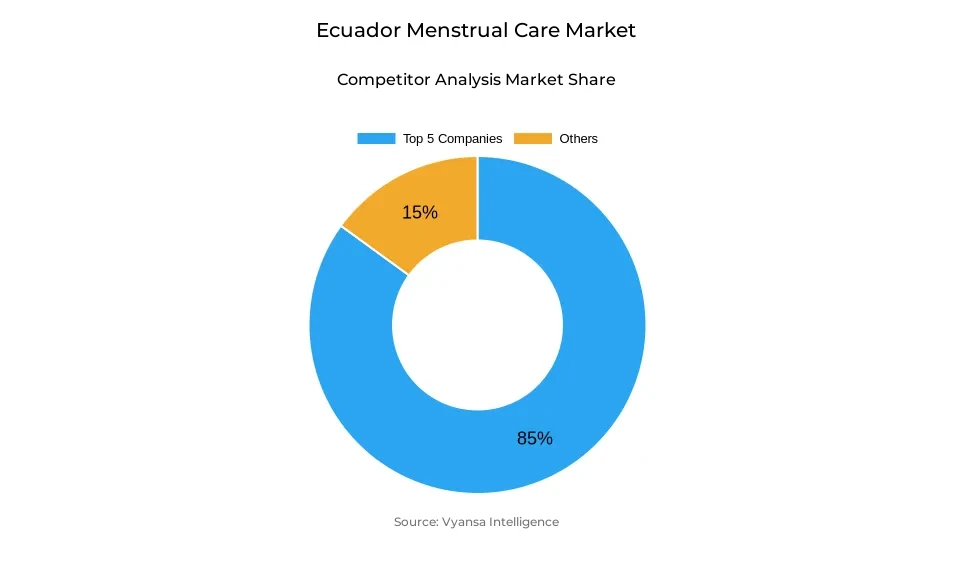
- Top 5 companies acquired around 85% of the market share.
- Zaimella del Ecuador SA; Softys Ecuador SA; Productos Tissue del Ecuador SA; Productos Familia Sancela del Ecuador SA; Johnson & Johnson del Ecuador SA etc., are few of the top companies.
- Sales Channel
- Retail offline grabbed 85% of the market.
Ecuador Menstrual Care Market Outlook
The Ecuador Menstrual Care market was valued around USD 65 million in 2025 and is projected to reach around USD 70 million by 2032, growing at a CAGR of approximately 1.06% from 2026 to 2032. The Menstrual Care market in Ecuador will grow at a moderate rate due to economic uncertainty and rising levels of inflation, affecting buying power in the economy. Menstrual Care products continue to remain exempt from the VAT charge, yet women are finding the products unaffordable, forcing them to buy less or turn to more economical alternatives to manage their health.
Towels lead in terms of sales, with a share of close to 70% of overall sales, given their easy access and affordability in the market. Regular towels are also leading compared to slim or night use towels, in terms of cost-effectiveness. However, in terms of volume growth, it is predicted that tampons will show a remarkable rise, although from a small base, due to increased awareness, along with promotions by brands such as Nosotras for women from richer segments.
Essity is still the dominant brand in the Ecuador menstrual care market because of its strong innovation and distribution. Its main brand, Nosotras, continues to innovate by producing better products like Nosotras Buenas Noches, which uses Max Cur-V technology that provides better comfort and absorption. It also spends on infrastructure aimed at educating people about menstruation health to prevent any taboo associated with menstruation. This helps the company maintain its dominant position.
Retail offline remains dominant, accounting around 85% of sales, with discounter groups like Tiendas Tuti that have proliferated nationwide. The private label brand, Velvet Rose, remains popular among value-conscious end users. While growth is being driven slowly by the lack of widespread online payment options, the role of online sales is expected to evolve over time with increasing adoption of retail online shopping due to convenience and value-for-money that these sales promise.
Ecuador Menstrual Care Market Growth DriverEconomic Pressures Encourage Demand for Affordable Menstrual Solutions
Affordability considerations are shaping demand for menstrual products in Ecuador, as economic pressures and periods of slowdown continue to constrain overall purchasing power. According to the World Bank, Ecuador's GDP grew by only 1.5% in the year 2024. This affects people's spending and inspires them to adopt affordable solutions for managing their menstruation. Menstrual products are also exempt from VAT in Ecuador, but the challenge of affordability still exists, especially among the poorer and more rural sectors of the country. UN Women's Ecuador office explains that more than 40% of women in the countryside face difficulties in accessing menstrual hygiene products.
Such economic conditions have ensured that the demand for normal towels has remained consistent, as they continue to be the dominant product owing to their affordability. Public awareness campaigns for hygiene and inclusivity have ensured that the baseline demand is met despite the lack of economic flexibility. These conditions combined ensure that the market for the product stays stable.
Ecuador Menstrual Care Market ChallengePersistent Period Poverty and Unequal Access to Hygiene Facilities
Structural gaps in affordability and access continue to constrain the Ecuador menstrual management market, as period poverty and sanitation inequality remain prevalent despite rising awareness. As per the UNICEF Ecuador, about 25% of girls in rural areas skip classes when they are in their menstrual periods because of a lack of access to the required products and a lack of proper sanitation facilities to use while menstruating. As per the INEC Ecuador, about 26.5% of people suffer from income poverty in 2024.
Although NGOs such as Plan International have started promoting menstrual cups as affordable approaches, their uptake has remained low because of taboo and lack of awareness. All these have been worsened by poor financial inclusion, where over 40% of adults in the country have no access to financial services offered through banks, as indicated in World Bank Global Findex 2023.
Unlock Market Intelligence
Explore the market potential with our data-driven report
Ecuador Menstrual Care Market TrendTechnology-driven innovation and education strengthen brand trust and engagement
Innovation and education have emerged as key characteristics in the Ecuadorian sanitary product market. Leading players are shifting their focus to awareness-driven marketing and scientific innovation to win the trust of the end-user. Essity, through its Nosotras brand, has introduced an advanced product line such as Nosotras Buenas Noches, which has enhanced absorption and comfort capabilities. This approach resonates with the WHO campaigns aimed at spreading menstrual literacy.
The presence of the young female population in Ecuador, comprising 23% of the total people who are between the ages of 15 and 29 years, as indicated by INEC 2024, ensures an ideal target group that can easily be reached by education and inclusion. Innovative and open communication channels are helping to boost confidence in branded products and overcome cultural barriers. This combination of education and effectiveness has come to be a crucial factor in the efforts to boost loyalty and redefine consumption trends associated with menses.
Ecuador Menstrual Care Market OpportunityThe Rise of Reusable and Eco-Friendly Menstrual Products
Sustainable practices in Ecuador as well as increased awareness about the environment are expected to provide new opportunities in the area of reusable sanitary care items. This is in line with the UN Environment Program's (UNEP) estimation that over 45 billion sanitary items are dumped worldwide annually. This precipitates the need for eco-friendly items. The Ecuadorian Ministry of Environment, Water, and Ecological Transition is pushing the agenda of waste reduction via the Circular Economy Strategy.
There are also local entities in Ecuador, such as Plan International and Fundación Humana, which have already started the distribution of washable menstrual pads and menstrual cups to help promote both cleanliness and affordability. Since consumers have become more conscious about the preservation of the environment, these products also have a good chance of being accepted on a larger scale in the future.
Unlock Market Intelligence
Explore the market potential with our data-driven report
Ecuador Menstrual Care Market Segmentation Analysis
By Product Type
- Pantyliners
- Tampons
- Applicator Tampons
- Digital Tampons
- Towels
- Standard Towels
- Standard Towels with Wings
- Standard Towels Without Wings
- Slim/Thin/Ultra-Thin Towels
- Slim/Thin/Ultra-Thin Towels with Wings
- Slim/Thin/Ultra-Thin Towels Without Wings
- Standard Towels
- Intimate Wipes
- Menstrual Cups
- Period Underwear
The segment with highest market share under product type is towels, which accounted for approximately 70% of the total Ecuadorian market for menstrual care. These towels are the most sought after among women across the country owing to their affordability, comfort, and accessibility. Biodegradable towels, specifically, continue to lead the market because these towels are value for money, being multifunctional, meaning that one set of towels is sufficient for use both by day and by night. The familiarity and comfort that towels provide can be attributed to their popularity too.
However new products in this area, such as tampons and products that can be reused, have been introduced, their usage is not widespread. Thus, towels will continue to dominate this market, assisted by their availability and importance in women’s personal hygiene practices.
By Sales Channel
- Retail Offline
- Retail Online
The segment with highest market share under sales channel is retail offline. This is comprised of around 85% within the Ecuadorian market for menstruation-related care. This particular distributional method is so effective mainly due to the presence of small grocery stores, supermarkets, and discounters like those found within Tiendas Tuti. This is particularly useful within the Ecuadorian market, where banking is not so commonly practiced.
Retail offline also has the benefit of the trust factor in the case of offline sales of products, and especially products related to hygiene. This factor has been further assisted by the rise of discounter chains, given the option of seeking quality at reasonable prices in the form of their in-house products for menstrual care. Even with the rise in offline sales, the trend for the purchase of menstrual care products shall be offline.
List of Companies Covered in Ecuador Menstrual Care Market
The companies listed below are highly influential in the Ecuador menstrual care market, with a significant market share and a strong impact on industry developments.
- Zaimella del Ecuador SA
- Softys Ecuador SA
- Productos Tissue del Ecuador SA
- Productos Familia Sancela del Ecuador SA
- Johnson & Johnson del Ecuador SA
- Kimberly-Clark Ecuador SA
- Otelo & Fabell SA
Competitive Landscape
The competitive landscape of menstrual care in Ecuador in 2025 remains highly concentrated, with Essity firmly holding a commanding leadership position supported by its extensive distribution network, broad price-tiered portfolio, and sustained investment in marketing and innovation under brands such as Nosotras. While smaller brands and private label have gained some value share, their growth has largely come at the expense of mid-sized competitors rather than Essity, underscoring the strength of its market position. Softys’ Ladysoft emerged as one of the better-performing brands following the relaunch of its night towels, while Intima by La Fabri expanded its presence in small local grocers, resonating with price-sensitive end users through competitive pricing. The rapid expansion of discounter Tiendas Tuti has further reshaped competition by accelerating private label growth, intensifying price-based rivalry, and reinforcing the shift toward value-focused offerings in a market constrained by weak economic conditions.
Frequently Asked Questions
Related Report
1. Market Segmentation
1.1. Research Scope
1.2. Research Methodology
1.3. Definitions and Assumptions
2. Executive Summary
3. Ecuador Menstrual Care Market Policies, Regulations, and Standards
4. Ecuador Menstrual Care Market Dynamics
4.1. Growth Factors
4.2. Challenges
4.3. Trends
4.4. Opportunities
5. Ecuador Menstrual Care Market Statistics, 2022-2032F
5.1. Market Size & Growth Outlook
5.1.1.By Revenues in USD Million
5.2. Market Segmentation & Growth Outlook
5.2.1.By Product Type
5.2.1.1. Pantyliners- Market Insights and Forecast 2022-2032, USD Million
5.2.1.2. Tampons- Market Insights and Forecast 2022-2032, USD Million
5.2.1.2.1. Applicator Tampons- Market Insights and Forecast 2022-2032, USD Million
5.2.1.2.2. Digital Tampons- Market Insights and Forecast 2022-2032, USD Million
5.2.1.3. Towels- Market Insights and Forecast 2022-2032, USD Million
5.2.1.3.1. Standard Towels- Market Insights and Forecast 2022-2032, USD Million
5.2.1.3.1.1. Standard Towels with Wings- Market Insights and Forecast 2022-2032, USD Million
5.2.1.3.1.2. Standard Towels Without Wings- Market Insights and Forecast 2022-2032, USD Million
5.2.1.3.2. Slim/Thin/Ultra-Thin Towels- Market Insights and Forecast 2022-2032, USD Million
5.2.1.3.2.1. Slim/Thin/Ultra-Thin Towels with Wings- Market Insights and Forecast 2022-2032, USD Million
5.2.1.3.2.2. Slim/Thin/Ultra-Thin Towels Without Wings- Market Insights and Forecast 2022-2032, USD Million
5.2.1.4. Intimate Wipes- Market Insights and Forecast 2022-2032, USD Million
5.2.1.5. Menstrual Cups- Market Insights and Forecast 2022-2032, USD Million
5.2.1.6. Period Underwear- Market Insights and Forecast 2022-2032, USD Million
5.2.2.By Nature
5.2.2.1. Disposable- Market Insights and Forecast 2022-2032, USD Million
5.2.2.2. Reusable- Market Insights and Forecast 2022-2032, USD Million
5.2.3.By Age Group
5.2.3.1. Up to 18 Years- Market Insights and Forecast 2022-2032, USD Million
5.2.3.2. 19-30 Years- Market Insights and Forecast 2022-2032, USD Million
5.2.3.3. 31-40 Years- Market Insights and Forecast 2022-2032, USD Million
5.2.3.4. 40 Years and Above- Market Insights and Forecast 2022-2032, USD Million
5.2.4.By Sales Channel
5.2.4.1. Retail Offline- Market Insights and Forecast 2022-2032, USD Million
5.2.4.2. Retail Online- Market Insights and Forecast 2022-2032, USD Million
5.2.5.By Competitors
5.2.5.1. Competition Characteristics
5.2.5.2. Market Share & Analysis
6. Ecuador Pantyliners Menstrual Care Market Statistics, 2022-2032
6.1. Market Size & Growth Outlook
6.1.1.By Revenues in USD Million
6.2. Market Segmentation & Growth Outlook
6.2.1.By Nature- Market Insights and Forecast 2022-2032, USD Million
6.2.2.By Age Group- Market Insights and Forecast 2022-2032, USD Million
6.2.3.By Sales Channel- Market Insights and Forecast 2022-2032, USD Million
7. Ecuador Tampons Menstrual Care Market Statistics, 2022-2032
7.1. Market Size & Growth Outlook
7.1.1.By Revenues in USD Million
7.2. Market Segmentation & Growth Outlook
7.2.1.By Product Type- Market Insights and Forecast 2022-2032, USD Million
7.2.2.By Nature- Market Insights and Forecast 2022-2032, USD Million
7.2.3.By Age Group- Market Insights and Forecast 2022-2032, USD Million
7.2.4.By Sales Channel- Market Insights and Forecast 2022-2032, USD Million
8. Ecuador Towels Menstrual Care Market Statistics, 2022-2032
8.1. Market Size & Growth Outlook
8.1.1.By Revenues in USD Million
8.2. Market Segmentation & Growth Outlook
8.2.1.By Product Type- Market Insights and Forecast 2022-2032, USD Million
8.2.2.By Nature- Market Insights and Forecast 2022-2032, USD Million
8.2.3.By Age Group- Market Insights and Forecast 2022-2032, USD Million
8.2.4.By Sales Channel- Market Insights and Forecast 2022-2032, USD Million
9. Ecuador Intimate Wipes Market Statistics, 2022-2032
9.1. Market Size & Growth Outlook
9.1.1.By Revenues in USD Million
9.2. Market Segmentation & Growth Outlook
9.2.1.By Nature- Market Insights and Forecast 2022-2032, USD Million
9.2.2.By Age Group- Market Insights and Forecast 2022-2032, USD Million
9.2.3.By Sales Channel- Market Insights and Forecast 2022-2032, USD Million
10. Ecuador Menstrual Cups Menstrual Care Market Statistics, 2022-2032
10.1. Market Size & Growth Outlook
10.1.1. By Revenues in USD Million
10.2. Market Segmentation & Growth Outlook
10.2.1. By Nature- Market Insights and Forecast 2022-2032, USD Million
10.2.2. By Age Group- Market Insights and Forecast 2022-2032, USD Million
10.2.3. By Sales Channel- Market Insights and Forecast 2022-2032, USD Million
11. Ecuador Period Underwear Menstrual Care Market Statistics, 2022-2032
11.1. Market Size & Growth Outlook
11.1.1. By Revenues in USD Million
11.2. Market Segmentation & Growth Outlook
11.2.1. By Nature- Market Insights and Forecast 2022-2032, USD Million
11.2.2. By Age Group- Market Insights and Forecast 2022-2032, USD Million
11.2.3. By Sales Channel- Market Insights and Forecast 2022-2032, USD Million
12. Competitive Outlook
12.1. Company Profiles
12.1.1. Productos Familia Sancela del Ecuador SA
12.1.1.1. Business Description
12.1.1.2. Product Portfolio
12.1.1.3. Collaborations & Alliances
12.1.1.4. Recent Developments
12.1.1.5. Financial Details
12.1.1.6. Others
12.1.2. Johnson & Johnson del Ecuador SA
12.1.2.1. Business Description
12.1.2.2. Product Portfolio
12.1.2.3. Collaborations & Alliances
12.1.2.4. Recent Developments
12.1.2.5. Financial Details
12.1.2.6. Others
12.1.3. Kimberly-Clark Ecuador SA
12.1.3.1. Business Description
12.1.3.2. Product Portfolio
12.1.3.3. Collaborations & Alliances
12.1.3.4. Recent Developments
12.1.3.5. Financial Details
12.1.3.6. Others
12.1.4. Softys Ecuador SA
12.1.4.1. Business Description
12.1.4.2. Product Portfolio
12.1.4.3. Collaborations & Alliances
12.1.4.4. Recent Developments
12.1.4.5. Financial Details
12.1.4.6. Others
12.1.5. Otelo & Fabell SA
12.1.5.1. Business Description
12.1.5.2. Product Portfolio
12.1.5.3. Collaborations & Alliances
12.1.5.4. Recent Developments
12.1.5.5. Financial Details
12.1.5.6. Others
12.1.6. Zaimella del Ecuador SA
12.1.6.1. Business Description
12.1.6.2. Product Portfolio
12.1.6.3. Collaborations & Alliances
12.1.6.4. Recent Developments
12.1.6.5. Financial Details
12.1.6.6. Others
12.1.7. Productos Tissue del Ecuador SA
12.1.7.1. Business Description
12.1.7.2. Product Portfolio
12.1.7.3. Collaborations & Alliances
12.1.7.4. Recent Developments
12.1.7.5. Financial Details
12.1.7.6. Others
13. Disclaimer
| Segment | Sub-Segment |
|---|---|
| By Product Type |
|
| By Nature |
|
| By Age Group |
|
| By Sales Channel |
|
Research Methodology
This study followed a structured approach comprising four key phases to assess the size and scope of the electro-oxidation market. The process began with thorough secondary research to collect data on the target market, related markets, and broader industry context. These findings, along with preliminary assumptions and estimates, were then validated through extensive primary research involving industry experts from across the value chain. To calculate the overall market size, both top-down and bottom-up methodologies were employed. Finally, market segmentation and data triangulation techniques were applied to refine and validate segment-level estimations.
Secondary Research
The secondary research phase involved gathering data from a wide range of credible and published sources. This step helped in identifying industry trends, defining market segmentation, and understanding the market landscape and value chain.
Sources consulted during this phase included:
- Company annual reports, investor presentations, and press releases
- Industry white papers and certified publications
- Trade directories and market-recognized databases
- Articles from authoritative authors and reputable journals
- Gold and silver standard websites
Secondary research was critical in mapping out the industry's value chain and monetary flow, identifying key market segments, understanding regional variations, and tracking significant industry developments.
Other key sources:
- Financial disclosures
- Industry associations and trade bodies
- News outlets and business magazines
- Academic journals and research studies
- Paid industry databases
Primary Research
To validate secondary data and gain deeper market insights, primary research was conducted with key stakeholders across both the supply and demand sides of the market.
On the demand side, participants included decision-makers and influencers from end-user industries—such as CIOs, CTOs, and CSOs—who provided first-hand perspectives on market needs, product usage, and future expectations.
On the supply side, interviews were conducted with manufacturers, industry associations, and institutional participants to gather insights into current offerings, product pipelines, and market challenges.
Primary interviews provided critical inputs such as:
- Market size and revenue data
- Product and service breakdowns
- Market forecasts
- Regional and application-specific trends
Stakeholders consulted included:
- Leading OEM and solution providers
- Channel and distribution partners
- End users across various applications
- Independent consultants and industry specialists
Market Size Estimation and Data Triangulation
- Identifying Key Market Participants (Secondary Research)
- Goal: To identify the major players or companies in the target market. This typically involves using publicly available data sources such as industry reports, market research publications, and financial statements of companies.
- Tools: Reports from firms like Gartner, Forrester, Euromonitor, Statista, IBISWorld, and others. Public financial statements, news articles, and press releases from top market players.
- Extracting Earnings of Key Market Participants
- Goal: To estimate the earnings generated from the product or service being analyzed. This step helps in understanding the revenue potential of each market player in a specific geography.
- Methods: Earnings data can be gathered from:
- Publicly available financial reports (for listed companies).
- Interviews and primary data sources from professionals, such as Directors, VPs, SVPs, etc. This is especially useful for understanding more nuanced, internal data that isn't publicly disclosed.
- Annual reports and investor presentations of key players.
- Data Collation and Development of a Relevant Data Model
- Goal: To collate inputs from both primary and secondary sources into a structured, data-driven model for market estimation. This model will incorporate key market KPIs and any independent variables relevant to the market.
- Key KPIs: These could include:
- Market size, growth rate, and demand drivers.
- Industry-specific metrics like market share, average revenue per customer (ARPC), or average deal size.
- External variables, such as economic growth rates, inflation rates, or commodity prices, that could affect the market.
- Data Modeling: Based on this data, the market forecasts are developed for the next 5 years. A combination of trend analysis, scenario modeling, and statistical regression might be used to generate projections.
- Scenario Analysis
- Goal: To test different assumptions and validate how sensitive the market is to changes in key variables (e.g., market demand, regulatory changes, technological disruptions).
- Types of Scenarios:
- Base Case: Based on current assumptions and historical data.
- Best-Case Scenario: Assuming favorable market conditions, regulatory environments, and technological advancements.
- Worst-Case Scenario: Accounting for adverse factors, such as economic downturns, stricter regulations, or unexpected disruptions.












