China Wireless Headphones Market Report: Trends, Growth and Forecast (2026-2032)
By Product Type (Over-Ear Headphones, On-Ear Headphones), By Price Range (Mass, Premium), By Technology (Bluetooth, RF (Radio Frequency), Infrared, NFC-enabled, Wi-Fi Wireless), By Features (Active Noise Cancellation (ANC), Passive Noise Isolation, Voice Assistant Integration, Water/Sweat Resistance, Touch Controls, Spatial/3D Audio, Multipoint Connectivity, Fast Charging, Foldable Design, Detachable Microphone), By Application/Use Case (Music & Entertainment, Gaming, Fitness & Sports, Communication/Work, Travel, Professional/Studio Use, Education/E-learning), By Sales Channel (Retail Offline (Electronics Stores, Hypermarkets/Supermarkets, Specialty Audio Stores, Brand Stores, Other Retail Stores), Retail Online (E-commerce Marketplaces, Brand Websites/D2C, Online Electronics Retailers)), By End User (Personal, Commercial/Enterprise, Gaming/Esports Users, Professional Audio Users), By Region (North, East, Southwest, Northwest, North East, South) ... Read more

|
Major Players
|
China Wireless Headphones Market Statistics and Insights, 2026
- Market Size Statistics
- Wireless headphones market size in China was valued at USD 1.7 billion in 2025 and is estimated at USD 1.82 billion in 2026.
- The market size is expected to grow to USD 2.14 billion by 2032.
- Market to register a CAGR of around 3.34% during 2026-32.
- Product Type Shares
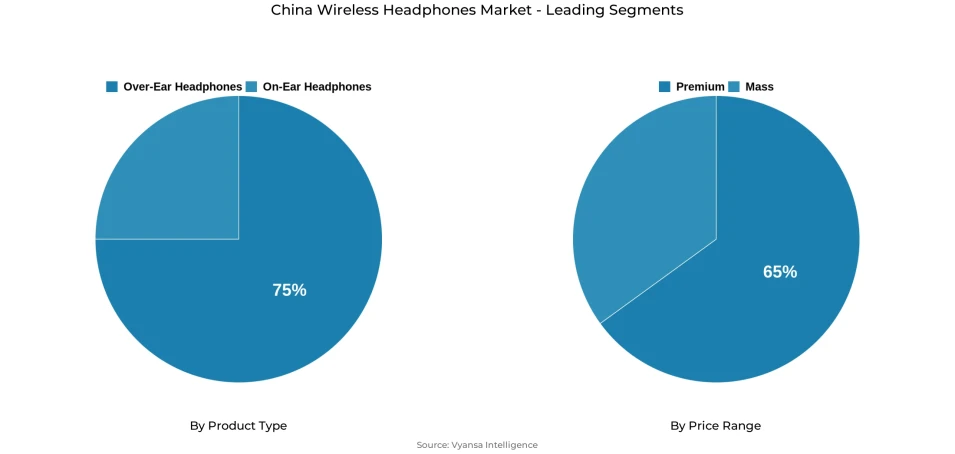
- Over-ear headphones grabbed market share of 75%.
- Competition
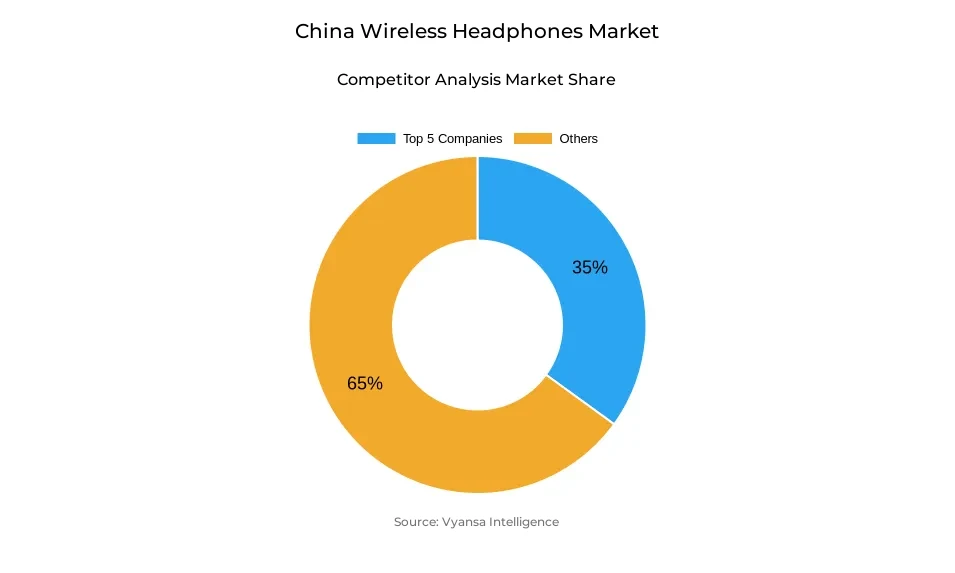
- More than 5 companies are actively engaged in producing wireless headphones in China.
- Top 5 companies acquired around 35% of the market share.
- Sony (China) Ltd, Bose Electronics (Shanghai) Co Ltd, Anker Innovations Technology Co Ltd, Xiaomi Technology Co Ltd, Huawei Technologies Co Ltd etc., are few of the top companies.
- Price Range
- Premium grabbed 65% of the market.
China Wireless Headphones Market Outlook
China wireless headphones market size was valued at USD 1.7 billion in 2025 and is projected to grow from USD 1.82 billion in 2026 to USD 2.14 billion by 2032, exhibiting a CAGR of 3.34% during the forecast period.
Growth is supported by strong digital media usage and high smartphone based internet access in the country. Consumers increasingly watch, stream, study, and browse through mobile devices in shared spaces, which supports demand for private and convenient listening solutions. This usage pattern keeps wireless headphones relevant as users look for better sound quality and cable free comfort in daily entertainment and communication needs.
The category also remains shaped by product and pricing preferences. Over-ear headphones hold around 75% share, making them the leading product type due to their stronger sound depth, longer wear comfort, and better noise isolation. At the same time, the premium price range accounts for 65% share, showing that many buyers prefer feature rich wireless headphones with better battery life, refined design, and advanced functions instead of choosing only low priced options.
At the same time, the outlook stays balanced by ongoing price competition in online channels, where promotions can limit pricing power across brands. Even so, demand conditions remain supported by AI linked feature adoption and replacement buying driven by device upgrade programs. These factors together help sustain interest in wireless headphones through the forecast period while keeping competition centered on experience, innovation, and premium appeal rather than only price.
China Wireless Headphones Market Growth Driver
Rising Mobile-First Entertainment Habits
China’s wireless headphones demand is supported by the depth of mobile digital use. As of December 2024, China had 1.108 billion internet users, and 1.105 billion accessed the internet through mobile phones, showing how strongly daily media use is tied to personal mobile devices. The same official China Internet Network Information Center (CNNIC) report also shows 662 million users watch micro short dramas, a format built around frequent, on the go viewing and longer personal listening sessions.
This usage pattern supports wireless headphones because consumers increasingly watch, stream, study, and browse through smartphones in shared homes, offices, and public spaces. Private listening, better sound quality, and cable free convenience become more relevant when mobile internet access is nearly universal and entertainment formats continue to expand across short form and immersive content ecosystems.
China Wireless Headphones Market Challenge
Persistent Price Pressure in Online Channels
A key challenge is intense price competition in China’s online led consumer electronics environment. In 2025, China’s online retail sales of physical goods reach CNY13.09 trillion and account for 26.1% of total retail sales of consumer goods, showing how large digital commerce has become in shaping pricing behavior. In the same year, retail sales of household appliances and audio video equipment rise 11.0% for the full year, but fall 18.7% year on year in December alone, pointing to uneven sell through and promotion driven demand.
For wireless headphones brands, this means volume can grow while pricing power stays under pressure. Frequent promotions, shopping festivals, and platform led discounts make it harder to sustain premium positioning across models, especially when broader electronics demand shows month to month volatility. That can limit margin expansion even when consumer traffic remains healthy.
Unlock Market Intelligence
Explore the market potential with our data-driven report
China Wireless Headphones Market Trend
Smart Audio Moves Toward AI-Led Use Cases
Wireless headphones in China are increasingly aligned with AI based features rather than basic audio alone. CNNIC reports that China’s generative AI user base reaches 515 million by June 2025, with a penetration rate of 36.5%. The same report states that by August 2025, 538 generative AI services have completed filing and 263 applications or functions have completed registration, showing that the domestic AI ecosystem is scaling quickly.
This creates a clear trend toward headphones that support voice assistants, real time translation, smart search access, meeting support, and other AI linked functions. As AI becomes part of everyday digital behavior, consumers are more likely to value headphones as interactive smart hardware instead of only music accessories, which pushes product development toward higher feature and ecosystem connected models.
China Wireless Headphones Market Opportunity
Upgrade Incentives Open Replacement Demand
A strong opportunity comes from China’s device upgrade and trade in push, which supports replacement buying in personal electronics. The Ministry of Commerce says about 7.92 million consumers apply for subsidies to trade in old electronic products and buy new ones soon after the 2025 policy rollout, covering about 10.79 million units. This shows clear policy backed consumer willingness to replace devices rather than delay purchases.
For wireless headphones, this matters because replacement demand is often easier to unlock than first time demand in mature urban markets. Subsidies and upgrade campaigns can shorten replacement cycles, improve premium product consideration, and help brands convert users from older wired or entry level products into higher value wireless models through organized retail and retail online channels.
Unlock Market Intelligence
Explore the market potential with our data-driven report
China Wireless Headphones Market Segmentation Analysis
By Product Type
- Over-Ear Headphones
- On-Ear Headphones
The segment with the highest share under the product type category is over-ear headphones, holding around 75% of the market. This leadership reflects stronger consumer preference for better sound depth, longer wear comfort, and stronger noise isolation, especially for music streaming, gaming, work calls, and long daily listening sessions. Over-ear models also fit well with the premium image many wireless headphone buyers look for in China.
Their lead remains strong because these products usually offer a fuller feature package, including larger drivers, better battery performance, and stronger active noise cancellation support. That makes them more appealing than compact alternatives when buyers prioritize experience over portability. As a result, over-ear headphones continue to anchor value creation within the category and remain the most influential product format in the market.
By Price Range
- Mass
- Premium
The segment with the highest share around segment under the price range is premium, which grabs 65% of the market. This shows that buyers in China’s wireless headphones space are not choosing on price alone. Many consumers are willing to spend more for better audio quality, stronger brand trust, longer battery life, refined design, and advanced features such as noise cancellation and smart connectivity.
This share also suggests that the category is shaped more by experience led buying than by basic replacement demand. Premium models benefit from gifting demand, lifestyle positioning, and demand from professionals, travelers, and entertainment focused users. Because of this, the premium range continues to command the largest portion of the market and sets the tone for innovation, branding, and feature competition across the category.
List of Companies Covered in China Wireless Headphones Market
The companies listed below are highly influential in the China wireless headphones market, with a significant market share and a strong impact on industry developments.
- Sony (China) Ltd
- Bose Electronics (Shanghai) Co Ltd
- Anker Innovations Technology Co Ltd
- Xiaomi Technology Co Ltd
- Huawei Technologies Co Ltd
- Edifier Technology Co Ltd
- Guangdong OPPO Mobile Telecommunications Corp Ltd
- Apple Computer Trading (Shanghai) Co Ltd
Market News & Updates
- Huawei Technologies Co Ltd, 2026:
In 2026, Huawei strengthened its wireless headphones position in China through the official launch and commercialization of HUAWEI FreeBuds 6, which the company describes on its China site as its first semi-open dual-driver earbuds, supporting up to 2.3 Mbps lossless audio transmission, spatial audio with head tracking, AI-assisted features, and upgraded call-noise reduction. For the wireless headphones market in China, this is a major verified product development because it shows Huawei pushing higher-end audio innovation inside its domestic ecosystem, which can support premium demand, encourage upgrades among HarmonyOS users, and intensify competition around sound quality, intelligent features, and seamless device integration.
- Sony (China) Ltd, 2026:
In January 2026, Sony (China) officially introduced the new LinkBuds Clip true wireless earphones in China, positioning the product around an open listening experience, a new acoustic structure, and improved wear comfort for users who want to stay connected to both digital audio and surrounding sounds. For the wireless headphones market in China, this is one of the most significant verified updates because it expands Sony’s product strategy beyond conventional ANC-focused earbuds into differentiated open-style use cases, which can broaden category appeal and increase competition in premium lifestyle and everyday-use wireless audio segments.
Frequently Asked Questions
Related Report
- Market Segmentation
- Research Scope
- Research Methodology
- Definitions and Assumptions
- Executive Summary
- China Wireless Headphones Market Policies, Regulations, and Standards
- China Wireless Headphones Market Dynamics
- Growth Factors
- Challenges
- Trends
- Opportunities
- China Wireless Headphones Market Statistics, 2022-2032F
- Market Size & Growth Outlook
- By Revenues in USD Million
- Market Segmentation & Growth Outlook
- By Product Type
- Over-Ear Headphones- Market Insights and Forecast 2022-2032, USD Million
- On-Ear Headphones- Market Insights and Forecast 2022-2032, USD Million
- By Price Range
- Mass- Market Insights and Forecast 2022-2032, USD Million
- Premium- Market Insights and Forecast 2022-2032, USD Million
- By Technology
- Bluetooth- Market Insights and Forecast 2022-2032, USD Million
- RF (Radio Frequency)- Market Insights and Forecast 2022-2032, USD Million
- Infrared- Market Insights and Forecast 2022-2032, USD Million
- NFC-enabled- Market Insights and Forecast 2022-2032, USD Million
- Wi-Fi Wireless- Market Insights and Forecast 2022-2032, USD Million
- By Features
- Active Noise Cancellation (ANC)- Market Insights and Forecast 2022-2032, USD Million
- Passive Noise Isolation- Market Insights and Forecast 2022-2032, USD Million
- Voice Assistant Integration- Market Insights and Forecast 2022-2032, USD Million
- Water/Sweat Resistance- Market Insights and Forecast 2022-2032, USD Million
- Touch Controls- Market Insights and Forecast 2022-2032, USD Million
- Spatial/3D Audio- Market Insights and Forecast 2022-2032, USD Million
- Multipoint Connectivity- Market Insights and Forecast 2022-2032, USD Million
- Fast Charging- Market Insights and Forecast 2022-2032, USD Million
- Foldable Design- Market Insights and Forecast 2022-2032, USD Million
- Detachable Microphone- Market Insights and Forecast 2022-2032, USD Million
- By Application/Use Case
- Music & Entertainment- Market Insights and Forecast 2022-2032, USD Million
- Gaming- Market Insights and Forecast 2022-2032, USD Million
- Fitness & Sports- Market Insights and Forecast 2022-2032, USD Million
- Communication/Work- Market Insights and Forecast 2022-2032, USD Million
- Travel- Market Insights and Forecast 2022-2032, USD Million
- Professional/Studio Use- Market Insights and Forecast 2022-2032, USD Million
- Education/E-learning- Market Insights and Forecast 2022-2032, USD Million
- By Sales Channel
- Retail Offline- Market Insights and Forecast 2022-2032, USD Million
- Electronics Stores- Market Insights and Forecast 2022-2032, USD Million
- Hypermarkets/Supermarkets- Market Insights and Forecast 2022-2032, USD Million
- Specialty Audio Stores- Market Insights and Forecast 2022-2032, USD Million
- Brand Stores- Market Insights and Forecast 2022-2032, USD Million
- Other Retail Stores- Market Insights and Forecast 2022-2032, USD Million
- Retail Online- Market Insights and Forecast 2022-2032, USD Million
- E-commerce Marketplaces- Market Insights and Forecast 2022-2032, USD Million
- Brand Websites/D2C- Market Insights and Forecast 2022-2032, USD Million
- Online Electronics Retailers- Market Insights and Forecast 2022-2032, USD Million
- Retail Offline- Market Insights and Forecast 2022-2032, USD Million
- By End User
- Personal- Market Insights and Forecast 2022-2032, USD Million
- Commercial/Enterprise- Market Insights and Forecast 2022-2032, USD Million
- Gaming/Esports Users- Market Insights and Forecast 2022-2032, USD Million
- Professional Audio Users- Market Insights and Forecast 2022-2032, USD Million
- By Region
- North
- East
- Southwest
- Northwest
- North East
- South
- By Competitors
- Competition Characteristics
- Market Share & Analysis
- By Product Type
- Market Size & Growth Outlook
- China Over-Ear Headphones Market Statistics, 2022-2032
- Market Size & Growth Outlook
- By Revenues in USD Million
- Market Segmentation & Growth Outlook
- By Price Range- Market Insights and Forecast 2022-2032, USD Million
- By Technology- Market Insights and Forecast 2022-2032, USD Million
- By Features- Market Insights and Forecast 2022-2032, USD Million
- By Application/Use Case- Market Insights and Forecast 2022-2032, USD Million
- By Sales Channel- Market Insights and Forecast 2022-2032, USD Million
- By End User- Market Insights and Forecast 2022-2032, USD Million
- By Region- Market Insights and Forecast 2022-2032, USD Million
- Market Size & Growth Outlook
- China On-Ear Headphones Market Statistics, 2022-2032
- Market Size & Growth Outlook
- By Revenues in USD Million
- Market Segmentation & Growth Outlook
- By Price Range- Market Insights and Forecast 2022-2032, USD Million
- By Technology- Market Insights and Forecast 2022-2032, USD Million
- By Features- Market Insights and Forecast 2022-2032, USD Million
- By Application/Use Case- Market Insights and Forecast 2022-2032, USD Million
- By Sales Channel- Market Insights and Forecast 2022-2032, USD Million
- By End User- Market Insights and Forecast 2022-2032, USD Million
- By Region- Market Insights and Forecast 2022-2032, USD Million
- Market Size & Growth Outlook
- Competitive Outlook
- Company Profiles
- Xiaomi Technology Co Ltd
- Business Description
- Product Portfolio
- Collaborations & Alliances
- Recent Developments
- Financial Details
- Others
- Huawei Technologies Co Ltd
- Business Description
- Product Portfolio
- Collaborations & Alliances
- Recent Developments
- Financial Details
- Others
- Edifier Technology Co Ltd
- Business Description
- Product Portfolio
- Collaborations & Alliances
- Recent Developments
- Financial Details
- Others
- Guangdong OPPO Mobile Telecommunications Corp Ltd
- Business Description
- Product Portfolio
- Collaborations & Alliances
- Recent Developments
- Financial Details
- Others
- Apple Computer Trading (Shanghai) Co Ltd
- Business Description
- Product Portfolio
- Collaborations & Alliances
- Recent Developments
- Financial Details
- Others
- Sony (China) Ltd
- Business Description
- Product Portfolio
- Collaborations & Alliances
- Recent Developments
- Financial Details
- Others
- Bose Electronics (Shanghai) Co Ltd
- Business Description
- Product Portfolio
- Collaborations & Alliances
- Recent Developments
- Financial Details
- Others
- Anker Innovations Technology Co Ltd
- Business Description
- Product Portfolio
- Collaborations & Alliances
- Recent Developments
- Financial Details
- Others
- Others
- Business Description
- Product Portfolio
- Collaborations & Alliances
- Recent Developments
- Financial Details
- Others
- Xiaomi Technology Co Ltd
- Company Profiles
- Disclaimer
| Segment | Sub-Segment |
|---|---|
| By Product Type |
|
| By Price Range |
|
| By Technology |
|
| By Features |
|
| By Application/Use Case |
|
| By Sales Channel |
|
| By End User |
|
| By Region |
|
Research Methodology
This study followed a structured approach comprising four key phases to assess the size and scope of the electro-oxidation market. The process began with thorough secondary research to collect data on the target market, related markets, and broader industry context. These findings, along with preliminary assumptions and estimates, were then validated through extensive primary research involving industry experts from across the value chain. To calculate the overall market size, both top-down and bottom-up methodologies were employed. Finally, market segmentation and data triangulation techniques were applied to refine and validate segment-level estimations.
Secondary Research
The secondary research phase involved gathering data from a wide range of credible and published sources. This step helped in identifying industry trends, defining market segmentation, and understanding the market landscape and value chain.
Sources consulted during this phase included:
- Company annual reports, investor presentations, and press releases
- Industry white papers and certified publications
- Trade directories and market-recognized databases
- Articles from authoritative authors and reputable journals
- Gold and silver standard websites
Secondary research was critical in mapping out the industry's value chain and monetary flow, identifying key market segments, understanding regional variations, and tracking significant industry developments.
Other key sources:
- Financial disclosures
- Industry associations and trade bodies
- News outlets and business magazines
- Academic journals and research studies
- Paid industry databases
Primary Research
To validate secondary data and gain deeper market insights, primary research was conducted with key stakeholders across both the supply and demand sides of the market.
On the demand side, participants included decision-makers and influencers from end-user industries—such as CIOs, CTOs, and CSOs—who provided first-hand perspectives on market needs, product usage, and future expectations.
On the supply side, interviews were conducted with manufacturers, industry associations, and institutional participants to gather insights into current offerings, product pipelines, and market challenges.
Primary interviews provided critical inputs such as:
- Market size and revenue data
- Product and service breakdowns
- Market forecasts
- Regional and application-specific trends
Stakeholders consulted included:
- Leading OEM and solution providers
- Channel and distribution partners
- End users across various applications
- Independent consultants and industry specialists
Market Size Estimation and Data Triangulation
- Identifying Key Market Participants (Secondary Research)
- Goal: To identify the major players or companies in the target market. This typically involves using publicly available data sources such as industry reports, market research publications, and financial statements of companies.
- Tools: Reports from firms like Gartner, Forrester, Euromonitor, Statista, IBISWorld, and others. Public financial statements, news articles, and press releases from top market players.
- Extracting Earnings of Key Market Participants
- Goal: To estimate the earnings generated from the product or service being analyzed. This step helps in understanding the revenue potential of each market player in a specific geography.
- Methods: Earnings data can be gathered from:
- Publicly available financial reports (for listed companies).
- Interviews and primary data sources from professionals, such as Directors, VPs, SVPs, etc. This is especially useful for understanding more nuanced, internal data that isn't publicly disclosed.
- Annual reports and investor presentations of key players.
- Data Collation and Development of a Relevant Data Model
- Goal: To collate inputs from both primary and secondary sources into a structured, data-driven model for market estimation. This model will incorporate key market KPIs and any independent variables relevant to the market.
- Key KPIs: These could include:
- Market size, growth rate, and demand drivers.
- Industry-specific metrics like market share, average revenue per customer (ARPC), or average deal size.
- External variables, such as economic growth rates, inflation rates, or commodity prices, that could affect the market.
- Data Modeling: Based on this data, the market forecasts are developed for the next 5 years. A combination of trend analysis, scenario modeling, and statistical regression might be used to generate projections.
- Scenario Analysis
- Goal: To test different assumptions and validate how sensitive the market is to changes in key variables (e.g., market demand, regulatory changes, technological disruptions).
- Types of Scenarios:
- Base Case: Based on current assumptions and historical data.
- Best-Case Scenario: Assuming favorable market conditions, regulatory environments, and technological advancements.
- Worst-Case Scenario: Accounting for adverse factors, such as economic downturns, stricter regulations, or unexpected disruptions.












