China Soil Treatment Market Report: Trends, Growth and Forecast (2026-2032)
By Type (Organic Amendments (Animal Manure, Crop Residue, Compost, Sewage Sludge and Biosolids), pH Adjusters and Soil Conditioners (Aglime, Gypsum, Others), Soil Protection Products (Herbicides, Insecticides, Fungicides, Nematicides)), By Technology (Physicochemical Treatment, Biological Treatment, Thermal Treatment), By Application (Soil Fertility Improvement, Soil Remediation, pH Correction, Weed Management, Pest Management, Soil Structure Improvement), By Crop Type (Grains and Cereals, Fruits and Vegetables, Pulses and Oilseeds, Commercial Crops, Turf and Ornamentals), By Region (North, East, Southwest, Northwest, North East, South) ... Read more
|
Major Players
|
China Soil Treatment Market Statistics and Insights, 2026
- Market Size Statistics
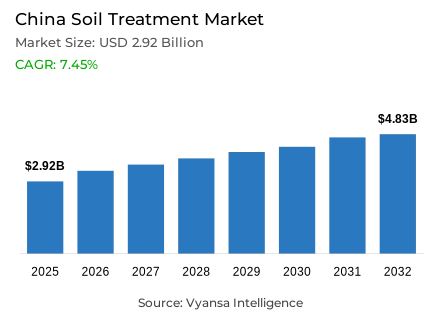
- Soil treatment market size in China was valued at USD 2.92 billion in 2025 and is estimated at USD 3.12 billion in 2026.
- The market size is expected to grow to USD 4.83 billion by 2032.
- Market to register a CAGR of around 7.45% during 2026-32.
- Type Shares
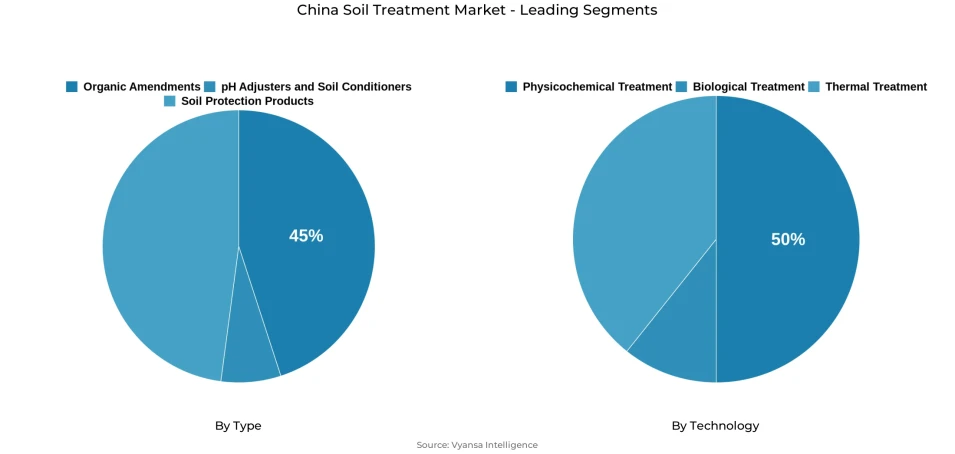
- Organic amendments grabbed market share of 45%.
- Competition
- Soil treatment in China is currently being catered to by more than 10 companies.
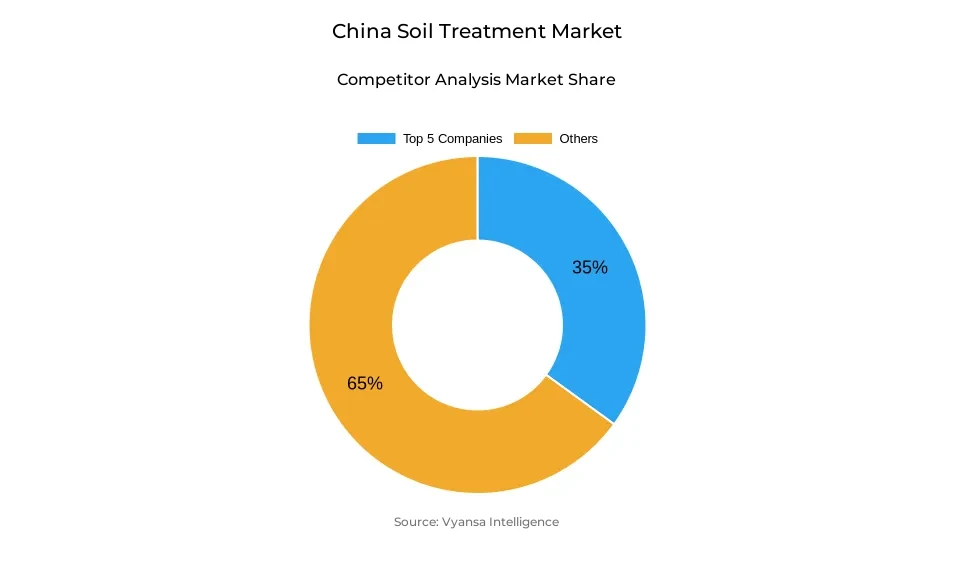
- Top 5 companies acquired around 35% of the market share.
- Yonker Environmental Protection Co. Ltd., Guangxi Bossco Environmental Protection Technology Co. Ltd., Shanghai Construction Group Environmental Technology Co. Ltd., Beijing Construction Engineering Environmental Remediation Co. Ltd., Beijing GeoEnviron Engineering & Technology Inc. etc., are few of the top companies.
- Technology
- Physiochemical treatment grabbed 50% of the market.
China Soil Treatment Market Outlook
China soil treatment market covers agricultural soil amendments, contaminated land remediation, soil conditioning products, and soil pollution control services used by farms, industrial site owners, developers, municipal bodies, and environmental contractors. The market is valued at USD 2.92 Billion in 2025 and is projected to reach USD 4.83 Billion by 2032, with USD 3.12 Billion in 2026 and a CAGR of 7.45% from 2026 to 2032. China soil treatment industry now links food security, land-use safety, and ecological restoration.
Policy catalysts are strengthening procurement for soil remediation in China, farmland soil restoration, and construction land soil remediation. China’s 2026 rural policy priorities call for stronger agricultural production capacity, arable land protection, and quality improvement, while the 2024 soil pollution source plan expands control over industrial, mining, construction-land, and groundwater risks. These measures direct the China soil treatment market toward compliant technologies, field-level monitoring, and soil health improvement.
Industrial impact is concentrated in higher adoption of organic amendments, physicochemical remediation, contaminated site management, and soil testing services. China soil treatment industry supports crop yield stability by improving nutrient balance, while remediation contractors address heavy metal soil remediation, petroleum hydrocarbon soil remediation, and brownfield redevelopment soil treatment. As land reuse, food safety, and rural modernization converge, procurement shifts from reactive cleanup toward integrated soil quality enhancement. This profile gives China contaminated soil treatment market and agricultural soil treatment solutions stronger strategic visibility.
The 2026 trajectory favors suppliers that combine agronomic soil solutions with verifiable remediation performance. Soil treatment market in China benefits from food-security programs, high-standard farmland investment, and tighter environmental compliance China requirements. China soil treatment industry is also moving toward biochar amendment, microbial soil treatment China, soil conditioners, stabilization and solidification, and soil washing, enabling suppliers to improve demand capture across agriculture, municipal land restoration, and industrial site remediation.
China Soil Treatment Market Growth Driver
Arable Land Quality Push Accelerates Adoption
Food-security pressure is increasing demand for farmland soil restoration, soil fertility management, and sustainable soil amendments. China soil treatment market benefits as grain producers, input suppliers, and local governments prioritize soil organic matter restoration, pH correction, nutrient balancing, and contamination control to protect crop productivity. China soil treatment industry is therefore positioned around production resilience rather than discretionary environmental spending, with procurement increasingly tied to agronomic performance, compliance records, and measurable soil health outcomes.
National Bureau of Statistics data shows China’s total grain production reached 714.88 million tons in 2025, up 1.2% from 2024. This output base raises the operational value of soil treatment for crop productivity in China because stable yields require better soil quality, heavy metal risk control, and consistent amendment use across intensive grain belts and high-yield farming systems. It also strengthens demand for soil testing and treatment services before planting cycles and harvest planning programs.
China Soil Treatment Market Challenge
Site Complexity Extends Remediation Timelines
Site-specific contamination complexity raises project risk across heavy metal soil remediation, petroleum hydrocarbon soil remediation, pesticide residue soil treatment, and construction land soil remediation China. Soil treatment market in China faces longer technical screening cycles because contaminant chemistry, groundwater exposure, land-use conversion, and site access conditions determine whether stabilization, soil washing, chemical oxidation, or thermal desorption can meet acceptance criteria. This raises bid preparation cost and slows project mobilization. Fragmented site data further weakens pricing accuracy across provinces.
A 2024 study of 643 contaminated-site cases in China found that more than half used ex situ remediation, about 88.04%, while in situ remediation represented only 7.23%. This imbalance increases handling, transport, and secondary-pollution concerns, limiting faster adoption by smaller remediation contractors and increasing procurement scrutiny for land remediation services. Technology mismatch also exposes clients to retesting delays and compliance disputes. Both factors restrict participation by newer service providers and provinces nationwide.
Unlock Market Intelligence
Explore the market potential with our data-driven report
China Soil Treatment Market Trend
Codified Environmental Governance Raises Compliance Standards
Regulatory consolidation is shifting soil pollution control in China from fragmented compliance toward lifecycle governance covering monitoring, risk assessment, remediation planning, and post-treatment accountability. China soil treatment industry gains from this transition as industrial parks, chemical sites, brownfield owners, and municipal authorities require auditable remediation designs, standardized soil pollution risk management, and traceable records for construction land contamination control. This strengthens service differentiation for technically qualified contractors during site reuse approvals nationwide.
NPC Observer reported that China’s Ecological and Environmental Code was adopted on March 12, 2026, takes effect on August 15, 2026, and repeals the earlier Soil Pollution Prevention and Control Law. Soil treatment market in China is therefore moving toward stricter legal continuity, improving demand for environmental remediation compliance China, contaminated site risk assessment, and certified treatment execution. Suppliers with monitoring, documentation, and verification capability should gain procurement advantage across high-compliance land projects and redevelopment approval pipelines.
China Soil Treatment Market Opportunity
Residue Valorization Opens Supplier White Space
Localized circular-agriculture supply chains create expansion room for organic amendments, compost soil amendment, biochar soil treatment in China, and microbial soil treatment products for Chinese farmland. China soil treatment industry can capture demand by converting manure, straw, and crop residues into standardized inputs that support soil organic matter restoration, nutrient balancing, and lower chemical dependence across intensive cultivation zones. This underpenetrated opportunity favors suppliers with testing, formulation, and field-advisory capabilities across priority farming counties.
World Bank implementation data from December 2025 lists a June 2029 program target of 929,970 metric tons per year of organic fertilizer use and 74,608 hectares under green manure in Hubei and Hunan program counties. China soil treatment market suppliers that align products with provincial green agriculture programs can improve localization, distributor access, and institutional procurement visibility. It also supports longer-term supply planning for soil conditioner manufacturers China and rural input procurement networks nationwide.
Unlock Market Intelligence
Explore the market potential with our data-driven report
China Soil Treatment Market Segmentation Analysis
By Type
- Organic Amendments
- Animal Manure
- Crop Residue
- Compost
- Sewage Sludge and Biosolids
- pH Adjusters and Soil Conditioners
- Aglime
- Gypsum
- Others
- Soil Protection Products
- Herbicides
- Insecticides
- Fungicides
- Nematicides
Organic Amendments hold 45% share under Type, supported by China’s transition from input-intensive cultivation toward soil fertility restoration, organic soil treatment, and sustainable soil amendments. China soil treatment industry benefits because compost soil amendment, manure-based soil amendment, biochar amendment, and microbial inoculants improve nutrient cycling while supporting soil health improvement across grain, vegetable, orchard, and greenhouse cultivation systems. Procurement also favors inputs compatible with local circular residue-return programs and agronomy-led distribution channels.
World Bank implementation data published in December 2025 shows a June 2029 target of 6,178,327 metric tons per year of livestock and poultry manure treated and recycled in Hubei and Hunan program counties. This pipeline strengthens China soil treatment market demand for standardized amendment processing, contaminant control, and field-application support services linked to provincial green agricultural value chains. It also improves localized supply planning for soil amendment manufacturers China across certified green farming program counties.
By Technology
- Physicochemical Treatment
- Biological Treatment
- Thermal Treatment
Physiochemical Treatment holds 50% share under Technology, driven by contaminated land cleanup requirements where rapid contaminant immobilization, separation, oxidation, reduction, and thermal handling are operationally practical. Soil treatment market in China relies on these methods for heavy metal soil treatment, industrial chemical soil contamination, construction land soil remediation, and brownfield redevelopment soil treatment where project owners require measurable risk reduction before land conversion. The segment also fits projects with strict regulatory handover schedules and redevelopment approvals.
A 2024 review of 643 contaminated sites in China identified cement kiln coprocessing, chemical oxidation and reduction, thermal desorption, and solidification and stabilization as the four primary remediation technologies, collectively accounting for over 90% of cases. This confirms the operational weight of physicochemical remediation and supports procurement for soil decontamination technologies, engineering services, laboratory validation, and compliance testing. It also strengthens supplier positioning in contaminated land remediation China across industrial and municipal land portfolios.
List of Companies Covered in China Soil Treatment Market
The companies listed below are highly influential in the China soil treatment market, with a significant market share and a strong impact on industry developments.
- Yonker Environmental Protection Co. Ltd.
- Guangxi Bossco Environmental Protection Technology Co. Ltd.
- Shanghai Construction Group Environmental Technology Co. Ltd.
- Beijing Construction Engineering Environmental Remediation Co. Ltd.
- Beijing GeoEnviron Engineering & Technology Inc.
- DDBS Environmental Remediation Co. Ltd.
- CECEP DADI Environmental Remediation Co. Ltd.
- Zhongke Dingshi Environmental Engineering Co. Ltd.
- Chongqing Derun Simbond Environmental Remediation Co. Ltd.
- Zhejiang Zone-King Environmental Sci&Tech Co. Ltd.
Market News & Updates
- Beijing Construction Engineering Environmental Remediation Co. Ltd., 2025:
Beijing Construction Engineering Environmental Remediation announced in March 2025 that it would jointly undertake the Hefei Paper Mill soil remediation project. The project involves contaminated soil remediation, secondary pollution prevention, and environmental engineering works at the Yaohai District site in Hefei. The update adds a China-specific contaminated-site remediation contract.
- Shanghai Construction Group Environmental Technology Co. Ltd., 2025:
Shanghai Construction Group Environmental Technology completed acceptance of two key R&D projects in March 2025. The projects covered functional recovery technology after contaminated soil remediation and in-situ microbial enhanced remediation agents and equipment. The update strengthens China-based remediation technology development for soil reuse and organic-contaminated site treatment.
Frequently Asked Questions
Related Report
- Market Segmentation
- Research Scope
- Research Methodology
- Definitions and Assumptions
- Executive Summary
- China Soil Treatment Market Policies, Regulations, and Standards
- China Soil Treatment Market Dynamics
- Growth Factors
- Challenges
- Trends
- Opportunities
- China Soil Treatment Market Statistics, 2022-2032F
- Market Size & Growth Outlook
- By Revenues in USD Million
- Market Segmentation & Growth Outlook
- By Type
- Organic Amendments- Market Insights and Forecast 2022-2032, USD Million
- Animal Manure- Market Insights and Forecast 2022-2032, USD Million
- Crop Residue- Market Insights and Forecast 2022-2032, USD Million
- Compost- Market Insights and Forecast 2022-2032, USD Million
- Sewage Sludge and Biosolids- Market Insights and Forecast 2022-2032, USD Million
- pH Adjusters and Soil Conditioners- Market Insights and Forecast 2022-2032, USD Million
- Aglime- Market Insights and Forecast 2022-2032, USD Million
- Gypsum- Market Insights and Forecast 2022-2032, USD Million
- Others- Market Insights and Forecast 2022-2032, USD Million
- Soil Protection Products- Market Insights and Forecast 2022-2032, USD Million
- Herbicides- Market Insights and Forecast 2022-2032, USD Million
- Insecticides- Market Insights and Forecast 2022-2032, USD Million
- Fungicides- Market Insights and Forecast 2022-2032, USD Million
- Nematicides- Market Insights and Forecast 2022-2032, USD Million
- Organic Amendments- Market Insights and Forecast 2022-2032, USD Million
- By Technology
- Physicochemical Treatment- Market Insights and Forecast 2022-2032, USD Million
- Biological Treatment- Market Insights and Forecast 2022-2032, USD Million
- Thermal Treatment- Market Insights and Forecast 2022-2032, USD Million
- By Application
- Soil Fertility Improvement- Market Insights and Forecast 2022-2032, USD Million
- Soil Remediation- Market Insights and Forecast 2022-2032, USD Million
- pH Correction- Market Insights and Forecast 2022-2032, USD Million
- Weed Management- Market Insights and Forecast 2022-2032, USD Million
- Pest Management- Market Insights and Forecast 2022-2032, USD Million
- Soil Structure Improvement- Market Insights and Forecast 2022-2032, USD Million
- By Crop Type
- Grains and Cereals- Market Insights and Forecast 2022-2032, USD Million
- Fruits and Vegetables- Market Insights and Forecast 2022-2032, USD Million
- Pulses and Oilseeds- Market Insights and Forecast 2022-2032, USD Million
- Commercial Crops- Market Insights and Forecast 2022-2032, USD Million
- Turf and Ornamentals- Market Insights and Forecast 2022-2032, USD Million
- By Region
- North- Market Insights and Forecast 2022-2032, USD Million
- East- Market Insights and Forecast 2022-2032, USD Million
- Southwest- Market Insights and Forecast 2022-2032, USD Million
- Northwest- Market Insights and Forecast 2022-2032, USD Million
- North East- Market Insights and Forecast 2022-2032, USD Million
- South- Market Insights and Forecast 2022-2032, USD Million
- By Competitors
- Competition Characteristics
- Market Share & Analysis
- By Type
- Market Size & Growth Outlook
- China Organic Amendments Market Statistics, 2022-2032
- Market Size & Growth Outlook
- By Revenues in USD Million
- Market Segmentation & Growth Outlook
- By Technology- Market Insights and Forecast 2022-2032, USD Million
- By Application- Market Insights and Forecast 2022-2032, USD Million
- By Crop Type- Market Insights and Forecast 2022-2032, USD Million
- By Region- Market Insights and Forecast 2022-2032, USD Million
- Market Size & Growth Outlook
- China pH Adjusters and Soil Conditioners Market Statistics, 2022-2032
- Market Size & Growth Outlook
- By Revenues in USD Million
- Market Segmentation & Growth Outlook
- By Technology- Market Insights and Forecast 2022-2032, USD Million
- By Application- Market Insights and Forecast 2022-2032, USD Million
- By Crop Type- Market Insights and Forecast 2022-2032, USD Million
- By Region- Market Insights and Forecast 2022-2032, USD Million
- Market Size & Growth Outlook
- China Soil Protection Products Market Statistics, 2022-2032
- Market Size & Growth Outlook
- By Revenues in USD Million
- Market Segmentation & Growth Outlook
- By Technology- Market Insights and Forecast 2022-2032, USD Million
- By Application- Market Insights and Forecast 2022-2032, USD Million
- By Crop Type- Market Insights and Forecast 2022-2032, USD Million
- By Region- Market Insights and Forecast 2022-2032, USD Million
- Market Size & Growth Outlook
- Competitive Outlook
- Company Profiles
- Beijing Construction Engineering Environmental Remediation Co. Ltd.
- Business Description
- Product Portfolio
- Collaborations & Alliances
- Recent Developments
- Financial Details
- Others
- Beijing GeoEnviron Engineering & Technology Inc.
- Business Description
- Product Portfolio
- Collaborations & Alliances
- Recent Developments
- Financial Details
- Others
- DDBS Environmental Remediation Co. Ltd.
- Business Description
- Product Portfolio
- Collaborations & Alliances
- Recent Developments
- Financial Details
- Others
- CECEP DADI Environmental Remediation Co. Ltd.
- Business Description
- Product Portfolio
- Collaborations & Alliances
- Recent Developments
- Financial Details
- Others
- Zhongke Dingshi Environmental Engineering Co. Ltd.
- Business Description
- Product Portfolio
- Collaborations & Alliances
- Recent Developments
- Financial Details
- Others
- Yonker Environmental Protection Co. Ltd.
- Business Description
- Product Portfolio
- Collaborations & Alliances
- Recent Developments
- Financial Details
- Others
- Guangxi Bossco Environmental Protection Technology Co. Ltd.
- Business Description
- Product Portfolio
- Collaborations & Alliances
- Recent Developments
- Financial Details
- Others
- Shanghai Construction Group Environmental Technology Co. Ltd.
- Business Description
- Product Portfolio
- Collaborations & Alliances
- Recent Developments
- Financial Details
- Others
- Chongqing Derun Simbond Environmental Remediation Co. Ltd.
- Business Description
- Product Portfolio
- Collaborations & Alliances
- Recent Developments
- Financial Details
- Others
- Zhejiang Zone-King Environmental Sci&Tech Co. Ltd.
- Business Description
- Product Portfolio
- Collaborations & Alliances
- Recent Developments
- Financial Details
- Others
- Beijing Construction Engineering Environmental Remediation Co. Ltd.
- Company Profiles
- Disclaimer
| Segment | Sub-Segment |
|---|---|
| By Type |
|
| By Technology |
|
| By Application |
|
| By Crop Type |
|
| By Region |
|
Research Methodology
This study followed a structured approach comprising four key phases to assess the size and scope of the electro-oxidation market. The process began with thorough secondary research to collect data on the target market, related markets, and broader industry context. These findings, along with preliminary assumptions and estimates, were then validated through extensive primary research involving industry experts from across the value chain. To calculate the overall market size, both top-down and bottom-up methodologies were employed. Finally, market segmentation and data triangulation techniques were applied to refine and validate segment-level estimations.
Secondary Research
The secondary research phase involved gathering data from a wide range of credible and published sources. This step helped in identifying industry trends, defining market segmentation, and understanding the market landscape and value chain.
Sources consulted during this phase included:
- Company annual reports, investor presentations, and press releases
- Industry white papers and certified publications
- Trade directories and market-recognized databases
- Articles from authoritative authors and reputable journals
- Gold and silver standard websites
Secondary research was critical in mapping out the industry's value chain and monetary flow, identifying key market segments, understanding regional variations, and tracking significant industry developments.
Other key sources:
- Financial disclosures
- Industry associations and trade bodies
- News outlets and business magazines
- Academic journals and research studies
- Paid industry databases
Primary Research
To validate secondary data and gain deeper market insights, primary research was conducted with key stakeholders across both the supply and demand sides of the market.
On the demand side, participants included decision-makers and influencers from end-user industries—such as CIOs, CTOs, and CSOs—who provided first-hand perspectives on market needs, product usage, and future expectations.
On the supply side, interviews were conducted with manufacturers, industry associations, and institutional participants to gather insights into current offerings, product pipelines, and market challenges.
Primary interviews provided critical inputs such as:
- Market size and revenue data
- Product and service breakdowns
- Market forecasts
- Regional and application-specific trends
Stakeholders consulted included:
- Leading OEM and solution providers
- Channel and distribution partners
- End users across various applications
- Independent consultants and industry specialists
Market Size Estimation and Data Triangulation
- Identifying Key Market Participants (Secondary Research)
- Goal: To identify the major players or companies in the target market. This typically involves using publicly available data sources such as industry reports, market research publications, and financial statements of companies.
- Tools: Reports from firms like Gartner, Forrester, Euromonitor, Statista, IBISWorld, and others. Public financial statements, news articles, and press releases from top market players.
- Extracting Earnings of Key Market Participants
- Goal: To estimate the earnings generated from the product or service being analyzed. This step helps in understanding the revenue potential of each market player in a specific geography.
- Methods: Earnings data can be gathered from:
- Publicly available financial reports (for listed companies).
- Interviews and primary data sources from professionals, such as Directors, VPs, SVPs, etc. This is especially useful for understanding more nuanced, internal data that isn't publicly disclosed.
- Annual reports and investor presentations of key players.
- Data Collation and Development of a Relevant Data Model
- Goal: To collate inputs from both primary and secondary sources into a structured, data-driven model for market estimation. This model will incorporate key market KPIs and any independent variables relevant to the market.
- Key KPIs: These could include:
- Market size, growth rate, and demand drivers.
- Industry-specific metrics like market share, average revenue per customer (ARPC), or average deal size.
- External variables, such as economic growth rates, inflation rates, or commodity prices, that could affect the market.
- Data Modeling: Based on this data, the market forecasts are developed for the next 5 years. A combination of trend analysis, scenario modeling, and statistical regression might be used to generate projections.
- Scenario Analysis
- Goal: To test different assumptions and validate how sensitive the market is to changes in key variables (e.g., market demand, regulatory changes, technological disruptions).
- Types of Scenarios:
- Base Case: Based on current assumptions and historical data.
- Best-Case Scenario: Assuming favorable market conditions, regulatory environments, and technological advancements.
- Worst-Case Scenario: Accounting for adverse factors, such as economic downturns, stricter regulations, or unexpected disruptions.












