China Insecticides Market Report: Trends, Growth and Forecast (2026-2032)
By Origin (Synthetic Insecticides, Bio-Insecticides), By Product Type (Pyrethroids, Organophosphate, Carbamates, Neonicotinoids, Botanicals, Others), By Crop Type (Cereals & Grains, Oilseeds & Pulses, Fruits & Vegetables, Commercial Crops, Others), By Form (Sprays, Baits, Strips), By Formulation (Wettable Powder, Emulsifiable Concentrate, Suspension Concentrate, Granules, Others), By Insect Pest Type (Sucking Pest Insecticides, Biting and Chewing Pest Insecticides), By Region (North, East, Southwest, Northwest, North East, South) ... Read more
|
Major Players
|
China Insecticides Market Statistics and Insights, 2026
- Market Size Statistics
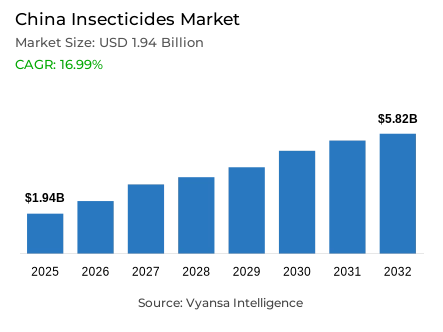
- Insecticides market size in China was valued at USD 1.94 billion in 2025 and is estimated at USD 2.34 billion in 2026.
- The market size is expected to grow to USD 5.82 billion by 2032.
- Market to register a CAGR of around 16.99% during 2026-32.
- Origin Shares
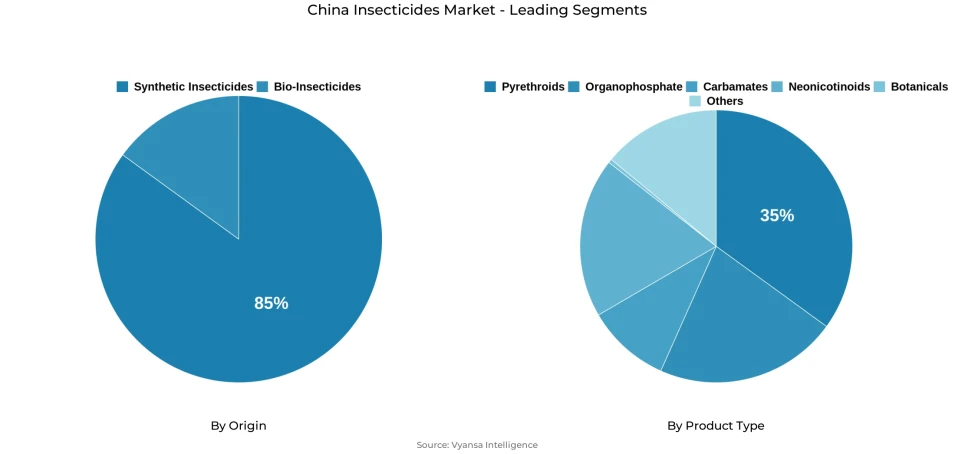
- Synthetic insecticides grabbed market share of 85%.
- Competition
- More than 10 companies are actively engaged in producing insecticides in China.
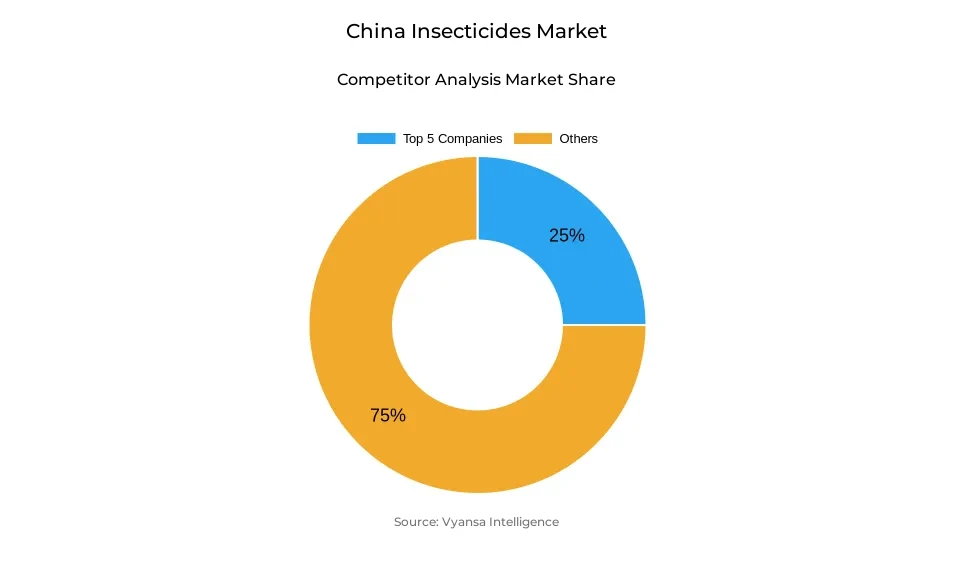
- Top 5 companies acquired around 25% of the market share.
- BASF SE, Corteva Inc., FMC Corporation, Syngenta Group Co., Ltd., ADAMA Ltd. etc., are few of the top companies.
- Product Type
- Pyrethroids grabbed 35% of the market.
China Insecticides Market Outlook
The china insecticides market size was valued at USD 1.94 billion in 2025 and is projected to grow from USD 2.34 billion in 2026 to USD 5.82 billion by 2032, exhibiting a CAGR of 16.99% during the forecast period. Demand expands as growers protect grain, cotton, oilseeds, vegetables, fruits, tea, and greenhouse crops from pest pressure affecting yield, quality, and harvest reliability.
insecticides are used against aphids, beetles, moth larvae, armyworms, borers, rice planthoppers, fall armyworm, whiteflies, thrips, and other sucking or chewing pests. These insects can damage leaves, stems, roots, flowers, bolls, grain formation, and marketable produce before losses are fully visible. This keeps crop protection linked to food security and commercial farming economics across high-volume staple crops and quality-sensitive horticulture.
The market reflects field-level treatment decisions rather than broad pesticide use alone. Growers apply products when monitoring data, crop stage, pest density, weather conditions, and expected yield loss justify treatment. Product choice depends on crop label, speed of action, resistance risk, residue compliance, pre-harvest interval, application method, formulation quality, and fit with green prevention and control programs. Pesticide category structure also supports relevance, as insecticides remain the second major pesticide group after herbicides in national demand reporting for 2025 crop-protection planning and procurement across china overall.
The outlook remains positive but increasingly disciplined. Synthetic products remain important for rapid control, while biological tools, monitoring systems, precision spraying, drone-based application, and lower-risk formulations gain relevance. Future adoption will depend on pest intensity, registration discipline, provincial crop patterns, pesticide reduction policy, maximum residue limits, and technical support for targeted pest-control programs. The insecticides market in china is moving toward selective, evidence-led use, where value depends on efficacy, compliant labeling, crop timing, and advisory-led pest monitoring. Demand remains strongest where outbreak risk threatens staple output, specialty crop quality, and harvest reliability.
China Insecticides Market Growth Driver
Pest Pressure Keeps Crop Protection Essential
The strongest driver is the need to protect crops where pest and disease pressure can quickly affect grain formation, leaf area, fruit quality, and harvest timing. National plant-protection reporting for 2024 stated that major diseases and pests across wheat, rice, and maize had an actual occurrence area of 2.41 billion mu-times after effective control, while nationwide control operations reached 5.981 billion mu-times. This is stronger than crop-area evidence because it shows active plant-protection work rather than only cultivated scale.
The evidence should be read carefully because these figures cover disease and pest control, not insecticides alone. Still, they directly support demand for crop protection systems that include insect-control products where rice planthoppers, corn borers, fall armyworm, aphids, caterpillars, and beetles cross economic thresholds. The same reporting states that effective control recovered more than 61 million tons of losses across the three major grain crops, showing why treatment readiness matters for food security. Demand therefore remains tied to monitoring, outbreak warnings, treatment windows, and crop yield protection, especially when pests threaten staple output and specialty crop quality. This keeps the china insecticides market anchored in operational risk reduction, not broad chemical-use expansion across farming regions and crop calendars each production season.
China Insecticides Market Challenge
Registration and Safe-Use Requirements Tighten Adoption
The main challenge is regulatory discipline around pesticide registration, safe use, residue control, and environmental risk. china’s Ministry of Agriculture and Rural Affairs states that pesticide registration reviews whether application information and data are authentic and comply with required test standards, while also checking applicant qualifications. This raises the technical burden for manufacturers because products must be supported by valid data, approved uses, correct labeling, and reliable field-use instructions before adoption can scale across rice, maize, cotton, vegetables, fruits, and tea.
The barrier continues after approval. Growers must match products with registered crops, target pests, dosage, timing, pre-harvest intervals, and label conditions. Weak guidance can create residue compliance problems, poor efficacy, resistance pressure, or environmental exposure. Synthetic insecticides, biological products, and pyrethroids all need clearer stewardship because field performance depends on correct crop fit and application timing. The market therefore favors suppliers with strong registration files, formulation quality, farmer education, resistance-management support, and residue guidance. Compliance becomes a purchasing filter in vegetables, fruits, tea, and greenhouse crops where buyer testing and food-safety expectations limit poorly timed applications. This shifts competition toward label clarity and safe-use and residue support, not only active-ingredient efficacy or field price advantages for crop growers.
Unlock Market Intelligence
Explore the market potential with our data-driven report
China Insecticides Market Trend
Green Prevention Programs Reshape Product Use
The strongest trend is the shift toward green prevention, monitoring-led control, and lower-risk pest programs. china’s 2024 climate action reporting states that pesticide reduction and efficiency enhancement were rolled out, with 54.1% coverage for eco-friendly pest prevention and control of major crop diseases and pests. National plant-protection reporting also expects planting-sector pesticide use to remain at 240,000 to 250,000 tons, with biological pesticides rising slightly and insecticides remaining the second major category after herbicides.
This trend does not remove synthetic products from farming. It changes how they are used. Growers increasingly combine scouting, threshold-based spraying, biological control, pheromone tools, selective chemistry, precision application, and resistance rotation. Product adoption improves when insecticides deliver reliable efficacy with lower residue pressure and stronger fit with green prevention and control programs. The market moves toward integrated pest management, especially in rice, maize, vegetables, fruits, tea, greenhouse crops, and specialty crops. Future demand favors products that support resistance management, advisory-led use, and practical farm schedules without encouraging blanket spraying. This creates room for bio-insecticides, IPM-compatible insecticides, and formulation and monitoring support systems that help growers reduce unnecessary applications while protecting crop quality and harvest timing in high-value fields and protected cultivation settings.
China Insecticides Market Opportunity
Smart Spraying Opens Precision-Control Potential
The strongest opportunity lies in precision application through smart agriculture and plant-protection equipment. National plant-protection reporting states that china’s plant-protection drone stock reached 251,000 units by the end of 2024, with cumulative control operations covering 2.67 billion mu-times. It also projected 2025 demand for more than 60,000 drones and operating area above 3 billion mu-times. This gives precision spraying stronger national relevance than a single city-level example.
The opportunity is narrower than broad pesticide growth. Drone-based spraying can improve coverage, reduce waste, support faster response when pests appear, and connect treatment with monitoring data. Insecticide suppliers benefit when formulations are compatible with drones, service providers, digital warning systems, and large-scale operations. Demand becomes more technical as growers require products with stable dilution behavior, coverage reliability, label clarity, and fit with rice, maize, vegetables, fruits, and specialty crop programs. The commercial upside is better application discipline and service-led use, not simple volume expansion. This positions precision spraying as a focused value pocket for insecticide products that support targeted intervention under provincial pest-warning systems. Adoption is strongest where farm-service providers combine pest detection, spraying capacity, and farmer guidance into one operating model for efficient crop treatment service programs regionally.
Unlock Market Intelligence
Explore the market potential with our data-driven report
China Insecticides Market Segmentation Analysis
By Origin
- Synthetic Insecticides
- Bio-Insecticides
The segment with the highest share under the Origin category is Synthetic insecticides, holding around 85% of the market, based on supplied market-share input. Synthetic products lead because they provide rapid knockdown, established field performance, wide grower familiarity, and clearer use protocols against major insect groups. Growers rely on them when pest pressure threatens rice, wheat, maize, cotton, vegetables, fruits, tea, and other commercial crops during sensitive growth stages.
Biological products are gaining relevance under green prevention programs, but they remain behind in many commercial field applications because performance can depend more on pest stage, temperature, humidity, formulation stability, and application timing. Synthetic insecticides remain central where growers need immediate suppression and predictable field response across high-volume crop systems and provinces. Future demand will depend on residue compliance, pesticide reduction policy, resistance management, and integration with biological control tools. The segment’s leadership is practical because fast field response still matters when untreated pests can affect yield, quality, and harvest timing. The emerging shift is disciplined rotation, where synthetic chemistry supports integrated programs rather than routine blanket spraying. This strengthens fit with registration and label rules, buyer residue expectations, and farmer demand for reliable crop-risk control during localized pest outbreaks.
By Product Type
- Pyrethroids
- Organophosphate
- Carbamates
- Neonicotinoids
- Botanicals
- Others
The segment with the highest share under the Product Type category is Pyrethroids, holding around 35% of the market, based on supplied market-share input. Pyrethroids lead because they are familiar and fast synthetic insecticides with fast knockdown, broad field utility, and practical fit where approved labels allow quick treatment against chewing and selected sucking pests. Their role is strongest when treatment windows are short and growers need visible suppression to protect crop quality and harvest timing.
IRAC classifies pyrethroids and pyrethrins under Group 3A sodium-channel modulators, which keep sodium channels open and cause hyperexcitation or nerve block in insects. This mode-of-action evidence is cleaner for a china report because IRAC is used internationally for resistance management. Organophosphates, carbamates, neonicotinoids, botanicals, and biological products remain alternatives where residue exposure, pest spectrum, or resistance risk requires different crop-use choices overall. Future pyrethroid demand depends on correct dosage, label compliance, rotation, and integration with biological or lower-risk tools. Pyrethroids remain important, but their long-term role depends on disciplined resistance-management planning rather than repeated single-mode use in fields. This keeps relevance tied to approved crop uses, pest thresholds, seasonal timing, applicator discipline, and advisory-led programs across rice, maize, cotton, vegetables, fruits, and tea systems.
List of Companies Covered in China Insecticides Market
The companies listed below are highly influential in the China insecticides market, with a significant market share and a strong impact on industry developments.
- BASF SE
- Corteva Inc.
- FMC Corporation
- Syngenta Group Co., Ltd.
- ADAMA Ltd.
- Jiangsu Yangnong Chemical Co. Ltd.
- Shandong Weifang Rainbow Chemical Co., Ltd.
- Bayer AG
- Zhejiang Xinan Chemical Industrial Group Co. Ltd.
- Lier Chemical Co. Ltd.
Market News & Updates
- BASF SE, 2025:
BASF announced Prexio Active registration activity in February 2025 and identified China among key Asia-Pacific countries expected to follow the first market introductions. The active ingredient is designed for rice hopper control and classified as IRAC Group 4E, with no known cross-resistance to market standards. The update adds a new rice-focused insecticide pipeline option for China’s insect pest control systems across paddy rice production and related crop protection programs in key provinces nationally. for regional rice growers. in China. market
- Syngenta Group Co., 2026:
Syngenta Group reported in March 2026 that its new Nantong crop protection formulation plant in China was completed and inaugurated in January 2026. The company also noted that crop protection technologies, biologicals and product approvals supported its 2025 performance. The facility strengthens local formulation capability for Syngenta’s Chinese crop protection operations, supporting supply of formulated products used across herbicide, fungicide, insecticide and biological crop-protection categories in China for agricultural customers and distributors. across priority crop systems. in China today. overall.
Frequently Asked Questions
Related Report
- Market Segmentation
- Research Scope
- Research Methodology
- Definitions and Assumptions
- Executive Summary
- China Insecticides Market Policies, Regulations, and Standards
- China Insecticides Market Dynamics
- Growth Factors
- Challenges
- Trends
- Opportunities
- China Insecticides Market Statistics, 2022-2032F
- Market Size & Growth Outlook
- By Revenues in USD Million
- By Quantity Sold in Million Tons
- Market Segmentation & Growth Outlook
- By Origin
- Synthetic Insecticides- Market Insights and Forecast 2022-2032, USD Million
- Bio-Insecticides- Market Insights and Forecast 2022-2032, USD Million
- By Product Type
- Pyrethroids- Market Insights and Forecast 2022-2032, USD Million
- Organophosphate- Market Insights and Forecast 2022-2032, USD Million
- Carbamates- Market Insights and Forecast 2022-2032, USD Million
- Neonicotinoids- Market Insights and Forecast 2022-2032, USD Million
- Botanicals- Market Insights and Forecast 2022-2032, USD Million
- Others- Market Insights and Forecast 2022-2032, USD Million
- By Crop Type
- Cereals & Grains- Market Insights and Forecast 2022-2032, USD Million
- Oilseeds & Pulses- Market Insights and Forecast 2022-2032, USD Million
- Fruits & Vegetables- Market Insights and Forecast 2022-2032, USD Million
- Commercial Crops- Market Insights and Forecast 2022-2032, USD Million
- Others- Market Insights and Forecast 2022-2032, USD Million
- By Form
- Sprays- Market Insights and Forecast 2022-2032, USD Million
- Baits- Market Insights and Forecast 2022-2032, USD Million
- Strips- Market Insights and Forecast 2022-2032, USD Million
- By Formulation
- Wettable Powder- Market Insights and Forecast 2022-2032, USD Million
- Emulsifiable Concentrate- Market Insights and Forecast 2022-2032, USD Million
- Suspension Concentrate- Market Insights and Forecast 2022-2032, USD Million
- Granules- Market Insights and Forecast 2022-2032, USD Million
- Others- Market Insights and Forecast 2022-2032, USD Million
- By Insect Pest Type
- Sucking Pest Insecticides- Market Insights and Forecast 2022-2032, USD Million
- Biting and Chewing Pest Insecticides- Market Insights and Forecast 2022-2032, USD Million
- By Region
- North- Market Insights and Forecast 2022-2032, USD Million
- East- Market Insights and Forecast 2022-2032, USD Million
- Southwest- Market Insights and Forecast 2022-2032, USD Million
- Northwest- Market Insights and Forecast 2022-2032, USD Million
- North East- Market Insights and Forecast 2022-2032, USD Million
- South- Market Insights and Forecast 2022-2032, USD Million
- By Competitors
- Competition Characteristics
- Market Share & Analysis
- By Origin
- Market Size & Growth Outlook
- China Synthetic Insecticides Market Statistics, 2022-2032
- Market Size & Growth Outlook
- By Revenues in USD Million
- By Quantity Sold in Million Tons
- Market Segmentation & Growth Outlook
- By Product Type- Market Insights and Forecast 2022-2032, USD Million
- By Crop Type- Market Insights and Forecast 2022-2032, USD Million
- By Form- Market Insights and Forecast 2022-2032, USD Million
- By Formulation- Market Insights and Forecast 2022-2032, USD Million
- By Insect Pest Type- Market Insights and Forecast 2022-2032, USD Million
- By Region- Market Insights and Forecast 2022-2032, USD Million
- Market Size & Growth Outlook
- China Bio-Insecticides Market Statistics, 2022-2032
- Market Size & Growth Outlook
- By Revenues in USD Million
- By Quantity Sold in Million Tons
- Market Segmentation & Growth Outlook
- By Product Type- Market Insights and Forecast 2022-2032, USD Million
- By Crop Type- Market Insights and Forecast 2022-2032, USD Million
- By Form- Market Insights and Forecast 2022-2032, USD Million
- By Formulation- Market Insights and Forecast 2022-2032, USD Million
- By Insect Pest Type- Market Insights and Forecast 2022-2032, USD Million
- By Region- Market Insights and Forecast 2022-2032, USD Million
- Market Size & Growth Outlook
- Competitive Outlook
- Company Profiles
- Syngenta Group Co., Ltd.
- Business Description
- Product Portfolio
- Collaborations & Alliances
- Recent Developments
- Financial Details
- Others
- ADAMA Ltd.
- Business Description
- Product Portfolio
- Collaborations & Alliances
- Recent Developments
- Financial Details
- Others
- Jiangsu Yangnong Chemical Co., Ltd.
- Business Description
- Product Portfolio
- Collaborations & Alliances
- Recent Developments
- Financial Details
- Others
- Shandong Weifang Rainbow Chemical Co., Ltd.
- Business Description
- Product Portfolio
- Collaborations & Alliances
- Recent Developments
- Financial Details
- Others
- Bayer AG
- Business Description
- Product Portfolio
- Collaborations & Alliances
- Recent Developments
- Financial Details
- Others
- BASF SE
- Business Description
- Product Portfolio
- Collaborations & Alliances
- Recent Developments
- Financial Details
- Others
- Corteva, Inc.
- Business Description
- Product Portfolio
- Collaborations & Alliances
- Recent Developments
- Financial Details
- Others
- FMC Corporation
- Business Description
- Product Portfolio
- Collaborations & Alliances
- Recent Developments
- Financial Details
- Others
- Zhejiang Xinan Chemical Industrial Group Co., Ltd.
- Business Description
- Product Portfolio
- Collaborations & Alliances
- Recent Developments
- Financial Details
- Others
- Lier Chemical Co., Ltd.
- Business Description
- Product Portfolio
- Collaborations & Alliances
- Recent Developments
- Financial Details
- Others
- Syngenta Group Co., Ltd.
- Company Profiles
- Disclaimer
| Segment | Sub-Segment |
|---|---|
| By Origin |
|
| By Product Type |
|
| By Crop Type |
|
| By Form |
|
| By Formulation |
|
| By Insect Pest Type |
|
| By Region |
|
Research Methodology
This study followed a structured approach comprising four key phases to assess the size and scope of the electro-oxidation market. The process began with thorough secondary research to collect data on the target market, related markets, and broader industry context. These findings, along with preliminary assumptions and estimates, were then validated through extensive primary research involving industry experts from across the value chain. To calculate the overall market size, both top-down and bottom-up methodologies were employed. Finally, market segmentation and data triangulation techniques were applied to refine and validate segment-level estimations.
Secondary Research
The secondary research phase involved gathering data from a wide range of credible and published sources. This step helped in identifying industry trends, defining market segmentation, and understanding the market landscape and value chain.
Sources consulted during this phase included:
- Company annual reports, investor presentations, and press releases
- Industry white papers and certified publications
- Trade directories and market-recognized databases
- Articles from authoritative authors and reputable journals
- Gold and silver standard websites
Secondary research was critical in mapping out the industry's value chain and monetary flow, identifying key market segments, understanding regional variations, and tracking significant industry developments.
Other key sources:
- Financial disclosures
- Industry associations and trade bodies
- News outlets and business magazines
- Academic journals and research studies
- Paid industry databases
Primary Research
To validate secondary data and gain deeper market insights, primary research was conducted with key stakeholders across both the supply and demand sides of the market.
On the demand side, participants included decision-makers and influencers from end-user industries—such as CIOs, CTOs, and CSOs—who provided first-hand perspectives on market needs, product usage, and future expectations.
On the supply side, interviews were conducted with manufacturers, industry associations, and institutional participants to gather insights into current offerings, product pipelines, and market challenges.
Primary interviews provided critical inputs such as:
- Market size and revenue data
- Product and service breakdowns
- Market forecasts
- Regional and application-specific trends
Stakeholders consulted included:
- Leading OEM and solution providers
- Channel and distribution partners
- End users across various applications
- Independent consultants and industry specialists
Market Size Estimation and Data Triangulation
- Identifying Key Market Participants (Secondary Research)
- Goal: To identify the major players or companies in the target market. This typically involves using publicly available data sources such as industry reports, market research publications, and financial statements of companies.
- Tools: Reports from firms like Gartner, Forrester, Euromonitor, Statista, IBISWorld, and others. Public financial statements, news articles, and press releases from top market players.
- Extracting Earnings of Key Market Participants
- Goal: To estimate the earnings generated from the product or service being analyzed. This step helps in understanding the revenue potential of each market player in a specific geography.
- Methods: Earnings data can be gathered from:
- Publicly available financial reports (for listed companies).
- Interviews and primary data sources from professionals, such as Directors, VPs, SVPs, etc. This is especially useful for understanding more nuanced, internal data that isn't publicly disclosed.
- Annual reports and investor presentations of key players.
- Data Collation and Development of a Relevant Data Model
- Goal: To collate inputs from both primary and secondary sources into a structured, data-driven model for market estimation. This model will incorporate key market KPIs and any independent variables relevant to the market.
- Key KPIs: These could include:
- Market size, growth rate, and demand drivers.
- Industry-specific metrics like market share, average revenue per customer (ARPC), or average deal size.
- External variables, such as economic growth rates, inflation rates, or commodity prices, that could affect the market.
- Data Modeling: Based on this data, the market forecasts are developed for the next 5 years. A combination of trend analysis, scenario modeling, and statistical regression might be used to generate projections.
- Scenario Analysis
- Goal: To test different assumptions and validate how sensitive the market is to changes in key variables (e.g., market demand, regulatory changes, technological disruptions).
- Types of Scenarios:
- Base Case: Based on current assumptions and historical data.
- Best-Case Scenario: Assuming favorable market conditions, regulatory environments, and technological advancements.
- Worst-Case Scenario: Accounting for adverse factors, such as economic downturns, stricter regulations, or unexpected disruptions.












