Canada Room Air Conditioners Market Report: Trends, Growth and Forecast (2026-2032)
By Product Type (Split Air Conditioners (Up to 9,000 BTU/h, 9,001-12,000 BTU/h, 12,001-18,000 BTU/h, 18,001-24,000 BTU/h, Above 24,000 BTU/h), Window Air Conditioners (Up to 9,000 BTU/h, 9,001-12,000 BTU/h, 12,001-18,000 BTU/h, 18,001-24,000 BTU/h, Above 24,000 BTU/h), Others), By Technology (Inverter, Non-Inverter), By Price (Up to USD 300, USD 301 to USD 600, USD 601 to USD 1,000, Above USD 1,000), By End User (Residential (Individual Households, Apartments/Condominiums, Vacation/Secondary Homes), Commercial (Offices, Retail Stores/Showrooms, Hospitality, Healthcare Facilities, Educational Institutions, Small Commercial Establishments, Others)), By Sales Channel (Retail Online (Brand-Owned Websites/D2C, E-Commerce Marketplaces), Retail Offline (Exclusive Brand Stores, Multi-Brand Electronics & Appliance Stores, Specialty Stores, Hypermarkets/Supermarkets, Home Improvement Stores, Dealer/Distributor Network, Direct Sales/Institutional Sales, Local Independent Retailers)), By Refrigerant Type (R-32, R-410A, R-290, R-454B, Others), By Connectivity (Smart/Connected, Conventional/Non-Smart), By Energy Efficiency (1 Star, 2 Star, 3 Star, 4 Star, 5 Star) ... Read more
|
Major Players
|
Canada Room Air Conditioners Market Statistics and Insights, 2026
- Market Size Statistics
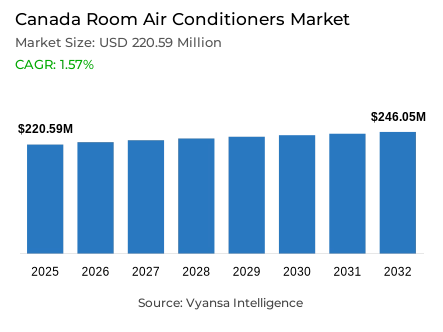
- Room air conditioners market size in Canada was valued at USD 220.59 million in 2025 and is estimated at USD 224.2 million in 2026.
- The market size is expected to grow to USD 246.05 million by 2032.
- Market to register a CAGR of around 1.57% during 2026-32.
- Product Type Shares
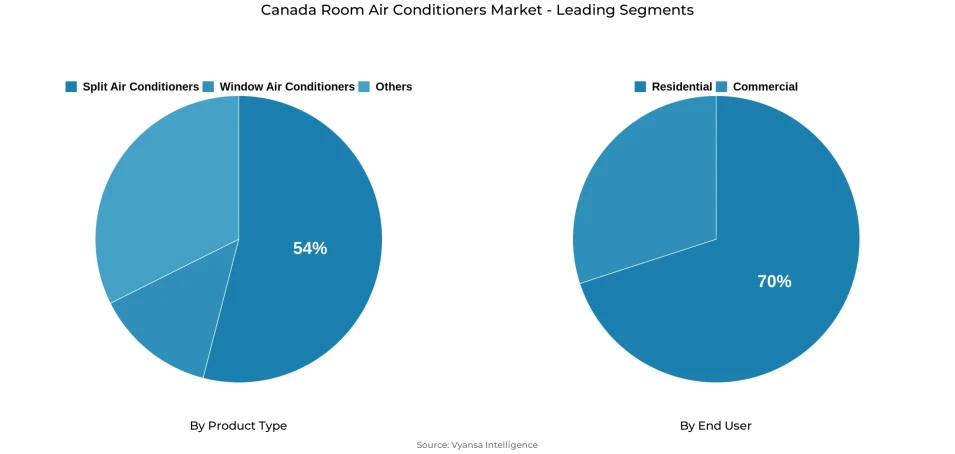
- Split air conditioners grabbed market share of 54%.
- Competition
- More than 10 companies are actively engaged in producing room air conditioners in Canada.
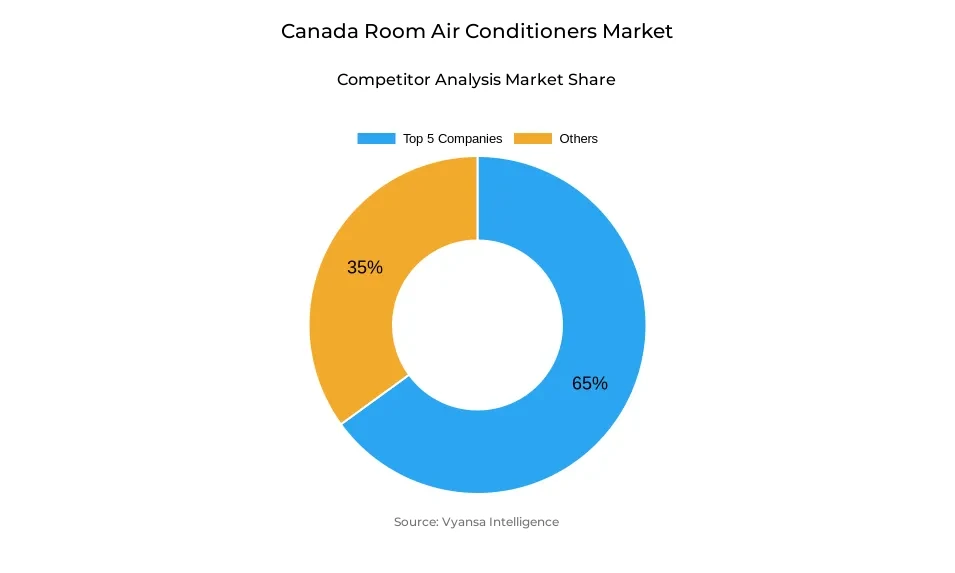
- Top 5 companies acquired around 65% of the market share.
- LG Corp, Heat Controller Inc, Samsung Corp, Noma, Danby Products Inc etc., are few of the top companies.
- End User
- Residential grabbed 70% of the market.
Canada Room Air Conditioners Market Outlook
Canada room air conditioners market size was valued at USD 220.59 million in 2025 and is projected to grow from USD 224.2 million in 2026 to USD 246.05 million by 2032, exhibiting a CAGR of 1.57% during the forecast period. Growth remains steady as hotter summer conditions continue to support cooling demand across households. Statistics Canada reports that more than 68% of Canadian households used air conditioning or similar cooling equipment in 2025, up from 64% in 2021, showing that cooling remains an important household need.
Demand continues to be supported by rising heat exposure and strong household reliance on cooling equipment. Climate research highlighted by Environment and Climate Change Canada shows that nine out of the ten hottest heat waves affecting Canada in July and August 2025 were made much more likely by climate change. In this setting, room air conditioners remain important for everyday comfort, especially as households increasingly depend on cooling systems during high temperature periods.
By product type, split air conditioners lead with around 54% share, showing that product demand remains centered on this format. Their leading position keeps them closely tied to overall category performance, especially in residential cooling. At the same time, energy efficiency is becoming a stronger market trend, as buyers increasingly compare room air conditioners through a more formal efficiency and labelling framework supported by updated Canadian regulations.
By end user, residential holds the leading share at around 70%, keeping households at the center of overall demand. Statistics Canada also shows that 75.9% of homeowners reported having air conditioning in 2025, while Canada Mortgage and Housing Corporation (CMHC) reported 259,028 housing starts in 2025. Even so, cost pressure remains important, as higher household spending on housing and utilities makes consumers more careful when buying or upgrading cooling equipment.
Canada Room Air Conditioners Market Growth DriverHeat Exposure Keeps Cooling Demand Strong
Hotter summer conditions continue to support room air conditioner demand in Canada. According to Statistics Canada, in 2025, 68% of Canadian households had air conditioning (or other similar devices) to keep cool from the summer heat; an increase from 64% in 2021. Thus, continuing the importance of cooling within the home, as households rely more upon devices to help with extreme summer temperatures.
In addition, Environment and Climate Change Canada has released their findings from their analysis of the hottest heat waves in Canada during July and August 2025. They found that 9 out of 10 of those events were made much more likely to occur due to climate change. Therefore, keeping the demand for cooling in homes at the forefront of daily life; and thus confirming the operational role of room air conditioners and comfort.
Canada Room Air Conditioners Market ChallengeHousehold Cost Pressure Limits Faster Upgrading
Cost pressure remains a key challenge for room air conditioners in Canada. Even when cooling needs are rising, households still weigh appliance spending carefully because running costs and wider living expenses affect purchase decisions. This can slow replacement cycles and make buyers more cautious when choosing between basic and higher priced models.
Statistics Canada reports that in the third quarter of 2025, growth in household consumption expenditure (+3.7%) outpaced growth in disposable income (+2.7%), driven partly by stronger spending on housing and utilities. It also reports that the annual average CPI rose 2.1% in 2025, while prices remained 19.9% higher than five years earlier.
Unlock Market Intelligence
Explore the market potential with our data-driven report
Canada Room Air Conditioners Market TrendEfficiency Rules Are Becoming More Visible
Energy efficiency is becoming a clearer trend in Canada’s room air conditioners category. Buyers increasingly have to compare products through a more formal efficiency and labelling framework, which pushes attention toward models that can deliver cooling with lower energy use. This gives more visibility to better performing products and supports a stronger efficiency led buying pattern.
Natural Resources Canada states that new room air conditioner requirements apply to products manufactured on or after May 26, 2026, while other requirements took effect on October 9, 2025. NRCan also notes that Amendment 18 to the Energy Efficiency Regulations was published in the Canada Gazette, Part II, in April 2025, and it includes room air conditioners.
Canada Room Air Conditioners Market OpportunityResidential Construction Creates Wider Installation Scope
Housing expansion creates a clear opportunity for room air conditioners in Canada. More new homes and rental units give manufacturers and retailers a broader base for installation demand, especially in urban markets where summer cooling needs are already well established. This supports stronger scope for room air conditioner placement in both owner occupied and rental residential properties.
CMHC reports that total housing starts in Canada reach 259,028 in 2025, up 5.6% from 245,367 in 2024. In centres with populations above 10,000, actual 2025 housing starts rise 6% to 241,171 units. Statistics Canada also shows that 75.9% of homeowners reported having air conditioning in 2025.
Unlock Market Intelligence
Explore the market potential with our data-driven report
Canada Room Air Conditioners Market Segmentation Analysis
By Product Type
- Split Air Conditioners
- Up to 9,000 BTU/h
- 9,001-12,000 BTU/h
- 12,001-18,000 BTU/h
- 18,001-24,000 BTU/h
- Above 24,000 BTU/h
- Window Air Conditioners
- Up to 9,000 BTU/h
- 9,001-12,000 BTU/h
- 12,001-18,000 BTU/h
- 18,001-24,000 BTU/h
- Above 24,000 BTU/h
- Others
The segment with the highest share under the product type is split air conditioners, holding around 54% of the Canada room air conditioners market. This lead shows that product demand remains centered on split units, keeping this format ahead of other room air conditioner types in the category. Its leading share also indicates that buyers continue to prefer this format for regular residential cooling needs.
Split air conditioners remain the key product segment because their leading share keeps them closely tied to overall category performance. Canada’s cooling demand base is already broad, with Statistics Canada reporting that 68% of households use air conditioning or similar cooling equipment in 2025. This large installed use base supports continued importance for the leading room air conditioner format.
By End User
- Residential
- Individual Households
- Apartments/Condominiums
- Vacation/Secondary Homes
- Commercial
- Offices
- Retail Stores/Showrooms
- Hospitality
- Healthcare Facilities
- Educational Institutions
- Small Commercial Establishments
- Others
The segment with the highest share under the end user is residential, accounting for around 70% of the Canada room air conditioners market. This lead shows that household use remains the main demand base for room air conditioners and keeps residential installations at the center of overall market activity.
Residential stays ahead because cooling use is already widespread at household level. Statistics Canada reports that in 2025, 68.3% of households used air conditioning, while the share rises to 75.9% among homeowners and 80.3% in homes built in 2001 and later. These figures support the strong position of residential demand in room air conditioners across Canada.
List of Companies Covered in Canada Room Air Conditioners Market
The companies listed below are highly influential in the Canada room air conditioners market, with a significant market share and a strong impact on industry developments.
- LG Corp
- Heat Controller Inc
- Samsung Corp
- Noma
- Danby Products Inc
- Midea Group Co Ltd
- Hisense Group
- Haier Group
- Electrolux AB
Market News & Updates
- Midea Group Co Ltd, 2026:
As of 2026, Midea Canada is highlighting the 8,000 BTU Window Air Conditioner (MWMWT080CR2A) as a new addition to its local room air conditioner portfolio, strengthening its offering in the smart and easy-install cooling segment. According to Midea Canada’s official product page, the unit features Wi-Fi connectivity, compatibility with the MSmartHome app, Alexa and Google Assistant support, a ComfortSense remote, three fan speeds, three cooling modes, R32 refrigerant, and cooling coverage of up to 350 sq. ft.. For the Canadian room air conditioner market, this development is important because it reflects Midea’s continued focus on innovation-led residential cooling products that combine convenience, connected functionality, and practical installation for apartment and small-home users, thereby strengthening its competitiveness in the smart window AC category.
- Hisense Group, 2025:
In January 2025, Hisense Canada introduced its Smart UltraSlim Window Air Conditioner and Smart Tower Portable Air Conditioner through its official CES 2025 announcement, marking a notable innovation-focused development in the country’s room air conditioner segment. The company stated that the 12,000 BTU inverter Smart UltraSlim Window AC is designed for spaces up to 550 sq. ft. and operates 34% quieter than traditional models, while the tower portable model adds smart, space-saving cooling with a more premium design approach. Hisense’s current Canada product pages also show these newer window and portable air conditioner models as active additions in its local portfolio, indicating that the launch supported a broader market rollout rather than a limited showcase. For the Canadian room air conditioner market, this development is important because it strengthens Hisense’s position in smart and inverter-based cooling, while increasing competitive pressure around quieter operation, connected features, modern design, and energy-efficient performance.
Frequently Asked Questions
Related Report
- Market Segmentation
- Research Scope
- Research Methodology
- Definitions and Assumptions
- Executive Summary
- Canada Room Air Conditioners Market Policies, Regulations, and Standards
- Canada Room Air Conditioners Market Dynamics
- Growth Factors
- Challenges
- Trends
- Opportunities
- Canada Room Air Conditioners Market Statistics, 2022-2032F
- Market Size & Growth Outlook
- By Revenues in USD Million
- By Units Sold in Thousand Units
- Market Segmentation & Growth Outlook
- By Product Type
- Split Air Conditioners- Market Insights and Forecast 2022-2032, USD Million
- Up to 9,000 BTU/h- Market Insights and Forecast 2022-2032, USD Million
- 9,001-12,000 BTU/h- Market Insights and Forecast 2022-2032, USD Million
- 12,001-18,000 BTU/h- Market Insights and Forecast 2022-2032, USD Million
- 18,001-24,000 BTU/h- Market Insights and Forecast 2022-2032, USD Million
- Above 24,000 BTU/h- Market Insights and Forecast 2022-2032, USD Million
- Window Air Conditioners- Market Insights and Forecast 2022-2032, USD Million
- Up to 9,000 BTU/h- Market Insights and Forecast 2022-2032, USD Million
- 9,001-12,000 BTU/h- Market Insights and Forecast 2022-2032, USD Million
- 12,001-18,000 BTU/h- Market Insights and Forecast 2022-2032, USD Million
- 18,001-24,000 BTU/h- Market Insights and Forecast 2022-2032, USD Million
- Above 24,000 BTU/h- Market Insights and Forecast 2022-2032, USD Million
- Others- Market Insights and Forecast 2022-2032, USD Million
- Split Air Conditioners- Market Insights and Forecast 2022-2032, USD Million
- By Technology
- Inverter- Market Insights and Forecast 2022-2032, USD Million
- Non-Inverter- Market Insights and Forecast 2022-2032, USD Million
- By Price
- Up to USD 300- Market Insights and Forecast 2022-2032, USD Million
- USD 301 to USD 600- Market Insights and Forecast 2022-2032, USD Million
- USD 601 to USD 1,000- Market Insights and Forecast 2022-2032, USD Million
- Above USD 1,000- Market Insights and Forecast 2022-2032, USD Million
- By End User
- Residential- Market Insights and Forecast 2022-2032, USD Million
- Individual Households- Market Insights and Forecast 2022-2032, USD Million
- Apartments/Condominiums- Market Insights and Forecast 2022-2032, USD Million
- Vacation/Secondary Homes- Market Insights and Forecast 2022-2032, USD Million
- Commercial- Market Insights and Forecast 2022-2032, USD Million
- Offices- Market Insights and Forecast 2022-2032, USD Million
- Retail Stores/Showrooms- Market Insights and Forecast 2022-2032, USD Million
- Hospitality- Market Insights and Forecast 2022-2032, USD Million
- Healthcare Facilities- Market Insights and Forecast 2022-2032, USD Million
- Educational Institutions- Market Insights and Forecast 2022-2032, USD Million
- Small Commercial Establishments- Market Insights and Forecast 2022-2032, USD Million
- Others- Market Insights and Forecast 2022-2032, USD Million
- Residential- Market Insights and Forecast 2022-2032, USD Million
- By Sales Channel
- Retail Online- Market Insights and Forecast 2022-2032, USD Million
- Brand-Owned Websites/D2C- Market Insights and Forecast 2022-2032, USD Million
- E-Commerce Marketplaces- Market Insights and Forecast 2022-2032, USD Million
- Retail Offline- Market Insights and Forecast 2022-2032, USD Million
- Exclusive Brand Stores- Market Insights and Forecast 2022-2032, USD Million
- Multi-Brand Electronics & Appliance Stores- Market Insights and Forecast 2022-2032, USD Million
- Specialty Stores- Market Insights and Forecast 2022-2032, USD Million
- Hypermarkets/Supermarkets- Market Insights and Forecast 2022-2032, USD Million
- Home Improvement Stores- Market Insights and Forecast 2022-2032, USD Million
- Dealer/Distributor Network- Market Insights and Forecast 2022-2032, USD Million
- Direct Sales/Institutional Sales- Market Insights and Forecast 2022-2032, USD Million
- Local Independent Retailers- Market Insights and Forecast 2022-2032, USD Million
- Retail Online- Market Insights and Forecast 2022-2032, USD Million
- By Refrigerant Type
- R-32- Market Insights and Forecast 2022-2032, USD Million
- R-410A- Market Insights and Forecast 2022-2032, USD Million
- R-290- Market Insights and Forecast 2022-2032, USD Million
- R-454B- Market Insights and Forecast 2022-2032, USD Million
- Others- Market Insights and Forecast 2022-2032, USD Million
- By Connectivity
- Smart/Connected- Market Insights and Forecast 2022-2032, USD Million
- Conventional/Non-Smart- Market Insights and Forecast 2022-2032, USD Million
- By Energy Efficiency
- 1 Star- Market Insights and Forecast 2022-2032, USD Million
- 2 Star- Market Insights and Forecast 2022-2032, USD Million
- 3 Star- Market Insights and Forecast 2022-2032, USD Million
- 4 Star- Market Insights and Forecast 2022-2032, USD Million
- 5 Star- Market Insights and Forecast 2022-2032, USD Million
- By Competitors
- Competition Characteristics
- Market Share & Analysis
- By Product Type
- Market Size & Growth Outlook
- Canada Split Air Conditioners Market Statistics, 2022-2032
- Market Size & Growth Outlook
- By Revenues in USD Million
- By Units Sold in Thousand Units
- Market Segmentation & Growth Outlook
- By Technology- Market Insights and Forecast 2022-2032, USD Million
- By Price- Market Insights and Forecast 2022-2032, USD Million
- By End User- Market Insights and Forecast 2022-2032, USD Million
- By Sales Channel- Market Insights and Forecast 2022-2032, USD Million
- By Refrigerant Type- Market Insights and Forecast 2022-2032, USD Million
- By Connectivity- Market Insights and Forecast 2022-2032, USD Million
- By Energy Efficiency- Market Insights and Forecast 2022-2032, USD Million
- Market Size & Growth Outlook
- Canada Window Air Conditioners Market Statistics, 2022-2032
- Market Size & Growth Outlook
- By Revenues in USD Million
- By Units Sold in Thousand Units
- Market Segmentation & Growth Outlook
- By Technology- Market Insights and Forecast 2022-2032, USD Million
- By Price- Market Insights and Forecast 2022-2032, USD Million
- By End User- Market Insights and Forecast 2022-2032, USD Million
- By Sales Channel- Market Insights and Forecast 2022-2032, USD Million
- By Refrigerant Type- Market Insights and Forecast 2022-2032, USD Million
- By Connectivity- Market Insights and Forecast 2022-2032, USD Million
- By Energy Efficiency- Market Insights and Forecast 2022-2032, USD Million
- Market Size & Growth Outlook
- Competitive Outlook
- Company Profiles
- Noma
- Business Description
- Product Portfolio
- Collaborations & Alliances
- Recent Developments
- Financial Details
- Others
- Danby Products Inc
- Business Description
- Product Portfolio
- Collaborations & Alliances
- Recent Developments
- Financial Details
- Others
- Midea Group Co Ltd
- Business Description
- Product Portfolio
- Collaborations & Alliances
- Recent Developments
- Financial Details
- Others
- Hisense Group
- Business Description
- Product Portfolio
- Collaborations & Alliances
- Recent Developments
- Financial Details
- Others
- Haier Group
- Business Description
- Product Portfolio
- Collaborations & Alliances
- Recent Developments
- Financial Details
- Others
- LG Corp
- Business Description
- Product Portfolio
- Collaborations & Alliances
- Recent Developments
- Financial Details
- Others
- Heat Controller Inc
- Business Description
- Product Portfolio
- Collaborations & Alliances
- Recent Developments
- Financial Details
- Others
- Samsung Corp
- Business Description
- Product Portfolio
- Collaborations & Alliances
- Recent Developments
- Financial Details
- Others
- Electrolux AB
- Business Description
- Product Portfolio
- Collaborations & Alliances
- Recent Developments
- Financial Details
- Others
- Others
- Business Description
- Product Portfolio
- Collaborations & Alliances
- Recent Developments
- Financial Details
- Others
- Noma
- Company Profiles
- Disclaimer
| Segment | Sub-Segment |
|---|---|
| By Product Type |
|
| By Technology |
|
| By Price |
|
| By End User |
|
| By Sales Channel |
|
| By Refrigerant Type |
|
| By Connectivity |
|
| By Energy Efficiency |
|
Research Methodology
This study followed a structured approach comprising four key phases to assess the size and scope of the electro-oxidation market. The process began with thorough secondary research to collect data on the target market, related markets, and broader industry context. These findings, along with preliminary assumptions and estimates, were then validated through extensive primary research involving industry experts from across the value chain. To calculate the overall market size, both top-down and bottom-up methodologies were employed. Finally, market segmentation and data triangulation techniques were applied to refine and validate segment-level estimations.
Secondary Research
The secondary research phase involved gathering data from a wide range of credible and published sources. This step helped in identifying industry trends, defining market segmentation, and understanding the market landscape and value chain.
Sources consulted during this phase included:
- Company annual reports, investor presentations, and press releases
- Industry white papers and certified publications
- Trade directories and market-recognized databases
- Articles from authoritative authors and reputable journals
- Gold and silver standard websites
Secondary research was critical in mapping out the industry's value chain and monetary flow, identifying key market segments, understanding regional variations, and tracking significant industry developments.
Other key sources:
- Financial disclosures
- Industry associations and trade bodies
- News outlets and business magazines
- Academic journals and research studies
- Paid industry databases
Primary Research
To validate secondary data and gain deeper market insights, primary research was conducted with key stakeholders across both the supply and demand sides of the market.
On the demand side, participants included decision-makers and influencers from end-user industries—such as CIOs, CTOs, and CSOs—who provided first-hand perspectives on market needs, product usage, and future expectations.
On the supply side, interviews were conducted with manufacturers, industry associations, and institutional participants to gather insights into current offerings, product pipelines, and market challenges.
Primary interviews provided critical inputs such as:
- Market size and revenue data
- Product and service breakdowns
- Market forecasts
- Regional and application-specific trends
Stakeholders consulted included:
- Leading OEM and solution providers
- Channel and distribution partners
- End users across various applications
- Independent consultants and industry specialists
Market Size Estimation and Data Triangulation
- Identifying Key Market Participants (Secondary Research)
- Goal: To identify the major players or companies in the target market. This typically involves using publicly available data sources such as industry reports, market research publications, and financial statements of companies.
- Tools: Reports from firms like Gartner, Forrester, Euromonitor, Statista, IBISWorld, and others. Public financial statements, news articles, and press releases from top market players.
- Extracting Earnings of Key Market Participants
- Goal: To estimate the earnings generated from the product or service being analyzed. This step helps in understanding the revenue potential of each market player in a specific geography.
- Methods: Earnings data can be gathered from:
- Publicly available financial reports (for listed companies).
- Interviews and primary data sources from professionals, such as Directors, VPs, SVPs, etc. This is especially useful for understanding more nuanced, internal data that isn't publicly disclosed.
- Annual reports and investor presentations of key players.
- Data Collation and Development of a Relevant Data Model
- Goal: To collate inputs from both primary and secondary sources into a structured, data-driven model for market estimation. This model will incorporate key market KPIs and any independent variables relevant to the market.
- Key KPIs: These could include:
- Market size, growth rate, and demand drivers.
- Industry-specific metrics like market share, average revenue per customer (ARPC), or average deal size.
- External variables, such as economic growth rates, inflation rates, or commodity prices, that could affect the market.
- Data Modeling: Based on this data, the market forecasts are developed for the next 5 years. A combination of trend analysis, scenario modeling, and statistical regression might be used to generate projections.
- Scenario Analysis
- Goal: To test different assumptions and validate how sensitive the market is to changes in key variables (e.g., market demand, regulatory changes, technological disruptions).
- Types of Scenarios:
- Base Case: Based on current assumptions and historical data.
- Best-Case Scenario: Assuming favorable market conditions, regulatory environments, and technological advancements.
- Worst-Case Scenario: Accounting for adverse factors, such as economic downturns, stricter regulations, or unexpected disruptions.












