Bolivia Dermatologicals Market Report: Trends, Growth and Forecast (2026-2032)
By Category (Medicated Shampoos, Topical Antifungals, Vaginal Antifungals, Hair Loss Treatments, Nappy (Diaper) Rash Treatments, Antiparasitics/Lice (Head and Body) Treatments, Antipruritics, Cold Sore Treatments, Haemorrhoid Treatments, Paediatric Dermatologicals, Topical Allergy Remedies/Antihistamines, Topical Germicidals/Antiseptics), By Dispensing Status (Prescription-based Drugs, Over-the-counter Drugs), By Route of Administration (Topical Administration, Oral Administration, Parenteral Administration), By Drug Type (Branded, Generics), By Skin Condition (Acne, Dermatitis, Psoriasis, Skin Cancer, Rosacea, Alopecia, Fungal Infections, Others), By End User (Hospitals, Cosmetic Centers, Dermatology Clinics, Homecare, Others), By Sales Channel (Retail Offline, Retail Online) ... Read more
|
Major Players
|
Bolivia Dermatologicals Market Statistics and Insights, 2026
- Market Size Statistics
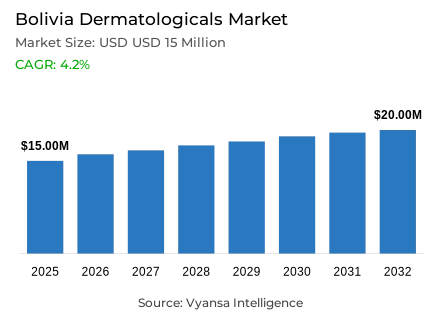
- Dermatologicals in Bolivia is estimated at USD 15 million in 2025.
- The market size is expected to grow to USD 20 million by 2032.
- Market to register a cagr of around 4.2% during 2026-32.
- Category Shares
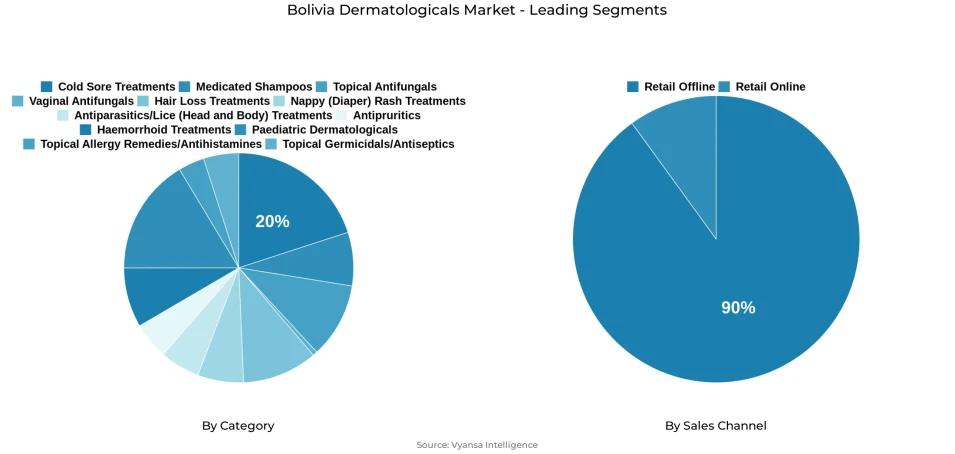
- Cold sore treatments grabbed market share of 20%.
- Competition
- More than 15 companies are actively engaged in producing dermatologicals in Bolivia.
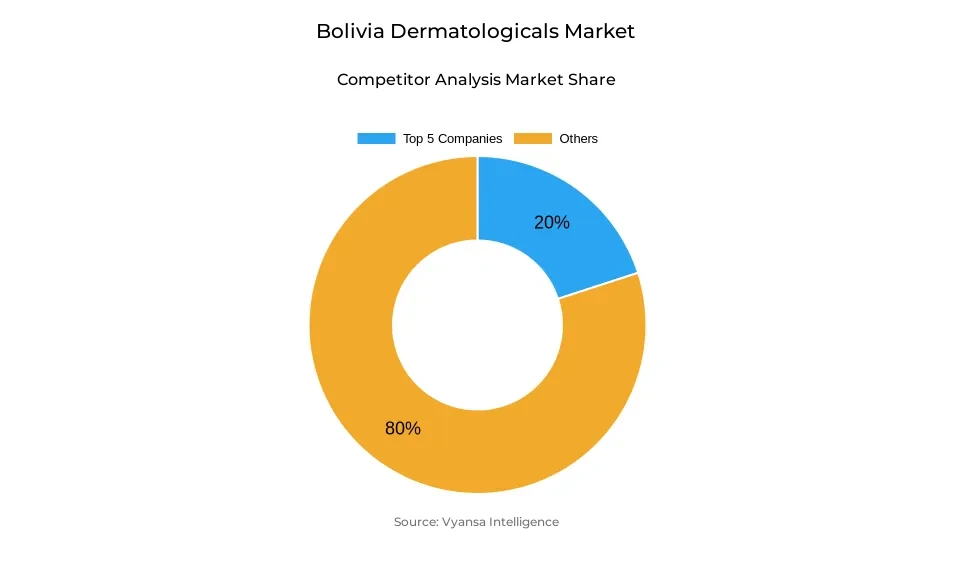
- Top 5 companies acquired around 20% of the market share.
- Laboratorios Bagó de Bolivia SA; Laboratorios LAFAR SA; Ifarbo Ltda; Colher Group SRL; Promedical SA etc., are few of the top companies.
- Sales Channel
- Retail offline grabbed 90% of the market.
Bolivia Dermatologicals Market Outlook
The Bolivia dermatological market is expected to grow to USD 15 million in 2025 to about USD 20 million in 2032, which is a compound annual growth rate of about 4.2%. The economic pressures, stress-related dermatological disorders, and frequent skin issues associated with climatic conditions and the lack of hygiene infrastructure are expected to drive growth. The fastest-growing segment is expected to be cold sore treatments, which already occupy 20% of the market, as end users demand quick and cheap therapeutic solutions. Further growth in the market will be supported by the growing end user interest in medicated shampoos, antifungals, and topical germicidals, especially as end users focus on products with efficacy and longer benefit duration.
The competitive environment will continue to be dominated by local market players, which will be supported by their affordability positioning, wide geographic distribution networks, and high penetration in the traditional retail formats. The Colher Group brands will remain visible in the market, and the Eucerin portfolio of Beiersdorf Bolivia will remain appealing to end users who want to use high-quality therapeutic products to treat chronic skin issues. With the contraband product flows decreasing and the formal Sales Channels becoming stronger, the legally registered brands are gaining end user confidence, thus enhancing product accessibility and supply stability at the point-of-sale points.
It is estimated that retail offline channels will continue to dominate the market with a market share of 90%, with pharmacy retail establishments that show high accessibility in major urban centres and intermediate cities. The constrained economic conditions and the increasing cost of medical expenditure are pushing end users to self-treatment methods of common dermatological conditions, which further supports the topicality of the pharmacy channel. At the same time, retail online is becoming the most active Sales Channel with a low starting point, which is supported by online stores like Farmacorp and Hipermaxi Farma that provide home delivery services, online payment options, and product comparison features—showing specific popularity among younger and urban end user groups.
During the 2026–2032 forecast period, the market will be influenced by the increase in demand of available therapeutic treatments, the development of Retail onlineing platforms, and the development of generic formulations that are affordable. Stress-related diseases such as haemorrhoids, loss of hair, and cold sores will continue to be major demand drivers. Sustainability efforts, including the recycling programmes of Laboratorios Bago de Bolivia, can also enhance brand reputation curves in the long run. The market is expected to evolve slowly as brands strike a balance between affordability needs, accessibility needs, and end user trust building in a difficult macroeconomic environment.
Bolivia Dermatologicals Market Growth Driver
Endemic hygiene gaps and population scale sustain baseline demand for basic dermatological care
The large and geographically dispersed population of Bolivia, combined with the lack of full coverage of the sanitation infrastructure, supports the stable base of demand of low-cost dermatological services, especially antifungals, antiparasitics/lice remedies, and topical germicidals. The total population of Bolivia was about 12.24 million in 2023, which forms the population base of pharmacy-level self-care solutions. No less powerful, in 2022, an estimated 68.6% of the population had access to at least basic sanitation services, leaving large segments of the population with increased susceptibility to hygiene-related dermatological infections.
These institutional factors population size and incomplete basic sanitation facilities—create repetitive occurrence of superficial infections and parasitism, which are usually treated at the pharmacy and primary-care levels, which in turn sustain consistent retail demand of low-cost, rapid-acting dermatological stock-keeping units even in times of macroeconomic weakness.
Bolivia Dermatologicals Market Challenge
Macro-economic strain and high poverty constrain consumer spending on non-urgent dermatological treatments
The macroeconomic conditions in Bolivia placed a negative effect on the purchasing power of households and limited discretionary spending on more expensive dermatological services. At the end of 2023, national inflation statistics were relatively contained at around 2.12%, but later periods experienced upward inflationary pressure. At the same time, the official poverty rates show that the national poverty rate is approximately 37.7% according to the latest household survey data of 2022, which significantly limits the ability to spend out-of-pocket on non-essential therapeutic services.
These economic pressures are converging to push end user demand to lower-priced generic formulations, locally produced stock-keeping units, and single-use treatment formats, and to restrain the adoption of high-end dermatological innovations that demand higher willingness-to-pay levels or repeated spending obligations.
Unlock Market Intelligence
Explore the market potential with our data-driven report
Bolivia Dermatologicals Market Trend
Market shifts toward multifunctional, plant-based and low-irritant formulations as consumers seek safer, value-for-money care
Bolivian end users are becoming more ingredient conscious and prefer mild, multi-functional, and plant-based dermatological products that integrate perceived safety benefits with affordability positioning. The economic vulnerability in the region increased during 2020–2023, and significant population groups returned to poverty levels, which strengthened the price-sensitive purchasing behavioural patterns of households. In line with this dynamic, the 2023 macroeconomic performance of Bolivia, with a moderate gross domestic product growth of around 2.5% but limited real income growth, facilitates a market environment in which multifunctional, lower-cost stock-keeping units are gaining market share.
As a result, manufacturers are focusing on product reformulation strategies that include mild active ingredients and lower allergenic excipient formulations, as well as multi-use positioning strategies such as antifungal formulations combined with moisturising barrier-care functionality, which allow them to compete differentiation without requiring significant price premium impositions.
Bolivia Dermatologicals Market Opportunity
Targeted Growth in Self-Care and Medicated Categories
Structural demand drivers refer to discrete, high-opportunity market segments in which Bolivian end users will still be interested in available over-the-counter therapeutic solutions. According to public health reporting, stress-related and hygiene-related skin diseases exhibit high prevalence in communities with low sanitation facilities and low income security. Disease surveillance operations determine vulnerable groups of the population in relation to skin infections and unattended dermatological diseases in rural and peri-urban geographic regions. Water, sanitation, and hygiene statistics that show about 68.6% access to basic sanitation services in 2022 prove the existence of significant market gaps that can be addressed by antifungals, antiparasitics, and medicated shampoo categories.
Therefore, targeted product releases of low-cost acyclovir generic preparations to treat cold sores, low-cost product lines of medicated-shampoo products to treat dandruff and seborrhoeic dermatitis, and affordable antiparasitic formats at locally competitive prices can be effective in capturing market share. Suppliers who incorporate clinical efficacy demonstration, price competitiveness, and the implementation of pharmacy education programme will be best placed to transform latent end user demand into repeat purchase patterns.
Unlock Market Intelligence
Explore the market potential with our data-driven report
Bolivia Dermatologicals Market Segmentation Analysis
By Category
- Medicated Shampoos
- Topical Antifungals
- Vaginal Antifungals
- Hair Loss Treatments
- Nappy (Diaper) Rash Treatments
- Antiparasitics/Lice (Head and Body) Treatments
- Antipruritics
- Cold Sore Treatments
- Haemorrhoid Treatments
- Paediatric Dermatologicals
- Topical Allergy Remedies/Antihistamines
- Topical Germicidals/Antiseptics
Cold Sore Treatments represent the dominant category within Bolivia's dermatologicals market, commanding a 20% market share. This category leadership position is attributable to elevated prevalence of stress-related condition flare-ups within Bolivia's challenging macroeconomic environment. Amid rising unemployment rates, inflationary pressures, and declining household income trajectories, cold sores remain among the most visible and urgent dermatological concerns, encouraging end users to seek rapid and affordable therapeutic relief. Acyclovir-based formulations have emerged as preferred therapeutic solutions attributable to their demonstrated clinical effectiveness and accessible cost positioning.
Throughout the forecast period, this category is projected to maintain its market leadership position as stress-driven conditions increase in prevalence and self-medication practices expand. Cold sore treatments benefit from robust availability across pharmacy distribution networks and expanding digital platform channels, conferring broader market reach relative to alternative dermatological segments. The category's practical positioning, immediate therapeutic need characteristics, and affordability attributes will sustain its position at the forefront of end user demand.
By Sales Channel
- Retail Offline
- Retail Online
Retail Offline channels represent the dominant sales channel within Bolivia's dermatologicals market, accounting for 90% of total market value. Pharmacies dominate Bolivia's dermatologicals distribution landscape attributable to their extensive establishment presence across major urban centers and intermediate cities, offering accessible touchpoints for price-sensitive household segments. Limited specialist healthcare service access combined with frequent supply shortages within public health system infrastructure have strengthened the functional role of neighbourhood pharmacies, where end users increasingly seek guidance and self-treatment options for common dermatological conditions.
Throughout the forecast horizon, Retail Offline channels are projected to maintain the highest market share as pharmacies retain their position as the most trusted and convenient linkage between end users and dermatological therapeutic solutions. Despite accelerating retail online channel momentum, in-person Sales Channels provide immediate access to essential treatment products and maintain strong visibility for high-demand product categories. As economic pressures persist, affordable offline product offerings combined with pharmacist-led advisory services will sustain this channel's commanding market leadership position across the forecast period.
List of Companies Covered in Bolivia Dermatologicals Market
The companies listed below are highly influential in the Bolivia dermatologicals market, with a significant market share and a strong impact on industry developments.
- Laboratorios Bagó de Bolivia SA
- Laboratorios LAFAR SA
- Ifarbo Ltda
- Colher Group SRL
- Promedical SA
- South American Express SA (SAE)
- Laboratorios Ifa SA
- Laboratorios Droguería INTI SA
- Laboratorios COFAR SA
- Beiersdorf Bolivia Srl
Competitive Landscape
Bolivia dermatologicals market remains highly fragmented, with local laboratories dominating due to their affordable pricing, strong presence in traditional retail, and focus on high-demand segments such as lice treatments, topical germicidals and cold sore remedies. Colher Group SRL stands out as the largest identifiable player through its distribution of Genomma Lab brands like Medicast, SilkaMedic and Unesia, though its share remains stable amid pressure from numerous small competitors. The most dynamic performer is Beiersdorf Bolivia SRL, fuelled by rising demand for Eucerin’s clinically positioned products targeting dry, sensitive and problem skin. Pharmacies continue to drive visibility and sales for all brands, while e-commerce—though small—is the fastest-growing channel, enabling both multinational and domestic players to expand reach and compete more effectively on assortment and pricing.
Frequently Asked Questions
Related Report
1. Market Segmentation
1.1. Research Scope
1.2. Research Methodology
1.3. Definitions and Assumptions
2. Executive Summary
3. Bolivia Dermatologicals Market Policies, Regulations, and Standards
4. Bolivia Dermatologicals Market Dynamics
4.1. Growth Factors
4.2. Challenges
4.3. Trends
4.4. Opportunities
5. Bolivia Dermatologicals Market Statistics, 2022-2032F
5.1. Market Size & Growth Outlook
5.1.1.By Revenues in USD Million
5.2. Market Segmentation & Growth Outlook
5.2.1.By Category
5.2.1.1. Medicated Shampoos- Market Insights and Forecast 2022-2032, USD Million
5.2.1.2. Topical Antifungals- Market Insights and Forecast 2022-2032, USD Million
5.2.1.3. Vaginal Antifungals- Market Insights and Forecast 2022-2032, USD Million
5.2.1.4. Hair Loss Treatments- Market Insights and Forecast 2022-2032, USD Million
5.2.1.5. Nappy (Diaper) Rash Treatments- Market Insights and Forecast 2022-2032, USD Million
5.2.1.6. Antiparasitics/Lice (Head and Body) Treatments- Market Insights and Forecast 2022-2032, USD Million
5.2.1.7. Antipruritics- Market Insights and Forecast 2022-2032, USD Million
5.2.1.8. Cold Sore Treatments- Market Insights and Forecast 2022-2032, USD Million
5.2.1.9. Haemorrhoid Treatments- Market Insights and Forecast 2022-2032, USD Million
5.2.1.10. Paediatric Dermatologicals- Market Insights and Forecast 2022-2032, USD Million
5.2.1.11. Topical Allergy Remedies/Antihistamines- Market Insights and Forecast 2022-2032, USD Million
5.2.1.12. Topical Germicidals/Antiseptics- Market Insights and Forecast 2022-2032, USD Million
5.2.2.By Dispensing Status
5.2.2.1. Prescription-based Drugs- Market Insights and Forecast 2022-2032, USD Million
5.2.2.2. Over-the-counter Drugs- Market Insights and Forecast 2022-2032, USD Million
5.2.3.By Route of Administration
5.2.3.1. Topical Administration- Market Insights and Forecast 2022-2032, USD Million
5.2.3.2. Oral Administration- Market Insights and Forecast 2022-2032, USD Million
5.2.3.3. Parenteral Administration- Market Insights and Forecast 2022-2032, USD Million
5.2.4.By Drug Type
5.2.4.1. Branded- Market Insights and Forecast 2022-2032, USD Million
5.2.4.2. Generics- Market Insights and Forecast 2022-2032, USD Million
5.2.5.By Skin Condition
5.2.5.1. Acne- Market Insights and Forecast 2022-2032, USD Million
5.2.5.2. Dermatitis- Market Insights and Forecast 2022-2032, USD Million
5.2.5.3. Psoriasis- Market Insights and Forecast 2022-2032, USD Million
5.2.5.4. Skin Cancer- Market Insights and Forecast 2022-2032, USD Million
5.2.5.5. Rosacea- Market Insights and Forecast 2022-2032, USD Million
5.2.5.6. Alopecia- Market Insights and Forecast 2022-2032, USD Million
5.2.5.7. Fungal Infections- Market Insights and Forecast 2022-2032, USD Million
5.2.5.8. Others- Market Insights and Forecast 2022-2032, USD Million
5.2.6.By End User
5.2.6.1. Hospitals- Market Insights and Forecast 2022-2032, USD Million
5.2.6.2. Cosmetic Centers- Market Insights and Forecast 2022-2032, USD Million
5.2.6.3. Dermatology Clinics- Market Insights and Forecast 2022-2032, USD Million
5.2.6.4. Homecare- Market Insights and Forecast 2022-2032, USD Million
5.2.6.5. Others- Market Insights and Forecast 2022-2032, USD Million
5.2.7.By Sales Channel
5.2.7.1. Retail Offline- Market Insights and Forecast 2022-2032, USD Million
5.2.7.2. Retail Online- Market Insights and Forecast 2022-2032, USD Million
5.2.8.By Competitors
5.2.8.1. Competition Characteristics
5.2.8.2. Market Share & Analysis
6. Bolivia Medicated Shampoos Market Statistics, 2022-2032
6.1. Market Size & Growth Outlook
6.1.1.By Revenues in USD Million
6.2. Market Segmentation & Growth Outlook
6.2.1.By Dispensing Status- Market Insights and Forecast 2022-2032, USD Million
6.2.2.By Route of Administration- Market Insights and Forecast 2022-2032, USD Million
6.2.3.By Drug Type- Market Insights and Forecast 2022-2032, USD Million
6.2.4.By Skin Condition- Market Insights and Forecast 2022-2032, USD Million
6.2.5.By End User- Market Insights and Forecast 2022-2032, USD Million
6.2.6.By Sales Channel- Market Insights and Forecast 2022-2032, USD Million
7. Bolivia Topical Antifungals Market Statistics, 2022-2032
7.1. Market Size & Growth Outlook
7.1.1.By Revenues in USD Million
7.2. Market Segmentation & Growth Outlook
7.2.1.By Dispensing Status- Market Insights and Forecast 2022-2032, USD Million
7.2.2.By Route of Administration- Market Insights and Forecast 2022-2032, USD Million
7.2.3.By Drug Type- Market Insights and Forecast 2022-2032, USD Million
7.2.4.By Skin Condition- Market Insights and Forecast 2022-2032, USD Million
7.2.5.By End User- Market Insights and Forecast 2022-2032, USD Million
7.2.6.By Sales Channel- Market Insights and Forecast 2022-2032, USD Million
8. Bolivia Vaginal Antifungals Market Statistics, 2022-2032
8.1. Market Size & Growth Outlook
8.1.1.By Revenues in USD Million
8.2. Market Segmentation & Growth Outlook
8.2.1.By Dispensing Status- Market Insights and Forecast 2022-2032, USD Million
8.2.2.By Route of Administration- Market Insights and Forecast 2022-2032, USD Million
8.2.3.By Drug Type- Market Insights and Forecast 2022-2032, USD Million
8.2.4.By Skin Condition- Market Insights and Forecast 2022-2032, USD Million
8.2.5.By End User- Market Insights and Forecast 2022-2032, USD Million
8.2.6.By Sales Channel- Market Insights and Forecast 2022-2032, USD Million
9. Bolivia Hair Loss Treatments Market Statistics, 2022-2032
9.1. Market Size & Growth Outlook
9.1.1.By Revenues in USD Million
9.2. Market Segmentation & Growth Outlook
9.2.1.By Dispensing Status- Market Insights and Forecast 2022-2032, USD Million
9.2.2.By Route of Administration- Market Insights and Forecast 2022-2032, USD Million
9.2.3.By Drug Type- Market Insights and Forecast 2022-2032, USD Million
9.2.4.By Skin Condition- Market Insights and Forecast 2022-2032, USD Million
9.2.5.By End User- Market Insights and Forecast 2022-2032, USD Million
9.2.6.By Sales Channel- Market Insights and Forecast 2022-2032, USD Million
10. Bolivia Nappy (Diaper) Rash Treatments Market Statistics, 2022-2032
10.1. Market Size & Growth Outlook
10.1.1. By Revenues in USD Million
10.2. Market Segmentation & Growth Outlook
10.2.1. By Dispensing Status- Market Insights and Forecast 2022-2032, USD Million
10.2.2. By Route of Administration- Market Insights and Forecast 2022-2032, USD Million
10.2.3. By Drug Type- Market Insights and Forecast 2022-2032, USD Million
10.2.4. By Skin Condition- Market Insights and Forecast 2022-2032, USD Million
10.2.5. By End User- Market Insights and Forecast 2022-2032, USD Million
10.2.6. By Sales Channel- Market Insights and Forecast 2022-2032, USD Million
11. Bolivia Antiparasitics/Lice (Head and Body) Treatments Market Statistics, 2022-2032
11.1. Market Size & Growth Outlook
11.1.1. By Revenues in USD Million
11.2. Market Segmentation & Growth Outlook
11.2.1. By Dispensing Status- Market Insights and Forecast 2022-2032, USD Million
11.2.2. By Route of Administration- Market Insights and Forecast 2022-2032, USD Million
11.2.3. By Drug Type- Market Insights and Forecast 2022-2032, USD Million
11.2.4. By Skin Condition- Market Insights and Forecast 2022-2032, USD Million
11.2.5. By End User- Market Insights and Forecast 2022-2032, USD Million
11.2.6. By Sales Channel- Market Insights and Forecast 2022-2032, USD Million
12. Bolivia Antipruritics Market Statistics, 2022-2032
12.1. Market Size & Growth Outlook
12.1.1. By Revenues in USD Million
12.2. Market Segmentation & Growth Outlook
12.2.1. By Dispensing Status- Market Insights and Forecast 2022-2032, USD Million
12.2.2. By Route of Administration- Market Insights and Forecast 2022-2032, USD Million
12.2.3. By Drug Type- Market Insights and Forecast 2022-2032, USD Million
12.2.4. By Skin Condition- Market Insights and Forecast 2022-2032, USD Million
12.2.5. By End User- Market Insights and Forecast 2022-2032, USD Million
12.2.6. By Sales Channel- Market Insights and Forecast 2022-2032, USD Million
13. Bolivia Cold Sore Treatments Market Statistics, 2022-2032
13.1. Market Size & Growth Outlook
13.1.1. By Revenues in USD Million
13.2. Market Segmentation & Growth Outlook
13.2.1. By Dispensing Status- Market Insights and Forecast 2022-2032, USD Million
13.2.2. By Route of Administration- Market Insights and Forecast 2022-2032, USD Million
13.2.3. By Drug Type- Market Insights and Forecast 2022-2032, USD Million
13.2.4. By Skin Condition- Market Insights and Forecast 2022-2032, USD Million
13.2.5. By End User- Market Insights and Forecast 2022-2032, USD Million
13.2.6. By Sales Channel- Market Insights and Forecast 2022-2032, USD Million
14. Bolivia Haemorrhoid Treatments Market Statistics, 2022-2032
14.1. Market Size & Growth Outlook
14.1.1. By Revenues in USD Million
14.2. Market Segmentation & Growth Outlook
14.2.1. By Dispensing Status- Market Insights and Forecast 2022-2032, USD Million
14.2.2. By Route of Administration- Market Insights and Forecast 2022-2032, USD Million
14.2.3. By Drug Type- Market Insights and Forecast 2022-2032, USD Million
14.2.4. By Skin Condition- Market Insights and Forecast 2022-2032, USD Million
14.2.5. By End User- Market Insights and Forecast 2022-2032, USD Million
14.2.6. By Sales Channel- Market Insights and Forecast 2022-2032, USD Million
15. Bolivia Paediatric Dermatologicals Market Statistics, 2022-2032
15.1. Market Size & Growth Outlook
15.1.1. By Revenues in USD Million
15.2. Market Segmentation & Growth Outlook
15.2.1. By Dispensing Status- Market Insights and Forecast 2022-2032, USD Million
15.2.2. By Route of Administration- Market Insights and Forecast 2022-2032, USD Million
15.2.3. By Drug Type- Market Insights and Forecast 2022-2032, USD Million
15.2.4. By Skin Condition- Market Insights and Forecast 2022-2032, USD Million
15.2.5. By End User- Market Insights and Forecast 2022-2032, USD Million
15.2.6. By Sales Channel- Market Insights and Forecast 2022-2032, USD Million
16. Bolivia Topical Allergy Remedies/Antihistamines Market Statistics, 2022-2032
16.1. Market Size & Growth Outlook
16.1.1. By Revenues in USD Million
16.2. Market Segmentation & Growth Outlook
16.2.1. By Dispensing Status- Market Insights and Forecast 2022-2032, USD Million
16.2.2. By Route of Administration- Market Insights and Forecast 2022-2032, USD Million
16.2.3. By Drug Type- Market Insights and Forecast 2022-2032, USD Million
16.2.4. By Skin Condition- Market Insights and Forecast 2022-2032, USD Million
16.2.5. By End User- Market Insights and Forecast 2022-2032, USD Million
16.2.6. By Sales Channel- Market Insights and Forecast 2022-2032, USD Million
17. Bolivia Topical Germicidals/Antiseptics Market Statistics, 2022-2032
17.1. Market Size & Growth Outlook
17.1.1. By Revenues in USD Million
17.2. Market Segmentation & Growth Outlook
17.2.1. By Dispensing Status- Market Insights and Forecast 2022-2032, USD Million
17.2.2. By Route of Administration- Market Insights and Forecast 2022-2032, USD Million
17.2.3. By Drug Type- Market Insights and Forecast 2022-2032, USD Million
17.2.4. By Skin Condition- Market Insights and Forecast 2022-2032, USD Million
17.2.5. By End User- Market Insights and Forecast 2022-2032, USD Million
17.2.6. By Sales Channel- Market Insights and Forecast 2022-2032, USD Million
18. Competitive Outlook
18.1. Company Profiles
18.1.1. Colher Group SRL
18.1.1.1. Business Description
18.1.1.2. Product Portfolio
18.1.1.3. Collaborations & Alliances
18.1.1.4. Recent Developments
18.1.1.5. Financial Details
18.1.1.6. Others
18.1.2. Promedical SA
18.1.2.1. Business Description
18.1.2.2. Product Portfolio
18.1.2.3. Collaborations & Alliances
18.1.2.4. Recent Developments
18.1.2.5. Financial Details
18.1.2.6. Others
18.1.3. South American Express SA (SAE)
18.1.3.1. Business Description
18.1.3.2. Product Portfolio
18.1.3.3. Collaborations & Alliances
18.1.3.4. Recent Developments
18.1.3.5. Financial Details
18.1.3.6. Others
18.1.4. Laboratorios Ifa SA
18.1.4.1. Business Description
18.1.4.2. Product Portfolio
18.1.4.3. Collaborations & Alliances
18.1.4.4. Recent Developments
18.1.4.5. Financial Details
18.1.4.6. Others
18.1.5. Laboratorios Droguería INTI SA
18.1.5.1. Business Description
18.1.5.2. Product Portfolio
18.1.5.3. Collaborations & Alliances
18.1.5.4. Recent Developments
18.1.5.5. Financial Details
18.1.5.6. Others
18.1.6. Laboratorios Bagó de Bolivia SA
18.1.6.1. Business Description
18.1.6.2. Product Portfolio
18.1.6.3. Collaborations & Alliances
18.1.6.4. Recent Developments
18.1.6.5. Financial Details
18.1.6.6. Others
18.1.7. Laboratorios LAFAR SA
18.1.7.1. Business Description
18.1.7.2. Product Portfolio
18.1.7.3. Collaborations & Alliances
18.1.7.4. Recent Developments
18.1.7.5. Financial Details
18.1.7.6. Others
18.1.8. Ifarbo Ltda
18.1.8.1. Business Description
18.1.8.2. Product Portfolio
18.1.8.3. Collaborations & Alliances
18.1.8.4. Recent Developments
18.1.8.5. Financial Details
18.1.8.6. Others
18.1.9. Laboratorios COFAR SA
18.1.9.1. Business Description
18.1.9.2. Product Portfolio
18.1.9.3. Collaborations & Alliances
18.1.9.4. Recent Developments
18.1.9.5. Financial Details
18.1.9.6. Others
18.1.10. Beiersdorf Bolivia Srl
18.1.10.1.Business Description
18.1.10.2.Product Portfolio
18.1.10.3.Collaborations & Alliances
18.1.10.4.Recent Developments
18.1.10.5.Financial Details
18.1.10.6.Others
19. Disclaimer
| Segment | Sub-Segment |
|---|---|
| By Category |
|
| By Dispensing Status |
|
| By Route of Administration |
|
| By Drug Type |
|
| By Skin Condition |
|
| By End User |
|
| By Sales Channel |
|
Research Methodology
This study followed a structured approach comprising four key phases to assess the size and scope of the electro-oxidation market. The process began with thorough secondary research to collect data on the target market, related markets, and broader industry context. These findings, along with preliminary assumptions and estimates, were then validated through extensive primary research involving industry experts from across the value chain. To calculate the overall market size, both top-down and bottom-up methodologies were employed. Finally, market segmentation and data triangulation techniques were applied to refine and validate segment-level estimations.
Secondary Research
The secondary research phase involved gathering data from a wide range of credible and published sources. This step helped in identifying industry trends, defining market segmentation, and understanding the market landscape and value chain.
Sources consulted during this phase included:
- Company annual reports, investor presentations, and press releases
- Industry white papers and certified publications
- Trade directories and market-recognized databases
- Articles from authoritative authors and reputable journals
- Gold and silver standard websites
Secondary research was critical in mapping out the industry's value chain and monetary flow, identifying key market segments, understanding regional variations, and tracking significant industry developments.
Other key sources:
- Financial disclosures
- Industry associations and trade bodies
- News outlets and business magazines
- Academic journals and research studies
- Paid industry databases
Primary Research
To validate secondary data and gain deeper market insights, primary research was conducted with key stakeholders across both the supply and demand sides of the market.
On the demand side, participants included decision-makers and influencers from end-user industries—such as CIOs, CTOs, and CSOs—who provided first-hand perspectives on market needs, product usage, and future expectations.
On the supply side, interviews were conducted with manufacturers, industry associations, and institutional participants to gather insights into current offerings, product pipelines, and market challenges.
Primary interviews provided critical inputs such as:
- Market size and revenue data
- Product and service breakdowns
- Market forecasts
- Regional and application-specific trends
Stakeholders consulted included:
- Leading OEM and solution providers
- Channel and distribution partners
- End users across various applications
- Independent consultants and industry specialists
Market Size Estimation and Data Triangulation
- Identifying Key Market Participants (Secondary Research)
- Goal: To identify the major players or companies in the target market. This typically involves using publicly available data sources such as industry reports, market research publications, and financial statements of companies.
- Tools: Reports from firms like Gartner, Forrester, Euromonitor, Statista, IBISWorld, and others. Public financial statements, news articles, and press releases from top market players.
- Extracting Earnings of Key Market Participants
- Goal: To estimate the earnings generated from the product or service being analyzed. This step helps in understanding the revenue potential of each market player in a specific geography.
- Methods: Earnings data can be gathered from:
- Publicly available financial reports (for listed companies).
- Interviews and primary data sources from professionals, such as Directors, VPs, SVPs, etc. This is especially useful for understanding more nuanced, internal data that isn't publicly disclosed.
- Annual reports and investor presentations of key players.
- Data Collation and Development of a Relevant Data Model
- Goal: To collate inputs from both primary and secondary sources into a structured, data-driven model for market estimation. This model will incorporate key market KPIs and any independent variables relevant to the market.
- Key KPIs: These could include:
- Market size, growth rate, and demand drivers.
- Industry-specific metrics like market share, average revenue per customer (ARPC), or average deal size.
- External variables, such as economic growth rates, inflation rates, or commodity prices, that could affect the market.
- Data Modeling: Based on this data, the market forecasts are developed for the next 5 years. A combination of trend analysis, scenario modeling, and statistical regression might be used to generate projections.
- Scenario Analysis
- Goal: To test different assumptions and validate how sensitive the market is to changes in key variables (e.g., market demand, regulatory changes, technological disruptions).
- Types of Scenarios:
- Base Case: Based on current assumptions and historical data.
- Best-Case Scenario: Assuming favorable market conditions, regulatory environments, and technological advancements.
- Worst-Case Scenario: Accounting for adverse factors, such as economic downturns, stricter regulations, or unexpected disruptions.












