Argentina Childrenswear Market Report: Trends, Growth and Forecast (2026-2032)
By Product Type (Apparel (Baby and Toddler Wear, Boys Apparel, Girls Apparel), Footwear (Boys Footwear, Girls Footwear), Accessories (Boys Accessories, Girls Accessories), Others), By Age Group (Infant/Toddler (Below 2 years), Kids/Children (2 - 14 years)), By Price Category (Mass, Premium), By Sales Channel (Retail Offline, Retail Online) ... Read more

|
Major Players
|
Argentina Childrenswear Market Statistics and Insights, 2026
- Market Size Statistics
- Childrenswear in Argentina is estimated at USD 315 million in 2025.
- The market size is expected to grow to USD 360 million by 2032.
- Market to register a cagr of around 1.93% during 2026-32.
- Product Type Shares
- Apparel grabbed market share of 75%.
- Apparel to witness a volume cagr of around 1.04%.
- Competition
- More than 10 companies are actively engaged in producing childrenswear in Argentina.
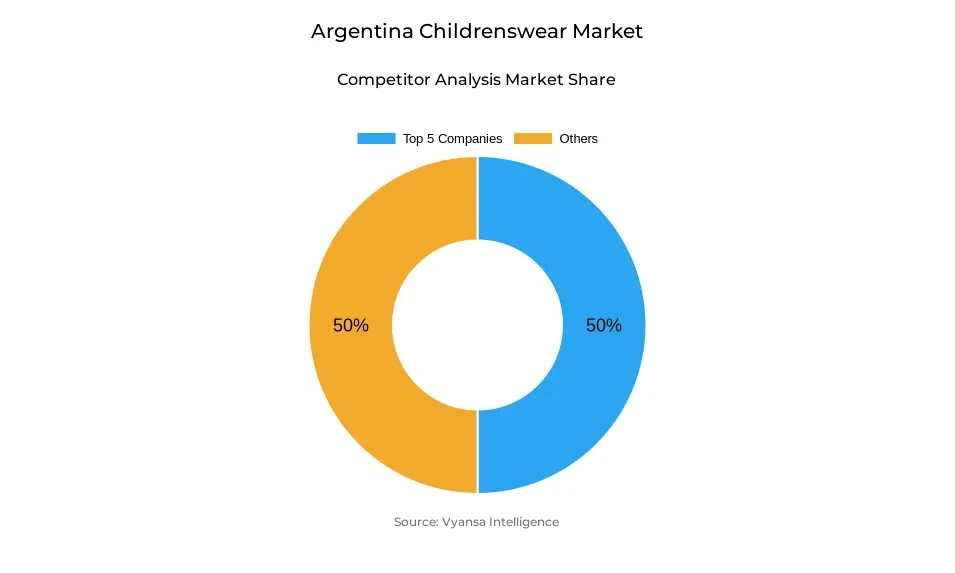
- Top 5 companies acquired around 50% of the market share.
- Gossip SA; Conbra SA; Be Enterprises SA; Vestiditos SA; Cheek SA etc., are few of the top companies.
- Sales Channel
- Retail offline grabbed 80% of the market.
Argentina Childrenswear Market Outlook
The Argentina childrenwear market of USD 315 million in 2025 is expected to grow to USD 360 million by 2032, advancing at a CAGR of around 1.93% between 2026–2032. While financial challenges and inflation are ever-present, the category will be relatively cushioned because parents will still attach significance to undertaking essential garment purchases for children. Demand stability will be driven by the necessity-driven nature of the segment, with spending reductions less drastic compared to other apparel segments.
Apparel, which controls around 75% of the total market, will be the leading Category with a volume CAGR of around 1.04%. Growth will be funded to a significant degree through private label and unbranded merchandise as price-sensitive end users seek less expensive quality products. These product lines replicate similar styles and comfort levels as premium brands while offering more affordable pricing, enabling families to maximize their household budgets. At the same time, market leaders like Cheeky and Mimo & Co are also expected to hold on to positions based on solid marketing efforts and frequent promotional offers to attract a broad spectrum of consumers.
The Retail offline channel, accounting for around 80% of overall sales, will remain the primary sales medium. The franchise operations have been successful far and wide in Argentina so that master brands have been able to extend to cities with little capital risk. The model is also conducive to global extension, with the likes of Cheeky, Mimo & Co, and Grisino extending to neighboring Latin American nations and further afield.
In the future, children's growing influence in purchasing decisions will shape future product designs, with firms adapting style based on adult trends into smaller size ranges. Promotions, price cuts, and consumer financing such as instalments will remain key to maintaining sales momentum. Due to this, the market is poised to maintain stable growth through price-driven sales and the continued success of leading-local brands
Argentina Childrenswear Market Growth DriverParental Spending Priorities Sustain Market Stability
The Argentina Childrenswear Market remains strong as parents continue to value apparel purchases for children. Since Given that children frequently outgrow their clothing within short time spans, parents consider these purchases as essentials and hence continue to feed the category with a steady demand even in economic downturns. Such persistent action allows the category to perform better than mensswear or womenswear, in which discretionary spending decreases faster.
Apart from that, parents reduce expenditure on discretionary items but keep spending on children everyday apparel requirements. The continued emphasis helps maintain private label and branded product sales. Therefore, childrenswear maintains market stability with sound and price-focused offerings at the heart of buying behavior of Argentina households.
Argentina Childrenswear Market TrendChildren's Growing Role in Purchase Decisions
A major shift is emerging as children increasingly influence purchasing decisions, with many now choosing their own apparel based on comfort, style, and brand appeal. Children currently prefer more youthful fashion in their apparel, including loose-fitting clothing, trendy designs, and bright colors. Such a shift has encouraged firms to revamp their lines and appeal to fresher tastes.
Parents increasingly consider children's opinions while shopping, so aesthetics and product design have become crucial to brand success. Brands like Cheeky and Mimo & Co have witnessed their products being altered due to this trend, maintaining high levels of interest among young consumers. This shift captures the manner in which children's direct participation in buying decisions is altering brand strategies and design creation across the market.
Unlock Market Intelligence
Explore the market potential with our data-driven report
Argentina Childrenswear Market OpportunityDigital Advertising to Reinforce Brand Reach
Expanding digital presence and rising preference for online shopping are expected to boost growth through enhanced online marketing initiatives in the Argentina childrenswear segment. Brands will rely more on social media sites such as Instagram, TikTok, and Facebook to sell their products and engage with both children and their parents. These channels offer budget-friendly and target-specific opportunities for promotion that raise the profile of the brand and reach of the audience.
Through using new campaigns and influencer marketing, children clothing brands will have the ability to communicate more successfully with young households and register greater brand awareness. This digital revolution will also help local brands to compete more intensely with multinational brands, supporting growth from enhanced marketing effectivity and end users engagement.
Unlock Market Intelligence
Explore the market potential with our data-driven report
Argentina Childrenswear Market Segmentation Analysis
By Product Type
- Apparel
- Footwear
- Accessories
- Others
The segment with highest market share under Product Type under Apparel, commanding nearly 75% of share. Apparel takes the lead due to the regular and habitual purchase of children's apparel because children grow up fast and require new apparel instantly. Parents are not holding back on childrenswear expenditure even during recession, and thus the category is witnessing steady demand even during challenging economic times. The success of private label and unbranded apparel further propels the category by providing an affordable option without compromising on quality and design, suiting cost-conscious Argentina end user.
Key players such as Cheeky and Mimo & Co maintain this dominance through aggressive promotion, festival sales, and a strong franchise network across the country. Chic, well-made clothing at reasonable prices from them remain clothes the product category of choice in the childrenswear market. Consistent with this, the apparel segment is expected to witness a volume CAGR of around 1.04% over the forecast period.

By Sales Channel
- Retail Offline
- Retail Online
The segment with highest market share under Sales Channel is Retail Offline, taking up around 80% of the market. Conventional retail stores are still the favorite destination for purchasing childrenswear because of the high number of franchise-based stores across Argentina. Companies such as Cheeky, Mimo & Co, and Grisino have built large physical networks, where end users are able to see, feel, and test the products before purchasing a critical factor for parents purchasing clothing for children.
The Retail offline also benefits from robust in-store promotions and end-of-season sales, which induce volume purchasing, especially for families having more than one child. Moreover, interest-free instalment plans and end-of-year clearances make it easy to shop offline and inexpensive. All these have made retail offline the market leader, which will continue to dominate the childrenswear distribution pie in Argentina.
List of Companies Covered in Argentina Childrenswear Market
The companies listed below are highly influential in the Argentina childrenswear market, with a significant market share and a strong impact on industry developments.
- Gossip SA
- Conbra SA
- Be Enterprises SA
- Vestiditos SA
- Cheek SA
- Creskotec SA
- Zara Argentina SA
- Sachi & Sach SA
- Koso SRL
- Argentrade SRL
Frequently Asked Questions
Related Report
1. Market Segmentation
1.1. Research Scope
1.2. Research Methodology
1.3. Definitions and Assumptions
2. Executive Summary
3. Argentina Childrenswear Market Policies, Regulations, and Standards
4. Argentina Childrenswear Market Dynamics
4.1. Growth Factors
4.2. Challenges
4.3. Trends
4.4. Opportunities
5. Argentina Childrenswear Market Statistics, 2022-2032F
5.1. Market Size & Growth Outlook
5.1.1.By Revenues in US$ Million
5.2. Market Segmentation & Growth Outlook
5.2.1.By Product Type
5.2.1.1. Apparel- Market Insights and Forecast 2022-2032, USD Million
5.2.1.1.1. Baby and Toddler Wear- Market Insights and Forecast 2022-2032, USD Million
5.2.1.1.2. Boys Apparel- Market Insights and Forecast 2022-2032, USD Million
5.2.1.1.3. Girls Apparel- Market Insights and Forecast 2022-2032, USD Million
5.2.1.2. Footwear- Market Insights and Forecast 2022-2032, USD Million
5.2.1.2.1. Boys Footwear- Market Insights and Forecast 2022-2032, USD Million
5.2.1.2.2. Girls Footwear- Market Insights and Forecast 2022-2032, USD Million
5.2.1.3. Accessories- Market Insights and Forecast 2022-2032, USD Million
5.2.1.3.1. Boys Accessories- Market Insights and Forecast 2022-2032, USD Million
5.2.1.3.2. Girls Accessories- Market Insights and Forecast 2022-2032, USD Million
5.2.1.4. Others- Market Insights and Forecast 2022-2032, USD Million
5.2.2.By Age Group
5.2.2.1. Infant/Toddler (Below 2 years)- Market Insights and Forecast 2022-2032, USD Million
5.2.2.2. Kids/Children (2 - 14 years)- Market Insights and Forecast 2022-2032, USD Million
5.2.3.By Price Category
5.2.3.1. Mass- Market Insights and Forecast 2022-2032, USD Million
5.2.3.2. Premium- Market Insights and Forecast 2022-2032, USD Million
5.2.4.By Sales Channel
5.2.4.1. Retail Offline- Market Insights and Forecast 2022-2032, USD Million
5.2.4.2. Retail Online- Market Insights and Forecast 2022-2032, USD Million
5.2.5.By Competitors
5.2.5.1. Competition Characteristics
5.2.5.2. Market Share & Analysis
6. Argentina Apparel Childrenswear Market Statistics, 2022-2032
6.1. Market Size & Growth Outlook
6.1.1.By Revenues in US$ Million
6.2. Market Segmentation & Growth Outlook
6.2.1.By Age Group- Market Insights and Forecast 2022-2032, USD Million
6.2.2.By Price Category- Market Insights and Forecast 2022-2032, USD Million
6.2.3.By Sales Channel- Market Insights and Forecast 2022-2032, USD Million
7. Argentina Footwear Childrenswear Market Statistics, 2022-2032
7.1. Market Size & Growth Outlook
7.1.1.By Revenues in US$ Million
7.2. Market Segmentation & Growth Outlook
7.2.1.By Age Group- Market Insights and Forecast 2022-2032, USD Million
7.2.2.By Price Category- Market Insights and Forecast 2022-2032, USD Million
7.2.3.By Sales Channel- Market Insights and Forecast 2022-2032, USD Million
8. Argentina Accessories Childrenswear Market Statistics, 2022-2032
8.1. Market Size & Growth Outlook
8.1.1.By Revenues in US$ Million
8.2. Market Segmentation & Growth Outlook
8.2.1.By Age Group- Market Insights and Forecast 2022-2032, USD Million
8.2.2.By Price Category- Market Insights and Forecast 2022-2032, USD Million
8.2.3.By Sales Channel- Market Insights and Forecast 2022-2032, USD Million
9. Competitive Outlook
9.1. Company Profiles
9.1.1.Vestiditos SA
9.1.1.1. Business Description
9.1.1.2. Product Portfolio
9.1.1.3. Collaborations & Alliances
9.1.1.4. Recent Developments
9.1.1.5. Financial Details
9.1.1.6. Others
9.1.2.Cheek SA
9.1.2.1. Business Description
9.1.2.2. Product Portfolio
9.1.2.3. Collaborations & Alliances
9.1.2.4. Recent Developments
9.1.2.5. Financial Details
9.1.2.6. Others
9.1.3.Creskotec SA
9.1.3.1. Business Description
9.1.3.2. Product Portfolio
9.1.3.3. Collaborations & Alliances
9.1.3.4. Recent Developments
9.1.3.5. Financial Details
9.1.3.6. Others
9.1.4.Zara Argentina SA
9.1.4.1. Business Description
9.1.4.2. Product Portfolio
9.1.4.3. Collaborations & Alliances
9.1.4.4. Recent Developments
9.1.4.5. Financial Details
9.1.4.6. Others
9.1.5.Sachi & Sach SA
9.1.5.1. Business Description
9.1.5.2. Product Portfolio
9.1.5.3. Collaborations & Alliances
9.1.5.4. Recent Developments
9.1.5.5. Financial Details
9.1.5.6. Others
9.1.6.Gossip SA
9.1.6.1. Business Description
9.1.6.2. Product Portfolio
9.1.6.3. Collaborations & Alliances
9.1.6.4. Recent Developments
9.1.6.5. Financial Details
9.1.6.6. Others
9.1.7.Conbra SA
9.1.7.1. Business Description
9.1.7.2. Product Portfolio
9.1.7.3. Collaborations & Alliances
9.1.7.4. Recent Developments
9.1.7.5. Financial Details
9.1.7.6. Others
9.1.8.Be Enterprises SA
9.1.8.1. Business Description
9.1.8.2. Product Portfolio
9.1.8.3. Collaborations & Alliances
9.1.8.4. Recent Developments
9.1.8.5. Financial Details
9.1.8.6. Others
9.1.9.Koso SRL
9.1.9.1. Business Description
9.1.9.2. Product Portfolio
9.1.9.3. Collaborations & Alliances
9.1.9.4. Recent Developments
9.1.9.5. Financial Details
9.1.9.6. Others
9.1.10. Argentrade SRL
9.1.10.1. Business Description
9.1.10.2. Product Portfolio
9.1.10.3. Collaborations & Alliances
9.1.10.4. Recent Developments
9.1.10.5. Financial Details
9.1.10.6. Others
10. Disclaimer
| Segment | Sub-Segment |
|---|---|
| By Product Type |
|
| By Age Group |
|
| By Price Category |
|
| By Sales Channel |
|
Research Methodology
This study followed a structured approach comprising four key phases to assess the size and scope of the electro-oxidation market. The process began with thorough secondary research to collect data on the target market, related markets, and broader industry context. These findings, along with preliminary assumptions and estimates, were then validated through extensive primary research involving industry experts from across the value chain. To calculate the overall market size, both top-down and bottom-up methodologies were employed. Finally, market segmentation and data triangulation techniques were applied to refine and validate segment-level estimations.
Secondary Research
The secondary research phase involved gathering data from a wide range of credible and published sources. This step helped in identifying industry trends, defining market segmentation, and understanding the market landscape and value chain.
Sources consulted during this phase included:
- Company annual reports, investor presentations, and press releases
- Industry white papers and certified publications
- Trade directories and market-recognized databases
- Articles from authoritative authors and reputable journals
- Gold and silver standard websites
Secondary research was critical in mapping out the industry's value chain and monetary flow, identifying key market segments, understanding regional variations, and tracking significant industry developments.
Other key sources:
- Financial disclosures
- Industry associations and trade bodies
- News outlets and business magazines
- Academic journals and research studies
- Paid industry databases
Primary Research
To validate secondary data and gain deeper market insights, primary research was conducted with key stakeholders across both the supply and demand sides of the market.
On the demand side, participants included decision-makers and influencers from end-user industries—such as CIOs, CTOs, and CSOs—who provided first-hand perspectives on market needs, product usage, and future expectations.
On the supply side, interviews were conducted with manufacturers, industry associations, and institutional participants to gather insights into current offerings, product pipelines, and market challenges.
Primary interviews provided critical inputs such as:
- Market size and revenue data
- Product and service breakdowns
- Market forecasts
- Regional and application-specific trends
Stakeholders consulted included:
- Leading OEM and solution providers
- Channel and distribution partners
- End users across various applications
- Independent consultants and industry specialists
Market Size Estimation and Data Triangulation
- Identifying Key Market Participants (Secondary Research)
- Goal: To identify the major players or companies in the target market. This typically involves using publicly available data sources such as industry reports, market research publications, and financial statements of companies.
- Tools: Reports from firms like Gartner, Forrester, Euromonitor, Statista, IBISWorld, and others. Public financial statements, news articles, and press releases from top market players.
- Extracting Earnings of Key Market Participants
- Goal: To estimate the earnings generated from the product or service being analyzed. This step helps in understanding the revenue potential of each market player in a specific geography.
- Methods: Earnings data can be gathered from:
- Publicly available financial reports (for listed companies).
- Interviews and primary data sources from professionals, such as Directors, VPs, SVPs, etc. This is especially useful for understanding more nuanced, internal data that isn't publicly disclosed.
- Annual reports and investor presentations of key players.
- Data Collation and Development of a Relevant Data Model
- Goal: To collate inputs from both primary and secondary sources into a structured, data-driven model for market estimation. This model will incorporate key market KPIs and any independent variables relevant to the market.
- Key KPIs: These could include:
- Market size, growth rate, and demand drivers.
- Industry-specific metrics like market share, average revenue per customer (ARPC), or average deal size.
- External variables, such as economic growth rates, inflation rates, or commodity prices, that could affect the market.
- Data Modeling: Based on this data, the market forecasts are developed for the next 5 years. A combination of trend analysis, scenario modeling, and statistical regression might be used to generate projections.
- Scenario Analysis
- Goal: To test different assumptions and validate how sensitive the market is to changes in key variables (e.g., market demand, regulatory changes, technological disruptions).
- Types of Scenarios:
- Base Case: Based on current assumptions and historical data.
- Best-Case Scenario: Assuming favorable market conditions, regulatory environments, and technological advancements.
- Worst-Case Scenario: Accounting for adverse factors, such as economic downturns, stricter regulations, or unexpected disruptions.












