Africa Poultry Feed Market Report: Trends, Growth and Forecast (2026-2032)
By Poultry Type (Broilers, Layers, Breeders, Chicks, Others), By Feed Type (Starter Feed, Grower Feed, Finisher Feed, Layer Feed, Breeder Feed, Concentrates, Premixes), By Ingredient Type (Cereals, Oilseed Meals, Amino Acids, Vitamins & Minerals, Enzymes, Feed Additives, Others), By Form (Mash, Pellets, Crumbles, Others), By Farm Type (Commercial Poultry Farms, Smallholder Farms, Integrated Poultry Producers, Cooperatives, Others), By Sales Channel (Direct Sales, Distributors & Dealers, Cooperatives, Feed Mills, Retail Stores, Others), By Country (South Africa, Nigeria, Egypt, Kenya, Morocco, Ghana, Ethiopia, Zambia, Tanzania, Rest of Africa) ... Read more
|
Major Players
|
Africa Poultry Feed Market Statistics and Insights, 2026
- Market Size Statistics
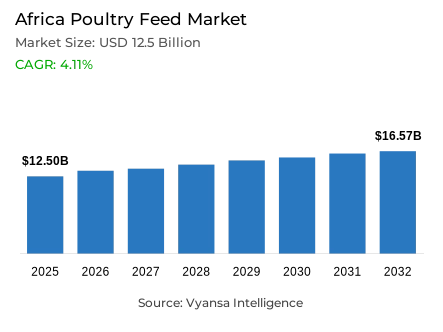
- Poultry feed market size in Africa was valued at USD 12.5 billion in 2025 and is estimated at USD 13.02 billion in 2026.
- The market size is expected to grow to USD 16.57 billion by 2032.
- Market to register a CAGR of around 4.11% during 2026-32.
- Poultry Type Shares
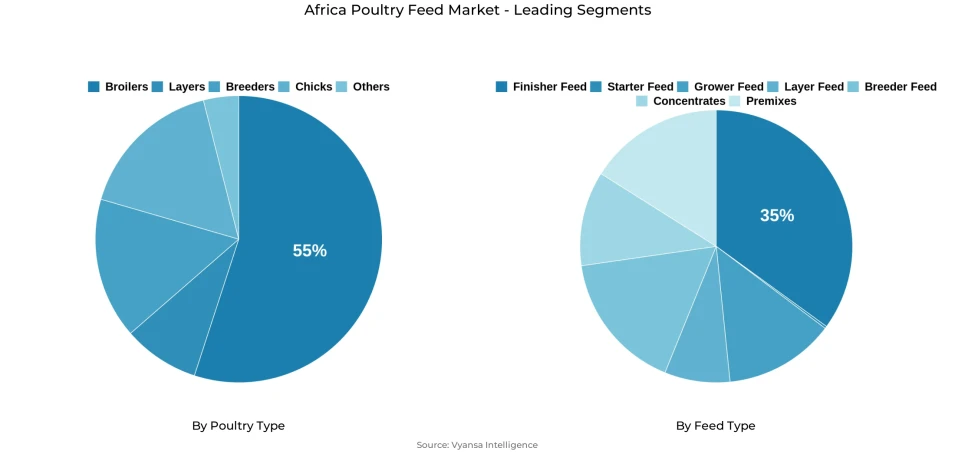
- Broilers grabbed market share of 55%.
- Competition
- More than 15 companies are actively engaged in producing poultry feed in Africa.
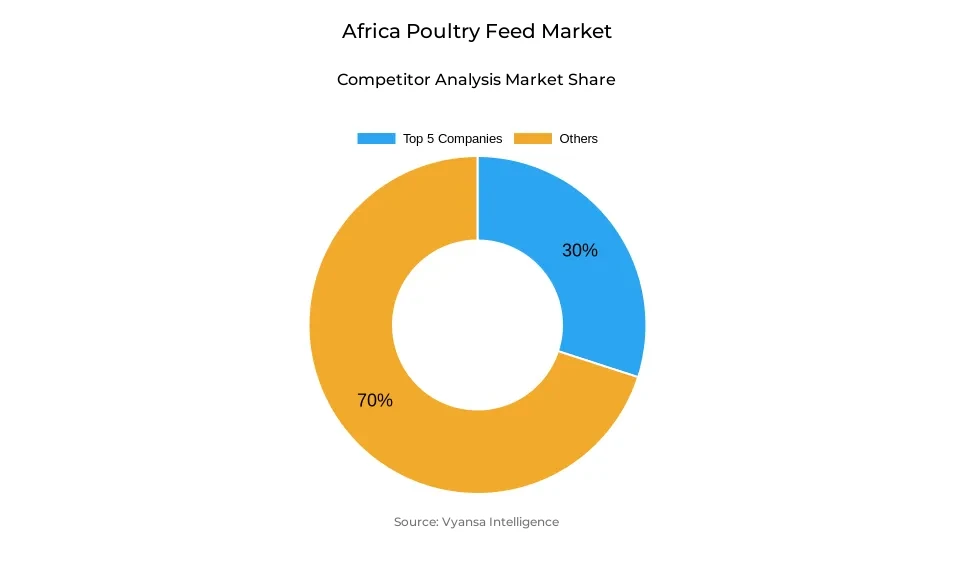
- Top 5 companies acquired around 30% of the market share.
- Olam Agri, Premier Feed Mills, Livestock Feeds PLC, Astral Foods/Meadow Feeds, RCL Foods/Epol etc., are few of the top companies.
- Feed Type
- Finisher Feed grabbed 35% of the market.
- Country
- South Africa leads with a 25% share of the Africa market.
Africa Poultry Feed Market Outlook
Backed by rising demand for affordable poultry protein, the Africa Poultry Feed Market was valued at USD 12.5 billion in 2025 and is projected to grow from USD 13.02 billion in 2026 to USD 16.57 billion by 2032, at a CAGR of 4.11%. Demand is shaped by broiler, layer, starter, grower, finisher, breeder, concentrate, premix, amino acid, vitamin, mineral, enzyme, and additive use across commercial poultry systems.
Poultry remains one of the most practical protein systems across African food economies, as chicken and eggs fit urban, peri-urban, and price-sensitive consumption patterns. OECD-FAO projects global poultry consumption to reach 173 million tons ready-to-cook by 2034 and account for 62% of additional meat consumed globally. This reinforces commercial poultry feed Africa demand where consistent nutrition supports flock output, daily food access, and protein affordability for expanding urban and peri-urban consumer bases.
Broilers dominate the poultry type category, reflecting short production cycles, high feed intensity, and direct linkage with chicken meat availability. Finisher feed holds 35% share under feed type, as final-stage diets carry high intake and influence bird weight, carcass yield, and cost per kilogram of live weight. This keeps broiler feed Africa closely tied to stage-specific formulation, maize quality, soybean meal balance, amino acid adequacy, and premix discipline across organized farms and semi-commercial producers.
South Africa leads with 25% share, supported by organized poultry production, formal feed milling, processing capacity, cold-chain systems, and structured retail demand. USDA FAS Pretoria forecasts South Africa’s chicken meat production at 1.68 million tons in marketing year 2026, supported by domestic expansion and lower feed prices after grain harvest recovery. Through 2032, market direction remains tied to feed-cost control, compound feed adoption, local ingredient development, disease resilience, and affordable poultry output across African farming systems and organized retail channels steadily over time and regions sustainably.
Africa Poultry Feed Market Growth Driver
Affordable Protein Demand Expands Commercial Feed Use
Rising demand for affordable poultry meat and eggs remains the strongest driver, as poultry provides a shorter-cycle protein system than cattle and can be produced near urban markets. This increases the need for broiler feed, layer feed Africa, starter feed, grower feed, finisher feed, breeder feed, concentrates, and premixes. Feed quality directly shapes bird growth, feed conversion, egg output, and final poultry pricing, making nutrition a central mechanism for food affordability across African poultry systems where household protein access remains highly price-sensitive and supply consistency matters.
FAO notes that feed is the most important cost input in intensive poultry production and that low-priced, high-quality feed is critical for industry expansion. World Bank data shows high urban population shares in several African economies in 2024, including South Africa at 64%, Côte d’Ivoire at 54%, and Equatorial Guinea at 71%. Urban demand supports standardized chicken and egg supply through retail, foodservice, processors, and informal vendors. This keeps poultry feed demand in Africa linked with compound diets, reliable raw materials, and stage-specific nutrition rather than informal grain mixing alone, especially where producers need predictable flock weight, shell quality, and feed conversion outcomes throughout repeated cycles across farms, processors, and retail channels consistently.
Africa Poultry Feed Market Challenge
Grain and Oilseed Volatility Tightens Feed Economics
Maize and soybean volatility remains the main challenge, as poultry feed depends heavily on energy grains and protein meals. Maize supports energy supply, while soybean meal supports protein and amino acid needs. When these inputs rise, feed prices increase, farm margins tighten, and poultry affordability weakens. This affects maize poultry feed Africa and soybean-based diets across broiler, layer, breeder, starter, grower, and finisher programs, especially where smaller farms buy finished feed at market prices and have limited storage or procurement flexibility during volatile seasons.
NAMC reported South Africa’s yellow maize at R3,540 per ton and soybeans at R7,032 per ton in the fourth quarter of 2025, both lower year-on-year, showing how quickly feed economics shift. USDA also forecast higher global coarse grain production for 2025 to 2026, yet local currency, freight, logistics, and grain quality can limit benefits for African feed mills. The restraint is therefore tied to procurement timing, raw material testing, mycotoxin control, and least-cost formulation discipline. Poultry feed cost Africa remains sensitive where ingredient prices move faster than farm-gate poultry prices, creating pressure on flock placements, feed quality decisions, and consumer poultry affordability across commercial and smallholder poultry systems during volatile input cycles repeatedly.
Unlock Market Intelligence
Explore the market potential with our data-driven report
Africa Poultry Feed Market Trend
Compound Feed Adoption Reshapes Poultry Nutrition
Commercial compound feed adoption is reshaping poultry nutrition Africa as producers move away from informal grain mixing toward formulated diets by production stage, poultry type, raw material profile, and performance target. Starter feed supports early chick development, grower feed supports frame and muscle formation, and finisher feed supports final live-weight performance. Layer and breeder feeds require different calcium, amino acid, vitamin, mineral, and additive structures, making compound feed central to predictable flock outcomes in commercial and upgrading smallholder systems with measurable productivity needs.
SAPA reported South Africa’s national feed production at 12.170 million tons in 2023 to 2024, with AFMA member sales representing 57.9% of national feed output. A 2025 review in Animal Feed Science and Technology also links feed additives with productivity, intestinal microbiome, environmental impact, welfare, and bird health. This trend keeps compound poultry feed Africa tied to formulation accuracy, pellet quality, ingredient testing, additive use, and technical guidance. Adoption remains strongest where feed mills connect local raw materials with measurable flock performance, stable feed conversion, egg output, shell strength, and lower variability across production cycles, flock sizes, feed forms, regional farms, and farmer groups across Africa steadily.
Africa Poultry Feed Market Opportunity
Local Ingredient Development Reduces Cost Exposure
Local feed ingredient development creates the strongest opportunity, as Africa’s poultry feed expansion depends on affordable access to maize, soybean meal, sunflower meal, sorghum, cassava-based ingredients, wheat bran, oilseed meals, agro-industrial by-products, premixes, vitamins, minerals, and amino acids. Stronger local sourcing can reduce import exposure, exchange-rate risk, freight cost, and delivery delays. The opportunity is strongest when alternative feed ingredients for poultry are evaluated for digestibility, contamination risk, fiber, protein quality, amino acid contribution, and safe inclusion levels within balanced formulations.
The African Union states that AfCFTA aims to accelerate intra-African trade, which is relevant where feed ingredient availability differs across African economies. Peer-reviewed research from Ethiopia shows that locally sourced alternative energy and protein ingredients can improve chicken production economics when nutritionally evaluated and safely included. Local ingredient development therefore depends on drying, storage, aggregation, oilseed crushing, testing, and feed-grade quality control. This keeps poultry feed ingredients Africa tied to cost resilience, formulation accuracy, regional trade, and more reliable poultry nutrition systems, especially where feed mills need stable inputs for broiler, layer, and finisher diets across local supply chains, storage systems, premix networks, and regional feed mills serving broiler, layer, breeder, and finisher demand reliably across regions steadily.
Africa Poultry Feed Market Country Analysis
By Country
- South Africa
- Nigeria
- Egypt
- Kenya
- Morocco
- Ghana
- Ethiopia
- Zambia
- Tanzania
- Rest of Africa
Organized poultry systems position South Africa as the leading country in the Africa Poultry Feed Market, with 25% share. Leadership is linked with formal feed milling, broiler integration, layer operations, grain-market infrastructure, processing capacity, cold-chain systems, and structured retail demand. SAPA reported national feed production of 12.170 million tons in 2023 to 2024, while AFMA member sales represented 57.9% of national feed output, indicating a sizeable formal feed base for South Africa poultry feed market demand and stage-specific poultry nutrition.
South Africa’s Department of Trade, Industry and Competition reported poultry as the largest contributor to agriculture in 2024, with nearly R87.95 billion in annual gross value, including R72.09 billion from meat and R15.86 billion from eggs. World Bank data also places South Africa’s urban population at 64% in 2024. The regional outlook remains tied to grain cost control, disease resilience, feed mill capacity, premix access, and consistent poultry supply across organized and emerging production systems. This keeps leadership linked with production structure, feed availability, poultry affordability, and formal value-chain coordination across feed mills, processors, retailers, farms, hatcheries, distributors, agro-dealers, storage networks, cold chains, and input suppliers across urban, peri-urban, and regional poultry systems over time regionally consistently today.
Unlock Market Intelligence
Explore the market potential with our data-driven report
Africa Poultry Feed Market Segmentation Analysis
By Poultry Type
- Broilers
- Layers
- Breeders
- Chicks
- Others
Broilers hold the leading position under poultry type with around 55% of the market share, reflecting their short production cycle, high feed intensity, and direct link with affordable chicken supply. Broiler feed Africa remains the main volume base for feed mills, as each flock requires starter, grower, and finisher diets from placement to slaughter. Broiler production also uses concentrates, premixes, amino acids, enzymes, vitamins, minerals, toxin binders, and gut-health additives to support weight gain, feed conversion, flock uniformity, final live weight, and predictable sale timing in formal and informal channels.
OECD-FAO states that poultry accounts for 62% of additional meat produced over the next decade and benefits from short cycles, high feed conversion efficiency, lower production cost, and production close to urbanizing markets. USDA FAS Pretoria also noted South Africa’s weekly poultry output improved from 19 million birds in 2023 to 22.6 million birds by July 2024 after HPAI recovery. This keeps broiler chicken feed demand tied to flock placements, processing schedules, uniform bird size, and cost per kilogram of live weight. Broilers remain the clearest volume anchor for commercial poultry feed demand across organized and semi-commercial farms, where repeated flock cycles sustain feed volume, ingredient use, premix demand, and additive inclusion consistently across farms annually.
By Feed Type
- Starter Feed
- Grower Feed
- Finisher Feed
- Layer Feed
- Breeder Feed
- Others
Finisher feed leads under feed type with 35% share, reflecting its high use during the final growth stage when broilers consume larger volumes and producers focus on final weight, carcass quality, and feed conversion. Broiler finisher feed Africa requires balanced energy, digestible amino acids, vitamins, minerals, and additives that support growth without unnecessary formulation cost. This stage links feed quality directly with saleable poultry meat, processing consistency, farm-level cost control, and delivery schedules for formal retail and foodservice buyers across organized poultry systems.
NAMC pricing data for yellow maize and soybeans is relevant to finisher diets, as maize drives energy supply and soybean meal supports protein and amino acid requirements. South Africa’s Competition Commission notes that broiler chicken and egg production account for 65% of animal protein consumed in South Africa, highlighting the importance of final-stage poultry output. Feed conversion ratio poultry remains central in this segment, as large feed volumes near market weight make ingredient cost, diet density, and flock uniformity decisive for production economics. Finisher feed therefore remains tied to measurable output, feed-cost discipline, and carcass consistency across processor-linked, retail-oriented, and farm-level supply systems where feed quality shapes saleable meat output consistently over time sustainably across regions.
Various Market Players in Africa Poultry Feed Market
The companies mentioned below are highly active in the Africa poultry feed market, occupying a considerable portion of the market and shaping industry progress.
- Olam Agri
- Premier Feed Mills
- Livestock Feeds PLC
- Astral Foods/Meadow Feeds
- RCL Foods/Epol
- Nutri Feeds
- Nova Feeds
- AFGRI Animal Feeds
- Flour Mills of Nigeria
- Unga Farm Care
- Pwani Feeds
- Bidco Land O’Lakes
Market News & Updates
- De Heus Animal Nutrition, 2026:
De Heus opened a new animal feed production plant in Athi River, Kenya, in February 2026. The facility has 240,000 metric tons of annual production capacity and serves poultry, pig, and cattle farmers. The opening adds local feed production capacity and farmer support infrastructure in Kenya.
- RCL Foods / Epol, 2025:
Epol released its Complete Laying Ration product sheet in 2025 for commercial layer feed. The product is designed for hens throughout the laying cycle and includes balanced protein, lysine, methionine, moisture, calcium, phosphorus, and fat specifications. The update supports layer feed availability for poultry producers in South Africa.
Frequently Asked Questions
Related Report
- Market Segmentation
- Research Scope
- Research Methodology
- Definitions and Assumptions
- Executive Summary
- Africa Poultry Feed Market Policies, Regulations, and Standards
- Africa Poultry Feed Production (Tons) Trend 2022-2032
- Africa Poultry Feed Production (Tons) Trend By Country
- South Africa
- Nigeria
- Egypt
- Kenya
- Morocco
- Ghana
- Ethiopia
- Zambia
- Tanzania
- Rest of Africa
- Africa Poultry Feed Production (Tons) Trend By Poultry Type
- Broilers
- Layers
- Breeders
- Chicks
- Others
- Company Wise Production Plants and Statistics
- Installed Production Capacity
- Actual Production
- Planned Production Target
- Africa Poultry Feed Production (Tons) Trend By Country
- Africa Poultry Feed Pricing Analysis 2022-2032
- Africa Poultry Feed Pricing Trend (USD/Ton) 2022-2032
- Africa Poultry Feed Pricing Trend (USD/Ton) By Country 2022-2032
- South Africa
- Nigeria
- Egypt
- Kenya
- Morocco
- Ghana
- Ethiopia
- Zambia
- Tanzania
- Rest of Africa
- Africa Poultry Feed Pricing Trend (USD/Ton) By Poultry Type 2022-2032
- Broilers
- Layers
- Breeders
- Chicks
- Others
- Africa Poultry Feed Market Dynamics
- Growth Factors
- Challenges
- Trends
- Opportunities
- Africa Poultry Feed Market Statistics, 2022-2032
- Market Size & Growth Outlook
- By Revenues in USD Million
- By Quantity Sold in Tons
- Market Segmentation & Growth Outlook
- By Poultry Type
- Broilers- Market Insights and Forecast 2022-2032, USD Million
- Layers- Market Insights and Forecast 2022-2032, USD Million
- Breeders- Market Insights and Forecast 2022-2032, USD Million
- Chicks- Market Insights and Forecast 2022-2032, USD Million
- Others- Market Insights and Forecast 2022-2032, USD Million
- By Feed Type
- Starter Feed- Market Insights and Forecast 2022-2032, USD Million
- Grower Feed- Market Insights and Forecast 2022-2032, USD Million
- Finisher Feed- Market Insights and Forecast 2022-2032, USD Million
- Layer Feed- Market Insights and Forecast 2022-2032, USD Million
- Breeder Feed- Market Insights and Forecast 2022-2032, USD Million
- Others- Market Insights and Forecast 2022-2032, USD Million
- By Ingredient Type
- Cereals/Grains- Market Insights and Forecast 2022-2032, USD Million
- Oilseed Meals- Market Insights and Forecast 2022-2032, USD Million
- Amino Acids- Market Insights and Forecast 2022-2032, USD Million
- Vitamins & Minerals- Market Insights and Forecast 2022-2032, USD Million
- Enzymes- Market Insights and Forecast 2022-2032, USD Million
- Feed Additives- Market Insights and Forecast 2022-2032, USD Million
- Others- Market Insights and Forecast 2022-2032, USD Million
- By Form
- Mash- Market Insights and Forecast 2022-2032, USD Million
- Pellets- Market Insights and Forecast 2022-2032, USD Million
- Crumbles- Market Insights and Forecast 2022-2032, USD Million
- Others- Market Insights and Forecast 2022-2032, USD Million
- By Farm Type
- Commercial Farms- Market Insights and Forecast 2022-2032, USD Million
- Smallholder Farms- Market Insights and Forecast 2022-2032, USD Million
- Others- Market Insights and Forecast 2022-2032, USD Million
- By Sales Channel
- Direct Sales- Market Insights and Forecast 2022-2032, USD Million
- Distributors & Dealers- Market Insights and Forecast 2022-2032, USD Million
- Cooperatives- Market Insights and Forecast 2022-2032, USD Million
- Retail Stores- Market Insights and Forecast 2022-2032, USD Million
- Others- Market Insights and Forecast 2022-2032, USD Million
- By Country
- South Africa
- Nigeria
- Egypt
- Kenya
- Morocco
- Ghana
- Ethiopia
- Zambia
- Tanzania
- Rest of Africa
- By Competitors
- Competition Characteristics
- Market Share & Analysis
- By Poultry Type
- Market Size & Growth Outlook
- South Africa Poultry Feed Market Statistics, 2022-2032
- Market Size & Growth Outlook
- By Revenues in USD Million
- By Quantity Sold in Tons
- Market Segmentation & Growth Outlook
- By Poultry Type- Market Insights and Forecast 2022-2032, USD Million
- By Feed Type- Market Insights and Forecast 2022-2032, USD Million
- By Ingredient Type- Market Insights and Forecast 2022-2032, USD Million
- By Form- Market Insights and Forecast 2022-2032, USD Million
- By Farm Type- Market Insights and Forecast 2022-2032, USD Million
- By Sales Channel- Market Insights and Forecast 2022-2032, USD Million
- Market Size & Growth Outlook
- Nigeria Poultry Feed Market Statistics, 2022-2032
- Market Size & Growth Outlook
- By Revenues in USD Million
- By Quantity Sold in Tons
- Market Segmentation & Growth Outlook
- By Poultry Type- Market Insights and Forecast 2022-2032, USD Million
- By Feed Type- Market Insights and Forecast 2022-2032, USD Million
- By Ingredient Type- Market Insights and Forecast 2022-2032, USD Million
- By Form- Market Insights and Forecast 2022-2032, USD Million
- By Farm Type- Market Insights and Forecast 2022-2032, USD Million
- By Sales Channel- Market Insights and Forecast 2022-2032, USD Million
- Market Size & Growth Outlook
- Egypt Poultry Feed Market Statistics, 2022-2032
- Market Size & Growth Outlook
- By Revenues in USD Million
- By Quantity Sold in Tons
- Market Segmentation & Growth Outlook
- By Poultry Type- Market Insights and Forecast 2022-2032, USD Million
- By Feed Type- Market Insights and Forecast 2022-2032, USD Million
- By Ingredient Type- Market Insights and Forecast 2022-2032, USD Million
- By Form- Market Insights and Forecast 2022-2032, USD Million
- By Farm Type- Market Insights and Forecast 2022-2032, USD Million
- By Sales Channel- Market Insights and Forecast 2022-2032, USD Million
- Market Size & Growth Outlook
- Kenya Poultry Feed Market Statistics, 2022-2032
- Market Size & Growth Outlook
- By Revenues in USD Million
- By Quantity Sold in Tons
- Market Segmentation & Growth Outlook
- By Poultry Type- Market Insights and Forecast 2022-2032, USD Million
- By Feed Type- Market Insights and Forecast 2022-2032, USD Million
- By Ingredient Type- Market Insights and Forecast 2022-2032, USD Million
- By Form- Market Insights and Forecast 2022-2032, USD Million
- By Farm Type- Market Insights and Forecast 2022-2032, USD Million
- By Sales Channel- Market Insights and Forecast 2022-2032, USD Million
- Market Size & Growth Outlook
- Morocco Poultry Feed Market Statistics, 2022-2032
- Market Size & Growth Outlook
- By Revenues in USD Million
- By Quantity Sold in Tons
- Market Segmentation & Growth Outlook
- By Poultry Type- Market Insights and Forecast 2022-2032, USD Million
- By Feed Type- Market Insights and Forecast 2022-2032, USD Million
- By Ingredient Type- Market Insights and Forecast 2022-2032, USD Million
- By Form- Market Insights and Forecast 2022-2032, USD Million
- By Farm Type- Market Insights and Forecast 2022-2032, USD Million
- By Sales Channel- Market Insights and Forecast 2022-2032, USD Million
- Market Size & Growth Outlook
- Ghana Poultry Feed Market Statistics, 2022-2032
- Market Size & Growth Outlook
- By Revenues in USD Million
- By Quantity Sold in Tons
- Market Segmentation & Growth Outlook
- By Poultry Type- Market Insights and Forecast 2022-2032, USD Million
- By Feed Type- Market Insights and Forecast 2022-2032, USD Million
- By Ingredient Type- Market Insights and Forecast 2022-2032, USD Million
- By Form- Market Insights and Forecast 2022-2032, USD Million
- By Farm Type- Market Insights and Forecast 2022-2032, USD Million
- By Sales Channel- Market Insights and Forecast 2022-2032, USD Million
- Market Size & Growth Outlook
- Ethiopia Poultry Feed Market Statistics, 2022-2032
- Market Size & Growth Outlook
- By Revenues in USD Million
- By Quantity Sold in Tons
- Market Segmentation & Growth Outlook
- By Poultry Type- Market Insights and Forecast 2022-2032, USD Million
- By Feed Type- Market Insights and Forecast 2022-2032, USD Million
- By Ingredient Type- Market Insights and Forecast 2022-2032, USD Million
- By Form- Market Insights and Forecast 2022-2032, USD Million
- By Farm Type- Market Insights and Forecast 2022-2032, USD Million
- By Sales Channel- Market Insights and Forecast 2022-2032, USD Million
- Market Size & Growth Outlook
- Zambia Poultry Feed Market Statistics, 2022-2032
- Market Size & Growth Outlook
- By Revenues in USD Million
- By Quantity Sold in Tons
- Market Segmentation & Growth Outlook
- By Poultry Type- Market Insights and Forecast 2022-2032, USD Million
- By Feed Type- Market Insights and Forecast 2022-2032, USD Million
- By Ingredient Type- Market Insights and Forecast 2022-2032, USD Million
- By Form- Market Insights and Forecast 2022-2032, USD Million
- By Farm Type- Market Insights and Forecast 2022-2032, USD Million
- By Sales Channel- Market Insights and Forecast 2022-2032, USD Million
- Market Size & Growth Outlook
- Tanzania Poultry Feed Market Statistics, 2022-2032
- Market Size & Growth Outlook
- By Revenues in USD Million
- By Quantity Sold in Tons
- Market Segmentation & Growth Outlook
- By Poultry Type- Market Insights and Forecast 2022-2032, USD Million
- By Feed Type- Market Insights and Forecast 2022-2032, USD Million
- By Ingredient Type- Market Insights and Forecast 2022-2032, USD Million
- By Form- Market Insights and Forecast 2022-2032, USD Million
- By Farm Type- Market Insights and Forecast 2022-2032, USD Million
- By Sales Channel- Market Insights and Forecast 2022-2032, USD Million
- Market Size & Growth Outlook
- Competitive Outlook
- Company Profiles
- Astral Foods/Meadow Feeds
- Business Description
- Product Portfolio
- Collaborations & Alliances
- Recent Developments
- Financial Details
- Others
- RCL Foods/Epol
- Business Description
- Product Portfolio
- Collaborations & Alliances
- Recent Developments
- Financial Details
- Others
- Nutri Feeds
- Business Description
- Product Portfolio
- Collaborations & Alliances
- Recent Developments
- Financial Details
- Others
- Nova Feeds
- Business Description
- Product Portfolio
- Collaborations & Alliances
- Recent Developments
- Financial Details
- Others
- AFGRI Animal Feeds
- Business Description
- Product Portfolio
- Collaborations & Alliances
- Recent Developments
- Financial Details
- Others
- Olam Agri
- Business Description
- Product Portfolio
- Collaborations & Alliances
- Recent Developments
- Financial Details
- Others
- Premier Feed Mills
- Business Description
- Product Portfolio
- Collaborations & Alliances
- Recent Developments
- Financial Details
- Others
- Livestock Feeds PLC
- Business Description
- Product Portfolio
- Collaborations & Alliances
- Recent Developments
- Financial Details
- Others
- Flour Mills of Nigeria
- Business Description
- Product Portfolio
- Collaborations & Alliances
- Recent Developments
- Financial Details
- Others
- Unga Farm Care
- Business Description
- Product Portfolio
- Collaborations & Alliances
- Recent Developments
- Financial Details
- Others
- Pwani Feeds
- Business Description
- Product Portfolio
- Collaborations & Alliances
- Recent Developments
- Financial Details
- Others
- Bidco Land O’Lakes
- Business Description
- Product Portfolio
- Collaborations & Alliances
- Recent Developments
- Financial Details
- Others
- Pioneer Feeds
- Business Description
- Product Portfolio
- Collaborations & Alliances
- Recent Developments
- Financial Details
- Others
- Zambeef/Novatek Animal Feeds
- Business Description
- Product Portfolio
- Collaborations & Alliances
- Recent Developments
- Financial Details
- Others
- De Heus Animal Nutrition
- Business Description
- Product Portfolio
- Collaborations & Alliances
- Recent Developments
- Financial Details
- Others
- Astral Foods/Meadow Feeds
- Company Profiles
- Disclaimer
| Segment | Sub-Segment |
|---|---|
| By Poultry Type |
|
| By Feed Type |
|
| By Ingredient Type |
|
| By Form |
|
| By Farm Type |
|
| By Sales Channel |
|
| By Country |
|
Research Methodology
This study followed a structured approach comprising four key phases to assess the size and scope of the electro-oxidation market. The process began with thorough secondary research to collect data on the target market, related markets, and broader industry context. These findings, along with preliminary assumptions and estimates, were then validated through extensive primary research involving industry experts from across the value chain. To calculate the overall market size, both top-down and bottom-up methodologies were employed. Finally, market segmentation and data triangulation techniques were applied to refine and validate segment-level estimations.
Secondary Research
The secondary research phase involved gathering data from a wide range of credible and published sources. This step helped in identifying industry trends, defining market segmentation, and understanding the market landscape and value chain.
Sources consulted during this phase included:
- Company annual reports, investor presentations, and press releases
- Industry white papers and certified publications
- Trade directories and market-recognized databases
- Articles from authoritative authors and reputable journals
- Gold and silver standard websites
Secondary research was critical in mapping out the industry's value chain and monetary flow, identifying key market segments, understanding regional variations, and tracking significant industry developments.
Other key sources:
- Financial disclosures
- Industry associations and trade bodies
- News outlets and business magazines
- Academic journals and research studies
- Paid industry databases
Primary Research
To validate secondary data and gain deeper market insights, primary research was conducted with key stakeholders across both the supply and demand sides of the market.
On the demand side, participants included decision-makers and influencers from end-user industries—such as CIOs, CTOs, and CSOs—who provided first-hand perspectives on market needs, product usage, and future expectations.
On the supply side, interviews were conducted with manufacturers, industry associations, and institutional participants to gather insights into current offerings, product pipelines, and market challenges.
Primary interviews provided critical inputs such as:
- Market size and revenue data
- Product and service breakdowns
- Market forecasts
- Regional and application-specific trends
Stakeholders consulted included:
- Leading OEM and solution providers
- Channel and distribution partners
- End users across various applications
- Independent consultants and industry specialists
Market Size Estimation and Data Triangulation
- Identifying Key Market Participants (Secondary Research)
- Goal: To identify the major players or companies in the target market. This typically involves using publicly available data sources such as industry reports, market research publications, and financial statements of companies.
- Tools: Reports from firms like Gartner, Forrester, Euromonitor, Statista, IBISWorld, and others. Public financial statements, news articles, and press releases from top market players.
- Extracting Earnings of Key Market Participants
- Goal: To estimate the earnings generated from the product or service being analyzed. This step helps in understanding the revenue potential of each market player in a specific geography.
- Methods: Earnings data can be gathered from:
- Publicly available financial reports (for listed companies).
- Interviews and primary data sources from professionals, such as Directors, VPs, SVPs, etc. This is especially useful for understanding more nuanced, internal data that isn't publicly disclosed.
- Annual reports and investor presentations of key players.
- Data Collation and Development of a Relevant Data Model
- Goal: To collate inputs from both primary and secondary sources into a structured, data-driven model for market estimation. This model will incorporate key market KPIs and any independent variables relevant to the market.
- Key KPIs: These could include:
- Market size, growth rate, and demand drivers.
- Industry-specific metrics like market share, average revenue per customer (ARPC), or average deal size.
- External variables, such as economic growth rates, inflation rates, or commodity prices, that could affect the market.
- Data Modeling: Based on this data, the market forecasts are developed for the next 5 years. A combination of trend analysis, scenario modeling, and statistical regression might be used to generate projections.
- Scenario Analysis
- Goal: To test different assumptions and validate how sensitive the market is to changes in key variables (e.g., market demand, regulatory changes, technological disruptions).
- Types of Scenarios:
- Base Case: Based on current assumptions and historical data.
- Best-Case Scenario: Assuming favorable market conditions, regulatory environments, and technological advancements.
- Worst-Case Scenario: Accounting for adverse factors, such as economic downturns, stricter regulations, or unexpected disruptions.












