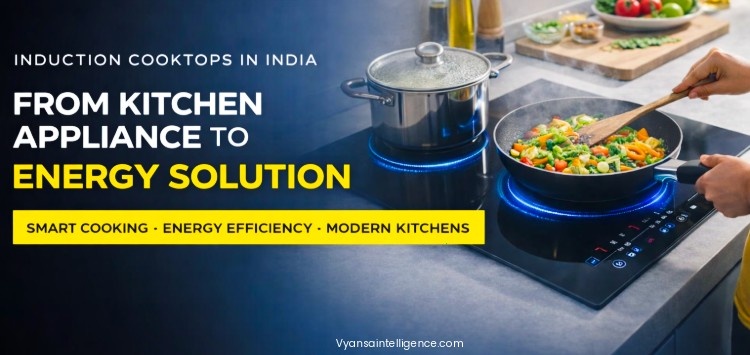
Induction Cooktops in India: How a Kitchen Appliance Became an Energy Solution
April 06, 2026
There is a quiet revolution happening in Indian kitchens. Not in restaurants, not in cooking shows, but in ordinary homes where a family used to wait for the LPG delivery man and now simply plugs in a sleek glass-top appliance and gets cooking in seconds. What once seemed like a foreign gadget suited only for minimalist apartments in Seoul or Berlin has firmly planted itself on the kitchen counters of Mumbai, Lucknow, Coimbatore, and thousands of towns in between.
The shift is not accidental. It is the result of rising fuel costs, smarter and more affordable technology, a generation of urban consumers who cook differently from their parents, and a government increasingly serious about reducing the country's dependence on imported fossil fuels.
According to Vyansa Intelligence's report, India's induction cooktop market is on a strong double-digit growth trajectory, one that reflects not a passing trend but a permanent restructuring of how India thinks about cooking energy.
What Exactly Is an Induction Cooktop, and How Is It Different?
Most people, when they first encounter an induction cooktop, make the same mistake: they assume it works like an electric heater, with a coil underneath the glass that gets hot and transfers that heat to the pan. That is not what happens at all.
An induction cooktop works using electromagnetic energy. Inside the appliance, a copper coil generates a rapidly alternating magnetic field. When a compatible metal pan is placed on the surface, this magnetic field induces an electric current directly inside the pan's base. That current creates heat inside the pan itself, not on the glass surface. The cooktop stays cool; only the cookware heats up.
This is not a trivial distinction. It has enormous practical consequences. Because the surface itself does not get hot, a piece of paper placed next to the pan would not scorch. A child's hand accidentally touching the cooktop while food is being cooked would feel warmth, not a burn. Spilled food does not get baked onto a scorching surface. It simply wipes clean with a damp cloth.
The other advantage is speed. Because the heat is being generated inside the vessel rather than transferred from an external source, energy delivery is almost instantaneous. Water boils faster. A pressure cooker reaches temperature quicker. The overall cooking time for most Indian dishes is comparable to, or faster than, gas.
There is one important constraint that every potential buyer must understand upfront: induction cooktops only work with cookware that has a magnetic base. Stainless steel and cast iron work perfectly. Traditional aluminium kadais, copper pots, and unglazed clay vessels do not. This is the single most important factor Indian buyers need to plan for before making the switch.
The Slow Start: How Induction Cooktops First Entered Indian Homes
Induction cooking technology was developed in the United States in the early 1970s, but it took several decades for it to become practical, affordable, and reliable enough for everyday household use. By the early 2000s, European and East Asian markets had begun adopting it seriously. In India, it arrived mostly as a curiosity: an imported appliance sold in premium electronics stores at prices that put it firmly out of reach for the average urban family.
The first induction cooktops available in India were typically imported from China, Korea, or Europe and retailed for anywhere between ₹5,000 and ₹15,000. At those prices, the buyers were a very narrow slice: dual-income urban professionals, NRI returnees who had used induction cooking abroad, and early technology adopters who prized novelty. For the vast majority of Indian households managing tight budgets, it simply did not register as a consideration.
The real inflection point came between 2007 and 2012, when Indian domestic appliance brands entered the segment decisively. TTK Prestige, Bajaj Electricals, and Pigeon (a brand under Stovekraft) began manufacturing and marketing induction cooktops designed specifically for Indian consumers, with prices starting below ₹2,000. This was a watershed moment. At ₹1,500 to ₹2,000, the induction cooktop stopped being a luxury and became an option.
The earliest mass adopters were not nuclear families replacing their gas stoves. They were students living in PG accommodations where open flames were prohibited, young professionals in studio apartments, and migrants in cities who needed a compact, safe, and self-contained cooking solution. The portable single-burner induction cooktop became the unofficial kitchen of urban India's renting class.
But the technology also carried a reputation problem it would spend the better part of a decade overcoming. The conventional wisdom, passed from neighbour to neighbour and from mother to daughter, was that induction cooking was simply not suited to Indian food. You cannot make a proper chapati on glass, people said. Deep frying is impossible. The pressure cooker will not work. Dal will not taste the same.
Most of these concerns were based on unfamiliarity rather than fact, but they were deeply held and widely shared. Brands had to invest significantly in consumer education through in-store demonstrations, television advertising, and eventually YouTube, to shift this perception. That effort paid off slowly but surely.
The Real Fuel Behind the Boom: India's LPG Price Problem
To understand why induction cooktops have grown so rapidly in recent years, you have to understand what happened to LPG prices in India. For decades, cooking gas in India was heavily subsidised by the central government. An average household in a metropolitan city paid between ₹400 and ₹500 for a 14.2 kg LPG cylinder, a price that bore little relationship to the actual market cost of the fuel. Subsidies made up the difference, and most Indian families simply did not think about cooking fuel as a significant monthly expense.
That changed structurally with the 2014 PAHAL (Pratyaksha Hanstantarit Laabh) scheme, under which the government shifted to a Direct Benefit Transfer model. Households would now pay market price for the cylinder, with the subsidy credited directly to their bank account. In theory, the consumer was no better or worse off. In practice, the transparency of paying a higher upfront price made Indians acutely aware of what LPG actually cost, and how that cost was creeping upward.
By the time the post-COVID global energy crisis hit in 2021–22, LPG prices in many Indian cities had crossed ₹900 per cylinder, and in some states touched ₹1,000 or beyond. For a family that uses two cylinders a month (not unusual for a household of four that cooks three meals a day), this translated to a cooking fuel bill of ₹1,800 to ₹2,000 per month. For middle-income families, that was a number that demanded attention.
The arithmetic shifted. An induction cooktop costing ₹2,000 could pay for itself in a single month's electricity savings compared to LPG, depending on local electricity tariffs. The conversation in Indian kitchens changed from "should we try induction?" to "why are we still on gas?"
The pressure intensified further in 2025–26, when escalating tensions in the Middle East, specifically disruptions around the Strait of Hormuz, created fresh uncertainty in global LNG supply chains. India, which imports a substantial share of its LPG needs, felt the effect in prices almost immediately. Each new supply shock has nudged a fresh cohort of Indian households to revisit the economics of their kitchen setup, and many of them have arrived at the same conclusion.
The Indian Induction Cooktop Consumer: A Changing Profile
India's induction cooktop market is not driven by a single type of buyer. What makes it particularly interesting, and particularly resilient, is how many different consumer segments are adopting the product for their own distinct reasons.
Urban nuclear families represent the core of the current market. In a household where both partners work, cooking time is precious. An induction cooktop that boils water in under three minutes, auto-shuts off when the cookware is removed, and requires zero cleaning effort after use is not just convenient. It is genuinely transformative for a weekday evening. For these buyers, price is secondary to reliability and features.
Working women and millennials were perhaps the earliest enthusiastic adopters of the current wave. This demographic discovered induction cooking partly through social media: a food creator demonstrating a pasta dish on an induction hob, or a health-focused influencer showing how precise temperature control makes a difference in cooking proteins. The aspirational association of induction cooking with modern, clean, health-conscious kitchens has been a powerful driver that no advertising campaign could have manufactured.
Students and paying guest tenants continue to drive portable single-burner unit sales. This is a buyer who needs to cook independently in a room where an open flame may be unsafe, prohibited, or impractical. For them, an induction cooktop under ₹1,500 is a practical necessity, and it typically becomes their first introduction to the technology, one they often carry into their adult households.
The commercial segment deserves special mention. Cloud kitchens, which proliferated dramatically during and after the COVID-19 pandemic, were built with induction cooking at their centre. Without the need for expensive gas piping, commercial kitchen infrastructure, or safety clearances associated with LPG, a cloud kitchen could be set up in a rented apartment with a bank of induction cooktops. Catering businesses, canteens, and quick-service restaurants have followed similar logic: induction is faster, cleaner, and easier to regulate for food safety compliance.
Tier-2 and Tier-3 city buyers are the emerging growth driver that most market analysts are watching closely. As e-commerce platforms like Flipkart, Amazon, and Meesho extended their delivery networks deep into non-metropolitan India, they brought ₹1,500 induction cooktops to households in Surat, Jhansi, Rajkot, and Patna. The value proposition in these cities is, if anything, more compelling than in metros, because local electricity tariffs are often lower and LPG access less reliable.
Who's Winning the Indian Induction Cooktop Market?
India's induction cooktop market has a clearly defined structure: a group of domestic brands that built early scale and brand trust, increasingly challenged by international players chasing the premium segment.
TTK Prestige is arguably the most trusted name in Indian kitchen appliances, and its induction cooktop range reflects that positioning. The brand has invested heavily in features designed specifically for Indian cooking, including a whistle-counter function for pressure cookers, auto-off timers, and Indian menu presets. In 2024, Prestige launched a 2,000-watt stainless steel induction cooktop that claimed up to 25% energy savings over conventional stoves, targeting the family buyer who wants performance without compromise.
Pigeon by Stovekraft owns the value end of the market with remarkable efficiency. Its products are found in virtually every price comparison list for induction cooktops under ₹2,000. The brand's distribution reach, spanning both modern retail and e-commerce, has given it enormous volume, particularly in Tier-2 markets.
Bajaj Electricals and Preethi occupy the mid-market with well-regarded product lines that balance features and affordability. Havells and Butterfly are strong in South India, where brand loyalty in kitchen appliances runs deep.
On the international side, Philips has maintained a consistent premium positioning, while LG and Samsung have brought their consumer electronics marketing muscle into the kitchen appliance segment. The most interesting recent entrant is South Korean brand Daewoo, which re-entered the Indian market in late 2024 with two 2,000-watt induction cooktop models featuring durable micro-crystal plates and multi-cook modes, signalling that global brands see real opportunity in India's premiumisation trend.
The price war of the 2010s, which drove entry-level prices from ₹3,000-plus all the way to under ₹1,500, has largely stabilised. The competition today is less about who can offer the cheapest product and more about who can offer the most thoughtfully India-specific features at a reasonable price. That is a battle being fought in product development labs, not just on pricing spreadsheets.
How Government Policy Is Quietly Accelerating Adoption
The Indian government's role in the induction cooktop market has been both direct and indirect, and its influence is growing more deliberate over time.
The Bureau of Energy Efficiency (BEE) has extended its star-rating system to induction cooktops, the same framework that transformed consumer behaviour around air conditioners and refrigerators. A BEE star rating on a cooktop gives the buyer a simple, standardised way to compare energy efficiency across brands. It also puts pressure on manufacturers to improve their products continuously. In a market where energy savings are a core selling point, a higher star rating is a genuine competitive advantage.
The National Mission for Enhanced Energy Efficiency (NMEEE), part of India's National Action Plan on Climate Change, has created a broader policy environment that favours the transition from fossil-fuel cooking to electric alternatives. While NMEEE does not directly subsidise induction cooktops, its framework shapes procurement decisions in government canteens, public sector kitchens, and institutional catering, creating a large, visible reference market for induction technology.
The PM Ujjwala Yojana presents a fascinating paradox. Launched in 2016 to bring LPG connections to below-poverty-line households, it was a welfare scheme that had the secondary effect of making 90 million rural families aware of, and dependent on, a fuel source that is priced by international commodity markets. As LPG prices have risen, the scheme has inadvertently created a constituency that is actively looking for alternatives, alongside a government that is politically motivated to provide them.
State electricity tariff policies add another layer. In states like Karnataka, Tamil Nadu, and Telangana, where domestic electricity tariffs are subsidised for consumption up to a certain monthly limit, induction cooking falls well within the subsidised band for most households. The effective cost of cooking electrically, in these states, is even lower than the headline numbers suggest.
Induction vs. Gas: Which Actually Saves More Money?
This is the question every Indian consumer asks before making the switch, and it deserves a careful, honest answer.
An induction cooktop converts approximately 85 to 90% of the electricity it consumes directly into heat in the cookware. A gas stove, by comparison, converts only about 35 to 40% of the energy in LPG into useful cooking heat. The rest escapes as ambient heat into the kitchen and surrounding air. This efficiency gap is not marginal; it is enormous, and it shows up directly in monthly household expenses.
Consider a typical Indian family of four that cooks two to three meals daily. On LPG, this family uses roughly 1.5 to 2 cylinders per month. At current market prices of ₹900 to ₹1,000 per cylinder in most cities, that is a monthly cooking fuel bill of ₹1,350 to ₹2,000. On induction, the same meals can typically be cooked using 50 to 70 units of electricity per month. At an average domestic tariff of ₹6 to ₹8 per unit, that translates to ₹300 to ₹560 per month in electricity charges for cooking. Even accounting for the fact that induction electricity consumption is not zero-cost, the monthly savings are substantial, often ₹800 to ₹1,200 or more.
Over a year, those savings more than offset the cost of a mid-range induction cooktop. Over two years, the appliance has paid for itself several times over. This is before accounting for further LPG price increases, which given global energy market dynamics, are more likely than not.
The environmental calculus is also shifting in induction's favour. As India's electricity grid becomes progressively greener, with renewable energy now accounting for a growing share of national generation capacity, the carbon footprint per meal cooked on induction falls steadily. Cooking on gas will remain a fossil-fuel activity regardless of how clean India's future energy mix becomes. Cooking on induction becomes cleaner every year, as more solar and wind power flows into the grid.
What's Still Holding Induction Cooktops Back in India?
For all the momentum behind induction adoption, it would be dishonest to ignore the real and significant barriers that continue to slow the technology's spread across India, particularly beyond its urban strongholds.
Cookware incompatibility is the most immediate and concrete obstacle. Hundreds of millions of Indian households have built their kitchen inventories over decades around aluminium kadais, copper vessels, and clay pots, none of which work on an induction surface. Replacing this cookware requires an upfront investment that can easily exceed the cost of the cooktop itself for a family that cooks in multiple vessels. For price-sensitive buyers, this hidden cost is a deal-breaker.
Power supply reliability is a structural challenge in large parts of India. In rural areas and many semi-urban towns, electricity supply is still interrupted for hours each day. A household that relies solely on induction for cooking is stranded during every outage. Gas, whatever its cost disadvantages, is immune to power cuts. Until India achieves truly reliable 24/7 electricity supply everywhere, most rural and semi-urban households will keep a gas connection as backup, which limits how fully they switch to induction.
Cultural resistance remains more powerful than technology marketers would like to admit. The Indian kitchen is a deeply personal space, and cooking methods are learned from parents and grandparents, not from product manuals. For an older Indian cook who has spent forty years reading the colour of a flame to judge heat, the idea of tapping a glass surface to set a temperature number is genuinely alien. The fear that food cooked on induction "tastes different", that the dal lacks body or the tadka lacks aroma, persists in many households despite being demonstrably false.
Voltage fluctuations pose a real technical risk in areas with unstable power supply. Induction cooktops contain sensitive electronics that can be damaged by sudden voltage spikes or drops, a common occurrence in Indian residential supply, particularly in older buildings and smaller towns. While most reputable brands now build voltage protection into their products, cheaper models remain vulnerable, and word-of-mouth about a burned-out induction cooktop travels far in a neighbourhood.
The awareness gap is the final, and perhaps most intractable, barrier. In rural India, across villages and small towns where access to digital media is limited, many consumers have simply never seen an induction cooktop used in a real kitchen. Awareness, consideration, and eventual trial all require exposure, and that exposure requires distribution, demonstration, and trusted information. All three remain thin in India's vast rural hinterland.
The Next Generation of Indian Induction Cooktops
The induction cooktop of 2025 bears only a surface resemblance to the models sold in 2012. The underlying electromagnetic technology is the same, but everything built around it, from the interface and connectivity to the India-specific functionality, has been transformed.
Smart and IoT-enabled models represent the premium tier of the current market. These cooktops connect to a smartphone app, allowing users to set cooking temperatures remotely, monitor energy consumption in real time, receive alerts when a dish is ready, and even access pre-programmed recipes. For a generation of consumers who manage their lives through their phones, a kitchen appliance that integrates seamlessly into that digital ecosystem feels natural rather than gimmicky.
The whistle-counter is one of the most India-specific innovations in the induction cooktop's evolution, and it deserves special recognition. Indian pressure cooking relies on counting whistles, meaning the number of times the pressure valve releases steam, to determine when food is ready. This is a sensory, experience-based judgement call that induction cooking initially made more difficult, because the enclosed, efficient heat of induction changed the timing and rhythm of whistles. TTK Prestige's whistle-counter technology, which uses audio detection to count pressure cooker whistles and automatically switch to a keep-warm mode after the preset number, is a genuinely elegant solution to a genuinely Indian problem.
Multi-burner induction hobs, built-in units with two, three, or four cooking zones, are beginning to appear in premium Indian kitchens as part of modular kitchen setups. These units require no gas pipeline, no cylinder storage space, and no ventilation infrastructure beyond a standard kitchen exhaust. For new apartment construction, where modular kitchen packages are increasingly standard in the ₹60 lakh-and-above segment, built-in induction hobs are fast becoming the default rather than the exception.
Low-wattage, solar-compatible models are at an earlier stage of development, but they represent a potentially transformative opportunity. A 500-watt or 800-watt induction cooktop compatible with small solar home systems could unlock induction cooking for rural households that have solar electricity but limited capacity. Startups and development-sector organisations are actively working in this space, and it is likely to see meaningful product launches before the end of the decade.
Sub-₹999 price innovation is the competitive frontier at the mass-market end. Several brands have announced ambitions to bring reliable, India-compatible induction cooktops below the ₹1,000 price point, a threshold that would open the product to the next 100 million buyers who currently consider even ₹1,500 a stretch.
Where Is India's Induction Cooktop Market Headed by 2030 and Beyond?
Over the next five years, the trajectory of induction cooking in India will be decisive. It will determine whether induction cooktops evolve into the country’s primary cooking technology or continue to serve as a secondary solution, largely limited to a segment of urban households. This transition is supported by strong market momentum. The India induction cooktop market was valued at USD 763 million in 2025 and is projected to grow from USD 842 million in 2026 to USD 1.52 billion by 2032, reflecting a CAGR of 10.35% during the forecast period.
These growth trends indicate a clear shift in consumer adoption and increasing market confidence. However, despite these favorable dynamics, widespread mainstream adoption is not yet guaranteed. The forces driving this transition are significant, but their long-term impact will depend on how effectively key barriers are addressed. Without continued attention to these challenges, induction cooking may fall short of becoming the dominant cooking technology in India.
The most important variable is LPG pricing. If cylinder prices remain elevated, say above ₹900 in most cities, or continue to rise, the economic argument for induction becomes overwhelming. At ₹1,000 per cylinder, induction cooking is already cheaper for most urban households. At ₹1,200, it becomes cheaper even for semi-urban households with moderate electricity access. Price is the single most powerful adoption driver in the Indian market, and it is currently working in induction's favour.
Rural India is the next frontier, and a genuinely exciting one. The Saubhagya scheme, launched in 2017 to achieve 100% household electrification, has brought electricity access to over 99% of Indian villages. This is the foundational infrastructure that induction adoption requires. The challenge now is not electrification but power quality, specifically ensuring that the electricity supply is reliable enough for a household to depend on it for cooking. As grid infrastructure investments continue under projects like the Revamped Distribution Sector Scheme (RDSS), this gap will narrow, and rural induction adoption will follow.
The modular kitchen boom is creating a structural shift in how new Indian homes are built and fitted. India's premium residential real estate sector, which has been growing at double-digit rates, routinely packages modular kitchens as a selling point. Developers who once specified gas piping as standard are now increasingly specifying induction hob cutouts in kitchen countertops. Once built-in induction infrastructure becomes standard in new construction, the category's growth becomes self-reinforcing.
India as a manufacturing hub may be the most strategically significant long-term development. Under the Production Linked Incentive (PLI) scheme for white goods, Indian manufacturers are being incentivised to scale up domestic production of components and finished appliances. Several induction cooktop brands have announced capacity expansions. If India can reduce its dependence on Chinese components, currently the source of most induction coils and control electronics, it can lower costs further, improve supply chain resilience, and eventually position itself as an exporter to other developing markets in Asia and Africa that are on a similar energy transition path.
The trajectory, in short, points strongly upward. The induction cooktop has graduated from novelty to utility to economic necessity for millions of Indian households. What remains to be determined is the pace at which the rest of India catches up.