Vietnam Small Cooking Appliances Market Report: Trends, Growth and Forecast (2026-2032)
By Appliances (Breadmakers, Coffee Machines (Standard Coffee Machines (Espresso Coffee Machines, Filter Coffee Machines), Pod Coffee Machines (Hard Pods, Soft Pods)), Coffee Mills, Fryers (Air Fryers, Oil Based Fryers), Electric Grills, Electric Steamers, Freestanding Hobs (Gas, Induction, Standard Electric, Mixed, Vitroceramic), Kettles, Rice Cookers, Slow Cookers, Others), By Sales Channel (Retail Offline (Grocery Retailers (Hypermarkets), Non-Grocery Retailers (General Merchandise Stores, Department Stores, Variety Stores, Appliances and Electronics Specialists, Home Products Specialists)), Retail Online) ... Read more

|
Major Players
|
Vietnam Small Cooking Appliances Market Statistics and Insights, 2026
- Market Size Statistics
- Small cooking appliances market size in Vietnam was valued at USD 240 million in 2025 and is estimated at USD 252 million in 2026.
- The market size is expected to grow to USD 280 million by 2032.
- Market to register a CAGR of around 2.23% during 2026-32.
- Appliances Shares
- Freestanding hobs grabbed market share of 52%.
- Competition
- More than 20 companies are actively engaged in producing small cooking appliances in Vietnam.
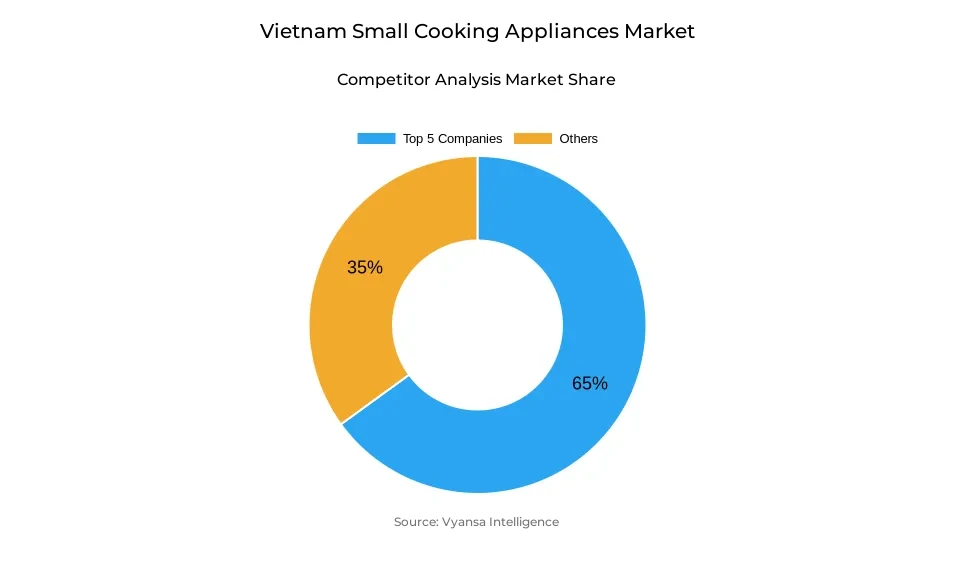
- Top 5 companies acquired around 65% of the market share.
- Philips Electronics Vietnam Co Ltd, Toshiba Consumer Products Vietnam Co Ltd, Panasonic Vietnam Co Ltd, Sunhouse Group JSC, Sharp Electronics (Vietnam) Co Ltd etc., are few of the top companies.
- Sales Channel
- Retail offline grabbed 75% of the market.
Vietnam Small Cooking Appliances Market Outlook
The Vietnam small cooking appliances market size was valued at USD 240 million in 2025 and is projected to grow from USD 252 million in 2026 to USD 280 million by 2032, exhibiting a CAGR of 2.23% during the forecast period. The growth trend is stable because the increasing spending power, busier lifestyles, and the growing interest in convenient home cooking are still favoring the demand of the products. Meanwhile, the category proceeds with a healthy yet cautious speed with buyers remaining picky on price and product advantages.
The demand remains sustained by consumers who seek fast, convenient, and healthier cooking options. In daily use, small cooking appliances are gaining attention because they save time, support multiple cooking functions, and fit well into compact urban kitchens. This change has been advantageous to products like air fryers and rice cookers, as people are increasingly interested in healthy cooking techniques, less oil consumption, and appliances that provide more than a single cooking option in a single device.
Meanwhile, purchase behaviour is still influenced by price sensitivity, as most buyers compare deals, promotions, and features before buying. Even so, small cooking appliances continue to gain visibility through social media, livestream selling, and retail online activity, while smart features and attractive designs are drawing stronger interest from younger consumers. This makes innovation topical, especially in products that are convenient, technologically advanced, and beautiful.
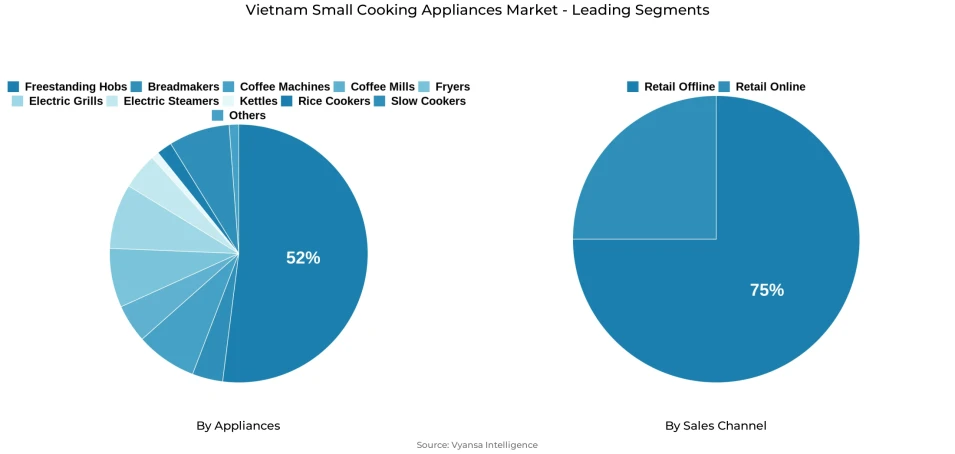
By segment, freestanding hobs lead the appliances category with a 52% share, reflecting strong preference for practical and easy-to-use cooking solutions. On the sales side, retail offline holds the dominant position with a 75% share, as many consumers still prefer to inspect products in person, compare build quality, and seek advice before buying. Even with digital influence rising, small cooking appliances continue to rely strongly on store-led trust and guided purchase decisions across Vietnam.
Vietnam Small Cooking Appliances Market Growth DriverRising Incomes Support Better Kitchen Upgrades
Improving consumer spending power supports demand for small cooking appliances in Vietnam. According to the National Statistics Office, GDP per capita will be USD 5,026 in 2025, compared to USD 4,700 in 2024. The average income of employees in the fourth quarter of 2025 will be VND 8.7 million per month. This provides the households with more space to go beyond the simple cooking devices and think about appliances that have additional convenience, improved functionality, and greater design attractiveness.
This revenue boost is appropriate to a segment where customers already seek fast, convenient, and affordable cooking options. There is a particular demand in time-saving products, healthy cooking, and the ability to cook in several modes in a single device. The demand of more expensive rice cookers and more feature-rich air fryers also becomes easier to maintain as household budgets increase and daily schedules become more hectic.
Vietnam Small Cooking Appliances Market ChallengeAffordability Pressure Keeps Buyers Price Conscious
In Vietnam, the small cooking appliance market faces substantial price sensitivities. According to the National Statistics Authority, the consumer price index has an increase of 3.31% from the prior year to 2025, with January 2025's CPI increasing over the prior year by 3.63%. As household expenses continue to increase year-over-year, there is much more focus on being very careful when buying non-essential items and spending more time comparing prices, discounts and other product advantages.
This pressure is critical in a segment where customers are actively seeking available price points and regular promotions. Omnichannel campaigns and discount activity are already used by retailers to generate demand, which demonstrates that affordability is still at the heart of the purchase decision. This means that brands must strike a balance between added functionality and reasonable prices since increased product sophistication does not necessarily lead to quicker purchase conversion in a cost-conscious market.
Unlock Market Intelligence
Explore the market potential with our data-driven report
Vietnam Small Cooking Appliances Market TrendSmart and Social-Led Buying Shapes Product Direction
Digital commerce and social-led product discovery are shaping a strong trend in Vietnam’s small cooking appliances space. In December 2025, the law on retail online is passed by the National Assembly of Vietnam, with 444 of 446 deputies present voting in favour, and the Ministry of Industry and Trade announces that the law will become effective on July 1, 2026. The legislation also explains the duties of social media retail online and livestreamed sales, demonstrating the way digital purchasing platforms are getting more organized and significant in retail operations.
This aligns with a category in which Tik Tok, YouTube, influencers, and livestream promotions are already visible in influencing awareness and purchase interest. Meanwhile, younger consumers are becoming increasingly interested in Wi-Fi enabled devices, control via apps, voice recognition, and appealing designs. Consequently, intelligent functionalities and attractive designs are increasingly receiving focus in products like rice cookers and air fryers.
Vietnam Small Cooking Appliances Market OpportunityRural Reach Creates Fresh Demand Space
Expansion beyond major cities opens a strong opportunity for small cooking appliances in Vietnam. The demand in 2026 is driven by consumers in suburban and rural regions, and electronics experts and retail online participants are expanding their influence beyond major urban centres. This opens up space to broader product penetration particularly on practical appliances that offer convenience, healthy cooking support and value to money.
The introduction is not in vain since Vietnam already has a very huge consumer base. According to the latest available data by World Bank data, the population of the country is 100,987,686. Once that scale is added to a wider retail presence, promotion, and increased product visibility in smaller cities and rural areas, brands will have more chances to appeal to first time buyers and households that are replacing their simple cooking solutions.
Unlock Market Intelligence
Explore the market potential with our data-driven report
Vietnam Small Cooking Appliances Market Segmentation Analysis
By Appliances
- Breadmakers
- Coffee Machines
- Standard Coffee Machines
- Espresso Coffee Machines
- Filter Coffee Machines
- Pod Coffee Machines
- Hard Pods
- Soft Pods
- Standard Coffee Machines
- Coffee Mills
- Fryers
- Air Fryers
- Oil Based Fryers
- Electric Grills
- Electric Steamers
- Freestanding Hobs
- Gas
- Induction
- Standard Electric
- Mixed
- Vitroceramic
- Kettles
- Rice Cookers
- Slow Cookers
- Others
The segment with the highest share under the appliances category is freestanding hobs, holding around 52%. This market leadership indicates high demand of practical cooking solutions that can be used in daily meal preparation and households that seek convenience at a convenient level of expenditure. The category in Vietnam already enjoys the demand of fast cooking, greater price range, and the necessity of efficient appliances that can perform effectively in both busy urban households and cost-conscious households beyond the big cities.
Freestanding hobs are also consistent with a market where convenience and value are core to product selection. People are becoming more attracted to appliances that make their lives easier and save time in the kitchen. That underpins high demand on formats that are simple to adopt, simple to install and formats that are pertinent to everyday cooking practices. This assists the segment to stay ahead as the larger category keeps on appealing to consumers with varying budgets.
By Sales Channel
- Retail Offline
- Grocery Retailers
- Hypermarkets
- Non-Grocery Retailers
- General Merchandise Stores
- Department Stores
- Variety Stores
- Appliances and Electronics Specialists
- Home Products Specialists
- Grocery Retailers
- Retail Online
The segment with the highest share under the sales channel category is retail offline, holding around 75%. This lead remains high since most Vietnamese consumers still like to visit stores when comparing cooking appliances, particularly when it comes to high-value products and premium brands. The physical stores provide the shoppers with an opportunity to see the product, learn about the quality of the build, and talk to the salespeople before purchasing, which helps to build confidence in the purchasing process.
The category also has a wide product mix and guided selling is significant to retail offline. Online channels are effective in the case of low priced products and deal hunting, but store based shopping is more applicable when consumers require assurance on product quality, warranty and real features. This makes offline retail especially important for appliances where purchase confidence matters, helping the channel retain its dominant position in the Vietnam small cooking appliances space.
List of Companies Covered in Vietnam Small Cooking Appliances Market
The companies listed below are highly influential in the Vietnam small cooking appliances market, with a significant market share and a strong impact on industry developments.
- Philips Electronics Vietnam Co Ltd
- Toshiba Consumer Products Vietnam Co Ltd
- Panasonic Vietnam Co Ltd
- Sunhouse Group JSC
- Sharp Electronics (Vietnam) Co Ltd
- Rinnai Vietnam Co Ltd
- Goldsun JSC
- Midea Consumer Electric Vietnam Co Ltd
- Vietnam Supor Co Ltd
- Tiger Vietnam Co Ltd
Competitive Landscape
In 2025, small cooking appliances in Vietnam recorded healthy but moderating retail volume growth, driven by rising demand for multifunctional and health-oriented appliances such as air fryers and rice cookers, alongside increasing influence from social media, urban lifestyles, and expanding e-commerce reach; within this competitive landscape, Sunhouse Group JSC held the leading position, supported by its strong presence across affordable product segments and wide accessibility, while Sharp Electronics (Vietnam) Co Ltd ranked second, benefiting from its established brand reputation and focus on quality and innovation, with both players leveraging product diversification and alignment with consumer demand for convenience and healthier cooking solutions to maintain their positions.
Frequently Asked Questions
Related Report
- Market Segmentation
- Research Scope
- Research Methodology
- Definitions and Assumptions
- Executive Summary
- Vietnam Small Cooking Appliances Market Policies, Regulations, and Standards
- Vietnam Small Cooking Appliances Market Dynamics
- Growth Factors
- Challenges
- Trends
- Opportunities
- Vietnam Small Cooking Appliances Market Statistics, 2022-2032F
- Market Size & Growth Outlook
- By Revenues in USD Million
- Market Segmentation & Growth Outlook
- By Appliances
- Breadmakers- Market Insights and Forecast 2022-2032, USD Million
- Coffee Machines- Market Insights and Forecast 2022-2032, USD Million
- Standard Coffee Machines- Market Insights and Forecast 2022-2032, USD Million
- Espresso Coffee Machines- Market Insights and Forecast 2022-2032, USD Million
- Filter Coffee Machines- Market Insights and Forecast 2022-2032, USD Million
- Pod Coffee Machines- Market Insights and Forecast 2022-2032, USD Million
- Hard Pods- Market Insights and Forecast 2022-2032, USD Million
- Soft Pods- Market Insights and Forecast 2022-2032, USD Million
- Standard Coffee Machines- Market Insights and Forecast 2022-2032, USD Million
- Coffee Mills- Market Insights and Forecast 2022-2032, USD Million
- Fryers- Market Insights and Forecast 2022-2032, USD Million
- Air Fryers- Market Insights and Forecast 2022-2032, USD Million
- Oil Based Fryers- Market Insights and Forecast 2022-2032, USD Million
- Electric Grills- Market Insights and Forecast 2022-2032, USD Million
- Electric Steamers- Market Insights and Forecast 2022-2032, USD Million
- Freestanding Hobs- Market Insights and Forecast 2022-2032, USD Million
- Gas- Market Insights and Forecast 2022-2032, USD Million
- Induction- Market Insights and Forecast 2022-2032, USD Million
- Standard Electric- Market Insights and Forecast 2022-2032, USD Million
- Mixed- Market Insights and Forecast 2022-2032, USD Million
- Vitroceramic- Market Insights and Forecast 2022-2032, USD Million
- Kettles- Market Insights and Forecast 2022-2032, USD Million
- Rice Cookers- Market Insights and Forecast 2022-2032, USD Million
- Slow Cookers- Market Insights and Forecast 2022-2032, USD Million
- Others- Market Insights and Forecast 2022-2032, USD Million
- By Sales Channel
- Retail Offline- Market Insights and Forecast 2022-2032, USD Million
- Grocery Retailers- Market Insights and Forecast 2022-2032, USD Million
- Hypermarkets- Market Insights and Forecast 2022-2032, USD Million
- Non-Grocery Retailers- Market Insights and Forecast 2022-2032, USD Million
- General Merchandise Stores- Market Insights and Forecast 2022-2032, USD Million
- Department Stores- Market Insights and Forecast 2022-2032, USD Million
- Variety Stores- Market Insights and Forecast 2022-2032, USD Million
- Appliances and Electronics Specialists- Market Insights and Forecast 2022-2032, USD Million
- Home Products Specialists- Market Insights and Forecast 2022-2032, USD Million
- Grocery Retailers- Market Insights and Forecast 2022-2032, USD Million
- Retail Online- Market Insights and Forecast 2022-2032, USD Million
- Retail Offline- Market Insights and Forecast 2022-2032, USD Million
- By Competitors
- Competition Characteristics
- Market Share & Analysis
- By Appliances
- Market Size & Growth Outlook
- Vietnam Breadmakers Market Statistics, 2022-2032
- Market Size & Growth Outlook
- By Revenues in USD Million
- Market Segmentation & Growth Outlook
- By Sales Channel- Market Insights and Forecast 2022-2032, USD Million
- Market Size & Growth Outlook
- Vietnam Coffee Machines Market Statistics, 2022-2032
- Market Size & Growth Outlook
- By Revenues in USD Million
- Market Segmentation & Growth Outlook
- By Sales Channel- Market Insights and Forecast 2022-2032, USD Million
- Market Size & Growth Outlook
- Vietnam Coffee Mills Market Statistics, 2022-2032
- Market Size & Growth Outlook
- By Revenues in USD Million
- Market Segmentation & Growth Outlook
- By Sales Channel- Market Insights and Forecast 2022-2032, USD Million
- Market Size & Growth Outlook
- Vietnam Fryers Market Statistics, 2022-2032
- Market Size & Growth Outlook
- By Revenues in USD Million
- Market Segmentation & Growth Outlook
- By Sales Channel- Market Insights and Forecast 2022-2032, USD Million
- Market Size & Growth Outlook
- Vietnam Electric Grills Market Statistics, 2022-2032
- Market Size & Growth Outlook
- By Revenues in USD Million
- Market Segmentation & Growth Outlook
- By Sales Channel- Market Insights and Forecast 2022-2032, USD Million
- Market Size & Growth Outlook
- Vietnam Electric Steamers Market Statistics, 2022-2032
- Market Size & Growth Outlook
- By Revenues in USD Million
- Market Segmentation & Growth Outlook
- By Sales Channel- Market Insights and Forecast 2022-2032, USD Million
- Market Size & Growth Outlook
- Vietnam Freestanding Hobs Market Statistics, 2022-2032
- Market Size & Growth Outlook
- By Revenues in USD Million
- Market Segmentation & Growth Outlook
- By Sales Channel- Market Insights and Forecast 2022-2032, USD Million
- Market Size & Growth Outlook
- Vietnam Kettles Market Statistics, 2022-2032
- Market Size & Growth Outlook
- By Revenues in USD Million
- Market Segmentation & Growth Outlook
- By Sales Channel- Market Insights and Forecast 2022-2032, USD Million
- Market Size & Growth Outlook
- Vietnam Rice Cookers Market Statistics, 2022-2032
- Market Size & Growth Outlook
- By Revenues in USD Million
- Market Segmentation & Growth Outlook
- By Sales Channel- Market Insights and Forecast 2022-2032, USD Million
- Market Size & Growth Outlook
- Vietnam Slow Cookers Market Statistics, 2022-2032
- Market Size & Growth Outlook
- By Revenues in USD Million
- Market Segmentation & Growth Outlook
- By Sales Channel- Market Insights and Forecast 2022-2032, USD Million
- Market Size & Growth Outlook
- Competitive Outlook
- Company Profiles
- Sharp Electronics (Vietnam) Co Ltd
- Business Description
- Product Portfolio
- Collaborations & Alliances
- Recent Developments
- Financial Details
- Others
- Sunhouse Group JSC
- Business Description
- Product Portfolio
- Collaborations & Alliances
- Recent Developments
- Financial Details
- Others
- Rinnai Vietnam Co Ltd
- Business Description
- Product Portfolio
- Collaborations & Alliances
- Recent Developments
- Financial Details
- Others
- Goldsun JSC
- Business Description
- Product Portfolio
- Collaborations & Alliances
- Recent Developments
- Financial Details
- Others
- Midea Consumer Electric Vietnam Co Ltd
- Business Description
- Product Portfolio
- Collaborations & Alliances
- Recent Developments
- Financial Details
- Others
- Philips Electronics Vietnam Co Ltd
- Business Description
- Product Portfolio
- Collaborations & Alliances
- Recent Developments
- Financial Details
- Others
- Toshiba Consumer Products Vietnam Co Ltd
- Business Description
- Product Portfolio
- Collaborations & Alliances
- Recent Developments
- Financial Details
- Others
- Panasonic Vietnam Co Ltd
- Business Description
- Product Portfolio
- Collaborations & Alliances
- Recent Developments
- Financial Details
- Others
- Vietnam Supor Co Ltd
- Business Description
- Product Portfolio
- Collaborations & Alliances
- Recent Developments
- Financial Details
- Others
- Tiger Vietnam Co Ltd
- Business Description
- Product Portfolio
- Collaborations & Alliances
- Recent Developments
- Financial Details
- Others
- Sharp Electronics (Vietnam) Co Ltd
- Company Profiles
- Disclaimer
| Segment | Sub-Segment |
|---|---|
| By Appliances |
|
| By Sales Channel |
|
Research Methodology
This study followed a structured approach comprising four key phases to assess the size and scope of the electro-oxidation market. The process began with thorough secondary research to collect data on the target market, related markets, and broader industry context. These findings, along with preliminary assumptions and estimates, were then validated through extensive primary research involving industry experts from across the value chain. To calculate the overall market size, both top-down and bottom-up methodologies were employed. Finally, market segmentation and data triangulation techniques were applied to refine and validate segment-level estimations.
Secondary Research
The secondary research phase involved gathering data from a wide range of credible and published sources. This step helped in identifying industry trends, defining market segmentation, and understanding the market landscape and value chain.
Sources consulted during this phase included:
- Company annual reports, investor presentations, and press releases
- Industry white papers and certified publications
- Trade directories and market-recognized databases
- Articles from authoritative authors and reputable journals
- Gold and silver standard websites
Secondary research was critical in mapping out the industry's value chain and monetary flow, identifying key market segments, understanding regional variations, and tracking significant industry developments.
Other key sources:
- Financial disclosures
- Industry associations and trade bodies
- News outlets and business magazines
- Academic journals and research studies
- Paid industry databases
Primary Research
To validate secondary data and gain deeper market insights, primary research was conducted with key stakeholders across both the supply and demand sides of the market.
On the demand side, participants included decision-makers and influencers from end-user industries—such as CIOs, CTOs, and CSOs—who provided first-hand perspectives on market needs, product usage, and future expectations.
On the supply side, interviews were conducted with manufacturers, industry associations, and institutional participants to gather insights into current offerings, product pipelines, and market challenges.
Primary interviews provided critical inputs such as:
- Market size and revenue data
- Product and service breakdowns
- Market forecasts
- Regional and application-specific trends
Stakeholders consulted included:
- Leading OEM and solution providers
- Channel and distribution partners
- End users across various applications
- Independent consultants and industry specialists
Market Size Estimation and Data Triangulation
- Identifying Key Market Participants (Secondary Research)
- Goal: To identify the major players or companies in the target market. This typically involves using publicly available data sources such as industry reports, market research publications, and financial statements of companies.
- Tools: Reports from firms like Gartner, Forrester, Euromonitor, Statista, IBISWorld, and others. Public financial statements, news articles, and press releases from top market players.
- Extracting Earnings of Key Market Participants
- Goal: To estimate the earnings generated from the product or service being analyzed. This step helps in understanding the revenue potential of each market player in a specific geography.
- Methods: Earnings data can be gathered from:
- Publicly available financial reports (for listed companies).
- Interviews and primary data sources from professionals, such as Directors, VPs, SVPs, etc. This is especially useful for understanding more nuanced, internal data that isn't publicly disclosed.
- Annual reports and investor presentations of key players.
- Data Collation and Development of a Relevant Data Model
- Goal: To collate inputs from both primary and secondary sources into a structured, data-driven model for market estimation. This model will incorporate key market KPIs and any independent variables relevant to the market.
- Key KPIs: These could include:
- Market size, growth rate, and demand drivers.
- Industry-specific metrics like market share, average revenue per customer (ARPC), or average deal size.
- External variables, such as economic growth rates, inflation rates, or commodity prices, that could affect the market.
- Data Modeling: Based on this data, the market forecasts are developed for the next 5 years. A combination of trend analysis, scenario modeling, and statistical regression might be used to generate projections.
- Scenario Analysis
- Goal: To test different assumptions and validate how sensitive the market is to changes in key variables (e.g., market demand, regulatory changes, technological disruptions).
- Types of Scenarios:
- Base Case: Based on current assumptions and historical data.
- Best-Case Scenario: Assuming favorable market conditions, regulatory environments, and technological advancements.
- Worst-Case Scenario: Accounting for adverse factors, such as economic downturns, stricter regulations, or unexpected disruptions.












